Renaissance  Art Mr. Redelsheimer World History
Three Eras Part 1:  Early Renaissance -- Florence Part 2:  High Renaissance -- Rome Part 3: Northern Renaissance
Part 1: The Early Renaissance Florence 1300s and 1400s
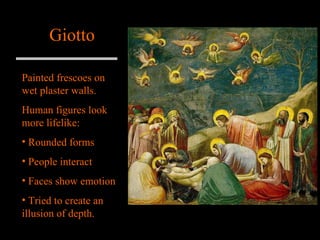
Giotto Painted frescoes on wet plaster walls. Human figures look more lifelike: Rounded forms People interact  Faces show emotion Tried to create an illusion of depth.
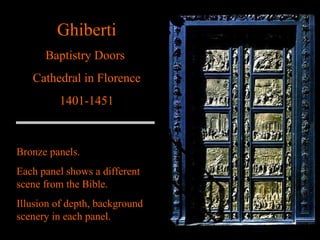
Ghiberti Baptistry Doors  Cathedral in Florence 1401-1451 Bronze panels. Each panel shows a different scene from the Bible. Illusion of depth, background scenery in each panel.
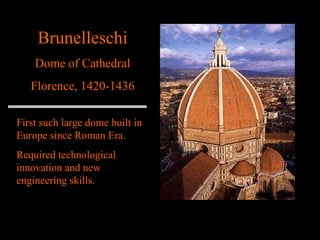
Brunelleschi Dome of Cathedral Florence, 1420-1436 First such large dome built in Europe since Roman Era.  Required technological innovation and new engineering skills.
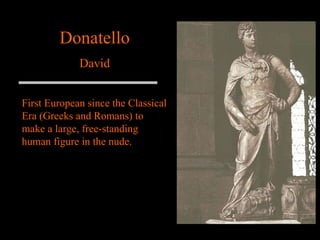
Donatello David First European since the Classical Era (Greeks and Romans) to make a large, free-standing human figure in the nude.
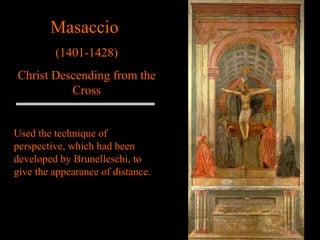
Masaccio  (1401-1428) Christ Descending from the Cross Used the technique of perspective, which had been developed by Brunelleschi, to give the appearance of distance.
Renaissance Terms Quattrocento:  Century beginning in 1400 Humanist:  scholars who studied classical texts Vernacular: common, everyday language
Part 2: The High Renaissance Rome Early 1500s
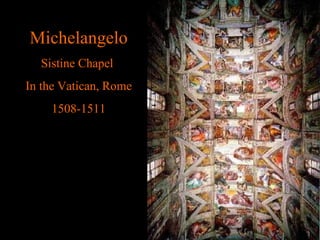
Michelangelo Sistine Chapel  In the Vatican, Rome 1508-1511
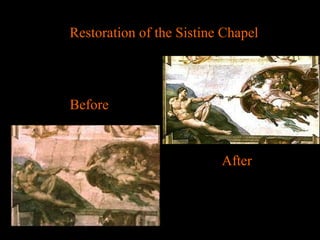
Restoration of the Sistine Chapel Before After
Michelangelo “ My stomach is thrust toward my chin,  My beard curls up, toward the sky,  My head leans right over into my back,  My chest is like that of an old shrew,  The brush endlessly dripping onto my face, Has coated it with a multi-colored paving.”
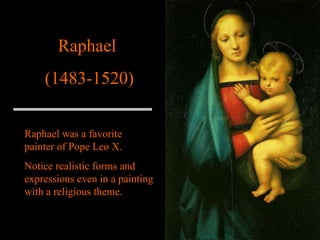
Raphael  (1483-1520) Raphael was a favorite painter of Pope Leo X. Notice realistic forms and expressions even in a painting with a religious theme.
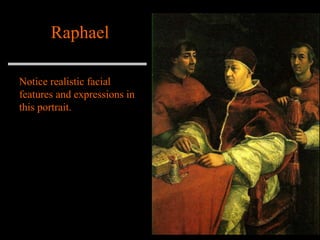
Raphael Notice realistic facial features and expressions in this portrait.
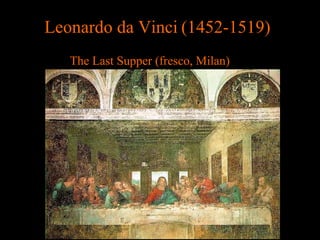
Leonardo da Vinci   (1452-1519) The Last Supper (fresco, Milan)
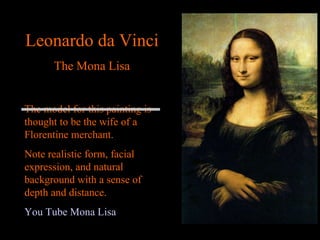
Leonardo da Vinci The Mona Lisa The model for this painting is thought to be the wife of a Florentine merchant. Note realistic form, facial expression, and natural background with a sense of depth and distance. You Tube Mona Lisa
Part 3: The Northern Renaissance Northern Europe 1500-1600
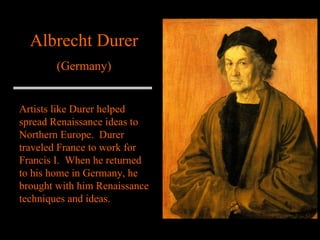
Albrecht Durer (Germany) Artists like Durer helped spread Renaissance ideas to Northern Europe.  Durer traveled France to work for Francis I.  When he returned to his home in Germany, he brought with him Renaissance techniques and ideas.
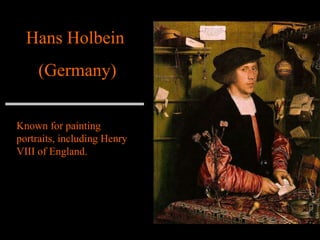
Hans Holbein  (Germany) Known for painting portraits, including Henry VIII of England.
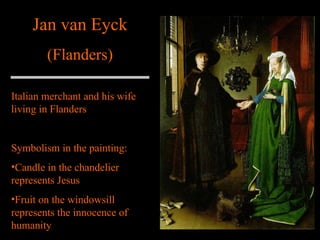
Jan van Eyck (Flanders) Italian merchant and his wife living in Flanders Symbolism in the painting: Candle in the chandelier represents Jesus Fruit on the windowsill represents the innocence of humanity
The End
Sources:  DC Heath,  World History: Perspectives on the Past Saint Paul Academy and Summit School:  www.spa.edu

Renaissance Art

  • 1.
    Renaissance ArtMr. Redelsheimer World History
  • 2.
    Three Eras Part1: Early Renaissance -- Florence Part 2: High Renaissance -- Rome Part 3: Northern Renaissance
  • 3.
    Part 1: TheEarly Renaissance Florence 1300s and 1400s
  • 4.
    Giotto Painted frescoeson wet plaster walls. Human figures look more lifelike: Rounded forms People interact Faces show emotion Tried to create an illusion of depth.
  • 5.
    Ghiberti Baptistry Doors Cathedral in Florence 1401-1451 Bronze panels. Each panel shows a different scene from the Bible. Illusion of depth, background scenery in each panel.
  • 6.
    Brunelleschi Dome ofCathedral Florence, 1420-1436 First such large dome built in Europe since Roman Era. Required technological innovation and new engineering skills.
  • 7.
    Donatello David FirstEuropean since the Classical Era (Greeks and Romans) to make a large, free-standing human figure in the nude.
  • 8.
    Masaccio (1401-1428)Christ Descending from the Cross Used the technique of perspective, which had been developed by Brunelleschi, to give the appearance of distance.
  • 9.
    Renaissance Terms Quattrocento: Century beginning in 1400 Humanist: scholars who studied classical texts Vernacular: common, everyday language
  • 10.
    Part 2: TheHigh Renaissance Rome Early 1500s
  • 11.
    Michelangelo Sistine Chapel In the Vatican, Rome 1508-1511
  • 12.
    Restoration of theSistine Chapel Before After
  • 13.
    Michelangelo “ Mystomach is thrust toward my chin, My beard curls up, toward the sky, My head leans right over into my back, My chest is like that of an old shrew, The brush endlessly dripping onto my face, Has coated it with a multi-colored paving.”
  • 14.
    Raphael (1483-1520)Raphael was a favorite painter of Pope Leo X. Notice realistic forms and expressions even in a painting with a religious theme.
  • 15.
    Raphael Notice realisticfacial features and expressions in this portrait.
  • 16.
    Leonardo da Vinci (1452-1519) The Last Supper (fresco, Milan)
  • 17.
    Leonardo da VinciThe Mona Lisa The model for this painting is thought to be the wife of a Florentine merchant. Note realistic form, facial expression, and natural background with a sense of depth and distance. You Tube Mona Lisa
  • 18.
    Part 3: TheNorthern Renaissance Northern Europe 1500-1600
  • 19.
    Albrecht Durer (Germany)Artists like Durer helped spread Renaissance ideas to Northern Europe. Durer traveled France to work for Francis I. When he returned to his home in Germany, he brought with him Renaissance techniques and ideas.
  • 20.
    Hans Holbein (Germany) Known for painting portraits, including Henry VIII of England.
  • 21.
    Jan van Eyck(Flanders) Italian merchant and his wife living in Flanders Symbolism in the painting: Candle in the chandelier represents Jesus Fruit on the windowsill represents the innocence of humanity
  • 22.
  • 23.
    Sources: DCHeath, World History: Perspectives on the Past Saint Paul Academy and Summit School: www.spa.edu