Diabetic Peripheral Neuropathy
A Critical Look Separating Fact from Fiction


      Michael E. Graham, DPM, FACFAS, FAENS
What is a Peripheral Nerve?


A peripheral nerve is a extension
from the central nervous system
(CNS-brain and spinal cord) whose
function is to carry electrical
impulses either towards the CNS
(sensory information) or away from
the CNS (motor function).
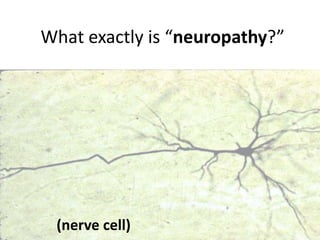
What exactly is “neuropathy?”


 (nerve cell)
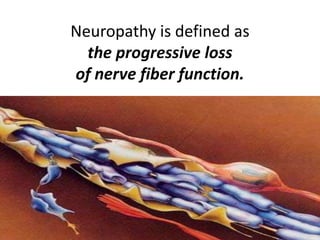
Neuropathy is defined as
  the progressive loss
of nerve fiber function.
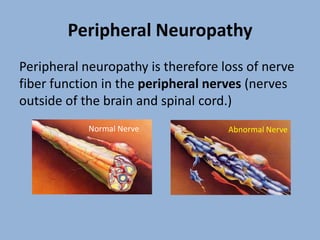
Peripheral Neuropathy
Peripheral neuropathy is therefore loss of nerve
fiber function in the peripheral nerves (nerves
outside of the brain and spinal cord.)
            Normal Nerve            Abnormal Nerve
Diabetic peripheral neuropathy
                     has been defined as:


    “The presence of symptoms and/or signs of
    peripheral nerve dysfunction in people with
    diabetes after the exclusion of other causes.”


Boulton, AJ, et. al, Diabetic Neuropathy. Med Clin North America, Jul 1998:82(4): 909-929.
Unfortunately, no one pays much
    attention to the last and most
  important part of that definition:

“after the exclusion of other causes.”
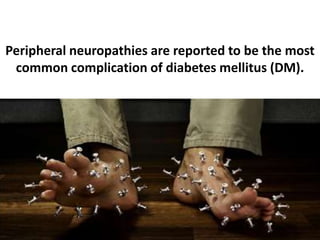
Peripheral neuropathies are reported to be the most
 common complication of diabetes mellitus (DM).
                      Fact:
It is believed that up to 50% of both
Type I and Type II diabetics have some
   degree of peripheral neuropathy.
Strange Fact
Type I diabetics are potentially affected with this nerve
condition after decades of chronic uncontrolled blood sugar
levels,

                            while

Type II diabetics can have signs/symptoms of
neuropathy after only a few years of diagnosis.


(Seems like it would be the other way around?)
Type I diabetics don’t usually develop
signs/symptoms of peripheral neuropathy
      until they are in their 40s/50s.

       The average age of diagnosis of Type I DM is 14 years old.
Type II diabetics aren’t usually
diagnosed until they are middle age or
           older (50 years +)
  Unfortunately, that number is getting younger due to an
          increase in type II pediatric diabetes.
Signs and/or symptoms of
peripheral neuropathy usually begin
 in the toes or the ball of the foot.
The loss of sensation on the bottom
  of the foot is NOT a good thing.
It leads to all sorts of problems.
And it’s more complicated than
    just the loss of feeling.
There is also painful neuropathy.
Neuropathy severely affects the
     quality of one’s life.
Besides living with severe pain
There are secondary effects including
  • Foot ulcers-
    – Typical cost to heal a foot ulcer is $8,000
    – Typical cost to heal an infected ulcer is $17,000
  • Falls
  • Fractures
But the worst thing is:

        WARNING:
  The next side is graphic.
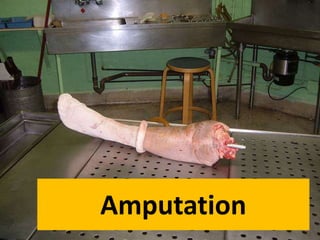
Amputation
It is estimated that someone loses a
leg every 18 minutes as an ultimate
    complication from neuropathy.

     Average cost for a below-knee amputation (BKA) is $45,000
                There are 80,000 BKA performed/year
    Usually the opposite limb develops an ulcer within 18 months
    58% go on to have a BKA of the residual limb within 3-5 years.
Anything and everything needs to
     be done to combat this
   progressive nerve disorder.
The unfortunate
fact is that once a
 patient presents
 to a doctor with
 nerve symptoms
 the first thought
  the doctor has
         is:
DIABETIC NEUROPATHY!
At that point the case is closed.
“Sorry, we can’t do much for you.”
It will only get worse.
Sure, you can try to keep
 your blood sugar under
         control.
You can take vitamin
supplements and wear
  cushioned shoes.
Keep coming back for check-
 ups so that we can monitor
    how bad it is getting.
If you develop painful
             neuropathy we will offer
            you pills to mask the pain.

Have you ever taken a look at the possible
       side-effects of those pills?
        You might be surprised.
What is it about diabetes that leads
to the destruction of nerves in the
          feet and hands?
The fact is - we really don’t know.
There is quite a bit of confusion as
  to why and there are several
             theories.
  Only thing is that none of them have
           really been proven.
DM peripheral neuropathy
          is blamed on:
•   Long-term high blood sugar levels
•   High cholesterol
•   High blood pressure
•   Smoking
•   Increased height (taller than normal?)
•   High exposure to ethanol
•   Genetic factors
Diabetes isn’t the only disease that
   affects the peripheral nerves.
There are several other forms of
     neuropathy including:

•   Alcohol consumption
•   Chemotherapeutic medicine
•   COMPRESSION of the nerve
•   Familiar (parent/grandparent)
•   Idiopathic (can’t figure out why, can’t blame it on anything
    else)
Besides the co-finding that you also
      have a family history of
    neuropathy, you have been
     diagnosed as being “pre-
 diabetic”, Type I or II diabetic, had
 chemotherapy, drank beer for too
many years, or we don’t know why
             you have it…
… are there different findings as far
   as the signs or symptoms of
           neuropathy?
In other words, there is

 not one symptom or finding

  that links the cause of nerve
 damage to diabetes, genetics,
alcoholism, known or unknown
             reasons.
We don’t say “oh you have
diabetic neuropathy because you
  have pain or loss of feeling in
your big toe” or “if you have pain
or loss of feeling in your little toe
    it is related specifically to
           chemotherapy”.
Peripheral nerve facts

• Nerves outside of the spine are capable of
  repairing themselves when damaged.
• Nerves are able to withstand up to a 6% strain
  without being affected.
• Nerves can be slightly flattened without long-
  term damage.
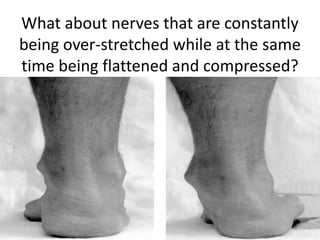
What about nerves that are constantly
being over-stretched while at the same
time being flattened and compressed?
And this happens-
   day after day,
 week after week,
month after month,
  year after year.
Another fact:
          An overwhelming majority of
individuals suffering with peripheral neuropathy
            are over 40 years of age.
The majority of those cases are in patients
          over 50 years of age.
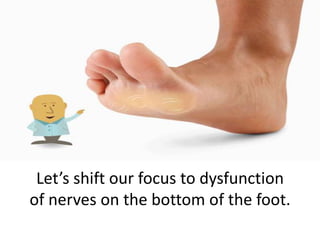
Let’s shift our focus to dysfunction
of nerves on the bottom of the foot.
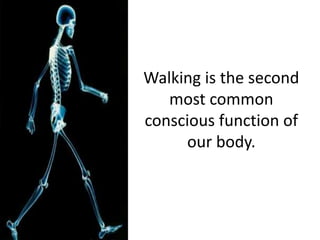
Walking is the second
   most common
conscious function of
     our body.
Average person takes
6,000 steps a day
42,000 steps a week
168,000 steps a month
2,016,000 steps a year
40,320,000 steps in 20 yrs
80,640,000 steps in 40 yrs
120,960,000 steps in 60 yrs
Remember earlier we learned that
most diabetics (either Type I or Type
   II) don’t develop peripheral
 neuropathy signs/symptoms until
  they are 40 years old or older.

Anyone 40 years old has on average
   taken over 80,000,000 steps.
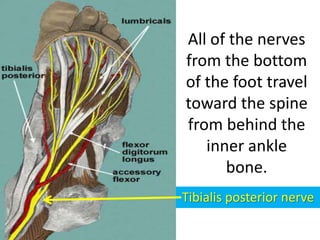
Did you know there is
    one main nerve
  collecting all of the
  sensations from the
  bottom of the foot?

Tibialis posterior nerve
All of the nerves
from the bottom
of the foot travel
toward the spine
from behind the
   inner ankle
      bone.
Tibialis posterior nerve
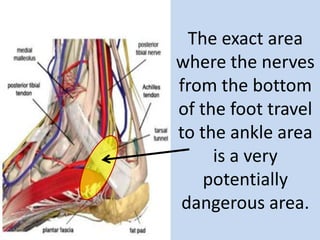
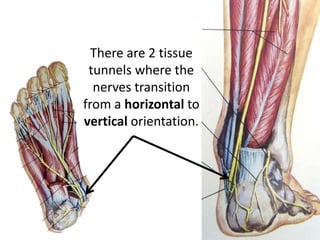
The exact area
where the nerves
from the bottom
of the foot travel
to the ankle area
     is a very
    potentially
 dangerous area.
There are 2 tissue
 tunnels where the
  nerves transition
from a horizontal to
vertical orientation.
There is a reason why I am
pointing this out- keep going.
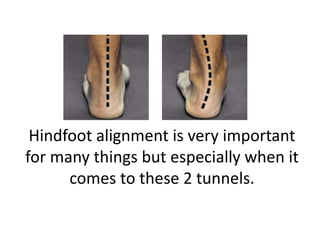
Hindfoot alignment is very important
for many things but especially when it
      comes to these 2 tunnels.
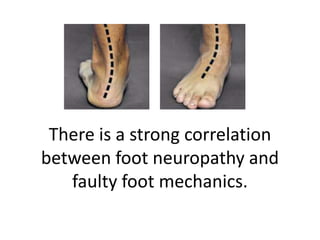
There is a strong correlation
between foot neuropathy and
   faulty foot mechanics.
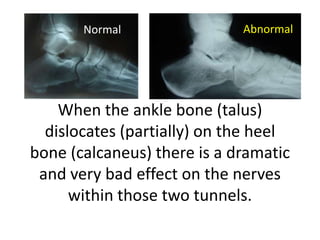
Normal                Abnormal


    When the ankle bone (talus)
  dislocates (partially) on the heel

bone (calcaneus) there is a dramatic

 and very bad effect on the nerves
      within those two tunnels.
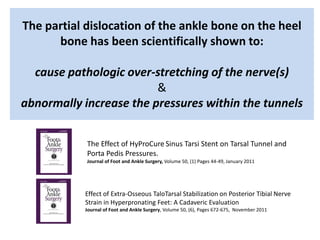
The partial dislocation of the ankle bone on the heel
      bone has been scientifically shown to:

  cause pathologic over-stretching of the nerve(s)
                         &
abnormally increase the pressures within the tunnels


            The Effect of HyProCure Sinus Tarsi Stent on Tarsal Tunnel and
            Porta Pedis Pressures.
            Journal of Foot and Ankle Surgery, Volume 50, (1) Pages 44-49, January 2011


           Effect of Extra-Osseous TaloTarsal Stabilization on Posterior Tibial Nerve
           Strain in Hyperpronating Feet: A Cadaveric Evaluation
           Journal of Foot and Ankle Surgery, Volume 50, (6), Pages 672-675, November 2011
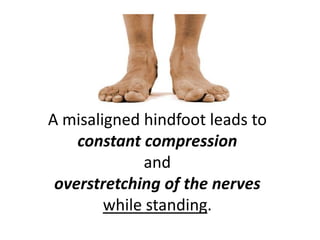
A misaligned hindfoot leads to
    constant compression
             and
 overstretching of the nerves
        while standing.
And a misaligned hindfoot leads to
      intermittent damage
      with every step taken.
Walking is supposed to be so good for
you. That is, unless you have misaligned
                   feet!
 There are hidden dangers of walking!
Many people with peripheral
     neuropathy will tell you that the
 symptoms aren’t so bad or even non-
existent when they first get out of bed in
            the morning …
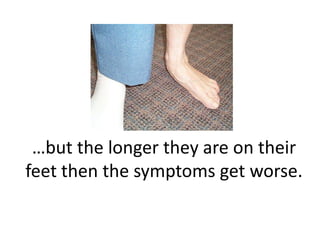
…but the longer they are on their
feet then the symptoms get worse.
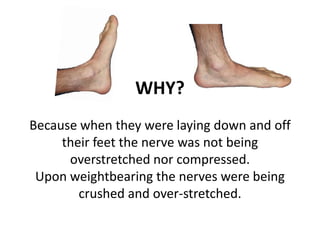
WHY?
Because when they were laying down and off
     their feet the nerve was not being
      overstretched nor compressed.
 Upon weightbearing the nerves were being
        crushed and over-stretched.
Other individuals with painful neuropathy at
   night have often gotten out of bed and
started walking round and round until finally
      the pain in their feet went away.
The reason why the pain was worse
 after they had been off their feet
 was that the nerves were “waking
up” and walking around made them
         go “back to sleep”.
Generally speaking, the medical
establishment has always been
  against any surgical option.
The problem with typical nerve surgery is
 that nothing is done to realign the foot.
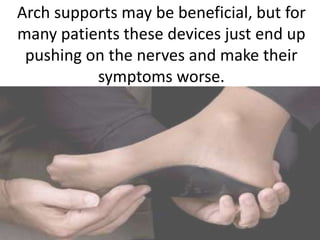
Arch supports may be beneficial, but for
many patients these devices just end up
 pushing on the nerves and make their
          symptoms worse.
A somewhat new and more
importantly, scientifically proven
  internal option now exists.
HyProCure        ®


Extra-osseous, extra-articular,
  talotarsal fixation device.
HyProCure         ®


  is a titanium stent that is inserted into a naturally
 occurring space (sinus tarsi) in between the ankle &
    heel bones. This minimally invasive soft tissue
procedure instantly maintains the natural opening of
the sinus tarsi while restoring the normal motion and
            alignment of the hindfoot bones.
Did you know…
HyProCure                                   ®


has been used safely and effectively in thousands
   of pediatric and adult patients since 2004.
          Extra-Osseous Talotarsal Stabilization using HyProCure in Adults: A
          5 Year Retrospective Follow-up
          Journal of Foot and Ankle Surgery – Vol. 51 (1), p. 23-29, 2012


           Stabilization of Joint Forces of the Subtalar Complex via
           the HyProCure Sinus Tarsi Stent
           Journal of American Podiatric Medical Association, Volume 101 No. 5, Pages 390-399, Sept/Oct 2011
HyProCure        ®


                  +         =

 is the only extra-osseous talotarsal stabilization
        device that works with the normal
  biomechanics, unlike other devices that work
against the normal function and often leading to
               failure of the device.
HyProCure                                ®


     is the only medical treatment that has been
scientifically proven to decrease the pressures within
 the tarsal tunnel and porta pedis while at the same
        time decreasing the strain on the nerve.
           The Effect of HyProCure Sinus Tarsi Stent on Tarsal Tunnel and
           Porta Pedis Pressures.
           Journal of Foot and Ankle Surgery, Volume 50, (1) Pages 44-49, January 2011


           Effect of Extra-Osseous TaloTarsal Stabilization on Posterior Tibial
           Nerve Strain in Hyperpronating Feet: A Cadaveric Evaluation
           Journal of Foot and Ankle Surgery, Volume 50, (6), Pages 672-675, November 2011
Every effort must be considered to
eliminate any factor that could lead to
 the destruction of peripheral nerves.
We have followed their advice of:
                    early detection
              frequent physician visits
                strict diabetic control
but the disease still remains and often gets worse.
The need for early surgical
intervention is important.

While standing, walking, or
 running the nerves to the
bottom of the foot are being
        destroyed.
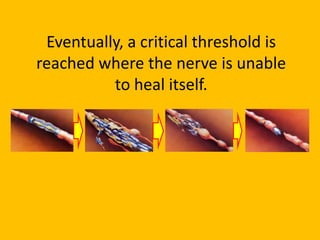
Eventually, a critical threshold is
reached where the nerve is unable
          to heal itself.
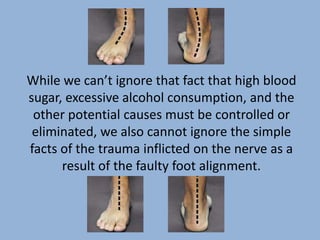
While we can’t ignore that fact that high blood
sugar, excessive alcohol consumption, and the
 other potential causes must be controlled or
 eliminated, we also cannot ignore the simple
facts of the trauma inflicted on the nerve as a
      result of the faulty foot alignment.
The risk benefit analysis of the
HyProCure® option shows that the
 benefits are far greater than any
          potential risks.
To learn more about
    neuropathy, misaligned
feet, HyProCure® and to find a
      specialist near you…
Please visit:

www.HyProCure.com

Peripheral Neuropathy Diabetic Connection? - A Critical Analysis

  • 1.
    Diabetic Peripheral Neuropathy ACritical Look Separating Fact from Fiction Michael E. Graham, DPM, FACFAS, FAENS
  • 2.
    What is aPeripheral Nerve? A peripheral nerve is a extension from the central nervous system (CNS-brain and spinal cord) whose function is to carry electrical impulses either towards the CNS (sensory information) or away from the CNS (motor function).
  • 3.
    What exactly is“neuropathy?” (nerve cell)
  • 4.
    Neuropathy is definedas the progressive loss of nerve fiber function.
  • 5.
    Peripheral Neuropathy Peripheral neuropathyis therefore loss of nerve fiber function in the peripheral nerves (nerves outside of the brain and spinal cord.) Normal Nerve Abnormal Nerve
  • 6.
    Diabetic peripheral neuropathy has been defined as: “The presence of symptoms and/or signs of peripheral nerve dysfunction in people with diabetes after the exclusion of other causes.” Boulton, AJ, et. al, Diabetic Neuropathy. Med Clin North America, Jul 1998:82(4): 909-929.
  • 7.
    Unfortunately, no onepays much attention to the last and most important part of that definition: “after the exclusion of other causes.”
  • 8.
    Peripheral neuropathies arereported to be the most common complication of diabetes mellitus (DM). Fact:
  • 9.
    It is believedthat up to 50% of both Type I and Type II diabetics have some degree of peripheral neuropathy.
  • 10.
    Strange Fact Type Idiabetics are potentially affected with this nerve condition after decades of chronic uncontrolled blood sugar levels, while Type II diabetics can have signs/symptoms of neuropathy after only a few years of diagnosis. (Seems like it would be the other way around?)
  • 11.
    Type I diabeticsdon’t usually develop signs/symptoms of peripheral neuropathy until they are in their 40s/50s. The average age of diagnosis of Type I DM is 14 years old.
  • 12.
    Type II diabeticsaren’t usually diagnosed until they are middle age or older (50 years +) Unfortunately, that number is getting younger due to an increase in type II pediatric diabetes.
  • 13.
    Signs and/or symptomsof peripheral neuropathy usually begin in the toes or the ball of the foot.
  • 14.
    The loss ofsensation on the bottom of the foot is NOT a good thing.
  • 15.
    It leads toall sorts of problems.
  • 16.
    And it’s morecomplicated than just the loss of feeling.
  • 17.
    There is alsopainful neuropathy.
  • 18.
    Neuropathy severely affectsthe quality of one’s life.
  • 19.
  • 20.
    There are secondaryeffects including • Foot ulcers- – Typical cost to heal a foot ulcer is $8,000 – Typical cost to heal an infected ulcer is $17,000 • Falls • Fractures
  • 21.
    But the worstthing is: WARNING: The next side is graphic.
  • 22.
  • 23.
    It is estimatedthat someone loses a leg every 18 minutes as an ultimate complication from neuropathy. Average cost for a below-knee amputation (BKA) is $45,000 There are 80,000 BKA performed/year Usually the opposite limb develops an ulcer within 18 months 58% go on to have a BKA of the residual limb within 3-5 years.
  • 24.
    Anything and everythingneeds to be done to combat this progressive nerve disorder.
  • 25.
    The unfortunate fact isthat once a patient presents to a doctor with nerve symptoms the first thought the doctor has is:
  • 26.
  • 27.
    At that pointthe case is closed.
  • 28.
    “Sorry, we can’tdo much for you.”
  • 29.
    It will onlyget worse.
  • 30.
    Sure, you cantry to keep your blood sugar under control.
  • 31.
    You can takevitamin supplements and wear cushioned shoes.
  • 32.
    Keep coming backfor check- ups so that we can monitor how bad it is getting.
  • 33.
    If you developpainful neuropathy we will offer you pills to mask the pain. Have you ever taken a look at the possible side-effects of those pills? You might be surprised.
  • 34.
    What is itabout diabetes that leads to the destruction of nerves in the feet and hands?
  • 35.
    The fact is- we really don’t know.
  • 36.
    There is quitea bit of confusion as to why and there are several theories. Only thing is that none of them have really been proven.
  • 37.
    DM peripheral neuropathy is blamed on: • Long-term high blood sugar levels • High cholesterol • High blood pressure • Smoking • Increased height (taller than normal?) • High exposure to ethanol • Genetic factors
  • 38.
    Diabetes isn’t theonly disease that affects the peripheral nerves.
  • 39.
    There are severalother forms of neuropathy including: • Alcohol consumption • Chemotherapeutic medicine • COMPRESSION of the nerve • Familiar (parent/grandparent) • Idiopathic (can’t figure out why, can’t blame it on anything else)
  • 40.
    Besides the co-findingthat you also have a family history of neuropathy, you have been diagnosed as being “pre- diabetic”, Type I or II diabetic, had chemotherapy, drank beer for too many years, or we don’t know why you have it…
  • 41.
    … are theredifferent findings as far as the signs or symptoms of neuropathy?
  • 42.
    In other words,there is not one symptom or finding that links the cause of nerve damage to diabetes, genetics, alcoholism, known or unknown reasons.
  • 43.
    We don’t say“oh you have diabetic neuropathy because you have pain or loss of feeling in your big toe” or “if you have pain or loss of feeling in your little toe it is related specifically to chemotherapy”.
  • 44.
    Peripheral nerve facts •Nerves outside of the spine are capable of repairing themselves when damaged. • Nerves are able to withstand up to a 6% strain without being affected. • Nerves can be slightly flattened without long- term damage.
  • 45.
    What about nervesthat are constantly being over-stretched while at the same time being flattened and compressed?
  • 46.
    And this happens- day after day, week after week, month after month, year after year.
  • 47.
    Another fact: An overwhelming majority of individuals suffering with peripheral neuropathy are over 40 years of age.
  • 48.
    The majority ofthose cases are in patients over 50 years of age.
  • 49.
    Let’s shift ourfocus to dysfunction of nerves on the bottom of the foot.
  • 50.
    Walking is thesecond most common conscious function of our body.
  • 51.
    Average person takes 6,000steps a day 42,000 steps a week 168,000 steps a month 2,016,000 steps a year 40,320,000 steps in 20 yrs 80,640,000 steps in 40 yrs 120,960,000 steps in 60 yrs
  • 52.
    Remember earlier welearned that most diabetics (either Type I or Type II) don’t develop peripheral neuropathy signs/symptoms until they are 40 years old or older. Anyone 40 years old has on average taken over 80,000,000 steps.
  • 53.
    Did you knowthere is one main nerve collecting all of the sensations from the bottom of the foot? Tibialis posterior nerve
  • 54.
    All of thenerves from the bottom of the foot travel toward the spine from behind the inner ankle bone. Tibialis posterior nerve
  • 55.
    The exact area wherethe nerves from the bottom of the foot travel to the ankle area is a very potentially dangerous area.
  • 56.
    There are 2tissue tunnels where the nerves transition from a horizontal to vertical orientation.
  • 57.
    There is areason why I am pointing this out- keep going.
  • 58.
    Hindfoot alignment isvery important for many things but especially when it comes to these 2 tunnels.
  • 59.
    There is astrong correlation between foot neuropathy and faulty foot mechanics.
  • 60.
    Normal Abnormal When the ankle bone (talus) dislocates (partially) on the heel bone (calcaneus) there is a dramatic and very bad effect on the nerves within those two tunnels.
  • 61.
    The partial dislocationof the ankle bone on the heel bone has been scientifically shown to: cause pathologic over-stretching of the nerve(s) & abnormally increase the pressures within the tunnels The Effect of HyProCure Sinus Tarsi Stent on Tarsal Tunnel and Porta Pedis Pressures. Journal of Foot and Ankle Surgery, Volume 50, (1) Pages 44-49, January 2011 Effect of Extra-Osseous TaloTarsal Stabilization on Posterior Tibial Nerve Strain in Hyperpronating Feet: A Cadaveric Evaluation Journal of Foot and Ankle Surgery, Volume 50, (6), Pages 672-675, November 2011
  • 62.
    A misaligned hindfootleads to constant compression and overstretching of the nerves while standing.
  • 63.
    And a misalignedhindfoot leads to intermittent damage with every step taken.
  • 64.
    Walking is supposedto be so good for you. That is, unless you have misaligned feet! There are hidden dangers of walking!
  • 65.
    Many people withperipheral neuropathy will tell you that the symptoms aren’t so bad or even non- existent when they first get out of bed in the morning …
  • 66.
    …but the longerthey are on their feet then the symptoms get worse.
  • 67.
    WHY? Because when theywere laying down and off their feet the nerve was not being overstretched nor compressed. Upon weightbearing the nerves were being crushed and over-stretched.
  • 68.
    Other individuals withpainful neuropathy at night have often gotten out of bed and started walking round and round until finally the pain in their feet went away.
  • 69.
    The reason whythe pain was worse after they had been off their feet was that the nerves were “waking up” and walking around made them go “back to sleep”.
  • 70.
    Generally speaking, themedical establishment has always been against any surgical option.
  • 71.
    The problem withtypical nerve surgery is that nothing is done to realign the foot.
  • 72.
    Arch supports maybe beneficial, but for many patients these devices just end up pushing on the nerves and make their symptoms worse.
  • 73.
    A somewhat newand more importantly, scientifically proven internal option now exists.
  • 74.
    HyProCure ® Extra-osseous, extra-articular, talotarsal fixation device.
  • 75.
    HyProCure ® is a titanium stent that is inserted into a naturally occurring space (sinus tarsi) in between the ankle & heel bones. This minimally invasive soft tissue procedure instantly maintains the natural opening of the sinus tarsi while restoring the normal motion and alignment of the hindfoot bones.
  • 76.
  • 77.
    HyProCure ® has been used safely and effectively in thousands of pediatric and adult patients since 2004. Extra-Osseous Talotarsal Stabilization using HyProCure in Adults: A 5 Year Retrospective Follow-up Journal of Foot and Ankle Surgery – Vol. 51 (1), p. 23-29, 2012 Stabilization of Joint Forces of the Subtalar Complex via the HyProCure Sinus Tarsi Stent Journal of American Podiatric Medical Association, Volume 101 No. 5, Pages 390-399, Sept/Oct 2011
  • 78.
    HyProCure ® + = is the only extra-osseous talotarsal stabilization device that works with the normal biomechanics, unlike other devices that work against the normal function and often leading to failure of the device.
  • 79.
    HyProCure ® is the only medical treatment that has been scientifically proven to decrease the pressures within the tarsal tunnel and porta pedis while at the same time decreasing the strain on the nerve. The Effect of HyProCure Sinus Tarsi Stent on Tarsal Tunnel and Porta Pedis Pressures. Journal of Foot and Ankle Surgery, Volume 50, (1) Pages 44-49, January 2011 Effect of Extra-Osseous TaloTarsal Stabilization on Posterior Tibial Nerve Strain in Hyperpronating Feet: A Cadaveric Evaluation Journal of Foot and Ankle Surgery, Volume 50, (6), Pages 672-675, November 2011
  • 80.
    Every effort mustbe considered to eliminate any factor that could lead to the destruction of peripheral nerves.
  • 81.
    We have followedtheir advice of: early detection frequent physician visits strict diabetic control but the disease still remains and often gets worse.
  • 82.
    The need forearly surgical intervention is important. While standing, walking, or running the nerves to the bottom of the foot are being destroyed.
  • 83.
    Eventually, a criticalthreshold is reached where the nerve is unable to heal itself.
  • 84.
    While we can’tignore that fact that high blood sugar, excessive alcohol consumption, and the other potential causes must be controlled or eliminated, we also cannot ignore the simple facts of the trauma inflicted on the nerve as a result of the faulty foot alignment.
  • 85.
    The risk benefitanalysis of the HyProCure® option shows that the benefits are far greater than any potential risks.
  • 86.
    To learn moreabout neuropathy, misaligned feet, HyProCure® and to find a specialist near you…
  • 87.