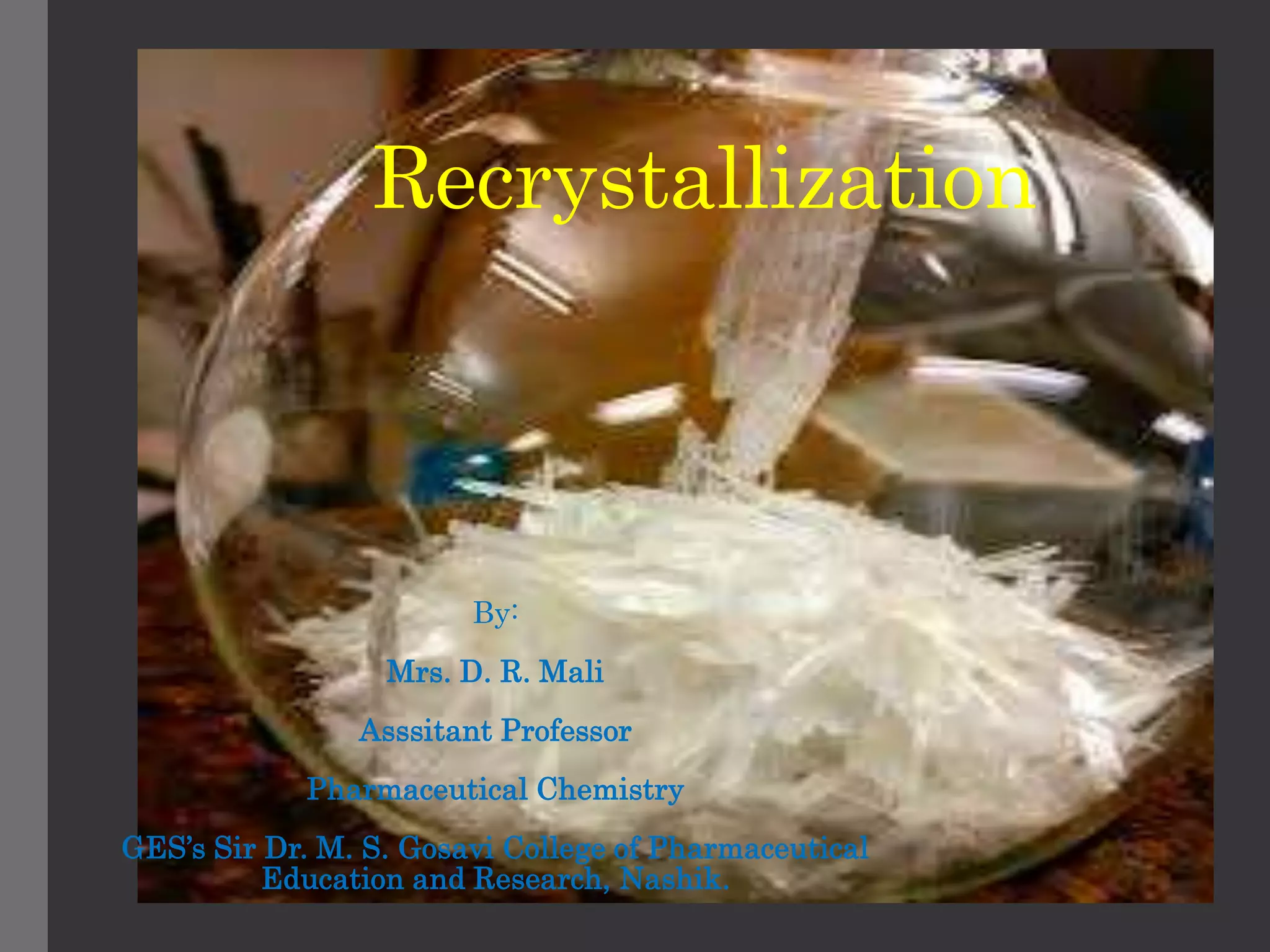
Recrystallization
By:
Mrs. D. R. Mali
Asssitant Professor
Pharmaceutical Chemistry
GES’s Sir Dr. M. S. Gosavi College of Pharmaceutical
Education and Research, Nashik.
AIM
 To study recrystallization technique for
purification of solid compound.
References:
 B. S. Furniss, A. J. Hannaford, Peter W. G. Smith
and A. R. Tatchell, ‘Textbook Of Practical Organic
Chemistry’ Vth edition, Longman Scientific &
Technical, New York, 1989, pp.135-142
 Frederick George Mann and Bernard Charles
Saunders, ‘Practical Organic Chemistry’, IVth
edition Longman Group Limited, London, 1978,
pp. 13-20
Need of recrystallization
 Solid compounds synthesized in the
organic laboratory usually need to
be purified before final
confirmation tests are performed
 One of the most commonly used
techniques to purify a sample is
recrystallization followed by
vacuum filtration.
 Solid organic compounds produced
in the laboratory usually need to be
purified.
 The most common technique
involves recrystallizing the sample
from an appropriate Solvent.
 The recrystallization process is a
relatively slow and selective
formation of crystals from a solvent.
 Precipitation is a rapid and
nonselective process; thus not used
to purify samples.
Defination
 Recrystallization is a
purification technique which
consists of dissolving the
impure substance in a
minimal volume of a solvent
near its boiling point, then
allowing the solution to cool
slowly to crystallize the
substance (ideally, leaving
the impurities dissolved.)
Principles of Recrystallization
Select a solvent that will dissolve the desired
solid in the hot but not the cold solvent. Cooling
should lead to crystallization again.
Impurities should be well soluble in cold solvent
thus stay in solution
Or
Impurities should be insoluble in hot solvent
(filter them off while solution is hot)
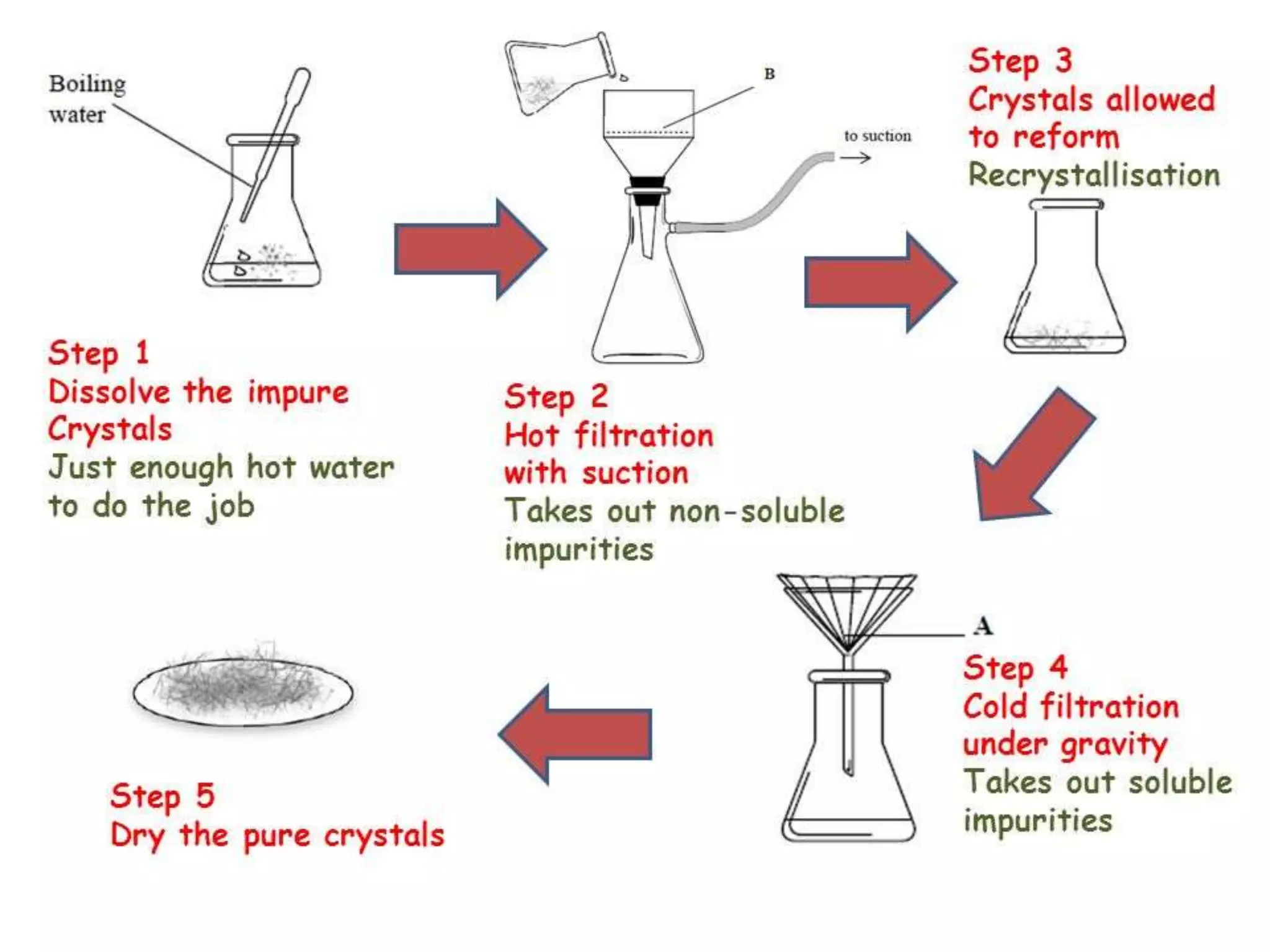
Recrystallization Procedure
 Dissolve sample in a minimal amount of an
appropriate solvent.
 Sample should be insoluble in solvent at
room temperature, but soluble at elevated
(boiling point) temperature.
 If solution is colorized, it is sometimes
necessary to add a decolorizing agent
(activated charcoal)
 Colorized solutions are first filtered through
a fluted filter or a column containing
alumina or silica gel.
Recrystallization Procedure
 The hot solution is cooled slowly to room
temperature.
As the temperature changes the solute particles
begin to come out of solution, leaving the more
soluble impurities in solution.
 After crystallization, place beaker in water/ice
bath.
 Collect crystals by vacuum filtration.
 Rinse the crystals with small portion of cold
solvent.
 Dry the crystals in air.
 Determine melting point of dried sample.
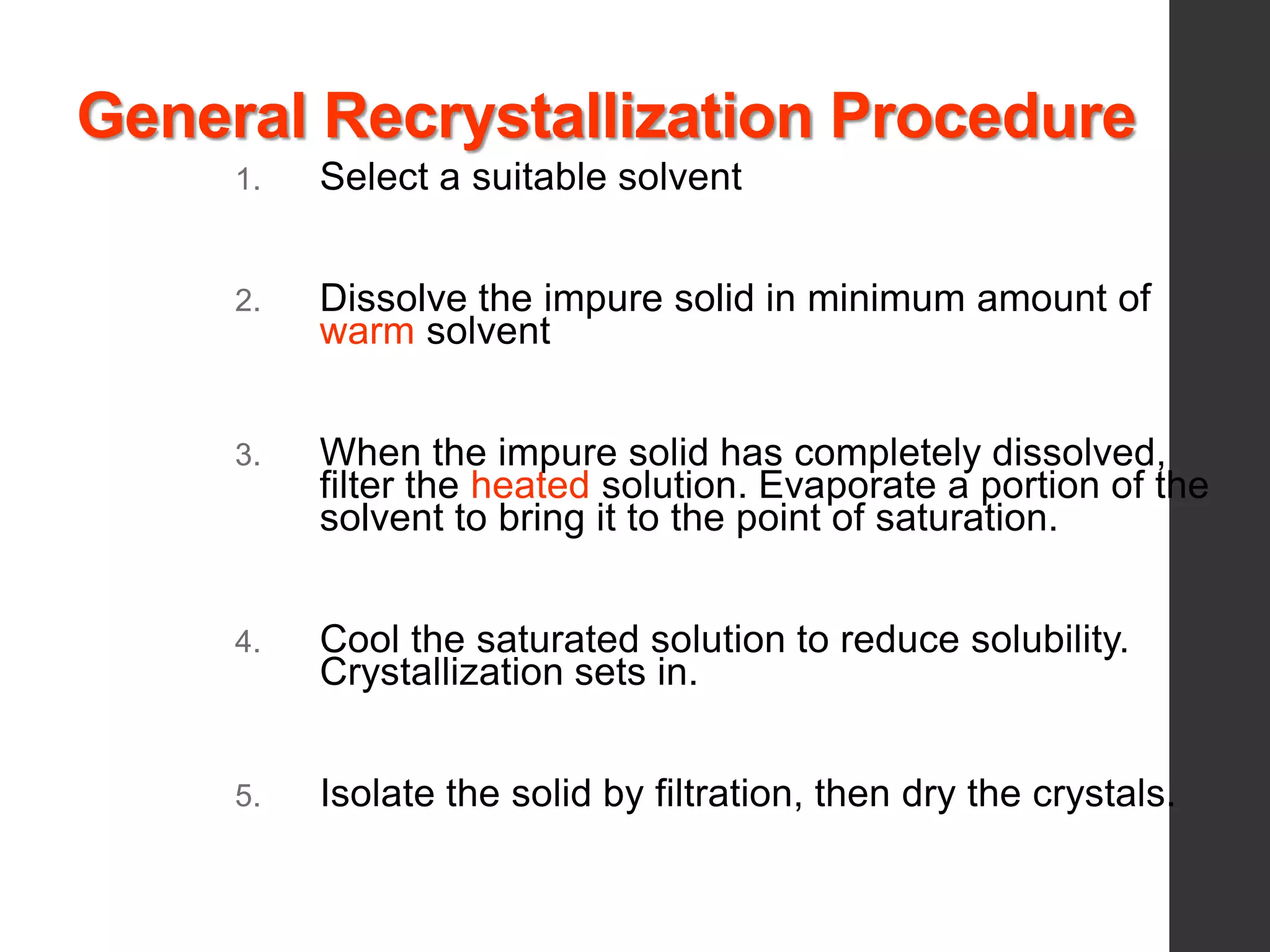
General Recrystallization Procedure
1. Select a suitable solvent
2. Dissolve the impure solid in minimum amount of
warm solvent
3. When the impure solid has completely dissolved,
filter the heated solution. Evaporate a portion of the
solvent to bring it to the point of saturation.
4. Cool the saturated solution to reduce solubility.
Crystallization sets in.
5. Isolate the solid by filtration, then dry the crystals.
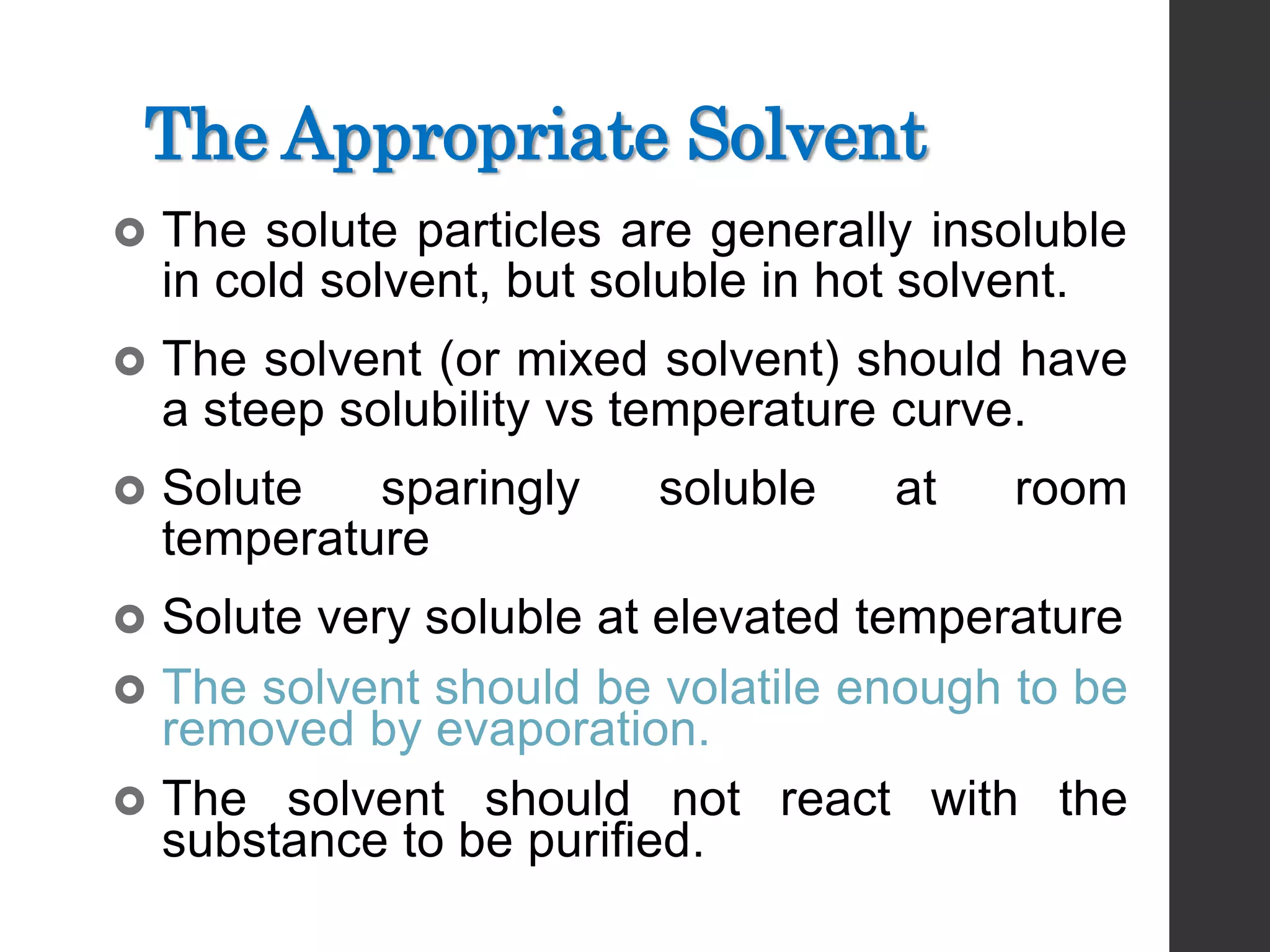
The Appropriate Solvent
 The solute particles are generally insoluble
in cold solvent, but soluble in hot solvent.
 The solvent (or mixed solvent) should have
a steep solubility vs temperature curve.
 Solute sparingly soluble at room
temperature
 Solute very soluble at elevated temperature
 The solvent should be volatile enough to be
removed by evaporation.
 The solvent should not react with the
substance to be purified.
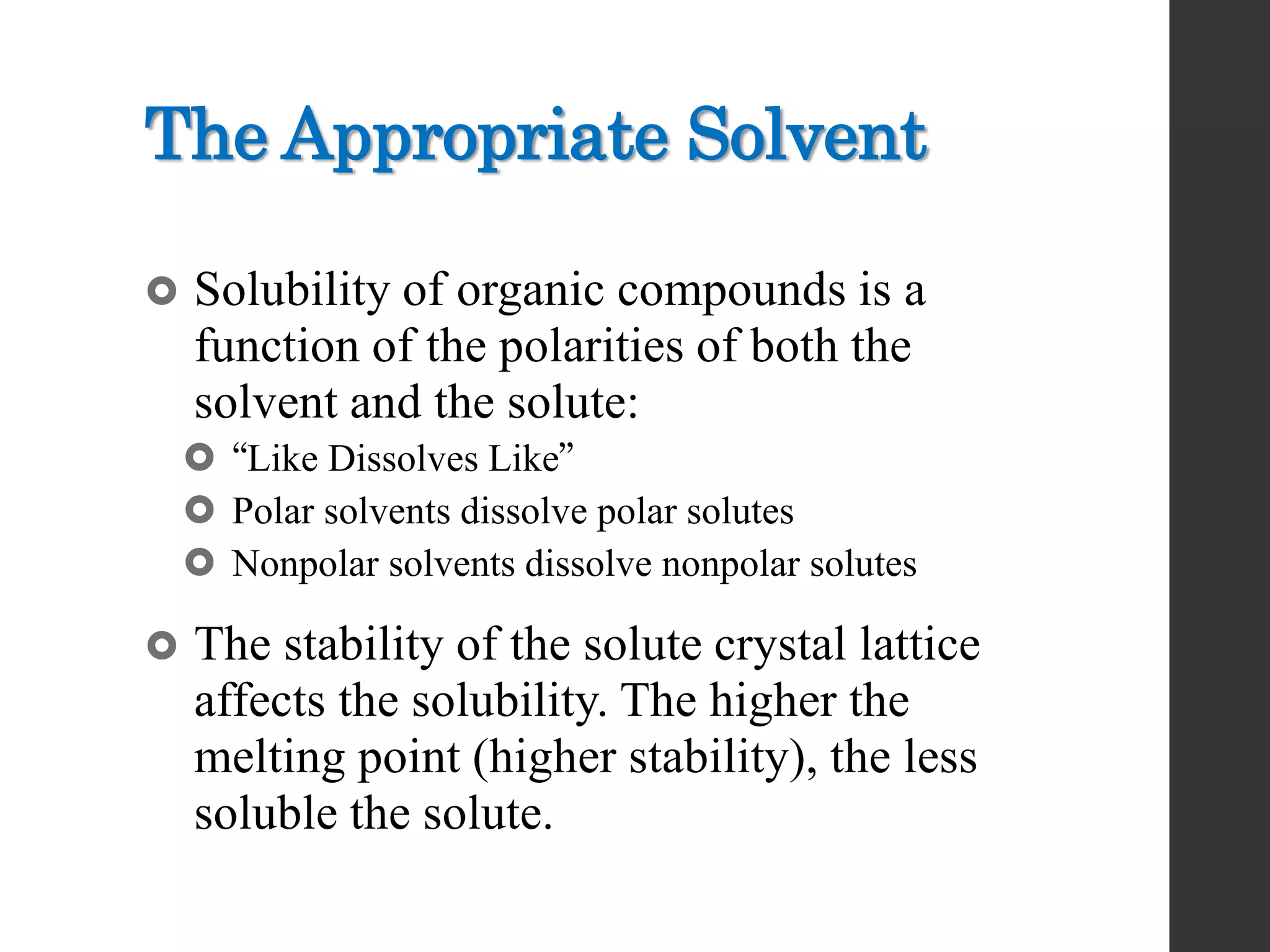
The Appropriate Solvent
 Solubility of organic compounds is a
function of the polarities of both the
solvent and the solute:
 “Like Dissolves Like”
 Polar solvents dissolve polar solutes
 Nonpolar solvents dissolve nonpolar solutes
 The stability of the solute crystal lattice
affects the solubility. The higher the
melting point (higher stability), the less
soluble the solute.
The Appropriate Solvent
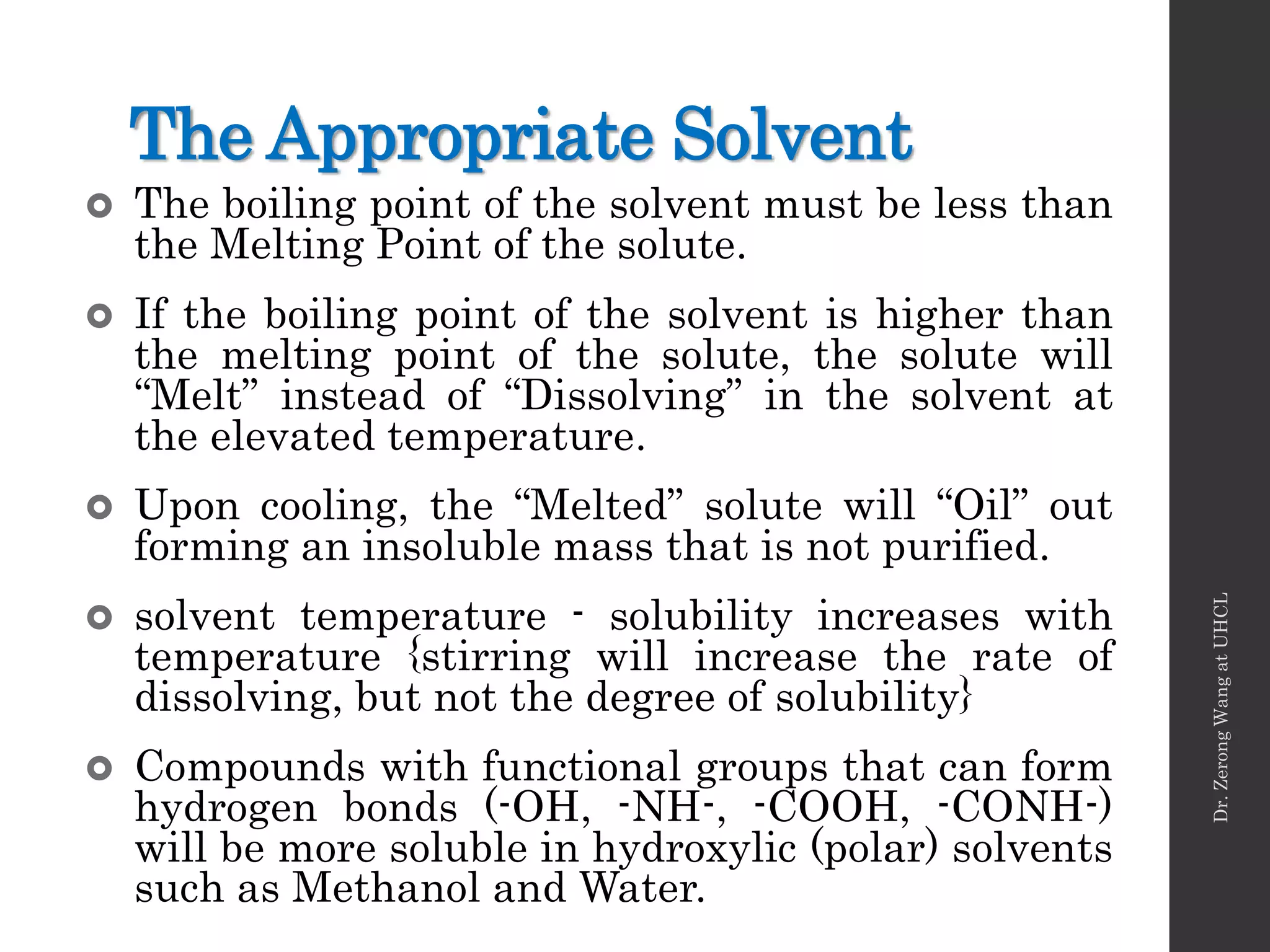
 The boiling point of the solvent must be less than
the Melting Point of the solute.
 If the boiling point of the solvent is higher than
the melting point of the solute, the solute will
“Melt” instead of “Dissolving” in the solvent at
the elevated temperature.
 Upon cooling, the “Melted” solute will “Oil” out
forming an insoluble mass that is not purified.
 solvent temperature - solubility increases with
temperature {stirring will increase the rate of
dissolving, but not the degree of solubility}
 Compounds with functional groups that can form
hydrogen bonds (-OH, -NH-, -COOH, -CONH-)
will be more soluble in hydroxylic (polar) solvents
such as Methanol and Water.
Dr.ZerongWangatUHCL
The Appropriate Solvent
 Sometimes the best recrystallization
solvent is a mixture of two miscible
solvents, one which dissolves the
compound readily, the other which
does not.
 For example, aspirin is very soluble
in ethanol but quite insoluble in
water, even hot water.
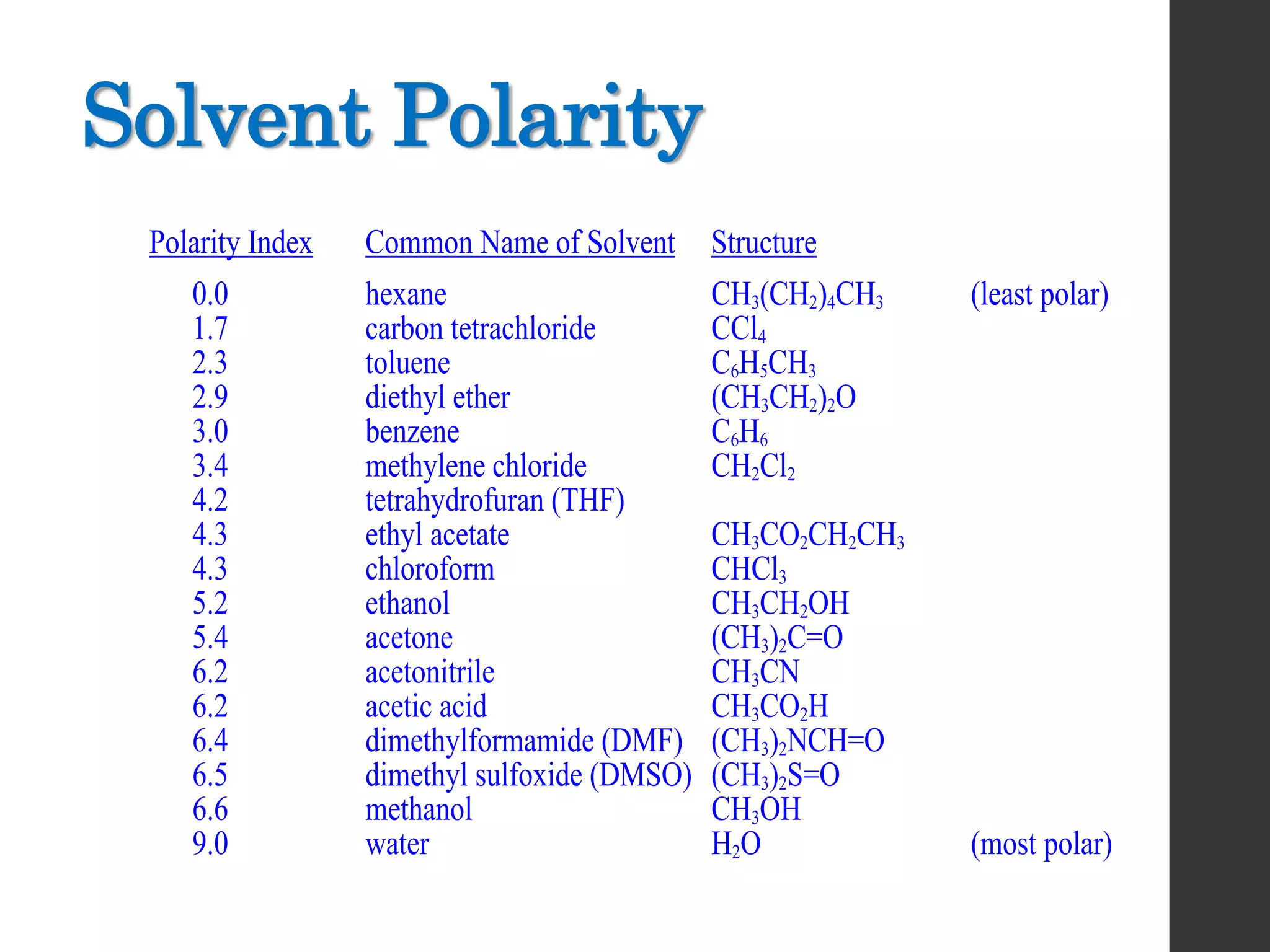
Solvent Polarity
Polarity Index Common Name of Solvent Structure
0.0 hexane CH3(CH2)4CH3 (least polar)
1.7 carbon tetrachloride CCl4
2.3 toluene C6H5CH3
2.9 diethyl ether (CH3CH2)2O
3.0 benzene C6H6
3.4 methylene chloride CH2Cl2
4.2 tetrahydrofuran (THF)
4.3 ethyl acetate CH3CO2CH2CH3
4.3 chloroform CHCl3
5.2 ethanol CH3CH2OH
5.4 acetone (CH3)2C=O
6.2 acetonitrile CH3CN
6.2 acetic acid CH3CO2H
6.4 dimethylformamide (DMF) (CH3)2NCH=O
6.5 dimethyl sulfoxide (DMSO) (CH3)2S=O
6.6 methanol CH3OH
9.0 water H2O (most polar)
An Ideal Recrystallization Solvent
should dissolve all of the compound when
the solvent is hot (boiling).
should dissolve none of the compound when
the solvent is at room temperature.
should have different solubilities for the
compound and the impurities.
should have a lower boiling point than the
melting point of the compound.
should have a fairly low boiling point
should be cheap, non-toxic, non-reactive,
and non-smelly
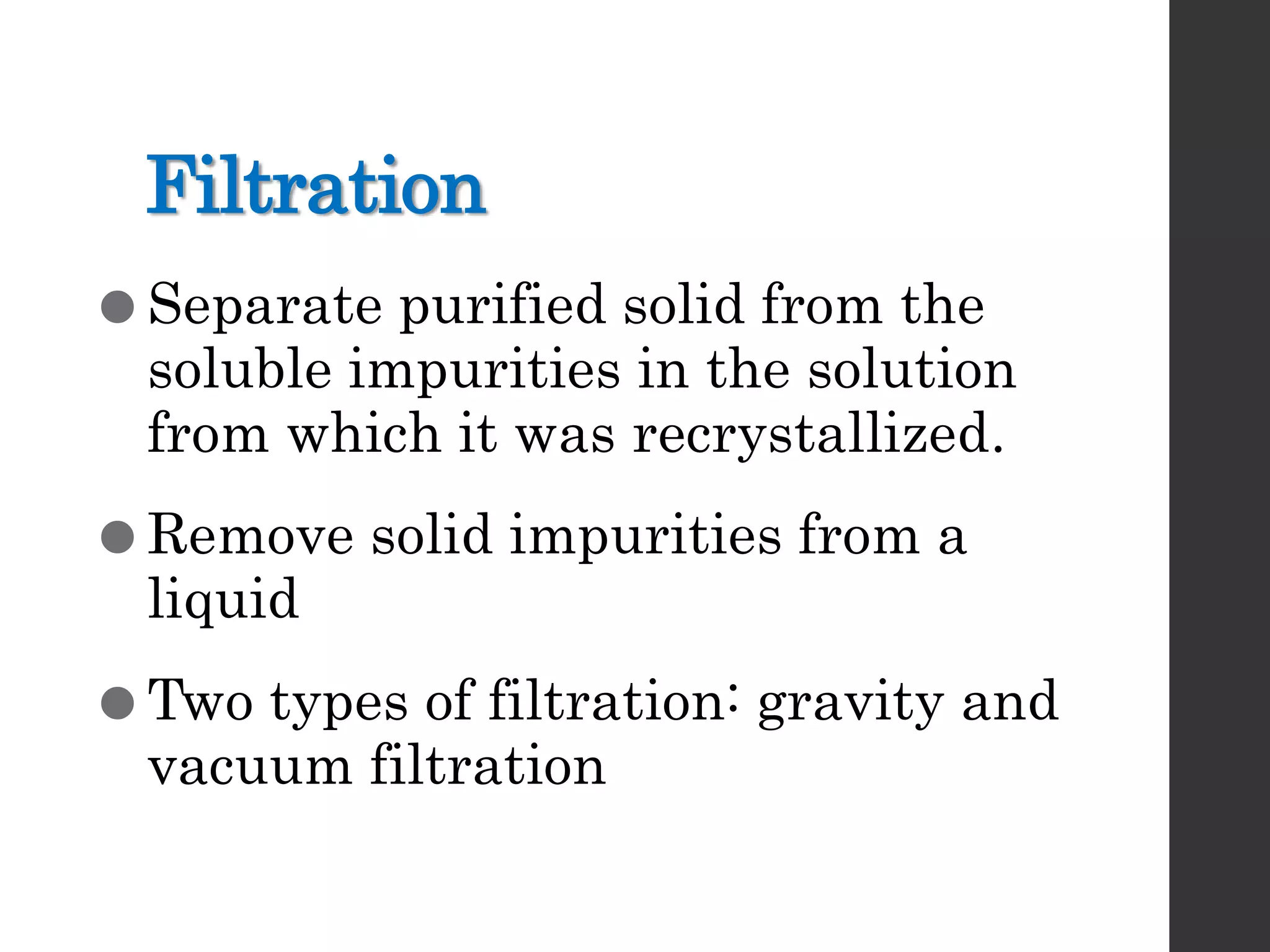
Filtration
 Separate purified solid from the
soluble impurities in the solution
from which it was recrystallized.
 Remove solid impurities from a
liquid
 Two types of filtration: gravity and
vacuum filtration
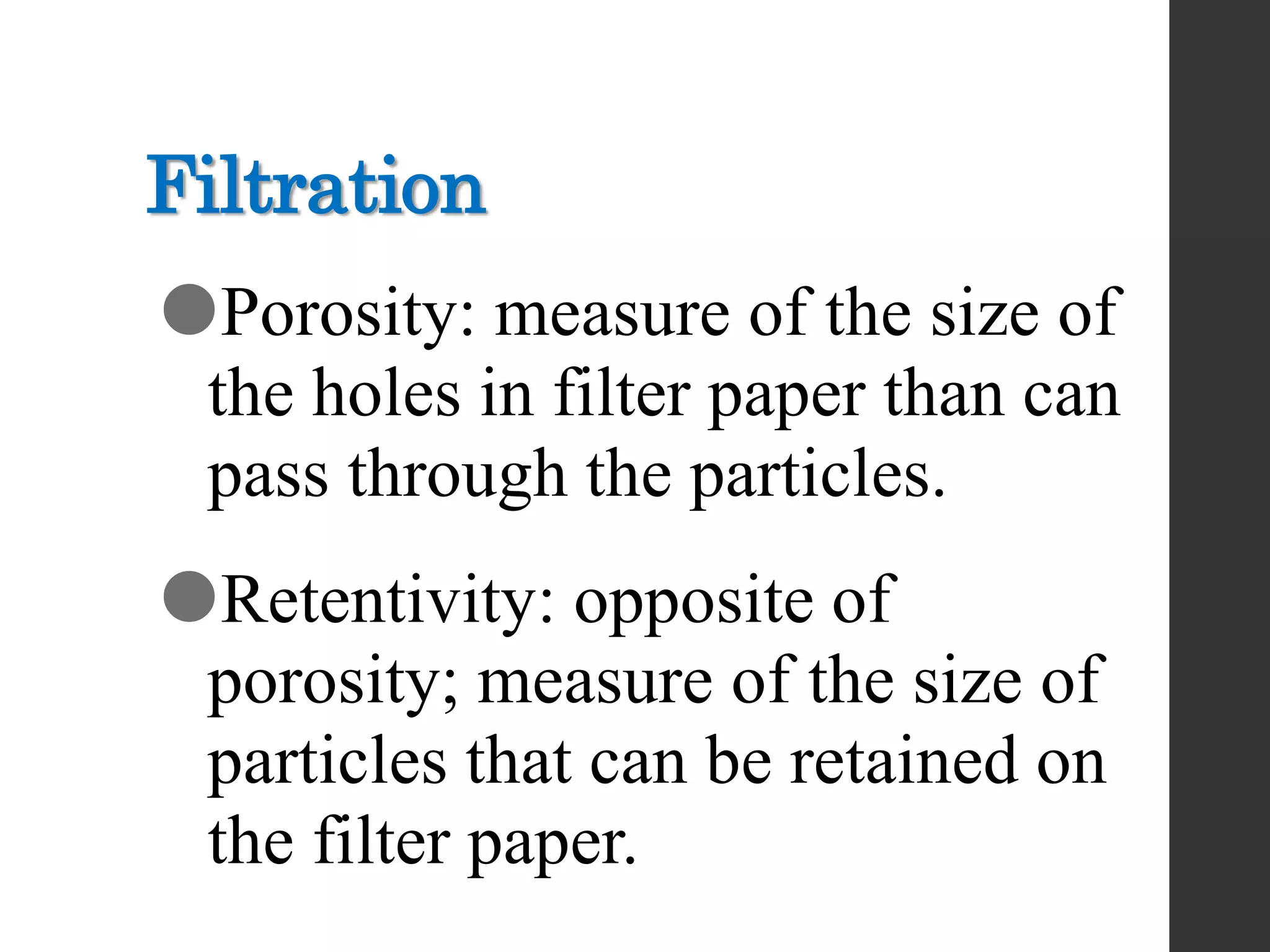
Filtration
Porosity: measure of the size of
the holes in filter paper than can
pass through the particles.
Retentivity: opposite of
porosity; measure of the size of
particles that can be retained on
the filter paper.
Gravity Filtration
Filter Cones: folded paper filter inserted into
a glass funnel with stem extending into a
receiving flask. Applicable volume > 10 mL.
Fluted Filters: specially folded (many
creases) filter paper inserted into a glass
funnel with stem extending into a receiving
flask. Applicable volume > 10 mL
 Filtering Pipettes: microscale
technique used with Pasteur Pipets.
A piece of cotton is inserted into
the top of the lower constriction.
Applicable volume < 10mL
 Decantation: careful pouring of
supernatant liquid into another
vessel leaving solids particles
behind
Vacuum Filtration: A Rapid
Process
 Buchner Funnels: primarily used to
filter large volumes of liquid from
solids, such as crystals from the
recrystallization process. Applicable
volume > 10 mL.
 Hirsch Funnels: similar, but smaller
than Buchner Funnel, with sloping
sides. Used in microscale techniques.
Applicable volume < 10 mL.
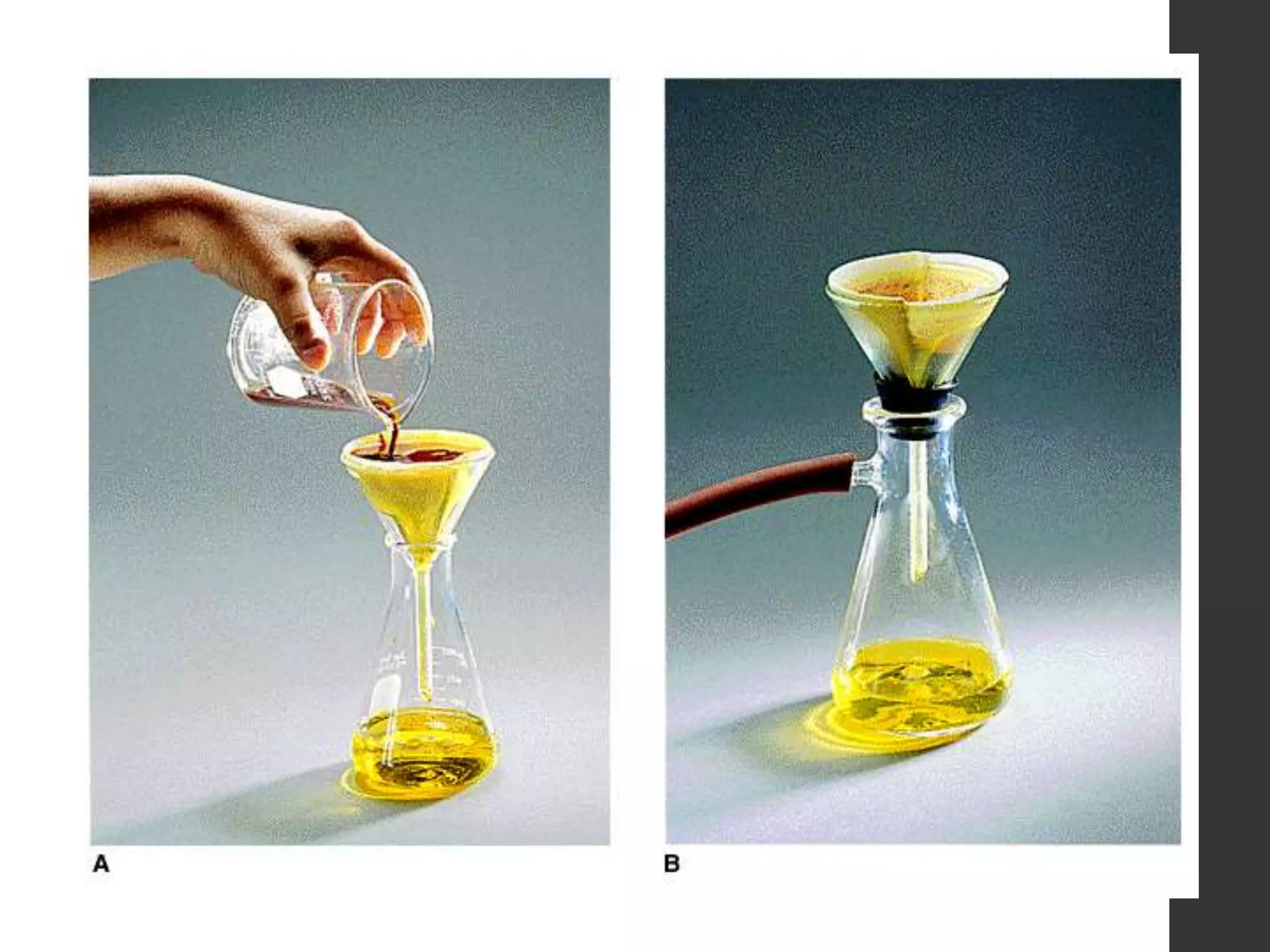
Suction Filtration Apparatus.
Recrystallization
Recrystallization

Recrystallization

  • 1.
    Recrystallization By: Mrs. D. R.Mali Asssitant Professor Pharmaceutical Chemistry GES’s Sir Dr. M. S. Gosavi College of Pharmaceutical Education and Research, Nashik.
  • 2.
    AIM  To studyrecrystallization technique for purification of solid compound. References:  B. S. Furniss, A. J. Hannaford, Peter W. G. Smith and A. R. Tatchell, ‘Textbook Of Practical Organic Chemistry’ Vth edition, Longman Scientific & Technical, New York, 1989, pp.135-142  Frederick George Mann and Bernard Charles Saunders, ‘Practical Organic Chemistry’, IVth edition Longman Group Limited, London, 1978, pp. 13-20
  • 3.
    Need of recrystallization Solid compounds synthesized in the organic laboratory usually need to be purified before final confirmation tests are performed  One of the most commonly used techniques to purify a sample is recrystallization followed by vacuum filtration.
  • 4.
     Solid organiccompounds produced in the laboratory usually need to be purified.  The most common technique involves recrystallizing the sample from an appropriate Solvent.  The recrystallization process is a relatively slow and selective formation of crystals from a solvent.  Precipitation is a rapid and nonselective process; thus not used to purify samples.
  • 5.
    Defination  Recrystallization isa purification technique which consists of dissolving the impure substance in a minimal volume of a solvent near its boiling point, then allowing the solution to cool slowly to crystallize the substance (ideally, leaving the impurities dissolved.)
  • 6.
    Principles of Recrystallization Selecta solvent that will dissolve the desired solid in the hot but not the cold solvent. Cooling should lead to crystallization again. Impurities should be well soluble in cold solvent thus stay in solution Or Impurities should be insoluble in hot solvent (filter them off while solution is hot)
  • 7.
    Recrystallization Procedure  Dissolvesample in a minimal amount of an appropriate solvent.  Sample should be insoluble in solvent at room temperature, but soluble at elevated (boiling point) temperature.  If solution is colorized, it is sometimes necessary to add a decolorizing agent (activated charcoal)  Colorized solutions are first filtered through a fluted filter or a column containing alumina or silica gel.
  • 8.
    Recrystallization Procedure  Thehot solution is cooled slowly to room temperature. As the temperature changes the solute particles begin to come out of solution, leaving the more soluble impurities in solution.  After crystallization, place beaker in water/ice bath.  Collect crystals by vacuum filtration.  Rinse the crystals with small portion of cold solvent.  Dry the crystals in air.  Determine melting point of dried sample.
  • 9.
    General Recrystallization Procedure 1.Select a suitable solvent 2. Dissolve the impure solid in minimum amount of warm solvent 3. When the impure solid has completely dissolved, filter the heated solution. Evaporate a portion of the solvent to bring it to the point of saturation. 4. Cool the saturated solution to reduce solubility. Crystallization sets in. 5. Isolate the solid by filtration, then dry the crystals.
  • 11.
    The Appropriate Solvent The solute particles are generally insoluble in cold solvent, but soluble in hot solvent.  The solvent (or mixed solvent) should have a steep solubility vs temperature curve.  Solute sparingly soluble at room temperature  Solute very soluble at elevated temperature  The solvent should be volatile enough to be removed by evaporation.  The solvent should not react with the substance to be purified.
  • 12.
    The Appropriate Solvent Solubility of organic compounds is a function of the polarities of both the solvent and the solute:  “Like Dissolves Like”  Polar solvents dissolve polar solutes  Nonpolar solvents dissolve nonpolar solutes  The stability of the solute crystal lattice affects the solubility. The higher the melting point (higher stability), the less soluble the solute.
  • 13.
    The Appropriate Solvent The boiling point of the solvent must be less than the Melting Point of the solute.  If the boiling point of the solvent is higher than the melting point of the solute, the solute will “Melt” instead of “Dissolving” in the solvent at the elevated temperature.  Upon cooling, the “Melted” solute will “Oil” out forming an insoluble mass that is not purified.  solvent temperature - solubility increases with temperature {stirring will increase the rate of dissolving, but not the degree of solubility}  Compounds with functional groups that can form hydrogen bonds (-OH, -NH-, -COOH, -CONH-) will be more soluble in hydroxylic (polar) solvents such as Methanol and Water. Dr.ZerongWangatUHCL
  • 14.
    The Appropriate Solvent Sometimes the best recrystallization solvent is a mixture of two miscible solvents, one which dissolves the compound readily, the other which does not.  For example, aspirin is very soluble in ethanol but quite insoluble in water, even hot water.
  • 15.
    Solvent Polarity Polarity IndexCommon Name of Solvent Structure 0.0 hexane CH3(CH2)4CH3 (least polar) 1.7 carbon tetrachloride CCl4 2.3 toluene C6H5CH3 2.9 diethyl ether (CH3CH2)2O 3.0 benzene C6H6 3.4 methylene chloride CH2Cl2 4.2 tetrahydrofuran (THF) 4.3 ethyl acetate CH3CO2CH2CH3 4.3 chloroform CHCl3 5.2 ethanol CH3CH2OH 5.4 acetone (CH3)2C=O 6.2 acetonitrile CH3CN 6.2 acetic acid CH3CO2H 6.4 dimethylformamide (DMF) (CH3)2NCH=O 6.5 dimethyl sulfoxide (DMSO) (CH3)2S=O 6.6 methanol CH3OH 9.0 water H2O (most polar)
  • 16.
    An Ideal RecrystallizationSolvent should dissolve all of the compound when the solvent is hot (boiling). should dissolve none of the compound when the solvent is at room temperature. should have different solubilities for the compound and the impurities. should have a lower boiling point than the melting point of the compound. should have a fairly low boiling point should be cheap, non-toxic, non-reactive, and non-smelly
  • 17.
    Filtration  Separate purifiedsolid from the soluble impurities in the solution from which it was recrystallized.  Remove solid impurities from a liquid  Two types of filtration: gravity and vacuum filtration
  • 18.
    Filtration Porosity: measure ofthe size of the holes in filter paper than can pass through the particles. Retentivity: opposite of porosity; measure of the size of particles that can be retained on the filter paper.
  • 19.
    Gravity Filtration Filter Cones:folded paper filter inserted into a glass funnel with stem extending into a receiving flask. Applicable volume > 10 mL. Fluted Filters: specially folded (many creases) filter paper inserted into a glass funnel with stem extending into a receiving flask. Applicable volume > 10 mL
  • 20.
     Filtering Pipettes:microscale technique used with Pasteur Pipets. A piece of cotton is inserted into the top of the lower constriction. Applicable volume < 10mL  Decantation: careful pouring of supernatant liquid into another vessel leaving solids particles behind
  • 21.
    Vacuum Filtration: ARapid Process  Buchner Funnels: primarily used to filter large volumes of liquid from solids, such as crystals from the recrystallization process. Applicable volume > 10 mL.  Hirsch Funnels: similar, but smaller than Buchner Funnel, with sloping sides. Used in microscale techniques. Applicable volume < 10 mL.
  • 23.