Asymmetric synthesis
Christeenashaji
198208
Asymmetric synthesis
 Asymmetric synthesis is a reaction in which an achiral unit in a substrate a
molecule is converted into a chiral unit in such a manner that unequal
amounts of stereoisomers (enantiomers or diastereomers) are produced
 When a compound containing an asymmetric carbon (CHIRAL) is synthesized by
conventional laboratory methods from an achiral compound the product is a racemic
mixture.
 If such a synthesis carried out under chiral influence, only one of optically active isomer
will form preferentially over the other.
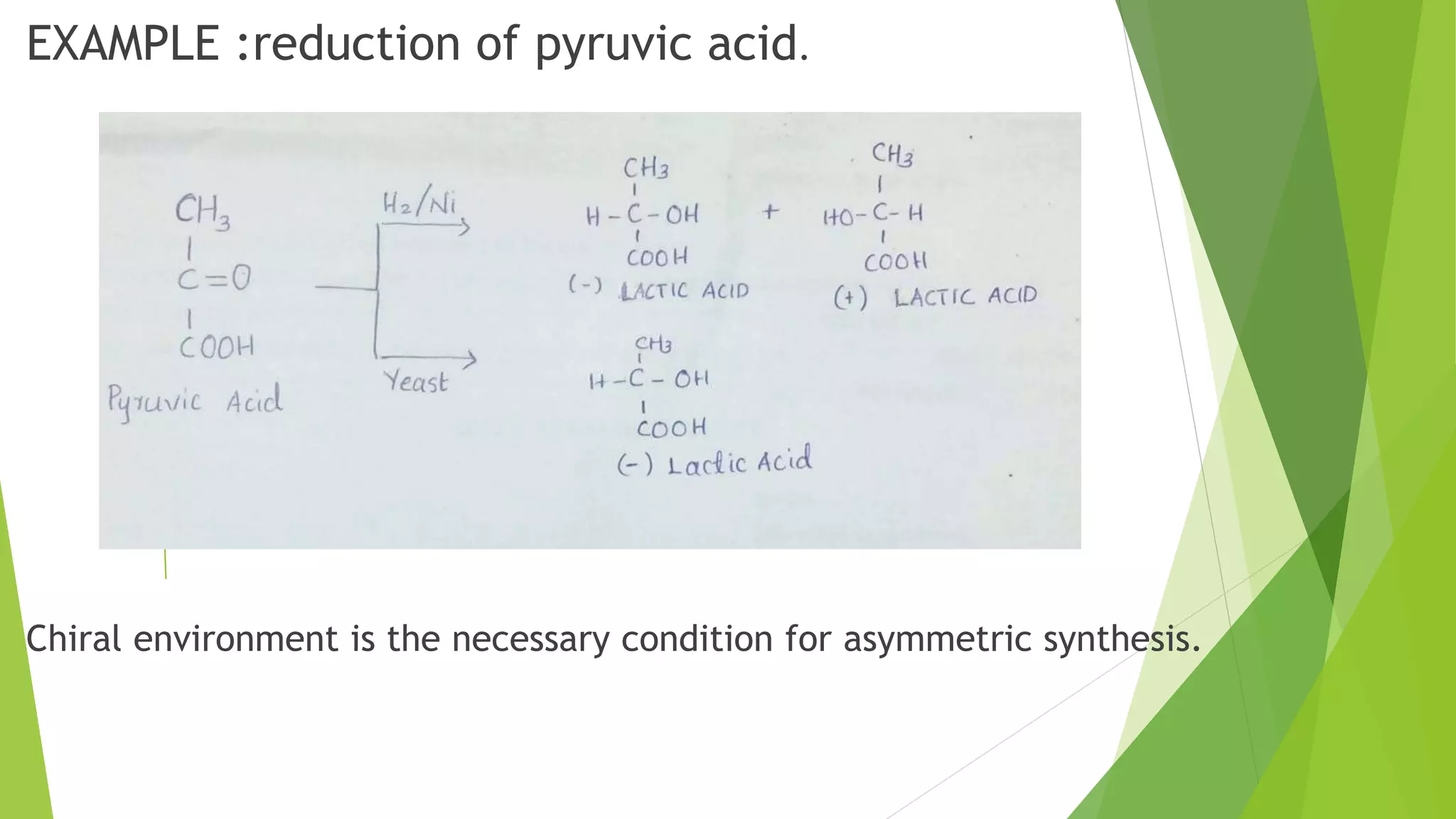
EXAMPLE :reduction of pyruvic acid.
Chiral environment is the necessary condition for asymmetric synthesis.
DEPENDING ON THE RELATIONSHIP BETWEEN PRODUCTS FORMED DURING ASYMMETRIC
SYNTHESIS ,REACTION MAY BE ENANTIOSELECTIVE OR DIASTEREOSELECTIVE .
A+B C + D
STEREOISOMERS
C and D formed in unequal amounts
STEREOSELECTIVE
C and D are diastereomers C and D are enantiomers
DIASTEREOSELECTIVE ENANTIOSELECTIVE
FUNDAMENTALS
One of the two conditions need to be met for successful asymmetric synthesis.
A) PROCHIRALITY
A tetrahedrally bonded achiral atom have general formula
Cabc2 will become a chiral center Cabcd on replacement of
one of the identical ligand c with a different ligand d is called a
prochiral centre and the molecule is said to be prochiral.
DEPENDING ON THE PRODUCT FORMED FROM A PROCHIRAL CENTRE, THE MOLECULE WILL BE
ENANTIOTOPIC OR DIASTEREOTOPIC .
Eg:Enantiotopic
Eg:Diastereotopic
B) ASYMMETRIC INDUCTION
The second condition of asymmetric synthesis is brought about in the reaction
pathway by the presence of an element of chirality, which plays an active role in the
reaction.
Property of chirality is induced by chiral reagent,solvent,catalyst or circularly
polarized light
WHY ASYMMETRIC SYNTHESIS IMPORTANT
 Before 1940 optically pure compound is obtained by isolation from natural
products, resolution of racemic mixture and by laboratory controlled enzymatic
reactions, but the yield of optically pure compound was very less.
 All natural or biologically occurring molecules are chiral . Because nature uses
enzymes ,these are biological catalysts.
 Synthesis of optically pure substance are important because different enantiomers
or diasteroemers of a compound have different biological activity. Eg:+ and –
thalidomide have different action with biological receptors.
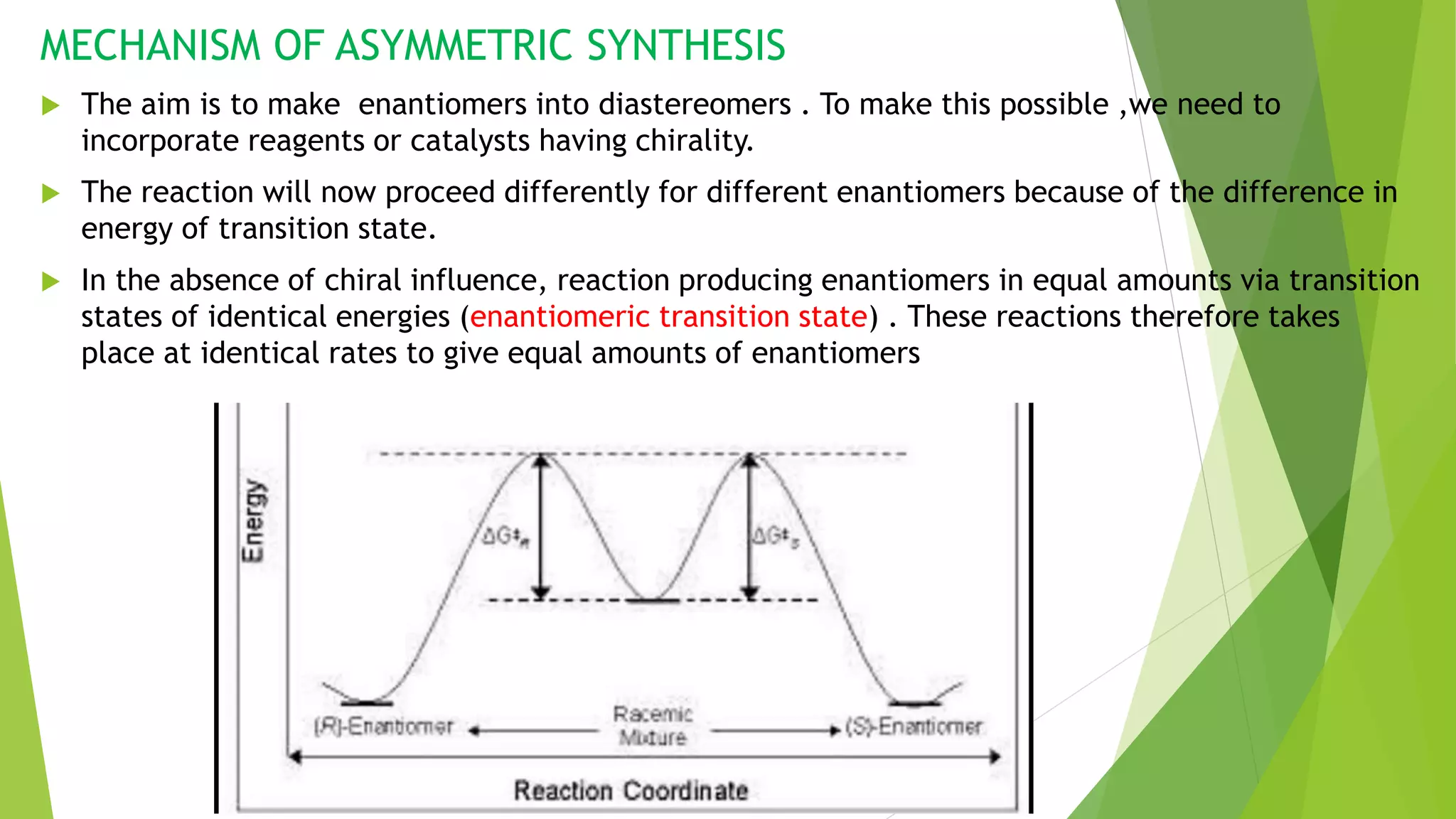
MECHANISM OF ASYMMETRIC SYNTHESIS
 The aim is to make enantiomers into diastereomers . To make this possible ,we need to
incorporate reagents or catalysts having chirality.
 The reaction will now proceed differently for different enantiomers because of the difference in
energy of transition state.
 In the absence of chiral influence, reaction producing enantiomers in equal amounts via transition
states of identical energies (enantiomeric transition state) . These reactions therefore takes
place at identical rates to give equal amounts of enantiomers
 If we are using chiral components , then we could make the possible enantomeric
transition state , diastereomeric transition state with different activation energy
which results in unequal amounts of isomers.
 We have to go through a diastereomeric transition state to achieve asymmetric
synthesis.
MAJOR APPROACHES IN ASYMMETRIC SYNTHESIS
 Asymmetric synthesis are of two types
A) PARTIAL ASYMMETRIC SYNTHESIS
synthesis of a new chiral center from an achiral center by using optically active
reagents .
 Different methods of partial asymmetric synthesis are:
1) Use of chiral substrate (first generation method)
 It uses natures ready-made chiral centers as starting materials .
 More economical way of making compounds in enantiopure form.
Eg: Conversion of L-tyrosine into L-DOPA
 In this conversion starting material L-tyrosine is a naturally occurring chiral
molecule .
 This conversion doesn’t affect the existing stereocenter .
 This method is also known as “ CHIRAL POOL” STRATEGY.
 Chiral pool is the collection of cheap , readily available natural products .
Eg:(+)nicotine, (+)tartaric acid, D-glyceraldehyde etc .
 Nucleophilic attack on acyclic carbonyl compounds :
 For certain additions to c=o groups of chiral aldehyde or ketones CRAM’S RULE
is useful to predict which diastereomer will predominate .
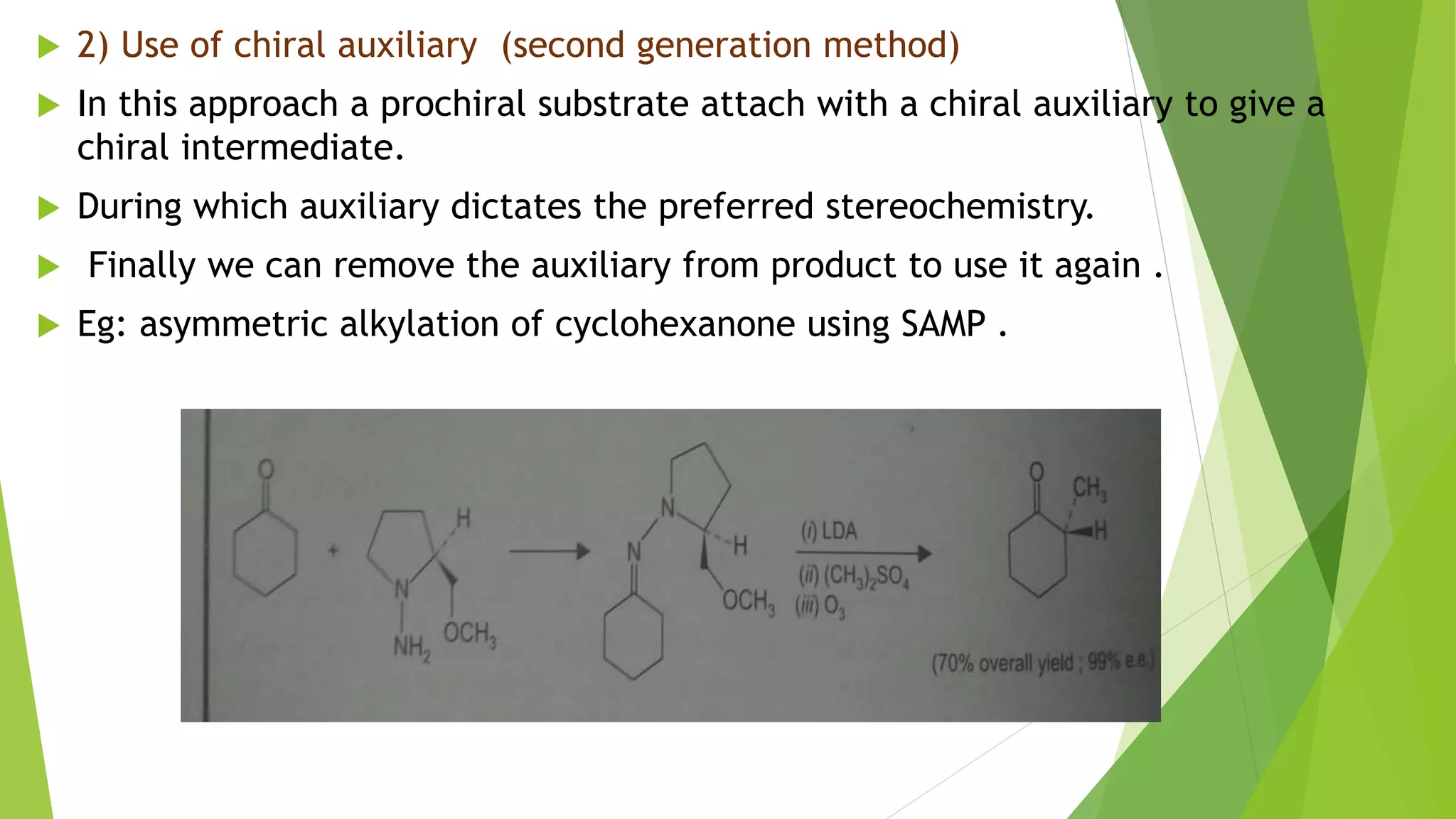
 2) Use of chiral auxiliary (second generation method)
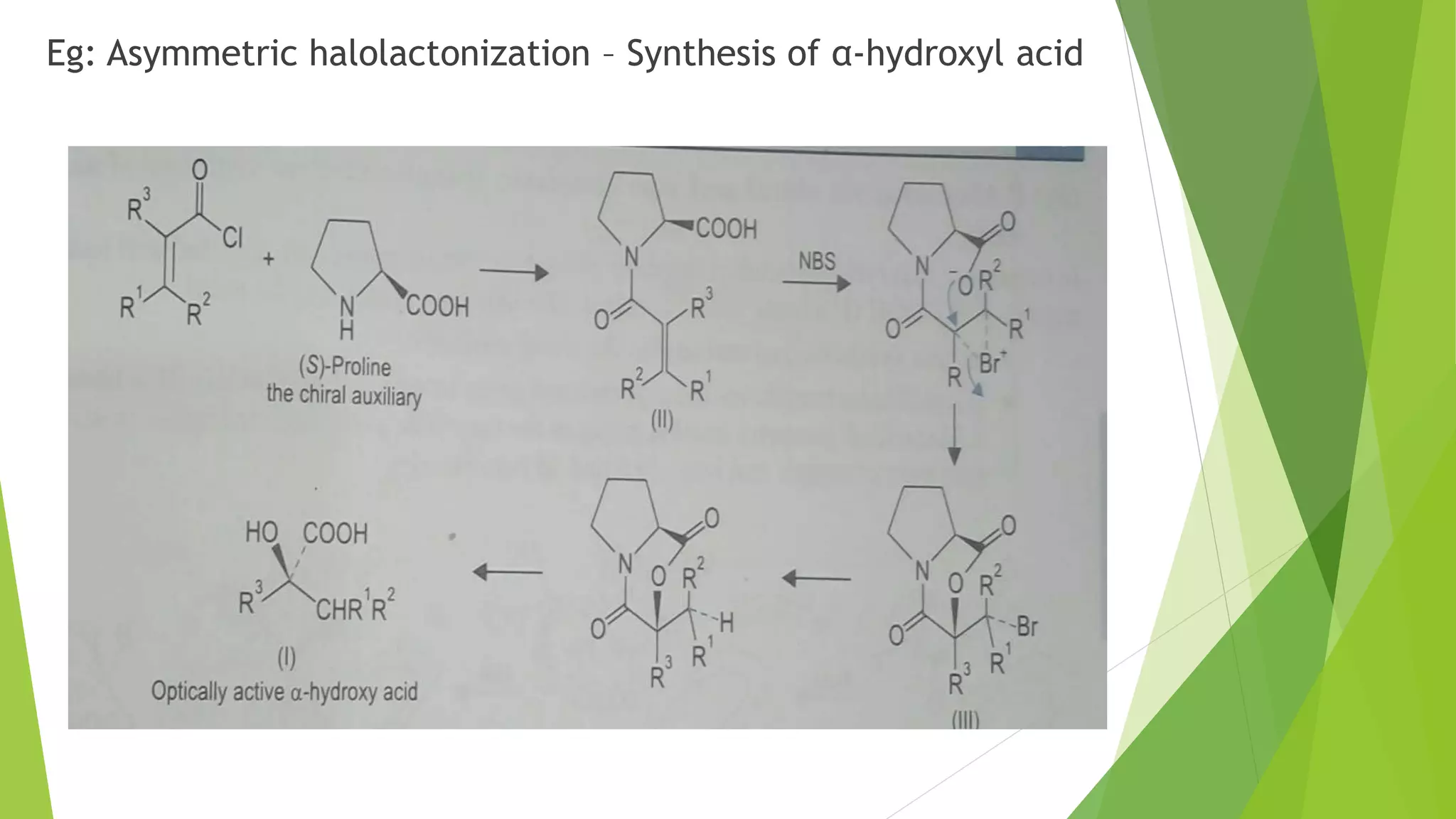
 In this approach a prochiral substrate attach with a chiral auxiliary to give a
chiral intermediate.
 During which auxiliary dictates the preferred stereochemistry.
 Finally we can remove the auxiliary from product to use it again .
 Eg: asymmetric alkylation of cyclohexanone using SAMP .
Eg: Asymmetric halolactonization – Synthesis of α-hydroxyl acid
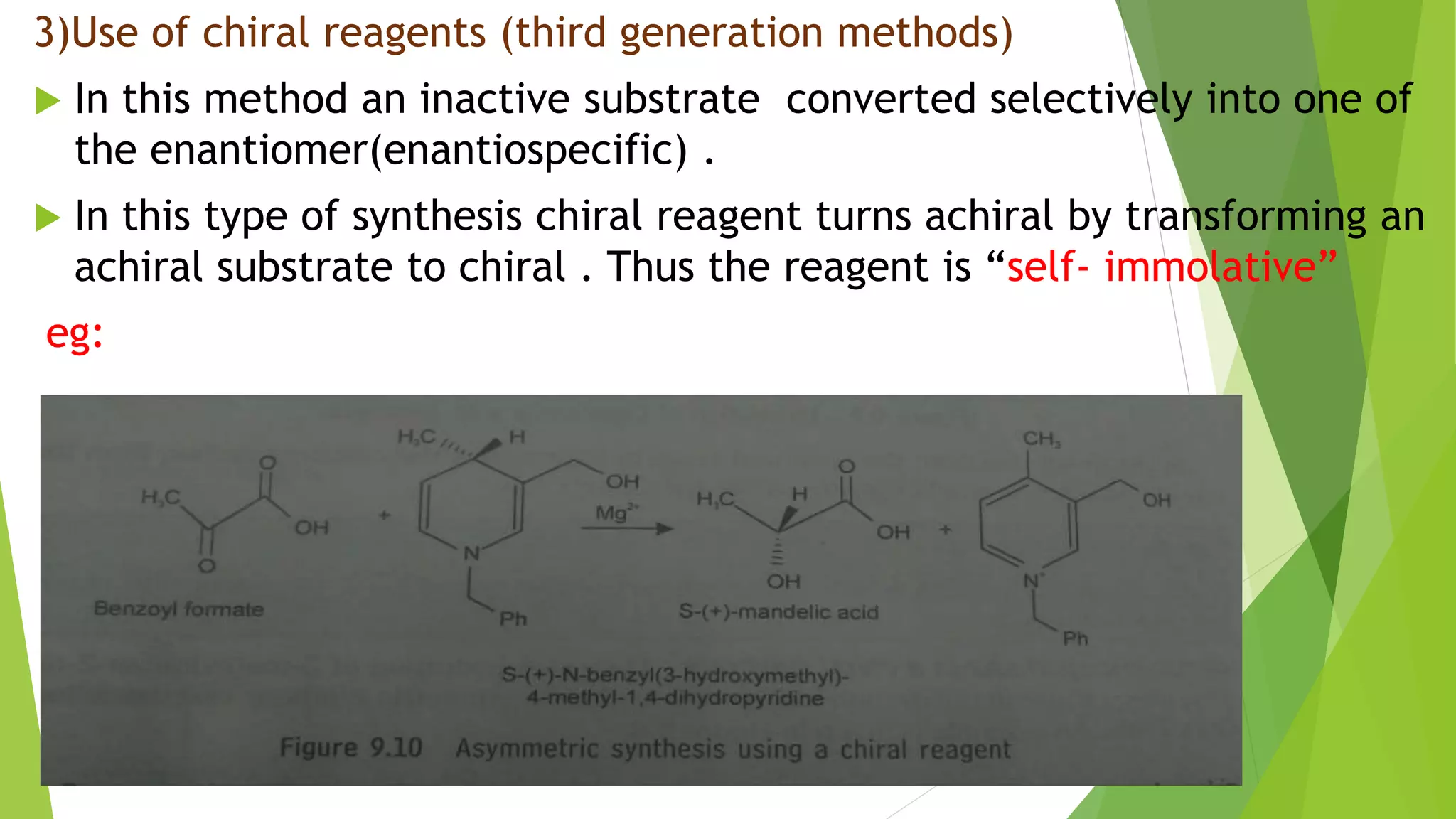
3)Use of chiral reagents (third generation methods)
 In this method an inactive substrate converted selectively into one of
the enantiomer(enantiospecific) .
 In this type of synthesis chiral reagent turns achiral by transforming an
achiral substrate to chiral . Thus the reagent is “self- immolative”
eg:
Eg: Reduction of a prochiral carbonyl group enantioselectively by a
chiral reducing agent
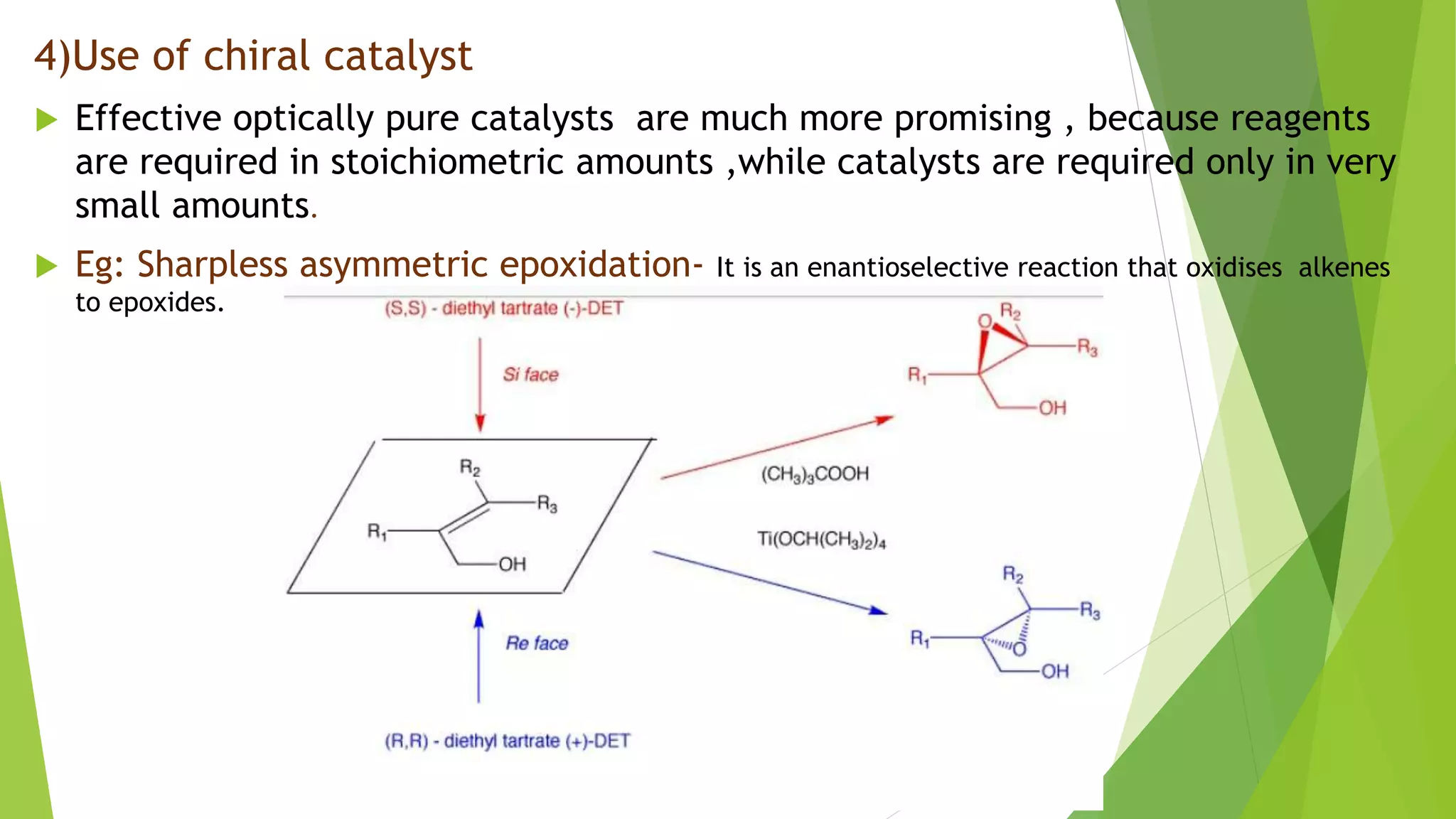
4)Use of chiral catalyst
 Effective optically pure catalysts are much more promising , because reagents
are required in stoichiometric amounts ,while catalysts are required only in very
small amounts.
 Eg: Sharpless asymmetric epoxidation- It is an enantioselective reaction that oxidises alkenes
to epoxides.
The mechanism of Sharpless asymmetric epoxidation involves following
steps .
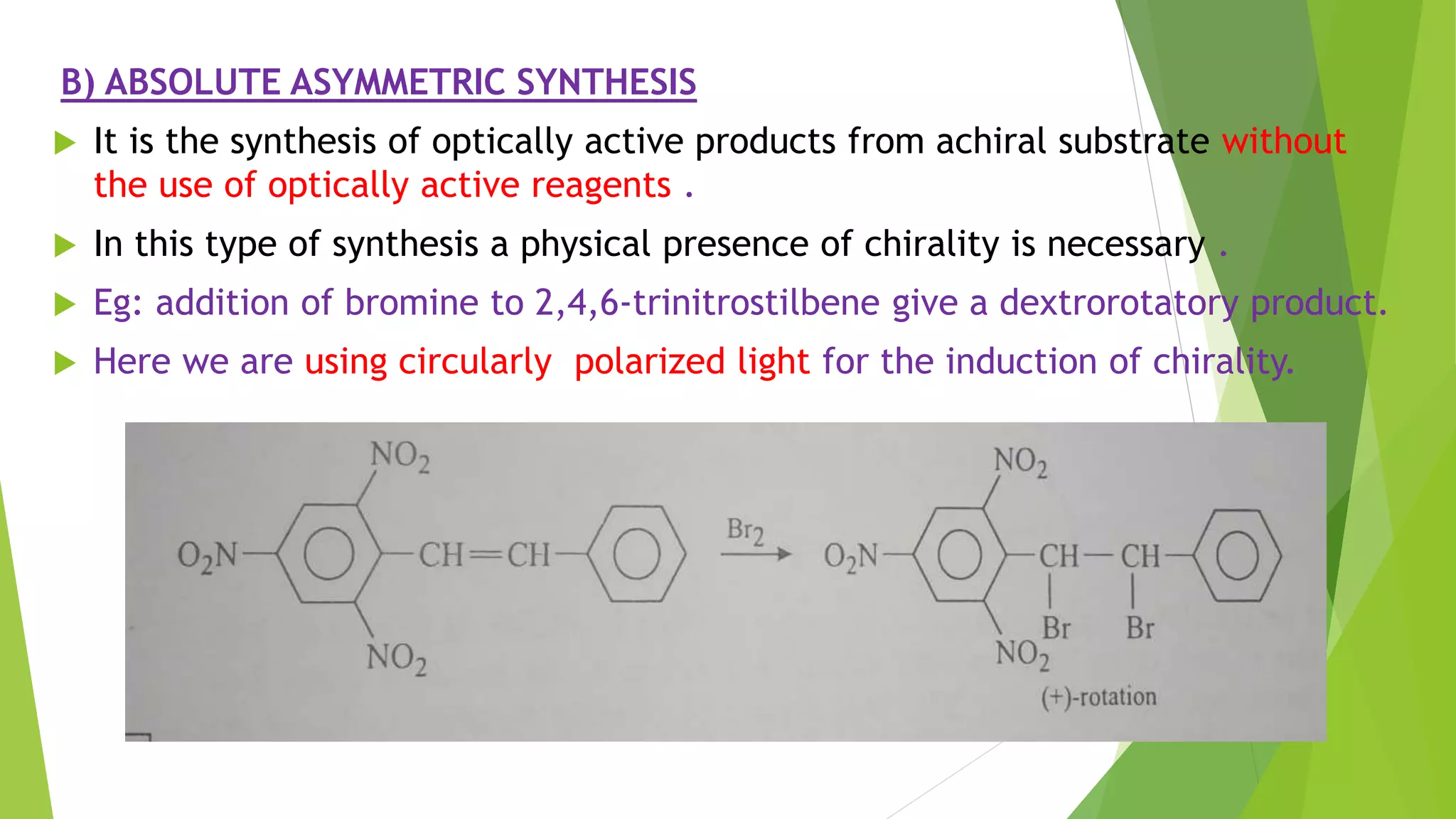
B) ABSOLUTE ASYMMETRIC SYNTHESIS
 It is the synthesis of optically active products from achiral substrate without
the use of optically active reagents .
 In this type of synthesis a physical presence of chirality is necessary .
 Eg: addition of bromine to 2,4,6-trinitrostilbene give a dextrorotatory product.
 Here we are using circularly polarized light for the induction of chirality.
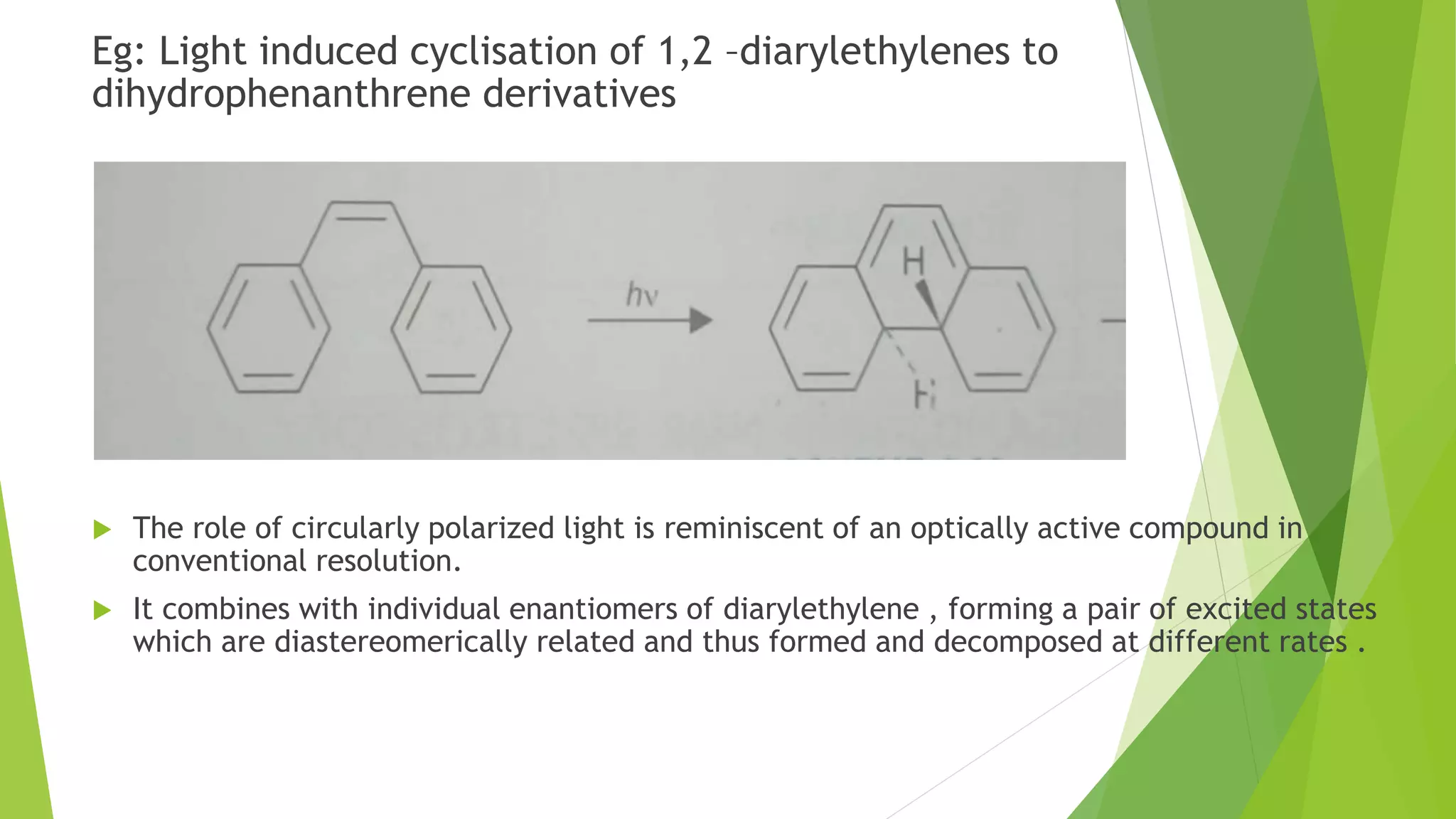
Eg: Light induced cyclisation of 1,2 –diarylethylenes to
dihydrophenanthrene derivatives
 The role of circularly polarized light is reminiscent of an optically active compound in
conventional resolution.
 It combines with individual enantiomers of diarylethylene , forming a pair of excited states
which are diastereomerically related and thus formed and decomposed at different rates .
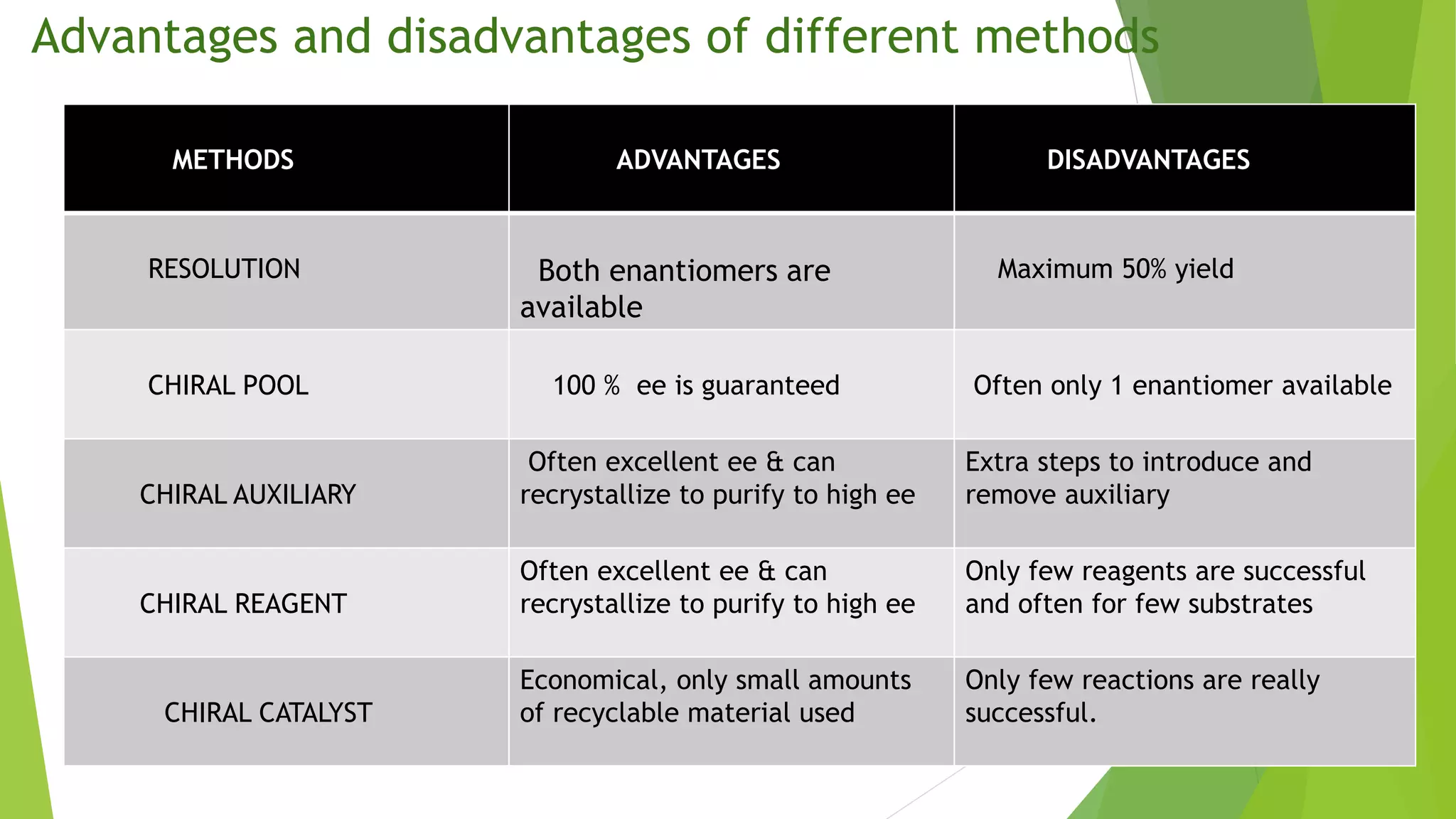
Advantages and disadvantages of different methods
METHODS ADVANTAGES DISADVANTAGES
RESOLUTION Both enantiomers are
available
Maximum 50% yield
CHIRAL POOL 100 % ee is guaranteed Often only 1 enantiomer available
CHIRAL AUXILIARY
Often excellent ee & can
recrystallize to purify to high ee
Extra steps to introduce and
remove auxiliary
CHIRAL REAGENT
Often excellent ee & can
recrystallize to purify to high ee
Only few reagents are successful
and often for few substrates
CHIRAL CATALYST
Economical, only small amounts
of recyclable material used
Only few reactions are really
successful.
 REFERENCES
1. STEREOCHEMISTRY :CONFORMATION AND MECHANISM – P S Kalsi
2. BASIC ORGANIC CHEMISTRY : Ernest L Eliel
THANK YOU

Asymmetric Synthesis - Christeena Shaji

  • 1.
  • 2.
    Asymmetric synthesis  Asymmetricsynthesis is a reaction in which an achiral unit in a substrate a molecule is converted into a chiral unit in such a manner that unequal amounts of stereoisomers (enantiomers or diastereomers) are produced  When a compound containing an asymmetric carbon (CHIRAL) is synthesized by conventional laboratory methods from an achiral compound the product is a racemic mixture.  If such a synthesis carried out under chiral influence, only one of optically active isomer will form preferentially over the other.
  • 3.
    EXAMPLE :reduction ofpyruvic acid. Chiral environment is the necessary condition for asymmetric synthesis.
  • 4.
    DEPENDING ON THERELATIONSHIP BETWEEN PRODUCTS FORMED DURING ASYMMETRIC SYNTHESIS ,REACTION MAY BE ENANTIOSELECTIVE OR DIASTEREOSELECTIVE . A+B C + D STEREOISOMERS C and D formed in unequal amounts STEREOSELECTIVE C and D are diastereomers C and D are enantiomers DIASTEREOSELECTIVE ENANTIOSELECTIVE
  • 6.
    FUNDAMENTALS One of thetwo conditions need to be met for successful asymmetric synthesis. A) PROCHIRALITY A tetrahedrally bonded achiral atom have general formula Cabc2 will become a chiral center Cabcd on replacement of one of the identical ligand c with a different ligand d is called a prochiral centre and the molecule is said to be prochiral.
  • 7.
    DEPENDING ON THEPRODUCT FORMED FROM A PROCHIRAL CENTRE, THE MOLECULE WILL BE ENANTIOTOPIC OR DIASTEREOTOPIC . Eg:Enantiotopic Eg:Diastereotopic
  • 8.
    B) ASYMMETRIC INDUCTION Thesecond condition of asymmetric synthesis is brought about in the reaction pathway by the presence of an element of chirality, which plays an active role in the reaction. Property of chirality is induced by chiral reagent,solvent,catalyst or circularly polarized light
  • 9.
    WHY ASYMMETRIC SYNTHESISIMPORTANT  Before 1940 optically pure compound is obtained by isolation from natural products, resolution of racemic mixture and by laboratory controlled enzymatic reactions, but the yield of optically pure compound was very less.  All natural or biologically occurring molecules are chiral . Because nature uses enzymes ,these are biological catalysts.  Synthesis of optically pure substance are important because different enantiomers or diasteroemers of a compound have different biological activity. Eg:+ and – thalidomide have different action with biological receptors.
  • 10.
    MECHANISM OF ASYMMETRICSYNTHESIS  The aim is to make enantiomers into diastereomers . To make this possible ,we need to incorporate reagents or catalysts having chirality.  The reaction will now proceed differently for different enantiomers because of the difference in energy of transition state.  In the absence of chiral influence, reaction producing enantiomers in equal amounts via transition states of identical energies (enantiomeric transition state) . These reactions therefore takes place at identical rates to give equal amounts of enantiomers
  • 11.
     If weare using chiral components , then we could make the possible enantomeric transition state , diastereomeric transition state with different activation energy which results in unequal amounts of isomers.  We have to go through a diastereomeric transition state to achieve asymmetric synthesis.
  • 12.
    MAJOR APPROACHES INASYMMETRIC SYNTHESIS  Asymmetric synthesis are of two types A) PARTIAL ASYMMETRIC SYNTHESIS synthesis of a new chiral center from an achiral center by using optically active reagents .  Different methods of partial asymmetric synthesis are: 1) Use of chiral substrate (first generation method)  It uses natures ready-made chiral centers as starting materials .  More economical way of making compounds in enantiopure form.
  • 13.
    Eg: Conversion ofL-tyrosine into L-DOPA  In this conversion starting material L-tyrosine is a naturally occurring chiral molecule .  This conversion doesn’t affect the existing stereocenter .
  • 14.
     This methodis also known as “ CHIRAL POOL” STRATEGY.  Chiral pool is the collection of cheap , readily available natural products . Eg:(+)nicotine, (+)tartaric acid, D-glyceraldehyde etc .  Nucleophilic attack on acyclic carbonyl compounds :  For certain additions to c=o groups of chiral aldehyde or ketones CRAM’S RULE is useful to predict which diastereomer will predominate .
  • 15.
     2) Useof chiral auxiliary (second generation method)  In this approach a prochiral substrate attach with a chiral auxiliary to give a chiral intermediate.  During which auxiliary dictates the preferred stereochemistry.  Finally we can remove the auxiliary from product to use it again .  Eg: asymmetric alkylation of cyclohexanone using SAMP .
  • 16.
    Eg: Asymmetric halolactonization– Synthesis of α-hydroxyl acid
  • 17.
    3)Use of chiralreagents (third generation methods)  In this method an inactive substrate converted selectively into one of the enantiomer(enantiospecific) .  In this type of synthesis chiral reagent turns achiral by transforming an achiral substrate to chiral . Thus the reagent is “self- immolative” eg:
  • 18.
    Eg: Reduction ofa prochiral carbonyl group enantioselectively by a chiral reducing agent
  • 19.
    4)Use of chiralcatalyst  Effective optically pure catalysts are much more promising , because reagents are required in stoichiometric amounts ,while catalysts are required only in very small amounts.  Eg: Sharpless asymmetric epoxidation- It is an enantioselective reaction that oxidises alkenes to epoxides.
  • 20.
    The mechanism ofSharpless asymmetric epoxidation involves following steps .
  • 21.
    B) ABSOLUTE ASYMMETRICSYNTHESIS  It is the synthesis of optically active products from achiral substrate without the use of optically active reagents .  In this type of synthesis a physical presence of chirality is necessary .  Eg: addition of bromine to 2,4,6-trinitrostilbene give a dextrorotatory product.  Here we are using circularly polarized light for the induction of chirality.
  • 22.
    Eg: Light inducedcyclisation of 1,2 –diarylethylenes to dihydrophenanthrene derivatives  The role of circularly polarized light is reminiscent of an optically active compound in conventional resolution.  It combines with individual enantiomers of diarylethylene , forming a pair of excited states which are diastereomerically related and thus formed and decomposed at different rates .
  • 23.
    Advantages and disadvantagesof different methods METHODS ADVANTAGES DISADVANTAGES RESOLUTION Both enantiomers are available Maximum 50% yield CHIRAL POOL 100 % ee is guaranteed Often only 1 enantiomer available CHIRAL AUXILIARY Often excellent ee & can recrystallize to purify to high ee Extra steps to introduce and remove auxiliary CHIRAL REAGENT Often excellent ee & can recrystallize to purify to high ee Only few reagents are successful and often for few substrates CHIRAL CATALYST Economical, only small amounts of recyclable material used Only few reactions are really successful.
  • 24.
     REFERENCES 1. STEREOCHEMISTRY:CONFORMATION AND MECHANISM – P S Kalsi 2. BASIC ORGANIC CHEMISTRY : Ernest L Eliel
  • 25.