SARASWATHI VIDYA BHAVANS
COLLEGE OF PHARMACY, DOMBIVLI -E
RECRYSTALLISATION
By - Mrs. Priyanka Kalamkar
Asst Professor
Solid organic compounds when isolated from organic
reactions are seldom pure; they are usually contaminated
with small amounts of other compounds (impurities) which
are produced along with desired product.
RECRYSTALLISATION
The purification of impure crystalline compounds is
usually effected by crystallization from a suitable
solvent or mixture of solvents.
The purification of solids by crystallization is based upon
differences in their solubility in a given solvent or mixture
of solvents.
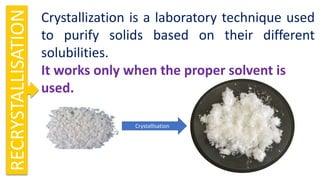
Crystallization is a laboratory technique used
to purify solids based on their different
solubilities.
It works only when the proper solvent is
used.
RECRYSTALLISATION
Crystallisation
Process
RECRYSTALLISATION
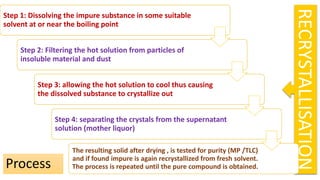
Step 1: Dissolving the impure substance in some suitable
solvent at or near the boiling point
Step 2: Filtering the hot solution from particles of
insoluble material and dust
Step 3: allowing the hot solution to cool thus causing
the dissolved substance to crystallize out
Step 4: separating the crystals from the supernatant
solution (mother liquor)
The resulting solid after drying , is tested for purity (MP /TLC)
and if found impure is again recrystallized from fresh solvent.
The process is repeated until the pure compound is obtained.
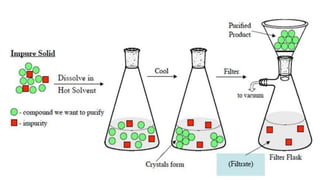
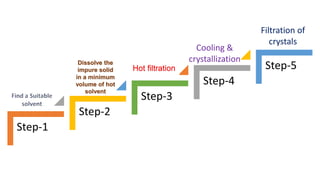
Step-1
Step-2
Step-3
Step-4
Step-5Dissolve the
impure solid
in a minimum
volume of hot
solvent
Hot filtration
Cooling &
crystallization
Filtration of
crystals
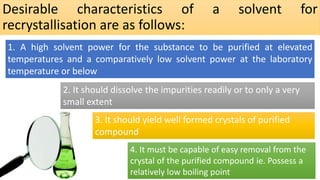
Desirable characteristics of a solvent for
recrystallisation are as follows:
1. A high solvent power for the substance to be purified at elevated
temperatures and a comparatively low solvent power at the laboratory
temperature or below
2. It should dissolve the impurities readily or to only a very
small extent
3. It should yield well formed crystals of purified
compound
4. It must be capable of easy removal from the
crystal of the purified compound ie. Possess a
relatively low boiling point
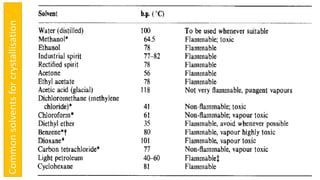
Commonsolventsforcrystallisation
Precautions:
Use of ETHER as a solvent for
recrystallisation should be avoided
----its great flammability
----tendency to creep up walls of the
containing vessels, thus depositing solid
matter by complete evaporation instead
of crystallisation
Use of CS2 (BP 460C )
-dangerously low flash
point
forms very explosive
mixtures with Air.
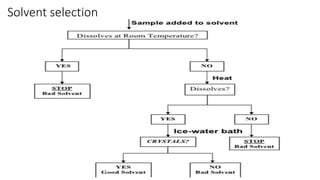
Solvent selection
Choice of solvent for crystallisation
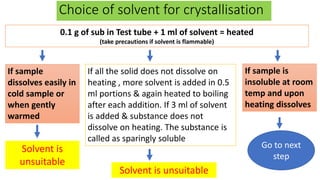
0.1 g of sub in Test tube + 1 ml of solvent = heated
(take precautions if solvent is flammable)
If sample
dissolves easily in
cold sample or
when gently
warmed
Solvent is
unsuitable
If all the solid does not dissolve on
heating , more solvent is added in 0.5
ml portions & again heated to boiling
after each addition. If 3 ml of solvent
is added & substance does not
dissolve on heating. The substance is
called as sparingly soluble
Solvent is unsuitable
If sample is
insoluble at room
temp and upon
heating dissolves
Go to next
step
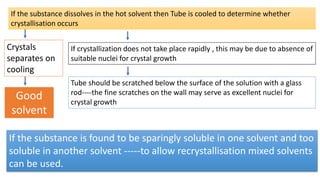
If the substance dissolves in the hot solvent then Tube is cooled to determine whether
crystallisation occurs
Crystals
separates on
cooling
Good
solvent
If crystallization does not take place rapidly , this may be due to absence of
suitable nuclei for crystal growth
Tube should be scratched below the surface of the solution with a glass
rod----the fine scratches on the wall may serve as excellent nuclei for
crystal growth
If the substance is found to be sparingly soluble in one solvent and too
soluble in another solvent -----to allow recrystallisation mixed solvents
can be used.
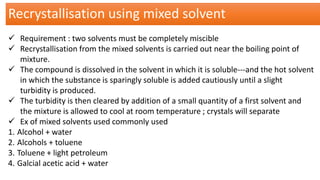
Recrystallisation using mixed solvent
 Requirement : two solvents must be completely miscible
 Recrystallisation from the mixed solvents is carried out near the boiling point of
mixture.
 The compound is dissolved in the solvent in which it is soluble---and the hot solvent
in which the substance is sparingly soluble is added cautiously until a slight
turbidity is produced.
 The turbidity is then cleared by addition of a small quantity of a first solvent and
the mixture is allowed to cool at room temperature ; crystals will separate
 Ex of mixed solvents used commonly used
1. Alcohol + water
2. Alcohols + toluene
3. Toluene + light petroleum
4. Galcial acetic acid + water
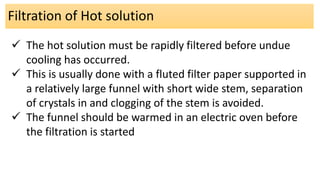
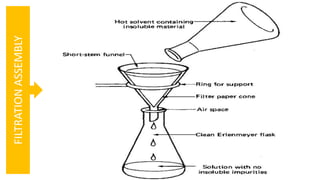
Filtration of Hot solution
 The hot solution must be rapidly filtered before undue
cooling has occurred.
 This is usually done with a fluted filter paper supported in
a relatively large funnel with short wide stem, separation
of crystals in and clogging of the stem is avoided.
 The funnel should be warmed in an electric oven before
the filtration is started
FILTRATIONASSEMBLY
The main advantage of this
method is that
 It increases the speed of
filtration by letting air
enter the flask along its
sides to bring about
pressure equalization.
 The fluted filter paper
has a larger surface area
through which the
solvent can seep
Advantage of fluted filter
paper
? Questions
1] What happens if you add too much solvent
during recrystallization?
2]During filtration, why is it important to only
wash your solid with ice-cold solvent?
3] Why should you fold and put creases in your
filter paper prior to filtration?
References:
1] Vogel's textbook of quantitative chemical analysis. – 5th
ed.
2] https://slideplayer.com/slide/7629283/

Recrystallisation

  • 1.
    SARASWATHI VIDYA BHAVANS COLLEGEOF PHARMACY, DOMBIVLI -E RECRYSTALLISATION By - Mrs. Priyanka Kalamkar Asst Professor
  • 2.
    Solid organic compoundswhen isolated from organic reactions are seldom pure; they are usually contaminated with small amounts of other compounds (impurities) which are produced along with desired product. RECRYSTALLISATION The purification of impure crystalline compounds is usually effected by crystallization from a suitable solvent or mixture of solvents. The purification of solids by crystallization is based upon differences in their solubility in a given solvent or mixture of solvents.
  • 3.
    Crystallization is alaboratory technique used to purify solids based on their different solubilities. It works only when the proper solvent is used. RECRYSTALLISATION Crystallisation
  • 4.
    Process RECRYSTALLISATION Step 1: Dissolvingthe impure substance in some suitable solvent at or near the boiling point Step 2: Filtering the hot solution from particles of insoluble material and dust Step 3: allowing the hot solution to cool thus causing the dissolved substance to crystallize out Step 4: separating the crystals from the supernatant solution (mother liquor) The resulting solid after drying , is tested for purity (MP /TLC) and if found impure is again recrystallized from fresh solvent. The process is repeated until the pure compound is obtained.
  • 6.
    Step-1 Step-2 Step-3 Step-4 Step-5Dissolve the impure solid ina minimum volume of hot solvent Hot filtration Cooling & crystallization Filtration of crystals
  • 7.
    Desirable characteristics ofa solvent for recrystallisation are as follows: 1. A high solvent power for the substance to be purified at elevated temperatures and a comparatively low solvent power at the laboratory temperature or below 2. It should dissolve the impurities readily or to only a very small extent 3. It should yield well formed crystals of purified compound 4. It must be capable of easy removal from the crystal of the purified compound ie. Possess a relatively low boiling point
  • 8.
  • 9.
    Precautions: Use of ETHERas a solvent for recrystallisation should be avoided ----its great flammability ----tendency to creep up walls of the containing vessels, thus depositing solid matter by complete evaporation instead of crystallisation Use of CS2 (BP 460C ) -dangerously low flash point forms very explosive mixtures with Air.
  • 10.
  • 11.
    Choice of solventfor crystallisation 0.1 g of sub in Test tube + 1 ml of solvent = heated (take precautions if solvent is flammable) If sample dissolves easily in cold sample or when gently warmed Solvent is unsuitable If all the solid does not dissolve on heating , more solvent is added in 0.5 ml portions & again heated to boiling after each addition. If 3 ml of solvent is added & substance does not dissolve on heating. The substance is called as sparingly soluble Solvent is unsuitable If sample is insoluble at room temp and upon heating dissolves Go to next step
  • 12.
    If the substancedissolves in the hot solvent then Tube is cooled to determine whether crystallisation occurs Crystals separates on cooling Good solvent If crystallization does not take place rapidly , this may be due to absence of suitable nuclei for crystal growth Tube should be scratched below the surface of the solution with a glass rod----the fine scratches on the wall may serve as excellent nuclei for crystal growth If the substance is found to be sparingly soluble in one solvent and too soluble in another solvent -----to allow recrystallisation mixed solvents can be used.
  • 13.
    Recrystallisation using mixedsolvent  Requirement : two solvents must be completely miscible  Recrystallisation from the mixed solvents is carried out near the boiling point of mixture.  The compound is dissolved in the solvent in which it is soluble---and the hot solvent in which the substance is sparingly soluble is added cautiously until a slight turbidity is produced.  The turbidity is then cleared by addition of a small quantity of a first solvent and the mixture is allowed to cool at room temperature ; crystals will separate  Ex of mixed solvents used commonly used 1. Alcohol + water 2. Alcohols + toluene 3. Toluene + light petroleum 4. Galcial acetic acid + water
  • 14.
    Filtration of Hotsolution  The hot solution must be rapidly filtered before undue cooling has occurred.  This is usually done with a fluted filter paper supported in a relatively large funnel with short wide stem, separation of crystals in and clogging of the stem is avoided.  The funnel should be warmed in an electric oven before the filtration is started
  • 15.
  • 16.
    The main advantageof this method is that  It increases the speed of filtration by letting air enter the flask along its sides to bring about pressure equalization.  The fluted filter paper has a larger surface area through which the solvent can seep Advantage of fluted filter paper
  • 17.
    ? Questions 1] Whathappens if you add too much solvent during recrystallization? 2]During filtration, why is it important to only wash your solid with ice-cold solvent? 3] Why should you fold and put creases in your filter paper prior to filtration?
  • 18.
    References: 1] Vogel's textbookof quantitative chemical analysis. – 5th ed. 2] https://slideplayer.com/slide/7629283/