PYRROLE
Presented by
Minal saini
M.Sc.previous
180000701047
PYRROLE - INTRODUCTION
STRUCTURE OF PYRROLE
AROMATIC CHARACTER OF PYRROLE
PREPARATION OF PYRROLE
PHYSICAL PROPERTIES
CHEMICAL PROPERTIES
APPLICATIONS OF PYRROLE
CONCLUSION
REFERENCES 2
Contents
INTRODUCTION
3
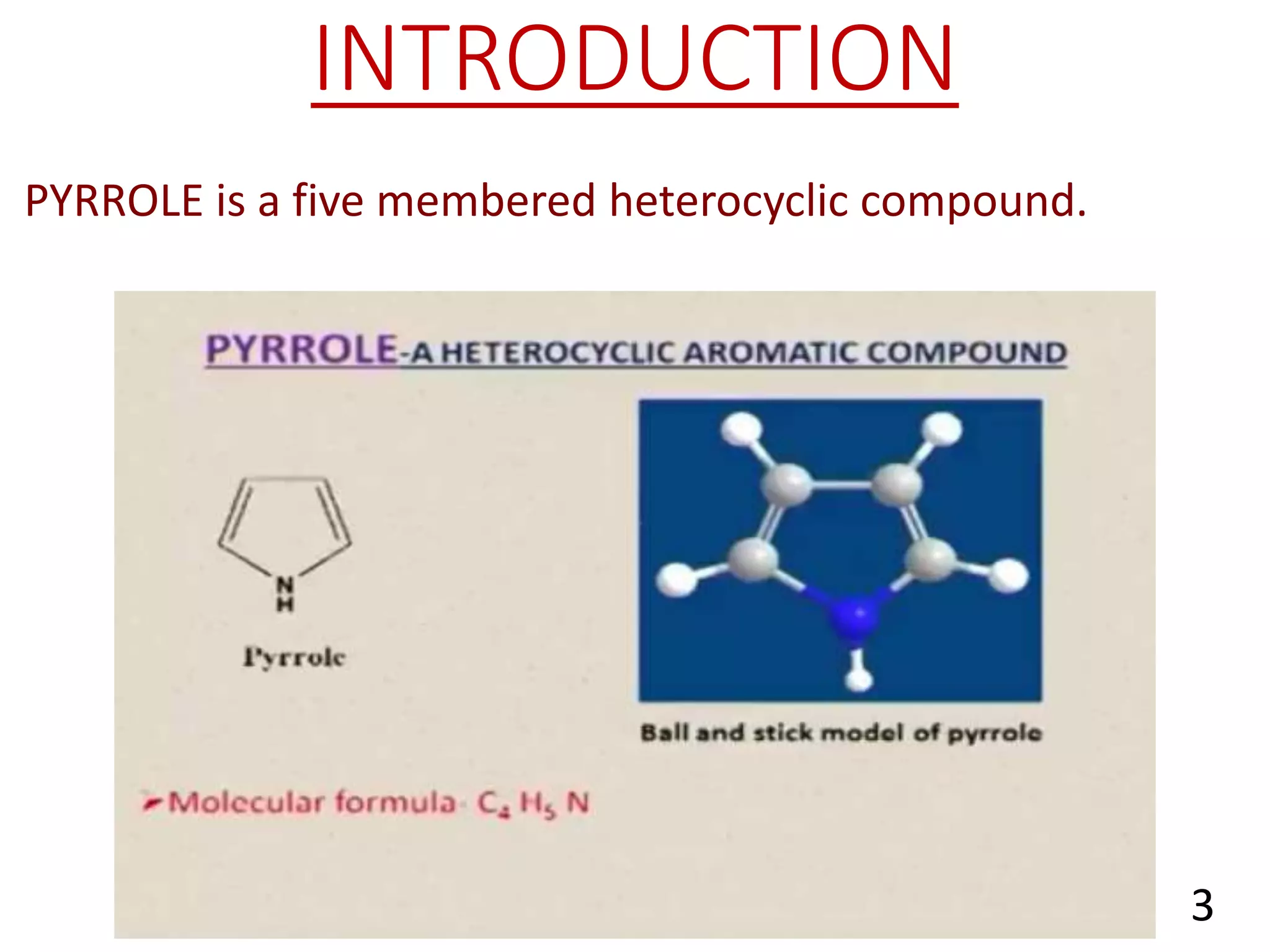
PYRROLE is a five membered heterocyclic compound.
STRUCTURE OF PYRROLE
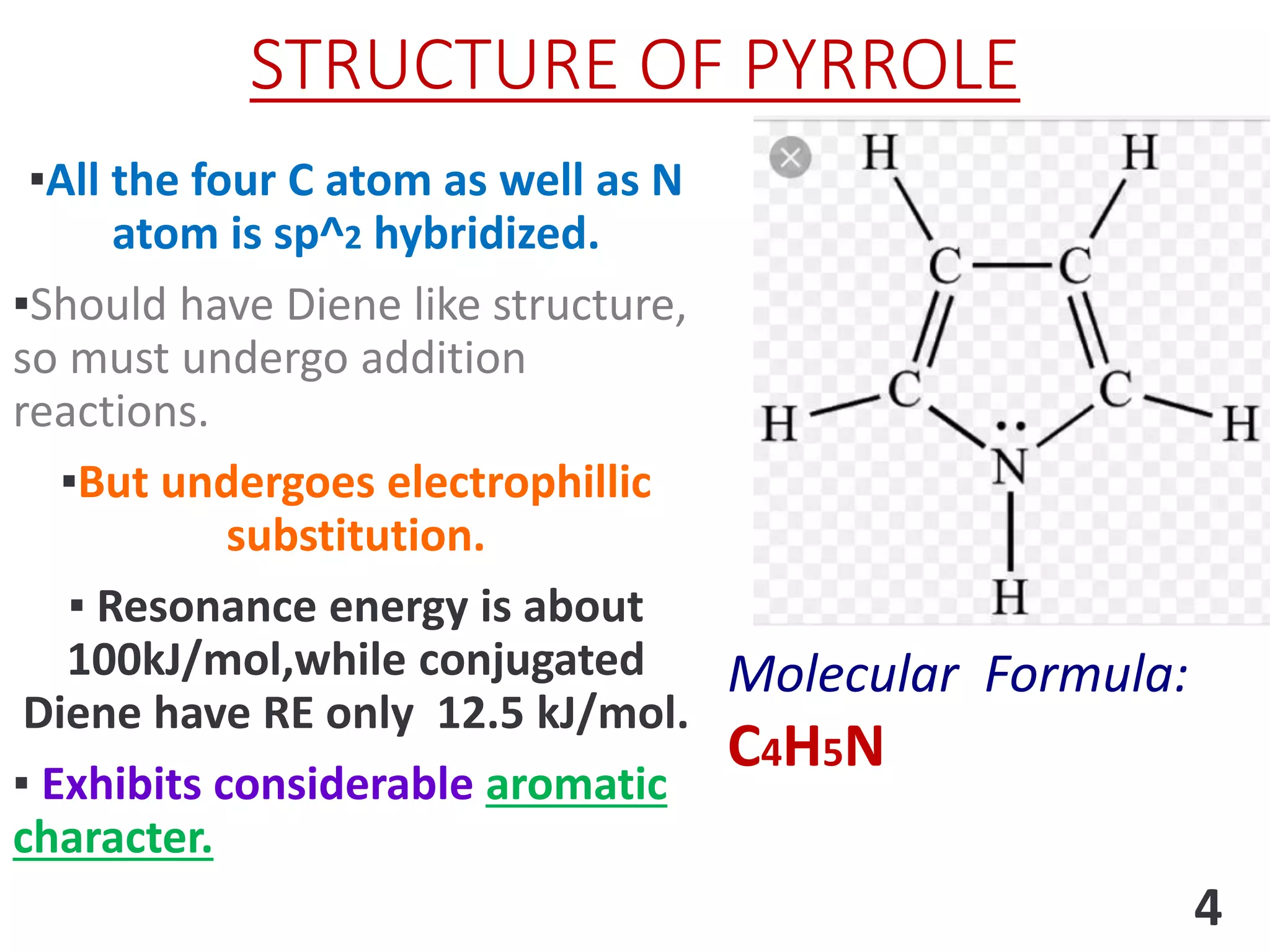
▪All the four C atom as well as N
atom is sp^2 hybridized.
▪Should have Diene like structure,
so must undergo addition
reactions.
▪But undergoes electrophillic
substitution.
▪ Resonance energy is about
100kJ/mol,while conjugated
Diene have RE only 12.5 kJ/mol.
▪ Exhibits considerable aromatic
character.
Molecular Formula:
C4H5N
4
AROMATIC CHARACTER
•The hybridized orbitals of C and
N atom are involved in axial
overlap forming sigma bonds.
•Each unhybridizied orbital of C
atom has one electron while
N atom has a pair of electrons.
•The sidewise overlap of the un
-hybridized orbitals results in a
delocalised ll electron cloud which
accounts for the
aromatic character of pyrrole.
5
☆Cyclic and planar structure
☆Delocalised ll- electrons
☆Obeys HUCKLE's
Rule,(4n+2)ll electron rule
6
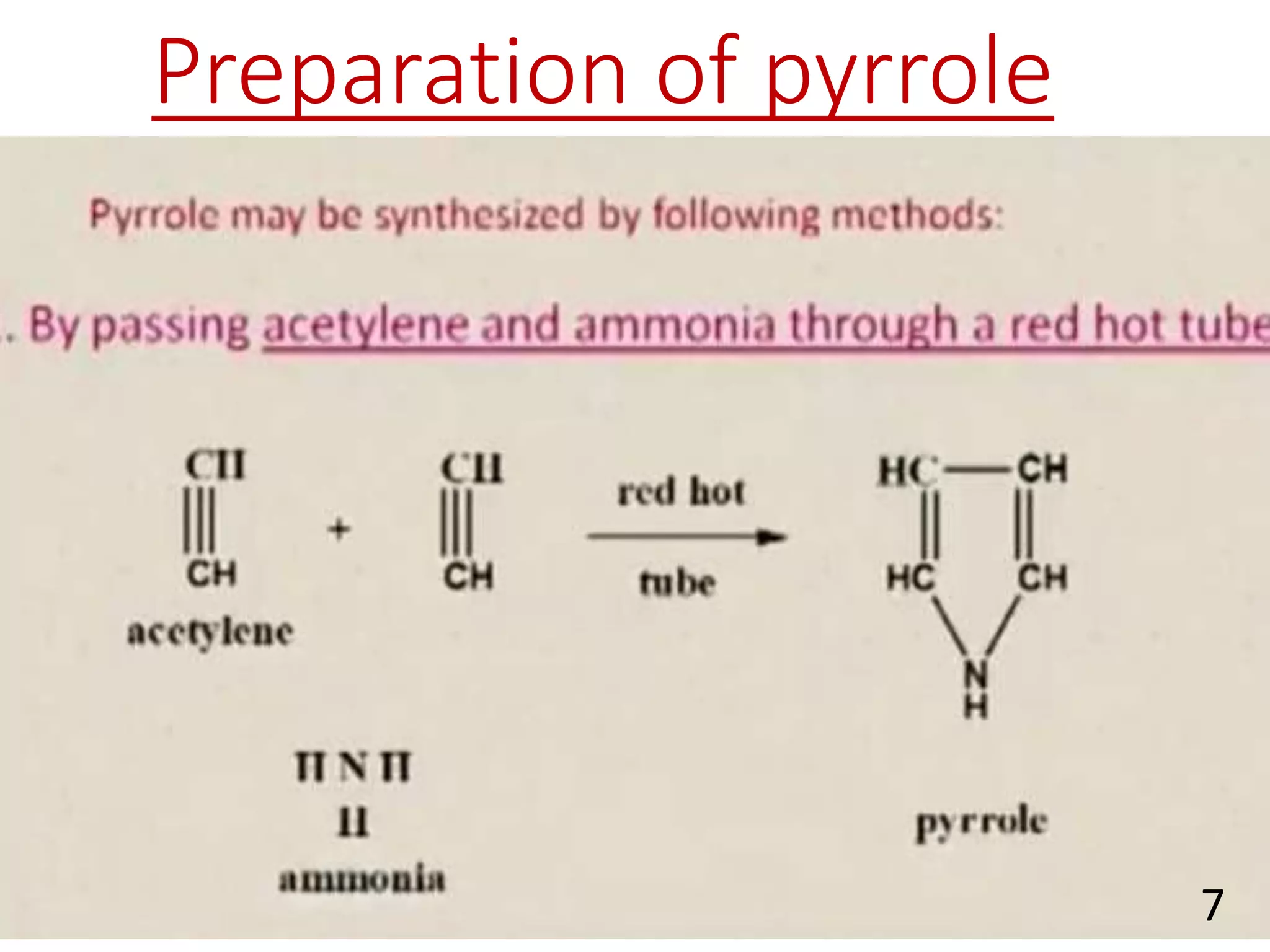
Preparation of pyrrole
7
8
9
10
PHYSICAL PROPERTIES
1. It is colorless volatile liquid that darkens readily
upon exposure to air.
2. It is sparingly soluble in water but readily
soluble in alcohol and ether.
3. It has dipole in which positive end lies towards
nitrogen with a dipole moment of 1.58D
4. Weakly basic, with a conjugate acid with aPka
of -3.8
5. Also weakly acidic at N-H position, with a Pka of
17.5
11
CHEMICAL PROPERTIES
 Weak base.
 Lone pair of electrons on the N atom is not readily available
for protonation and hence pyrrole behave as a weak base.
 Much weaker base than pyridine because lone pair of electron
is involved in forming aromatic sextet.
12
I. Basic character:
• Acidic character:
Pyrrole is weakly acidic compound due to the
presence of imino hydrogen atom.
Acidic character can be explained by two factors:
1. Due to greater s-character in the N-H bond in
pyrrole the bonding electrons are held more
strongly to the pyrrole nitrogen. so, hydrogen
is eliminated as a proton.
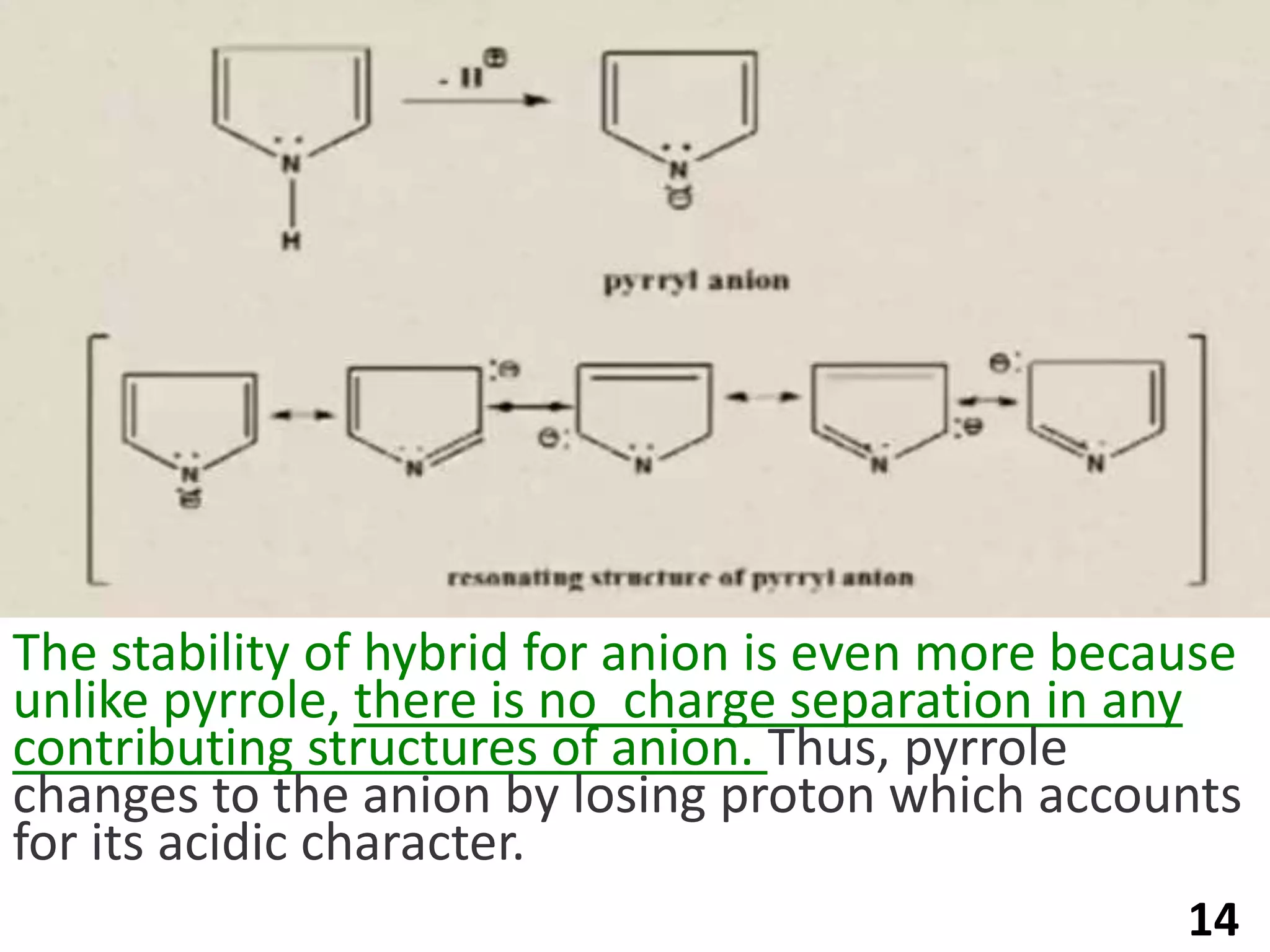
2. Once the pyrryl anion is formed, it is stabilized
due to resonance.
13
The stability of hybrid for anion is even more because
unlike pyrrole, there is no charge separation in any
contributing structures of anion. Thus, pyrrole
changes to the anion by losing proton which accounts
for its acidic character.
14
• ELECTROPHILLIC SUBSTITUTION REACTION:
Pyrrole is very
reactive towar
ds electrophile due to ||-electron density at the
carbon atom of the pyrrole ring is high because of
resonance.
Electrophillic substitution of pyrrole preferably
occurred at 2 &5th position. 15
G
16
• REDUCTION:
17
• OXIDATION:
18
☆ APPLICATIONS OF PYRROLE :
I. Pyrrole and its derivatives are widely used as an
intermediate in synthesis of pharmaceuticals,
medicines,agrochemicals, dyes, photographic
chemicals, perfumes and other organic compounds.
II. They are used as catalysts for polymerization process,
corrosion inhibitor, preservatives and as solvents for
resin and terpenes.
III. They are used as the standard of chromatographic
analysis.
IV.They are used also in many organic synthesis.
19
☆ CONCLUSION :
 PYRROLE IS AROMATIC HETEROCYCLIC COMPOUND.
 IT BEHAVES AS A WEAK ACID AND AS A WEAK BASE.
 REDUCTION OF PYRROLE YIELDS PYRROLIDINE WHICH IS
IMPORTANT NUCLEUS IN MANY NATURAL PRODUCTS.
 IT UNDERGOES ELECTROPHILLIC SUBSTITUTION REACTIONS
LIKE HALOGENATION, SULPHONATION, NITRATION,
COUPLING REACTION, ACETYLATION ETC.
 PYRROLE CAN UNDERGO RING EXPANSION AND RING
OPENING MECHANISMS. 20
☆ REFERENCES :
https://en.m.Wikipedia.org/wiki/pyrrole
https://www.nature.com/articles/pj200812
6
https://www.researchgate.net/publication
224008257
21
Chemistry of pyrrole

Chemistry of pyrrole

  • 1.
  • 2.
    PYRROLE - INTRODUCTION STRUCTUREOF PYRROLE AROMATIC CHARACTER OF PYRROLE PREPARATION OF PYRROLE PHYSICAL PROPERTIES CHEMICAL PROPERTIES APPLICATIONS OF PYRROLE CONCLUSION REFERENCES 2 Contents
  • 3.
    INTRODUCTION 3 PYRROLE is afive membered heterocyclic compound.
  • 4.
    STRUCTURE OF PYRROLE ▪Allthe four C atom as well as N atom is sp^2 hybridized. ▪Should have Diene like structure, so must undergo addition reactions. ▪But undergoes electrophillic substitution. ▪ Resonance energy is about 100kJ/mol,while conjugated Diene have RE only 12.5 kJ/mol. ▪ Exhibits considerable aromatic character. Molecular Formula: C4H5N 4
  • 5.
    AROMATIC CHARACTER •The hybridizedorbitals of C and N atom are involved in axial overlap forming sigma bonds. •Each unhybridizied orbital of C atom has one electron while N atom has a pair of electrons. •The sidewise overlap of the un -hybridized orbitals results in a delocalised ll electron cloud which accounts for the aromatic character of pyrrole. 5 ☆Cyclic and planar structure ☆Delocalised ll- electrons ☆Obeys HUCKLE's Rule,(4n+2)ll electron rule
  • 6.
  • 7.
  • 8.
  • 9.
  • 10.
  • 11.
    PHYSICAL PROPERTIES 1. Itis colorless volatile liquid that darkens readily upon exposure to air. 2. It is sparingly soluble in water but readily soluble in alcohol and ether. 3. It has dipole in which positive end lies towards nitrogen with a dipole moment of 1.58D 4. Weakly basic, with a conjugate acid with aPka of -3.8 5. Also weakly acidic at N-H position, with a Pka of 17.5 11
  • 12.
    CHEMICAL PROPERTIES  Weakbase.  Lone pair of electrons on the N atom is not readily available for protonation and hence pyrrole behave as a weak base.  Much weaker base than pyridine because lone pair of electron is involved in forming aromatic sextet. 12 I. Basic character:
  • 13.
    • Acidic character: Pyrroleis weakly acidic compound due to the presence of imino hydrogen atom. Acidic character can be explained by two factors: 1. Due to greater s-character in the N-H bond in pyrrole the bonding electrons are held more strongly to the pyrrole nitrogen. so, hydrogen is eliminated as a proton. 2. Once the pyrryl anion is formed, it is stabilized due to resonance. 13
  • 14.
    The stability ofhybrid for anion is even more because unlike pyrrole, there is no charge separation in any contributing structures of anion. Thus, pyrrole changes to the anion by losing proton which accounts for its acidic character. 14
  • 15.
    • ELECTROPHILLIC SUBSTITUTIONREACTION: Pyrrole is very reactive towar ds electrophile due to ||-electron density at the carbon atom of the pyrrole ring is high because of resonance. Electrophillic substitution of pyrrole preferably occurred at 2 &5th position. 15
  • 16.
  • 17.
  • 18.
  • 19.
    ☆ APPLICATIONS OFPYRROLE : I. Pyrrole and its derivatives are widely used as an intermediate in synthesis of pharmaceuticals, medicines,agrochemicals, dyes, photographic chemicals, perfumes and other organic compounds. II. They are used as catalysts for polymerization process, corrosion inhibitor, preservatives and as solvents for resin and terpenes. III. They are used as the standard of chromatographic analysis. IV.They are used also in many organic synthesis. 19
  • 20.
    ☆ CONCLUSION : PYRROLE IS AROMATIC HETEROCYCLIC COMPOUND.  IT BEHAVES AS A WEAK ACID AND AS A WEAK BASE.  REDUCTION OF PYRROLE YIELDS PYRROLIDINE WHICH IS IMPORTANT NUCLEUS IN MANY NATURAL PRODUCTS.  IT UNDERGOES ELECTROPHILLIC SUBSTITUTION REACTIONS LIKE HALOGENATION, SULPHONATION, NITRATION, COUPLING REACTION, ACETYLATION ETC.  PYRROLE CAN UNDERGO RING EXPANSION AND RING OPENING MECHANISMS. 20
  • 21.