By:
Mrs. D. R. Mali
Asssitant Professor
Pharmaceutical Chemistry
GES’s Sir Dr. M. S. Gosavi College of
Pharmaceutical Education and Research,
Nashik.
 To synthesize benzanilide from aniline
 Laboratory Manual of Organic Chemistry by
Raj K. Bansal, Page No.111.
 Frederick George Mann and Bernard Charles
Saunders, ‘Practical Organic Chemistry’, IVth
edition Longman Group Limited, London,
1978, pp. 245
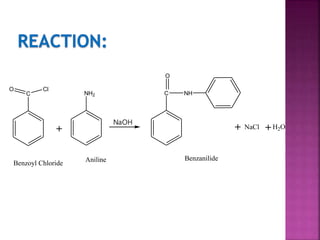
C
ClO
+
NH2
NaOH
+ NaCl +H2O
Benzoyl Chloride
Aniline Benzanilide
C
O
NH
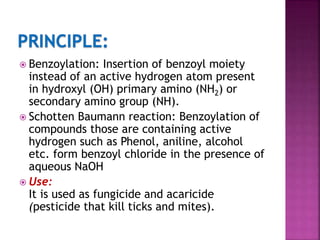
 Benzoylation: Insertion of benzoyl moiety
instead of an active hydrogen atom present
in hydroxyl (OH) primary amino (NH2) or
secondary amino group (NH).
 Schotten Baumann reaction: Benzoylation of
compounds those are containing active
hydrogen such as Phenol, aniline, alcohol
etc. form benzoyl chloride in the presence of
aqueous NaOH
 Use:
It is used as fungicide and acaricide
(pesticide that kill ticks and mites).
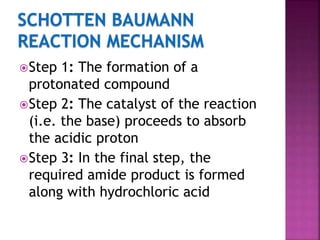
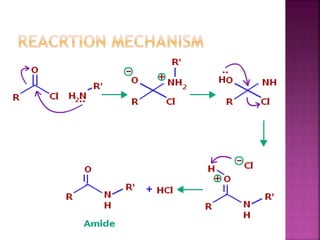
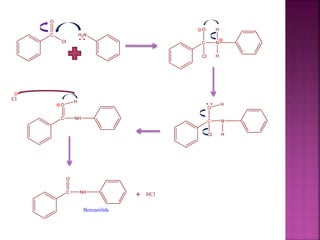
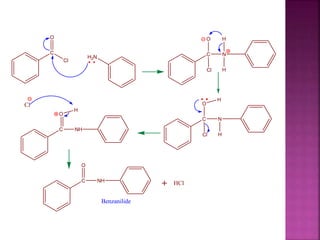
Step 1: The formation of a
protonated compound
Step 2: The catalyst of the reaction
(i.e. the base) proceeds to absorb
the acidic proton
Step 3: In the final step, the
required amide product is formed
along with hydrochloric acid
C
Cl
O
H2N
C N
O
Cl H
H
C N
O
Cl H
H
C NH
O
H
Cl
C NH
O
Benzanilide
+ HCl
C
Cl
O
H2N
C N
O
Cl H
H
C N
O
Cl H
H
C NH
O
H
Cl
C NH
O
Benzanilide
+ HCl
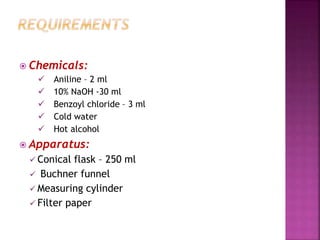
 Chemicals:
 Aniline – 2 ml
 10% NaOH -30 ml
 Benzoyl chloride – 3 ml
 Cold water
 Hot alcohol
 Apparatus:
 Conical flask – 250 ml
 Buchner funnel
 Measuring cylinder
 Filter paper
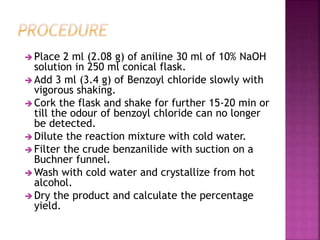
 Place 2 ml (2.08 g) of aniline 30 ml of 10% NaOH
solution in 250 ml conical flask.
 Add 3 ml (3.4 g) of Benzoyl chloride slowly with
vigorous shaking.
 Cork the flask and shake for further 15-20 min or
till the odour of benzoyl chloride can no longer
be detected.
 Dilute the reaction mixture with cold water.
 Filter the crude benzanilide with suction on a
Buchner funnel.
 Wash with cold water and crystallize from hot
alcohol.
 Dry the product and calculate the percentage
yield.
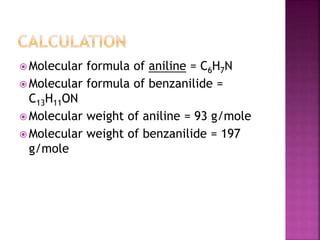
 Molecular formula of aniline = C6H7N
 Molecular formula of benzanilide =
C13H11ON
 Molecular weight of aniline = 93 g/mole
 Molecular weight of benzanilide = 197
g/mole
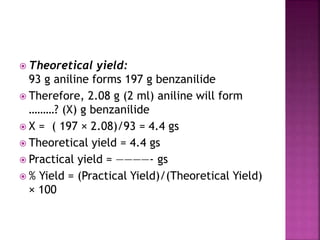
 Theoretical yield:
93 g aniline forms 197 g benzanilide
 Therefore, 2.08 g (2 ml) aniline will form
………? (X) g benzanilide
 X = ( 197 × 2.08)/93 = 4.4 gs
 Theoretical yield = 4.4 gs
 Practical yield = ————- gs
 % Yield = (Practical Yield)/(Theoretical Yield)
× 100
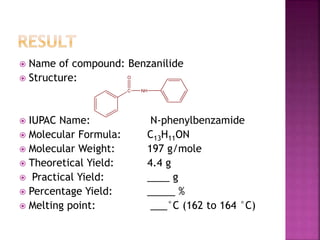
 Name of compound: Benzanilide
 Structure:
 IUPAC Name: N-phenylbenzamide
 Molecular Formula: C13H11ON
 Molecular Weight: 197 g/mole
 Theoretical Yield: 4.4 g
 Practical Yield: ____ g
 Percentage Yield: _____ %
 Melting point: ___°C (162 to 164 °C)
C NH
O
Benzanilide synthesis

Benzanilide synthesis

  • 1.
    By: Mrs. D. R.Mali Asssitant Professor Pharmaceutical Chemistry GES’s Sir Dr. M. S. Gosavi College of Pharmaceutical Education and Research, Nashik.
  • 2.
     To synthesizebenzanilide from aniline  Laboratory Manual of Organic Chemistry by Raj K. Bansal, Page No.111.  Frederick George Mann and Bernard Charles Saunders, ‘Practical Organic Chemistry’, IVth edition Longman Group Limited, London, 1978, pp. 245
  • 3.
    C ClO + NH2 NaOH + NaCl +H2O BenzoylChloride Aniline Benzanilide C O NH
  • 4.
     Benzoylation: Insertionof benzoyl moiety instead of an active hydrogen atom present in hydroxyl (OH) primary amino (NH2) or secondary amino group (NH).  Schotten Baumann reaction: Benzoylation of compounds those are containing active hydrogen such as Phenol, aniline, alcohol etc. form benzoyl chloride in the presence of aqueous NaOH  Use: It is used as fungicide and acaricide (pesticide that kill ticks and mites).
  • 5.
    Step 1: Theformation of a protonated compound Step 2: The catalyst of the reaction (i.e. the base) proceeds to absorb the acidic proton Step 3: In the final step, the required amide product is formed along with hydrochloric acid
  • 7.
    C Cl O H2N C N O Cl H H CN O Cl H H C NH O H Cl C NH O Benzanilide + HCl
  • 8.
    C Cl O H2N C N O Cl H H CN O Cl H H C NH O H Cl C NH O Benzanilide + HCl
  • 9.
     Chemicals:  Aniline– 2 ml  10% NaOH -30 ml  Benzoyl chloride – 3 ml  Cold water  Hot alcohol  Apparatus:  Conical flask – 250 ml  Buchner funnel  Measuring cylinder  Filter paper
  • 10.
     Place 2ml (2.08 g) of aniline 30 ml of 10% NaOH solution in 250 ml conical flask.  Add 3 ml (3.4 g) of Benzoyl chloride slowly with vigorous shaking.  Cork the flask and shake for further 15-20 min or till the odour of benzoyl chloride can no longer be detected.  Dilute the reaction mixture with cold water.  Filter the crude benzanilide with suction on a Buchner funnel.  Wash with cold water and crystallize from hot alcohol.  Dry the product and calculate the percentage yield.
  • 11.
     Molecular formulaof aniline = C6H7N  Molecular formula of benzanilide = C13H11ON  Molecular weight of aniline = 93 g/mole  Molecular weight of benzanilide = 197 g/mole
  • 12.
     Theoretical yield: 93g aniline forms 197 g benzanilide  Therefore, 2.08 g (2 ml) aniline will form ………? (X) g benzanilide  X = ( 197 × 2.08)/93 = 4.4 gs  Theoretical yield = 4.4 gs  Practical yield = ————- gs  % Yield = (Practical Yield)/(Theoretical Yield) × 100
  • 13.
     Name ofcompound: Benzanilide  Structure:  IUPAC Name: N-phenylbenzamide  Molecular Formula: C13H11ON  Molecular Weight: 197 g/mole  Theoretical Yield: 4.4 g  Practical Yield: ____ g  Percentage Yield: _____ %  Melting point: ___°C (162 to 164 °C) C NH O