SCY 120: ORGANIC CHEMISTRY -I LAB
Chemistry (Gandhi Institute of Technology and Management (Deemed to be University))
Scan to open on Studocu
Studocu is not sponsored or endorsed by any college or university
SCY 120: ORGANIC CHEMISTRY -I LAB
Chemistry (Gandhi Institute of Technology and Management (Deemed to be University))
Scan to open on Studocu
Studocu is not sponsored or endorsed by any college or university
Downloaded by Ruthvik sai Kudupudi (kudupudiruthviksai5@gmail.com)
lOMoARcPSD|44858848
SCY 120: ORGANIC CHEMISTRY -I LAB (CC/PPC)
Experiments:
1. Checking the calibration of the thermometer
2. Purification of organic compounds by crystallization using the following solvents:
a. Water b. Alcohol c. Alcohol-Water
3. Determination of the melting points of above compounds and unknown organic compounds
4. Determination of boiling point of liquid compounds.
5. Chromatography:
a. Separation of a mixture of two amino acids by ascending and horizontal paper
chromatography
b. Separation of a mixture of two sugars by ascending paper chromatography
c. Separation of a mixture of o-and p-nitrophenol or o-and p-aminophenol by thin
layer chromatography (TLC)
Downloaded by Ruthvik sai Kudupudi (kudupudiruthviksai5@gmail.com)
lOMoARcPSD|44858848
Checking the calibration of the thermometer
Aim: In this exercise, we will calibrate a stem-type thermometer and then use it to correctly
measure the Air temperature of the laboratory.
Apparatus: Thermometer, Heater, Cold water, beaker and ring stand
Procedure:
Thermometer Identification
1. If possible, note the manufacturer, serial number and manufacture date of the thermometer.
2. Note the temperature Range of the thermometer.
3. Note the precision of the thermometer. (What is the “uncertain” digit to which readings can be
made?)
4. Note whether or not the thermometer is a Total Immersion or Partial Immersion type. Partial
Immersion thermometers will have an Immersion Mark and are designed so that only that part of
the stem is exposed to the temperature being measured. Total Immersion thermometers are
designed so that both the bulb and the entire liquid column must be exposed to the temperature
being measured.
5. Check to make sure that the liquid in the stem of the thermometer has not separated. If it has,
ask your laboratory instructor for a new thermometer.
Calibration at the Ice Point of Water:
1. Fill a styrofoam container with crushed Ice. (You will have to share a container with another
group, so become friendly with your neighbors.)
2. Add enough pre-cooled distilled Water to cover the Ice, but not so much Water such that the
Ice floats.
3. Thoroughly stir the Ice-Water mixture.
4. Hang your thermometer by a string from a clamp attached to a ring-stand until it is
appropriately inserted into the Ice-Water.
Downloaded by Ruthvik sai Kudupudi (kudupudiruthviksai5@gmail.com)
lOMoARcPSD|44858848
5. Allow the temperature shown by the thermometer to stabilize. (~10 minutes is required to
establish thermal equilibrium.) After 3 minutes at the stable temperature, record the
temperature to the correct precision.
6. The Ice Point of Water is remarkably stable at 0.00oC.
Calibration at the Boiling Point of Water:
1. Set up a hot plate with a 500 mL Florence Flask resting on it. The flask should be supported
by a clamp from a ring stand.
2. Fill the flask about half full with distilled Water. Add a few boiling chips to promote smooth
boiling.
3. Hang the thermometer from the ring stand as before such that the immersion mark is in the
neck of the flask. (Once at reflux, both the Water and its vapor will be at the boiling point.
Using a Florence Flask helps promote the reflux. Why?)
4. Turn on the hot plate and allow the Water to come to its Boiling Point.
5. Allow the temperature shown by the thermometer to stabilize. (~10 minutes after a rolling-
boil has been achieved.) After 3 minutes at the stable temperature, record the temperature to
the correct precision.
6. The Boiling Point of Water is extremely sensitive to the atmospheric pressure. You will be
provided with the day's atmospheric pressure. Use this, along with the data in the Appendix,
to determine the correct Boiling Point of Water. You may have to interpolate the data in the
Table. If so, a computer program that performs interpolation calculations will be provided.
What is the Percentage Error in your measurement?
Result:
Calibration at the Ice Point of Water: Thermo. Reading ……………….o
C
Calibration at the Boiling Point of Water
Thermo. Reading …………………o
C
Corr. BP Water: ………………….o
C
Percentage Error:.………………. %
Downloaded by Ruthvik sai Kudupudi (kudupudiruthviksai5@gmail.com)
lOMoARcPSD|44858848
Purification of organic compounds by crystallization using solvents
Aim: Recrystallization of given organic compound with suitable solvent like water, alcohol,
acetone etc.,
Apparatus:
Procedure: Recrystallization is a technique used to purify solid compounds.
1. Solids tend to be more soluble in hot liquids than in cold liquids. During recrystallization, an
impure solid compound is dissolved in a hot liquid until the solution is saturated, and then
the liquid is allowed to cool.
2. The compound should then form relatively pure crystals. Ideally, any impurities that are
present will remain in the solution and will not be incorporated into the growing crystals
(Figure 1). The crystals can then be removed from the solution by filtration. Not the entire
compound is recoverable — some will remain in the solution and will be lost.
Recrystallization is not generally thought of as a separation technique; rather, it is a purification
technique in which a small amount of an impurity is removed from a compound. However, if the
solubility properties of two compounds are sufficiently different, recrystallization can be used to
separate them, even if they are present in nearly equal amounts. Recrystallization works best
when most impurities have already been removed by another method, such as extraction or
column chromatography.
Figure 1. The general scheme for recrystallization.
PRINCIPLE:
Downloaded by Ruthvik sai Kudupudi (kudupudiruthviksai5@gmail.com)
lOMoARcPSD|44858848
A successful recrystallization depends on the proper choice of solvent. The compound must be
soluble in the hot solvent and insoluble in the same solvent when it is cold. For the purpose of
recrystallization, consider 3% w/v the dividing line between soluble and insoluble: if 3 g of a
compound dissolves in 100 mL of a solvent, it is considered soluble. In choosing a solvent, the
bigger the difference between hot solubility and cold solubility, the more product recoverable
from recrystallization.
The rate of cooling determines the size and quality of the crystals: rapid cooling favors small
crystals, and slow cooling favors the growth of large and generally purer crystals. The rate of
recrystallization is usually greatest at about 50 °C below the melting point of the substance; the
maximum formation of crystals occurs at about 100 °C below the melting point.
Although the terms "crystallization" and "recrystallization" are sometimes used interchangeably,
they technically refer to different processes. Crystallization refers to the formation of a new,
insoluble product by a chemical reaction; this product then precipitates out of the reaction
solution as an amorphous solid containing many trapped impurities. Recrystallization does not
involve a chemical reaction; the crude product is simply dissolved into solution, and then the
conditions are changed to allow crystals to re-form. Recrystallization produces a more pure final
product. For this reason, experimental procedures that produce a solid product by crystallization
normally include a final recrystallization step to give the pure compound.
PROCEDURE:
Perform all steps in a fume hood to prevent exposure to solvent fumes.
 Selecting a Solvent:
1. Place 50 mg of the sample (N-bromosuccinimide) in an Erlenmeyer flask.
2. Add 0.5 mL of boiling solvent (water). If the sample dissolves completely, the solubility in
the cold solvent is too high to be a good recrystallization solvent.
3. If the sample does not dissolve in the cold solvent, heat the test tube until the solvent boils.
 If the sample has not completely dissolved at this point, add more boiling solvent
drop-wise, until all of the solid dissolves. If it takes more than 3 mL to dissolve the
sample in the hot solvent, the solubility in this solvent is probably too low to make it
a good recrystallization solvent.
Downloaded by Ruthvik sai Kudupudi (kudupudiruthviksai5@gmail.com)
lOMoARcPSD|44858848
4. If the first choice of solvent is not a good recrystallization solvent, try others. If a single
solvent that works cannot be found, try a two solvent system.
 If you cannot find a suitable single solvent system, then a solvent pair may be
necessary. When identifying a solvent pair, there are several key considerations 1)
The first solvent should readily dissolve the solid. 2) The second solvent must be
miscible with the 1st solvent, but have a much lower solubility for the solute.
 As a general rule "likes dissolve likes" meaning that polar compounds tend to be
soluble in polar solvents and non-polar compounds are often more soluble non-polar
compounds.
 Common solvent pairs (Table 1)
5.Make sure the solvent has a boiling point of at least 40 °C, so there is a reasonable
temperature difference between boiling solvent and room-temperature solvent.
6. Ensure that the solvent has a boiling point below about 120 °C, so it's easier to remove the
last traces of solvent from the crystals.
7. Also make sure the boiling point of the solvent is lower than the melting point of the
compound, so the compound forms as solid crystals rather than as an insoluble oil.
8. Confirm that the impurities are either insoluble in the hot solvent (so they can be hot-filtered
out, once the compound is dissolved) or soluble in the cold solvent (so they stay dissolved
during the entire process).
 Dissolving the Sample in Hot Solvent
1. Place the compound to be recrystallized in an Erlenmeyer flask. This is a better choice
than a beaker, since the sloping sides help trap solvent vapors and slow the rate of
evaporation.
2. Place the solvent (water) in a separate Erlenmeyer flask, and add boiling chips or a stir
bar to keep it boiling smoothly. Heat it to boiling on a hotplate.
3. Add hot solvent to a flask at room temperature containing the compound in small
portions, swirling after each addition, until the compound is completely dissolved.
Downloaded by Ruthvik sai Kudupudi (kudupudiruthviksai5@gmail.com)
lOMoARcPSD|44858848
 During the dissolution process, keep the solution hot at all times by resting it on the
hotplate, too. Do not add more hot solvent than necessary - just enough to dissolve the
sample.
4. If a portion of the solid does not seem to dissolve, even after more hot solvent has been
added, it is likely due to the presence of very insoluble impurities. If this happens, stop
adding solvent and do a hot filtration before proceeding.
 To perform a hot filtration, fold a piece of filter paper into a fluted cone shape and
place it into a glass stemless funnel.
 Add a 10-20% excess of hot solvent to the hot solution to allow for evaporation in
the procedure.
 Pour the solution through the paper. If crystals begin to form at any time during
the process, add a small portion of warm solvent to dissolve them.
 Cooling the Solution
1. Set the flask containing the dissolved compound on a surface that does not conduct the
heat away too quickly, such as a paper towel set on a bench top.
2. Lightly cover the flask as it cools to prevent evaporation and to prevent dust from falling
into the solution.
3. Leave the flask undisturbed until it cools to room temperature.
4. Once the crystals have formed, place the solution in an ice bath to ensure that the
maximum amount of crystals is obtained. The solutions should be left undisturbed in the ice
bath for 30 min to 1 h, or till the compound appears to have completely crystalized out of
solution.
5. If no crystal formation is evident, it can be induced by scratching the inside walls of the
flask with a glass rod or by adding a small seed crystal of the same compound.
 If this still fails to work, then too much solvent was probably used. Reheat the
solution, allow some of the solvent to boil off, and then cool it.
Downloaded by Ruthvik sai Kudupudi (kudupudiruthviksai5@gmail.com)
lOMoARcPSD|44858848
 Isolating and Drying the Crystals
1.Set the cold flask containing the newly formed crystals on a bench top.
2. Lightly cover the flask to prevent evaporation and to prevent dust from falling into the
solution.
3.Isolate the crystals by vacuum filtration, using either a Büchner or Hirsch funnel (clamp the
flask to a ring stand first).
4.Rinse the crystals on the Büchner funnel with a small amount of fresh, cold solvent (the same
solvent used for recrystallization) to remove any impurities that may be sticking to the
crystals.
5.To dry the crystals, leave them in the filter funnel and draw air through them for several
minutes. Crystals can also be air-dried by allowing them to stand uncovered for several hours
or days. More efficient methods include vacuum drying or placing in a desiccator.
Polar Solvent Less Polar Solvent
Ethyl acetate Hexane
Methanol Methylene chloride
Water Ethanol
Toluene Hexane
Result:
Downloaded by Ruthvik sai Kudupudi (kudupudiruthviksai5@gmail.com)
lOMoARcPSD|44858848
Determination of the melting points of above compounds and unknown
organic compounds
Aim:this experiment is to determine the melting points of various organic compounds and to use
these to identify unknowns.
Apparatus:Mel-Temp apparatus, Thermometer, Organic compound, Capillary tubes, Mortar and
pestle (optional).
INTRODUCTION:
The melting point of a pure compound is an intensive property, like density and boiling
point. Intensive properties are independent of the amount of substance present. The melting point
of a compound is the temperature at which it changes from a solid to a liquid. Experimentally,
melting point is actually recorded as the range of temperatures in which the first crystal starts to
melt until the temperature at which the last crystal just disappears.
Purpose for determining melting points:
1. The melting point indicates the level of purity of a sample. An impure compound
melts over a wider range of temperatures, usually greater than 2 degrees.
2. The melting point helps to identify unknown samples, narrowing the number of
possibilities, because a pure solid melts reproducibly over a narrow range of
temperatures.
3. The melting point helps to characterize new compounds. In this lab, the identity
of an unknown organic compound will be determined by comparing its
experimental melting point to those of a variety of known compounds.
SAFETY:
1. Always wear safety goggles in the lab.
2. The parts on the top of the Mel-Temp are HOT while it is turned on. Do not touch
these parts or place your eye on the eyepiece. You will get burned!
3. Capillary tubes break very easily, handle them with caution.
4. Wash hands after performing experiment.
Downloaded by Ruthvik sai Kudupudi (kudupudiruthviksai5@gmail.com)
lOMoARcPSD|44858848
PROCEDURE:
1. Obtain a capillary melting point tube and a known compound. The known compound
may need to be ground into a fine powder with a mortar and pestle.
2. Place a small amount of the finely ground known compound in a weighing boat. Push the
open end of the capillary tube into the compound to load sample into tube. Load only 1-2
mm of sample into the tube. Larger samples will heat unevenly.
3. Hold the closed end of the capillary tube over a dropping tube; the dropping tube should
be held perpendicular to the table and on top of the table. Drop the capillary tube into the
dropping tube; the capillary tube will bounce on the table packing the powder into the
bottom. Remove the capillary tube from the dropping tube.
5. Place the capillary melting point tube in the Mel-Temp apparatus chamber, with the
closed end pointed down.
6. Turn power switch ON.
7. Set the power level to obtain the desired heating rate. Start with a setting of 40, and adjust
if needed to control the rate of temperature increase. The sample should be observed
continuously, so that the melting point of the sample is not missed. Heat slowly to acquire
the most accurate results.
8. Record the melting range, which begins when the sample first starts to melt and ends
when the sample is completely melted. The known sample should melt within the range
found in Table 1, on the following page.
9. Turn off the Melt-Temp to allow it to cool to about 50ºC before trying your unknown.
Use a hairdryer set on the cool setting to lower the temperature of the Mel-Temp faster.
10. Prepare a sample of your unknown in the same way that you prepared the known sample
and find its melting range
Known Compound Melting point(ºC)
Palmitic acid 63-64
Stearic acid 69-70
Vanillin 81-83
Oxalic acid(dihydrate) 101-102
Benzoic acid 122
Downloaded by Ruthvik sai Kudupudi (kudupudiruthviksai5@gmail.com)
lOMoARcPSD|44858848
acetylsalicylic acid 138-140
Table 1 Melting Points of Known Compounds
Result:
Melting Points data tables:
Known/unknown Compound Melting Range (ºC)
Downloaded by Ruthvik sai Kudupudi (kudupudiruthviksai5@gmail.com)
lOMoARcPSD|44858848
Determination of boiling point of liquid compounds
Aim:To determine the boiling points of various organic compounds and to use these to identify
unknowns.
Apparatus: hot plate, closed end capillary tube, thermometer, liquid organic compounds, small
test tube, 250 mL beaker
Introduction:
The boiling point of a compound is the temperature at which it changes from a liquid to a
gas. This is a physical property often used to identify substances or to check the purity of the
compound.
It is difficult, though, to find a boiling point. Usually, chemists can only obtain a boiling
range of a 2 - 3oC accuracy. This is usually sufficient for most uses of the boiling point.
Safety:
Always wear safety glasses in the lab.
Capillary tubes break very easily, handle them with caution.
Be careful with the thermometer. Mercury is very toxic.
Procedure:
1. Place a few milliliters of a known liquid organic compound in a small test tube.
2. Into the test tube, place the capillary tube with closed end upward.
3. Clamp the test tube to a ring stand and immerse a thermometer in the test tube. Be sure to
clamp the thermometer to the ring stand as well.
4. Fill a 250 mL beaker 3/4 full with water and place on the hot plate. Carefully lower lower
the test tube and thermometer combination into the beaker of water so that the test tube is
immersed half way in the water.
Downloaded by Ruthvik sai Kudupudi (kudupudiruthviksai5@gmail.com)
lOMoARcPSD|44858848
5. Begin to heat the hot plate/water slowly. As the liquid approaches its boiling point, a few
bubbles will be observed flowing out of the end of the capillary tube. When a steady stream
of bubbles is observed, turn off the hot plate and allow the contents of the test tube to cool.
6. As the contents of the test tube cools, observe the capillary tube carefully. When the liquid
begins to flow into the capillary tube, record the temperature of the liquid as its boiling
point temperature.
7. Obtain unknown liquid and repeat steps 1-6.
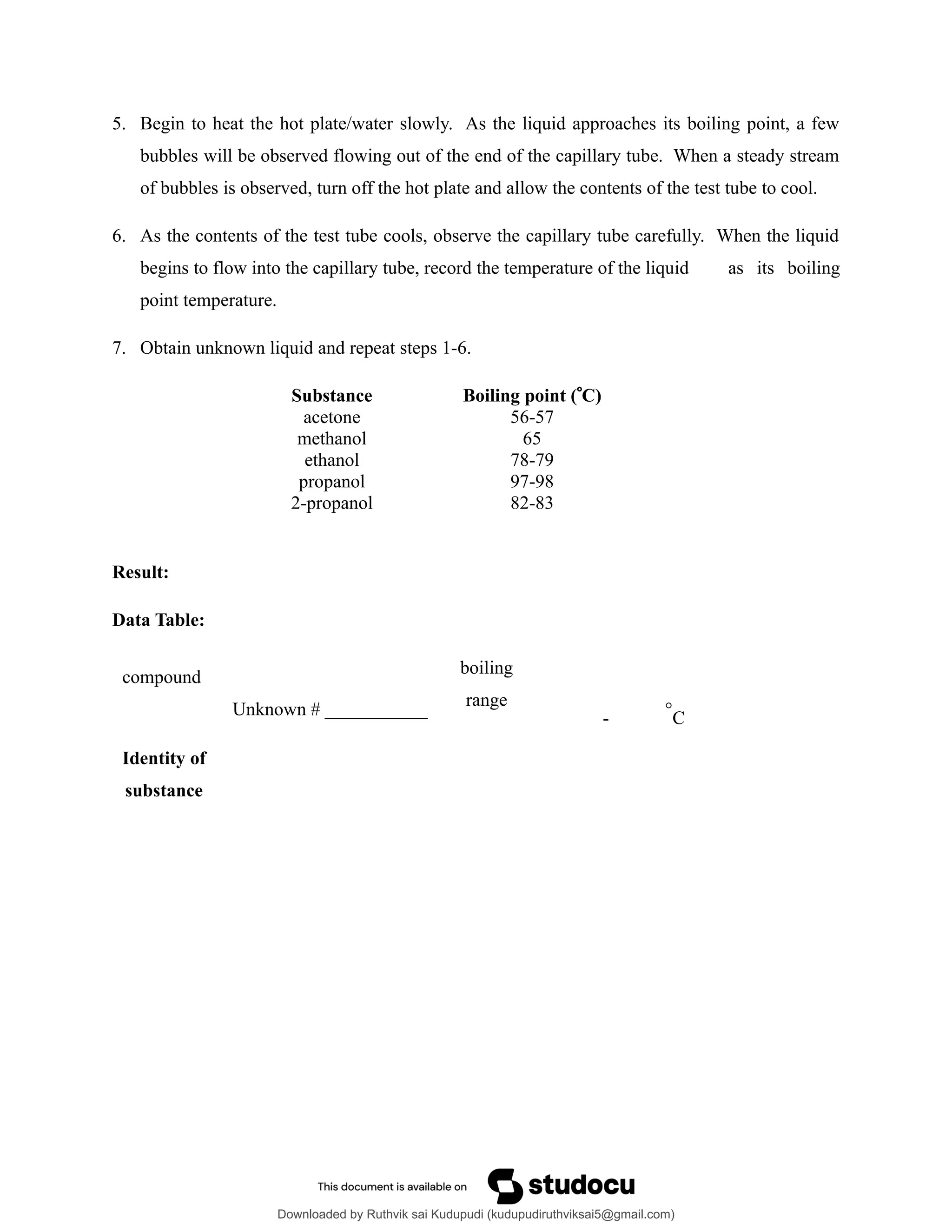
Substance Boiling point (C)
acetone 56-57
methanol 65
ethanol 78-79
propanol 97-98
2-propanol 82-83
Result:
Data Table:
compound
Unknown # ___________
boiling
range
- °C
Identity of
substance
Downloaded by Ruthvik sai Kudupudi (kudupudiruthviksai5@gmail.com)
lOMoARcPSD|44858848
Chromatography
Aim:In this laboratory you will separate spinach pigments using thin layer chromatography
(TLC).
INTRODUCTION
Mixtures of compounds are very common in Organic Chemistry. Most reactions produce more
than one product. Naturally occurring materials are only rarely 100% pure. It is therefore
desirable to have a simple, fast and efficient way to determine the purity of Organic mixtures.
The separation of a mixture by passing it, in solution, over an adsorbent (such as Alumina or
Silica Gel) is the basic idea ofChromatography.Chromatography is a very general phenomenon.
It involves the passage of a mobile phase across a stationary phase in a column. Usually a
mixture of compounds is present in the mobile phase. As soon as the mixture comes in contact
with the stationary phase, some or all of the components of the mixture are adsorbed on it. As
additional mobile phase comes along, some or all of the mixture will dissolve and continue
moving. This adsorption/solution process continues along the length of the column. If a proper
choice of mobile phase, stationary phase, solvent and other operating parameters was made, the
mixture will be separated in the column and its various components will emerge at different
times.In Thin Layer Chromatography ("TLC"), a liquid solution is directly applied to a solid
adsorbent. Capillary action draws a developing solvent up the TLC plate. As this solvent passes
through the spot, the mixture will be dissolved and will begin to move with the solvent front.
However, the adsorbent will also reabsorb part or all of the mixture. As more solvent comes by,
the mixture will again go into solution, move further and be reabsorbed. Since different
materials will be dissolved and reabsorbed at different rates, separation will take place. The slide
is removed from the chamber once the solvent front reaches a predetermined spot near the edge
farthest from the point of spotting. This passage of the solvent front through the adsorbent is
known as developing the plate. The extent of separation, measured by retention factor ("Rf ")
value differences, will depend on the relative solubilities and relative strengths of adsorption of
the components of the mixture.Organic compounds interact with absorbents by a variety of
interactions. If the compound is non-polar, it can only have weak 'Van der Waals' attractions for
the absorbent. However, more polar molecules may interact more strongly by a variety of
mechanisms including dipole-dipole interactions, coordination, and hydrogen bonding. The
Downloaded by Ruthvik sai Kudupudi (kudupudiruthviksai5@gmail.com)
lOMoARcPSD|44858848
most important rule of chromatography is that the more polar compounds will be absorbed most
strongly on absorbents (stationary phases), while non-polar compounds will be only very
weakly absorbed.In a typical chromatography experiment, the non-polar compounds, since they
are poorly absorbed, will be held least strongly and will move quickly through the plate. Polar
compounds, on the other hand, will be slowed on their process through the plate by their strong
interactions with the solid phase. This separation based on polarity will explain most of the
chromatography encountered in this course.
Types of Adsorbents used in Chromatography (Listed in decreasing power of adsorption):
 Alumina, Activated Charcoal, Magnesium Silicate, Silica, Starch.
Just as we have a variety of stationary phases to choose, we also have an even larger assortment
of mobile phases (or, eluting solvents). They are also categorized according to their ability to
move polar compounds through the chromatography column
Solvents Commonly Used in Chromatography (Listed in decreasing polarity):
Acetic Acid, Water, Methanol, Acetone, Ehtyl acetate, Diethyl ether, Chloroform, Methylene
chloride, Toluene, Cyclohexane and Petroleum ether
For a typical separation, a variety of different combinations of solvent and adsorbent may be
effective. However, these combinations are only obtained by trial and error, based on
experience. There is no magic formula that will allow prediction of just the right set of
conditions for any given separation.Once you have developed your plate, since most compounds
are colorless, the location of the separated samples, or spots, is usually not apparent. The plate
must be visualized. This visualization may be accomplished in a number of ways. If the
compound(s) fluoresce, shining a UV light on the plate may indicate the location of the
separated spots. Conversely, the adsorbent may be made to contain a small amount of a
fluorescing substance. When the developed plate is exposed to a UV lamp, most of the plate will
fluoresce one color. Wherever a spot is located there will be either a different color or less
fluorescence. While the UV light is ON, the position of the visualized spots is sketched on the
plate with a sharp pencil.Alternatively, visualization may be accomplished by reacting the
developed plate with a chemical reagent. Iodine (I2) is one of the easiest to use of the several
common chemical visualizing agents. The developed slide is simply exposed to I2 vapors in a
chamber similar to the developing chamber for a few minutes. Almost all compounds will form
Downloaded by Ruthvik sai Kudupudi (kudupudiruthviksai5@gmail.com)
lOMoARcPSD|44858848
a weak colored complex with the I2. This complex will appear as a darker area on the slide.
Again, the darkened areas are traced with a pencil before the I2 evaporates and the color
disappears.This TLC technique usually requires only a few minutes for a complete analysis, and
requires only about 10 microliters of the solution to be analyzed (a microliter is a millionth of a
Liter (10–6
L, or 10–3
mL)). A few mL of the developing solvent is placed in a simple chamber,
such as a 4-oz wide mouth jar. To insure an atmosphere saturated with the developing solvent in
the chamber, a piece of filter paper is also present to act as a wick and the chamber is kept
capped except when adding or removing a TLC plate.The 'spots' are characterized by
their Rf value, a measure of how far the spot traveled with that combination of adsorbent and
solvent. Rf values will change when either of these factors is changed.
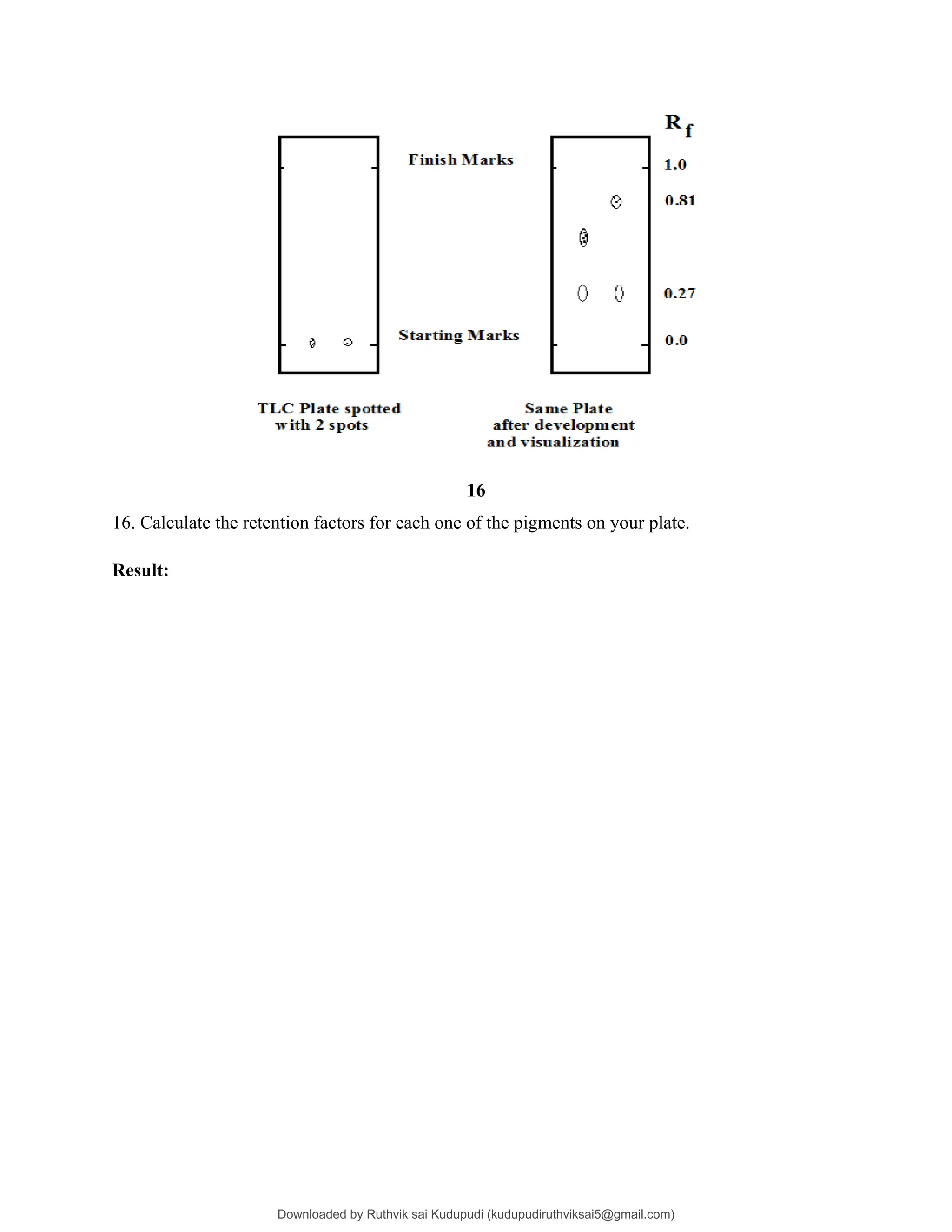
Rf=
Distance spot traveled
Distance Solvent Traveled
On this scale, TLC is only an analytical tool, albeit a very valuable one. If samples of the
separated materials were desired, the entire experiment could be scaled up to allow
milligrams to be separated. The plates would be larger and the amount of adsorbent would be
increased, but the procedure would be the same. The spots would be visualized by UV (non-
destructive) and then separately scraped from the glass plate. The samples could be
recovered from the adsorbent by extracting the scrapings with a pure solvent such as ether,
and then carefully evaporating the solvent.
Procedure:
1. We will start by extracting the pigments from the spinach juice: add 3 mL of spinach juice and
6 mL of pentane to a screw-capped test tube and shake vigorously for 1 minute.
2.Spin the mixture in a centrifuge for 5 minutes, after which time a transparent green top layer
should be visible. You can watch a videothat shows how to use our centrifuges.
3.Transfer the transparent green top layer using a Pasteur pipet to a clean 50-mL beaker.
4.Evaporate the pentane by heating the beaker on a hot plate at a low heat setting (about 95°C)
for a few minutes until 1-2 mm of liquid remain. Remove from the hot plate immediately to
prevent degrading the spinach pigments. If almost all of the solvent is accidentally evaporated,
two or three drops of pentane may be added to redissolve the green residue. Adding a drop or
two of pentane after evaporation will ensure better loading of the TLC plate.
Downloaded by Ruthvik sai Kudupudi (kudupudiruthviksai5@gmail.com)
lOMoARcPSD|44858848
5. Now you are ready to perform the thin layer chromatography separation. Please watch
the video before you proceed.
6. Obtain a TLC plate and a developing chamber.
7. In the developing chamber, place about 5 mL of the TLC developing solvent (7:3 mixture of
hexane:acetone). Be sure the depth of solvent is no more than 0.5 cm. If the start line should
touch the solvent directly, the TLC experiment is ruined since some or all of the sample will be
dissolved into the solvent pool.
8. Stopper the chamber to allow it to become saturated with solvent vapors. A cap is kept in place
at all times, except when adding or removing a plate. Allow at least 5-10 minutes for the
chamber to equilibrate before the first plate is developed.
9. Trace a light pencil line about 1 cm from the bottom of the plate and another light pencil line 5
cm up the plate from the first line. You should make your pencil marks on the papery side (not on
the side with the glossy finish).
10. Use a microcapillary tube to load the extract onto the TLC plate. Allow the tip of the drop at
the end of the capillary to just touch the plate. Blow lightly onto the plate after each drop is
added to allow the solvent to evaporate. Each time you add sample to the spot, make sure it never
gets any larger than it did the first time. This will ensure a very concentrated spot at the start line
and will give the most concentrated spots (nearly round) on development of the plate.
11. After all spots have been applied, and all spots are dry, the plate may be placed into the
developing chamber and capped immediately to avoid loss of the solvent saturated atmosphere.
Almost immediately, the solvent will begin to migrate up the plate.
12. Once the solvent reaches the top line on the plate, remove it and allow the plate to dry.
13. As the plate dries, you will notice a change in its appearance. However, the spots will not be
visible unless they are colored materials. The spots must be visualized. A UV lamp is the
simplest way to visualize.
14. Place the dry plate on the bench top and allow the UV light to shine on it. If there is a spot, it
will probably show as a different color of fluorescence than the background, or as a darkened
area on the adsorbent.
15. With a very sharp pencil or other sharp instrument, draw an outline of each spot in the
adsorbent. Turn OFF the UV lamp and carefully put it away. Include your TLC plate with your
lab worksheet.
Downloaded by Ruthvik sai Kudupudi (kudupudiruthviksai5@gmail.com)
lOMoARcPSD|44858848
16
16. Calculate the retention factors for each one of the pigments on your plate.
Result:
Downloaded by Ruthvik sai Kudupudi (kudupudiruthviksai5@gmail.com)
lOMoARcPSD|44858848

Organic chemistry 1 (1).pdf lab manual i

  • 1.
    SCY 120: ORGANICCHEMISTRY -I LAB Chemistry (Gandhi Institute of Technology and Management (Deemed to be University)) Scan to open on Studocu Studocu is not sponsored or endorsed by any college or university SCY 120: ORGANIC CHEMISTRY -I LAB Chemistry (Gandhi Institute of Technology and Management (Deemed to be University)) Scan to open on Studocu Studocu is not sponsored or endorsed by any college or university Downloaded by Ruthvik sai Kudupudi (kudupudiruthviksai5@gmail.com) lOMoARcPSD|44858848
  • 2.
    SCY 120: ORGANICCHEMISTRY -I LAB (CC/PPC) Experiments: 1. Checking the calibration of the thermometer 2. Purification of organic compounds by crystallization using the following solvents: a. Water b. Alcohol c. Alcohol-Water 3. Determination of the melting points of above compounds and unknown organic compounds 4. Determination of boiling point of liquid compounds. 5. Chromatography: a. Separation of a mixture of two amino acids by ascending and horizontal paper chromatography b. Separation of a mixture of two sugars by ascending paper chromatography c. Separation of a mixture of o-and p-nitrophenol or o-and p-aminophenol by thin layer chromatography (TLC) Downloaded by Ruthvik sai Kudupudi (kudupudiruthviksai5@gmail.com) lOMoARcPSD|44858848
  • 3.
    Checking the calibrationof the thermometer Aim: In this exercise, we will calibrate a stem-type thermometer and then use it to correctly measure the Air temperature of the laboratory. Apparatus: Thermometer, Heater, Cold water, beaker and ring stand Procedure: Thermometer Identification 1. If possible, note the manufacturer, serial number and manufacture date of the thermometer. 2. Note the temperature Range of the thermometer. 3. Note the precision of the thermometer. (What is the “uncertain” digit to which readings can be made?) 4. Note whether or not the thermometer is a Total Immersion or Partial Immersion type. Partial Immersion thermometers will have an Immersion Mark and are designed so that only that part of the stem is exposed to the temperature being measured. Total Immersion thermometers are designed so that both the bulb and the entire liquid column must be exposed to the temperature being measured. 5. Check to make sure that the liquid in the stem of the thermometer has not separated. If it has, ask your laboratory instructor for a new thermometer. Calibration at the Ice Point of Water: 1. Fill a styrofoam container with crushed Ice. (You will have to share a container with another group, so become friendly with your neighbors.) 2. Add enough pre-cooled distilled Water to cover the Ice, but not so much Water such that the Ice floats. 3. Thoroughly stir the Ice-Water mixture. 4. Hang your thermometer by a string from a clamp attached to a ring-stand until it is appropriately inserted into the Ice-Water. Downloaded by Ruthvik sai Kudupudi (kudupudiruthviksai5@gmail.com) lOMoARcPSD|44858848
  • 4.
    5. Allow thetemperature shown by the thermometer to stabilize. (~10 minutes is required to establish thermal equilibrium.) After 3 minutes at the stable temperature, record the temperature to the correct precision. 6. The Ice Point of Water is remarkably stable at 0.00oC. Calibration at the Boiling Point of Water: 1. Set up a hot plate with a 500 mL Florence Flask resting on it. The flask should be supported by a clamp from a ring stand. 2. Fill the flask about half full with distilled Water. Add a few boiling chips to promote smooth boiling. 3. Hang the thermometer from the ring stand as before such that the immersion mark is in the neck of the flask. (Once at reflux, both the Water and its vapor will be at the boiling point. Using a Florence Flask helps promote the reflux. Why?) 4. Turn on the hot plate and allow the Water to come to its Boiling Point. 5. Allow the temperature shown by the thermometer to stabilize. (~10 minutes after a rolling- boil has been achieved.) After 3 minutes at the stable temperature, record the temperature to the correct precision. 6. The Boiling Point of Water is extremely sensitive to the atmospheric pressure. You will be provided with the day's atmospheric pressure. Use this, along with the data in the Appendix, to determine the correct Boiling Point of Water. You may have to interpolate the data in the Table. If so, a computer program that performs interpolation calculations will be provided. What is the Percentage Error in your measurement? Result: Calibration at the Ice Point of Water: Thermo. Reading ……………….o C Calibration at the Boiling Point of Water Thermo. Reading …………………o C Corr. BP Water: ………………….o C Percentage Error:.………………. % Downloaded by Ruthvik sai Kudupudi (kudupudiruthviksai5@gmail.com) lOMoARcPSD|44858848
  • 5.
    Purification of organiccompounds by crystallization using solvents Aim: Recrystallization of given organic compound with suitable solvent like water, alcohol, acetone etc., Apparatus: Procedure: Recrystallization is a technique used to purify solid compounds. 1. Solids tend to be more soluble in hot liquids than in cold liquids. During recrystallization, an impure solid compound is dissolved in a hot liquid until the solution is saturated, and then the liquid is allowed to cool. 2. The compound should then form relatively pure crystals. Ideally, any impurities that are present will remain in the solution and will not be incorporated into the growing crystals (Figure 1). The crystals can then be removed from the solution by filtration. Not the entire compound is recoverable — some will remain in the solution and will be lost. Recrystallization is not generally thought of as a separation technique; rather, it is a purification technique in which a small amount of an impurity is removed from a compound. However, if the solubility properties of two compounds are sufficiently different, recrystallization can be used to separate them, even if they are present in nearly equal amounts. Recrystallization works best when most impurities have already been removed by another method, such as extraction or column chromatography. Figure 1. The general scheme for recrystallization. PRINCIPLE: Downloaded by Ruthvik sai Kudupudi (kudupudiruthviksai5@gmail.com) lOMoARcPSD|44858848
  • 6.
    A successful recrystallizationdepends on the proper choice of solvent. The compound must be soluble in the hot solvent and insoluble in the same solvent when it is cold. For the purpose of recrystallization, consider 3% w/v the dividing line between soluble and insoluble: if 3 g of a compound dissolves in 100 mL of a solvent, it is considered soluble. In choosing a solvent, the bigger the difference between hot solubility and cold solubility, the more product recoverable from recrystallization. The rate of cooling determines the size and quality of the crystals: rapid cooling favors small crystals, and slow cooling favors the growth of large and generally purer crystals. The rate of recrystallization is usually greatest at about 50 °C below the melting point of the substance; the maximum formation of crystals occurs at about 100 °C below the melting point. Although the terms "crystallization" and "recrystallization" are sometimes used interchangeably, they technically refer to different processes. Crystallization refers to the formation of a new, insoluble product by a chemical reaction; this product then precipitates out of the reaction solution as an amorphous solid containing many trapped impurities. Recrystallization does not involve a chemical reaction; the crude product is simply dissolved into solution, and then the conditions are changed to allow crystals to re-form. Recrystallization produces a more pure final product. For this reason, experimental procedures that produce a solid product by crystallization normally include a final recrystallization step to give the pure compound. PROCEDURE: Perform all steps in a fume hood to prevent exposure to solvent fumes.  Selecting a Solvent: 1. Place 50 mg of the sample (N-bromosuccinimide) in an Erlenmeyer flask. 2. Add 0.5 mL of boiling solvent (water). If the sample dissolves completely, the solubility in the cold solvent is too high to be a good recrystallization solvent. 3. If the sample does not dissolve in the cold solvent, heat the test tube until the solvent boils.  If the sample has not completely dissolved at this point, add more boiling solvent drop-wise, until all of the solid dissolves. If it takes more than 3 mL to dissolve the sample in the hot solvent, the solubility in this solvent is probably too low to make it a good recrystallization solvent. Downloaded by Ruthvik sai Kudupudi (kudupudiruthviksai5@gmail.com) lOMoARcPSD|44858848
  • 7.
    4. If thefirst choice of solvent is not a good recrystallization solvent, try others. If a single solvent that works cannot be found, try a two solvent system.  If you cannot find a suitable single solvent system, then a solvent pair may be necessary. When identifying a solvent pair, there are several key considerations 1) The first solvent should readily dissolve the solid. 2) The second solvent must be miscible with the 1st solvent, but have a much lower solubility for the solute.  As a general rule "likes dissolve likes" meaning that polar compounds tend to be soluble in polar solvents and non-polar compounds are often more soluble non-polar compounds.  Common solvent pairs (Table 1) 5.Make sure the solvent has a boiling point of at least 40 °C, so there is a reasonable temperature difference between boiling solvent and room-temperature solvent. 6. Ensure that the solvent has a boiling point below about 120 °C, so it's easier to remove the last traces of solvent from the crystals. 7. Also make sure the boiling point of the solvent is lower than the melting point of the compound, so the compound forms as solid crystals rather than as an insoluble oil. 8. Confirm that the impurities are either insoluble in the hot solvent (so they can be hot-filtered out, once the compound is dissolved) or soluble in the cold solvent (so they stay dissolved during the entire process).  Dissolving the Sample in Hot Solvent 1. Place the compound to be recrystallized in an Erlenmeyer flask. This is a better choice than a beaker, since the sloping sides help trap solvent vapors and slow the rate of evaporation. 2. Place the solvent (water) in a separate Erlenmeyer flask, and add boiling chips or a stir bar to keep it boiling smoothly. Heat it to boiling on a hotplate. 3. Add hot solvent to a flask at room temperature containing the compound in small portions, swirling after each addition, until the compound is completely dissolved. Downloaded by Ruthvik sai Kudupudi (kudupudiruthviksai5@gmail.com) lOMoARcPSD|44858848
  • 8.
     During thedissolution process, keep the solution hot at all times by resting it on the hotplate, too. Do not add more hot solvent than necessary - just enough to dissolve the sample. 4. If a portion of the solid does not seem to dissolve, even after more hot solvent has been added, it is likely due to the presence of very insoluble impurities. If this happens, stop adding solvent and do a hot filtration before proceeding.  To perform a hot filtration, fold a piece of filter paper into a fluted cone shape and place it into a glass stemless funnel.  Add a 10-20% excess of hot solvent to the hot solution to allow for evaporation in the procedure.  Pour the solution through the paper. If crystals begin to form at any time during the process, add a small portion of warm solvent to dissolve them.  Cooling the Solution 1. Set the flask containing the dissolved compound on a surface that does not conduct the heat away too quickly, such as a paper towel set on a bench top. 2. Lightly cover the flask as it cools to prevent evaporation and to prevent dust from falling into the solution. 3. Leave the flask undisturbed until it cools to room temperature. 4. Once the crystals have formed, place the solution in an ice bath to ensure that the maximum amount of crystals is obtained. The solutions should be left undisturbed in the ice bath for 30 min to 1 h, or till the compound appears to have completely crystalized out of solution. 5. If no crystal formation is evident, it can be induced by scratching the inside walls of the flask with a glass rod or by adding a small seed crystal of the same compound.  If this still fails to work, then too much solvent was probably used. Reheat the solution, allow some of the solvent to boil off, and then cool it. Downloaded by Ruthvik sai Kudupudi (kudupudiruthviksai5@gmail.com) lOMoARcPSD|44858848
  • 9.
     Isolating andDrying the Crystals 1.Set the cold flask containing the newly formed crystals on a bench top. 2. Lightly cover the flask to prevent evaporation and to prevent dust from falling into the solution. 3.Isolate the crystals by vacuum filtration, using either a Büchner or Hirsch funnel (clamp the flask to a ring stand first). 4.Rinse the crystals on the Büchner funnel with a small amount of fresh, cold solvent (the same solvent used for recrystallization) to remove any impurities that may be sticking to the crystals. 5.To dry the crystals, leave them in the filter funnel and draw air through them for several minutes. Crystals can also be air-dried by allowing them to stand uncovered for several hours or days. More efficient methods include vacuum drying or placing in a desiccator. Polar Solvent Less Polar Solvent Ethyl acetate Hexane Methanol Methylene chloride Water Ethanol Toluene Hexane Result: Downloaded by Ruthvik sai Kudupudi (kudupudiruthviksai5@gmail.com) lOMoARcPSD|44858848
  • 10.
    Determination of themelting points of above compounds and unknown organic compounds Aim:this experiment is to determine the melting points of various organic compounds and to use these to identify unknowns. Apparatus:Mel-Temp apparatus, Thermometer, Organic compound, Capillary tubes, Mortar and pestle (optional). INTRODUCTION: The melting point of a pure compound is an intensive property, like density and boiling point. Intensive properties are independent of the amount of substance present. The melting point of a compound is the temperature at which it changes from a solid to a liquid. Experimentally, melting point is actually recorded as the range of temperatures in which the first crystal starts to melt until the temperature at which the last crystal just disappears. Purpose for determining melting points: 1. The melting point indicates the level of purity of a sample. An impure compound melts over a wider range of temperatures, usually greater than 2 degrees. 2. The melting point helps to identify unknown samples, narrowing the number of possibilities, because a pure solid melts reproducibly over a narrow range of temperatures. 3. The melting point helps to characterize new compounds. In this lab, the identity of an unknown organic compound will be determined by comparing its experimental melting point to those of a variety of known compounds. SAFETY: 1. Always wear safety goggles in the lab. 2. The parts on the top of the Mel-Temp are HOT while it is turned on. Do not touch these parts or place your eye on the eyepiece. You will get burned! 3. Capillary tubes break very easily, handle them with caution. 4. Wash hands after performing experiment. Downloaded by Ruthvik sai Kudupudi (kudupudiruthviksai5@gmail.com) lOMoARcPSD|44858848
  • 11.
    PROCEDURE: 1. Obtain acapillary melting point tube and a known compound. The known compound may need to be ground into a fine powder with a mortar and pestle. 2. Place a small amount of the finely ground known compound in a weighing boat. Push the open end of the capillary tube into the compound to load sample into tube. Load only 1-2 mm of sample into the tube. Larger samples will heat unevenly. 3. Hold the closed end of the capillary tube over a dropping tube; the dropping tube should be held perpendicular to the table and on top of the table. Drop the capillary tube into the dropping tube; the capillary tube will bounce on the table packing the powder into the bottom. Remove the capillary tube from the dropping tube. 5. Place the capillary melting point tube in the Mel-Temp apparatus chamber, with the closed end pointed down. 6. Turn power switch ON. 7. Set the power level to obtain the desired heating rate. Start with a setting of 40, and adjust if needed to control the rate of temperature increase. The sample should be observed continuously, so that the melting point of the sample is not missed. Heat slowly to acquire the most accurate results. 8. Record the melting range, which begins when the sample first starts to melt and ends when the sample is completely melted. The known sample should melt within the range found in Table 1, on the following page. 9. Turn off the Melt-Temp to allow it to cool to about 50ºC before trying your unknown. Use a hairdryer set on the cool setting to lower the temperature of the Mel-Temp faster. 10. Prepare a sample of your unknown in the same way that you prepared the known sample and find its melting range Known Compound Melting point(ºC) Palmitic acid 63-64 Stearic acid 69-70 Vanillin 81-83 Oxalic acid(dihydrate) 101-102 Benzoic acid 122 Downloaded by Ruthvik sai Kudupudi (kudupudiruthviksai5@gmail.com) lOMoARcPSD|44858848
  • 12.
    acetylsalicylic acid 138-140 Table1 Melting Points of Known Compounds Result: Melting Points data tables: Known/unknown Compound Melting Range (ºC) Downloaded by Ruthvik sai Kudupudi (kudupudiruthviksai5@gmail.com) lOMoARcPSD|44858848
  • 13.
    Determination of boilingpoint of liquid compounds Aim:To determine the boiling points of various organic compounds and to use these to identify unknowns. Apparatus: hot plate, closed end capillary tube, thermometer, liquid organic compounds, small test tube, 250 mL beaker Introduction: The boiling point of a compound is the temperature at which it changes from a liquid to a gas. This is a physical property often used to identify substances or to check the purity of the compound. It is difficult, though, to find a boiling point. Usually, chemists can only obtain a boiling range of a 2 - 3oC accuracy. This is usually sufficient for most uses of the boiling point. Safety: Always wear safety glasses in the lab. Capillary tubes break very easily, handle them with caution. Be careful with the thermometer. Mercury is very toxic. Procedure: 1. Place a few milliliters of a known liquid organic compound in a small test tube. 2. Into the test tube, place the capillary tube with closed end upward. 3. Clamp the test tube to a ring stand and immerse a thermometer in the test tube. Be sure to clamp the thermometer to the ring stand as well. 4. Fill a 250 mL beaker 3/4 full with water and place on the hot plate. Carefully lower lower the test tube and thermometer combination into the beaker of water so that the test tube is immersed half way in the water. Downloaded by Ruthvik sai Kudupudi (kudupudiruthviksai5@gmail.com) lOMoARcPSD|44858848
  • 14.
    5. Begin toheat the hot plate/water slowly. As the liquid approaches its boiling point, a few bubbles will be observed flowing out of the end of the capillary tube. When a steady stream of bubbles is observed, turn off the hot plate and allow the contents of the test tube to cool. 6. As the contents of the test tube cools, observe the capillary tube carefully. When the liquid begins to flow into the capillary tube, record the temperature of the liquid as its boiling point temperature. 7. Obtain unknown liquid and repeat steps 1-6. Substance Boiling point (C) acetone 56-57 methanol 65 ethanol 78-79 propanol 97-98 2-propanol 82-83 Result: Data Table: compound Unknown # ___________ boiling range - °C Identity of substance Downloaded by Ruthvik sai Kudupudi (kudupudiruthviksai5@gmail.com) lOMoARcPSD|44858848
  • 15.
    Chromatography Aim:In this laboratoryyou will separate spinach pigments using thin layer chromatography (TLC). INTRODUCTION Mixtures of compounds are very common in Organic Chemistry. Most reactions produce more than one product. Naturally occurring materials are only rarely 100% pure. It is therefore desirable to have a simple, fast and efficient way to determine the purity of Organic mixtures. The separation of a mixture by passing it, in solution, over an adsorbent (such as Alumina or Silica Gel) is the basic idea ofChromatography.Chromatography is a very general phenomenon. It involves the passage of a mobile phase across a stationary phase in a column. Usually a mixture of compounds is present in the mobile phase. As soon as the mixture comes in contact with the stationary phase, some or all of the components of the mixture are adsorbed on it. As additional mobile phase comes along, some or all of the mixture will dissolve and continue moving. This adsorption/solution process continues along the length of the column. If a proper choice of mobile phase, stationary phase, solvent and other operating parameters was made, the mixture will be separated in the column and its various components will emerge at different times.In Thin Layer Chromatography ("TLC"), a liquid solution is directly applied to a solid adsorbent. Capillary action draws a developing solvent up the TLC plate. As this solvent passes through the spot, the mixture will be dissolved and will begin to move with the solvent front. However, the adsorbent will also reabsorb part or all of the mixture. As more solvent comes by, the mixture will again go into solution, move further and be reabsorbed. Since different materials will be dissolved and reabsorbed at different rates, separation will take place. The slide is removed from the chamber once the solvent front reaches a predetermined spot near the edge farthest from the point of spotting. This passage of the solvent front through the adsorbent is known as developing the plate. The extent of separation, measured by retention factor ("Rf ") value differences, will depend on the relative solubilities and relative strengths of adsorption of the components of the mixture.Organic compounds interact with absorbents by a variety of interactions. If the compound is non-polar, it can only have weak 'Van der Waals' attractions for the absorbent. However, more polar molecules may interact more strongly by a variety of mechanisms including dipole-dipole interactions, coordination, and hydrogen bonding. The Downloaded by Ruthvik sai Kudupudi (kudupudiruthviksai5@gmail.com) lOMoARcPSD|44858848
  • 16.
    most important ruleof chromatography is that the more polar compounds will be absorbed most strongly on absorbents (stationary phases), while non-polar compounds will be only very weakly absorbed.In a typical chromatography experiment, the non-polar compounds, since they are poorly absorbed, will be held least strongly and will move quickly through the plate. Polar compounds, on the other hand, will be slowed on their process through the plate by their strong interactions with the solid phase. This separation based on polarity will explain most of the chromatography encountered in this course. Types of Adsorbents used in Chromatography (Listed in decreasing power of adsorption):  Alumina, Activated Charcoal, Magnesium Silicate, Silica, Starch. Just as we have a variety of stationary phases to choose, we also have an even larger assortment of mobile phases (or, eluting solvents). They are also categorized according to their ability to move polar compounds through the chromatography column Solvents Commonly Used in Chromatography (Listed in decreasing polarity): Acetic Acid, Water, Methanol, Acetone, Ehtyl acetate, Diethyl ether, Chloroform, Methylene chloride, Toluene, Cyclohexane and Petroleum ether For a typical separation, a variety of different combinations of solvent and adsorbent may be effective. However, these combinations are only obtained by trial and error, based on experience. There is no magic formula that will allow prediction of just the right set of conditions for any given separation.Once you have developed your plate, since most compounds are colorless, the location of the separated samples, or spots, is usually not apparent. The plate must be visualized. This visualization may be accomplished in a number of ways. If the compound(s) fluoresce, shining a UV light on the plate may indicate the location of the separated spots. Conversely, the adsorbent may be made to contain a small amount of a fluorescing substance. When the developed plate is exposed to a UV lamp, most of the plate will fluoresce one color. Wherever a spot is located there will be either a different color or less fluorescence. While the UV light is ON, the position of the visualized spots is sketched on the plate with a sharp pencil.Alternatively, visualization may be accomplished by reacting the developed plate with a chemical reagent. Iodine (I2) is one of the easiest to use of the several common chemical visualizing agents. The developed slide is simply exposed to I2 vapors in a chamber similar to the developing chamber for a few minutes. Almost all compounds will form Downloaded by Ruthvik sai Kudupudi (kudupudiruthviksai5@gmail.com) lOMoARcPSD|44858848
  • 17.
    a weak coloredcomplex with the I2. This complex will appear as a darker area on the slide. Again, the darkened areas are traced with a pencil before the I2 evaporates and the color disappears.This TLC technique usually requires only a few minutes for a complete analysis, and requires only about 10 microliters of the solution to be analyzed (a microliter is a millionth of a Liter (10–6 L, or 10–3 mL)). A few mL of the developing solvent is placed in a simple chamber, such as a 4-oz wide mouth jar. To insure an atmosphere saturated with the developing solvent in the chamber, a piece of filter paper is also present to act as a wick and the chamber is kept capped except when adding or removing a TLC plate.The 'spots' are characterized by their Rf value, a measure of how far the spot traveled with that combination of adsorbent and solvent. Rf values will change when either of these factors is changed. Rf= Distance spot traveled Distance Solvent Traveled On this scale, TLC is only an analytical tool, albeit a very valuable one. If samples of the separated materials were desired, the entire experiment could be scaled up to allow milligrams to be separated. The plates would be larger and the amount of adsorbent would be increased, but the procedure would be the same. The spots would be visualized by UV (non- destructive) and then separately scraped from the glass plate. The samples could be recovered from the adsorbent by extracting the scrapings with a pure solvent such as ether, and then carefully evaporating the solvent. Procedure: 1. We will start by extracting the pigments from the spinach juice: add 3 mL of spinach juice and 6 mL of pentane to a screw-capped test tube and shake vigorously for 1 minute. 2.Spin the mixture in a centrifuge for 5 minutes, after which time a transparent green top layer should be visible. You can watch a videothat shows how to use our centrifuges. 3.Transfer the transparent green top layer using a Pasteur pipet to a clean 50-mL beaker. 4.Evaporate the pentane by heating the beaker on a hot plate at a low heat setting (about 95°C) for a few minutes until 1-2 mm of liquid remain. Remove from the hot plate immediately to prevent degrading the spinach pigments. If almost all of the solvent is accidentally evaporated, two or three drops of pentane may be added to redissolve the green residue. Adding a drop or two of pentane after evaporation will ensure better loading of the TLC plate. Downloaded by Ruthvik sai Kudupudi (kudupudiruthviksai5@gmail.com) lOMoARcPSD|44858848
  • 18.
    5. Now youare ready to perform the thin layer chromatography separation. Please watch the video before you proceed. 6. Obtain a TLC plate and a developing chamber. 7. In the developing chamber, place about 5 mL of the TLC developing solvent (7:3 mixture of hexane:acetone). Be sure the depth of solvent is no more than 0.5 cm. If the start line should touch the solvent directly, the TLC experiment is ruined since some or all of the sample will be dissolved into the solvent pool. 8. Stopper the chamber to allow it to become saturated with solvent vapors. A cap is kept in place at all times, except when adding or removing a plate. Allow at least 5-10 minutes for the chamber to equilibrate before the first plate is developed. 9. Trace a light pencil line about 1 cm from the bottom of the plate and another light pencil line 5 cm up the plate from the first line. You should make your pencil marks on the papery side (not on the side with the glossy finish). 10. Use a microcapillary tube to load the extract onto the TLC plate. Allow the tip of the drop at the end of the capillary to just touch the plate. Blow lightly onto the plate after each drop is added to allow the solvent to evaporate. Each time you add sample to the spot, make sure it never gets any larger than it did the first time. This will ensure a very concentrated spot at the start line and will give the most concentrated spots (nearly round) on development of the plate. 11. After all spots have been applied, and all spots are dry, the plate may be placed into the developing chamber and capped immediately to avoid loss of the solvent saturated atmosphere. Almost immediately, the solvent will begin to migrate up the plate. 12. Once the solvent reaches the top line on the plate, remove it and allow the plate to dry. 13. As the plate dries, you will notice a change in its appearance. However, the spots will not be visible unless they are colored materials. The spots must be visualized. A UV lamp is the simplest way to visualize. 14. Place the dry plate on the bench top and allow the UV light to shine on it. If there is a spot, it will probably show as a different color of fluorescence than the background, or as a darkened area on the adsorbent. 15. With a very sharp pencil or other sharp instrument, draw an outline of each spot in the adsorbent. Turn OFF the UV lamp and carefully put it away. Include your TLC plate with your lab worksheet. Downloaded by Ruthvik sai Kudupudi (kudupudiruthviksai5@gmail.com) lOMoARcPSD|44858848
  • 19.
    16 16. Calculate theretention factors for each one of the pigments on your plate. Result: Downloaded by Ruthvik sai Kudupudi (kudupudiruthviksai5@gmail.com) lOMoARcPSD|44858848