Deafness
Dr. Jairaj Vaishnav
SR in ENT
SMS Hospital
“When you lose your vision, you lose
contact with things; when you lose your
hearing, you lose contact with people.”
Helen Keller
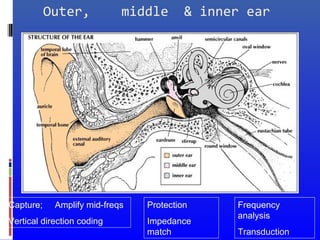
Protection
Impedance
match
Capture; Amplify mid-freqs
Vertical direction coding
Frequency
analysis
Transduction
Outer, middle & inner ear
ICF Defination (WHO:
2001DDD)
Hearing impairment :refers to complete or partial
loss of the ability to hear from one or both ears.
The level of impairment can be mild, moderate,
severe or profound;
Deafness : refers to the complete loss of ability to
hear from one or both ears.
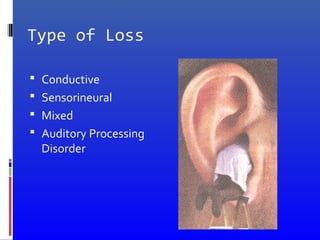
Type of Loss
 Conductive
 Sensorineural
 Mixed
 Auditory Processing
Disorder
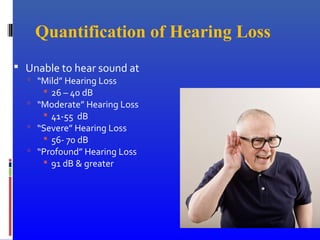
Quantification of Hearing Loss
 Unable to hear sound at
 “Mild” Hearing Loss
 26 – 40 dB
 “Moderate” Hearing Loss
 41-55 dB
 “Severe” Hearing Loss
 56- 70 dB
 “Profound” Hearing Loss
 91 dB & greater
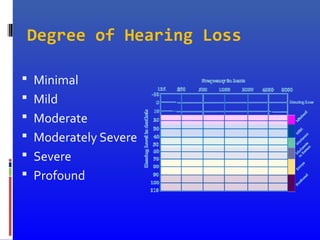
Degree of Hearing Loss
 Minimal
 Mild
 Moderate
 Moderately Severe
 Severe
 Profound
Impact of HL on Quality of Life
 Physical health
 Emotional & mental health
 Other’s perceptions of a person’s mental acuity
 Social skills
 Family relationships
 Self-esteem
 Work & school performance
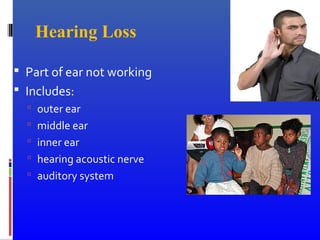
Hearing Loss
 Part of ear not working
 Includes:
 outer ear
 middle ear
 inner ear
 hearing acoustic nerve
 auditory system
Types
 Conductive deafness: due to defect in the
conducting mechanism of the ear namely external
and middle ear.
 Sensori-neural deafness / Perceptive deafness:

due to lesions in the labyrinth, 8th
nerve & central
connections. It includes psychogenic deafness.
 Mixed deafness: both the above mentioned types
are present.
External ear:
 Wax,
 Fungus,
 Otitis Externa,
 Foreign Bodies,
 Polyps,
 Myringitis,
 Stenosis,
 Atresia,
 Tumours.
Causes of Conductive deafness
Middle Ear
Cont…..
 Congenital defects of
the ear drum and
ossicles.
 Traumatic: Barotrauma,
rupture of ear drum, #
of the base of the skull
 Inflammation: AOM,
COM, Serous OM,
Adhesive OM.
 Tuberculosis and
syphilitic OM
 Neoplasms
 Otosclerosis
Causes of Conductive deafness
Eustachian tube Catarrh = xcessive discharge
from nose / throat / ear
 Eustachian catarrh
 Eustachian tube
dysfunction due to
diseases of the nose,
paranasal sinuses &
pharynx
 Barotrauma
Conductive Sensorineural
Causes of Sensori-neural deafness
Local causes (inner ear)
 Congenital
 Trauma: Head injury,
surgical injury to labyrinth,
loud sounds (acute or
chronic acoustic trauma)
producing concussion.
 Infections: mumps,
syphilis, tuberculous
meningitis, enteric fever,
labyrinthitis.
 Tumours: Acoustic
neuroma (Schwanoma of
C8 nerve)
 Meniere’s disease
 Ototoxic drugs:
streptomycin, Kanamycin,
neomycin, salicylates,
frusemide and quinine.
Causes of Sensori-neural deafness
General causes
 Presbycusis
 CVS: atherosclerosis, HTN
 CNS: disseminated
sclerosis
 DM
 Avitaminosis
 Hypothyroidism
 Smoking
 Alcoholism
 Presbyacusis: is a
progressive bilateral
symmetrical age-related
sensorineural hearing loss.
It is also known as age-
related hearing loss
Causes of Sensory-neural deafness
Psychogenic deafness: 2 types
 Functional: due to
emotional cause, but the
patient is not aware of the
cause.
 Malingering: no organic or
psychological cause.The
patient is aware that he is
pretending to be deaf for
personal gains.
 Trauma: Blast injury, acoustic trauma, head
injury.
 CSOM with labyrinthitis.
 Otosclerosis
 Senile deafness superimposed on conductive
deafness.
Causes of Mixed deafness
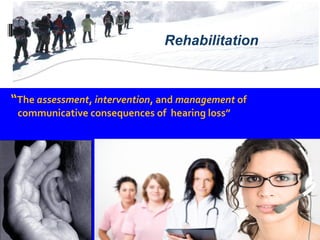
“The assessment, intervention, and management of
communicative consequences of hearing loss”
Rehabilitation
Methods of rehabilitation
I. Instrumental devices
A. Hearing Aids
- Conventional hearing aids
- Bone anchored hearing aids
- Implantable hearing aids
B. Implants
- Cochlear implants
- Auditory brainstem implants
C. Assistive devices for the deaf
II. Training
A. Speech(lip) training
B. Auditory training
C. Speech conservation
Hearing aids
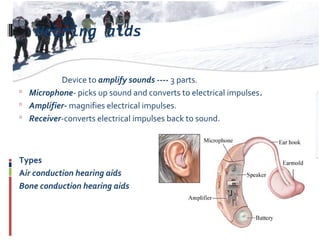
Device to amplify sounds ---- 3 parts.
 Microphone- picks up sound and converts to electrical impulses.
 Amplifier- magnifies electrical impulses.
 Receiver-converts electrical impulses back to sound.
Types
Air conduction hearing aids
Bone conduction hearing aids
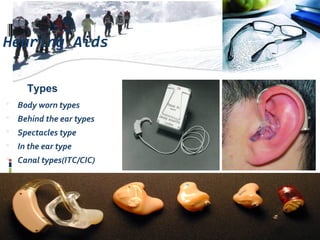
Hearing Aids
 Body worn types
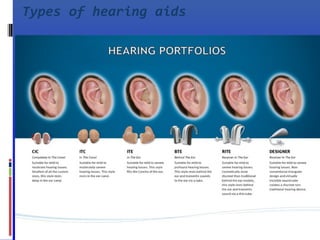
 Behind the ear types
 Spectacles type
 In the ear type
 Canal types(ITC/CIC)
Types
Types of hearing aids
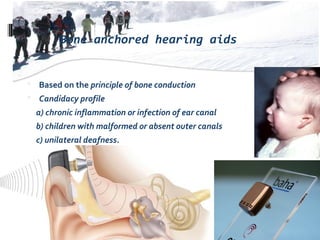
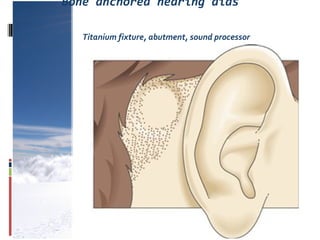
Bone anchored hearing aids
 Based on the principle of bone conduction
 Candidacy profile
a) chronic inflammation or infection of ear canal
b) children with malformed or absent outer canals
c) unilateral deafness.
Bone anchored hearing aids
Titanium fixture, abutment, sound processor
Bone anchored hearing aids
When air conduction hearing aid can’t be used
- Canal atresia
- Chronic ear discharge
- Excessive feedback and discomfort
CoHL / Mixed hearing loss
- otosclerosis / tympanosclerosis.
Single sided hearing loss
Indications for BAHA
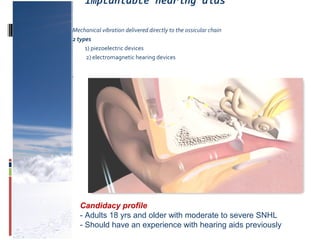
Implantable hearing aids
Mechanical vibration delivered directly to the ossicular chain
2 types
1) piezoelectric devices
2) electromagnetic hearing devices
.
Candidacy profile
- Adults 18 yrs and older with moderate to severe SNHL
- Should have an experience with hearing aids previously
Implantable hearing aids
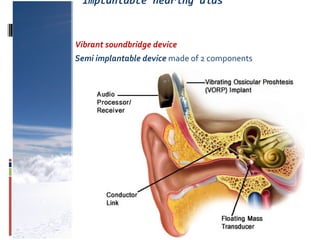
Vibrant soundbridge device
Semi implantable device made of 2 components
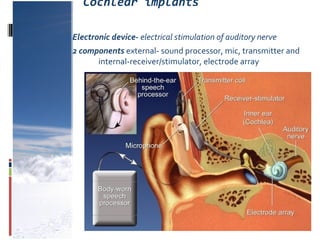
Cochlear implants
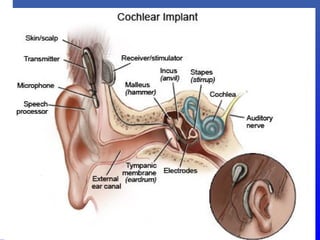
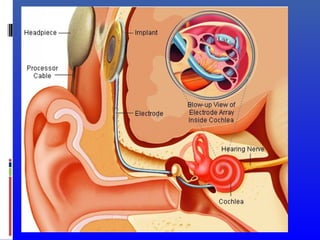
Electronic device- electrical stimulation of auditory nerve
2 components external- sound processor, mic, transmitter and
internal-receiver/stimulator, electrode array
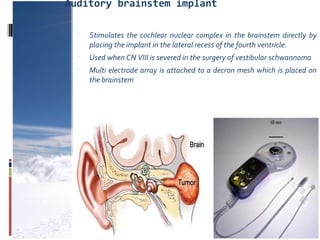
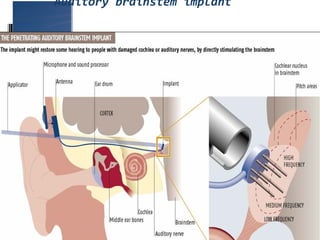
Auditory brainstem implant
 Stimulates the cochlear nuclear complex in the brainstem directly by
placing the implant in the lateral recess of the fourth ventricle.
 Used when CN VIII is severed in the surgery of vestibular schwannoma
 Multi electrode array is attached to a decron mesh which is placed on
the brainstem
Auditory brainstem implant
Definition
 Cochlear implants are surgically placed
electrical device that receive sound and
transmit the resulting electrical signals to
electrodes implanted in the cochlea of the
ear.
 The signals stimulate cochlea, allowing
patient to hear.
 It is also known as Bionic ear.
Parts of cochlear implant
 External
 Microphone
 Speech processor
 Transmitter
 Internal
 Receiver and stimulator
 An array of up to 22 electrodes
Mechanism
 Cochlear implants bypass damaged portion
of the ear & directly stimulate the auditory
nerve and later the brain recognizes it as
sound.
Assistive devices
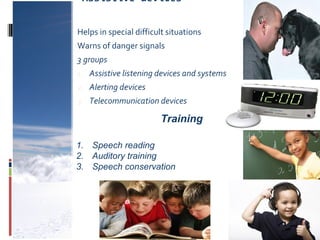
Helps in special difficult situations
Warns of danger signals
3 groups
1. Assistive listening devices and systems
2. Alerting devices
3. Telecommunication devices
Training
1. Speech reading
2. Auditory training
3. Speech conservation
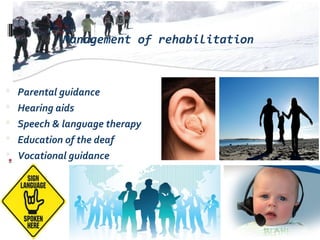
Management of rehabilitation
 Parental guidance
 Hearing aids
 Speech & language therapy
 Education of the deaf
 Vocational guidance
? How a cochlear implant works.webm
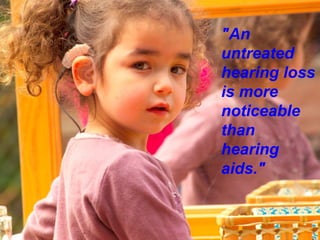
"An
untreated
hearing loss
is more
noticeable
than
hearing
aids."
Thank you for “LISTENING”

Deafness

  • 1.
  • 2.
    “When you loseyour vision, you lose contact with things; when you lose your hearing, you lose contact with people.” Helen Keller
  • 3.
    Protection Impedance match Capture; Amplify mid-freqs Verticaldirection coding Frequency analysis Transduction Outer, middle & inner ear
  • 4.
    ICF Defination (WHO: 2001DDD) Hearingimpairment :refers to complete or partial loss of the ability to hear from one or both ears. The level of impairment can be mild, moderate, severe or profound; Deafness : refers to the complete loss of ability to hear from one or both ears.
  • 5.
    Type of Loss Conductive  Sensorineural  Mixed  Auditory Processing Disorder
  • 6.
    Quantification of HearingLoss  Unable to hear sound at  “Mild” Hearing Loss  26 – 40 dB  “Moderate” Hearing Loss  41-55 dB  “Severe” Hearing Loss  56- 70 dB  “Profound” Hearing Loss  91 dB & greater
  • 7.
    Degree of HearingLoss  Minimal  Mild  Moderate  Moderately Severe  Severe  Profound
  • 8.
    Impact of HLon Quality of Life  Physical health  Emotional & mental health  Other’s perceptions of a person’s mental acuity  Social skills  Family relationships  Self-esteem  Work & school performance
  • 9.
    Hearing Loss  Partof ear not working  Includes:  outer ear  middle ear  inner ear  hearing acoustic nerve  auditory system
  • 10.
    Types  Conductive deafness:due to defect in the conducting mechanism of the ear namely external and middle ear.  Sensori-neural deafness / Perceptive deafness: due to lesions in the labyrinth, 8th nerve & central connections. It includes psychogenic deafness.  Mixed deafness: both the above mentioned types are present.
  • 11.
    External ear:  Wax, Fungus,  Otitis Externa,  Foreign Bodies,  Polyps,  Myringitis,  Stenosis,  Atresia,  Tumours. Causes of Conductive deafness
  • 12.
    Middle Ear Cont…..  Congenitaldefects of the ear drum and ossicles.  Traumatic: Barotrauma, rupture of ear drum, # of the base of the skull  Inflammation: AOM, COM, Serous OM, Adhesive OM.  Tuberculosis and syphilitic OM  Neoplasms  Otosclerosis
  • 13.
    Causes of Conductivedeafness Eustachian tube Catarrh = xcessive discharge from nose / throat / ear  Eustachian catarrh  Eustachian tube dysfunction due to diseases of the nose, paranasal sinuses & pharynx  Barotrauma
  • 14.
  • 15.
    Causes of Sensori-neuraldeafness Local causes (inner ear)  Congenital  Trauma: Head injury, surgical injury to labyrinth, loud sounds (acute or chronic acoustic trauma) producing concussion.  Infections: mumps, syphilis, tuberculous meningitis, enteric fever, labyrinthitis.  Tumours: Acoustic neuroma (Schwanoma of C8 nerve)  Meniere’s disease  Ototoxic drugs: streptomycin, Kanamycin, neomycin, salicylates, frusemide and quinine.
  • 16.
    Causes of Sensori-neuraldeafness General causes  Presbycusis  CVS: atherosclerosis, HTN  CNS: disseminated sclerosis  DM  Avitaminosis  Hypothyroidism  Smoking  Alcoholism  Presbyacusis: is a progressive bilateral symmetrical age-related sensorineural hearing loss. It is also known as age- related hearing loss
  • 17.
    Causes of Sensory-neuraldeafness Psychogenic deafness: 2 types  Functional: due to emotional cause, but the patient is not aware of the cause.  Malingering: no organic or psychological cause.The patient is aware that he is pretending to be deaf for personal gains.
  • 18.
     Trauma: Blastinjury, acoustic trauma, head injury.  CSOM with labyrinthitis.  Otosclerosis  Senile deafness superimposed on conductive deafness. Causes of Mixed deafness
  • 19.
    “The assessment, intervention,and management of communicative consequences of hearing loss” Rehabilitation
  • 20.
    Methods of rehabilitation I.Instrumental devices A. Hearing Aids - Conventional hearing aids - Bone anchored hearing aids - Implantable hearing aids B. Implants - Cochlear implants - Auditory brainstem implants C. Assistive devices for the deaf II. Training A. Speech(lip) training B. Auditory training C. Speech conservation
  • 21.
    Hearing aids Device toamplify sounds ---- 3 parts.  Microphone- picks up sound and converts to electrical impulses.  Amplifier- magnifies electrical impulses.  Receiver-converts electrical impulses back to sound. Types Air conduction hearing aids Bone conduction hearing aids
  • 22.
    Hearing Aids  Bodyworn types  Behind the ear types  Spectacles type  In the ear type  Canal types(ITC/CIC) Types
  • 23.
  • 24.
    Bone anchored hearingaids  Based on the principle of bone conduction  Candidacy profile a) chronic inflammation or infection of ear canal b) children with malformed or absent outer canals c) unilateral deafness.
  • 25.
    Bone anchored hearingaids Titanium fixture, abutment, sound processor
  • 26.
    Bone anchored hearingaids When air conduction hearing aid can’t be used - Canal atresia - Chronic ear discharge - Excessive feedback and discomfort CoHL / Mixed hearing loss - otosclerosis / tympanosclerosis. Single sided hearing loss Indications for BAHA
  • 27.
    Implantable hearing aids Mechanicalvibration delivered directly to the ossicular chain 2 types 1) piezoelectric devices 2) electromagnetic hearing devices . Candidacy profile - Adults 18 yrs and older with moderate to severe SNHL - Should have an experience with hearing aids previously
  • 28.
    Implantable hearing aids Vibrantsoundbridge device Semi implantable device made of 2 components
  • 29.
    Cochlear implants Electronic device-electrical stimulation of auditory nerve 2 components external- sound processor, mic, transmitter and internal-receiver/stimulator, electrode array
  • 30.
    Auditory brainstem implant Stimulates the cochlear nuclear complex in the brainstem directly by placing the implant in the lateral recess of the fourth ventricle.  Used when CN VIII is severed in the surgery of vestibular schwannoma  Multi electrode array is attached to a decron mesh which is placed on the brainstem
  • 31.
  • 32.
    Definition  Cochlear implantsare surgically placed electrical device that receive sound and transmit the resulting electrical signals to electrodes implanted in the cochlea of the ear.  The signals stimulate cochlea, allowing patient to hear.  It is also known as Bionic ear.
  • 33.
    Parts of cochlearimplant  External  Microphone  Speech processor  Transmitter  Internal  Receiver and stimulator  An array of up to 22 electrodes
  • 36.
    Mechanism  Cochlear implantsbypass damaged portion of the ear & directly stimulate the auditory nerve and later the brain recognizes it as sound.
  • 37.
    Assistive devices Helps inspecial difficult situations Warns of danger signals 3 groups 1. Assistive listening devices and systems 2. Alerting devices 3. Telecommunication devices Training 1. Speech reading 2. Auditory training 3. Speech conservation
  • 38.
    Management of rehabilitation Parental guidance  Hearing aids  Speech & language therapy  Education of the deaf  Vocational guidance
  • 39.
    ? How acochlear implant works.webm
  • 40.
  • 41.
    Thank you for“LISTENING”

Editor's Notes

  • #4 The human pinna colours high frequency sounds by interference between the echoes reflected off its different structures (like the colours of light produced by reflection from an oil slick). Only frequencies that have a wavelength comparable to the dimensions of the pinna are influenced by it (> 3kHz). Different high frequencies are amplified by different amounts depending on the direction of the sound in the vertical plane. The brain interprets these changes as direction. The meatus is the tube that links the pinna to the eardrum. It resonates at around 2kHz so that frequencies in that region are transmitted more efficiently to the cochlea than others. This frequency region is particularly important in speech.
  • #22 (useful in actively draining ears, OE, atresia of the ear canal)
  • #25 Suited to people with CoHL, Unilateral hearing loss, mixed hearing loss who can’t wear ITE or BTE hearing aids. 3 components a) titanium fixture b) titanium abutment c) sound processor.
  • #28 Rather than delivering acoustic energy into the EAC direct drive middle ear systems use mechanical vibration delivered directly to the ossicular chain
  • #29 Internal component – vibrating ossicular prosthesis (VORP)- receiver, floating mass transducer and a conductor A microphone, which picks up sound from the environment. A speech processor, which selects and arranges sounds picked up by the microphone. A transmitter and receiver/stimulator, which receive signals from the speech processor and convert them into electric impulses. An electrode array, which is a group of electrodes that collects the impulses from the stimulator and sends them to different regions of the auditory nerve. External component – audio processor worn behind the ear with a mic which picks up sound from the environment and transmit it across the skin by radio frequency waves to the internal receiver.
  • #30 Works by electronic stimulation of the auditory nerve where degeneration of the hair cells in the cochlea has progressed to a point such that amplification provided by hearing aids is no longer effective. aids in hearing and improved communication abilities for persons with severe to profound SNHL.