Auditory Brainstem Implant
Presenter: Dr. Adhishesh Kaul
Moderator: Dr. Udayabhanu H.N.
Associate Professor
Department of ENT
Introduction
• Neuroprosthetic device helping with hearing sensation in patients,
ineligible for Cochlear Implant.
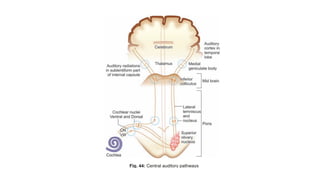
• ABI bypasses Cochlea and Cochlear nerve, stimulating the 2nd
order
neurons, using multichannel surface array in patients with cochlear
and retrocochlear pathologies.
• First ABI: House Ear Institute; 1970
History
1. Alessandro Volta: applied electric current through metal probe to his ears,
evoking sounds described as ‘bubbling’ or ‘crackling’.
2. Guillaume Duchenne: tested electrically evoked auditory sensations using
AC current to stimulate cochlea, associated with ‘buzzing’ or ringing
sound.
3. Djourno and Eyries: 1957; restored hearing sensation in deaf patient by
stimulating cochlear nerve
4. Dr. William House and Dr. John Doyle: implanted deaf patients with early
CI prototype, consisting of single ball electrode
Indications/ Criteria (Absolute)
Bilateral NF 2 with no audiological criteria
Bilateral cochlea / cochlear nerve – aplasia
Bilateral Cochlear ossification/ calcification
Cochlear nerve damage (d/t meningitis/ trauma)
Patient selection
• NF2 patients aged more than 12 years
• Patients with language competency
• Implantation at time of 1st
or 2nd
side surgery
Preoperative Evaluation & Counselling
• Goal: Help patients prepare for loss of hearing after tumor removal
surgery, and expectations from ABI
• Postoperative follow-up to optimize the functioning
• Counselling about post-implantation non auditory sensations like
tingling, or dizziness and no ABI sensations at all
Device
1. Hitselberger: 1979: used CI ball type probe in their 1st
ABI recipient
used with modified body worn hearing aid
2. Subsequently, patients received 2 x 8mm fabric mesh array with 2/3
platinum ribbon electrodes by Huntington Medical Research Institute
used with modified 3M-house type cochlear implant
3. HEI collaborated and developed 8-electrode multichannel ABI
4. Upgraded to 21-electrode (Nucleus ABI24)
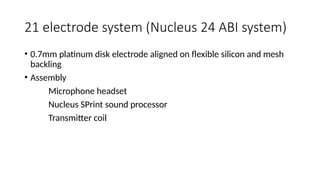
21 electrode system (Nucleus 24 ABI system)
• 0.7mm platinum disk electrode aligned on flexible silicon and mesh
backling
• Assembly
Microphone headset
Nucleus SPrint sound processor
Transmitter coil
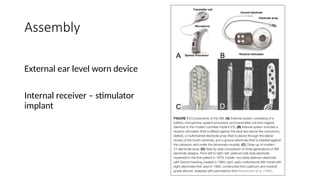
Assembly
External ear level worn device
Internal receiver – stimulator
implant
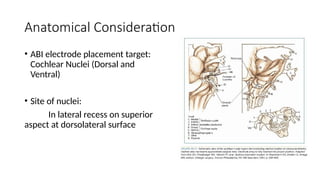
Anatomical Consideration
• ABI electrode placement target:
Cochlear Nuclei (Dorsal and
Ventral)
• Site of nuclei:
In lateral recess on superior
aspect at dorsolateral surface
• Landmarks:
terminus of sleeve like lateral recess forming foramen of Luschka
Inferiorly: roots of glossopharyngeal nerve
foramen vestibulocochlear
facial nerve roots
• Intact choroid plexus marks entry to - Lateral recess (foramen luschka)
• Taenia transverses roof of lateral recess
• In case of anatomical distortion by tumor,
trace – 8th
nerve stump to opening of lateral recess
9th
nerve
Lateral Recess Identification
• Entrance: marked by Choroid Plexus
• Superior wall: root of 8th
nerve
• Inferior edge: 9th
nerve – exits brain along inferior edge
Ventral Cochlear Nucleus
• the main relay between the afferent cochlear input and the ascending
auditory pathways
• Site: most lateral position of lateral recess (foramen of Luschka)
Surgical Considerations
• Approach: Translabyrinthine craniotomy – expose lateral recess of 4th
ventricle
• Recording electrodes: for evoked auditory brainstem responses
activity from CN VIII & IX
• EABR assists with confirmation that electrode array is positioned
properly
• EABR needle sites : vertex of head, 7th
cervical vertebrae, occiput
hairline
• Electromyographic recording of non-auditory activation: Facial nerve
monitoring
• CN 9 monitoring: bipolar electrodes in ipsilateral pharyngeal muscles
Implantation Procedure
• Tumor dissection
• Site for internal receiver: posterosuperior to mastoid cavity
• Suture tunnel holes are created on either side of receiver/stimulator;
prevents alteration of electrode placement
• Lateral recess confirmation: CSF egress as anesthetist induces valsava
maneuver in patient
• Electrode array is mounted on Rosen needle and inserted into lateral
recess with electrode oriented superiorly
• Selected electrodes in array are activated to confirm the position over
cochlear nucleus.
Electrodes tested for EABR, Stimulation of adjacent CN, Vital sign changes
• In case of CN IX stimulation, small insulating Teflon pad is interposed
between electrodes and nerve.
• Electrode array secured using a small Teflon packed into meatus of
lateral recess – further stabilized by fibrous tissue growth.
• Receiver magnet is removed to allow future MRI survillience.
Post-Operative complication
• CSF leak
• Meningitis
• Implant displacement / failure
• Irritation/ Inflammation of skin
• Increased non-auditory sensations
• Tinnitus, facial nerve stimulation, dizziness and pain
Device Activation and Programming
• Activation after 4-8 weeks after implantation – allowing resolution of skin
flap edema over receiver
• Given non-auditory responses and changes in vital signs, it must always be
done in medical setup with emergency assistance available.
• Initial stimulation tasks include:
setting of threshold and comfort levels
evaluation and management of non-auditory stimulation
pitch sealing
• Patients must shave the area and apply thin tape and metal disk to which
transmitter coil adheres.
Working
• Sound signal is processed in external processor
adaptation of the dynamic range
tonotopic reorganization regarding number of active channels
• Sound processor selects Speech Envelope and encodes them
electronically
• Processor selects number and location of electrodes to be stimulated
depending upon intensity and frequency of incoming signal
• After processing, transmitter sends signal to internal receiver
• Finally, signal is sent to ABI electrode array
Speech Envelope
A complex signal such as speech has
many frequencies and the amount
of energy in each frequency is
rapidly changing, over time. In the
figure below represents the speech
signal for the phrase “Mary Mary
quite contrary”. The red line is the
Hilbert envelope low pass filtered
below 50 Hz, representing the
overall slower rate modulation of
energy in the speech
Sound and Speech Perception
• Medical and audiologic follow up – 3 monthly for 1 year then annual
• At follow up extensive audiologic tests in performed
• Majority patients score above chance on CLOSED SET SPEECH
PERCEPTION TESTS, with significant comprehension provided by lip
reading
Benefits
• 82% users are able to perceive sound and use device post-operatively
• 82% users score significantly above chance on a recorded set closed-set
environmental sound identification
• 53.9% users identified common environmental sounds
• 85% users demonstrate statistically significant improvement in open-
sentence understanding when using ABI in conjugation with lip-reading
• 12% users scored greater than 10% in difficult open set sentence
understanding
Optogenetics
Novel strategy to improve brainstem implants through use of light to
control genetically modified cells
• Advantage of light (over electricity) is increased specificity – allowing
selective stimulation & inhibition of neural pathways
• Viral vector-mediated delivery of light-sensitive channel proteins is
used to sensitize human cells to light
• Darrow used adeno-associated viral gene transfer to express
channelrhodopsin-2(ChR-2) in murine model. Using optical fiber
coupled to blue light laser, directed at infected dorsal CN, excitatory
spiking activity was achieved in inferior colliculus and auditory cortex
• Klapoetke in 2014, isolated Chronos (new channelrhodopsin) from
algal species having high light sensitivity and faster channel kinetics,
making it ideal for optogenetically based auditory implants.
Conformable Electrode Arrays
• Modern electrode array designs are flat and result in suboptimal contact to the complex
curvature of the CN and may explain the poor spectral resolution of most ABI users.
• Application of flexible polymers that conform to the brainstem surface has been an
exciting area of research by our group (Minev et al., 2015; Figure 3). Among conducting
polymers, poly(3,4- ethylenedioxythiophene) (PEDOT) has gained particular interest for
its electrochemical stability, efficient charge transfer, and biocompatibility
• In a recent study, the electrode sites of conformable ABI electrode arrays were coated
with PEDOT and polystyrene sulfonate (PSS); the conformable array allowed for greater
access to the tonotopic axis of the CN in mice and the conductive polymer (PEDOT:PSS)
provided ideal electrical (impedance, charge injection capacity) and physical
characteristics (size, thickness, bendability) for CN stimulation (Guex et al., 2015).
Studies are soon underway to characterize acute and chronic responses using
conformable arrays in rodent and primate models.
Penetrating Microelectrode Array
• Classical electrode: Surface electrode
• Limitation: Modest benefit with regard to auditory sensation and
enhancement of lip reading
• Animal Studies: feasibility and effectiveness of implanting penetrating
electrodes in cochlear nucleus
• Advantage: Lower threshold and wider dynamic ranges
• Thresholds
Surface electrode: 10-100 nC/ph
Penetrating electrode: 0.8/2.0nC/ph
ABI in Non tumor patients
• Not approved in USA
• Approved in Europe
• Patient: Postlingually deafened
• Result: greater auditory benefit than tumor patient
• Hypothesis for benefit:
Subclinical brainstem injury due to tumor growth and resection
Intrinsic maldevelopment of cochlear nucleus due to NF2 mutation
• Report: Colletti and Shannon, reported ABI in 10 non-tumor patients,
with retrosigmoid implantation. ~50% outstanding result including open
set recognition with speech alone (comparable to CI)
ABI in Children
• Estimated 2.1% of all deal children in US have b/l cochlea or cochlear
nerve aplasia, making them ideal candidates for ABI.
• Early sound perception is important for cortical plasticity and critical
development of central auditory processing.
• In a study by Sennaroglu, it was found that 46.7% children achieved
closed set discrimination, 20% developed open set speech
discrimination after ABI.
References
1. Scott-Brown’s Otorhinologylaryngology Head & Neck Surgery
2. Glasscock-Shambaugh Surgery of the Ear
3. Schwartz MS, Otto SR, Shannon RV, et al. Auditory brainstem
implants. Neurotherapeutics. 2008;5(1):128-136.
4. Vincent C. Auditory Brainstem Implants: How Do They Work? Anat
Rec. 2012;295:1981-1986.
5. Wong K, Kozin ED, Kanumuri VV, Vachicouras N, Miller J, Lacour S,
Brown MC, Lee DJ. Auditory Brainstem Implants: Recent Progress and
Future Perspectives. Front Neurosci. 2019 Jan
29;13:10.3389/fnins.2019.00010.
Auditory Brainstem Implant Presentations

Auditory Brainstem Implant Presentations

  • 1.
    Auditory Brainstem Implant Presenter:Dr. Adhishesh Kaul Moderator: Dr. Udayabhanu H.N. Associate Professor Department of ENT
  • 2.
    Introduction • Neuroprosthetic devicehelping with hearing sensation in patients, ineligible for Cochlear Implant. • ABI bypasses Cochlea and Cochlear nerve, stimulating the 2nd order neurons, using multichannel surface array in patients with cochlear and retrocochlear pathologies. • First ABI: House Ear Institute; 1970
  • 4.
    History 1. Alessandro Volta:applied electric current through metal probe to his ears, evoking sounds described as ‘bubbling’ or ‘crackling’. 2. Guillaume Duchenne: tested electrically evoked auditory sensations using AC current to stimulate cochlea, associated with ‘buzzing’ or ringing sound. 3. Djourno and Eyries: 1957; restored hearing sensation in deaf patient by stimulating cochlear nerve 4. Dr. William House and Dr. John Doyle: implanted deaf patients with early CI prototype, consisting of single ball electrode
  • 5.
    Indications/ Criteria (Absolute) BilateralNF 2 with no audiological criteria Bilateral cochlea / cochlear nerve – aplasia Bilateral Cochlear ossification/ calcification Cochlear nerve damage (d/t meningitis/ trauma)
  • 6.
    Patient selection • NF2patients aged more than 12 years • Patients with language competency • Implantation at time of 1st or 2nd side surgery
  • 7.
    Preoperative Evaluation &Counselling • Goal: Help patients prepare for loss of hearing after tumor removal surgery, and expectations from ABI • Postoperative follow-up to optimize the functioning • Counselling about post-implantation non auditory sensations like tingling, or dizziness and no ABI sensations at all
  • 8.
    Device 1. Hitselberger: 1979:used CI ball type probe in their 1st ABI recipient used with modified body worn hearing aid 2. Subsequently, patients received 2 x 8mm fabric mesh array with 2/3 platinum ribbon electrodes by Huntington Medical Research Institute used with modified 3M-house type cochlear implant 3. HEI collaborated and developed 8-electrode multichannel ABI 4. Upgraded to 21-electrode (Nucleus ABI24)
  • 9.
    21 electrode system(Nucleus 24 ABI system) • 0.7mm platinum disk electrode aligned on flexible silicon and mesh backling • Assembly Microphone headset Nucleus SPrint sound processor Transmitter coil
  • 10.
    Assembly External ear levelworn device Internal receiver – stimulator implant
  • 11.
    Anatomical Consideration • ABIelectrode placement target: Cochlear Nuclei (Dorsal and Ventral) • Site of nuclei: In lateral recess on superior aspect at dorsolateral surface
  • 12.
    • Landmarks: terminus ofsleeve like lateral recess forming foramen of Luschka Inferiorly: roots of glossopharyngeal nerve foramen vestibulocochlear facial nerve roots • Intact choroid plexus marks entry to - Lateral recess (foramen luschka) • Taenia transverses roof of lateral recess • In case of anatomical distortion by tumor, trace – 8th nerve stump to opening of lateral recess 9th nerve
  • 13.
    Lateral Recess Identification •Entrance: marked by Choroid Plexus • Superior wall: root of 8th nerve • Inferior edge: 9th nerve – exits brain along inferior edge
  • 14.
    Ventral Cochlear Nucleus •the main relay between the afferent cochlear input and the ascending auditory pathways • Site: most lateral position of lateral recess (foramen of Luschka)
  • 15.
    Surgical Considerations • Approach:Translabyrinthine craniotomy – expose lateral recess of 4th ventricle • Recording electrodes: for evoked auditory brainstem responses activity from CN VIII & IX • EABR assists with confirmation that electrode array is positioned properly • EABR needle sites : vertex of head, 7th cervical vertebrae, occiput hairline • Electromyographic recording of non-auditory activation: Facial nerve monitoring • CN 9 monitoring: bipolar electrodes in ipsilateral pharyngeal muscles
  • 17.
    Implantation Procedure • Tumordissection • Site for internal receiver: posterosuperior to mastoid cavity • Suture tunnel holes are created on either side of receiver/stimulator; prevents alteration of electrode placement • Lateral recess confirmation: CSF egress as anesthetist induces valsava maneuver in patient • Electrode array is mounted on Rosen needle and inserted into lateral recess with electrode oriented superiorly • Selected electrodes in array are activated to confirm the position over cochlear nucleus. Electrodes tested for EABR, Stimulation of adjacent CN, Vital sign changes
  • 18.
    • In caseof CN IX stimulation, small insulating Teflon pad is interposed between electrodes and nerve. • Electrode array secured using a small Teflon packed into meatus of lateral recess – further stabilized by fibrous tissue growth. • Receiver magnet is removed to allow future MRI survillience.
  • 24.
    Post-Operative complication • CSFleak • Meningitis • Implant displacement / failure • Irritation/ Inflammation of skin • Increased non-auditory sensations • Tinnitus, facial nerve stimulation, dizziness and pain
  • 25.
    Device Activation andProgramming • Activation after 4-8 weeks after implantation – allowing resolution of skin flap edema over receiver • Given non-auditory responses and changes in vital signs, it must always be done in medical setup with emergency assistance available. • Initial stimulation tasks include: setting of threshold and comfort levels evaluation and management of non-auditory stimulation pitch sealing • Patients must shave the area and apply thin tape and metal disk to which transmitter coil adheres.
  • 27.
    Working • Sound signalis processed in external processor adaptation of the dynamic range tonotopic reorganization regarding number of active channels • Sound processor selects Speech Envelope and encodes them electronically • Processor selects number and location of electrodes to be stimulated depending upon intensity and frequency of incoming signal • After processing, transmitter sends signal to internal receiver • Finally, signal is sent to ABI electrode array
  • 28.
    Speech Envelope A complexsignal such as speech has many frequencies and the amount of energy in each frequency is rapidly changing, over time. In the figure below represents the speech signal for the phrase “Mary Mary quite contrary”. The red line is the Hilbert envelope low pass filtered below 50 Hz, representing the overall slower rate modulation of energy in the speech
  • 29.
    Sound and SpeechPerception • Medical and audiologic follow up – 3 monthly for 1 year then annual • At follow up extensive audiologic tests in performed • Majority patients score above chance on CLOSED SET SPEECH PERCEPTION TESTS, with significant comprehension provided by lip reading
  • 31.
    Benefits • 82% usersare able to perceive sound and use device post-operatively • 82% users score significantly above chance on a recorded set closed-set environmental sound identification • 53.9% users identified common environmental sounds • 85% users demonstrate statistically significant improvement in open- sentence understanding when using ABI in conjugation with lip-reading • 12% users scored greater than 10% in difficult open set sentence understanding
  • 32.
    Optogenetics Novel strategy toimprove brainstem implants through use of light to control genetically modified cells • Advantage of light (over electricity) is increased specificity – allowing selective stimulation & inhibition of neural pathways • Viral vector-mediated delivery of light-sensitive channel proteins is used to sensitize human cells to light • Darrow used adeno-associated viral gene transfer to express channelrhodopsin-2(ChR-2) in murine model. Using optical fiber coupled to blue light laser, directed at infected dorsal CN, excitatory spiking activity was achieved in inferior colliculus and auditory cortex
  • 33.
    • Klapoetke in2014, isolated Chronos (new channelrhodopsin) from algal species having high light sensitivity and faster channel kinetics, making it ideal for optogenetically based auditory implants.
  • 35.
    Conformable Electrode Arrays •Modern electrode array designs are flat and result in suboptimal contact to the complex curvature of the CN and may explain the poor spectral resolution of most ABI users. • Application of flexible polymers that conform to the brainstem surface has been an exciting area of research by our group (Minev et al., 2015; Figure 3). Among conducting polymers, poly(3,4- ethylenedioxythiophene) (PEDOT) has gained particular interest for its electrochemical stability, efficient charge transfer, and biocompatibility • In a recent study, the electrode sites of conformable ABI electrode arrays were coated with PEDOT and polystyrene sulfonate (PSS); the conformable array allowed for greater access to the tonotopic axis of the CN in mice and the conductive polymer (PEDOT:PSS) provided ideal electrical (impedance, charge injection capacity) and physical characteristics (size, thickness, bendability) for CN stimulation (Guex et al., 2015). Studies are soon underway to characterize acute and chronic responses using conformable arrays in rodent and primate models.
  • 36.
    Penetrating Microelectrode Array •Classical electrode: Surface electrode • Limitation: Modest benefit with regard to auditory sensation and enhancement of lip reading • Animal Studies: feasibility and effectiveness of implanting penetrating electrodes in cochlear nucleus • Advantage: Lower threshold and wider dynamic ranges
  • 37.
    • Thresholds Surface electrode:10-100 nC/ph Penetrating electrode: 0.8/2.0nC/ph
  • 39.
    ABI in Nontumor patients • Not approved in USA • Approved in Europe • Patient: Postlingually deafened • Result: greater auditory benefit than tumor patient • Hypothesis for benefit: Subclinical brainstem injury due to tumor growth and resection Intrinsic maldevelopment of cochlear nucleus due to NF2 mutation • Report: Colletti and Shannon, reported ABI in 10 non-tumor patients, with retrosigmoid implantation. ~50% outstanding result including open set recognition with speech alone (comparable to CI)
  • 40.
    ABI in Children •Estimated 2.1% of all deal children in US have b/l cochlea or cochlear nerve aplasia, making them ideal candidates for ABI. • Early sound perception is important for cortical plasticity and critical development of central auditory processing. • In a study by Sennaroglu, it was found that 46.7% children achieved closed set discrimination, 20% developed open set speech discrimination after ABI.
  • 41.
    References 1. Scott-Brown’s OtorhinologylaryngologyHead & Neck Surgery 2. Glasscock-Shambaugh Surgery of the Ear 3. Schwartz MS, Otto SR, Shannon RV, et al. Auditory brainstem implants. Neurotherapeutics. 2008;5(1):128-136. 4. Vincent C. Auditory Brainstem Implants: How Do They Work? Anat Rec. 2012;295:1981-1986. 5. Wong K, Kozin ED, Kanumuri VV, Vachicouras N, Miller J, Lacour S, Brown MC, Lee DJ. Auditory Brainstem Implants: Recent Progress and Future Perspectives. Front Neurosci. 2019 Jan 29;13:10.3389/fnins.2019.00010.

Editor's Notes

  • #4 3. discriminate sound intensity and recognize limited closed-set speech 4. frequency discrimination and closed set speech recognition
  • #9 Processor: also used with CI Uses nucleus SPEAK spectral peak speech coding stratergy
  • #15 Retrosigmoid approach also used
  • #16 is the thin, highly vascularized, loose connective tissue portion of pia mater that gives rise to the choroid plexus.
  • #17 Less non auditory stimulus if electrode placed fully in lateral recess
  • #20 Size: 3 * 8mm
  • #27 the speech envelope is an attempt to characterise this variation in the form of an acoustic feature
  • #29 SERT, MTS test, NU-CHIP test, CID sentence test