Cochlear Implantation
Dr. UtkalMishra
2nd Yr. PG (ENT)
INTRODUCTION
Cochlear implants are the 1st true bionic sense organs.
It is surgically implanted in the inner ear and activated by a device
worn behind the ear.
Cochlear Implants are not hearing aids.
The Fundamental Concept of Cochlear Implant is to bypass the
damaged hair cells.
The device bypasses damaged parts of the auditory system and
directly stimulates the nerve of hearing, allowing individuals who are
profoundly deaf to receive sound.
HISTORY
1800 – Alexandro Volta - electrical stimulation to metal rods inserted
in his ear canal created an auditory sensation .
1957 – Djourno & Eyeries – stimulated auditory nerve directly with
current & the patient reported a clear auditory percept.
1961 – House & Doyle – put electrodes in scala tympani of 2
profoundly deaf adults & get a clear auditory response
1972 – First single channel cochlear implant developed.
1984 – Cochlear Corporation introduced the first ever Multichannel
Cochlear Implant System called “NUCLEUS 22”
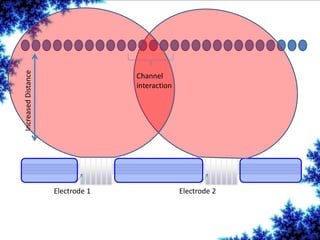
1976 Wednesday 22 September - The first cochlear implant took
place at Saint-Antoine hospital, Paris. It was performed by
CH Chouard & assisted by Bernard Meyer.
PARTS OF COCHLEAR IMPLANT
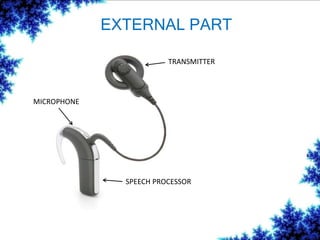
EXTERNAL PART –
1. Microphone
2. Speech processor
3. Transmitter
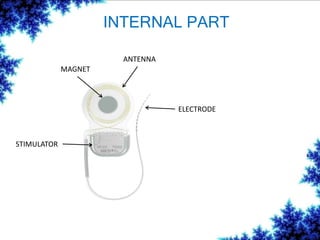
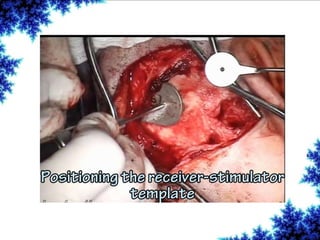
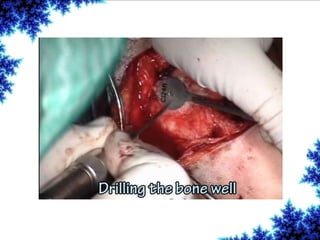
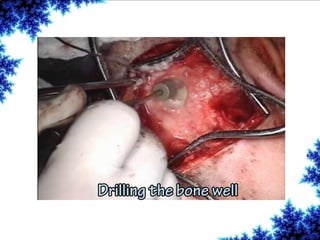
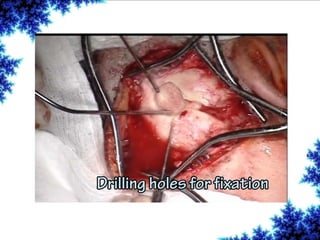
INTERNAL PART –
1. Receiver – Stimulator
2. Electrode Array
EXTERNAL PART
MICROPHONE
SPEECH PROCESSOR
TRANSMITTER
INTERNAL PART
MAGNET
ANTENNA
STIMULATOR
ELECTRODE
TYPES OF COCHLEAR IMPLANT
3 Types :-
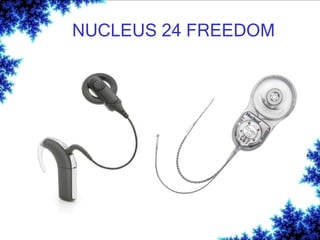
1. NUCLEUS 24 FREEDOM by Cochlear Corporation
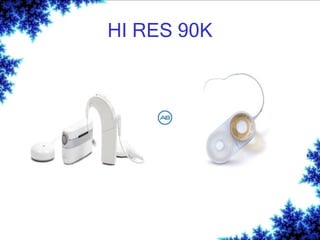
2. HI RES 90K by Advanced Bionics
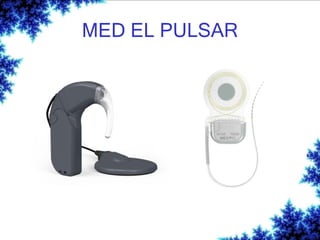
3. PULSAR by Med El
NUCLEUS 24 FREEDOM
HI RES 90K
MED EL PULSAR
COCHLEAR IMPLANT CANDIDATES
Each cochlear implant system is shipped with a
“Physician's Package Insert” which specifies the FDA
labeled indications for implantation.
Since the three cochlear implant manufacturers generally
work independently, the labeled indications for cochlear
implant criteria vary across the companies.
ADULT
Age – More than 18 yrs
Bilateral severe to profound Sensorineural hearing loss.
Both Advanced Bionics and Med El - severe-to-profound
Cochlear Corporation - moderate-to-profound
Must be Postlingual Deaf
Little or no benefit from hearing aids.
Inner ears must be surgically able to accept the device
Must not have any chronic illness
A deaf adult who never learned to speak does not benefit from a cochlear
implant.
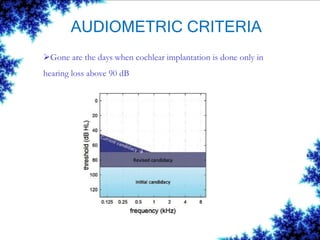
AUDIOMETRIC CRITERIA
Gone are the days when cochlear implantation is done only in
hearing loss above 90 dB
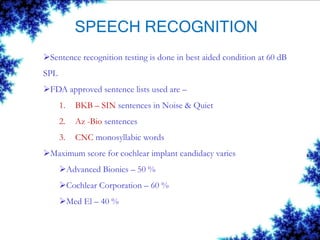
SPEECH RECOGNITION
Sentence recognition testing is done in best aided condition at 60 dB
SPL
FDA approved sentence lists used are –
1. BKB – SIN sentences in Noise & Quiet
2. Az -Bio sentences
3. CNC monosyllabic words
Maximum score for cochlear implant candidacy varies
Advanced Bionics – 50 %
Cochlear Corporation – 60 %
Med El – 40 %
PEDIATRIC
Age – More than 12 months
Bilateral profound sensorineural hearing loss > 90 dB
No benefit at all with the most optimized hearing aid.
Inner Ear surgically accesible in CT scan
Auditory nerve present in MRI
Post lingual profound deafness caused by meningitis is not a good
candidate for cochlear implant. – neoosteogenesis causing cochlear
duct obliteration.
AGE 12 – 24 months
Bilateral profound sensorineural hearing loss
Trial of hearing aids for 3 months - should make at least 3 months of
progress in auditory skills and speech/language development.
The evaluation of auditory skills and progress for children aged birth to 2
years is not achieved by simply looking at the audiogram.
Auditory skills are generally assessed via parental history and administration
of validated questionnaires designed to gauge auditory-based responsiveness to
speech and sounds in a child's environment.
QUESTIONNAIRE
IT-MAIS – Infant Toddler version of
meaningful Auditory Integration Scale
(Commonest)
FAPCI - 23-item Functioning after Pediatric
Cochlear Implantation
35-item Little Ears auditory questionnaire
PEACH - Parents' Evaluation of
Aural/Oral Performance in Children
OLDER CHILDREN
The determination of cochlear implant candidacy for older children
is generally based upon either mono- or multi-syllabic word
recognition by
Early Speech Perception Test
Multisyllabic Lexical Neighbourhood test
HINT Sentences for children < 30 %
WHICH EAR TO IMPLANT
Better hearing ear
Most recently deaf ear
Least obstructed labyrinth
In traumatic hearing loss the ear with reduced labyrinth
function chosen
Electroacoustic / Hybrid Implant
Combine a cochlear implant with hearing aid.
Indication – Individuals with profound high frequency loss with
retained low frequency hearing
CI – Stimulates basal turn >> High Frequency
Hearing aid amplifies low frequency
DEVICE SELECTION
Aesthetic looks
Coding Strategy
Electrode arrays –
1. Compressed array
2. Double array
CODING STRATEGY
A speech coding strategy defines the method by which pitch,
loudness & timing of sound is translated into series of impulses.
2 types –
1. Simultaneous (Only AB)
2. Non simultaneous
SIMULTANEOUS STRATEGY
Activation of more than one electrode at same time.
Provide a more natural quality of sound
Only Advanced Bionics is capable of SS.
Disadvantage- When 2 electrodes are activated simultaneously there
is chance of signal interference.
So Modiolus Hugging Electrodes are developed – lies close to
spiral ganglion so less intensity sound is required for activation hence
less interference.
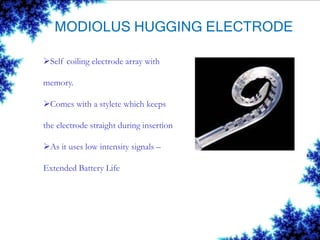
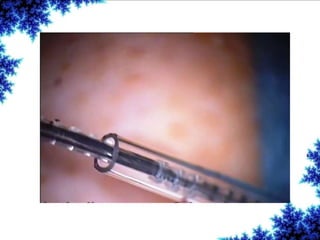
MODIOLUS HUGGING ELECTRODE
Self coiling electrode array with
memory.
Comes with a stylete which keeps
the electrode straight during insertion
As it uses low intensity signals –
Extended Battery Life
Electrode 1 Electrode 2
Channel
interaction
IncreasedDistance
Spiral Ganglion cells
Electrode 1 Electrode 2
Activated CellsActivated Cells
PRE-OP EVALUATION
1. AUDIOLOGICAL –
PTA
Speech audiometry
Aided audiometry
BERA
Promontory Stimulation Test
OAE
2. RADIOLOGICAL –
HRCT –
Cochlear Hypoplasia
IAC
MRI –
Early Labyrinthitis Ossificans
Postmeningitic Endocochlear
Obstruction
Absent Cochlear Nerve
SURGICAL PROCEDURE
CONSIDERATIONS
Can be done as outpatient or inpatient.
Can be done under GA or LA.
IV antibiotics should be given at least 20 minutes before skin
incision.
Surgery duration – 3 -5 hrs
Duration of stay in Hospital – 2 days
3 to 4 weeks later – Programming of device
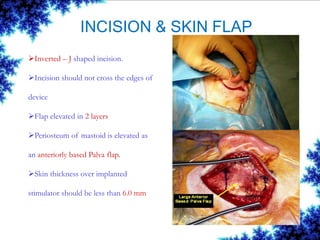
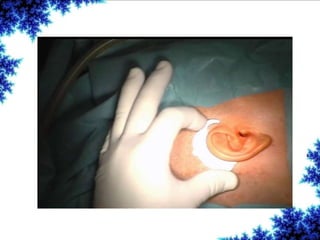
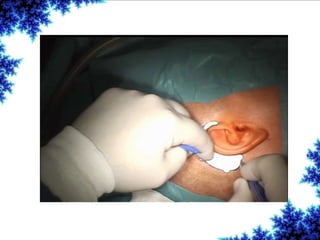
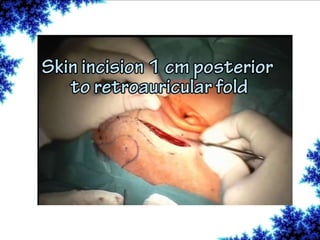
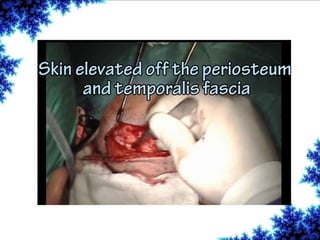
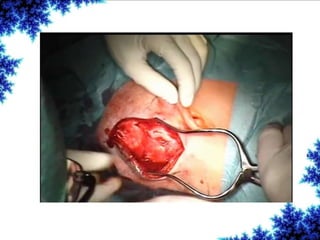
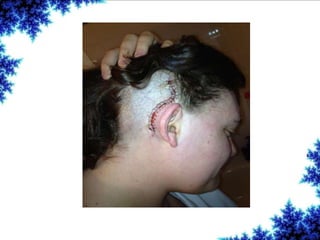
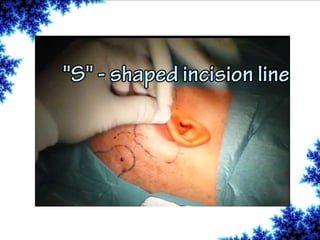
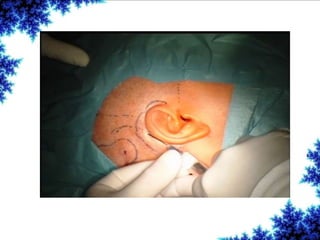
INCISION & SKIN FLAP
Inverted – J shaped incision.
Incision should not cross the edges of
device
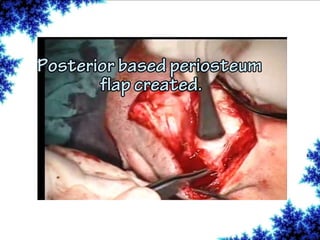
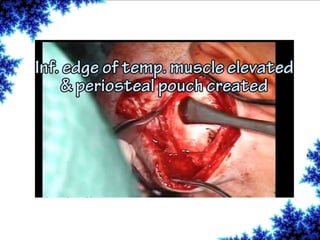
Flap elevated in 2 layers
Periosteum of mastoid is elevated as
an anteriorly based Palva flap.
Skin thickness over implanted
stimulator should be less than 6.0 mm
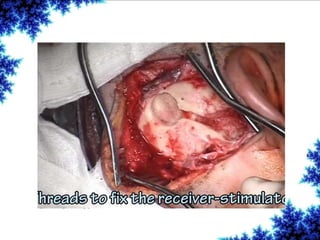
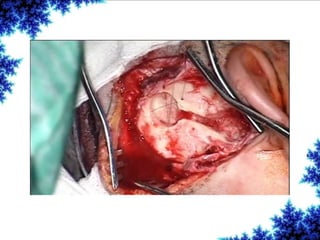
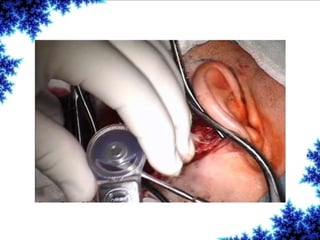
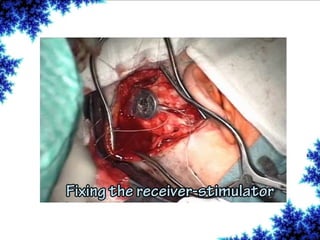
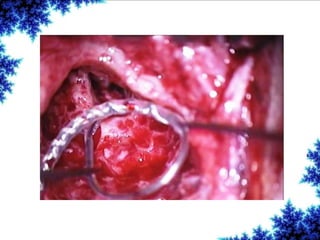
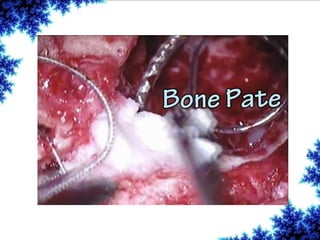
THE WELL
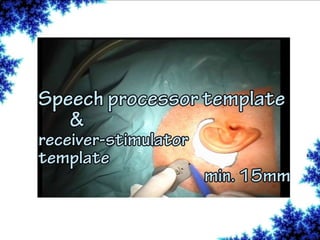
A portion of skull as flat as possible selected for the placement of
stimulator minm. 15mm postr. to EAC.
Surgical drill used to create a defect in the skull contoured exactly
to fit the stimulator
A channel is also formed for the passage of electrodes to mastoid
cavity.
Tie down holes are drilled around the well. Dangerous !!!
Device is fixed with sutures in the well.
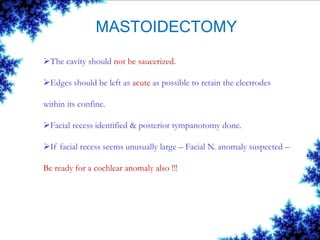
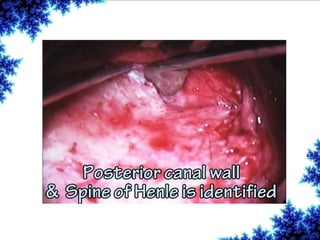
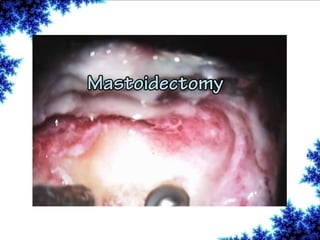
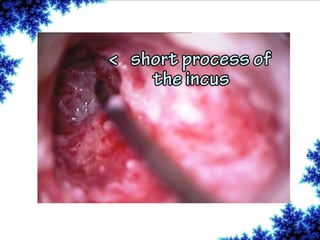
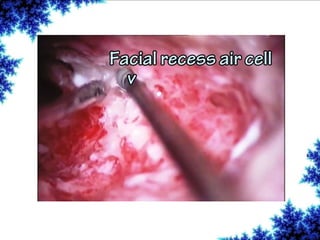
MASTOIDECTOMY
The cavity should not be saucerized.
Edges should be left as acute as possible to retain the electrodes
within its confine.
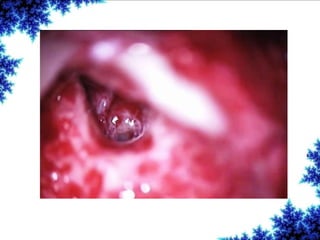
Facial recess identified & posterior tympanotomy done.
If facial recess seems unusually large – Facial N. anomaly suspected –
Be ready for a cochlear anomaly also !!!
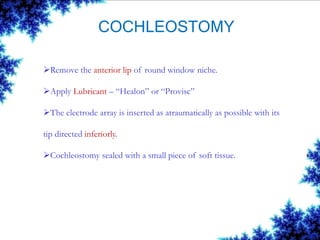
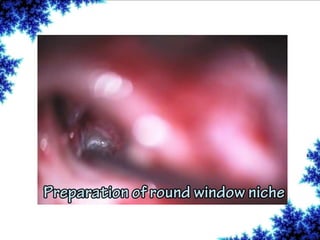
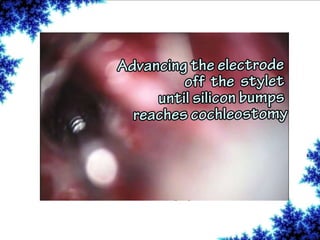
COCHLEOSTOMY
Remove the anterior lip of round window niche.
Apply Lubricant – “Healon” or “Provisc”
The electrode array is inserted as atraumatically as possible with its
tip directed inferiorly.
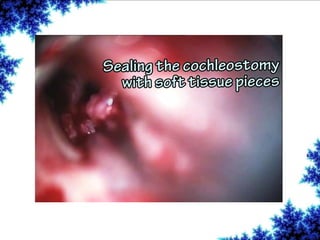
Cochleostomy sealed with a small piece of soft tissue.
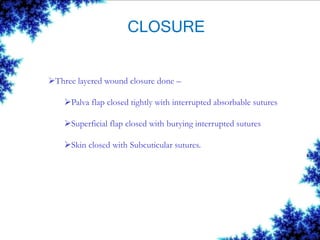
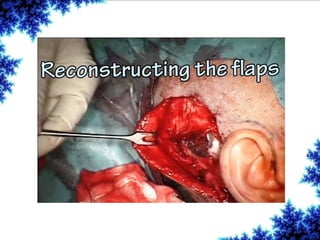
CLOSURE
Three layered wound closure done –
Palva flap closed tightly with interrupted absorbable sutures
Superficial flap closed with burying interrupted sutures
Skin closed with Subcuticular sutures.
POST OP COMPLICATIONS
EARLY
Facial N. Injury
Alteration of Taste
Infection
Wound dehiscnce / Flap Necrosis
Early Device Failure
CSF Leak
WOUND DEHISCENCE / FLAP NECROSIS
Wound dehiscence occurs commonly in an active child.
If small – leave as such to heal by secondary intension
If large – Secondary closure in OT
Flap Necrosis occurs due to aggressive thining of flap – most
serious complication & require device removal.
CSF LEAK
Occurs frequently at the time of drilling tie down holes.
Can also occur after opening of scala tympani in case of – modiolar
defect. / Common cavity deformity. GUSHERS
Controlled by packing the common cavity with muscle.
If still not controlled – Ear is closed by plugging the eustachian tube,
filling the middle ear & mastoid with fat and oversewing the Extn.
Auditory canal.
LATE
Extrusion / Exposure of Device
Pain
Displacement of Electrodes
Late device failure
Otitis Media
Meningitis
MENINGITIS
Cochlear implantation recipients are at high risk of developing
Pneumococcal Meningitis.
Center for Disease Control made it mandatory for pneumococcal vaccination
as follows -
All children < 1 yr. must receive 3 doses of Pneumococcal Conjugate
(PEVNAR) vaccine.
Cochlear implant child > 2 yr who have received PEVNAR should receive
one dose dose of pneumococcal polysacharide vaccine.
Cochlear Implant child > 5yr should receive one dose of pneumococcal
polysaccharide vaccine.
DEVICE ACTIVATION
PROCESS
After 3 -4 weeks post op when the wound is well healed implantee
returns to clinic to have the external parts of the device fitted called
“HOOK UP”
There are 2 types of device stimulation modes –
BIPOLAR – each active electrode paired with another
intracochlear electrode.
MONOPOLAR – It is most preferred mode. Paired with
extracochlear electrode.
PROCESS
Determination of Threshold level – (minimum) & most comfortable
loudness level (maximum) for each electrode
Then frequency bands are assigned to each electrode pair by software
program.
In prelingually deaf child this process is very complicated so recently
some objective methods are devised like –
Neural Response Telemetry
Stapedial reflex estimation
Electrical ABR
Now I am ready to answer
your Questions !!!

Cochlear implantation dr utkal

  • 1.
  • 2.
    INTRODUCTION Cochlear implants arethe 1st true bionic sense organs. It is surgically implanted in the inner ear and activated by a device worn behind the ear. Cochlear Implants are not hearing aids. The Fundamental Concept of Cochlear Implant is to bypass the damaged hair cells. The device bypasses damaged parts of the auditory system and directly stimulates the nerve of hearing, allowing individuals who are profoundly deaf to receive sound.
  • 3.
    HISTORY 1800 – AlexandroVolta - electrical stimulation to metal rods inserted in his ear canal created an auditory sensation . 1957 – Djourno & Eyeries – stimulated auditory nerve directly with current & the patient reported a clear auditory percept. 1961 – House & Doyle – put electrodes in scala tympani of 2 profoundly deaf adults & get a clear auditory response 1972 – First single channel cochlear implant developed. 1984 – Cochlear Corporation introduced the first ever Multichannel Cochlear Implant System called “NUCLEUS 22” 1976 Wednesday 22 September - The first cochlear implant took place at Saint-Antoine hospital, Paris. It was performed by CH Chouard & assisted by Bernard Meyer.
  • 4.
    PARTS OF COCHLEARIMPLANT EXTERNAL PART – 1. Microphone 2. Speech processor 3. Transmitter INTERNAL PART – 1. Receiver – Stimulator 2. Electrode Array
  • 5.
  • 6.
  • 7.
    TYPES OF COCHLEARIMPLANT 3 Types :- 1. NUCLEUS 24 FREEDOM by Cochlear Corporation 2. HI RES 90K by Advanced Bionics 3. PULSAR by Med El
  • 8.
  • 9.
  • 10.
  • 11.
    COCHLEAR IMPLANT CANDIDATES Eachcochlear implant system is shipped with a “Physician's Package Insert” which specifies the FDA labeled indications for implantation. Since the three cochlear implant manufacturers generally work independently, the labeled indications for cochlear implant criteria vary across the companies.
  • 12.
    ADULT Age – Morethan 18 yrs Bilateral severe to profound Sensorineural hearing loss. Both Advanced Bionics and Med El - severe-to-profound Cochlear Corporation - moderate-to-profound Must be Postlingual Deaf Little or no benefit from hearing aids. Inner ears must be surgically able to accept the device Must not have any chronic illness A deaf adult who never learned to speak does not benefit from a cochlear implant.
  • 13.
    AUDIOMETRIC CRITERIA Gone arethe days when cochlear implantation is done only in hearing loss above 90 dB
  • 14.
    SPEECH RECOGNITION Sentence recognitiontesting is done in best aided condition at 60 dB SPL FDA approved sentence lists used are – 1. BKB – SIN sentences in Noise & Quiet 2. Az -Bio sentences 3. CNC monosyllabic words Maximum score for cochlear implant candidacy varies Advanced Bionics – 50 % Cochlear Corporation – 60 % Med El – 40 %
  • 15.
    PEDIATRIC Age – Morethan 12 months Bilateral profound sensorineural hearing loss > 90 dB No benefit at all with the most optimized hearing aid. Inner Ear surgically accesible in CT scan Auditory nerve present in MRI Post lingual profound deafness caused by meningitis is not a good candidate for cochlear implant. – neoosteogenesis causing cochlear duct obliteration.
  • 16.
    AGE 12 –24 months Bilateral profound sensorineural hearing loss Trial of hearing aids for 3 months - should make at least 3 months of progress in auditory skills and speech/language development. The evaluation of auditory skills and progress for children aged birth to 2 years is not achieved by simply looking at the audiogram. Auditory skills are generally assessed via parental history and administration of validated questionnaires designed to gauge auditory-based responsiveness to speech and sounds in a child's environment.
  • 17.
    QUESTIONNAIRE IT-MAIS – InfantToddler version of meaningful Auditory Integration Scale (Commonest) FAPCI - 23-item Functioning after Pediatric Cochlear Implantation 35-item Little Ears auditory questionnaire PEACH - Parents' Evaluation of Aural/Oral Performance in Children
  • 18.
    OLDER CHILDREN The determinationof cochlear implant candidacy for older children is generally based upon either mono- or multi-syllabic word recognition by Early Speech Perception Test Multisyllabic Lexical Neighbourhood test HINT Sentences for children < 30 %
  • 19.
    WHICH EAR TOIMPLANT Better hearing ear Most recently deaf ear Least obstructed labyrinth In traumatic hearing loss the ear with reduced labyrinth function chosen
  • 20.
    Electroacoustic / HybridImplant Combine a cochlear implant with hearing aid. Indication – Individuals with profound high frequency loss with retained low frequency hearing CI – Stimulates basal turn >> High Frequency Hearing aid amplifies low frequency
  • 21.
    DEVICE SELECTION Aesthetic looks CodingStrategy Electrode arrays – 1. Compressed array 2. Double array
  • 22.
    CODING STRATEGY A speechcoding strategy defines the method by which pitch, loudness & timing of sound is translated into series of impulses. 2 types – 1. Simultaneous (Only AB) 2. Non simultaneous
  • 23.
    SIMULTANEOUS STRATEGY Activation ofmore than one electrode at same time. Provide a more natural quality of sound Only Advanced Bionics is capable of SS. Disadvantage- When 2 electrodes are activated simultaneously there is chance of signal interference. So Modiolus Hugging Electrodes are developed – lies close to spiral ganglion so less intensity sound is required for activation hence less interference.
  • 24.
    MODIOLUS HUGGING ELECTRODE Selfcoiling electrode array with memory. Comes with a stylete which keeps the electrode straight during insertion As it uses low intensity signals – Extended Battery Life
  • 25.
    Electrode 1 Electrode2 Channel interaction IncreasedDistance
  • 26.
    Spiral Ganglion cells Electrode1 Electrode 2 Activated CellsActivated Cells
  • 27.
    PRE-OP EVALUATION 1. AUDIOLOGICAL– PTA Speech audiometry Aided audiometry BERA Promontory Stimulation Test OAE 2. RADIOLOGICAL – HRCT – Cochlear Hypoplasia IAC MRI – Early Labyrinthitis Ossificans Postmeningitic Endocochlear Obstruction Absent Cochlear Nerve
  • 28.
  • 29.
    CONSIDERATIONS Can be doneas outpatient or inpatient. Can be done under GA or LA. IV antibiotics should be given at least 20 minutes before skin incision. Surgery duration – 3 -5 hrs Duration of stay in Hospital – 2 days 3 to 4 weeks later – Programming of device
  • 30.
    INCISION & SKINFLAP Inverted – J shaped incision. Incision should not cross the edges of device Flap elevated in 2 layers Periosteum of mastoid is elevated as an anteriorly based Palva flap. Skin thickness over implanted stimulator should be less than 6.0 mm
  • 31.
    THE WELL A portionof skull as flat as possible selected for the placement of stimulator minm. 15mm postr. to EAC. Surgical drill used to create a defect in the skull contoured exactly to fit the stimulator A channel is also formed for the passage of electrodes to mastoid cavity. Tie down holes are drilled around the well. Dangerous !!! Device is fixed with sutures in the well.
  • 32.
    MASTOIDECTOMY The cavity shouldnot be saucerized. Edges should be left as acute as possible to retain the electrodes within its confine. Facial recess identified & posterior tympanotomy done. If facial recess seems unusually large – Facial N. anomaly suspected – Be ready for a cochlear anomaly also !!!
  • 33.
    COCHLEOSTOMY Remove the anteriorlip of round window niche. Apply Lubricant – “Healon” or “Provisc” The electrode array is inserted as atraumatically as possible with its tip directed inferiorly. Cochleostomy sealed with a small piece of soft tissue.
  • 34.
    CLOSURE Three layered woundclosure done – Palva flap closed tightly with interrupted absorbable sutures Superficial flap closed with burying interrupted sutures Skin closed with Subcuticular sutures.
  • 67.
  • 68.
    EARLY Facial N. Injury Alterationof Taste Infection Wound dehiscnce / Flap Necrosis Early Device Failure CSF Leak
  • 69.
    WOUND DEHISCENCE /FLAP NECROSIS Wound dehiscence occurs commonly in an active child. If small – leave as such to heal by secondary intension If large – Secondary closure in OT Flap Necrosis occurs due to aggressive thining of flap – most serious complication & require device removal.
  • 70.
    CSF LEAK Occurs frequentlyat the time of drilling tie down holes. Can also occur after opening of scala tympani in case of – modiolar defect. / Common cavity deformity. GUSHERS Controlled by packing the common cavity with muscle. If still not controlled – Ear is closed by plugging the eustachian tube, filling the middle ear & mastoid with fat and oversewing the Extn. Auditory canal.
  • 71.
    LATE Extrusion / Exposureof Device Pain Displacement of Electrodes Late device failure Otitis Media Meningitis
  • 72.
    MENINGITIS Cochlear implantation recipientsare at high risk of developing Pneumococcal Meningitis. Center for Disease Control made it mandatory for pneumococcal vaccination as follows - All children < 1 yr. must receive 3 doses of Pneumococcal Conjugate (PEVNAR) vaccine. Cochlear implant child > 2 yr who have received PEVNAR should receive one dose dose of pneumococcal polysacharide vaccine. Cochlear Implant child > 5yr should receive one dose of pneumococcal polysaccharide vaccine.
  • 73.
  • 74.
    PROCESS After 3 -4weeks post op when the wound is well healed implantee returns to clinic to have the external parts of the device fitted called “HOOK UP” There are 2 types of device stimulation modes – BIPOLAR – each active electrode paired with another intracochlear electrode. MONOPOLAR – It is most preferred mode. Paired with extracochlear electrode.
  • 75.
    PROCESS Determination of Thresholdlevel – (minimum) & most comfortable loudness level (maximum) for each electrode Then frequency bands are assigned to each electrode pair by software program. In prelingually deaf child this process is very complicated so recently some objective methods are devised like – Neural Response Telemetry Stapedial reflex estimation Electrical ABR
  • 76.
    Now I amready to answer your Questions !!!