Intra Tympanic Medications Dr. T. Balasubramanian M.S. D.L.O.
Why ? Focused application High drug levels where it is needed most Use of smaller quantity of the drug
Round window anatomy Round window is about 70  µ thick Consists of 3 layers Acts as a semi permeable membrane Blood labyrinthine barrier
What drugs can be used   ? Gentamycin Lignocaine Steroids Inner ear cells could be potential targets for gene therapy Calpain inhibitors (leupeptin)
Lignocaine as I.T. infusion Silences the hyper functional neuronal pathways which causes tinnitus Causes intense vertigo and nausea Effect does not last long hence abandoned
Indications for intra tympanic steroids Idiopathic sudden s/n loss Idiopathic rapidly progressive s/n loss Otologic manifestations of systemic auto immune disease
SSNHL New onset unilateral hearing loss developing within 72 hours Patient feels a sudden pop with development of tinnitus Hearing drops precipitously Hearing fluctuations are common Medical emergency
Causes of SSNHL Traumatic Immunologic Toxic Circulatory Neurologic Metabolic Viral
Pharmacology of steroids Genomic actions Non genomic immediate actions
Action of steroids in the ear Anti inflammatory action Increases cochlear vascularity Reduces degeneration of stria vascularis due to its anti oxidant effects
What steroid to use ? ? Methyl prednisolone ? Hydrocortisone ? Dexamethosone
Why Methyl prednisolone ? Methyl prednisolone reached high concentration in the inner ear fluids This high concentration is retained for a longer period of time. The anti inflammatory potential of Methyl prednisolone was the best
Mode of administration Through a middle ear catheter Through a grommet Continuous infusion pump
Factors affecting the transfer of drug through round window Size of the particle Charge Presence of facilitating substances Thickness of the round window membrane Presence of inflammation in the round window membrane
Facilitators Histamine Prostaglandins Leukotrienes E.coli endotoxin Staphylococcal exotoxin Ethacrinic acid
Aminoglycosides Gets preferentially concentrated in the endolymph Damages type I cells preferentially in the ampullar area Delivered using Silverstein micro wick technique through a grommet
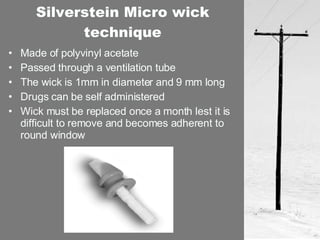
Silverstein Micro wick technique Made of polyvinyl acetate Passed through a ventilation tube The wick is 1mm in diameter and 9 mm long Drugs can be self administered Wick must be replaced once a month lest it is difficult to remove and becomes adherent to round window
 
Complications of IT medications Persistent perforation Mastoiditis Deafness
Role of reactive oxygen species Reactive oxygen species causes extensive damage to stria vascularis They are extremely toxic to cellular and sub cellular structures It is generated by noise trauma and also by aging Aminoglycosides cause trauma to cochlea by releasing R.O.S.
R.O.S. blockers Gluthathione D. Methionine Resveratrol Oxygen
Role of gene therapy Improves neuronal survival Prevents oxidative stress Regenerates auditory and vestibular hair cells
Gene therapy Direct delivery of genes Cochlea is suited because it is isolated from the remaining body by the blood labyrinth barrier Perilymph permits virus to reach the cochlea hence genes can be transmitted using a virus or non virus vectors


Intra Tympanic Medications

  • 1.
    Intra Tympanic MedicationsDr. T. Balasubramanian M.S. D.L.O.
  • 2.
    Why ? Focusedapplication High drug levels where it is needed most Use of smaller quantity of the drug
  • 3.
    Round window anatomyRound window is about 70 µ thick Consists of 3 layers Acts as a semi permeable membrane Blood labyrinthine barrier
  • 4.
    What drugs canbe used ? Gentamycin Lignocaine Steroids Inner ear cells could be potential targets for gene therapy Calpain inhibitors (leupeptin)
  • 5.
    Lignocaine as I.T.infusion Silences the hyper functional neuronal pathways which causes tinnitus Causes intense vertigo and nausea Effect does not last long hence abandoned
  • 6.
    Indications for intratympanic steroids Idiopathic sudden s/n loss Idiopathic rapidly progressive s/n loss Otologic manifestations of systemic auto immune disease
  • 7.
    SSNHL New onsetunilateral hearing loss developing within 72 hours Patient feels a sudden pop with development of tinnitus Hearing drops precipitously Hearing fluctuations are common Medical emergency
  • 8.
    Causes of SSNHLTraumatic Immunologic Toxic Circulatory Neurologic Metabolic Viral
  • 9.
    Pharmacology of steroidsGenomic actions Non genomic immediate actions
  • 10.
    Action of steroidsin the ear Anti inflammatory action Increases cochlear vascularity Reduces degeneration of stria vascularis due to its anti oxidant effects
  • 11.
    What steroid touse ? ? Methyl prednisolone ? Hydrocortisone ? Dexamethosone
  • 12.
    Why Methyl prednisolone? Methyl prednisolone reached high concentration in the inner ear fluids This high concentration is retained for a longer period of time. The anti inflammatory potential of Methyl prednisolone was the best
  • 13.
    Mode of administrationThrough a middle ear catheter Through a grommet Continuous infusion pump
  • 14.
    Factors affecting thetransfer of drug through round window Size of the particle Charge Presence of facilitating substances Thickness of the round window membrane Presence of inflammation in the round window membrane
  • 15.
    Facilitators Histamine ProstaglandinsLeukotrienes E.coli endotoxin Staphylococcal exotoxin Ethacrinic acid
  • 16.
    Aminoglycosides Gets preferentiallyconcentrated in the endolymph Damages type I cells preferentially in the ampullar area Delivered using Silverstein micro wick technique through a grommet
  • 17.
    Silverstein Micro wicktechnique Made of polyvinyl acetate Passed through a ventilation tube The wick is 1mm in diameter and 9 mm long Drugs can be self administered Wick must be replaced once a month lest it is difficult to remove and becomes adherent to round window
  • 18.
  • 19.
    Complications of ITmedications Persistent perforation Mastoiditis Deafness
  • 20.
    Role of reactiveoxygen species Reactive oxygen species causes extensive damage to stria vascularis They are extremely toxic to cellular and sub cellular structures It is generated by noise trauma and also by aging Aminoglycosides cause trauma to cochlea by releasing R.O.S.
  • 21.
    R.O.S. blockers GluthathioneD. Methionine Resveratrol Oxygen
  • 22.
    Role of genetherapy Improves neuronal survival Prevents oxidative stress Regenerates auditory and vestibular hair cells
  • 23.
    Gene therapy Directdelivery of genes Cochlea is suited because it is isolated from the remaining body by the blood labyrinth barrier Perilymph permits virus to reach the cochlea hence genes can be transmitted using a virus or non virus vectors
  • 24.
  • 25.