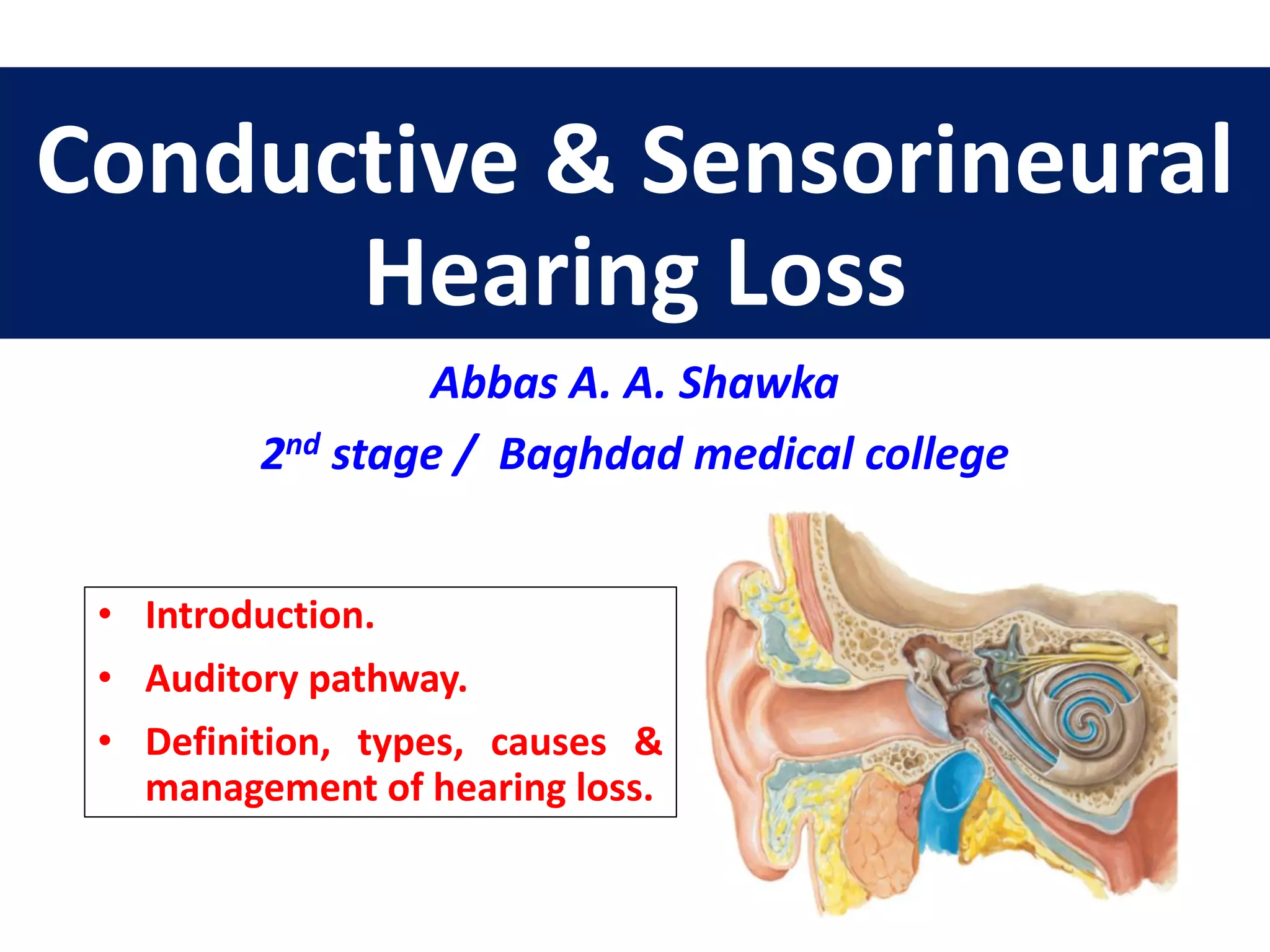
Conductive & Sensorineural
Hearing Loss
Abbas A. A. Shawka
2nd stage / Baghdad medical college
• Introduction.
• Auditory pathway.
• Definition, types, causes &
management of hearing loss.
Introduction
 Hearing loss is one of the most frequent sensory
deficient in human population. It affects more than
360 million people.
 Consequences of hearing impairment include
reduced ability to communicate, economic and
educational disadvantage, social isolation and
stigmatization.
 we will talk also about the common types & causes of
hearing loss and the possible applicable methods to
treat these conditions.
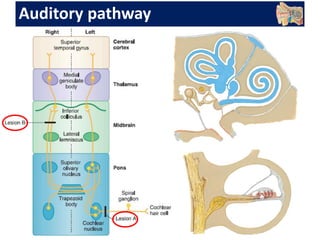
Auditory pathway
Hearing loss
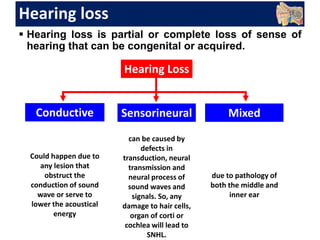
 Hearing loss is partial or complete loss of sense of
hearing that can be congenital or acquired.
Hearing Loss
MixedConductive Sensorineural
Could happen due to
any lesion that
obstruct the
conduction of sound
wave or serve to
lower the acoustical
energy
can be caused by
defects in
transduction, neural
transmission and
neural process of
sound waves and
signals. So, any
damage to hair cells,
organ of corti or
cochlea will lead to
SNHL.
due to pathology of
both the middle and
inner ear
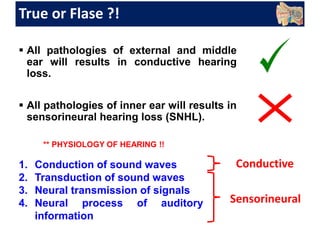
True or Flase ?!
 All pathologies of external and middle
ear will results in conductive hearing
loss.
 All pathologies of inner ear will results in
sensorineural hearing loss (SNHL).
** PHYSIOLOGY OF HEARING !!
1. Conduction of sound waves
2. Transduction of sound waves
3. Neural transmission of signals
4. Neural process of auditory
information
Conductive
Sensorineural
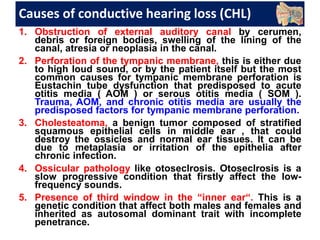
Causes of conductive hearing loss (CHL)
1. Obstruction of external auditory canal by cerumen,
debris or foreign bodies, swelling of the lining of the
canal, atresia or neoplasia in the canal.
2. Perforation of the tympanic membrane, this is either due
to high loud sound, or by the patient itself but the most
common causes for tympanic membrane perforation is
Eustachin tube dysfunction that predisposed to acute
otitis media ( AOM ) or serous otitis media ( SOM ).
Trauma, AOM, and chronic otitis media are usually the
predisposed factors for tympanic membrane perforation.
3. Cholesteatoma, a benign tumor composed of stratified
squamous epithelial cells in middle ear , that could
destroy the ossicles and normal ear tissues. It can be
due to metaplasia or irritation of the epithelia after
chronic infection.
4. Ossicular pathology like otoseclrosis. Otoseclrosis is a
slow progressive condition that firstly affect the low-
frequency sounds.
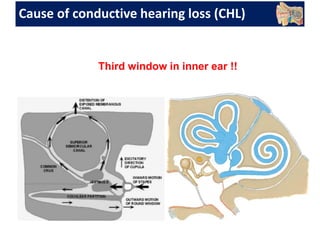
5. Presence of third window in the “inner ear“. This is a
genetic condition that affect both males and females and
inherited as autosomal dominant trait with incomplete
penetrance.
Cause of conductive hearing loss (CHL)
Third window in inner ear !!
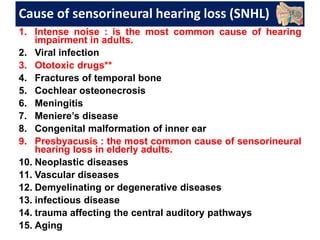
Cause of sensorineural hearing loss (SNHL)
1. Intense noise : is the most common cause of hearing
impairment in adults.
2. Viral infection
3. Ototoxic drugs**
4. Fractures of temporal bone
5. Cochlear osteonecrosis
6. Meningitis
7. Meniere’s disease
8. Congenital malformation of inner ear
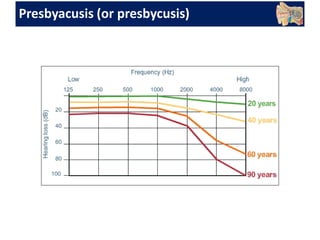
9. Presbyacusis : the most common cause of sensorineural
hearing loss in elderly adults.
10. Neoplastic diseases
11. Vascular diseases
12. Demyelinating or degenerative diseases
13. infectious disease
14. trauma affecting the central auditory pathways
15. Aging
Presbyacusis (or presbycusis)
Cause of mixed hearing loss
 Mixed hearing losses are due to pathology of both the
middle and inner ear, as can occur in otosclerosis
involving the ossicles and the cochlea, head trauma,
chronic otitis media, cholesteatoma, middle ear
tumors, and some inner ear malformations.
Genetic causes of hearing loss
Is childhood hearing loss is always due to genetic
causes ?!
NO,
 More than 40% of hearing impairments in childhood
are hereditary.
 It is due to mutations that affect genes which are
mainly structural proteins, transcriptional factors or
gap junction proteins.
 According to WHO, 60% of childhood hearing loss is
due to preventable causes.
 That includes infections, complications at time of
birth, jaundice & using of ototoxic drugs for both
mothers and babies.
Clinical approach to a patient with hearing impairment
How we can differentiate between
different types & causes of hearing
loss ?!
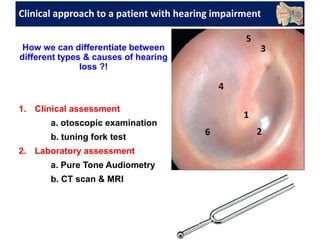
1. Clinical assessment
a. otoscopic examination
b. tuning fork test
2. Laboratory assessment
a. Pure Tone Audiometry
b. CT scan & MRI
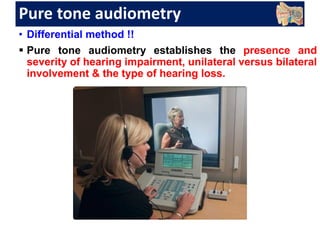
Pure tone audiometry
• Differential method !!
 Pure tone audiometry establishes the presence and
severity of hearing impairment, unilateral versus bilateral
involvement & the type of hearing loss.
Treatment of hearing loss …
• In conductive hearing loss we will treat the underlying
cause of the disease …
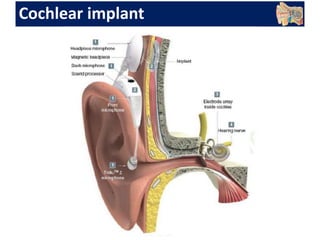
• In SNHL, we could treat patient with hearing aids or
cochlear implants.
• What is “hearing aids” ? And what is “cochlear
implants“ ? What is the difference between them ?!
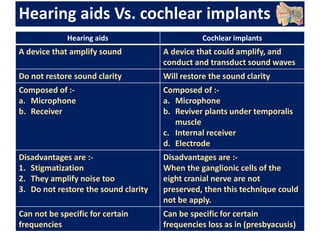
Hearing aids Vs. cochlear implants
Hearing aids Cochlear implants
A device that amplify sound A device that could amplify, and
conduct and transduct sound waves
Do not restore sound clarity Will restore the sound clarity
Composed of :-
a. Microphone
b. Receiver
Composed of :-
a. Microphone
b. Reviver plants under temporalis
muscle
c. Internal receiver
d. Electrode
Disadvantages are :-
1. Stigmatization
2. They amplify noise too
3. Do not restore the sound clarity
Disadvantages are :-
When the ganglionic cells of the
eight cranial nerve are not
preserved, then this technique could
not be apply.
Can not be specific for certain
frequencies
Can be specific for certain
frequencies loss as in (presbyacusis)
Let's think about this …
We said “corneal transplant”, but we never said
“ cochlear transplant” ?!
Transplant vs. implant
Biological vs. synthetic
So, Cochlear Implant do NOT mean exactly an
implantation of an intact cochlea !!!!
Cochlear implant
Epidemiology
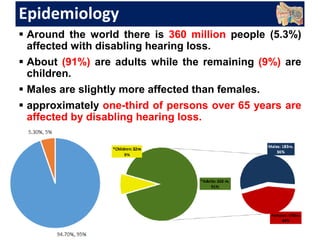
 Around the world there is 360 million people (5.3%)
affected with disabling hearing loss.
 About (91%) are adults while the remaining (9%) are
children.
 Males are slightly more affected than females.
 approximately one-third of persons over 65 years are
affected by disabling hearing loss.
Prevention of hearing loss
• We have already now the causes of hearing loss, so
the lines of prevention could be predicted !!
1. Immunization of children and adults.
2. Strengthening maternal and child health practices.
3. Avoiding the use of ototoxic drugs.
4. Early assessment of children with high risk to
develop hearing loss.
5. Reduce the exposure to both occupational and
recreational noise.
Summary
Disabling hearing loss is one of the most frequent
sensory deficit in people.
There is different types of hearing loss, each type
with a specific cause.
 Knowing the type, location and severity of the
condition is of high important in treatment &
management of the cases.
 There is 360 million people around the world affected
with this condition.
 Both congenital and acquired conditions could be
prevented
Thank You

Hearing loss 2018

  • 1.
    Conductive & Sensorineural HearingLoss Abbas A. A. Shawka 2nd stage / Baghdad medical college • Introduction. • Auditory pathway. • Definition, types, causes & management of hearing loss.
  • 2.
    Introduction  Hearing lossis one of the most frequent sensory deficient in human population. It affects more than 360 million people.  Consequences of hearing impairment include reduced ability to communicate, economic and educational disadvantage, social isolation and stigmatization.  we will talk also about the common types & causes of hearing loss and the possible applicable methods to treat these conditions.
  • 3.
  • 4.
    Hearing loss  Hearingloss is partial or complete loss of sense of hearing that can be congenital or acquired. Hearing Loss MixedConductive Sensorineural Could happen due to any lesion that obstruct the conduction of sound wave or serve to lower the acoustical energy can be caused by defects in transduction, neural transmission and neural process of sound waves and signals. So, any damage to hair cells, organ of corti or cochlea will lead to SNHL. due to pathology of both the middle and inner ear
  • 5.
    True or Flase?!  All pathologies of external and middle ear will results in conductive hearing loss.  All pathologies of inner ear will results in sensorineural hearing loss (SNHL). ** PHYSIOLOGY OF HEARING !! 1. Conduction of sound waves 2. Transduction of sound waves 3. Neural transmission of signals 4. Neural process of auditory information Conductive Sensorineural
  • 6.
    Causes of conductivehearing loss (CHL) 1. Obstruction of external auditory canal by cerumen, debris or foreign bodies, swelling of the lining of the canal, atresia or neoplasia in the canal. 2. Perforation of the tympanic membrane, this is either due to high loud sound, or by the patient itself but the most common causes for tympanic membrane perforation is Eustachin tube dysfunction that predisposed to acute otitis media ( AOM ) or serous otitis media ( SOM ). Trauma, AOM, and chronic otitis media are usually the predisposed factors for tympanic membrane perforation. 3. Cholesteatoma, a benign tumor composed of stratified squamous epithelial cells in middle ear , that could destroy the ossicles and normal ear tissues. It can be due to metaplasia or irritation of the epithelia after chronic infection. 4. Ossicular pathology like otoseclrosis. Otoseclrosis is a slow progressive condition that firstly affect the low- frequency sounds. 5. Presence of third window in the “inner ear“. This is a genetic condition that affect both males and females and inherited as autosomal dominant trait with incomplete penetrance.
  • 7.
    Cause of conductivehearing loss (CHL) Third window in inner ear !!
  • 8.
    Cause of sensorineuralhearing loss (SNHL) 1. Intense noise : is the most common cause of hearing impairment in adults. 2. Viral infection 3. Ototoxic drugs** 4. Fractures of temporal bone 5. Cochlear osteonecrosis 6. Meningitis 7. Meniere’s disease 8. Congenital malformation of inner ear 9. Presbyacusis : the most common cause of sensorineural hearing loss in elderly adults. 10. Neoplastic diseases 11. Vascular diseases 12. Demyelinating or degenerative diseases 13. infectious disease 14. trauma affecting the central auditory pathways 15. Aging
  • 9.
  • 10.
    Cause of mixedhearing loss  Mixed hearing losses are due to pathology of both the middle and inner ear, as can occur in otosclerosis involving the ossicles and the cochlea, head trauma, chronic otitis media, cholesteatoma, middle ear tumors, and some inner ear malformations.
  • 11.
    Genetic causes ofhearing loss Is childhood hearing loss is always due to genetic causes ?! NO,  More than 40% of hearing impairments in childhood are hereditary.  It is due to mutations that affect genes which are mainly structural proteins, transcriptional factors or gap junction proteins.  According to WHO, 60% of childhood hearing loss is due to preventable causes.  That includes infections, complications at time of birth, jaundice & using of ototoxic drugs for both mothers and babies.
  • 12.
    Clinical approach toa patient with hearing impairment How we can differentiate between different types & causes of hearing loss ?! 1. Clinical assessment a. otoscopic examination b. tuning fork test 2. Laboratory assessment a. Pure Tone Audiometry b. CT scan & MRI
  • 13.
    Pure tone audiometry •Differential method !!  Pure tone audiometry establishes the presence and severity of hearing impairment, unilateral versus bilateral involvement & the type of hearing loss.
  • 14.
    Treatment of hearingloss … • In conductive hearing loss we will treat the underlying cause of the disease … • In SNHL, we could treat patient with hearing aids or cochlear implants. • What is “hearing aids” ? And what is “cochlear implants“ ? What is the difference between them ?!
  • 15.
    Hearing aids Vs.cochlear implants Hearing aids Cochlear implants A device that amplify sound A device that could amplify, and conduct and transduct sound waves Do not restore sound clarity Will restore the sound clarity Composed of :- a. Microphone b. Receiver Composed of :- a. Microphone b. Reviver plants under temporalis muscle c. Internal receiver d. Electrode Disadvantages are :- 1. Stigmatization 2. They amplify noise too 3. Do not restore the sound clarity Disadvantages are :- When the ganglionic cells of the eight cranial nerve are not preserved, then this technique could not be apply. Can not be specific for certain frequencies Can be specific for certain frequencies loss as in (presbyacusis)
  • 16.
    Let's think aboutthis … We said “corneal transplant”, but we never said “ cochlear transplant” ?! Transplant vs. implant Biological vs. synthetic So, Cochlear Implant do NOT mean exactly an implantation of an intact cochlea !!!!
  • 17.
  • 18.
    Epidemiology  Around theworld there is 360 million people (5.3%) affected with disabling hearing loss.  About (91%) are adults while the remaining (9%) are children.  Males are slightly more affected than females.  approximately one-third of persons over 65 years are affected by disabling hearing loss.
  • 19.
    Prevention of hearingloss • We have already now the causes of hearing loss, so the lines of prevention could be predicted !! 1. Immunization of children and adults. 2. Strengthening maternal and child health practices. 3. Avoiding the use of ototoxic drugs. 4. Early assessment of children with high risk to develop hearing loss. 5. Reduce the exposure to both occupational and recreational noise.
  • 20.
    Summary Disabling hearing lossis one of the most frequent sensory deficit in people. There is different types of hearing loss, each type with a specific cause.  Knowing the type, location and severity of the condition is of high important in treatment & management of the cases.  There is 360 million people around the world affected with this condition.  Both congenital and acquired conditions could be prevented
  • 22.