
BOTOX
MITOMYCIN C
CIDOFOVIR
Dr. Ankit Choudhary
BOTOX
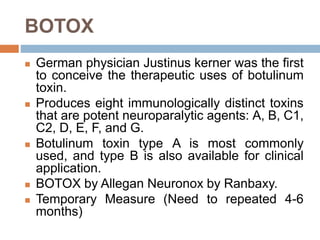
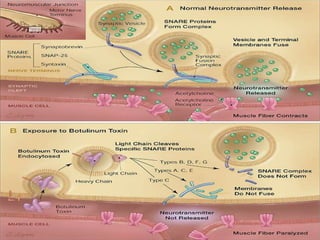
 German physician Justinus kerner was the first
to conceive the therapeutic uses of botulinum
toxin.
 Produces eight immunologically distinct toxins
that are potent neuroparalytic agents: A, B, C1,
C2, D, E, F, and G.
 Botulinum toxin type A is most commonly
used, and type B is also available for clinical
application.
 BOTOX by Allegan Neuronox by Ranbaxy.
 Temporary Measure (Need to repeated 4-6
months)
Uses in ENT
 Spasmodic dysphonia
 Oculopalatolaryngopharyngeal myoclonus
 Stuttering
 Essential Vocal Tremor
 Cricopharyngeal dysphagia
 Sialorrhea
 Facial hyperkinesia
 Migrane
 Frey's syndrome
 Postparotidectomy fistula
 Voice rehabilitation - after Laryngectomy
Spasmodic Dysphonia
 Focal dystonia involving uncontrollable spasms in the
muscles for voicing
 Onset is gradual with average age of onset is between
30 and 50.
 More common in females than in males
 Some cases are hereditary (gene on chromosome 9)
 Aggrevating Factors
 Respiratory tract infections
 Laryngeal damage due to injury
 Vocal overuse
 Stressful conditions
 Talking on the phone
Types
Mainly
 Adductor
 Abductor
Others are-
 Mixed
 Tremor
 Respiratory
Injected by Tuberculin syringe with a 27-gauge
monopolar poly teflon coated hollow EMG recording
needle.
Improvement in voice within 24 hours followed by a
breathy, hypophonic period lasting 1 to 2 weeks with
occasionally causing hyperventilation and dizziness
when trying to speak.
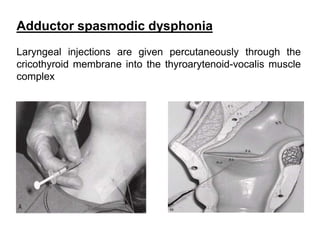
Adductor spasmodic dysphonia
Laryngeal injections are given percutaneously through the
cricothyroid membrane into the thyroarytenoid-vocalis muscle
complex
Adductor spasmodic dysphonia
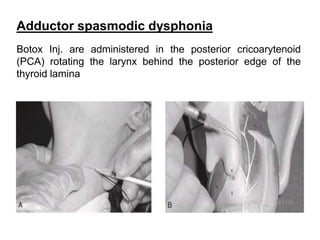
Botox Inj. are administered in the posterior cricoarytenoid
(PCA) rotating the larynx behind the posterior edge of the
thyroid lamina
Other Uses
 Oculopalatolaryngopharyngeal myoclonus
 Uncommon disorder consisting of rhythmic
contractions of the soft palate, pharynx, and
larynx at a rate of one or two contractions per
sec.
 Caused by a lesion in the central tegmental tract.
 The palate and vocal folds may be treated with
injections of botulinum
 Stuttering
 Small doses of botulinum toxin (1 unit or less,
given bilaterally)
 Causes chemodenervation of thyroarytenoid
muscles
 Essential vocal tremor
 Given into most tremulous muscles
 Most tremulous muscles are sternohyoid and
sternothyroid
 5 units are injected on each side.
 If the vocal folds are tremulous, they are injected at a
second sitting
 PROSTHETIC VOICE
 Hypertonicity of the PE segment is the most important
reason for failure to acquire fluent prosthetic speech
 After proper identification of the hypertonic PE segment
with videofluoroscopy, marking the segment on the skin,
100 MU of Botox is injected in the constrictor
pharyngeus muscle area
 Effect is long lasting
 Migrane
 Gustatory Sweating
 Sialorhea
Adverse effects
 Mild pain, local Oedema, erythema at the injection site
 Transient numbness
 Headache, malaise, mild nausea, Influenza-like illness
 Temporary unwanted weakness, neck weaknes & paralysis
of nearby musculature
 Fatigue
 Dysphagia
 Brachial plexopathy-A condition affecting the nerves either
side of the neck and chest
 Dry mouths
 Hypersensitivity (Hives, rashes, wheezing)
MITOMYCIN C
 Methylazirinopyrroloindoledione
 Antineoplastic antibiotic isolated from the bacterium
Streptomyces caespitosus
 Bioreduced mitomycin C generates oxygen radicals
Alkylates DNA Produces interstrand DNA cross-links
Inhibits DNA synthesis
 Preferentially toxic to hypoxic cells
 Also inhibits RNA and protein synthesis at high
concentrations
 Mitomycin powder is stable for at least 4 years at room
temperature
 Used in treatment regime, Palliative regime of various
CA and also as Intravesical injection in Bladder CA
IN ENT
 Antiproliferative agent- Inhibit fibroblastic
proliferation and decrease Scar formation
 Because of these properties used as topical
solution in various ENT surgeries viz.,
 FESS
 Endoscopic DCR
 Subglottic Stenosis
 Ventilation tube in OME
 Choanal atresia
 Oesophageal stenosis
 Hypopharyngeal stenosis
 Tracheal stenosis
CIDOFOVIR
 Cytosine nucleoside analogue
 Incorporated in growing viral and mammalian
DNA chains
 Inhibits viral DNA polymerization
 Antiviral effect lasts for days-weeks
 FDA approved only for CMV retinitis in AIDS
pts
 Use for RRP is “off label”
 Nephrotoxic and Neutropenic
 Vistide
Recurrent Respiratory
Papillomatosis
 Most common benign neoplasm of the larynx among
children
 Exophytic airway lesions & may involve entire aerodigestive
tract
 Etiology- HPV (Type 6 and 11 most common)
 HPV infection can remain clinically and histologically
normal. Reactivation can occur at any time
 Transmission linked to mothers with genital HPV infection –
Pts most likely to be first born, vaginally delivered to
primigravid mothers
 Hallmark triad
 Progressive hoarseness
 Stridor
 Surgery is treatment of choice for RRP
(By CO2 laser, Microdebrider, Nd yag laser, MLS, etc)
 Cidofovir is most commonly used Adjuvant therapy for RRP
(As per ASPO and BSPO)
 Cidofovir for RRP is given as intralesional injections to
avoid nephrotoxicity.
 Pransky et al. reported positive results with cidofovir in
children with severe RRP and have the longest follow-up
period of any series to date (51.6 months).They used a
treatment protocol of four initial injections (in conjunction
with surgical debulking) at a concentration of 5 mg/ml in 2-
4 week intervals, followed by subsequent injections as
dictated by recurrent disease. Prior to initiation of cidofovir
injections, patients required operations every 2 to 6 weeks.
After completing treatment with cidofovir, 5 of 11 patients
were free of disease and 5 patients had mild disease. One
patient had recalcitrant disease and continued to require
 Akst et al. reported a similar decrease in disease
burden following monthly injections and debulking,
although the response was not as dramatic, with 5
of 11 patients requiring an additional four
injections at a stepped-up dose of 10 mg/ml with
mixed results
 Optimal concentration still remains unclear
however most author recommends 5mg/ml(FDA
approved IV dose for CMV retinitis in HIV) as
standard dose with 7.5-10 mg/ml reserved for
refractory disease
 Half life of Cidofovir is 17-65 hours. Intralesional
injections beyond 4 wks have unfavourable
therapeutic response
Botox cidofovir mitomycin c in ent

Botox cidofovir mitomycin c in ent

  • 1.
  • 2.
    BOTOX  German physicianJustinus kerner was the first to conceive the therapeutic uses of botulinum toxin.  Produces eight immunologically distinct toxins that are potent neuroparalytic agents: A, B, C1, C2, D, E, F, and G.  Botulinum toxin type A is most commonly used, and type B is also available for clinical application.  BOTOX by Allegan Neuronox by Ranbaxy.  Temporary Measure (Need to repeated 4-6 months)
  • 4.
    Uses in ENT Spasmodic dysphonia  Oculopalatolaryngopharyngeal myoclonus  Stuttering  Essential Vocal Tremor  Cricopharyngeal dysphagia  Sialorrhea  Facial hyperkinesia  Migrane  Frey's syndrome  Postparotidectomy fistula  Voice rehabilitation - after Laryngectomy
  • 5.
    Spasmodic Dysphonia  Focaldystonia involving uncontrollable spasms in the muscles for voicing  Onset is gradual with average age of onset is between 30 and 50.  More common in females than in males  Some cases are hereditary (gene on chromosome 9)  Aggrevating Factors  Respiratory tract infections  Laryngeal damage due to injury  Vocal overuse  Stressful conditions  Talking on the phone
  • 6.
    Types Mainly  Adductor  Abductor Othersare-  Mixed  Tremor  Respiratory Injected by Tuberculin syringe with a 27-gauge monopolar poly teflon coated hollow EMG recording needle. Improvement in voice within 24 hours followed by a breathy, hypophonic period lasting 1 to 2 weeks with occasionally causing hyperventilation and dizziness when trying to speak.
  • 7.
    Adductor spasmodic dysphonia Laryngealinjections are given percutaneously through the cricothyroid membrane into the thyroarytenoid-vocalis muscle complex
  • 8.
    Adductor spasmodic dysphonia BotoxInj. are administered in the posterior cricoarytenoid (PCA) rotating the larynx behind the posterior edge of the thyroid lamina
  • 9.
    Other Uses  Oculopalatolaryngopharyngealmyoclonus  Uncommon disorder consisting of rhythmic contractions of the soft palate, pharynx, and larynx at a rate of one or two contractions per sec.  Caused by a lesion in the central tegmental tract.  The palate and vocal folds may be treated with injections of botulinum  Stuttering  Small doses of botulinum toxin (1 unit or less, given bilaterally)  Causes chemodenervation of thyroarytenoid muscles
  • 10.
     Essential vocaltremor  Given into most tremulous muscles  Most tremulous muscles are sternohyoid and sternothyroid  5 units are injected on each side.  If the vocal folds are tremulous, they are injected at a second sitting  PROSTHETIC VOICE  Hypertonicity of the PE segment is the most important reason for failure to acquire fluent prosthetic speech  After proper identification of the hypertonic PE segment with videofluoroscopy, marking the segment on the skin, 100 MU of Botox is injected in the constrictor pharyngeus muscle area  Effect is long lasting  Migrane  Gustatory Sweating  Sialorhea
  • 11.
    Adverse effects  Mildpain, local Oedema, erythema at the injection site  Transient numbness  Headache, malaise, mild nausea, Influenza-like illness  Temporary unwanted weakness, neck weaknes & paralysis of nearby musculature  Fatigue  Dysphagia  Brachial plexopathy-A condition affecting the nerves either side of the neck and chest  Dry mouths  Hypersensitivity (Hives, rashes, wheezing)
  • 12.
    MITOMYCIN C  Methylazirinopyrroloindoledione Antineoplastic antibiotic isolated from the bacterium Streptomyces caespitosus  Bioreduced mitomycin C generates oxygen radicals Alkylates DNA Produces interstrand DNA cross-links Inhibits DNA synthesis  Preferentially toxic to hypoxic cells  Also inhibits RNA and protein synthesis at high concentrations  Mitomycin powder is stable for at least 4 years at room temperature  Used in treatment regime, Palliative regime of various CA and also as Intravesical injection in Bladder CA
  • 13.
    IN ENT  Antiproliferativeagent- Inhibit fibroblastic proliferation and decrease Scar formation  Because of these properties used as topical solution in various ENT surgeries viz.,  FESS  Endoscopic DCR  Subglottic Stenosis  Ventilation tube in OME  Choanal atresia  Oesophageal stenosis  Hypopharyngeal stenosis  Tracheal stenosis
  • 14.
    CIDOFOVIR  Cytosine nucleosideanalogue  Incorporated in growing viral and mammalian DNA chains  Inhibits viral DNA polymerization  Antiviral effect lasts for days-weeks  FDA approved only for CMV retinitis in AIDS pts  Use for RRP is “off label”  Nephrotoxic and Neutropenic  Vistide
  • 15.
    Recurrent Respiratory Papillomatosis  Mostcommon benign neoplasm of the larynx among children  Exophytic airway lesions & may involve entire aerodigestive tract  Etiology- HPV (Type 6 and 11 most common)  HPV infection can remain clinically and histologically normal. Reactivation can occur at any time  Transmission linked to mothers with genital HPV infection – Pts most likely to be first born, vaginally delivered to primigravid mothers  Hallmark triad  Progressive hoarseness  Stridor
  • 16.
     Surgery istreatment of choice for RRP (By CO2 laser, Microdebrider, Nd yag laser, MLS, etc)  Cidofovir is most commonly used Adjuvant therapy for RRP (As per ASPO and BSPO)  Cidofovir for RRP is given as intralesional injections to avoid nephrotoxicity.  Pransky et al. reported positive results with cidofovir in children with severe RRP and have the longest follow-up period of any series to date (51.6 months).They used a treatment protocol of four initial injections (in conjunction with surgical debulking) at a concentration of 5 mg/ml in 2- 4 week intervals, followed by subsequent injections as dictated by recurrent disease. Prior to initiation of cidofovir injections, patients required operations every 2 to 6 weeks. After completing treatment with cidofovir, 5 of 11 patients were free of disease and 5 patients had mild disease. One patient had recalcitrant disease and continued to require
  • 17.
     Akst etal. reported a similar decrease in disease burden following monthly injections and debulking, although the response was not as dramatic, with 5 of 11 patients requiring an additional four injections at a stepped-up dose of 10 mg/ml with mixed results  Optimal concentration still remains unclear however most author recommends 5mg/ml(FDA approved IV dose for CMV retinitis in HIV) as standard dose with 7.5-10 mg/ml reserved for refractory disease  Half life of Cidofovir is 17-65 hours. Intralesional injections beyond 4 wks have unfavourable therapeutic response