ASSESSMENT AND
MANAGEMENT OF DEAFNESS IN
CHILDREN AND ADULTS
OVERVIEW
 Deafness
 Types of hearing impairment
 Causes of hearing impairment and deafness
 Evaluation of deafness
 Interventions and Treatments for Hearing Loss
 Protective measure for deafness
DEAFNESS
• Hearing impairment that is so severe that the child
is impaired in processing linguistic information
through hearing, with or without amplification, that
adversely affects a child's educational
performance.
National Dissemination Center for Children with Disabilities
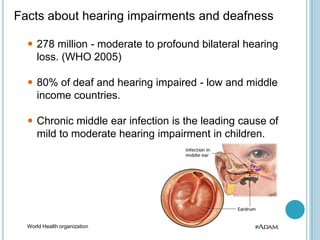
Facts about hearing impairments and deafness
 278 million - moderate to profound bilateral hearing
loss. (WHO 2005)
 80% of deaf and hearing impaired - low and middle
income countries.
 Chronic middle ear infection is the leading cause of
mild to moderate hearing impairment in children.
World Health organization
 50% of deafness and hearing impairment is
avoidable through prevention, early diagnosis and
management
 Current annual production of hearing aids is
estimated to meet less than 10% of global need.
 Hearing impairment impacts development in
◦ Speech
◦ Language
◦ Education
◦ Social integration
TYPES OF HEARING
IMPAIRMENT
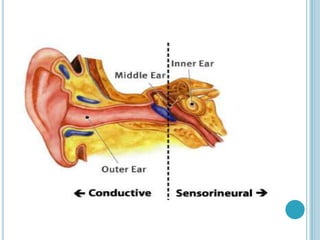
1. A conductive hearing impairment: Hearing
impairment caused by interference with sound or
vibratory energy in the external canal, middle
ear, or ossicles.
2. A sensorineural hearing impairment: One
resulting from dysfunction in the inner
ear, especially the cochlea where sound
vibrations are converted into neural signals, or in
any part of the brain that subsequently processes
these signals.
CAUSES OF HEARING
IMPAIRMENT AND DEAFNESS
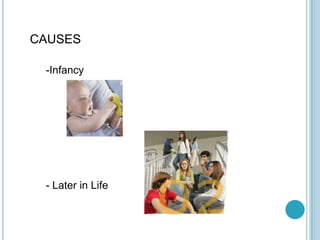
CAUSES
-Infancy
- Later in Life
Infancy
Causes
• Heredity & genetics (most common cause)
- Cleft Palate
- Cytomegalovirus, Herpes Simplex virus
- Down syndrome
- Hyperbilirubinemia
- Syphilis, Toxoplasmosis
- Treacher-Collins syndrome, Usher syndrome,
Waardenburg syndrome
• Meningitis
• OtitisMedia
• Noise
Harvard Medical School Center for Hereditary Deafness
Later in Life
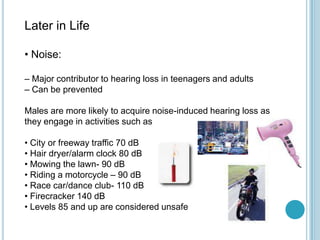
• Noise:
– Major contributor to hearing loss in teenagers and adults
– Can be prevented
Males are more likely to acquire noise-induced hearing loss as
they engage in activities such as
• City or freeway traffic 70 dB
• Hair dryer/alarm clock 80 dB
• Mowing the lawn- 90 dB
• Riding a motorcycle – 90 dB
• Race car/dance club- 110 dB
• Firecracker 140 dB
• Levels 85 and up are considered unsafe
• Other causes
 Acoustic Neurinoma.
 Sudden deafness hearing is lost w/o warning
 CAPD- Central Auditory Processing Disorder
 AIED- Autoimmune Inner Ear Disease
 Mondini Syndrome- incomplete cochlea
 Auditory Neuropathy- nerves cannot process sound
 Presbycusis- Age related hearing loss.
 Ototoxicity
 Glue Ear : untreated ear infection causing hearing loss
EVALUATION OF DEAFNESS
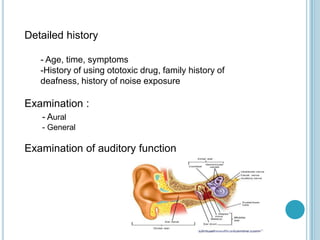
Detailed history
- Age, time, symptoms
-History of using ototoxic drug, family history of
deafness, history of noise exposure
Examination :
- Aural
- General
Examination of auditory function
Symptoms of hearing loss
• Symptoms that can accompany hearing impairment
due to ear infections include fever, ear pain, fullness
in the ear, chills and a discharge for the ear.
• Symptoms that can occur with hearing impairment
due to: Meniere’s disease or labyrinthitis include
tinnitus, vertigo, dizziness, nausea and vomiting.
• Symptoms that can accompany hearing impairment
due to barotrauma include ear pressure, ear
pain, tinnitus and dizziness.
• Symptoms that can occur with hearing impairment
due to ruptured eardrum include ear pain and ear
discharge.
• Symptoms that can occur with hearing impairment
due to earwax blockage include plugged ear and
tinnitus.
Examination of Auditory function
The stages for examination are:
1 Clinical assessment of the degree of deafness.
2 Tunning fork tests.
3 Audiometry.
4 Otoacoustic emissions
5 Auditory brainstem response
Clinical assessment of the degree of deafness.
Whispered speech test.
-The GP will whisper a combination of numbers and letters
behind the patient and check if he can hear anything by asking
the patient to repeat the combination.
- If unilateral deafness is suspected the good ear should be
masked and the deaf ear tested.
BMJ. 2003 October 25; 327(7421): 967
Tuning fork Test.
There are two types of tuning fork:
1 RINNE’S Test.
2 WEBER’S Test.
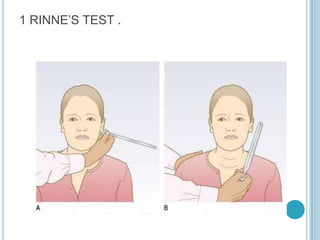
1 RINNE’S TEST .
INTERPRETATION OF RINNE’S TEST
o Air Conduction > Bone Conduction =
Normal or SNHL
o Bone Conduction > Air Conduction =
Conductive HL or dead ear
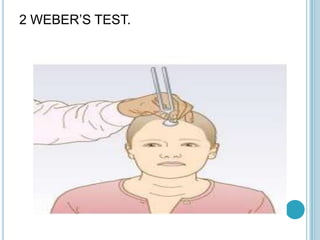
2 WEBER’S TEST.
INTERPRETATION OF WEBER’S TEST
 In conductive deafness the sound is heard loudest in the
affected ear.
 In sensorineural deafness the sound is heard louder in
the un affected ear.
3 AUDIOMETRY.
 Pure tone audiometry (PTA).
- Is the key hearing test used to identify hearing threshold levels of an
individual
- The lower the threshold the better hearing.
- AC threshold are obtained with headphones and measure outer
, middle, inner ear and the auditory nerve function.
- BC threshold are obtained with bone conduction oscillators which
effectively bypass outer and middle ear function
BRITISH SOCIETY OF AUDIOLOGY
AUDIOGRAM
AUDIOGRAM
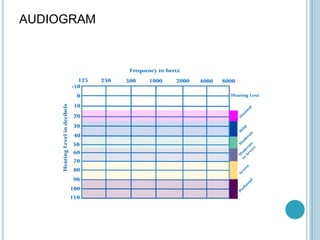
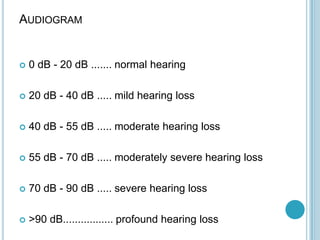
 0 dB - 20 dB ....... normal hearing
 20 dB - 40 dB ..... mild hearing loss
 40 dB - 55 dB ..... moderate hearing loss
 55 dB - 70 dB ..... moderately severe hearing loss
 70 dB - 90 dB ..... severe hearing loss
 >90 dB................. profound hearing loss
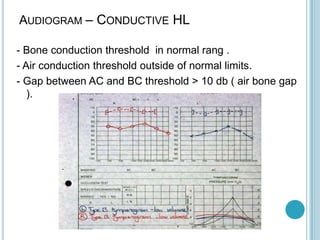
AUDIOGRAM – CONDUCTIVE HL
- Bone conduction threshold in normal rang .
- Air conduction threshold outside of normal limits.
- Gap between AC and BC threshold > 10 db ( air bone gap
).
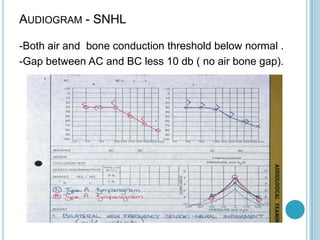
AUDIOGRAM - SNHL
-Both air and bone conduction threshold below normal .
-Gap between AC and BC less 10 db ( no air bone gap).
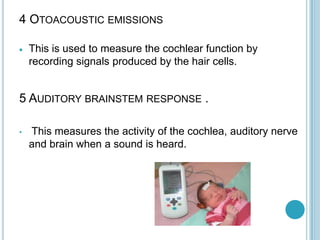
4 OTOACOUSTIC EMISSIONS
This is used to measure the cochlear function by
recording signals produced by the hair cells.
5 AUDITORY BRAINSTEM RESPONSE .
• This measures the activity of the cochlea, auditory nerve
and brain when a sound is heard.
INTERVENTIONS AND TREATMENTS
FOR HEARING LOSS
o Initial treatment- Surgery (Otomicrosurgery) and
medications
o Assistive technology
 Hearing aids
 Cochlear implants
o Communication and language options
o Family support systems
 Professional staff
CENTER FOR DISEASE CONTROL AND PREVENTION
Initial treatment
-Treatment for reversible hearing loss depends on its cause. It is often
treated successfully.
Hearing loss caused by:
 Ototoxic medicines (such as aspirin or ibuprofen) often improves after
you stop taking the medicine.
An ear infection, such as a middle ear infection, often clears up on its
own, but you may need antibiotics.
An injury to the ear or head you may need surgery.
Otosclerosis, acoustic neuroma, or Ménière's disease may require
medicine or surgery.
An autoimmune problem may be treated with corticosteroid
medicines, generally prednisone.
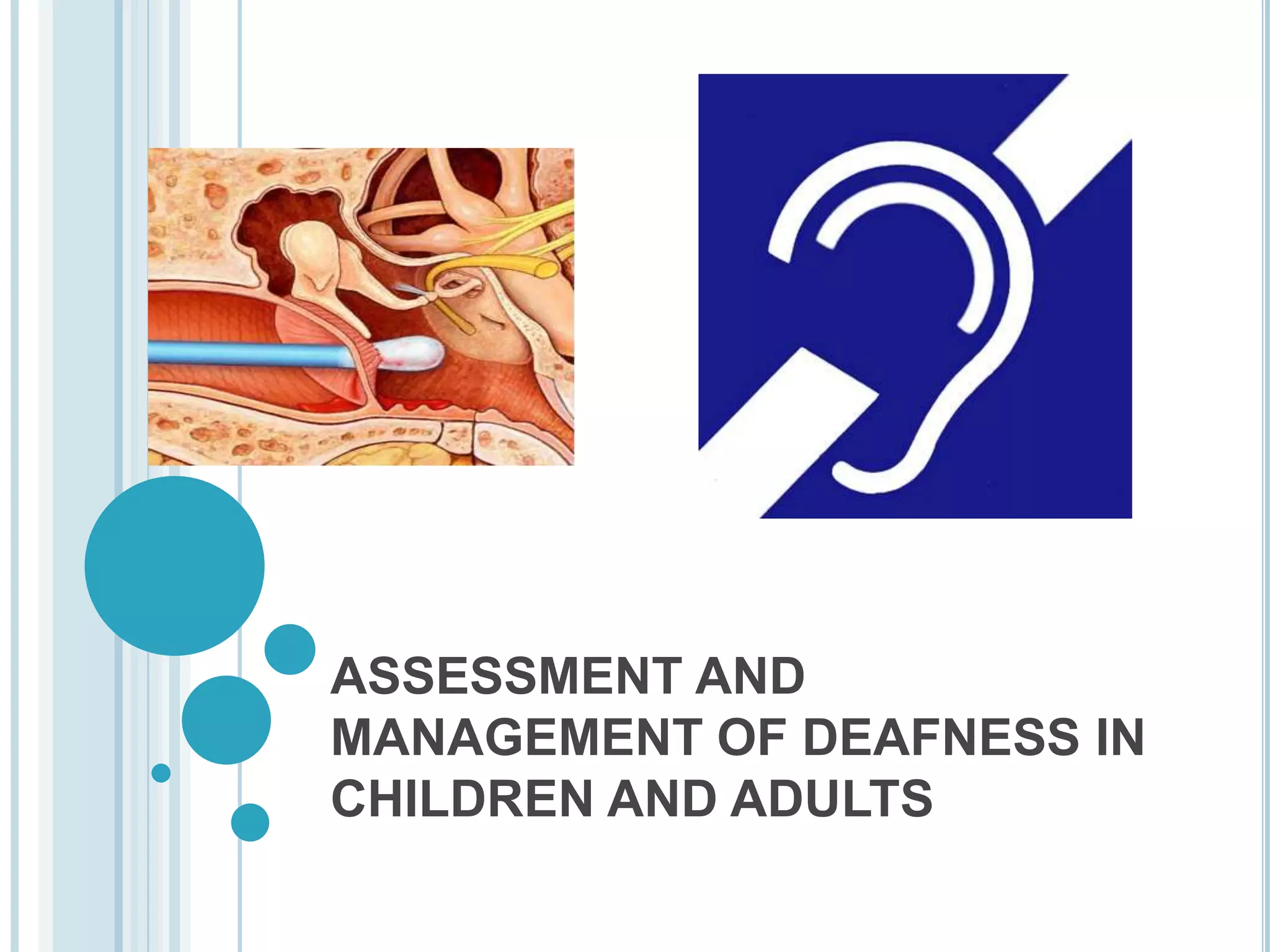
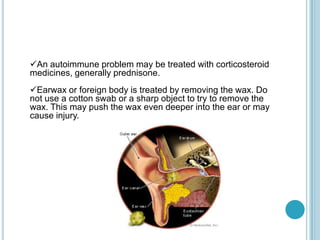
Earwax or foreign body is treated by removing the wax. Do
not use a cotton swab or a sharp object to try to remove the
wax. This may push the wax even deeper into the ear or may
cause injury.
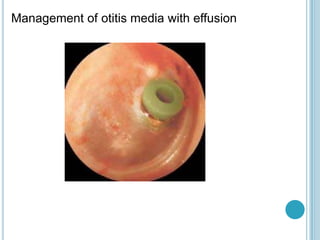
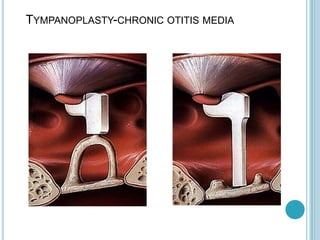
Management of otitis media with effusion
TYMPANOPLASTY-CHRONIC OTITIS MEDIA
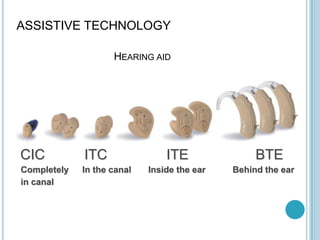
ASSISTIVE TECHNOLOGY
HEARING AID
CIC ITC ITE BTE
Completely In the canal Inside the ear Behind the ear
in canal
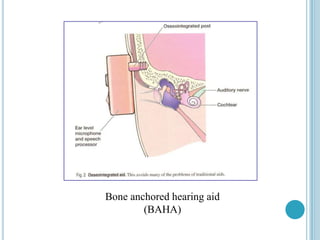
Bone anchored hearing aid
(BAHA)
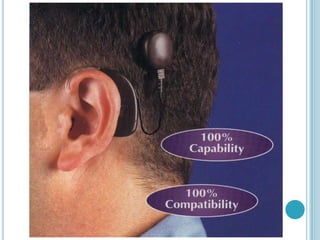
COCHLEAR IMPLANT
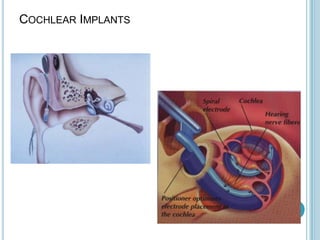
 Is a surgically implanted electronic device that provides a
sense of sound to a person who is profoundly deaf or
severely hard of hearing
 For children and adults who derive no benefit from the
use of properly fitted hearing aids
COCHLEAR IMPLANTS
Communication
Three ways of communicating for the deaf or hard of hearing
1.) Oral/aural communication through spoken English, speech
reading, residual hearing, and sound amplification
2.) American Sign Language (ASL) a visual/gestural language or fingers
spelling used for spelling words and proper names that have no known
sign
3.) Simultaneous communication uses sign language finger spelling and
speech, (manually coded English and pidgin sign language)
www.csus.edu
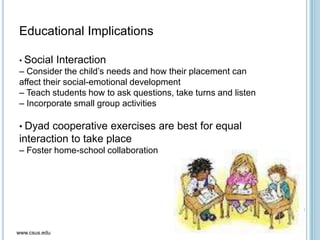
Educational Implications
• Social Interaction
– Consider the child’s needs and how their placement can
affect their social-emotional development
– Teach students how to ask questions, take turns and listen
– Incorporate small group activities
• Dyad cooperative exercises are best for equal
interaction to take place
– Foster home-school collaboration
www.csus.edu
PROTECTIVE MEASURE FOR
DEAFNESS
 Prevention of congenital deafness
 Genetic counseling and prenatal diagnosis
 Pregnant women are prohibited to use ototoxic drugs
 To avoid viral infection when pregnant
 Prevention of viral and bacterial infection
 Measles
 Varicella
 Parotitis
 Epidemic meningitis
 Rhinitis
 Otitis media
 To keep favourable mental status and avoid over-tired
 To avoid exposure to noise for long time
 To lower level of sound source
 To decrease exposure time
 To use ear protector
 To protect from ototoxic deafness
 To understand family history and susceptivity
 To control suitable dosage and course of treatment
Protective measure for deafness
THANKS FOR LISTENING

Deafness

  • 1.
    ASSESSMENT AND MANAGEMENT OFDEAFNESS IN CHILDREN AND ADULTS
  • 2.
    OVERVIEW  Deafness  Typesof hearing impairment  Causes of hearing impairment and deafness  Evaluation of deafness  Interventions and Treatments for Hearing Loss  Protective measure for deafness
  • 3.
  • 4.
    • Hearing impairmentthat is so severe that the child is impaired in processing linguistic information through hearing, with or without amplification, that adversely affects a child's educational performance. National Dissemination Center for Children with Disabilities
  • 5.
    Facts about hearingimpairments and deafness  278 million - moderate to profound bilateral hearing loss. (WHO 2005)  80% of deaf and hearing impaired - low and middle income countries.  Chronic middle ear infection is the leading cause of mild to moderate hearing impairment in children. World Health organization
  • 6.
     50% ofdeafness and hearing impairment is avoidable through prevention, early diagnosis and management  Current annual production of hearing aids is estimated to meet less than 10% of global need.  Hearing impairment impacts development in ◦ Speech ◦ Language ◦ Education ◦ Social integration
  • 7.
  • 8.
    1. A conductivehearing impairment: Hearing impairment caused by interference with sound or vibratory energy in the external canal, middle ear, or ossicles. 2. A sensorineural hearing impairment: One resulting from dysfunction in the inner ear, especially the cochlea where sound vibrations are converted into neural signals, or in any part of the brain that subsequently processes these signals.
  • 10.
  • 11.
  • 12.
    Infancy Causes • Heredity &genetics (most common cause) - Cleft Palate - Cytomegalovirus, Herpes Simplex virus - Down syndrome - Hyperbilirubinemia - Syphilis, Toxoplasmosis - Treacher-Collins syndrome, Usher syndrome, Waardenburg syndrome • Meningitis • OtitisMedia • Noise Harvard Medical School Center for Hereditary Deafness
  • 13.
    Later in Life •Noise: – Major contributor to hearing loss in teenagers and adults – Can be prevented Males are more likely to acquire noise-induced hearing loss as they engage in activities such as • City or freeway traffic 70 dB • Hair dryer/alarm clock 80 dB • Mowing the lawn- 90 dB • Riding a motorcycle – 90 dB • Race car/dance club- 110 dB • Firecracker 140 dB • Levels 85 and up are considered unsafe
  • 14.
    • Other causes Acoustic Neurinoma.  Sudden deafness hearing is lost w/o warning  CAPD- Central Auditory Processing Disorder  AIED- Autoimmune Inner Ear Disease  Mondini Syndrome- incomplete cochlea  Auditory Neuropathy- nerves cannot process sound  Presbycusis- Age related hearing loss.  Ototoxicity  Glue Ear : untreated ear infection causing hearing loss
  • 15.
  • 16.
    Detailed history - Age,time, symptoms -History of using ototoxic drug, family history of deafness, history of noise exposure Examination : - Aural - General Examination of auditory function
  • 17.
    Symptoms of hearingloss • Symptoms that can accompany hearing impairment due to ear infections include fever, ear pain, fullness in the ear, chills and a discharge for the ear. • Symptoms that can occur with hearing impairment due to: Meniere’s disease or labyrinthitis include tinnitus, vertigo, dizziness, nausea and vomiting.
  • 18.
    • Symptoms thatcan accompany hearing impairment due to barotrauma include ear pressure, ear pain, tinnitus and dizziness. • Symptoms that can occur with hearing impairment due to ruptured eardrum include ear pain and ear discharge. • Symptoms that can occur with hearing impairment due to earwax blockage include plugged ear and tinnitus.
  • 19.
    Examination of Auditoryfunction The stages for examination are: 1 Clinical assessment of the degree of deafness. 2 Tunning fork tests. 3 Audiometry. 4 Otoacoustic emissions 5 Auditory brainstem response
  • 20.
    Clinical assessment ofthe degree of deafness. Whispered speech test. -The GP will whisper a combination of numbers and letters behind the patient and check if he can hear anything by asking the patient to repeat the combination. - If unilateral deafness is suspected the good ear should be masked and the deaf ear tested. BMJ. 2003 October 25; 327(7421): 967
  • 21.
    Tuning fork Test. Thereare two types of tuning fork: 1 RINNE’S Test. 2 WEBER’S Test.
  • 22.
  • 23.
    INTERPRETATION OF RINNE’STEST o Air Conduction > Bone Conduction = Normal or SNHL o Bone Conduction > Air Conduction = Conductive HL or dead ear
  • 24.
  • 25.
    INTERPRETATION OF WEBER’STEST  In conductive deafness the sound is heard loudest in the affected ear.  In sensorineural deafness the sound is heard louder in the un affected ear.
  • 26.
    3 AUDIOMETRY.  Puretone audiometry (PTA). - Is the key hearing test used to identify hearing threshold levels of an individual - The lower the threshold the better hearing. - AC threshold are obtained with headphones and measure outer , middle, inner ear and the auditory nerve function. - BC threshold are obtained with bone conduction oscillators which effectively bypass outer and middle ear function BRITISH SOCIETY OF AUDIOLOGY
  • 27.
  • 28.
    AUDIOGRAM  0 dB- 20 dB ....... normal hearing  20 dB - 40 dB ..... mild hearing loss  40 dB - 55 dB ..... moderate hearing loss  55 dB - 70 dB ..... moderately severe hearing loss  70 dB - 90 dB ..... severe hearing loss  >90 dB................. profound hearing loss
  • 29.
    AUDIOGRAM – CONDUCTIVEHL - Bone conduction threshold in normal rang . - Air conduction threshold outside of normal limits. - Gap between AC and BC threshold > 10 db ( air bone gap ).
  • 30.
    AUDIOGRAM - SNHL -Bothair and bone conduction threshold below normal . -Gap between AC and BC less 10 db ( no air bone gap).
  • 31.
    4 OTOACOUSTIC EMISSIONS Thisis used to measure the cochlear function by recording signals produced by the hair cells. 5 AUDITORY BRAINSTEM RESPONSE . • This measures the activity of the cochlea, auditory nerve and brain when a sound is heard.
  • 32.
  • 33.
    o Initial treatment-Surgery (Otomicrosurgery) and medications o Assistive technology  Hearing aids  Cochlear implants o Communication and language options o Family support systems  Professional staff CENTER FOR DISEASE CONTROL AND PREVENTION
  • 34.
    Initial treatment -Treatment forreversible hearing loss depends on its cause. It is often treated successfully. Hearing loss caused by:  Ototoxic medicines (such as aspirin or ibuprofen) often improves after you stop taking the medicine. An ear infection, such as a middle ear infection, often clears up on its own, but you may need antibiotics. An injury to the ear or head you may need surgery. Otosclerosis, acoustic neuroma, or Ménière's disease may require medicine or surgery.
  • 35.
    An autoimmune problemmay be treated with corticosteroid medicines, generally prednisone. Earwax or foreign body is treated by removing the wax. Do not use a cotton swab or a sharp object to try to remove the wax. This may push the wax even deeper into the ear or may cause injury.
  • 36.
    Management of otitismedia with effusion
  • 37.
  • 38.
    ASSISTIVE TECHNOLOGY HEARING AID CICITC ITE BTE Completely In the canal Inside the ear Behind the ear in canal
  • 39.
  • 41.
    COCHLEAR IMPLANT  Isa surgically implanted electronic device that provides a sense of sound to a person who is profoundly deaf or severely hard of hearing  For children and adults who derive no benefit from the use of properly fitted hearing aids
  • 42.
  • 43.
    Communication Three ways ofcommunicating for the deaf or hard of hearing 1.) Oral/aural communication through spoken English, speech reading, residual hearing, and sound amplification 2.) American Sign Language (ASL) a visual/gestural language or fingers spelling used for spelling words and proper names that have no known sign 3.) Simultaneous communication uses sign language finger spelling and speech, (manually coded English and pidgin sign language) www.csus.edu
  • 44.
    Educational Implications • SocialInteraction – Consider the child’s needs and how their placement can affect their social-emotional development – Teach students how to ask questions, take turns and listen – Incorporate small group activities • Dyad cooperative exercises are best for equal interaction to take place – Foster home-school collaboration www.csus.edu
  • 45.
  • 46.
     Prevention ofcongenital deafness  Genetic counseling and prenatal diagnosis  Pregnant women are prohibited to use ototoxic drugs  To avoid viral infection when pregnant  Prevention of viral and bacterial infection  Measles  Varicella  Parotitis  Epidemic meningitis  Rhinitis  Otitis media
  • 47.
     To keepfavourable mental status and avoid over-tired  To avoid exposure to noise for long time  To lower level of sound source  To decrease exposure time  To use ear protector  To protect from ototoxic deafness  To understand family history and susceptivity  To control suitable dosage and course of treatment Protective measure for deafness
  • 48.