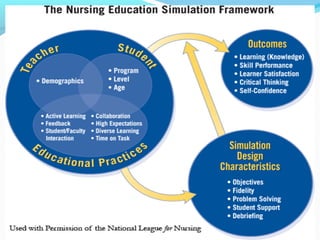
MS.J.JAYANTHI.,MSc(N).,
LECTURER IN PAEDIATRIC
NURSING
GRACIOUS COLLEGE OF
NURSING
“SIMULATION REALITY INTO REAL
WORLD
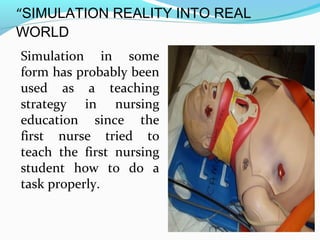
Simulation in some
form has probably been
used as a teaching
strategy in nursing
education since the
first nurse tried to
teach the first nursing
student how to do a
task properly.
Tell me, and I
will forget.
Show me, and I
may remember.
Involve me,
and I will
understand.”
- Confucius, 450 BC
MEANING
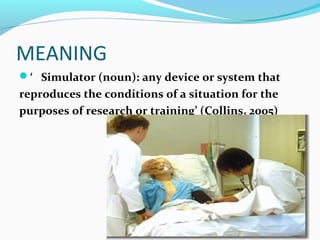
‘ Simulator (noun): any device or system that
reproduces the conditions of a situation for the
purposes of research or training’ (Collins, 2005)
DEFINITION
Simulation:
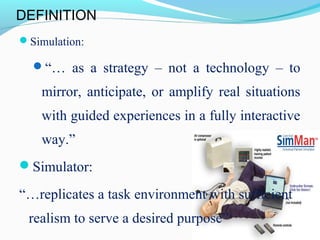
“… as a strategy – not a technology – to
mirror, anticipate, or amplify real situations
with guided experiences in a fully interactive
way.”
Simulator:
“…replicates a task environment with sufficient
realism to serve a desired purpose”
TRENDS IN NURSING EDUCATION
Providing more experimental learning opportunity
than instruction
Increased use of learning technology
More emphasis on outcome-based then process-
based education
More evidence-based education strategies and
curriculum
USES
Learning by doing
Improved quality of instruction
The simulation program enables multiple training
opportunities
Debriefing is an important part of the learning
experience
DEBRIEFING
 Debriefing is a process of receiving an explanation
of a study or investigation after participation is
complete.
 Debriefing (post-experience analysis) is thought to
be one of the most important features of simulation
based medical education. Simulation can lead to an
experience that is emotional and thought provoking –
experiential learning. (Think of how you feel when you
poorly execute the resuscitation of the manikin in a
simulation session.) Debriefing plays a role in the
reflection and analysis of that experiential learning.
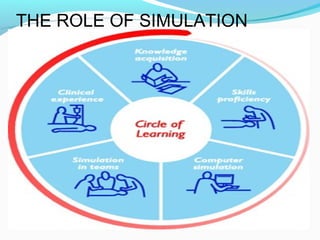
THE ROLE OF SIMULATION
Abstract
 The 1975 experiment demonstrated that when
learning occurs in a realistic environment related to
work, learning is retained and reproduced. Therefore,
the more realistic the environment is to the learner’s
own area of work, the more successful the learning
will be. This was one of the first reported occasions
when it was seen that by learning in a realistic
environment enhanced the educational experience.
Simulation allows the creation of realistic simulations
to allow greater retention of what is learned Learning
using simulators . (harvey).
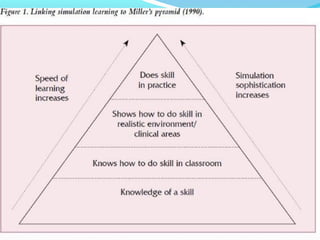
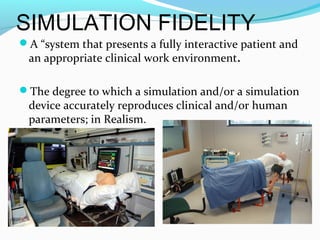
SIMULATION FIDELITY
A “system that presents a fully interactive patient and
an appropriate clinical work environment.
The degree to which a simulation and/or a simulation
device accurately reproduces clinical and/or human
parameters; in Realism.
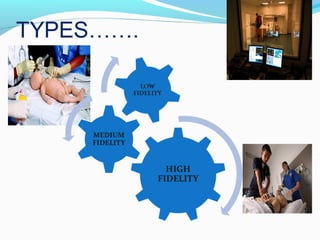
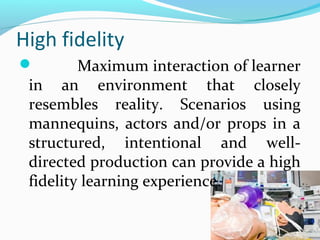
High fidelity
 Maximum interaction of learner
in an environment that closely
resembles reality. Scenarios using
mannequins, actors and/or props in a
structured, intentional and well-
directed production can provide a high
fidelity learning experience.
Over 365 facilities in 48
states/provinces in the US
and Canada, Germany,
Brazil, and Japan are
participating in the
NRCPR.
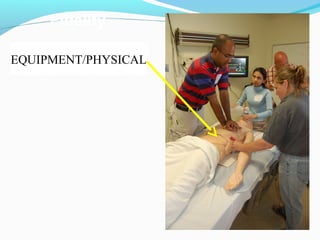
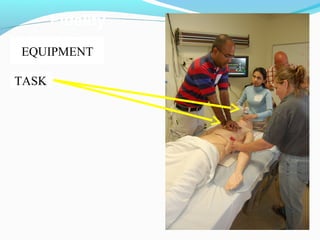
Equipment/Physical
Fidelity
EQUIPMENT/PHYSICAL
Over 365 facilities in 48
states/provinces in the US
and Canada, Germany,
Brazil, and Japan are
participating in the
NRCPR.
Equipment
Task
Fidelity
EQUIPMENT
TASK
Over 365 facilities in 48
states/provinces in the US
and Canada, Germany,
Brazil, and Japan are
participating in the
NRCPR.
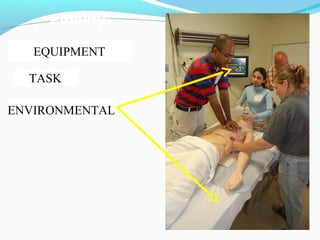
Equipment
Task
Environmental
Fidelity
EQUIPMENT
TASK
ENVIRONMENTAL
Over 365 facilities in 48
states/provinces in the US
and Canada, Germany,
Brazil, and Japan are
participating in the
NRCPR.
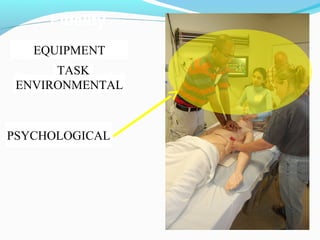
Equipment
Environmental
Psychological
Task
Fidelity
EQUIPMENT
TASK
ENVIRONMENTAL
PSYCHOLOGICAL
TYPES OF SIMULATION
Computer-based clinical
simulations
Task-specific simulators
Virtual reality
Full-bodied manikin-based
Standardized patients
Human cadavers
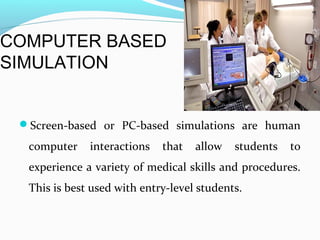
COMPUTER BASED
SIMULATION
Screen-based or PC-based simulations are human
computer interactions that allow students to
experience a variety of medical skills and procedures.
This is best used with entry-level students.
CONT……
Strengths
Easy, flexible and unlimited access
Useful for knowledge acquisition and critical thinking
Accommodating to individual pace of learning
Good for lower/entry level students
Relatively low cost
Limitations
No physical interactivity
Low fidelity
No experiential learning
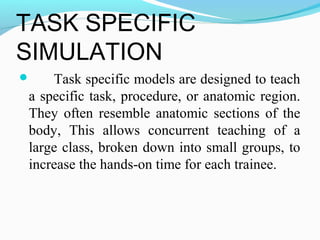
TASK SPECIFIC
SIMULATION
 Task specific models are designed to teach
a specific task, procedure, or anatomic region.
They often resemble anatomic sections of the
body, This allows concurrent teaching of a
large class, broken down into small groups, to
increase the hands-on time for each trainee.
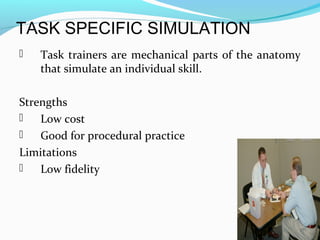
TASK SPECIFIC SIMULATION
 Task trainers are mechanical parts of the anatomy
that simulate an individual skill.
Strengths
 Low cost
 Good for procedural practice
Limitations
 Low fidelity
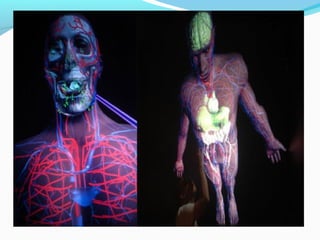
Virtual reality
 Virtual reality (VR), sometimes referred to
as immersive multimedia, is a computer simulated
environment that can simulate physical presence
in places in the real world or imagined worlds.
Virtual reality could recreate sensory experiences,
including visual, taste, sight, smell, sound, touch,
etc.
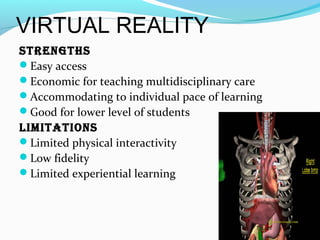
VIRTUAL REALITY
StrengthS
Easy access
Economic for teaching multidisciplinary care
Accommodating to individual pace of learning
Good for lower level of students
LimitationS
Limited physical interactivity
Low fidelity
Limited experiential learning
FULL-BODIED MANNIKIN-BASED
 Manikin-based simulations use high fidelity
simulators, manikins that breathe, with breath
sounds, heart tones, and palpable pulses. In
addition, the manikin has a monitor that can
display EKG, pulse oximeter, blood pressure ,
arterial wave forms, pulmonary artery wave forms,
anesthetic gases, etc. Procedures can be
performed on the simulators such as bag-mask
ventilation, intubation, defibrillation, chest tube
placement, cricothyrotomy and others.
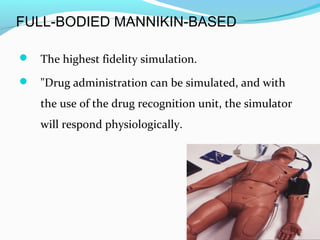
FULL-BODIED MANNIKIN-BASED
 The highest fidelity simulation.
 "Drug administration can be simulated, and with
the use of the drug recognition unit, the simulator
will respond physiologically.
CONT…..
Strengths
High fidelity
Interactive experience
Using emotional and sensory components
Good for critical thinking, decision-making and
delegation
Limitations
Costly
Limited access
Dependent on availability of human
instructors/operators
Limited realistic human interactions
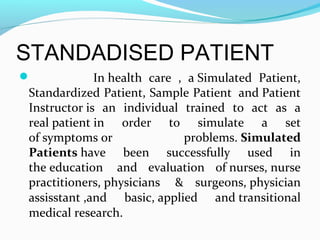
STANDADISED PATIENT
 In health care , a Simulated Patient,
Standardized Patient, Sample Patient and Patient
Instructor is an individual trained to act as a
real patient in order to simulate a set
of symptoms or problems. Simulated
Patients have been successfully used in
the education and evaluation of nurses, nurse
practitioners, physicians & surgeons, physician
assisstant ,and basic, applied and transitional
medical research.
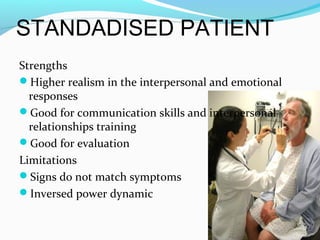
STANDADISED PATIENT
Strengths
Higher realism in the interpersonal and emotional
responses
Good for communication skills and interpersonal
relationships training
Good for evaluation
Limitations
Signs do not match symptoms
Inversed power dynamic
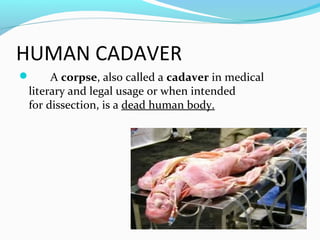
HUMAN CADAVER
 A corpse, also called a cadaver in medical
literary and legal usage or when intended
for dissection, is a dead human body.
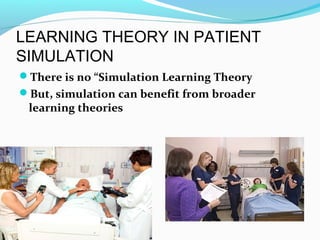
LEARNING THEORY IN PATIENT
SIMULATION
There is no “Simulation Learning Theory
But, simulation can benefit from broader
learning theories
EXPERIMENTAL LEARNING THEORY
Dominant learning theory in
simulation
David Kolb – Chief proponent
Based on Kurt Lewin’s Experiential
Learning Cycle
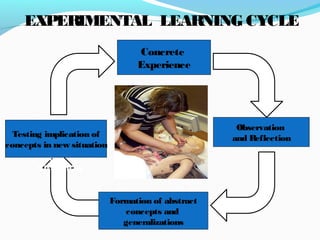
Concrete
Experience
Testing implication
of
concepts in new
situation
Observation
and Reflection
Formation of abstract
concepts and
generalizations
Concrete
Experience
Observation
and Reflection
Formation of abstract
concepts and
generalizations
Testing implication of
concepts in new situation
EXPERIMENTAL LEARNING CYCLE
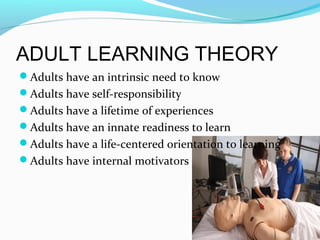
ADULT LEARNING THEORY
Adults have an intrinsic need to know
Adults have self-responsibility
Adults have a lifetime of experiences
Adults have an innate readiness to learn
Adults have a life-centered orientation to learning
Adults have internal motivators
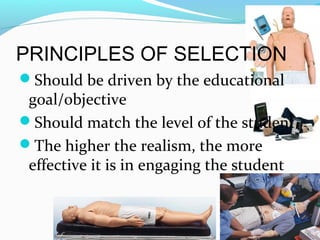
PRINCIPLES OF SELECTION
Should be driven by the educational
goal/objective
Should match the level of the student
The higher the realism, the more
effective it is in engaging the student
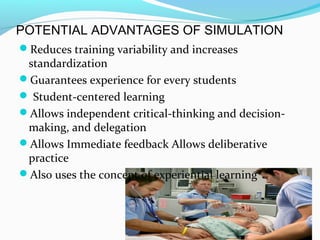
POTENTIAL ADVANTAGES OF SIMULATION
Reduces training variability and increases
standardization
Guarantees experience for every students
 Student-centered learning
Allows independent critical-thinking and decision-
making, and delegation
Allows Immediate feedback Allows deliberative
practice
Also uses the concept of experiential learning
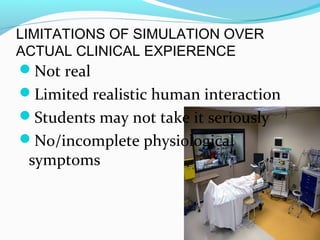
LIMITATIONS OF SIMULATION OVER
ACTUAL CLINICAL EXPIERENCE
Not real
Limited realistic human interaction
Students may not take it seriously
No/incomplete physiological
symptoms
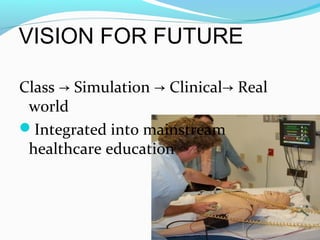
VISION FOR FUTURE
Class → Simulation C→ linical→ Real
world
Integrated into mainstream
healthcare education
SIMULATION AS A TEACHING
STRATERGY:CHALLENGES
Initial capital expenditures
High financial cost
Faculty development
Ongoing
faculty/administrative/technical
support
Vote for
Simulation

REALITY THE SIMULATION

  • 1.
  • 2.
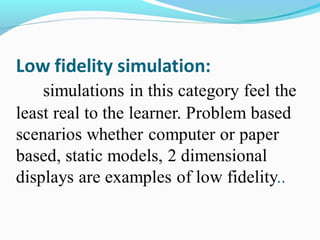
    “SIMULATION REALITY INTOREAL WORLD Simulation in some form has probably been used as a teaching strategy in nursing education since the first nurse tried to teach the first nursing student how to do a task properly.
  • 3.
    Tell me, andI will forget. Show me, and I may remember. Involve me, and I will understand.” - Confucius, 450 BC
  • 4.
    MEANING ‘ Simulator (noun):any device or system that reproduces the conditions of a situation for the purposes of research or training’ (Collins, 2005)
  • 5.
    DEFINITION Simulation: “… as astrategy – not a technology – to mirror, anticipate, or amplify real situations with guided experiences in a fully interactive way.” Simulator: “…replicates a task environment with sufficient realism to serve a desired purpose”
  • 6.
    TRENDS IN NURSINGEDUCATION Providing more experimental learning opportunity than instruction Increased use of learning technology More emphasis on outcome-based then process- based education More evidence-based education strategies and curriculum
  • 7.
    USES Learning by doing Improvedquality of instruction The simulation program enables multiple training opportunities Debriefing is an important part of the learning experience
  • 8.
    DEBRIEFING  Debriefing isa process of receiving an explanation of a study or investigation after participation is complete.  Debriefing (post-experience analysis) is thought to be one of the most important features of simulation based medical education. Simulation can lead to an experience that is emotional and thought provoking – experiential learning. (Think of how you feel when you poorly execute the resuscitation of the manikin in a simulation session.) Debriefing plays a role in the reflection and analysis of that experiential learning.
  • 9.
    THE ROLE OFSIMULATION
  • 13.
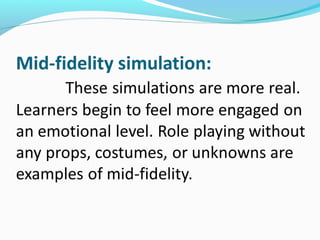
    Abstract  The 1975experiment demonstrated that when learning occurs in a realistic environment related to work, learning is retained and reproduced. Therefore, the more realistic the environment is to the learner’s own area of work, the more successful the learning will be. This was one of the first reported occasions when it was seen that by learning in a realistic environment enhanced the educational experience. Simulation allows the creation of realistic simulations to allow greater retention of what is learned Learning using simulators . (harvey).
  • 14.
    SIMULATION FIDELITY A “systemthat presents a fully interactive patient and an appropriate clinical work environment. The degree to which a simulation and/or a simulation device accurately reproduces clinical and/or human parameters; in Realism.
  • 18.
    High fidelity  Maximuminteraction of learner in an environment that closely resembles reality. Scenarios using mannequins, actors and/or props in a structured, intentional and well- directed production can provide a high fidelity learning experience.
  • 19.
    Over 365 facilitiesin 48 states/provinces in the US and Canada, Germany, Brazil, and Japan are participating in the NRCPR. Equipment/Physical Fidelity EQUIPMENT/PHYSICAL
  • 20.
    Over 365 facilitiesin 48 states/provinces in the US and Canada, Germany, Brazil, and Japan are participating in the NRCPR. Equipment Task Fidelity EQUIPMENT TASK
  • 21.
    Over 365 facilitiesin 48 states/provinces in the US and Canada, Germany, Brazil, and Japan are participating in the NRCPR. Equipment Task Environmental Fidelity EQUIPMENT TASK ENVIRONMENTAL
  • 22.
    Over 365 facilitiesin 48 states/provinces in the US and Canada, Germany, Brazil, and Japan are participating in the NRCPR. Equipment Environmental Psychological Task Fidelity EQUIPMENT TASK ENVIRONMENTAL PSYCHOLOGICAL
  • 23.
    TYPES OF SIMULATION Computer-basedclinical simulations Task-specific simulators Virtual reality Full-bodied manikin-based Standardized patients Human cadavers
  • 24.
    COMPUTER BASED SIMULATION Screen-based orPC-based simulations are human computer interactions that allow students to experience a variety of medical skills and procedures. This is best used with entry-level students.
  • 25.
    CONT…… Strengths Easy, flexible andunlimited access Useful for knowledge acquisition and critical thinking Accommodating to individual pace of learning Good for lower/entry level students Relatively low cost Limitations No physical interactivity Low fidelity No experiential learning
  • 26.
    TASK SPECIFIC SIMULATION  Taskspecific models are designed to teach a specific task, procedure, or anatomic region. They often resemble anatomic sections of the body, This allows concurrent teaching of a large class, broken down into small groups, to increase the hands-on time for each trainee.
  • 27.
    TASK SPECIFIC SIMULATION Task trainers are mechanical parts of the anatomy that simulate an individual skill. Strengths  Low cost  Good for procedural practice Limitations  Low fidelity
  • 28.
    Virtual reality  Virtualreality (VR), sometimes referred to as immersive multimedia, is a computer simulated environment that can simulate physical presence in places in the real world or imagined worlds. Virtual reality could recreate sensory experiences, including visual, taste, sight, smell, sound, touch, etc.
  • 29.
    VIRTUAL REALITY StrengthS Easy access Economicfor teaching multidisciplinary care Accommodating to individual pace of learning Good for lower level of students LimitationS Limited physical interactivity Low fidelity Limited experiential learning
  • 31.
    FULL-BODIED MANNIKIN-BASED  Manikin-basedsimulations use high fidelity simulators, manikins that breathe, with breath sounds, heart tones, and palpable pulses. In addition, the manikin has a monitor that can display EKG, pulse oximeter, blood pressure , arterial wave forms, pulmonary artery wave forms, anesthetic gases, etc. Procedures can be performed on the simulators such as bag-mask ventilation, intubation, defibrillation, chest tube placement, cricothyrotomy and others.
  • 32.
    FULL-BODIED MANNIKIN-BASED  Thehighest fidelity simulation.  "Drug administration can be simulated, and with the use of the drug recognition unit, the simulator will respond physiologically.
  • 33.
    CONT….. Strengths High fidelity Interactive experience Usingemotional and sensory components Good for critical thinking, decision-making and delegation Limitations Costly Limited access Dependent on availability of human instructors/operators Limited realistic human interactions
  • 34.
    STANDADISED PATIENT  Inhealth care , a Simulated Patient, Standardized Patient, Sample Patient and Patient Instructor is an individual trained to act as a real patient in order to simulate a set of symptoms or problems. Simulated Patients have been successfully used in the education and evaluation of nurses, nurse practitioners, physicians & surgeons, physician assisstant ,and basic, applied and transitional medical research.
  • 35.
    STANDADISED PATIENT Strengths Higher realismin the interpersonal and emotional responses Good for communication skills and interpersonal relationships training Good for evaluation Limitations Signs do not match symptoms Inversed power dynamic
  • 36.
    HUMAN CADAVER  Acorpse, also called a cadaver in medical literary and legal usage or when intended for dissection, is a dead human body.
  • 37.
    LEARNING THEORY INPATIENT SIMULATION There is no “Simulation Learning Theory But, simulation can benefit from broader learning theories
  • 38.
    EXPERIMENTAL LEARNING THEORY Dominantlearning theory in simulation David Kolb – Chief proponent Based on Kurt Lewin’s Experiential Learning Cycle
  • 39.
    Concrete Experience Testing implication of concepts innew situation Observation and Reflection Formation of abstract concepts and generalizations Concrete Experience Observation and Reflection Formation of abstract concepts and generalizations Testing implication of concepts in new situation EXPERIMENTAL LEARNING CYCLE
  • 40.
    ADULT LEARNING THEORY Adultshave an intrinsic need to know Adults have self-responsibility Adults have a lifetime of experiences Adults have an innate readiness to learn Adults have a life-centered orientation to learning Adults have internal motivators
  • 41.
    PRINCIPLES OF SELECTION Shouldbe driven by the educational goal/objective Should match the level of the student The higher the realism, the more effective it is in engaging the student
  • 42.
    POTENTIAL ADVANTAGES OFSIMULATION Reduces training variability and increases standardization Guarantees experience for every students  Student-centered learning Allows independent critical-thinking and decision- making, and delegation Allows Immediate feedback Allows deliberative practice Also uses the concept of experiential learning
  • 43.
    LIMITATIONS OF SIMULATIONOVER ACTUAL CLINICAL EXPIERENCE Not real Limited realistic human interaction Students may not take it seriously No/incomplete physiological symptoms
  • 44.
    VISION FOR FUTURE Class→ Simulation C→ linical→ Real world Integrated into mainstream healthcare education
  • 45.
    SIMULATION AS ATEACHING STRATERGY:CHALLENGES Initial capital expenditures High financial cost Faculty development Ongoing faculty/administrative/technical support
  • 46.