SIMULATION IN MEDICINE
BY
DR. RAVIKIRAN H M
MBBS, DNB ANAESTHESIOLOGY
ADMO, CENTRAL HOSPITAL, MALIGAON
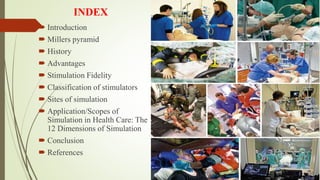
INDEX
 Introduction
 Millers pyramid
 History
 Advantages
 Stimulation Fidelity
 Classification of stimulators
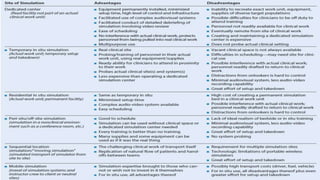
 Sites of simulation
 Application/Scopes of
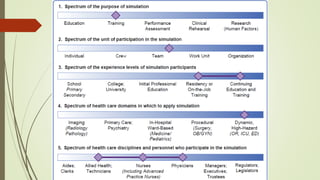
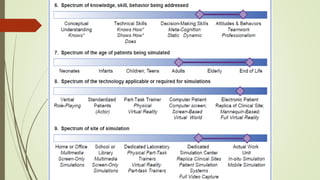
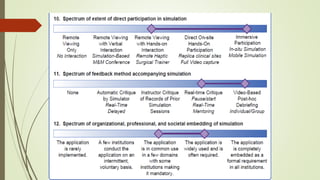
Simulation in Health Care: The
12 Dimensions of Simulation
 Conclusion
 References
INTRODUCTION
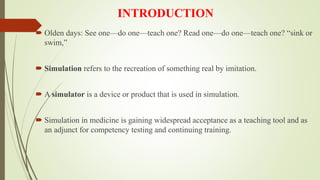
 Olden days: See one—do one—teach one? Read one—do one—teach one? “sink or
swim,”
 Simulation refers to the recreation of something real by imitation.
 A simulator is a device or product that is used in simulation.
 Simulation in medicine is gaining widespread acceptance as a teaching tool and as
an adjunct for competency testing and continuing training.
INTRODUCTION cont…
 Simulation allows personnel to practice and learn principles in a controlled environment that will
better prepare them for the safe administration of health care to patients.
 Potential way of learning and practicing all the skills without harm to a real patient.
 Can be part of an organization’s patient safety strategy and supports building a culture of safety.
 Obstacles to providing simulation training are :
• Obtaining access to the learner population for the requisite time
• Providing appropriately trained and skilled simulation instructors to prepare, conduct, debrief,
and evaluate the simulation sessions.
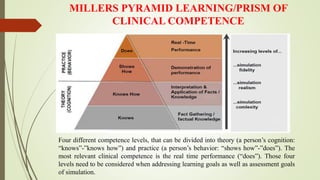
MILLERS PYRAMID LEARNING/PRISM OF
CLINICAL COMPETENCE
Four different competence levels, that can be divided into theory (a person’s cognition:
“knows”-”knows how”) and practice (a person’s behavior: “shows how”-”does”). The
most relevant clinical competence is the real time performance (“does”). Those four
levels need to be considered when addressing learning goals as well as assessment goals
of simulation.
HISTORY
 Medical simulators were introduced in the early 1960s, in the form of
manikins designed to aid in teaching mouth-to-mouth resuscitation: AMBU
man by Henning Ruben.
 First computer controlled simulators were seen in the mid-1960s.
 Impetus for the development of simulators came from the observed parallels
found in the aviation industry.
 Similar to the aviation environment, medical practice in the operating
room/ICU/Casualty involves multiple tasks requiring a high degree of
vigilance, procedural, monitoring and decision making skills in a dynamic,
complex environment, which is affected by the simultaneous interactions of
the different members of the operative team.
 As in aviation, critical life-threatening incidents are rare, but when they do
occur, they have potentially disastrous consequences unless the Doctor is able
to quickly diagnose and correct the problem.
ADVANTAGES
1. They simulate a high degree of reality
2. No risk for a real patient
3. Tasks/scenarios can be created to demand
4. Skills can be practiced repeatedly
5. Allows for practice on clinically rare scenarios
6. Videotaping allows for review
7. Simulation can be stopped or restarted for teaching
8. Transfer of training from classroom to real situation is enhanced.
OBJECTIVES
1. Education and training of technical and nontechnical skills
2. System probing
3. Testing of equipment and supplies
4. Assessment/evaluation
5. Research
6. Further purposes
SIMULATOR FIDELITY
 Fidelity is the extent to which the appearance and behavior of the simulator or
simulation match the appearance and behavior of the simulated system.
 The level of fidelity required depends on the type of task and stage of training and
influences skills transfer.
 Simulators are typically described as low, intermediate or high fidelity based on
this attribute.
 Fidelity could be physical fidelity (the device replicates physical aspects of the
human body), environmental fidelity (the simulation room looks like an operating
room), equipment fidelity (the clinical equipment works like or is the real thing),
or psychological fidelity (the simulation evokes behaviors similar to the real
situation).
CLASSIFICATION OF SIMULATORS
1. Part task trainers
2. Computer-based systems
3. Virtual reality and haptic systems
4. Simulated patients
5. Simulated environments
6. Integrated simulators
 Instructor-driven simulators
 Model-driven simulators.
PART TASK TRAINERS
 Part task trainers are designed to replicate only part of the environment.
 They will often resemble anatomical areas of the body, e.g. models used to
train basic skills, such as intubation, or venipuncture.
 They are relatively inexpensive.
COMPUTER-BASED SYSTEMS
 Computer systems can be used to model aspects of human physiology or
pharmacology, simulated tasks or environments and allow interaction with
these through a computer interface.
 The main focus of learning is on using information to make treatment
decisions.
 These systems can provide the student with feedback which allows for
independent learning.
 Computer-based systems are relatively inexpensive.
VIRTUAL REALITY AND HAPTIC SYSTEMS
 Virtual reality is the ultimate computer based technology.
 Its main aim is to present virtual objects or environments to all human senses
in a way which is identical to their natural counterpart.
 Haptic (touch) feedback is used to produce a feeling of resistance when using
instruments within the simulated environment, this creates the illusion that the
operator is coming into physical contact with the model, e.g. flexible
fiberoptic intubation trainer.
SIMULATED PATIENTS AND ENVIRONMENT
 Simulated patients: are the highest “fidelity” simulators. However, their use
is mainly restricted to the teaching of communication and interpersonal skills.
 Simulated Environment: This involves recreating the working environment
in which multidisciplinary teams can work together, e.g. operating room. This
gives an opportunity for learners to examine their roles within a team.
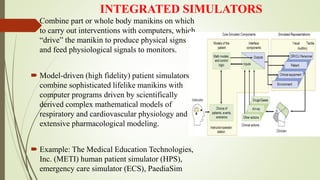
INTEGRATED SIMULATORS
 Combine part or whole body manikins on which
to carry out interventions with computers, which
“drive” the manikin to produce physical signs
and feed physiological signals to monitors.
 Model-driven (high fidelity) patient simulators
combine sophisticated lifelike manikins with
computer programs driven by scientifically
derived complex mathematical models of
respiratory and cardiovascular physiology and
extensive pharmacological modeling.
 Example: The Medical Education Technologies,
Inc. (METI) human patient simulator (HPS),
emergency care simulator (ECS), PaediaSim
INTEGRATED SIMULATORS cont…
 Model-driven simulators make the dynamic interaction and feedback less
operator- dependent and hence more complex scenarios can be undertaken.
 Due to their complexity, model driven simulators are very costly, both in terms
of purchase and running costs.
 “Instructor driven (‘intermediate fidelity’)” simulators combine part or full
body manikins with less complex computer programs, e.g. Laerdal SimMan®.
 The computer software produces physiological signals that are displayed on a
computer screen rather than standard clinical monitor and an instructor is
required to adjust signs to reflect patient responses.
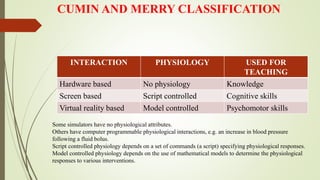
CUMIN AND MERRY CLASSIFICATION
INTERACTION PHYSIOLOGY USED FOR
TEACHING
Hardware based No physiology Knowledge
Screen based Script controlled Cognitive skills
Virtual reality based Model controlled Psychomotor skills
Some simulators have no physiological attributes.
Others have computer programmable physiological interactions, e.g. an increase in blood pressure
following a fluid bolus.
Script controlled physiology depends on a set of commands (a script) specifying physiological responses.
Model controlled physiology depends on the use of mathematical models to determine the physiological
responses to various interventions.
SCREEN-BASED SIMULATOR
 Runs on a computer with no additional hardware.
 Users interact with it through conventional devices (such as its keyboard or
mouse)
 Are good devices to acquire technical skills.
 The advantage of screen-based simulators is their low cost, more readily be
used by a trainee alone, without the need for a tutor or actors, which also
reduces cost.
 The disadvantage is that they cannot be used to practice psychomotor skills or
teamwork
HARDWARE-BASED SIMULATORS
 Also called mannequin-based simulator/full-scale simulator/hands-on
simulator/realistic simulator/high-fidelity simulator.
 The trainees interact in much the same way they would interact with a real patient.
 The control logic is manipulated through an instructor/operator’s station that allows
the instructor to create specific patients, select and implement abnormal events and
faults, and monitor the progress of the simulation session.
 It is common to obtain detailed records of the simulation and the actions taken from
video and audio recording of the personnel working in the replicated clinical
environment.
 Provide better training for behavioral aspects of crisis management, such as
communication, leadership, and interpersonal conflicts .
 Usually require more space, as well as other equipment (such as anesthetic
machines and defibrillators).
 The ongoing costs, such as repairs and maintenance, are therefore higher.
VIRTUAL REALITY SIMULATORS
 Refers to a set of techniques in which one interacts with a synthetic (virtual)
environment that exists solely in the computer.
 Using virtual reality, parts or all of the patient and environment are presented to the
user by three-dimensional representations with or without “touch” to create a more
“immersive” experience.
 A screen-only simulator could be viewed as a very limited virtual reality simulator.
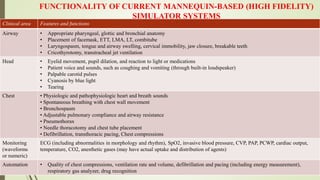
FUNCTIONALITY OF CURRENT MANNEQUIN-BASED (HIGH FIDELITY)
SIMULATOR SYSTEMS
Clinical area Features and functions
Airway • Appropriate pharyngeal, glottic and bronchial anatomy
• Placement of facemask, ETT, LMA, LT, combitube
• Laryngospasm, tongue and airway swelling, cervical immobility, jaw closure, breakable teeth
• Cricothyrotomy, transtracheal jet ventilation
Head • Eyelid movement, pupil dilation, and reaction to light or medications
• Patient voice and sounds, such as coughing and vomiting (through built-in loudspeaker)
• Palpable carotid pulses
• Cyanosis by blue light
• Tearing
Chest • Physiologic and pathophysiologic heart and breath sounds
• Spontaneous breathing with chest wall movement
• Bronchospasm
• Adjustable pulmonary compliance and airway resistance
• Pneumothorax
• Needle thoracotomy and chest tube placement
• Defibrillation, transthoracic pacing, Chest compressions
Monitoring
(waveforms
or numeric)
ECG (including abnormalities in morphology and rhythm), SpO2, invasive blood pressure, CVP, PAP, PCWP, cardiac output,
temperature, CO2, anesthetic gases (may have actual uptake and distribution of agents)
Automation • Quality of chest compressions, ventilation rate and volume, defibrillation and pacing (including energy measurement),
respiratory gas analyzer, drug recognition
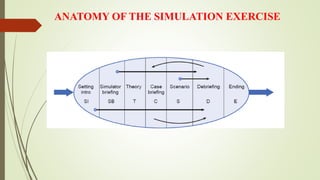
ANATOMY OF THE SIMULATION EXERCISE
CONCLUSION
 Simulation is an educational technique that allows interactive activity by recreating all
or part of a clinical experience without exposing patients to the associated risks.
 Many applications have been found for simulators in medical field including teaching
and training, evaluation and research.
 Most important component of high-fidelity patient simulation training is the self-
reflective (often video-assisted) debriefing session after the clinical scenario.
 Crisis resource management can be trained
REFERENCES
 Understanding Anesthetic Equipment & Procedures: A Practical Approach.
By Dwarkadas K Baheti.
 Millers Anesthesia. 9th edition.

Simulation in anesthesia and medicine. pptx

  • 1.
    SIMULATION IN MEDICINE BY DR.RAVIKIRAN H M MBBS, DNB ANAESTHESIOLOGY ADMO, CENTRAL HOSPITAL, MALIGAON
  • 2.
    INDEX  Introduction  Millerspyramid  History  Advantages  Stimulation Fidelity  Classification of stimulators  Sites of simulation  Application/Scopes of Simulation in Health Care: The 12 Dimensions of Simulation  Conclusion  References
  • 3.
    INTRODUCTION  Olden days:See one—do one—teach one? Read one—do one—teach one? “sink or swim,”  Simulation refers to the recreation of something real by imitation.  A simulator is a device or product that is used in simulation.  Simulation in medicine is gaining widespread acceptance as a teaching tool and as an adjunct for competency testing and continuing training.
  • 4.
    INTRODUCTION cont…  Simulationallows personnel to practice and learn principles in a controlled environment that will better prepare them for the safe administration of health care to patients.  Potential way of learning and practicing all the skills without harm to a real patient.  Can be part of an organization’s patient safety strategy and supports building a culture of safety.  Obstacles to providing simulation training are : • Obtaining access to the learner population for the requisite time • Providing appropriately trained and skilled simulation instructors to prepare, conduct, debrief, and evaluate the simulation sessions.
  • 5.
    MILLERS PYRAMID LEARNING/PRISMOF CLINICAL COMPETENCE Four different competence levels, that can be divided into theory (a person’s cognition: “knows”-”knows how”) and practice (a person’s behavior: “shows how”-”does”). The most relevant clinical competence is the real time performance (“does”). Those four levels need to be considered when addressing learning goals as well as assessment goals of simulation.
  • 6.
    HISTORY  Medical simulatorswere introduced in the early 1960s, in the form of manikins designed to aid in teaching mouth-to-mouth resuscitation: AMBU man by Henning Ruben.  First computer controlled simulators were seen in the mid-1960s.  Impetus for the development of simulators came from the observed parallels found in the aviation industry.  Similar to the aviation environment, medical practice in the operating room/ICU/Casualty involves multiple tasks requiring a high degree of vigilance, procedural, monitoring and decision making skills in a dynamic, complex environment, which is affected by the simultaneous interactions of the different members of the operative team.  As in aviation, critical life-threatening incidents are rare, but when they do occur, they have potentially disastrous consequences unless the Doctor is able to quickly diagnose and correct the problem.
  • 7.
    ADVANTAGES 1. They simulatea high degree of reality 2. No risk for a real patient 3. Tasks/scenarios can be created to demand 4. Skills can be practiced repeatedly 5. Allows for practice on clinically rare scenarios 6. Videotaping allows for review 7. Simulation can be stopped or restarted for teaching 8. Transfer of training from classroom to real situation is enhanced.
  • 8.
    OBJECTIVES 1. Education andtraining of technical and nontechnical skills 2. System probing 3. Testing of equipment and supplies 4. Assessment/evaluation 5. Research 6. Further purposes
  • 9.
    SIMULATOR FIDELITY  Fidelityis the extent to which the appearance and behavior of the simulator or simulation match the appearance and behavior of the simulated system.  The level of fidelity required depends on the type of task and stage of training and influences skills transfer.  Simulators are typically described as low, intermediate or high fidelity based on this attribute.  Fidelity could be physical fidelity (the device replicates physical aspects of the human body), environmental fidelity (the simulation room looks like an operating room), equipment fidelity (the clinical equipment works like or is the real thing), or psychological fidelity (the simulation evokes behaviors similar to the real situation).
  • 10.
    CLASSIFICATION OF SIMULATORS 1.Part task trainers 2. Computer-based systems 3. Virtual reality and haptic systems 4. Simulated patients 5. Simulated environments 6. Integrated simulators  Instructor-driven simulators  Model-driven simulators.
  • 11.
    PART TASK TRAINERS Part task trainers are designed to replicate only part of the environment.  They will often resemble anatomical areas of the body, e.g. models used to train basic skills, such as intubation, or venipuncture.  They are relatively inexpensive.
  • 12.
    COMPUTER-BASED SYSTEMS  Computersystems can be used to model aspects of human physiology or pharmacology, simulated tasks or environments and allow interaction with these through a computer interface.  The main focus of learning is on using information to make treatment decisions.  These systems can provide the student with feedback which allows for independent learning.  Computer-based systems are relatively inexpensive.
  • 13.
    VIRTUAL REALITY ANDHAPTIC SYSTEMS  Virtual reality is the ultimate computer based technology.  Its main aim is to present virtual objects or environments to all human senses in a way which is identical to their natural counterpart.  Haptic (touch) feedback is used to produce a feeling of resistance when using instruments within the simulated environment, this creates the illusion that the operator is coming into physical contact with the model, e.g. flexible fiberoptic intubation trainer.
  • 14.
    SIMULATED PATIENTS ANDENVIRONMENT  Simulated patients: are the highest “fidelity” simulators. However, their use is mainly restricted to the teaching of communication and interpersonal skills.  Simulated Environment: This involves recreating the working environment in which multidisciplinary teams can work together, e.g. operating room. This gives an opportunity for learners to examine their roles within a team.
  • 15.
    INTEGRATED SIMULATORS  Combinepart or whole body manikins on which to carry out interventions with computers, which “drive” the manikin to produce physical signs and feed physiological signals to monitors.  Model-driven (high fidelity) patient simulators combine sophisticated lifelike manikins with computer programs driven by scientifically derived complex mathematical models of respiratory and cardiovascular physiology and extensive pharmacological modeling.  Example: The Medical Education Technologies, Inc. (METI) human patient simulator (HPS), emergency care simulator (ECS), PaediaSim
  • 16.
    INTEGRATED SIMULATORS cont… Model-driven simulators make the dynamic interaction and feedback less operator- dependent and hence more complex scenarios can be undertaken.  Due to their complexity, model driven simulators are very costly, both in terms of purchase and running costs.  “Instructor driven (‘intermediate fidelity’)” simulators combine part or full body manikins with less complex computer programs, e.g. Laerdal SimMan®.  The computer software produces physiological signals that are displayed on a computer screen rather than standard clinical monitor and an instructor is required to adjust signs to reflect patient responses.
  • 17.
    CUMIN AND MERRYCLASSIFICATION INTERACTION PHYSIOLOGY USED FOR TEACHING Hardware based No physiology Knowledge Screen based Script controlled Cognitive skills Virtual reality based Model controlled Psychomotor skills Some simulators have no physiological attributes. Others have computer programmable physiological interactions, e.g. an increase in blood pressure following a fluid bolus. Script controlled physiology depends on a set of commands (a script) specifying physiological responses. Model controlled physiology depends on the use of mathematical models to determine the physiological responses to various interventions.
  • 18.
    SCREEN-BASED SIMULATOR  Runson a computer with no additional hardware.  Users interact with it through conventional devices (such as its keyboard or mouse)  Are good devices to acquire technical skills.  The advantage of screen-based simulators is their low cost, more readily be used by a trainee alone, without the need for a tutor or actors, which also reduces cost.  The disadvantage is that they cannot be used to practice psychomotor skills or teamwork
  • 19.
    HARDWARE-BASED SIMULATORS  Alsocalled mannequin-based simulator/full-scale simulator/hands-on simulator/realistic simulator/high-fidelity simulator.  The trainees interact in much the same way they would interact with a real patient.  The control logic is manipulated through an instructor/operator’s station that allows the instructor to create specific patients, select and implement abnormal events and faults, and monitor the progress of the simulation session.  It is common to obtain detailed records of the simulation and the actions taken from video and audio recording of the personnel working in the replicated clinical environment.  Provide better training for behavioral aspects of crisis management, such as communication, leadership, and interpersonal conflicts .  Usually require more space, as well as other equipment (such as anesthetic machines and defibrillators).  The ongoing costs, such as repairs and maintenance, are therefore higher.
  • 20.
    VIRTUAL REALITY SIMULATORS Refers to a set of techniques in which one interacts with a synthetic (virtual) environment that exists solely in the computer.  Using virtual reality, parts or all of the patient and environment are presented to the user by three-dimensional representations with or without “touch” to create a more “immersive” experience.  A screen-only simulator could be viewed as a very limited virtual reality simulator.
  • 21.
    FUNCTIONALITY OF CURRENTMANNEQUIN-BASED (HIGH FIDELITY) SIMULATOR SYSTEMS Clinical area Features and functions Airway • Appropriate pharyngeal, glottic and bronchial anatomy • Placement of facemask, ETT, LMA, LT, combitube • Laryngospasm, tongue and airway swelling, cervical immobility, jaw closure, breakable teeth • Cricothyrotomy, transtracheal jet ventilation Head • Eyelid movement, pupil dilation, and reaction to light or medications • Patient voice and sounds, such as coughing and vomiting (through built-in loudspeaker) • Palpable carotid pulses • Cyanosis by blue light • Tearing Chest • Physiologic and pathophysiologic heart and breath sounds • Spontaneous breathing with chest wall movement • Bronchospasm • Adjustable pulmonary compliance and airway resistance • Pneumothorax • Needle thoracotomy and chest tube placement • Defibrillation, transthoracic pacing, Chest compressions Monitoring (waveforms or numeric) ECG (including abnormalities in morphology and rhythm), SpO2, invasive blood pressure, CVP, PAP, PCWP, cardiac output, temperature, CO2, anesthetic gases (may have actual uptake and distribution of agents) Automation • Quality of chest compressions, ventilation rate and volume, defibrillation and pacing (including energy measurement), respiratory gas analyzer, drug recognition
  • 26.
    ANATOMY OF THESIMULATION EXERCISE
  • 27.
    CONCLUSION  Simulation isan educational technique that allows interactive activity by recreating all or part of a clinical experience without exposing patients to the associated risks.  Many applications have been found for simulators in medical field including teaching and training, evaluation and research.  Most important component of high-fidelity patient simulation training is the self- reflective (often video-assisted) debriefing session after the clinical scenario.  Crisis resource management can be trained
  • 28.
    REFERENCES  Understanding AnestheticEquipment & Procedures: A Practical Approach. By Dwarkadas K Baheti.  Millers Anesthesia. 9th edition.