MEU WORKSHOP
How to teach practical
skills
How to teach practical
skills
Definition (1)
The word “clinical” is derived from the Greek
‘klinikos’, which means ‘pertaining to or
around the sick bed’.
The term ‘clinical skills’ refers to those
clinical examination and procedural
skills commonly performed in real or
simulated clinical environments.
Definition (2)
 For the purpose of this session, “practical skills” means skills
performed by hand (as in tying a knot) or with human intervention
using equipment, tools or technology requiring guidance, force or
movement (as in utero blood transfusion).
 Practical skills primarily require physical dexterity, although an
understanding of principles, processes and sequences is also essential,
especially for more complex practical skills.
 In many learning environments, the word “competency” has replaced
the term “practical skill.” The terms are not entirely interchangeable
as competencies can also include the application of knowledge and
theory not associated with practical skills. But in general, the
demonstration of a practical skill can also be described as
demonstrating competency.
Teaching practical skills
 Teaching practical skills requires using
very precise instructions to enable the
learner to follow the process and to repeat
the skill.
 Most often this involves using both visual
clues and text or audio prompts.
 It certainly requires special skills in an
instructor if there are no visuals.
 For distance learners, the most frequently
used method for teaching practical skills is
using print-based illustrations of step-by-
step procedures.
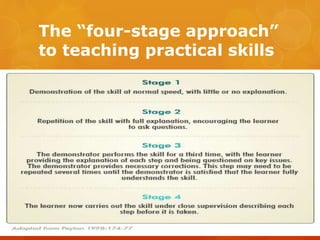
The “four-stage approach”
to teaching practical skills
Teaching clinical skills
“Observe, record, tabulate,
communicate.
Use your five senses… Learn to see,
learn to hear, learn to feel, learn to
smell, and know that by practice alone
you can become expert’
Sir William Osler (1849–1919)
Writing Skills objectives
An example of a skills-based
objective at the level of ‘precision’
would be:
‘At the end of the training
session, learners will be able
to insert a cannula into a
vein accurately without
causing a haematoma’.
Thinking points
Think about the clinical skills you
commonly teach.
1. Where do you teach them?
2. What teaching methods do you
commonly use?
3. How do you assess the learning of these
skills?
4. What theoretical models, if any, do you
base this teaching and learning on?
Where to teach clinical skills
 Traditionally, clinical teaching occurred in hospital wards,
outpatient settings and operating theatres. During the
past 20 years, clinical skills centres, laboratories and,
more recently, simulation centres with high-fidelity
simulation have been introduced.
 While traditional clinical settings have never been the
ideal teaching and learning environments, they are
becoming increasingly more difficult to use as service
demands stretch goodwill and reduce opportunity.
 Workplace-based learning however is vital for the
acquisition of a comprehensive range of clinical skills
that can be used in a variety of complex situations.
The planned clinical examination
session
 Small groups of students (two to six) are taken to
the bedside, an ‘expert’ demonstrates the skills and
then observes the students’ performance of the
skill.
 The main mistake teachers make during such
planned sessions is lecturing the students while
ignoring the wonderful resource that is the patient
and their clinical history and signs.
 These sessions must follow the simple philosophy of
making the most of the patient.
Opportunistic teaching and
learning
By definition, opportunistic teaching
and learning is unpredictable but can
be
maximised by setting learning
outcomes or educational objectives,
pre-planning and reflection on
important generic and specific
educational issues that may arise.
Teaching and learning in
simulated environments
 Simulation is the reproduction of part or
all of a clinical encounter through the use
of manikins, computer-assisted resources
and simulated patients.
 Advances in learning technologies have
seen a massive rise in the availability and
employment of high-fidelity simulators
and simulation. However, low-fidelity
resources have been used successfully for
many years and, like the traditional
teaching environments, need to be
carefully incorporated into the spectrum of
learning/training.
Simulation:
Simulations vary in their relation (fidelity) to
the real, lived experience.
allows learners to practise in a safe,
protected environment
assists learners’ reflection of their strengths
and weaknesses through teacher, peer and
‘patient’ feedback, including video analysis
allows teachers/staff to assess skills in an
objective, reproducible manner
Low-fidelity simulation
 Low-fidelity simulation might include
using manikins to practise clinical
examinations or procedures such as
vaginal examination.
 Manikins can also be used to rehearse the
skills of simple clinical procedures such as
suturing or the insertion of urinary
catheters, intravenous cannulae and
nasogastric tubes, taking a blood pressure
or temperature.
How IT can assist in the teaching
and learning of clinical skills
 There has been a huge explosion in the
availability of IT resources that can be
used to help teach clinical skills. However,
procedural skills are still heavily influenced
by local ‘experts’ who cling on to their
own local variation on the way to perform
given skills.
 With so many freely available web-based
resources, a good starting point is to
quality assure the best of these sites as
you would with course books.
Catering to the different needs is
critical for success.
 A major consideration when teaching practical skills
is the diversity in the preferred learning styles of
learners.
 Experiential learners become frustrated sitting
through a lengthy explanation of a process; they
just want to go and try it out.
 Theorists need to understand everything in minute
detail before they embark on the practical
application.
 Recognising different learning styles is an important
factor in assisting learners to develop practical skills.

MEU WORKSHOP How to teach_practical_skills

  • 1.
    MEU WORKSHOP How toteach practical skills
  • 2.
    How to teachpractical skills
  • 3.
    Definition (1) The word“clinical” is derived from the Greek ‘klinikos’, which means ‘pertaining to or around the sick bed’. The term ‘clinical skills’ refers to those clinical examination and procedural skills commonly performed in real or simulated clinical environments.
  • 4.
    Definition (2)  Forthe purpose of this session, “practical skills” means skills performed by hand (as in tying a knot) or with human intervention using equipment, tools or technology requiring guidance, force or movement (as in utero blood transfusion).  Practical skills primarily require physical dexterity, although an understanding of principles, processes and sequences is also essential, especially for more complex practical skills.  In many learning environments, the word “competency” has replaced the term “practical skill.” The terms are not entirely interchangeable as competencies can also include the application of knowledge and theory not associated with practical skills. But in general, the demonstration of a practical skill can also be described as demonstrating competency.
  • 5.
    Teaching practical skills Teaching practical skills requires using very precise instructions to enable the learner to follow the process and to repeat the skill.  Most often this involves using both visual clues and text or audio prompts.  It certainly requires special skills in an instructor if there are no visuals.  For distance learners, the most frequently used method for teaching practical skills is using print-based illustrations of step-by- step procedures.
  • 6.
    The “four-stage approach” toteaching practical skills
  • 7.
    Teaching clinical skills “Observe,record, tabulate, communicate. Use your five senses… Learn to see, learn to hear, learn to feel, learn to smell, and know that by practice alone you can become expert’ Sir William Osler (1849–1919)
  • 8.
    Writing Skills objectives Anexample of a skills-based objective at the level of ‘precision’ would be: ‘At the end of the training session, learners will be able to insert a cannula into a vein accurately without causing a haematoma’.
  • 9.
    Thinking points Think aboutthe clinical skills you commonly teach. 1. Where do you teach them? 2. What teaching methods do you commonly use? 3. How do you assess the learning of these skills? 4. What theoretical models, if any, do you base this teaching and learning on?
  • 10.
    Where to teachclinical skills  Traditionally, clinical teaching occurred in hospital wards, outpatient settings and operating theatres. During the past 20 years, clinical skills centres, laboratories and, more recently, simulation centres with high-fidelity simulation have been introduced.  While traditional clinical settings have never been the ideal teaching and learning environments, they are becoming increasingly more difficult to use as service demands stretch goodwill and reduce opportunity.  Workplace-based learning however is vital for the acquisition of a comprehensive range of clinical skills that can be used in a variety of complex situations.
  • 11.
    The planned clinicalexamination session  Small groups of students (two to six) are taken to the bedside, an ‘expert’ demonstrates the skills and then observes the students’ performance of the skill.  The main mistake teachers make during such planned sessions is lecturing the students while ignoring the wonderful resource that is the patient and their clinical history and signs.  These sessions must follow the simple philosophy of making the most of the patient.
  • 12.
    Opportunistic teaching and learning Bydefinition, opportunistic teaching and learning is unpredictable but can be maximised by setting learning outcomes or educational objectives, pre-planning and reflection on important generic and specific educational issues that may arise.
  • 13.
    Teaching and learningin simulated environments  Simulation is the reproduction of part or all of a clinical encounter through the use of manikins, computer-assisted resources and simulated patients.  Advances in learning technologies have seen a massive rise in the availability and employment of high-fidelity simulators and simulation. However, low-fidelity resources have been used successfully for many years and, like the traditional teaching environments, need to be carefully incorporated into the spectrum of learning/training.
  • 14.
    Simulation: Simulations vary intheir relation (fidelity) to the real, lived experience. allows learners to practise in a safe, protected environment assists learners’ reflection of their strengths and weaknesses through teacher, peer and ‘patient’ feedback, including video analysis allows teachers/staff to assess skills in an objective, reproducible manner
  • 15.
    Low-fidelity simulation  Low-fidelitysimulation might include using manikins to practise clinical examinations or procedures such as vaginal examination.  Manikins can also be used to rehearse the skills of simple clinical procedures such as suturing or the insertion of urinary catheters, intravenous cannulae and nasogastric tubes, taking a blood pressure or temperature.
  • 16.
    How IT canassist in the teaching and learning of clinical skills  There has been a huge explosion in the availability of IT resources that can be used to help teach clinical skills. However, procedural skills are still heavily influenced by local ‘experts’ who cling on to their own local variation on the way to perform given skills.  With so many freely available web-based resources, a good starting point is to quality assure the best of these sites as you would with course books.
  • 17.
    Catering to thedifferent needs is critical for success.  A major consideration when teaching practical skills is the diversity in the preferred learning styles of learners.  Experiential learners become frustrated sitting through a lengthy explanation of a process; they just want to go and try it out.  Theorists need to understand everything in minute detail before they embark on the practical application.  Recognising different learning styles is an important factor in assisting learners to develop practical skills.

Editor's Notes

  • #3 Speaker’s notes: The AAMC Project on the Clinical Education of Medical Students
  • #7 This model may be expanded or reduced depending on the background skills of the learner. Video may be used in Stages 1 and 2. As with all teaching, the learner must be given constructive feedback and allowed time for practice of the skills.
  • #10 Speaker’s Notes: Bloom suggested these five levels: Imitation (observes skill and tries to reproduce it) Manipulation (performs skill from instruction) Precision (reproduces skill with accuracy and proportion) Articulation (combines one or more skills in sequence with harmony and consistency) Naturalisation (completes skilful tasks competently and automatically). Bloom B and Kratwohl D. Taxonomy of educational objectives: the classification of educational goals: Handbook I, Cognitive Skills Domain, Longmans-Green, New York, 1956.
  • #17 Speaker’s notes: “Fidelity” may be defined as strict conformity to truth of fact.