



AN INTRODUCTION TO:

HUMAN PATIENT
SIMULATION


                      Prepared and Presented By:
                            David Hiltz, NREMT-P
                           and Rod Kimble, EMT-P

                                 LEADERSHIP AND LEARNING
                          ARE INDISPENSIBLE TO EACH OTHER
                                 JOHN FITZGERALD KENNEDY
Images and photos are for presentation purposes only and do not represent endorsement of the products shown.
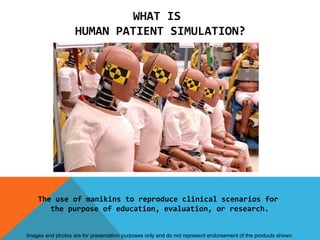
WHAT IS
                   HUMAN PATIENT SIMULATION?


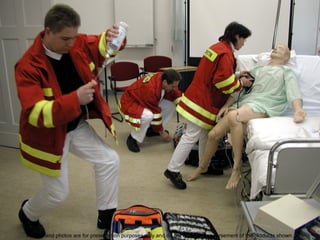
    The use of manikins to reproduce clinical scenarios for
       the purpose of education, evaluation, or research.


Images and photos are for presentation purposes only and do not represent endorsement of the products shown.
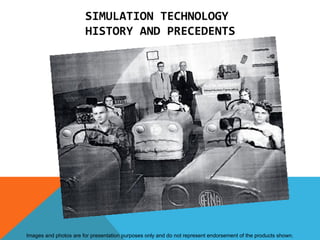
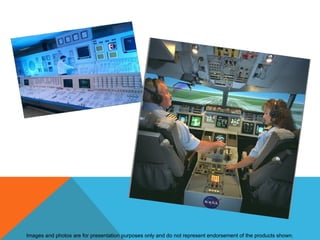
SIMULATION TECHNOLOGY
                       HISTORY AND PRECEDENTS


Images and photos are for presentation purposes only and do not represent endorsement of the products shown.
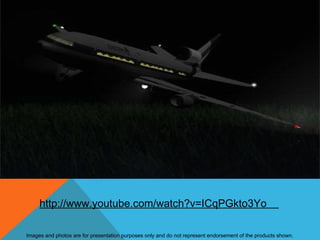
http://www.youtube.com/watch?v=ICqPGkto3Yo

Images and photos are for presentation purposes only and do not represent endorsement of the products shown.
Medical schools and residencies are currently facing a shift in
their teaching paradigm. The increasing amount of medical
information and research makes it difficult for medical
education to stay current in its curriculum. As patients become
increasingly concerned that students and residents are
‘‘practicing’’ on them, clinical medicine is becoming focused
more on patient safety and quality than on bed-side teaching
and education. Educators have faced these challenges by
restructuring curricula, developing small-group sessions, and
increasing self-directed learning and independent research.
Nevertheless, a disconnect still exists between the classroom
and the clinical environment. Many students feel that they are
inadequately trained in history taking, physical examination,
diagnosis, and management. Medical simulation has been proposed
as a technique to bridge this educational gap.


            The utility of simulation in medical education: what is
                                 the evidence?
                    Mt Sinai J Med. 2009 Aug;76(4):330-43.
                            doi: 10.1002/msj.20127.

 Images and photos are for presentation purposes only and do not represent endorsement of the products shown.
Images and photos are for presentation purposes only and do not represent endorsement of the products shown.
LOTS OF OPTIONS                                                  WHAT ARE THEY?


Images and photos are for presentation purposes only and do not represent endorsement of the products shown.
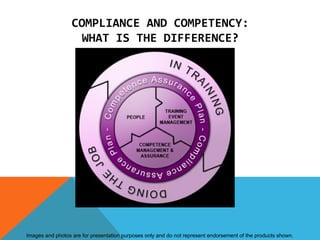
COMPLIANCE AND COMPETENCY:
                    WHAT IS THE DIFFERENCE?


Images and photos are for presentation purposes only and do not represent endorsement of the products shown.
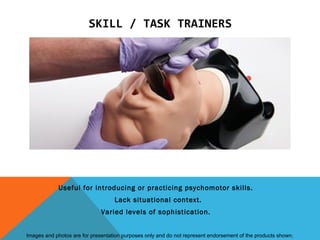
SKILL / TASK TRAINERS


             Useful for introducing or practicing psychomotor skills.
                                   Lack situational context.
                              Varied levels of sophistication.


Images and photos are for presentation purposes only and do not represent endorsement of the products shown.
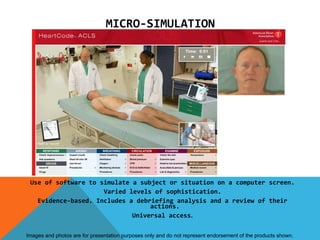
MICRO-SIMULATION


 Use of software to simulate a subject or situation on a computer screen.
                     Varied levels of sophistication.
   Evidence-based. Includes a debriefing analysis and a review of their
                                  actions.
                             Universal access.

Images and photos are for presentation purposes only and do not represent endorsement of the products shown.
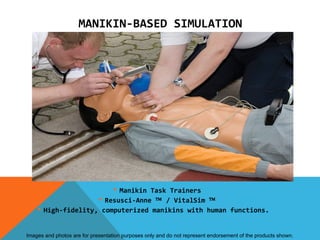
MANIKIN-BASED SIMULATION


                         Manikin Task Trainers
                     Resusci-Anne ™ / VitalSim ™
     High-fidelity, computerized manikins with human functions.


Images and photos are for presentation purposes only and do not represent endorsement of the products shown.
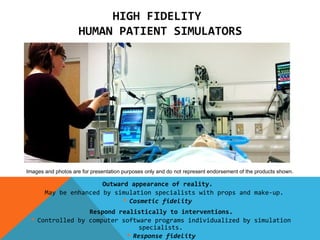
HIGH FIDELITY
                     HUMAN PATIENT SIMULATORS


Images and photos are for presentation purposes only and do not represent endorsement of the products shown.

                       Outward appearance of reality.
      May be enhanced by simulation specialists with props and make-up.
                              Cosmetic fidelity
                  Respond realistically to interventions.
   Controlled by computer software programs individualized by simulation
                                specialists.
                             Response fidelity
HIGH FIDELITY HUMAN PATIENT
                         SIMULATORS
                     RESPONSE FIDELITY
 Patient speaks to the participant.
 Able to perform interventions with realistic
  response.
  IV insertion with blood return.
  Chest tube insertion.
  Endotracheal Intubation.
 Physiologic responses.
  Patient’s chest rises.
  Patient has pulses, breath sounds, bowel sounds.
  Hemodynamic parameters display on typical monitor
   screens.


Images and photos are for presentation purposes only and do not represent endorsement of the products shown.
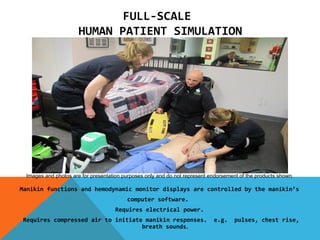
FULL-SCALE
                      HUMAN PATIENT SIMULATION


 Images and photos are for presentation purposes only and do not represent endorsement of the products shown.

Manikin functions and hemodynamic monitor displays are controlled by the manikin’s
                                         computer software.
                                    Requires electrical power.
 Requires compressed air to initiate manikin responses.                     e.g.     pulses, chest rise,
                                    breath sounds.
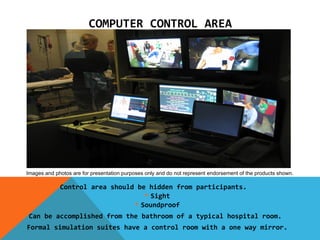
COMPUTER CONTROL AREA


Images and photos are for presentation purposes only and do not represent endorsement of the products shown.

             Control area should be hidden from participants.
                                    Sight
                                 Soundproof
 Can be accomplished from the bathroom of a typical hospital room.
Formal simulation suites have a control room with a one way mirror.
USES OF
                     FULL-SCALE SIMULATION?


                     Crisis Management -Team Training
                            Interdisciplinary Training
        Risk Management - Error Analysis and Avoidance
                                   Basic Patient Care
Images and photos are for presentation purposes only and do not represent endorsement of the products shown.
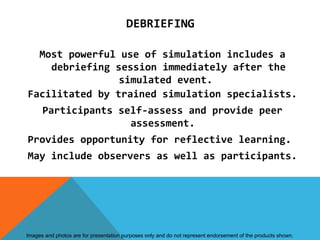
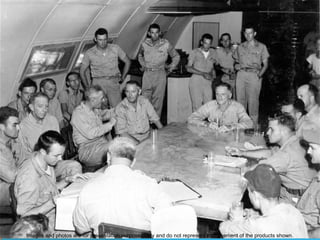
DEBRIEFING

  Most powerful use of simulation includes a
    debriefing session immediately after the
                simulated event.
Facilitated by trained simulation specialists.
      Participants self-assess and provide peer
                     assessment.
Provides opportunity for reflective learning.
May include observers as well as participants.


Images and photos are for presentation purposes only and do not represent endorsement of the products shown.
WHAT DO YOU KNOW ABOUT DEBRIEFING?


Images and photos are for presentation purposes only and do not represent endorsement of the products shown.
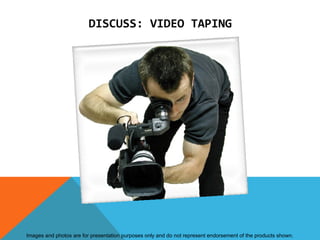
DISCUSS: VIDEO TAPING


Images and photos are for presentation purposes only and do not represent endorsement of the products shown.
SHOULD ACLS AND PALS BE CONDUCTED IN
                THE SIM LAB?


Images and photos are for presentation purposes only and do not represent endorsement of the products shown.
WHAT IS A CPR FRACTION?


Images and photos are for presentation purposes only and do not represent endorsement of the products shown.


  “Enthusiasm is one of the most powerful engines of success. When you
  do a thing, do it with all your might. Put your whole soul into it.
    Stamp it with your own personality. Be active, be energetic, be
    enthusiastic and faithful, and you will accomplish your object.
          Nothing great was ever achieved without enthusiasm.”
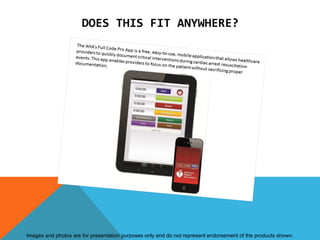
DOES THIS FIT ANYWHERE?


Images and photos are for presentation purposes only and do not represent endorsement of the products shown.
N S?
                                     TIO
                                 U ES
                                Q


Images and photos are for presentation purposes only and do not represent endorsement of the products shown.

Introduction to Human Patient Simulation

  • 1.
    AN INTRODUCTION TO: HUMANPATIENT SIMULATION Prepared and Presented By: David Hiltz, NREMT-P and Rod Kimble, EMT-P LEADERSHIP AND LEARNING ARE INDISPENSIBLE TO EACH OTHER JOHN FITZGERALD KENNEDY
  • 2.
    Images and photosare for presentation purposes only and do not represent endorsement of the products shown.
  • 3.
    Images and photosare for presentation purposes only and do not represent endorsement of the products shown.
  • 4.
    Images and photosare for presentation purposes only and do not represent endorsement of the products shown.
  • 5.
    WHAT IS HUMAN PATIENT SIMULATION? The use of manikins to reproduce clinical scenarios for the purpose of education, evaluation, or research. Images and photos are for presentation purposes only and do not represent endorsement of the products shown.
  • 6.
    SIMULATION TECHNOLOGY HISTORY AND PRECEDENTS Images and photos are for presentation purposes only and do not represent endorsement of the products shown.
  • 7.
    Images and photosare for presentation purposes only and do not represent endorsement of the products shown.
  • 8.
    http://www.youtube.com/watch?v=ICqPGkto3Yo Images and photosare for presentation purposes only and do not represent endorsement of the products shown.
  • 9.
    Medical schools andresidencies are currently facing a shift in their teaching paradigm. The increasing amount of medical information and research makes it difficult for medical education to stay current in its curriculum. As patients become increasingly concerned that students and residents are ‘‘practicing’’ on them, clinical medicine is becoming focused more on patient safety and quality than on bed-side teaching and education. Educators have faced these challenges by restructuring curricula, developing small-group sessions, and increasing self-directed learning and independent research. Nevertheless, a disconnect still exists between the classroom and the clinical environment. Many students feel that they are inadequately trained in history taking, physical examination, diagnosis, and management. Medical simulation has been proposed as a technique to bridge this educational gap. The utility of simulation in medical education: what is the evidence? Mt Sinai J Med. 2009 Aug;76(4):330-43. doi: 10.1002/msj.20127. Images and photos are for presentation purposes only and do not represent endorsement of the products shown.
  • 10.
    Images and photosare for presentation purposes only and do not represent endorsement of the products shown.
  • 11.
    LOTS OF OPTIONS WHAT ARE THEY? Images and photos are for presentation purposes only and do not represent endorsement of the products shown.
  • 12.
    Images and photosare for presentation purposes only and do not represent endorsement of the products shown.
  • 13.
    COMPLIANCE AND COMPETENCY: WHAT IS THE DIFFERENCE? Images and photos are for presentation purposes only and do not represent endorsement of the products shown.
  • 14.
    SKILL / TASKTRAINERS Useful for introducing or practicing psychomotor skills. Lack situational context. Varied levels of sophistication. Images and photos are for presentation purposes only and do not represent endorsement of the products shown.
  • 15.
    MICRO-SIMULATION Use ofsoftware to simulate a subject or situation on a computer screen. Varied levels of sophistication. Evidence-based. Includes a debriefing analysis and a review of their actions. Universal access. Images and photos are for presentation purposes only and do not represent endorsement of the products shown.
  • 16.
    MANIKIN-BASED SIMULATION  Manikin Task Trainers  Resusci-Anne ™ / VitalSim ™  High-fidelity, computerized manikins with human functions. Images and photos are for presentation purposes only and do not represent endorsement of the products shown.
  • 17.
    HIGH FIDELITY HUMAN PATIENT SIMULATORS Images and photos are for presentation purposes only and do not represent endorsement of the products shown. Outward appearance of reality.  May be enhanced by simulation specialists with props and make-up.  Cosmetic fidelity Respond realistically to interventions.  Controlled by computer software programs individualized by simulation specialists.  Response fidelity
  • 18.
    HIGH FIDELITY HUMANPATIENT SIMULATORS RESPONSE FIDELITY  Patient speaks to the participant.  Able to perform interventions with realistic response.  IV insertion with blood return.  Chest tube insertion.  Endotracheal Intubation.  Physiologic responses.  Patient’s chest rises.  Patient has pulses, breath sounds, bowel sounds.  Hemodynamic parameters display on typical monitor screens. Images and photos are for presentation purposes only and do not represent endorsement of the products shown.
  • 19.
    Images and photosare for presentation purposes only and do not represent endorsement of the products shown.
  • 20.
    FULL-SCALE HUMAN PATIENT SIMULATION Images and photos are for presentation purposes only and do not represent endorsement of the products shown. Manikin functions and hemodynamic monitor displays are controlled by the manikin’s computer software. Requires electrical power. Requires compressed air to initiate manikin responses. e.g. pulses, chest rise, breath sounds.
  • 21.
    COMPUTER CONTROL AREA Imagesand photos are for presentation purposes only and do not represent endorsement of the products shown. Control area should be hidden from participants.  Sight  Soundproof Can be accomplished from the bathroom of a typical hospital room. Formal simulation suites have a control room with a one way mirror.
  • 22.
    USES OF FULL-SCALE SIMULATION? Crisis Management -Team Training Interdisciplinary Training Risk Management - Error Analysis and Avoidance Basic Patient Care Images and photos are for presentation purposes only and do not represent endorsement of the products shown.
  • 23.
    DEBRIEFING Mostpowerful use of simulation includes a debriefing session immediately after the simulated event. Facilitated by trained simulation specialists. Participants self-assess and provide peer assessment. Provides opportunity for reflective learning. May include observers as well as participants. Images and photos are for presentation purposes only and do not represent endorsement of the products shown.
  • 24.
    Images and photosare for presentation purposes only and do not represent endorsement of the products shown.
  • 25.
    WHAT DO YOUKNOW ABOUT DEBRIEFING? Images and photos are for presentation purposes only and do not represent endorsement of the products shown.
  • 26.
    DISCUSS: VIDEO TAPING Imagesand photos are for presentation purposes only and do not represent endorsement of the products shown.
  • 27.
    SHOULD ACLS ANDPALS BE CONDUCTED IN THE SIM LAB? Images and photos are for presentation purposes only and do not represent endorsement of the products shown.
  • 28.
    WHAT IS ACPR FRACTION? Images and photos are for presentation purposes only and do not represent endorsement of the products shown.
  • 29.
    Images and photosare for presentation purposes only and do not represent endorsement of the products shown. “Enthusiasm is one of the most powerful engines of success. When you do a thing, do it with all your might. Put your whole soul into it. Stamp it with your own personality. Be active, be energetic, be enthusiastic and faithful, and you will accomplish your object. Nothing great was ever achieved without enthusiasm.”
  • 30.
    DOES THIS FITANYWHERE? Images and photos are for presentation purposes only and do not represent endorsement of the products shown.
  • 31.
    Images and photosare for presentation purposes only and do not represent endorsement of the products shown.
  • 32.
    N S? TIO U ES Q Images and photos are for presentation purposes only and do not represent endorsement of the products shown.

Editor's Notes

  • #20 Synopsis of the patient situation and then asked to perform based up their observations. Mannequin talks to them and there can be cohorts in the room to help suspend disbelief. After the scenario is completed, the group then enters into a debriefing session where their performance is discussed. This can be used for evaluations or reflective learning opportunities .