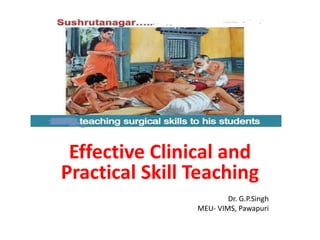
Effective Clinical and
Practical Skill Teaching
Dr. G.P.Singh
MEU- VIMS, Pawapuri
-
-
-
-
-
-
-
-
-
-
Types of Skill
-
-
-
-
-
-
-
-
-
-
-
-
-
Why Emphasis on Skill Education
• Growing mistrust among public for medical
profession (Negligence, misconduct, unethical
practice
• Performance emphasis is increasing at all level
of medical professional activity
• Great public awareness & enhanced public
rights
• To increase medical institution skill education
• “Must Know” changed to “Must Do”
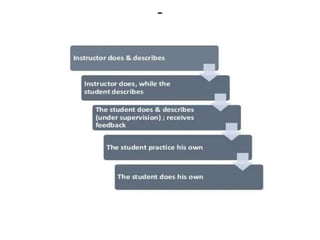
Steps of Skill acquisition
-
-
-
Teaching Skill at Workplace
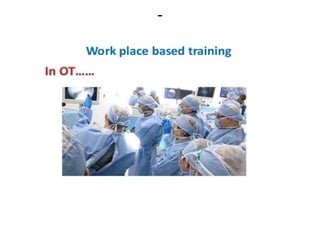
• Direct exposure to patient in ward, Operation
theater, Laboratory etc is important and can not
be simulated.
• Before starting direct teaching on patients it is
better to start with simulate patient-Role playing
• Patient should be briefed before teaching and
his/her consent taken
-
• Group of 2-5 students should be taught at a time
• Students are expected to behave professionally
• Students should be briefed in the beginning
about what they are expected to do. Learning
goal & objective should be framed before
teaching
-
• Facilitator (Teacher)helps to relieve anxieties
of patient & students participating in the
session
• At the end of examination facilitator should
assess the students, discuss with them 7 give
feedback
Work places of teaching
Important work places for teaching include:-
• OPD & Evening clinic
• Hospital wards
• Operation theater
• Clinical investigation unit
• Physiotherapy, Social service, other allied
departments
-
• Community visit
• Medical record unit
• Workshop, clinical conference, Task based
learning
• Standardized patient (Simulated)
Why Work place skill ?
• Provides foundation of learning all other skill
• Provides a cornerstone for life long learning
• Education, training and career options are
limited without their essential work place skill
-
• No Skill lab/ Simulator can prove workplace
experience
• You have in mild the consequences(fear) of
error which in lacking in skill lab or simulator
-
-
-
-
-
Simulation
-
-
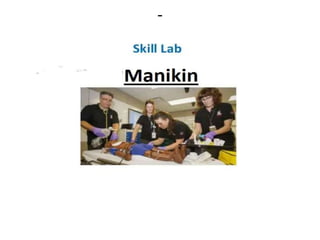
Skill Lab
• Skill Labs are Bridge between basic science
and ward clinical teaching
“A situation or environment created to
experience a representation of real life event
for practice, learning, evaluation ,testing”
-
-
-
-
-
-
-
-
-
-
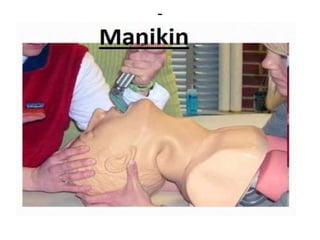
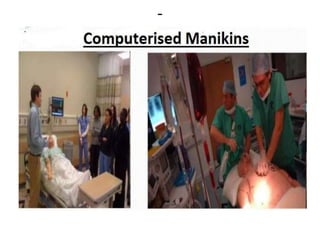
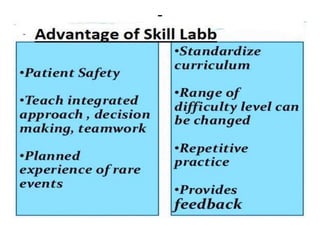
• Skill lab Imitate reality
• Offers limitless opportunity to go wrong which
is not possible in real patient
• Provides corrective feedback as a guide to
future action.
• Skill can be assessed in objective &
reproducible manner
• Rarely encountered clinical situation may be
simulated
-
Using Skill Lab. effectively
-
-
-
-
-
-
-
Thanks

Skill teaching

  • 1.
    Effective Clinical and PracticalSkill Teaching Dr. G.P.Singh MEU- VIMS, Pawapuri
  • 2.
  • 3.
  • 4.
  • 5.
  • 6.
  • 7.
  • 8.
  • 9.
  • 10.
  • 11.
  • 12.
  • 13.
  • 14.
  • 15.
  • 16.
  • 17.
  • 18.
  • 19.
  • 20.
  • 21.
  • 22.
  • 23.
  • 24.
  • 25.
    Why Emphasis onSkill Education • Growing mistrust among public for medical profession (Negligence, misconduct, unethical practice • Performance emphasis is increasing at all level of medical professional activity • Great public awareness & enhanced public rights • To increase medical institution skill education • “Must Know” changed to “Must Do”
  • 26.
    Steps of Skillacquisition
  • 27.
  • 28.
  • 29.
  • 30.
    Teaching Skill atWorkplace • Direct exposure to patient in ward, Operation theater, Laboratory etc is important and can not be simulated. • Before starting direct teaching on patients it is better to start with simulate patient-Role playing • Patient should be briefed before teaching and his/her consent taken
  • 31.
    - • Group of2-5 students should be taught at a time • Students are expected to behave professionally • Students should be briefed in the beginning about what they are expected to do. Learning goal & objective should be framed before teaching
  • 32.
    - • Facilitator (Teacher)helpsto relieve anxieties of patient & students participating in the session • At the end of examination facilitator should assess the students, discuss with them 7 give feedback
  • 33.
    Work places ofteaching Important work places for teaching include:- • OPD & Evening clinic • Hospital wards • Operation theater • Clinical investigation unit • Physiotherapy, Social service, other allied departments
  • 34.
    - • Community visit •Medical record unit • Workshop, clinical conference, Task based learning • Standardized patient (Simulated)
  • 35.
    Why Work placeskill ? • Provides foundation of learning all other skill • Provides a cornerstone for life long learning • Education, training and career options are limited without their essential work place skill
  • 36.
    - • No Skilllab/ Simulator can prove workplace experience • You have in mild the consequences(fear) of error which in lacking in skill lab or simulator
  • 37.
  • 38.
  • 39.
  • 40.
  • 41.
  • 42.
  • 43.
  • 44.
  • 45.
    Skill Lab • SkillLabs are Bridge between basic science and ward clinical teaching “A situation or environment created to experience a representation of real life event for practice, learning, evaluation ,testing”
  • 46.
  • 47.
  • 48.
  • 49.
  • 50.
  • 51.
  • 52.
  • 53.
  • 54.
  • 55.
    - • Skill labImitate reality • Offers limitless opportunity to go wrong which is not possible in real patient • Provides corrective feedback as a guide to future action. • Skill can be assessed in objective & reproducible manner • Rarely encountered clinical situation may be simulated
  • 56.
  • 57.
    Using Skill Lab.effectively
  • 58.
  • 59.
  • 60.
  • 61.
  • 62.
  • 63.
  • 64.
  • 65.