ROLE ASSIGNMENT IN SIMULATION NICOLE HARDER, RN, MPA UNIVERSITY OF MANITOBA HPSN09 – Tampa, Florida March 2009
Session agenda What are roles in simulation The use of roles in simulation How others “do it” Research: what does it recommend regarding roles? Learning that takes place with role assignment Demonstration Questions??
What are roles in simulation? Simulation is a unique learning environment Practice setting: often have one student assigned to one (or several) patient(s)/client(s) Simulation setting: often have several students assigned to one simulator If we have several students assigned to one client, is it realistic to have them all assigned to the same role?
Why do we use roles in simulation? Often have groups assigned to simulator Can have anything from 1 to 8 students (or more!) assigned to the same simulator What do we do with all the students? ASSIGN THEM ROLES
Use of roles in simulation Using roles or role-playing is a natural extension of simulation If you simulate the patient, then it’s reasonable to assume that you need to simulate the health care provider
Use of roles in simulation Most users of high-fidelity simulators have a good (or beginning) understanding of how to moulage or make the most of the simulator and the scenario …  but how do you simulate the health care provider?
Support for roles Why do we need specific roles?  Nikendie, Zuech & Diekmann (2005), published article titled “Role-playing for more realistic technical skills training” Develops student interaction and communication skills of learners from different backgrounds
Support for roles van Ments (1999.)  “The effective use of role-play” Found that role-playing promoted active learning This is valuable for student development of skills, knowledge and attitude
Support for roles Billings & Halstead (2005) Good for adult learners  because of the connection to real-life situations and active participation
Support for roles By using roles and role-playing, it acknowledges the importance of the social context of learning Allows student to take on roles in a secure environment A great match with the teaching philosophy behind simulation use!
Reasons to assign roles Groups are too large – to make these more manageable If we want to simulate the health care environment, there are several other disciplines working to together – maybe we can assign the various disciplines? To focus on a particular learner or skill Other reasons?
What kind of roles do we use? In nursing schools or programs, the following is common: Dividing the work of the nurse into roles  i.e. primary nurse, medication nurse, documentation nurse, treatment nurse, etc. Assigning the role of the family Assigning students to roles of another discipline  i.e. pharmacy, social work, etc. The role of the patient Observer – often not used to it’s potential
Developing roles Who chooses which roles to assign? How is this decision made? Are these developed ahead of time with the scenario in mind?  The students in mind?
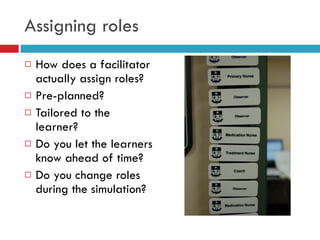
Assigning roles How does a facilitator actually assign roles? Pre-planned? Tailored to the learner? Do you let the learners know ahead of time? Do you change roles during the simulation?
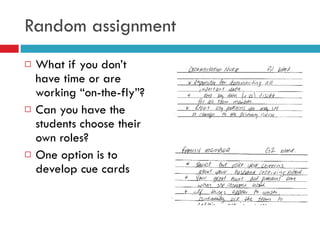
Random assignment What if you don’t have time or are working “on-the-fly”? Can you have the students choose their own roles? One option is to develop cue cards
Preparing the student for their role Do you prepare the student for their role? Why or why not? What type of preparation would you have available?
Support for structure Kiger (2004); Nestel & Tierney (2007); Kneebone (2005); Shearer & Davidhizar (2003) All suggest that role-play and role assignment works best in preplanned and structured situations that are kept as realistic as possible Feedback and discussion regarding the experience is important
Learning that takes place in roles Most learning focuses on the cognitive domain and cognitive outcomes however Using roles increases the affective domain of learning Want learners to respond to what they learn, to value it, and to organize it
What about the observer? Important role – do not ignore this Observation learning (social learning theory) Learning through observation involves for processes Attention Retention Production Motivation
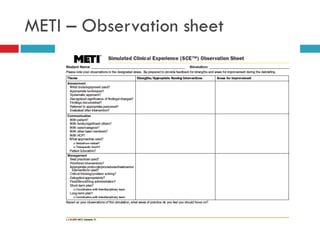
How to make the most of the observer role Attention Observers cannot learn unless they pay attention to what’s happening around them – METI has observation sheets available to keep them focused Retention Observers must not only recognize the observed behavior but also remember it at some later time – by documenting the behaviours or videotaping the scenario, this can help with retention
How to make the most of the observer role (cont’d) Production Observers must be physically and/intellectually capable of producing the act.  Must be of same skill level or year in program Motivation In general, observers will perform the act only if they have some motivation or reason to do so.  Be sure to include or highlight the observations in debriefing.  This is not to be a meaningless exercise
METI – Observation sheet
Pitfalls Students playing roles of other disciplines Students over-indulging in their roles Roles being vague or unclear Is it realistic to separate one nurse into several parts?
Limitations to roles Some find it difficult as it requires some amount of acting Can feel unnatural or awkward Important to reinforce that role-play is a single part of a more comprehensive learning and communication process
Recommendations Establish clear roles for simulation participants Give participants roles prior to start of simulation Pre-plan which roles you plan on using and why Give the observer clear direction as to what their role entails Debrief with the students their perceptions of their roles (bringing the pieces together)
Demonstration I need five volunteers!  GI bleed secondary to aspirin abuse SCE (state 1 only) What was the difference between both attempts at the scenario?
Questions????
Nicole Harder Email: nicole_harder@umanitoba.ca Telephone: 204.474.6714 How to reach me

Role Assignment In Simulation

  • 1.
    ROLE ASSIGNMENT INSIMULATION NICOLE HARDER, RN, MPA UNIVERSITY OF MANITOBA HPSN09 – Tampa, Florida March 2009
  • 2.
    Session agenda Whatare roles in simulation The use of roles in simulation How others “do it” Research: what does it recommend regarding roles? Learning that takes place with role assignment Demonstration Questions??
  • 3.
    What are rolesin simulation? Simulation is a unique learning environment Practice setting: often have one student assigned to one (or several) patient(s)/client(s) Simulation setting: often have several students assigned to one simulator If we have several students assigned to one client, is it realistic to have them all assigned to the same role?
  • 4.
    Why do weuse roles in simulation? Often have groups assigned to simulator Can have anything from 1 to 8 students (or more!) assigned to the same simulator What do we do with all the students? ASSIGN THEM ROLES
  • 5.
    Use of rolesin simulation Using roles or role-playing is a natural extension of simulation If you simulate the patient, then it’s reasonable to assume that you need to simulate the health care provider
  • 6.
    Use of rolesin simulation Most users of high-fidelity simulators have a good (or beginning) understanding of how to moulage or make the most of the simulator and the scenario … but how do you simulate the health care provider?
  • 7.
    Support for rolesWhy do we need specific roles? Nikendie, Zuech & Diekmann (2005), published article titled “Role-playing for more realistic technical skills training” Develops student interaction and communication skills of learners from different backgrounds
  • 8.
    Support for rolesvan Ments (1999.) “The effective use of role-play” Found that role-playing promoted active learning This is valuable for student development of skills, knowledge and attitude
  • 9.
    Support for rolesBillings & Halstead (2005) Good for adult learners because of the connection to real-life situations and active participation
  • 10.
    Support for rolesBy using roles and role-playing, it acknowledges the importance of the social context of learning Allows student to take on roles in a secure environment A great match with the teaching philosophy behind simulation use!
  • 11.
    Reasons to assignroles Groups are too large – to make these more manageable If we want to simulate the health care environment, there are several other disciplines working to together – maybe we can assign the various disciplines? To focus on a particular learner or skill Other reasons?
  • 12.
    What kind ofroles do we use? In nursing schools or programs, the following is common: Dividing the work of the nurse into roles i.e. primary nurse, medication nurse, documentation nurse, treatment nurse, etc. Assigning the role of the family Assigning students to roles of another discipline i.e. pharmacy, social work, etc. The role of the patient Observer – often not used to it’s potential
  • 13.
    Developing roles Whochooses which roles to assign? How is this decision made? Are these developed ahead of time with the scenario in mind? The students in mind?
  • 14.
    Assigning roles Howdoes a facilitator actually assign roles? Pre-planned? Tailored to the learner? Do you let the learners know ahead of time? Do you change roles during the simulation?
  • 15.
    Random assignment Whatif you don’t have time or are working “on-the-fly”? Can you have the students choose their own roles? One option is to develop cue cards
  • 16.
    Preparing the studentfor their role Do you prepare the student for their role? Why or why not? What type of preparation would you have available?
  • 17.
    Support for structureKiger (2004); Nestel & Tierney (2007); Kneebone (2005); Shearer & Davidhizar (2003) All suggest that role-play and role assignment works best in preplanned and structured situations that are kept as realistic as possible Feedback and discussion regarding the experience is important
  • 18.
    Learning that takesplace in roles Most learning focuses on the cognitive domain and cognitive outcomes however Using roles increases the affective domain of learning Want learners to respond to what they learn, to value it, and to organize it
  • 19.
    What about theobserver? Important role – do not ignore this Observation learning (social learning theory) Learning through observation involves for processes Attention Retention Production Motivation
  • 20.
    How to makethe most of the observer role Attention Observers cannot learn unless they pay attention to what’s happening around them – METI has observation sheets available to keep them focused Retention Observers must not only recognize the observed behavior but also remember it at some later time – by documenting the behaviours or videotaping the scenario, this can help with retention
  • 21.
    How to makethe most of the observer role (cont’d) Production Observers must be physically and/intellectually capable of producing the act. Must be of same skill level or year in program Motivation In general, observers will perform the act only if they have some motivation or reason to do so. Be sure to include or highlight the observations in debriefing. This is not to be a meaningless exercise
  • 22.
  • 23.
    Pitfalls Students playingroles of other disciplines Students over-indulging in their roles Roles being vague or unclear Is it realistic to separate one nurse into several parts?
  • 24.
    Limitations to rolesSome find it difficult as it requires some amount of acting Can feel unnatural or awkward Important to reinforce that role-play is a single part of a more comprehensive learning and communication process
  • 25.
    Recommendations Establish clearroles for simulation participants Give participants roles prior to start of simulation Pre-plan which roles you plan on using and why Give the observer clear direction as to what their role entails Debrief with the students their perceptions of their roles (bringing the pieces together)
  • 26.
    Demonstration I needfive volunteers! GI bleed secondary to aspirin abuse SCE (state 1 only) What was the difference between both attempts at the scenario?
  • 27.
  • 28.
    Nicole Harder Email:nicole_harder@umanitoba.ca Telephone: 204.474.6714 How to reach me

Editor's Notes

  • #4 Background:Clinical students have one to three patients, depending on their level or year of studyWe talk about realism in simulation, so how do we make it realistic when we now have one patient and each of us responsible for the same client? Isn’t this redundant?If we all have the same role, do we all prepare the same and act the same during the simulation? Who actually gets to “do” or decide anything if we all have the same role?<number>
  • #5 Students often struggle with patient care issues effectively. This includes communication with their clients, peers, other disciplines etc.Places students in scenarios that they had not previously experienced, where they can build upon empathetic abilities and better understand the motivation of others in a secure learning environment.<number>
  • #8 First, do we even need roles. Can’t everyone just be the nurse and work together? What’s the big deal with different roles?We understand that we need to assign roles, but do they need to be fully developed? Can we not just say “you are the nurse” and “you are the family member”Not if you want students to participate fully in the scenario.<number>
  • #9 If students are all playing roles during their simulation, they are more likely to be engaged and active in the learning that takes place during simulation.<number>
  • #10 With adults, there needs to be something in the learning for them. If they can see the connection to their chosen area of study (i.e. nursing), there is a perceived usefulness of the role-play and scenario. Adult learners prefer being active in their learning<number>
  • #11 Role-playing is a technique that is often used to develop student interaction and communication skills in a variety of disciplines and with learners of different backgrounds.<number>
  • #14 Options vary. Some have the students pick their role out of a hat. Some assign roles to students prior to the simulation while they prepare. Others assign at the beginning of the simulation. Others do this half-way (or switch roles) during the simulation<number>
  • #15 If you assign roles, regardless of when during the simulation, it can be difficult remembering who is in what role. The use of name tags or some other identifying marker (i.e. wigs)<number>
  • #16 Does random assignment work? I don’t want it to appear as thought this won’t work. Random assignments can work however they still need to be structured and there needs to be some direction as to what is required. Cue cards are a great way to assign roles “on-the-fly”<number>
  • #17 Structuring role play is important<number>
  • #19 <number>
  • #20 Attention: Observers cannot learn unless they pay attention to what’s happening around them. Retention: Observers must not only recognize the observed behavior but also remember it at some later time. Production: Observers must be physically and/intellectually capable of producing the act. In many cases the observer possesses the necessary responses. But sometimes, reproducing the model’s actions may involve skills the observer has not yet acquired. It is one thing to carefully watch a circus juggler, but it is quite another to go home and repeat those acts.Motivation: In general, observers will perform the act only if they have some motivation or reason to do so. The presence of reinforcement or punishment, either to the model or directly to the observer, becomes most important in this process.<number>