www.lssu.edu1/12/2015 1
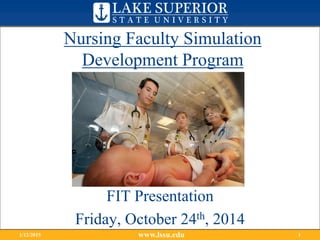
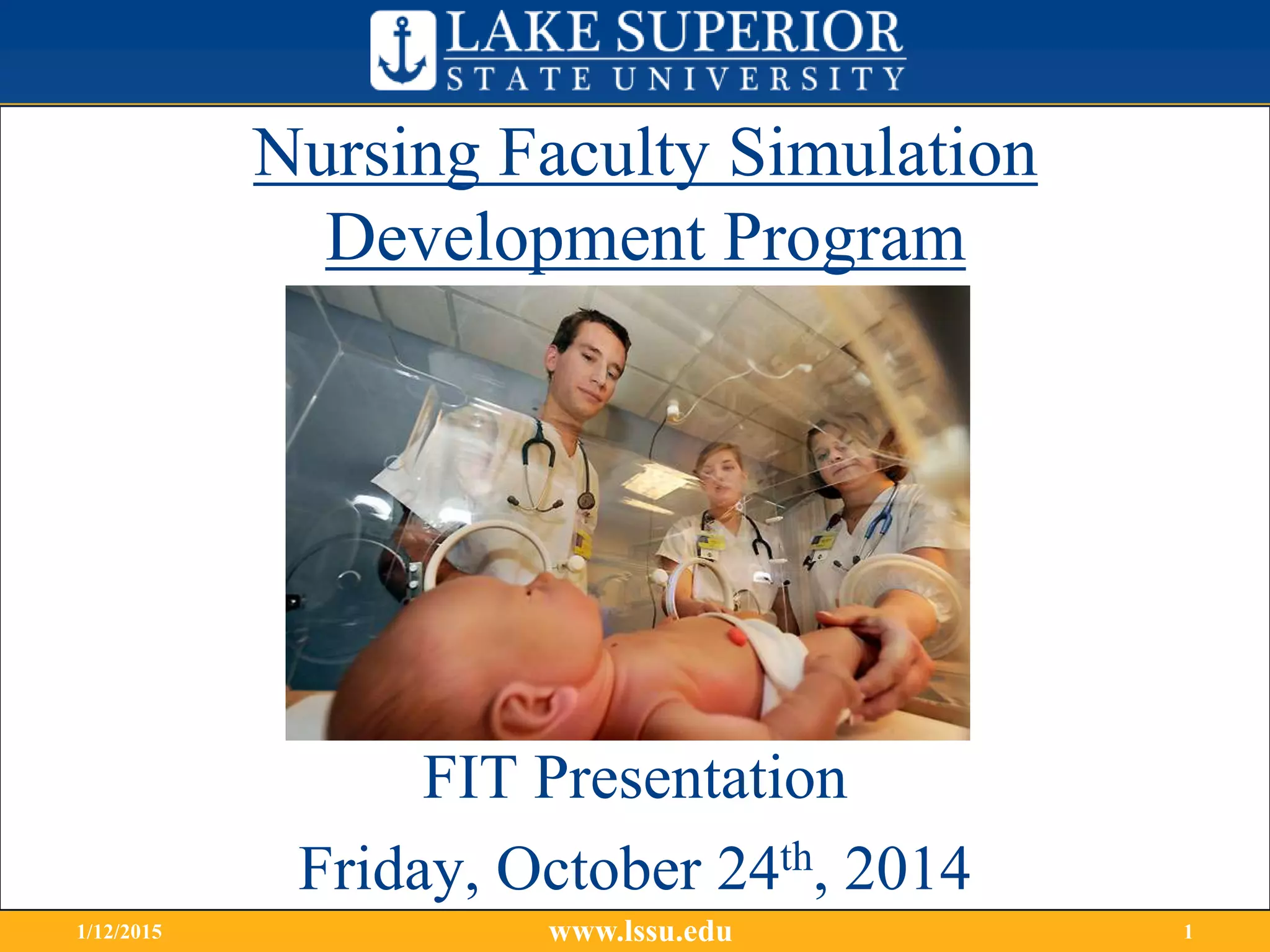
Nursing Faculty Simulation
Development Program
FIT Presentation
Friday, October 24th, 2014
FIT Grant & The Nursing Faculty
Simulation Development Program
• Online NLN modules
– 1 year access for all nursing faculty
• Pre-test
– Based on NLN modules
• Development day
– Faculty simulation learning (medical supplies)
• Post-test
– Based on NLN modules and development day learning
• Evaluation
www.lssu.edu1/12/2015 2
National League for Nursing (NLN)
Online Modules
• Designing and Developing Simulations
• Teaching and Learning Strategies
• Curriculum Integration
• Debriefing and Guided Reflection
• Beyond Basic Debriefing
• Evaluating Simulations
www.lssu.edu1/12/2015 3
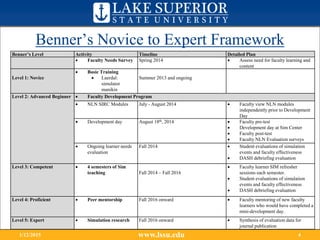
Benner’s Novice to Expert Framework
www.lssu.edu1/12/2015 4
Benner’s Level Activity Timeline Detailed Plan
 Faculty Needs Survey Spring 2014  Assess need for faculty learning and
content
Level 1: Novice
 Basic Training
 Laerdal:
simulator
manikin
Summer 2013 and ongoing
Level 2: Advanced Beginner  Faculty Development Program
 NLN SIRC Modules July - August 2014  Faculty view NLN modules
independently prior to Development
Day
 Development day August 18th, 2014  Faculty pre-test
 Development day at Sim Center
 Faculty post-test
 Faculty NLN Evaluation surveys
 Ongoing learner needs
evaluation
Fall 2014  Student evaluations of simulation
events and faculty effectiveness
 DASH debriefing evaluation
Level 3: Competent  4 semesters of Sim
teaching Fall 2014 – Fall 2016
 Faculty learner SIM refresher
sessions each semester.
 Student evaluations of simulation
events and faculty effectiveness
 DASH debriefing evaluation
Level 4: Proficient  Peer mentorship Fall 2016 onward  Faculty mentoring of new faculty
learners who would have completed a
mini-development day.
Level 5: Expert  Simulation research Fall 2016 onward  Synthesis of evaluation data for
journal publication
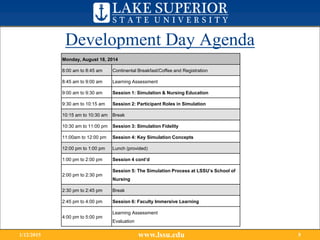
Development Day Agenda
www.lssu.edu1/12/2015 5
Monday, August 18, 2014
8:00 am to 8:45 am Continental Breakfast/Coffee and Registration
8:45 am to 9:00 am Learning Assessment
9:00 am to 9:30 am Session 1: Simulation & Nursing Education
9:30 am to 10:15 am Session 2: Participant Roles in Simulation
10:15 am to 10:30 am Break
10:30 am to 11:00 pm Session 3: Simulation Fidelity
11:00am to 12:00 pm Session 4: Key Simulation Concepts
12:00 pm to 1:00 pm Lunch (provided)
1:00 pm to 2:00 pm Session 4 cont’d
2:00 pm to 2:30 pm
Session 5: The Simulation Process at LSSU’s School of
Nursing
2:30 pm to 2:45 pm Break
2:45 pm to 4:00 pm Session 6: Faculty Immersive Learning
4:00 pm to 5:00 pm
Learning Assessment
Evaluation
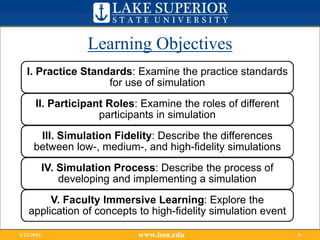
Learning Objectives
www.lssu.edu1/12/2015 6
I. Practice Standards: Examine the practice standards
for use of simulation
II. Participant Roles: Examine the roles of different
participants in simulation
III. Simulation Fidelity: Describe the differences
between low-, medium-, and high-fidelity simulations
IV. Simulation Process: Describe the process of
developing and implementing a simulation
V. Faculty Immersive Learning: Explore the
application of concepts to high-fidelity simulation event
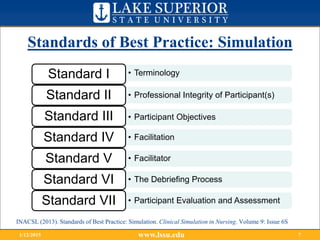
Standards of Best Practice: Simulation
INACSL (2013). Standards of Best Practice: Simulation. Clinical Simulation in Nursing. Volume 9: Issue 6S
www.lssu.edu1/12/2015 7
• TerminologyStandard I
• Professional Integrity of Participant(s)Standard II
• Participant ObjectivesStandard III
• FacilitationStandard IV
• FacilitatorStandard V
• The Debriefing ProcessStandard VI
• Participant Evaluation and AssessmentStandard VII
www.lssu.edu1/12/2015 8
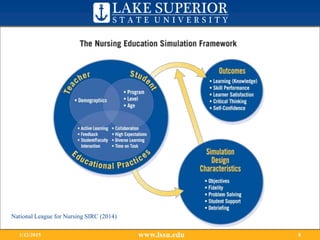
National League for Nursing SIRC (2014)
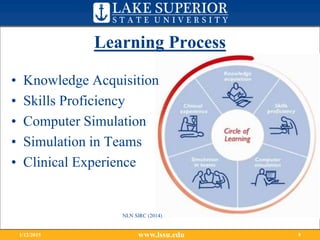
Learning Process
www.lssu.edu1/12/2015 9
• Knowledge Acquisition
• Skills Proficiency
• Computer Simulation
• Simulation in Teams
• Clinical Experience
NLN SIRC (2014)
www.lssu.edu1/12/2015 10
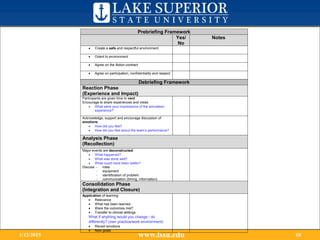
Prebriefing Framework
Yes/
No
Notes
 Create a safe and respectful environment
 Orient to environment
 Agree on the fiction contract
 Agree on participation, confidentiality and respect
Debriefing Framework
Reaction Phase
(Experience and Impact)
Participants are given time to vent
Encourage to share experiences and views
 What were your impressions of the simulation
experience?
Acknowledge, support and encourage discussion of
emotions
 How did you feel?
 How did you feel about the team’s performance?
Analysis Phase
(Recollection)
Major events are deconstructed:
 What happened?
 What was done well?
 What could have been better?
Discuss - roles
- equipment
- identification of problem
- communication (timing, information)
Consolidation Phase
(Integration and Closure)
Application of learning
 Relevance
 What has been learned
 Were the outcomes met?
 Transfer to clinical settings
What if anything would you change / do
differently? (own practice/work environment)
 Revisit emotions
 New goals
V. Faculty Immersive Learning
• First 5 Minutes
– 3 ‘students’
– 3 ‘instructors’
1. Prebrief
2. Simulation
3. Debrief
www.lssu.edu1/12/2015 11
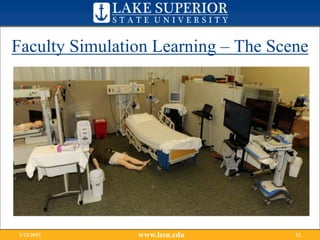
Faculty Simulation Learning – The Scene
www.lssu.edu1/12/2015 12
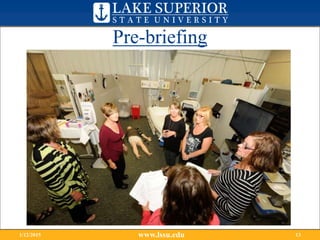
Pre-briefing
www.lssu.edu1/12/2015 13
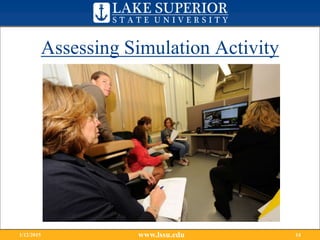
Assessing Simulation Activity
www.lssu.edu1/12/2015 14
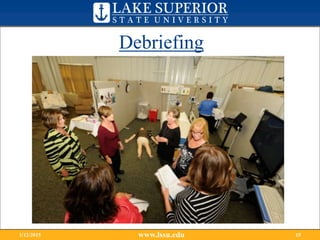
Debriefing
www.lssu.edu1/12/2015 15
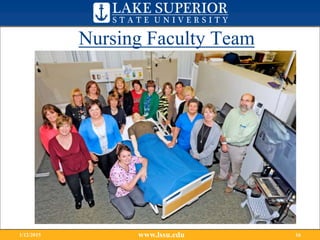
Nursing Faculty Team
www.lssu.edu1/12/2015 16
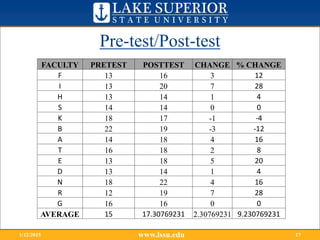
Pre-test/Post-test
www.lssu.edu1/12/2015 17
FACULTY PRETEST POSTTEST CHANGE % CHANGE
F 13 16 3 12
I 13 20 7 28
H 13 14 1 4
S 14 14 0 0
K 18 17 -1 -4
B 22 19 -3 -12
A 14 18 4 16
T 16 18 2 8
E 13 18 5 20
D 13 14 1 4
N 18 22 4 16
R 12 19 7 28
G 16 16 0 0
AVERAGE 15 17.30769231 2.30769231 9.230769231
www.lssu.edu1/12/2015 18
13 13 13
14
18
22
14
16
13 13
18
12
1616
20
14 14
17
19
18 18 18
14
22
19
16
0
5
10
15
20
25
1 2 3 4 5 6 7 8 9 10 11 12 13
PretestPost-testscores
Faculty learner
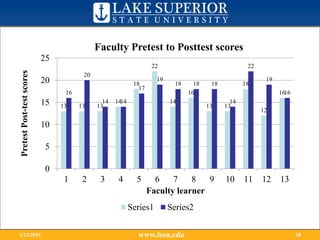
Faculty Pretest to Posttest scores
Series1 Series2
www.lssu.edu1/12/2015 19
12
28
4
0
-4
-12
16
8
20
4
16
28
0
-15
-10
-5
0
5
10
15
20
25
30
1 2 3 4 5 6 7 8 9 10 11 12 13
Percentagescorechange
Faculty learner
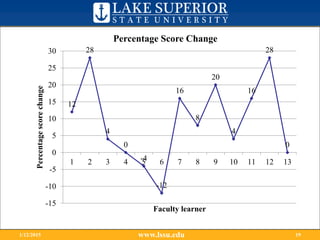
Percentage Score Change
www.lssu.edu1/12/2015 20
1.00
1.50
2.00
2.50
3.00
3.50
4.00
4.50
5.00
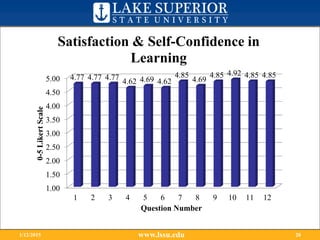
1 2 3 4 5 6 7 8 9 10 11 12
4.77 4.77 4.77
4.62 4.69 4.62
4.85
4.69
4.85 4.92 4.85 4.85
0-5LikertScale
Question Number
Satisfaction & Self-Confidence in
Learning
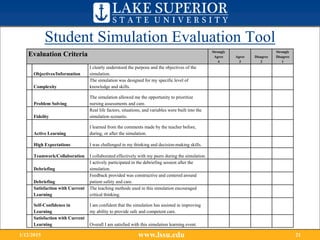
Student Simulation Evaluation Tool
www.lssu.edu1/12/2015 21
Evaluation Criteria Strongly
Agree
4
Agree
3
Disagree
2
Strongly
Disagree
1
Objectives/Information
I clearly understood the purpose and the objectives of the
simulation.
Complexity
The simulation was designed for my specific level of
knowledge and skills.
Problem Solving
The simulation allowed me the opportunity to prioritize
nursing assessments and care.
Fidelity
Real life factors, situations, and variables were built into the
simulation scenario.
Active Learning
I learned from the comments made by the teacher before,
during, or after the simulation.
High Expectations I was challenged in my thinking and decision-making skills.
Teamwork/Collaboration I collaborated effectively with my peers during the simulation.
Debriefing
I actively participated in the debriefing session after the
simulation.
Debriefing
Feedback provided was constructive and centered around
patient safety and care.
Satisfaction with Current
Learning
The teaching methods used in this simulation encouraged
critical thinking.
Self-Confidence in
Learning
I am confident that the simulation has assisted in improving
my ability to provide safe and competent care.
Satisfaction with Current
Learning Overall I am satisfied with this simulation learning event.
www.lssu.edu1/12/2015 22
0.00
0.50
1.00
1.50
2.00
2.50
3.00
3.50
4.00
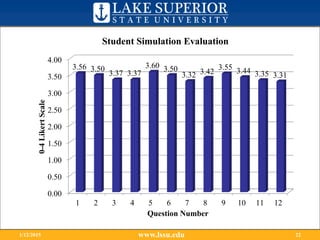
1 2 3 4 5 6 7 8 9 10 11 12
3.56 3.50
3.37 3.37
3.60 3.50
3.32 3.42
3.55 3.44 3.35 3.31
0-4LikertScale
Question Number
Student Simulation Evaluation
DASH - Debriefing Assessment for
Simulation in Healthcare
www.lssu.edu1/12/2015 23
• Rating tool used to assess and improve debriefing (not a
check list)
– 2 versions – student (learner) and instructor
• Evaluates the strategies and techniques used to conduct
debriefings by examining concrete behaviors.
Opportunities
• Adaptation of process
– Clinical adjunct faculty
– Paramedic program
– Newly hired faculty
– Ongoing current faculty development
www.lssu.edu1/12/2015 24
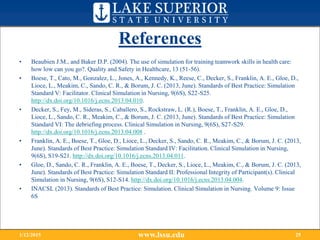
References
• Beaubien J.M., and Baker D.P. (2004). The use of simulation for training teamwork skills in health care:
how low can you go?. Quality and Safety in Healthcare, 13 (51-56).
• Boese, T., Cato, M., Gonzalez, L., Jones, A., Kennedy, K., Reese, C., Decker, S., Franklin, A. E., Gloe, D.,
Lioce, L., Meakim, C., Sando, C. R., & Borum, J. C. (2013, June). Standards of Best Practice: Simulation
Standard V: Facilitator. Clinical Simulation in Nursing, 9(6S), S22-S25.
http://dx.doi.org/10.1016/j.ecns.2013.04.010.
• Decker, S., Fey, M., Sideras, S., Caballero, S., Rockstraw, L. (R.), Boese, T., Franklin, A. E., Gloe, D.,
Lioce, L., Sando, C. R., Meakim, C., & Borum, J. C. (2013, June). Standards of Best Practice: Simulation
Standard VI: The debriefing process. Clinical Simulation in Nursing, 9(6S), S27-S29.
http://dx.doi.org/10.1016/j.ecns.2013.04.008 .
• Franklin, A. E., Boese, T., Gloe, D., Lioce, L., Decker, S., Sando, C. R., Meakim, C., & Borum, J. C. (2013,
June). Standards of Best Practice: Simulation Standard IV: Facilitation. Clinical Simulation in Nursing,
9(6S), S19-S21. http://dx.doi.org/10.1016/j.ecns.2013.04.011.
• Gloe, D., Sando, C. R., Franklin, A. E., Boese, T., Decker, S., Lioce, L., Meakim, C., & Borum, J. C. (2013,
June). Standards of Best Practice: Simulation Standard II: Professional Integrity of Participant(s). Clinical
Simulation in Nursing, 9(6S), S12-S14. http://dx.doi.org/10.1016/j.ecns.2013.04.004.
• INACSL (2013). Standards of Best Practice: Simulation. Clinical Simulation in Nursing. Volume 9: Issue
6S
www.lssu.edu1/12/2015 25
References cont’d
• Lioce, L., Reed, C. C., Lemon, D., King, M. A., Martinez, P. A., Franklin, A. E., Boese, T., Decker, S.,
Sando, C. R., Gloe, D., Meakim, C., & Borum, J. C. (2013, June). Standards of Best Practice: Simulation
Standard III: Participant Objectives. Clinical Simulation in Nursing, 9(6S), S15-S18.
http://dx.doi.org/10.1016/j.ecns.2013.04.005.
• Meakim, C., Boese, T., Decker, S., Franklin, A. E., Gloe, D., Lioce, L., Sando, C. R., & Borum, J. C. (2013,
June). Standards of Best Practice: Simulation Standard I: Terminology. Clinical Simulation in Nursing,
9(6S), S3-S11. http://dx.doi.org/10.1016/j.ecns.2013.04.001.
• Moore, M. (2013, November). Pearls from the Harvard Courses. Powerpoint. Canterbury Collaborative
Simulation Interest Group). Retrieved from https://www.cdhb.health.nz/Hospitals-Services/Health-
Professionals/CSU/Clinical-Skills-Unit-
Simulation/PublishingImages/Pages/default/Harvard%20Pearls%20for%20CCSIG%20-
%20Dr%20maryLeigh%20Moore.pdf
• NLN SIRC (2014). The Circle of Learning. Designing and Developing Simulations. http://sirc.nln.org/
• NLN SIRC (2014). The Nursing Education Simulation Framework. Designing and Developing Simulations.
http://sirc.nln.org/
• Sando, C. R., Coggins, R. M., Meakim, C., Franklin, A. E., Gloe, D., Boese, T., Decker, S., Lioce, L., &
Borum, J. C. (2013, June). Standards of Best Practice: Simulation Standard VII: Participant Assessment and
Evaluation. Clinical Simulation in Nursing, 9(6S), S30-S32. http://dx.doi.org/10.1016/j.ecns.2013.04.007.
www.lssu.edu1/12/2015 26

Using Simulations for Instruction

  • 1.
    www.lssu.edu1/12/2015 1 Nursing FacultySimulation Development Program FIT Presentation Friday, October 24th, 2014
  • 2.
    FIT Grant &The Nursing Faculty Simulation Development Program • Online NLN modules – 1 year access for all nursing faculty • Pre-test – Based on NLN modules • Development day – Faculty simulation learning (medical supplies) • Post-test – Based on NLN modules and development day learning • Evaluation www.lssu.edu1/12/2015 2
  • 3.
    National League forNursing (NLN) Online Modules • Designing and Developing Simulations • Teaching and Learning Strategies • Curriculum Integration • Debriefing and Guided Reflection • Beyond Basic Debriefing • Evaluating Simulations www.lssu.edu1/12/2015 3
  • 4.
    Benner’s Novice toExpert Framework www.lssu.edu1/12/2015 4 Benner’s Level Activity Timeline Detailed Plan  Faculty Needs Survey Spring 2014  Assess need for faculty learning and content Level 1: Novice  Basic Training  Laerdal: simulator manikin Summer 2013 and ongoing Level 2: Advanced Beginner  Faculty Development Program  NLN SIRC Modules July - August 2014  Faculty view NLN modules independently prior to Development Day  Development day August 18th, 2014  Faculty pre-test  Development day at Sim Center  Faculty post-test  Faculty NLN Evaluation surveys  Ongoing learner needs evaluation Fall 2014  Student evaluations of simulation events and faculty effectiveness  DASH debriefing evaluation Level 3: Competent  4 semesters of Sim teaching Fall 2014 – Fall 2016  Faculty learner SIM refresher sessions each semester.  Student evaluations of simulation events and faculty effectiveness  DASH debriefing evaluation Level 4: Proficient  Peer mentorship Fall 2016 onward  Faculty mentoring of new faculty learners who would have completed a mini-development day. Level 5: Expert  Simulation research Fall 2016 onward  Synthesis of evaluation data for journal publication
  • 5.
    Development Day Agenda www.lssu.edu1/12/20155 Monday, August 18, 2014 8:00 am to 8:45 am Continental Breakfast/Coffee and Registration 8:45 am to 9:00 am Learning Assessment 9:00 am to 9:30 am Session 1: Simulation & Nursing Education 9:30 am to 10:15 am Session 2: Participant Roles in Simulation 10:15 am to 10:30 am Break 10:30 am to 11:00 pm Session 3: Simulation Fidelity 11:00am to 12:00 pm Session 4: Key Simulation Concepts 12:00 pm to 1:00 pm Lunch (provided) 1:00 pm to 2:00 pm Session 4 cont’d 2:00 pm to 2:30 pm Session 5: The Simulation Process at LSSU’s School of Nursing 2:30 pm to 2:45 pm Break 2:45 pm to 4:00 pm Session 6: Faculty Immersive Learning 4:00 pm to 5:00 pm Learning Assessment Evaluation
  • 6.
    Learning Objectives www.lssu.edu1/12/2015 6 I.Practice Standards: Examine the practice standards for use of simulation II. Participant Roles: Examine the roles of different participants in simulation III. Simulation Fidelity: Describe the differences between low-, medium-, and high-fidelity simulations IV. Simulation Process: Describe the process of developing and implementing a simulation V. Faculty Immersive Learning: Explore the application of concepts to high-fidelity simulation event
  • 7.
    Standards of BestPractice: Simulation INACSL (2013). Standards of Best Practice: Simulation. Clinical Simulation in Nursing. Volume 9: Issue 6S www.lssu.edu1/12/2015 7 • TerminologyStandard I • Professional Integrity of Participant(s)Standard II • Participant ObjectivesStandard III • FacilitationStandard IV • FacilitatorStandard V • The Debriefing ProcessStandard VI • Participant Evaluation and AssessmentStandard VII
  • 8.
  • 9.
    Learning Process www.lssu.edu1/12/2015 9 •Knowledge Acquisition • Skills Proficiency • Computer Simulation • Simulation in Teams • Clinical Experience NLN SIRC (2014)
  • 10.
    www.lssu.edu1/12/2015 10 Prebriefing Framework Yes/ No Notes Create a safe and respectful environment  Orient to environment  Agree on the fiction contract  Agree on participation, confidentiality and respect Debriefing Framework Reaction Phase (Experience and Impact) Participants are given time to vent Encourage to share experiences and views  What were your impressions of the simulation experience? Acknowledge, support and encourage discussion of emotions  How did you feel?  How did you feel about the team’s performance? Analysis Phase (Recollection) Major events are deconstructed:  What happened?  What was done well?  What could have been better? Discuss - roles - equipment - identification of problem - communication (timing, information) Consolidation Phase (Integration and Closure) Application of learning  Relevance  What has been learned  Were the outcomes met?  Transfer to clinical settings What if anything would you change / do differently? (own practice/work environment)  Revisit emotions  New goals
  • 11.
    V. Faculty ImmersiveLearning • First 5 Minutes – 3 ‘students’ – 3 ‘instructors’ 1. Prebrief 2. Simulation 3. Debrief www.lssu.edu1/12/2015 11
  • 12.
    Faculty Simulation Learning– The Scene www.lssu.edu1/12/2015 12
  • 13.
  • 14.
  • 15.
  • 16.
  • 17.
    Pre-test/Post-test www.lssu.edu1/12/2015 17 FACULTY PRETESTPOSTTEST CHANGE % CHANGE F 13 16 3 12 I 13 20 7 28 H 13 14 1 4 S 14 14 0 0 K 18 17 -1 -4 B 22 19 -3 -12 A 14 18 4 16 T 16 18 2 8 E 13 18 5 20 D 13 14 1 4 N 18 22 4 16 R 12 19 7 28 G 16 16 0 0 AVERAGE 15 17.30769231 2.30769231 9.230769231
  • 18.
    www.lssu.edu1/12/2015 18 13 1313 14 18 22 14 16 13 13 18 12 1616 20 14 14 17 19 18 18 18 14 22 19 16 0 5 10 15 20 25 1 2 3 4 5 6 7 8 9 10 11 12 13 PretestPost-testscores Faculty learner Faculty Pretest to Posttest scores Series1 Series2
  • 19.
    www.lssu.edu1/12/2015 19 12 28 4 0 -4 -12 16 8 20 4 16 28 0 -15 -10 -5 0 5 10 15 20 25 30 1 23 4 5 6 7 8 9 10 11 12 13 Percentagescorechange Faculty learner Percentage Score Change
  • 20.
    www.lssu.edu1/12/2015 20 1.00 1.50 2.00 2.50 3.00 3.50 4.00 4.50 5.00 1 23 4 5 6 7 8 9 10 11 12 4.77 4.77 4.77 4.62 4.69 4.62 4.85 4.69 4.85 4.92 4.85 4.85 0-5LikertScale Question Number Satisfaction & Self-Confidence in Learning
  • 21.
    Student Simulation EvaluationTool www.lssu.edu1/12/2015 21 Evaluation Criteria Strongly Agree 4 Agree 3 Disagree 2 Strongly Disagree 1 Objectives/Information I clearly understood the purpose and the objectives of the simulation. Complexity The simulation was designed for my specific level of knowledge and skills. Problem Solving The simulation allowed me the opportunity to prioritize nursing assessments and care. Fidelity Real life factors, situations, and variables were built into the simulation scenario. Active Learning I learned from the comments made by the teacher before, during, or after the simulation. High Expectations I was challenged in my thinking and decision-making skills. Teamwork/Collaboration I collaborated effectively with my peers during the simulation. Debriefing I actively participated in the debriefing session after the simulation. Debriefing Feedback provided was constructive and centered around patient safety and care. Satisfaction with Current Learning The teaching methods used in this simulation encouraged critical thinking. Self-Confidence in Learning I am confident that the simulation has assisted in improving my ability to provide safe and competent care. Satisfaction with Current Learning Overall I am satisfied with this simulation learning event.
  • 22.
    www.lssu.edu1/12/2015 22 0.00 0.50 1.00 1.50 2.00 2.50 3.00 3.50 4.00 1 23 4 5 6 7 8 9 10 11 12 3.56 3.50 3.37 3.37 3.60 3.50 3.32 3.42 3.55 3.44 3.35 3.31 0-4LikertScale Question Number Student Simulation Evaluation
  • 23.
    DASH - DebriefingAssessment for Simulation in Healthcare www.lssu.edu1/12/2015 23 • Rating tool used to assess and improve debriefing (not a check list) – 2 versions – student (learner) and instructor • Evaluates the strategies and techniques used to conduct debriefings by examining concrete behaviors.
  • 24.
    Opportunities • Adaptation ofprocess – Clinical adjunct faculty – Paramedic program – Newly hired faculty – Ongoing current faculty development www.lssu.edu1/12/2015 24
  • 25.
    References • Beaubien J.M.,and Baker D.P. (2004). The use of simulation for training teamwork skills in health care: how low can you go?. Quality and Safety in Healthcare, 13 (51-56). • Boese, T., Cato, M., Gonzalez, L., Jones, A., Kennedy, K., Reese, C., Decker, S., Franklin, A. E., Gloe, D., Lioce, L., Meakim, C., Sando, C. R., & Borum, J. C. (2013, June). Standards of Best Practice: Simulation Standard V: Facilitator. Clinical Simulation in Nursing, 9(6S), S22-S25. http://dx.doi.org/10.1016/j.ecns.2013.04.010. • Decker, S., Fey, M., Sideras, S., Caballero, S., Rockstraw, L. (R.), Boese, T., Franklin, A. E., Gloe, D., Lioce, L., Sando, C. R., Meakim, C., & Borum, J. C. (2013, June). Standards of Best Practice: Simulation Standard VI: The debriefing process. Clinical Simulation in Nursing, 9(6S), S27-S29. http://dx.doi.org/10.1016/j.ecns.2013.04.008 . • Franklin, A. E., Boese, T., Gloe, D., Lioce, L., Decker, S., Sando, C. R., Meakim, C., & Borum, J. C. (2013, June). Standards of Best Practice: Simulation Standard IV: Facilitation. Clinical Simulation in Nursing, 9(6S), S19-S21. http://dx.doi.org/10.1016/j.ecns.2013.04.011. • Gloe, D., Sando, C. R., Franklin, A. E., Boese, T., Decker, S., Lioce, L., Meakim, C., & Borum, J. C. (2013, June). Standards of Best Practice: Simulation Standard II: Professional Integrity of Participant(s). Clinical Simulation in Nursing, 9(6S), S12-S14. http://dx.doi.org/10.1016/j.ecns.2013.04.004. • INACSL (2013). Standards of Best Practice: Simulation. Clinical Simulation in Nursing. Volume 9: Issue 6S www.lssu.edu1/12/2015 25
  • 26.
    References cont’d • Lioce,L., Reed, C. C., Lemon, D., King, M. A., Martinez, P. A., Franklin, A. E., Boese, T., Decker, S., Sando, C. R., Gloe, D., Meakim, C., & Borum, J. C. (2013, June). Standards of Best Practice: Simulation Standard III: Participant Objectives. Clinical Simulation in Nursing, 9(6S), S15-S18. http://dx.doi.org/10.1016/j.ecns.2013.04.005. • Meakim, C., Boese, T., Decker, S., Franklin, A. E., Gloe, D., Lioce, L., Sando, C. R., & Borum, J. C. (2013, June). Standards of Best Practice: Simulation Standard I: Terminology. Clinical Simulation in Nursing, 9(6S), S3-S11. http://dx.doi.org/10.1016/j.ecns.2013.04.001. • Moore, M. (2013, November). Pearls from the Harvard Courses. Powerpoint. Canterbury Collaborative Simulation Interest Group). Retrieved from https://www.cdhb.health.nz/Hospitals-Services/Health- Professionals/CSU/Clinical-Skills-Unit- Simulation/PublishingImages/Pages/default/Harvard%20Pearls%20for%20CCSIG%20- %20Dr%20maryLeigh%20Moore.pdf • NLN SIRC (2014). The Circle of Learning. Designing and Developing Simulations. http://sirc.nln.org/ • NLN SIRC (2014). The Nursing Education Simulation Framework. Designing and Developing Simulations. http://sirc.nln.org/ • Sando, C. R., Coggins, R. M., Meakim, C., Franklin, A. E., Gloe, D., Boese, T., Decker, S., Lioce, L., & Borum, J. C. (2013, June). Standards of Best Practice: Simulation Standard VII: Participant Assessment and Evaluation. Clinical Simulation in Nursing, 9(6S), S30-S32. http://dx.doi.org/10.1016/j.ecns.2013.04.007. www.lssu.edu1/12/2015 26