GOOD MORNING
SIMULATION
Presented by:- Ms. Annu panchal
M.Sc nursing Ist year
Subharti nursing college
INTRODUCTION
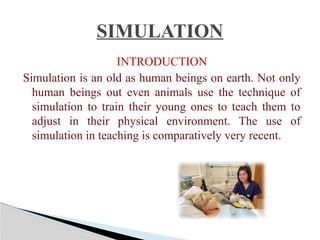
Simulation is an old as human beings on earth. Not only
human beings out even animals use the technique of
simulation to train their young ones to teach them to
adjust in their physical environment. The use of
simulation in teaching is comparatively very recent.
SIMULATION
Definition:-
According to international dictionary of education,
simulation is a teaching technique used particularly in
management education and training in which a ‘real
life situation’ and values are simulated by ‘substitute’
displaying similar characteristics.
SIMULATION
-Simulation has been defined “as an attempt to give
appearance and/or to give the effect of something
else”
Barton, 1970
- Role playing in which the process of teaching is
displaying artificially an effort is made to practice
some important skills of communication through this
technique.
There are three types of simulation:-
 SIMULATION EXERCISE - A controlled representation of a piece of
reality that learners can manipulate to better understand the
corresponding real situation .
 SIMULATION GAME- A game that represents real life situations in
which learners complete according to a set of rules in order to win or
achieve an objectives.
 ROLE PLAYING- A form of drama in which learners spontaneously
act out roles in an interaction involving problems or challenges in
human relation.
Types of simulation:-
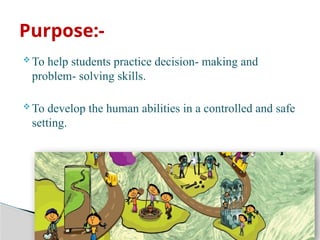
 To help students practice decision- making and
problem- solving skills.
 To develop the human abilities in a controlled and safe
setting.
Purpose:-
 By means of active involvement in a simulation exercise,
a game, or a role playing situation, the student achieves
cognitive, affective and psychomotor outcomes.
 Students have a chance to apply principles and theories
they have learned and to see how and when these
principles work.
 Players take on roles, which are representatives or the
real world and than make decisions in response to their
assessment of the setting in which they find
themselves.
 The experiences simulated are consequences. Which
relate to their decision and their general performance.
Principles of simulation:-
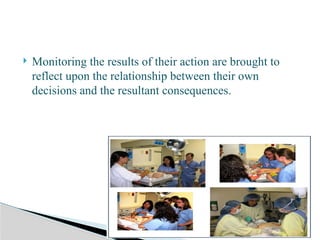
 Monitoring the results of their action are brought to
reflect upon the relationship between their own
decisions and the resultant consequences.
Simulation technique can be used to achieve many
learning objectives.
 Simulation can help nursing students can gain
skill in applying the nursing process.
 Learn to solve problems efficiently with minimal
wasting of time and resources.
 In the acquisition of communication skills. They
get immediate feedback about how they affect
other people learning communication.
Uses of simulation:-
 Simulation is also an avenue attitude change.
 Decision making skills can be fostered via
simulation.
 Simulation technique can be applied to the
learning of psychomotor skills.
 Used to evaluate the student learning and
competence.
1.Planner: - planning begins with choosing or
developing and appropriate simulation that will meet
course objectives. Assign some reading for the students
to do before class. Textbooks or library resources
should be pointed out to students so that they can
prepare for the simulation. Teacher is responsible for
preparing environment; it includes arrangement of
chairs and tables, ventilation and lighting.
Role of teachers in simulation:-
2.Facilitator:- Teacher should function as a facilitator
during the actual process of the simulation. After
introducing the activity may take a back seat and talk
relatively little. You must coach students who are trying
to find their way through a sticky problem and
encourage creative thinking and act as an information
resource. Take note during the class so that in later
discussion you can refer back to specific strengths and
weakness of the process.
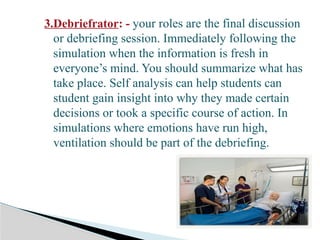
3.Debriefrator: - your roles are the final discussion
or debriefing session. Immediately following the
simulation when the information is fresh in
everyone’s mind. You should summarize what has
take place. Self analysis can help students can
student gain insight into why they made certain
decisions or took a specific course of action. In
simulations where emotions have run high,
ventilation should be part of the debriefing.
1) Simulation simplifies the complexity of real life to a
level that can be handled by the beginners.
2) Simulation is highly student centered because of its
very interesting and motivating nature, effectiveness
in teaching slow learners as well as fast learners and
all types of students.
Advantages of simulation:-
3) There is a teacher to guide, simulation always
facilitates peer learning, which is considered as an
excellent way of learning.
4) Simulation offers an excellent opportunity to learn
from mistakes, especially from those which are
detrimental to the nursing student.
5) By conducting a simulation, teacher can easily
make the student understand the concepts like
interpersonal relationship, assertive communication.
1) Students may generalize the result of a single
simulation, however, teacher can prevent this by
proper explanation.
2) Simulation is expensive in terms of time, money and
energy.
3) Emotion laden simulation may cause mental trauma
to the participating students. Simulations, especially
role plays can cause mental trauma to student who are
handling negative roles like drug addicts or
alcoholics.
Disadvantages of simulation:-
4) If the group dynamic is not good as expected,
simulation may fail to attain objectives.
 Not real
 Limited realistic human interaction
 Students may not take it seriously
 Time consuming
 Need for many simulator
 Can not be used in case of small children
 Incomplete physiological symptoms
Limitations
Critical thinking skills in nursing students: comparison of
simulation-based performance with metrics
 Methods:-
In 2007, a convenience sample of 36 nursing students
participated in measurement of critical thinking skills and
simulation-based performance using videotaped vignettes, high-
fidelity human simulation, the California Critical Thinking
Disposition Inventory and California Critical Thinking Skills
Test. Simulation-based performance was rated as ‘meeting’ or
‘not meeting’ overall expectations. Test scores were categorized
as strong, average, or weak.
Research Input-1
Abstract
Most (75·0%) students did not meet overall performance
expectations using videotaped vignettes or high-fidelity
human simulation; most difficulty related to problem
recognition and reporting findings to the physician. There
was no difference between overall performance based on
method of assessment (P = 0·277). More students met
subcategory expectations for initiating nursing
interventions (P 0·001) using high-fidelity human
≤
simulation. The relationship between videotaped vignette
performance and critical thinking disposition or skills
scores was not statistically significant, except for problem
recognition and overall critical thinking skills scores
(Cramer’s V = 0·444, P = 0·029). There was a statistically
significant relationship between overall high-fidelity
human simulation performance and overall critical
thinking disposition scores (Cramer’s V = 0·413, P = 0·047).
 Simulation Experience Enhances Physical Therapist
Student Confidence in Managing a Patient in the Critical
Care Environment
Patricia J. Ohtake, Marcilene Lazarus, Rebecca Schillo and
Michael Rosen
Abstract:- A one-group, pretest-posttest, quasi-experimental
design was used.
Research Input-2
Methods:- Physical therapist students (N=43)
participated in a critical care simulation experience
requiring technical (assessing bed mobility and
pulmonary status), behavioral (patient and
interprofessional communication), and cognitive
(recognizing a patient status change and initiating
appropriate responses) skill performance
 Conclusion:- Improved physical therapist student
confidence in technical, behavioral, and cognitive
performance measures and was associated with high
student satisfaction.SS
Conclusion :-
Students’ performance reflected difficulty meeting
expectations in simulated clinical scenarios. High-
fidelity human simulation performance appeared to
approximate scores on metrics of critical thinking best.
Further research is needed to determine if simulation-
based performance correlates with critical thinking
skills in the clinical setting.
 In this topic, I discussed introduction,
definition, types of simulation, purposes,
principles, value, procedure, uses, role of
teacher in simulation, advantages,
disadvantages, limitations of simulation.
Summary
 Simulation technology is becoming a major
component of nursing education programs
throughout the world. Many schools are
investing major sums of money into this
technology. To discover this we must look at
both the strengths and weaknesses to
simulation.
Conclusion
 1. Elsa Sanatombi Devi, manual of Nursing Education,
Ist edition, published by, CBS Publishers & distributors
PVT. LTD, New Delhi, page no.189-196.
 2. Neeraja.KP, year-2003 text book of nursing
education Ist edition jaypee Brothers medical Publisher
LTD New Delhi. Page no. 118- 125
 3. Basavanthappa. B.T year-2009 nursing education 2nd
edition, edition jaypee Brothers medical Publisher LTD
New Delhi. Page no.502-503.
Referances
SIMULATION ppt for M.Sc Nursing Students

SIMULATION ppt for M.Sc Nursing Students

  • 1.
  • 2.
    SIMULATION Presented by:- Ms.Annu panchal M.Sc nursing Ist year Subharti nursing college
  • 3.
    INTRODUCTION Simulation is anold as human beings on earth. Not only human beings out even animals use the technique of simulation to train their young ones to teach them to adjust in their physical environment. The use of simulation in teaching is comparatively very recent. SIMULATION
  • 4.
    Definition:- According to internationaldictionary of education, simulation is a teaching technique used particularly in management education and training in which a ‘real life situation’ and values are simulated by ‘substitute’ displaying similar characteristics. SIMULATION
  • 5.
    -Simulation has beendefined “as an attempt to give appearance and/or to give the effect of something else” Barton, 1970 - Role playing in which the process of teaching is displaying artificially an effort is made to practice some important skills of communication through this technique.
  • 6.
    There are threetypes of simulation:-  SIMULATION EXERCISE - A controlled representation of a piece of reality that learners can manipulate to better understand the corresponding real situation .  SIMULATION GAME- A game that represents real life situations in which learners complete according to a set of rules in order to win or achieve an objectives.  ROLE PLAYING- A form of drama in which learners spontaneously act out roles in an interaction involving problems or challenges in human relation. Types of simulation:-
  • 7.
     To helpstudents practice decision- making and problem- solving skills.  To develop the human abilities in a controlled and safe setting. Purpose:-
  • 8.
     By meansof active involvement in a simulation exercise, a game, or a role playing situation, the student achieves cognitive, affective and psychomotor outcomes.  Students have a chance to apply principles and theories they have learned and to see how and when these principles work.
  • 9.
     Players takeon roles, which are representatives or the real world and than make decisions in response to their assessment of the setting in which they find themselves.  The experiences simulated are consequences. Which relate to their decision and their general performance. Principles of simulation:-
  • 10.
     Monitoring theresults of their action are brought to reflect upon the relationship between their own decisions and the resultant consequences.
  • 11.
    Simulation technique canbe used to achieve many learning objectives.  Simulation can help nursing students can gain skill in applying the nursing process.  Learn to solve problems efficiently with minimal wasting of time and resources.  In the acquisition of communication skills. They get immediate feedback about how they affect other people learning communication. Uses of simulation:-
  • 12.
     Simulation isalso an avenue attitude change.  Decision making skills can be fostered via simulation.  Simulation technique can be applied to the learning of psychomotor skills.  Used to evaluate the student learning and competence.
  • 13.
    1.Planner: - planningbegins with choosing or developing and appropriate simulation that will meet course objectives. Assign some reading for the students to do before class. Textbooks or library resources should be pointed out to students so that they can prepare for the simulation. Teacher is responsible for preparing environment; it includes arrangement of chairs and tables, ventilation and lighting. Role of teachers in simulation:-
  • 14.
    2.Facilitator:- Teacher shouldfunction as a facilitator during the actual process of the simulation. After introducing the activity may take a back seat and talk relatively little. You must coach students who are trying to find their way through a sticky problem and encourage creative thinking and act as an information resource. Take note during the class so that in later discussion you can refer back to specific strengths and weakness of the process.
  • 15.
    3.Debriefrator: - yourroles are the final discussion or debriefing session. Immediately following the simulation when the information is fresh in everyone’s mind. You should summarize what has take place. Self analysis can help students can student gain insight into why they made certain decisions or took a specific course of action. In simulations where emotions have run high, ventilation should be part of the debriefing.
  • 16.
    1) Simulation simplifiesthe complexity of real life to a level that can be handled by the beginners. 2) Simulation is highly student centered because of its very interesting and motivating nature, effectiveness in teaching slow learners as well as fast learners and all types of students. Advantages of simulation:-
  • 17.
    3) There isa teacher to guide, simulation always facilitates peer learning, which is considered as an excellent way of learning. 4) Simulation offers an excellent opportunity to learn from mistakes, especially from those which are detrimental to the nursing student. 5) By conducting a simulation, teacher can easily make the student understand the concepts like interpersonal relationship, assertive communication.
  • 18.
    1) Students maygeneralize the result of a single simulation, however, teacher can prevent this by proper explanation. 2) Simulation is expensive in terms of time, money and energy. 3) Emotion laden simulation may cause mental trauma to the participating students. Simulations, especially role plays can cause mental trauma to student who are handling negative roles like drug addicts or alcoholics. Disadvantages of simulation:-
  • 19.
    4) If thegroup dynamic is not good as expected, simulation may fail to attain objectives.
  • 20.
     Not real Limited realistic human interaction  Students may not take it seriously  Time consuming  Need for many simulator  Can not be used in case of small children  Incomplete physiological symptoms Limitations
  • 21.
    Critical thinking skillsin nursing students: comparison of simulation-based performance with metrics  Methods:- In 2007, a convenience sample of 36 nursing students participated in measurement of critical thinking skills and simulation-based performance using videotaped vignettes, high- fidelity human simulation, the California Critical Thinking Disposition Inventory and California Critical Thinking Skills Test. Simulation-based performance was rated as ‘meeting’ or ‘not meeting’ overall expectations. Test scores were categorized as strong, average, or weak. Research Input-1
  • 22.
    Abstract Most (75·0%) studentsdid not meet overall performance expectations using videotaped vignettes or high-fidelity human simulation; most difficulty related to problem recognition and reporting findings to the physician. There was no difference between overall performance based on method of assessment (P = 0·277). More students met subcategory expectations for initiating nursing interventions (P 0·001) using high-fidelity human ≤ simulation. The relationship between videotaped vignette performance and critical thinking disposition or skills scores was not statistically significant, except for problem recognition and overall critical thinking skills scores (Cramer’s V = 0·444, P = 0·029). There was a statistically significant relationship between overall high-fidelity human simulation performance and overall critical thinking disposition scores (Cramer’s V = 0·413, P = 0·047).
  • 23.
     Simulation ExperienceEnhances Physical Therapist Student Confidence in Managing a Patient in the Critical Care Environment Patricia J. Ohtake, Marcilene Lazarus, Rebecca Schillo and Michael Rosen Abstract:- A one-group, pretest-posttest, quasi-experimental design was used. Research Input-2
  • 24.
    Methods:- Physical therapiststudents (N=43) participated in a critical care simulation experience requiring technical (assessing bed mobility and pulmonary status), behavioral (patient and interprofessional communication), and cognitive (recognizing a patient status change and initiating appropriate responses) skill performance  Conclusion:- Improved physical therapist student confidence in technical, behavioral, and cognitive performance measures and was associated with high student satisfaction.SS
  • 25.
    Conclusion :- Students’ performancereflected difficulty meeting expectations in simulated clinical scenarios. High- fidelity human simulation performance appeared to approximate scores on metrics of critical thinking best. Further research is needed to determine if simulation- based performance correlates with critical thinking skills in the clinical setting.
  • 26.
     In thistopic, I discussed introduction, definition, types of simulation, purposes, principles, value, procedure, uses, role of teacher in simulation, advantages, disadvantages, limitations of simulation. Summary
  • 27.
     Simulation technologyis becoming a major component of nursing education programs throughout the world. Many schools are investing major sums of money into this technology. To discover this we must look at both the strengths and weaknesses to simulation. Conclusion
  • 28.
     1. ElsaSanatombi Devi, manual of Nursing Education, Ist edition, published by, CBS Publishers & distributors PVT. LTD, New Delhi, page no.189-196.  2. Neeraja.KP, year-2003 text book of nursing education Ist edition jaypee Brothers medical Publisher LTD New Delhi. Page no. 118- 125  3. Basavanthappa. B.T year-2009 nursing education 2nd edition, edition jaypee Brothers medical Publisher LTD New Delhi. Page no.502-503. Referances