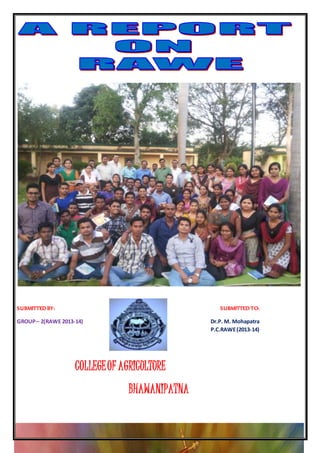
SUBMITTED BY: SUBMITTED TO:
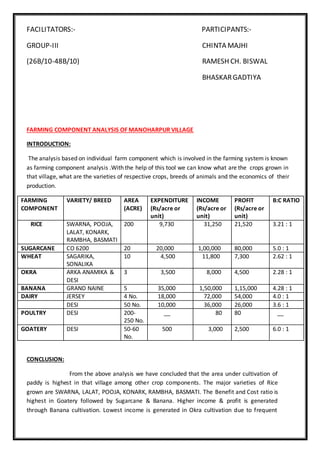
GROUP– 2(RAWE 2013-14) Dr.P. M. Mohapatra
P.C.RAWE(2013-14)
COLLEGEOF AGRICULTURE
BHAWANIPATNA
R A W E
ACKNOWLEDGEMENT
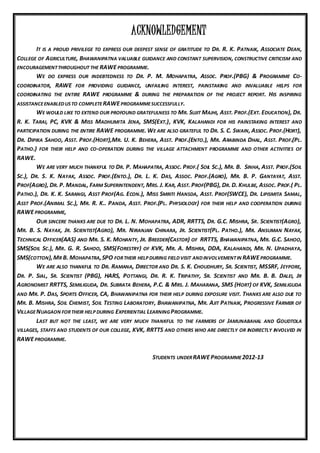
IT IS A PROUD PRIVILEGE TO EXPRESS OUR DEEPEST SENSE OF GRATITUDE TO DR. R. K. PATNAIK, ASSOCIATE DEAN,
COLLEGE OF AGRICULTURE, BHAWANIPATNA VALUABLE GUIDANCE AND CONSTANT SUPERVISION, CONSTRUCTIVE CRITICISM AND
ENCOURAGEMENTTHROUGHOUT THE RAWEPROGRAMME.
WE DO EXPRESS OUR INDEBTEDNESS TO DR. P. M. MOHAPATRA, ASSOC. PROF.(PBG) & PROGRAMME CO-
COORDINATOR, RAWE FOR PROVIDING GUIDANCE, UNFAILING INTEREST, PAINSTAKING AND INVALUABLE HELPS FOR
COORDINATING THE ENTIRE RAWE PROGRAMME & DURING THE PREPARATION OF THE PROJECT REPORT. HIS INSPIRING
ASSISTANCEENABLEDUS TO COMPLETERAWEPROGRAMMESUCCESSFULLY.
WE WOULD LIKE TO EXTEND OUR PROFOUND GRATEFULNESS TO MR. SUJIT MAJHI, ASST. PROF.(EXT. EDUCATION), DR.
R. K. TARAI, PC, KVK & MISS MADHUMITA JENA, SMS(EXT.), KVK, KALAHANDI FOR HIS PAINSTAKING INTEREST AND
PARTICIPATION DURING THE ENTIRE RAWE PROGRAMME. WE ARE ALSO GRATEFUL TO DR. S. C. SWAIN, ASSOC. PROF.(HORT),
DR. DIPIKA SAHOO, ASST. PROF.(HORT),MR. U. K. BEHERA, ASST. PROF.(ENTO.), MR. ARABINDA DHAL, ASST. PROF.(PL.
PATHO.) FOR THEIR HELP AND CO-OPERATION DURING THE VILLAGE ATTACHMENT PROGRAMME AND OTHER ACTIVITIES OF
RAWE.
WE ARE VERY MUCH THANKFUL TO DR. P. MAHAPATRA, ASSOC. PROF.( SOIL SC.), MR. B. SINHA, ASST. PROF.(SOIL
SC.), DR. S. K. NAYAK, ASSOC. PROF.(ENTO.), DR. L. K. DAS, ASSOC. PROF.(AGRO), MR. B. P. GANTAYAT, ASST.
PROF(AGRO), DR. P. MANDAL, FARM SUPERINTENDENT, MRS. J. KAR, ASST. PROF(PBG), DR. D. KHULBE, ASSOC. PROF.( PL.
PATHO.), DR. K. K. SARANGI, ASST PROF(AG. ECON.), MISS SMRITI HANSDA, ASST. PROF(SWCE), DR. LIPISMITA SAMAL,
ASST PROF.(ANIMAL SC.), MR. R. K.. PANDA, ASST. PROF.(PL. PHYSIOLOGY) FOR THEIR HELP AND COOPERATION DURING
RAWEPROGRAMME,
OUR SINCERE THANKS ARE DUE TO DR. L. N. MOHAPATRA, ADR, RRTTS, DR. G.C. MISHRA, SR. SCIENTIST(AGRO),
MR. B. S. NAYAK, JR. SCIENTIST(AGRO), MR. NIRANJAN CHINARA, JR. SCIENTIST(PL. PATHO.), MR. ANSUMAN NAYAK,
TECHNICAL OFFICER(AAS) AND MR. S. K. MOHANTY, JR. BREEDER(CASTOR) OF RRTTS, BHAWANIPATNA, MR. G.C. SAHOO,
SMS(SOIL SC.), MR. G. R. SAHOO, SMS(FORESTRY) OF KVK, MR. A. MISHRA, DDA, KALAHANDI, MR. N. UPADHAYA,
SMS(COTTON),MR B. MOHAPATRA,SPO FORTHEIR HELP DURING FIELDVISIT ANDINVOLVEMENTIN RAWEPROGRAMME.
WE ARE ALSO THANKFUL TO DR. RAMANA, DIRECTOR AND DR. S. K. CHOUDHURY, SR. SCIENTIST, MSSRF, JEYPORE,
DR. P. SIAL, SR. SCIENTIST (PBG), HARS, POTTANGI, DR. R. K. TRIPATHY, SR. SCIENTIST AND MR. B. B. DALEI, JR
AGRONOMIST RRTTS, SEMILIGUDA, DR. SUBRATA BEHERA, P.C. & MRS. J. MAHARANA, SMS (HORT) OF KVK, SEMILIGUDA
AND MR. P. DAS, SPORTS OFFICER, CA, BHAWANIPATNA FOR THEIR HELP DURING EXPOSURE VISIT. THANKS ARE ALSO DUE TO
MR. B. MISHRA, SOIL CHEMIST, SOIL TESTING LABORATORY, BHAWANIPATNA, MR. AJIT PATNAIK, PROGRESSIVE FARMER OF
VILLAGENUAGAON FORTHEIR HELP DURING EXPERIENTIAL LEARNINGPROGRAMME.
LAST BUT NOT THE LEAST, WE ARE VERY MUCH THANKFUL TO THE FARMERS OF JAMUNABAHAL AND GOUDTOLA
VILLAGES, STAFFS AND STUDENTS OF OUR COLLEGE, KVK, RRTTS AND OTHERS WHO ARE DIRECTLY OR INDIRECTLY INVOLVED IN
RAWEPROGRAMME.
STUDENTS UNDERRAWEPROGRAMME2012-13
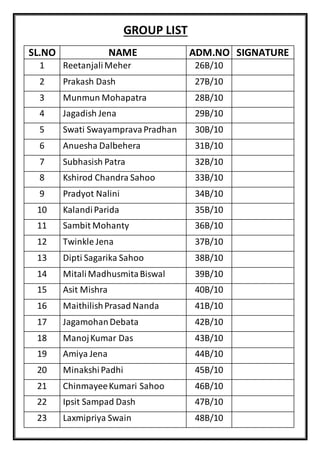
GROUP LIST
SL.NO NAME ADM.NO SIGNATURE
1 ReetanjaliMeher 26B/10
2 Prakash Dash 27B/10
3 Munmun Mohapatra 28B/10
4 Jagadish Jena 29B/10
5 Swati SwayampravaPradhan 30B/10
6 Anuesha Dalbehera 31B/10
7 Subhasish Patra 32B/10
8 Kshirod Chandra Sahoo 33B/10
9 Pradyot Nalini 34B/10
10 KalandiParida 35B/10
11 Sambit Mohanty 36B/10
12 Twinkle Jena 37B/10
13 Dipti Sagarika Sahoo 38B/10
14 MitaliMadhusmitaBiswal 39B/10
15 Asit Mishra 40B/10
16 MaithilishPrasad Nanda 41B/10
17 JagamohanDebata 42B/10
18 ManojKumar Das 43B/10
19 Amiya Jena 44B/10
20 MinakshiPadhi 45B/10
21 ChinmayeeKumari Sahoo 46B/10
22 Ipsit Sampad Dash 47B/10
23 Laxmipriya Swain 48B/10
INDEX
1. Introduction to RAWE
2. College information
3. District information
4. KVK, Kalahandi
5. RRTTS, Kalahandi
6. PRA & PRA Tools
7. PRA Activities conducted in Different villages
o MANOHARPUR
 Action plan
 Training& Demonstration
o kANAKPUR
 Action plan
 Training& Demonstration
8. DDA, Kalahandi
9. OTELP, Kalahandi
10. Exposure visit
o SOIL TESTING LABORATORY, BHAWANIPATNA
o SEED PROCESSING UNIT, BHAWANIPATNA
o GRAMVIKASH, THUAMUL RAMPUR
11. Experiential Learning Programme
Annexure
Interview schedule
Village information
Experience gained during RAWE programme
RURAL AGRICULTURAL WORK EXPERIANCE
Agricultural Education is an important tool in ensuring increased agricultural productivity, sustainability,
environmental and ecological security, profitability, job security & equity. In India, Randhawa Committee
(1992) recommended the Rural Agriculture Work Experience (RAWE) programme for imparting quality,
practical and production oriented education for agriculture degree programme. The World Bank (1975)
stated that there was little emphasis on curricula on preparing the agricultural graduates for bette r career
in agriculture or agribusiness outside govt. jobs. Therefore, the agenda for the 21st century in agricultural
education should be drawn on the basis of the challenges it has to meet in the near future. RAWE
programme provides significant hands on experience in acquiring knowledge and skill.
WHAT IS RAWE:-
RAWE (Rural Agricultural Work Experience) is a programme for imparting quality, practical and production
oriented education for agriculture degree
IMPORTANCE OF RAWE:-
 Preparing Agricultural Graduates for better career in agriculture/ agribusiness
 Preparing Agricultural Graduates to face the challenges by acquiring knowledge & skill through
hands on experience
OBJECTIVES: RAWE:-
• Understanding of rural life by students
• Familiarity with the socio-economic situation of village
• Opportunity for practical training
• Development of Communication skill in Transfer of Technology
• Understanding of technologies followed by farmers
• Preparation of production plan suitable for local situation
• Development of confidence and competency for facing problematic situation and finding solutions
SURVEY & FARM PLANNING:-
• Make PRA survey of the villages (both irrigated and non-irrigated), preparation of report and
presentation
• Collection of data on socio-economic condition, population, cropping pattern, irrigation facilities,
resources available, labour, employment etc.
• Preparation of alternate farm plans including family system approach for the host farmer and village
in consultation with both govt. & local Research/ Extension scientists of the University for
reorganization of farm business for higher income and sustainable production
• Identify the constraints in marketing of Agril. Produce, institutional credit facilities, input supply
agencies and co-op. enterprises
• Student shall record family budgets of host farmers and two other families’ one agril. Labourer &
one rural artisan.
EXTENSION EDUCATION:-
• Identification of agricultural problems of village
• Conducting method demonstrations and result demonstration
• Field visit and group discussion with farmers on need based agricultural topics
• Organization of agricultural exhibitions for visual publicity of improved practices
• Study of on-going agricultural programmes in the village & their impact
• Organization of farmers training programme and participation in programmes conducted by govt.
Agril. & allied depts.
• Visit to local institutions to study their role in development programmes and research work.
• Study the role of mass media in transfer of technology
• Participation in village social work - conduct survey on youth problems, initiation of youth clubs,
working with youth & youth specific projects
• Submissionof reportonextensionactivities
RESEARCH STATION ACTIVITIES:-
• Visit to different research schemes and research stations under OUAT and ICAR.
• Acquaintance with various research activities of the concerned research scheme/ stations.
• Knowledge on the methodologies involved in conducting different types of experimental, trials,
analysis of experimental data, maintenance of farm records and project files.
• Observe closely the different aspects of research programmes.
• Interaction with the research scientists of different disciplines on the ongoing experiments and trials.
• Note down weather data during their period of study at the Research Station.
• Awareness on various methodologies involved in conducting research trials.
• Observation of different aspects of research programmes.
• Recording the titles and technical programmes of research projects and research procedures shown
to them.
IMPLICATION OF RAWE PROGRAMME:-
 Sensitization towards field agriculture.
 Hands-on experience in village condition.
 Development of favourable & required skill & attitude among agricultural graduates.
 Development of human resource in agriculture education.
Brief report of College of Agriculture, (OUAT) Bhawanipatna 2012-13
The College of Agriculture, Bhawanipatna is the 3rd Agriculture College established in the year 2009-10
under Odisha University of Agriculture and Technology, Bhubaneswar. The college is situated atlatitude: -
19°55'6"N 83°9'33"E.The total student enrolment of the college per year is 50 including two in-service
candidates. The students are selected on the basis of All Odisha entrance test conducted by OUAT,
Bhubaneswar and All India entrance conducted by Indian Council of Agricultural Research (ICAR) New Delhi.
At present there are 184students, the college is functioning in the Research Station Campus of OUAT,
Bhawanipatna. Students are accommodated in two hostels namely Bhawanishankar for boys and
Manikeswari for girls. The construction works of college building, guest house, dispensary and staff quarters
are under progress.
The college has total sanctioned staff strength of 52. Out of which23 are teaching posts, 17 are filled
up and 1 in the cadre of Associate Professor and 5 in the cadre of Asst. Professor are lying vacant one each
in the discipline ofSoil Science, Nematology, Seed Sci. &Technology, Agril. Statistics&Biotechnology. Out of
the 16 non-teaching positions, 8 are filled up and 8 are lying vacant. Our college is well equipped with all the
modern equipments for undertaking UG practical classes. The second batch (2010-11) students of our
college are now in 4th year and are being offered experiential learning and RAWE programme in this college.
However our students are actively involved in conducting field experiments at Instructional farm of the
college, identification of pests and diseases of well diversified crops in the adjoining areas of Bhawanipatna.
Student exposure visits are organized by the college from time to time to enhance their practical knowledge
and Participatory Rural Appraisal (PRA) exercises are being conducted by the students in different villages.
In addition to the routine activities our students participated in sports and literary activity at University level
and district level conducted by the Department of Environment and Forests, Vivekananda Seva Sangha,
Mahavir Sankrutika Anusthana, Department of Tourism etc. First athletic meet, literary competition and
annual function were held during the year under report.
Our faculty members were involved in capacity building of farmers and extension functionaries in
different training programmes mentioned below-
i. Water management in rainfed cropping systems
ii. ISOPOM on oilseeds and pulses
iii. Water management practices in Rice and Maize
iv. Technology week programme of KVK
v. Post harvest management and value addition in horticultural crops
vi. Improved production technology for onion cultivation
vii. Integrated cotton development programme (ICDP), Govt. of India
viii. Regular Radio and Doordarshan Programmes
ix. Regular Advisory services at college campus..
OTHER FACILITIES
LIBRARY:-
A total no of 2782 books have are available in the library.
NURSERY:-Here seedlings of different crops are raised by the students in the nursery beds & other
ornamental crops are grown in pots also.
STUDENT PLOT:-student plot is situated behind the girl’s hostel where a number of field crops &
horticultural crops are grown by the students which improves the field exposure knowledge.
ACHIEVEMENTS OF College of Agriculture, Bhawanipatna (2013-14)
 OUAT has ranked 3rdwith respect to qualifying students in the ICAR's 18th All India Entrance
Examination (AIEEA-PG-2013) and College of Agriculture, Bhawanipatna is emerged as best
constituent colleges of OUAT. The students are pursuing Master degree programmes in agriculture in
SAUs and ICAR institutes such as Karnal, Solan,faizabad, Hissar, Santiketan, Allahabad, Gujarat,
Bhubaneswar .
 Miss Aswathy Rani was placed as Girls’ University champion in the University Annual Meet-2012-
13.
 Pallavi Mishra was awarded with Chancellor’s and Vice Chancellor’schampion cup in the inter
University Odia debate.
 Pallavi Mishra and Lopamudra Singha were awarded cash prizes of Rs.30,000/- and Rs.20,000/-
respectively as 1st and 2nd Prizes in the ONGC essay competition.
 30 nos of students and 5 faculty members along with the Associate Dean, CA, Bhawanipatna donated
blood in a blood donation camp organised by SAMBAD in coordination with Red Cross Society on
18th August 2011.
 On 24th August 2011, on the eve of OUAT foundation day celebration “BANA MAHOTSHAV” was
organised in the College premises and essay as well as Art competition were held among the students
to mark the occasion.
 The students participated in literary activities at district level conducted by the Department of
Environment and Forests, Vivekananda Seva Sangha, Mahavir Sankrutika Anusthana, Department of
Tourism etc during 2012-13.
 90 % of students s are presently availing various scholarships such as O.U.A.T UG merit, O.U.A.T
UG Free ship, LIC,Post Matric & merit scholarships for SC & ST (PRERANA), CAFAS, NTS and
Medhabruti
 All the students, teaching and non-teaching staff members of College of Agriculture actively
participated in organizing Golden Jubilee Regional Kishan Mela & Plant/Animal Health Camp,
Frontier Technologies for enhancing farm productivity in rainfed agro-ecosystems and farmer
scientist interaction on 23rd April, 2012.
 Student-Teacher Ratio: 8:1
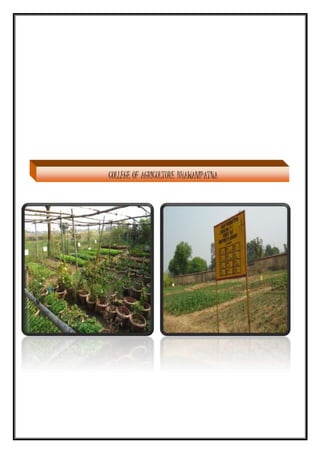
COLLEGE OF AGRICULTURE BHAWANIPATNA
WELCOME
TO
KALAHANDI
DISTRICT
Kalahandi district at a glance
Kalahandi (Oriya: କଳାହାଣ୍ଡି), is a district of Orissa in India. It is believed that the lands of Kalahandi
district and Koraput district were the ancient places where people started cultivation of paddy. In ancient
time it was known as Mahakantara (meaning Great Forest) and Karunda Mandal, which means treasure of
precious stones like karandam (Manik), Garnet (red stone), Beruz, Neelam (blue stone), and Alexandra etc.
Manikeswari (the goddess of Manikya or Karandam) is the clan deity of Kalahandi may also signify its
historical name. After Independence of the Country, merger of princely state took place on 1st January,
1948. The princely state of Kalahandi was merged in Orissa along with other princely states in the 1st
November, 1949. Subsequently, in 1962, Kashipur Police Station was taken out from this District and
merged with Koraput.
Geography: -Kalahandi district occupies the South-western portion of Orissa and is situated between 19
degree 3' N and 21 degree 5' N latitude and 82 degree 30 E and 83 Degree 74' E longitude. It is bounded in
the North by the District of Bolangir and Nuapara, on the South by the District of Rayagada, on the West by
the District of Nabarangpur and Raipur (Chhatisgarh) and on the East by the District of Rayagada and Boudh.
The District Headquarters is at Bhawanipatna town which stands almost to the Eastern border. Kalahandi
district has an area of 8,364.89 sq.km and ranks 7th among the 30 districts of Orissa. Forest occupies 4,964
of the total geographical area of the district, i.e. not cultivated area of the District in the year 1993 is 375752
ha. In the same year, 11,602 hectors were left as fallow lands or cultivable wasteland.
Topography:-
The District has two distinct physiographic regions, the plain lands and the hilly tracts. The plan region runs
Southward up to Bhawanipatna and then westward through Junagarh and Dharmgarh and then further up
to the boundary of the District. The plains cover about 59 percent of the total area of the District. The Hilly
tracts are mostly located in the South western part of Bhawanipatna Subdivision. Some of the hilly regions
are covered with dense forest.
Physiography:-
The District has two sub-divisions, 12 Police Stations, 13 Tahasils, 13 Blocks, 1 Municipality, two N.A.Cs., 1
Treasury, 5 Sub-Treasuries and 195 Gram Panchayats of 2185 villages
Rainfall and Climate:-
The climate of the District is of extreme type. It is dry except during monsoon. There are large varieties of
day and night temperature. The average annual rainfall of the district is 1378.20 mm. The variation in the
rainfall from year to year is not large. The monsoon starts late in June and generally lasts up to September.
90% of the rainfall received from June to September. August is the month with more number of rainy days.
About 28% of rainfall is received during this month. Drought is normal feature of this district.
Temperature and Humidity:-
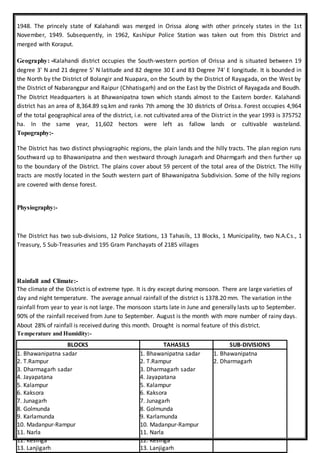
BLOCKS TAHASILS SUB-DIVISIONS
1. Bhawanipatna sadar
2. T.Rampur
3. Dharmagarh sadar
4. Jayapatana
5. Kalampur
6. Kaksora
7. Junagarh
8. Golmunda
9. Karlamunda
10. Madanpur-Rampur
11. Narla
12. Kesinga
13. Lanjigarh
1. Bhawanipatna sadar
2. T.Rampur
3. Dharmagarh sadar
4. Jayapatana
5. Kalampur
6. Kaksora
7. Junagarh
8. Golmunda
9. Karlamunda
10. Madanpur-Rampur
11. Narla
12. Kesinga
13. Lanjigarh
1. Bhawanipatna
2. Dharmagarh
There are large variations in the day and night temperature. The summer seasons starts from the beginning
of March. May is the hottest month when the maximum temperature is about 45 C (82 degree F). The
temperature drops down with the onset of monsoon towards the second week of June and throughout the
monsoon the weather remains cool. December is the coldest month, as the mean daily minimum
temperature is recorded at 11 degree C. Relative humidity is generally higher from June to December. It is
lower (27%) in the non-monsoon months. During August, it is the highest i.e. 70% and March is the month
lowest when it is lowest 27%. Northern plateau (at 2150 MSL) of Sunabeda in Komna Block of Nuapara
district has a cooler climate so also the Rampur area (at 2700 Feet MSL).
Soil of kalahandi:-
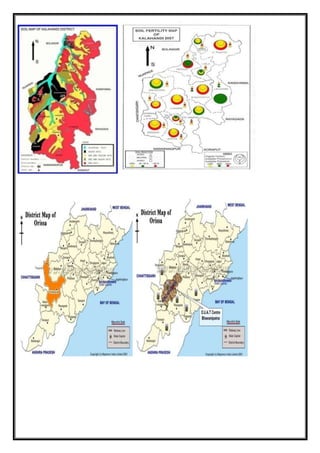
The district has five types of soils broadly classified as under)Red soil. ii) Red & Yellow soil. iii) Mixed Red &
Black soils. iv)Black soils and v) alluvial soil. Area covered is 38.5, 34.2, 11.1, 9.6 and 6.6 for red soils. Red &
yellow soils, mixed red & black soils, black soils and alluvial soils, respectively.
Rivers:-
Tel, Indrāvati which from tributaries of large rivers like Mahanadi and Godavari may be mentioned amongst
the principal rivers of Kalahandi. However, Tel is by far the longest and most important river of the District.
The tributaries of river Tel and Moter, Hati, Sagada, Ret, Uttei, Raul, Sunday, Undanti lands are also the
important other rivers. Most of the rivers are rained and go dry during summer. Indravati and Nagavali, two
important rivers have their origin from Th-Rampur of this District.
Forest:-
Nearly half of the total Geographical area of Kalahandi District 4,962 Sq.Kms was covered with forest. In the
recent times this has been a considerable shrinkage in forest areas due to denudation. Forest based
products like Mahua, Kendu leaf, wood, timber and bamboos are also contribute local economy largely.
Kalahandi supplied substantial raw materials to paper mills in neighboring Rayagada and Jeypore.
Minerals:-
Bauxite, Graphite, Manganese, Iron and Quartz are some of the minerals available in the district. Of these,
only Bauxite and Graphite has been commercially exploited. Bauxite is found in Lanjigarh block at Niamgiri
in large scale. Manganese deposits are found mostly in Khariar Plateau of Nuapara District and Iron ores in
places adjoining Koraput district. But these ores are of poor grade and are not considered suitable for
economy exploitation. According to the National Council of Applied Economic Research, the known deposits
of minerals in the district cannot by themselves sustain heavy mineral based industry.
Economy: - In 2006 the Ministry of Panchayati Raj named Kalahandi one of the country's 250 most
backward districts (out of a total of 640). It is one of the 19 districts in Orissa currently receiving funds from
the Backward Regions Grant Fund Programme (BRGF).
Agriculture:-Kalahandi is largely an agriculture based economy. During Bengal famine Kalahandi alone had
sent 100,000 tons of rice. During 1930s princely state of Kalahandi had proposed to build upper Indravati
project but subsequent merger of princely state with India delayed the project. It got approved in 1978 and
yet to be fully completed. In the mean time drought occurred in 1960s and lately in 1980s. In 1980s
Kalahandi become infamous for drought, child selling, malnutrition and starvation death and social worker
referred it as 'Kalahandi Syndrome. Though KBK project was announced in 1990s by central Government
especially for undivided Kalahandi, Bolangir and Koraput districts primarily keeping poverty, backwardness
and starvation death in mind, undivided Kalahandi district continued to remain politically ignored for
various reasons.
Kalahandi also is an example of disparity /contrasts that exist in many part of developing/underdeveloped
world. On the one side, this district is famous for famine and starvation deaths: this is the same district that
is rich with agriculture. Dharamgarh sub-division was historical known for rice production in Orissa. Since
2000s the Indravati Water Project, second biggest in the state has changed the landscape of southern
Kalahandi, leading to two crops in a year. Because of this, blocks like Kalampur, Jaipatna, Dharamgarh,
Jungarh, Bhawanipatna etc. are witnessing rapid agricultural growth. This has boasted the Highest Number
of Rice Mills in Kalahandi among districts in Orissa. The number of rice mills in the district was around 150 in
the year 2004-05. More than 70% have been built in the five years after commissioning of the Indravati
project.
Industry:-Vedanta Alumina Limited (VAL), a subsidiary of Sterlite Industries, a major aluminium processor
has made major investments by establishing an 1 MTPA Alumina Refinery and 75 MW Captive Power Plant
at Lanjigarh. Though this project has received criticism from environmentalists, especially from outside
groups; supporters of VAL claims it has brought significant changes in Socio-Economic scenario of Lanjigarh
and Kalahandi. The Union Environment Ministry in August 2010, rejected earlier clearances granted to a
joint venture led by the Vedanta Group company Sterlite Industries for mining bauxite from Niamgiri
hills making the company to depend on bauxite from outside Orissa. The company's proposal for Expansion
of the Refinery to 6 MTPA, which would have made it one of the largest refineries in the world, was halted
by India's environment ministry.
Demographics:-According to the 2011 census Kalahandi district has a population of 1,573,054. This gives it
a ranking of 317th in India (out of a total of 640). The district has a population density of 199 inhabitants per
square kilometre (520 /sq mi). Its population growth rate over the decade 2001-2011 was
17.79%. Kalahandi has a sex ratio of 1003 females for every 1000 males, and a literacy rate of 60.22%.
NOTABLE PERSONALITIES:-
 Rindo Majhi: Rindo Majhi was a freedom fighter in Orissa, India who started Kondha revolution
against British in 1853.
 Pratap Keshari Deo: Pratab Keshari Deo was Maharaja of princely state Kalahandi and represented
Kalahandi Lok Sabha constituency from 1950 to 1979. He took initiative for Upper Indrāvati Irrigation
Project in Kalahandi.
 Professor Bhubaneswar Behera: A known engineer, academic, administrator and author from
Kalahandi region.
 Ram Chandra Patra, IAS (retd.): A known bureaucrat, social worker, and administrator from
Kalahandi region who has been acknowledged for his simplicity.
 Natyarashmi Prafulla Ratha: Prafulla Ratha has been bestowed with natyarashmi for his
contribution to Oriya drama.
 Dayanidhi Naik: Dayanidhi Naik was a dalit leader and former minister from Kalahandi who became
popular for his honesty, public service and road infrastructure development in the region
 Kishan Patnaik: One of the great socialist leaders of the nation was born in 1930 into a lower-
middle-class family in Kalahandi. Mr Patnaik worked in the youth wing of Samajwadi Yuvjan Sabha
and soon rose to become its National President.
 Jayanta Kumar Behera: Jayata Kumar Behera is a social activist and artist. He is a Ghumura folk
dance Guru and has been working for popularizing Ghumura in the state, national and international
level since decades. Recently he was bestowed with Sarala Sanman.
Basic Information about Kalahandi district
1. Agro climatic zone: Western Undulating
2. Geographical area: 8197 sq.km
3. Cultivated area: 3,72,000 ha
I. High land : 2,32,000 ha
II. Medium Land:71.000ha
III. Low land: 68,000ha
4. Irrigated Area: Kharif: 27%, Rabi: 16%
5. Cropping intensity (%): 151
6. Population (2001 census) (in ‘000): 1131
i. Male: 566; Female: 565
ii Rural : 1053; Urban: 78
7. Population density: 138/ sq.km
8. No. of farm families; 1,68,000
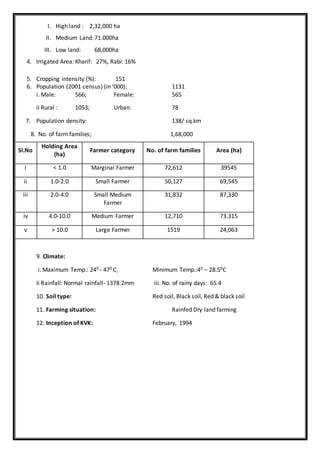
Sl.No
Holding Area
(ha)
Farmer category No. of farm families Area (ha)
i < 1.0 Marginal Farmer 72,612 39545
ii 1.0-2.0 Small Farmer 50,127 69,545
iii 2.0-4.0 Small Medium
Farmer
31,832 87,330
iv 4.0-10.0 Medium Farmer 12,710 73.315
v > 10.0 Large Farmer 1519 24,063
9. Climate:
i. Maximum Temp.: 240 - 470 C; Minimum Temp.:40 – 28.50C
Ii Rainfall: Normal rainfall- 1378.2mm iii. No. of rainy days: 65.4
10. Soil type: Red soil, Black soil, Red & black soil
11. Farming situation: Rainfed Dry land farming
12. Inception of KVK: February, 1994
KVK, KALAHANDI
A brief introduction on KVK, Kalahandi
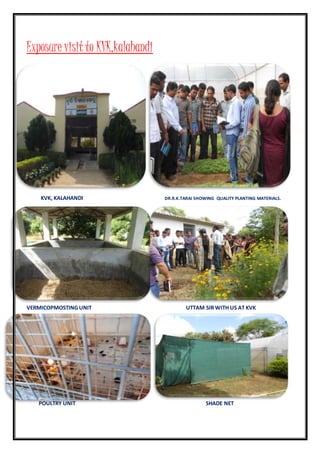
Krishi Vigyan Kendra, Kalahandi, is a First Line Transfer of Technology Project sanctioned by the
Indian Council of Agricultural Research to operate under Orissa University of Agriculture and Technology,
Bhubaneswar in pursuance to the Council’s Office Order No. 5(9) 92-KVK, (AE-II) dt. 27.08.1993. This
Kendra started functioning from 13.02.1994 in the Western Undulating Zone of Orissa with its headquarters
at Bhawanipatna, with a prime aim to enhance the agricultural production of Kalahandii district with help of
the mandatory activities like: On Farm Trials, Front Line Demonstrations, Vocational Trainings for farmers,
In-service Trainings, different Extension Activities, Seed & Seedling productions and making KVK
information hub.
Krishi Vigyan Kendra, Kalahandi, is a First Line Transfer of Technology Project sanctioned by the
Indian Council of Agricultural Research to operate under Orissa University of Agriculture and Technology,
Bhubaneswar in pursuance to the Council’s Office Order No. 5(9) 92-KVK, (AE-II) dt. 27.08.1993. This
Kendra of OUAT started functioning from 13.02.1994 in the Western Undulating Zone of Orissa, with its
headquarters at Bhawanipatna, Kalahandi.
Staff Position (as on 30.07.2013)
Mandate of the KVK: Assessment, refinement and demonstration of the technology/products.
Objectives of the KVK:
 On Farm Testing to identify the location specific technology in various farming system.
 Front Line Demonstration to establish production potentials of the technologies on the farmer’s fields.
 Training of farmers and farmwomen to update their knowledge and skills in modern agriculture
technologies and training extension personal to orient them in the frontier areas of technology
development.
 Work as resource and knowledge centre of agricultural technology for supporting initiatives of public,
private and voluntary sector for improving the agricultural economy of the district.
 Create awareness about frontier technologies through large number of extension activities like farmers
Fair, Field Day, strategic campaign and ex-trainees Meet etc.
 Production of quality seeds and planting materials to make it easily available to the farmers.
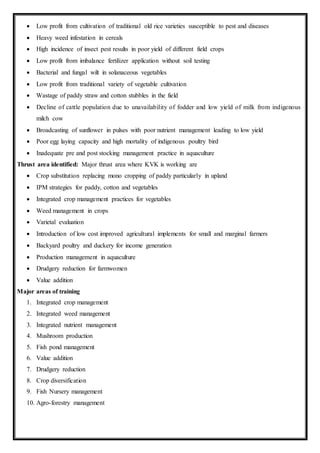
Problem identification: The KVK identify farmers’ problem through PRA (Participatory Rural appraisal)
method. In this method farmers and farm related problems are identified by the farmers. Scientists from KVK
act as facilitator for the programme. Problems identified by the farmer representatives are prioritised based on
the marks obtained and then ranked accordingly. Some of the common problems of the district identified by
the KVK are:
 Low profit from cultivation of traditional old rice varieties susceptible to pest and diseases
 Heavy weed infestation in cereals
 High incidence of insect pest results in poor yield of different field crops
 Low profit from imbalance fertilizer application without soil testing
 Bacterial and fungal wilt in solanaceous vegetables
 Low profit from traditional variety of vegetable cultivation
 Wastage of paddy straw and cotton stubbles in the field
 Decline of cattle population due to unavailability of fodder and low yield of milk from indigenous
milch cow
 Broadcasting of sunflower in pulses with poor nutrient management leading to low yield
 Poor egg laying capacity and high mortality of indigenous poultry bird
 Inadequate pre and post stocking management practice in aquaculture
Thrust area identified: Major thrust area where KVK is working are
 Crop substitution replacing mono cropping of paddy particularly in upland
 IPM strategies for paddy, cotton and vegetables
 Integrated crop management practices for vegetables
 Weed management in crops
 Varietal evaluation
 Introduction of low cost improved agricultural implements for small and marginal farmers
 Backyard poultry and duckery for income generation
 Production management in aquaculture
 Drudgery reduction for farmwomen
 Value addition
Major areas of training
1. Integrated crop management
2. Integrated weed management
3. Integrated nutrient management
4. Mushroom production
5. Fish pond management
6. Value addition
7. Drudgery reduction
8. Crop diversification
9. Fish Nursery management
10. Agro-forestry management
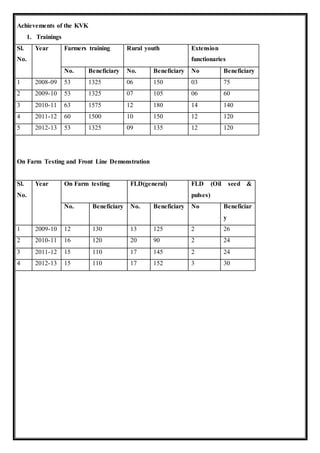
Achievements of the KVK
1. Trainings
Sl.
No.
Year Farmers training Rural youth Extension
functionaries
No. Beneficiary No. Beneficiary No Beneficiary
1 2008-09 53 1325 06 150 03 75
2 2009-10 53 1325 07 105 06 60
3 2010-11 63 1575 12 180 14 140
4 2011-12 60 1500 10 150 12 120
5 2012-13 53 1325 09 135 12 120
On Farm Testing and Front Line Demonstration
Sl.
No.
Year On Farm testing FLD(general) FLD (Oil seed &
pulses)
No. Beneficiary No. Beneficiary No Beneficiar
y
1 2009-10 12 130 13 125 2 26
2 2010-11 16 120 20 90 2 24
3 2011-12 15 110 17 145 2 24
4 2012-13 15 110 17 152 3 30
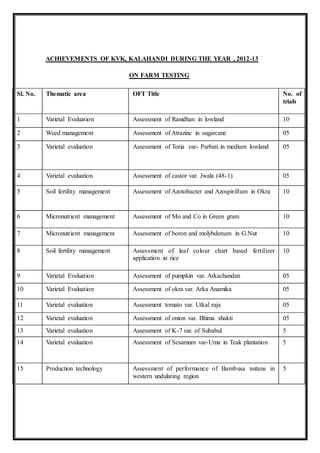
ACHIEVEMENTS OF KVK, KALAHANDI DURING THE YEAR , 2012-13
ON FARM TESTING
Sl. No. Thematic area OFT Title No. of
trials
1 Varietal Evaluation Assessment of Ranidhan in lowland 10
2 Weed management Assessment of Atrazine in sugarcane 05
3 Varietal evaluation Assessment of Toria var- Parbati in medium lowland 05
4 Varietal evaluation Assessment of castor var. Jwala (48-1) 05
5 Soil fertility management Assessment of Azotobacter and Azospirillum in Okra 10
6 Micronutrient management Assessment of Mo and Co in Green gram 10
7 Micronutrient management Assessment of boron and molybdenum in G.Nut 10
8 Soil fertility management Assessment of leaf colour chart based fertilizer
application in rice
10
9 Varietal Evaluation Assessment of pumpkin var. Arkachandan 05
10 Varietal Evaluation Assessment of okra var. Arka Anamika 05
11 Varietal evaluation Assessment tomato var. Utkal raja 05
12 Varietal evaluation Assessment of onion var. Bhima shakti 05
13 Varietal evaluation Assessment of K-7 var. of Subabul 5
14 Varietal evaluation Assessment of Sesamum var-Uma in Teak plantation 5
15 Production technology Assessment of performance of Bambusa nutans in
western undulating region
5
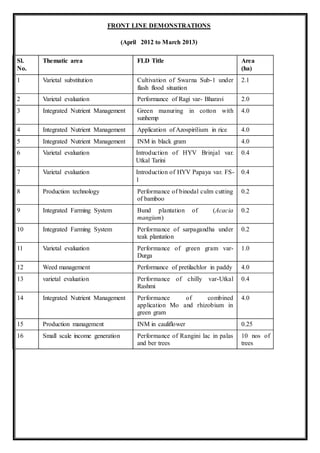
FRONT LINE DEMONSTRATIONS
(April 2012 to March 2013)
Sl.
No.
Thematic area FLD Title Area
(ha)
1 Varietal substitution Cultivation of Swarna Sub-1 under
flash flood situation
2.1
2 Varietal evaluation Performance of Ragi var- Bharavi 2.0
3 Integrated Nutrient Management Green manuring in cotton with
sunhemp
4.0
4 Integrated Nutrient Management Application of Azospirilium in rice 4.0
5 Integrated Nutrient Management INM in black gram 4.0
6 Varietal evaluation Introduction of HYV Brinjal var.
Utkal Tarini
0.4
7 Varietal evaluation Introduction of HYV Papaya var. FS-
1
0.4
8 Production technology Performance of binodal culm cutting
of bamboo
0.2
9 Integrated Farming System Bund plantation of (Acacia
mangium)
0.2
10 Integrated Farming System Performance of sarpagandha under
teak plantation
0.2
11 Varietal evaluation Performance of green gram var-
Durga
1.0
12 Weed management Performance of pretilachlor in paddy 4.0
13 varietal evaluation Performance of chilly var-Utkal
Rashmi
0.4
14 Integrated Nutrient Management Performance of combined
application Mo and rhizobium in
green gram
4.0
15 Production management INM in cauliflower 0.25
16 Small scale income generation Performance of Rangini lac in palas
and ber trees
10 nos of
trees
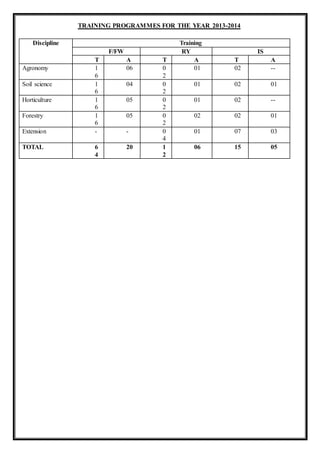
TRAINING PROGRAMMES FOR THE YEAR 2013-2014
Discipline Training
F/FW RY IS
T A T A T A
Agronomy 1
6
06 0
2
01 02 --
Soil science 1
6
04 0
2
01 02 01
Horticulture 1
6
05 0
2
01 02 --
Forestry 1
6
05 0
2
02 02 01
Extension - - 0
4
01 07 03
TOTAL 6
4
20 1
2
06 15 05
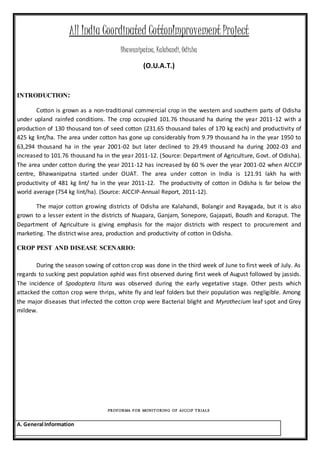
All India Coordinated CottonImprovement Project
Bhawanipatna, Kalahandi, Odisha
(O.U.A.T.)
INTRODUCTION:
Cotton is grown as a non-traditional commercial crop in the western and southern parts of Odisha
under upland rainfed conditions. The crop occupied 101.76 thousand ha during the year 2011-12 with a
production of 130 thousand ton of seed cotton (231.65 thousand bales of 170 kg each) and productivity of
425 kg lint/ha. The area under cotton has gone up considerably from 9.79 thousand ha in the year 1950 to
63,294 thousand ha in the year 2001-02 but later declined to 29.49 thousand ha during 2002-03 and
increased to 101.76 thousand ha in the year 2011-12. (Source: Department of Agriculture, Govt. of Odisha).
The area under cotton during the year 2011-12 has increased by 60 % over the year 2001-02 when AICCIP
centre, Bhawanipatna started under OUAT. The area under cotton in India is 121.91 lakh ha with
productivity of 481 kg lint/ ha in the year 2011-12. The productivity of cotton in Odisha is far below the
world average (754 kg lint/ha). (Source: AICCIP-Annual Report, 2011-12).
The major cotton growing districts of Odisha are Kalahandi, Bolangir and Rayagada, but it is also
grown to a lesser extent in the districts of Nuapara, Ganjam, Sonepore, Gajapati, Boudh and Koraput. The
Department of Agriculture is giving emphasis for the major districts with respect to procurement and
marketing. The district wise area, production and productivity of cotton in Odisha.
CROP PEST AND DISEASE SCENARIO:
During the season sowing of cotton crop was done in the third week of June to first week of July. As
regards to sucking pest population aphid was first observed during first week of August followed by jassids.
The incidence of Spodoptera litura was observed during the early vegetative stage. Other pests which
attacked the cotton crop were thrips, white fly and leaf folders but their population was negligible. Among
the major diseases that infected the cotton crop were Bacterial blight and Myrothecium leaf spot and Grey
mildew.
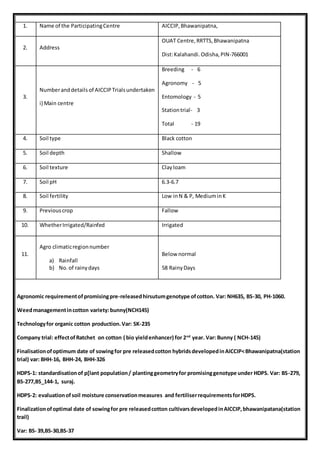
PROFORMA FOR MONITORING OF AICCIP TRIALS
A. General Information
1. Name of the ParticipatingCentre AICCIP,Bhawanipatna,
2. Address
OUAT Centre,RRTTS,Bhawanipatna
Dist:Kalahandi.Odisha,PIN-766001
3.
Numberanddetails of AICCIPTrialsundertaken
i) Main centre
Breeding - 6
Agronomy - 5
Entomology - 5
Stationtrial- 3
Total - 19
4. Soil type Black cotton
5. Soil depth Shallow
6. Soil texture Clayloam
7. Soil pH 6.3-6.7
8. Soil fertility Low inN & P, MediuminK
9. Previouscrop Fallow
10. WhetherIrrigated/Rainfed Irrigated
11.
Agro climaticregionnumber
a) Rainfall
b) No.of rainydays
Below normal
58 RainyDays
Agronomic requirementofpromisingpre-releasedhirsutumgenotype ofcotton. Var: NH635, BS-30, PH-1060.
Weedmanagementincotton variety:bunny(NCH145)
Technologyfor organic cotton production.Var: SK-235
Company trial: effectofRatchet on cotton ( bio yieldenhancer) for 2nd
year. Var: Bunny ( NCH-145)
Finalisationofoptimum date of sowingfor pre releasedcotton hybridsdevelopedinAICCIP<Bhawanipatna(station
trial) var: BHH-16, BHH-24, BHH-326
HDPS-1: standardisationof p[lant population/ plantinggeometryfor promisinggenotype under HDPS. Var: BS-279,
BS-277,BS_144-1, suraj.
HDPS-2: evaluationofsoil moisture conservationmeasures and fertiliserrequirementsforHDPS.
Finalizationofoptimal date of sowingfor pre releasedcotton cultivarsdevelopedinAICCIP,bhawanipatana(station
trail)
Var: BS- 39,BS-30,BS-37
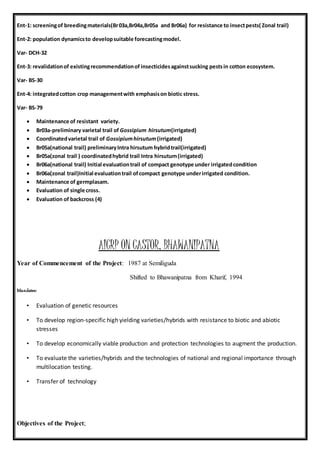
Ent-1: screeningof breedingmaterials(Br03a,Br04a,Br05a and Br06a) for resistance to insectpests( Zonal trail)
Ent-2: population dynamicsto developsuitable forecastingmodel.
Var- DCH-32
Ent-3: revalidationof existingrecommendationof insecticidesagainstsucking pestsin cotton ecosystem.
Var- BS-30
Ent-4: integratedcotton crop managementwith emphasison biotic stress.
Var- BS-79
 Maintenance of resistant variety.
 Br03a-preliminary varietal trail of Gossipium hirsutum(irrigated)
 Coordinatedvarietal trail of Gossipiumhirsutum (irrigated)
 Br05a(national trail) preliminaryIntra hirsutum hybridtrail(irrigated)
 Br05a(zonal trail ) coordinatedhybrid trail Intra hirsutum(irrigated)
 Br06a(national trail) Initial evaluationtrail of compact genotype under irrigatedcondition
 Br06a(zonal trail)Initial evaluationtrail ofcompact genotype underirrigated condition.
 Maintenance of germplasam.
 Evaluation of single cross.
 Evaluation of backcross (4)
AICRP ON CASTOR, BHAWANIPATNA
Year of Commencement of the Project: 1987 at Semiliguda
Shifted to Bhawanipatna from Kharif, 1994
Mandates:
• Evaluation of genetic resources
• To develop region-specific high yielding varieties/hybrids with resistance to biotic and abiotic
stresses
• To develop economically viable production and protection technologies to augment the production.
• To evaluate the varieties/hybrids and the technologies of national and regional importance through
multilocation testing.
• Transfer of technology
Objectives of the Project;
 To identify / develop early maturing, high yielding drought tolerant varieties / hybrids with high
oil content and resistance to biotic stress.
 To develop improved package of practices for maximization of yield.
 To conduct co-ordinated trials for evaluation of different varieties/hybrids suitable for the zone.
 To popularize the high yielding variety/hybrids and production technology among the farmers by
conducting Frontline demonstrations.
Thrust areas identified during XI plan:
 Development of varieties/hybrids with resistance to wilt, botrytis and capsule borer
 Development of early duration varieties/hybrids for rainfed and non-traditional areas
Major achievements
1. Among different high yielding varieties of castor tested over years the variety ‘48-1’ (Jwala), DCS-9
was found suitable for growing under rainfed upland eco-system in Odisha during kharif season.
2. Among different castor hybrids tested DCH-177 found suitable for cultivation in rainfed upland eco-
system in Odisha during kharif season.
3. Among pre-released varieties tested under coordinated trials the entries JI-353,JI-368, SKI-307,
SKI-324,SKI-333, SKI-337, MCI-3, MCI-11, JC-22, JC-26 and JC-24 were found promising.
4. Among pre-released hybrids tested under coordinated trials the entries RHC-231, RHC-199, RHC-
264, SHB-871, SHB-890 and SHB-875 were found promising.
5. Under breeding programme, seeds from F1 plants of 16 crosses were harvested through selfing for
imposing selection in F2.
6. Twenty one RG lines and eighteen parental lines received from DOR, Hyderabad and seven local land
races were maintained through selfing for their future use in breeding programmes.
Major crop production technology developed and recommended:
 Studies on optimization of production under resource constraints revealed that non adoption of
weeding and non adoption of fertilizer application are the most critical factors limiting higher
productivity in castor.
 Out of different sources of Sulphur, application of 20 kg S through SSP or Gypsum was found
beneficial for higher production in castor. It could give 27 - 32% higher yield than no sulphur
application.
 A spacing of 90cm x 60cm was found optimum for higher production in castor under rainfed upland
eco-system during kharif season.
Transferable TechnologiesDevelopedBy AICRP on Castor, Bhawanipatna
Plant Breeding:
 Among different high yielding varieties of castor ‘48-1’ (Jwala) and DCS-9 (Jyoti) were found suitable for
growing under rainfed upland eco-system in Odisha during kharif season.
 Among different castor hybrids tested, DCH-177 and DCH-519 were found suitable for cultivation in rainfed
upland eco-system in Odisha during kharif season.
Agronomy:
 Sowing of castor should be done after onset of monsoon. In areas where late kharif/pre- rabi sowing is
practiced, sowing should be done around 15th
of August for getting higher yield.
 Pre emergence application of Butachlor @ 1kg a.i. /ha is suitable in cotrolling weeds during initial growth
stage of castor.
Trials under AICRP CASTOR
Initial hybrid trial(IHT)- 13 hybrids
Initial varietal/hybrid trial(IVHT)- 15 entries
Advanced varietal/hybrid trial(AVHT)- 11 entries
Evaluation and identification of suitable hybrids/varieties of castor-15 entries
Evaluation of newly developed hybrids-26 hybrids
Maintenance of germplasm lines of castor- 60 nos
Development of suitable male combiners in castor( generation F1)- 21 crosses and 7 parents
Evaluation of paddy. Maizeand onion varieties:
Integrated weed management in transplanted rice:
Early post emergence application of Ethoxy sulfuron ethyl @ 15g/ha at 12 days after planting with
one hand weeding at 35 DAS enhances the mean yield (47.76q/ha) and net return (Rs31618.00/ha) with
suppression of weed population and dry matter accumulation. During non availability of labour force for
weeding operation, pre emergence application of Pretilachlor @ 0.5 kg /ha at 3 to 5 DAT + 2,4-D Na salt@
0.5 kg / ha at 28 DAT will be the suitable option to raise the economics(Rs31004.00/ha).
2. Studies on insect pest incidence in relation to meteorological parameters under rice agro-
ecosystemin western undulating zone:
Yellow stem borer, gallmidge, leaf folder, case worm, green leaf hopper, brown plant hopper and
white backed plant hopper were found to be major insect pests of rice. Peak activity of yellow stem borer and
gall midge was recorded during 40th std. week (1-7 Oct.) where as peak activity of brown plant hopper was
observed during 41st std.week (8-14Oct.).Maximum temperature favoured the attack of gall midge where as
minimum temperature favoured the attack of yellow stem borer.
3. Evaluation of location specific IPM module for sustainable rice production:
Combined results over two years revealed that the location specific IPM module comprising of various
components viz., seed treatment with carbendazim @ 1. 5grams /kg of seed, application of phorate 500g /10
cent in the nursery bed before 5 days of uprooting of seedling, release of Trichogramma japonicum
@1lakhs/ha at 30 DAT,.40DAT and 50DAT , setting up pheromone traps @ 5nos/ha for yellow stem borer ,
installation of bird perches @ 25nos/ha, foliar spraying of neemazol @1ml /lt at 60DAT and 70DAT and
foliar spraying of Buprofezin @ 1.5ml/lt at 85DAT at ETL afforded excellent control of major insect pests of
rice viz., yellow stem borer, gall midge, leaf folder, case worm, green leaf hopper and brown plant hopper
with higher grain yield of 31.86q/hq and monetary benefit of Rs11908/- per ha over the chemical control
schedule(Non IPM). IPM plot also recorded significantly higher numbers of natural enemies in rice
ecosystem.
Technical Trials:
agronomy trial:
Integrated nutrient management in aromatic paddy varieties and its residual effect on paira cropping. Var: nua
acharamati, geetanjali? Ketakijuha
Integrated nutrient management in SRI rice. Var: ajaya
Horticulture:
Varietal evaluation of onion cultivars in weastern undulating zone, bhawanipatna, var: bhima super, bhima
raj, agrifound light red, agrifound dark red, N53(yield check), arka kalian,arka niketan, arka pragati
Varietal evaluation of tomato cultivars in weastern undunating zone bhawanipatna. Var: utkal pallavi(
bacterial wilt resistant check), utkal dipti, utkal kumara( yield check), utkal urvashi, utkal raja. Utkal pragya,
BT-106, BT-317, swarna lalima
Entomology:
Studies on insect pest incidence in relation to meteorological parameters under rice agro-ecosystem in
western undulating zone. Var: swarna
Management of insect pest of rice through ITKS. Var swarna.
Company trail:
MLT ON PADDY
 Evaluation of 3 rice hybrids: BS-110G,BS-226,BS-6444G of Bayer bio science pvt. Ltd forwestern
undulating zone.
 Evaluation of rice hybrids: RH-664 plus,RH-1531,RH-10422,RH-10428 of Devgan seeds Crop tech. pvt.
Ltd.
 Evaluation of rice hybrids:SAVA-127,SAVA-134 of Savana seeds pvt. Ltd.
 Evaluation of rice hybrids: US-312and US-382 of seed workinternational pvt. Ltd.
 Evaluation of rice hybrids: NK- 5251 and NK-6302 of Syngenta india pvt. Ltd.
 Evaluation of rice hybrids : R-6301,R-6451,R-6606 of Zuari seeds pvt. Ltd.
MLT ON MAIZE
 Evaluation on maize hybrids: MM-1107 and TMH-67705 of Dhanya seeds pvt. Ltd.
 Evaluation of maize hybrids: Cyrus –G, Cyrus, Megan-G and PMH-495 of Prabardhan seeds pvt.Ltd.
For western undulating zone of odisha.
 Evaluation formaize hybrids : KMH-3646, KMH-6681 and KMH-3110 of M/S kaveri seeds pvt. ltd.
 Evaluation of maize hybrids: 3033,3591 and pro-agro-4558 of Rashi seed pvt. Ltd.
Voluntary center on soybean
Under rrtts, bhawanipatna
It isa voluntary ceneron soybeanunder RRTTS,Bhawanipatna.Here trials are not compoulsoryit may or may not. Only agronomic trial are carriedount
not the breedingtrial. Thereare 43 entries under initial varietal trail with one checkvariety, and 9 varieties under advancedvarietaltrial.
WELCOME
TO
TECHNOLOGY
MISSION
ON COTTON
TECHNOLOGY MISSION ON COTTON UNDER RKVY
During our R.A.W.E. programme we visited sinangbhatta village where Cotton & Arhar intercropping are
grown under the guidance of SMS cotton. Followings are the guideline by which this scheme is going on.
Cotton ,though a non-traditional crop in the state of odisha has gained importance over the years due to its high net
profit under drought prone rain fed up-land conditions prevailing in tribal dominated in land districts of
Bolangir,Subarnapur,Kalahandi,Nuapada,Rayagarda,Koraput along with Ganjam ,Gajapati bargarh, phulbani and
boudh .its comparable higher net profits over those of traditionally grown paddy and other crops under drought
prone rainfed upland conditions,has attracted the poor tribal farmers on one hand and high quality of the produce
varietal homogeneity and apparent organic nature of the crop has attracted a private traders / mill owners on the
other,especiallyinpresenttimes.
“Technology Mission on Cotton” will be operated in selected major cotton growing Districts of the state
under RKVY 2012-2013 with the following objectives.
1. To enhance the area, production, productivity&fibre quality improvement.
2. To overcome drought situation by intercropping of cotton with arhar
3. To get more net profit, substituting less remunerative crops like Suan, Gulji,local paddy etc.
4. To enable optimum use of family labour (as cotton is a labour consuming crop)
5. To put into use the underutilized/fallow lands for cotton cultivation.
6. To popularize the technology of IPM module-cum-Inter Cropping in cotton.
7. To reduce the cost of cultivation and pesticide consumption.
8. To enhance the net farm income of cotton growers.
9. To build up the capacity of cotton growers for production of quality cotton.
10. To meet the domestic and export demands of the country.
Ancillary projects to be implemented under “Technology Mission On Cotton”
1. IPM module-cum-intercropping in cotton crop.
2. Front Line Demonstration on cotton Varieties.
IPM module-cum-intercropping in cotton crop
This technology is developed by All India coordinated Cotton Improvement Project (AICCIP),
Bhawanipatna for sustainable yield by reducing the cost of cultivation & environmental pollution.
Principles / technology:
a) Deep summer ploughing for exposing the soil inhibiting stages of insect, pathogens and nematode
population to sunlight at least for 2-3 weeks and followed by stubble burning.
b) Grazing by animals after last picking of cotton is recommended for checking the carry
overpopulation of boll worm.
c) Sowing should be done timely within 10 to 15 days in a village or block in the season.
d) Broadcasting of sunhemp @ 6 kg per ac in between cotton / arhar rows followed by its incorporation
at 21 to 30 days of germination to suppress weed growth and to made valuable organic matter.
e) Seed treatment with imidacloprid 70WS @ 7 gm /kg of seeds.
f) Use pheromone traps for monitoring of American boll worm, spotted boll worm, pink boll worm and
spodoptera. Install pheromone traps at a distance of 50 m @ 5 traps per hect. For each ninse3ct
pest. Use specific lures for each insect pest species and change it after every 15 to 20 days. Trapped
months should be removed daily. ETL for pink boll worm is 80 months per day per trap consecutively
for three days. ETL for American boll worms is 4-5 months per day per trap.
g) Spraying of NSKE 5% at 45 and 100 days after germination.
h) To release3 of Trichogramma chilonis @ 1.5 lakh pe4r hect. At 60 and 70 days after germination.
i) Spraying of HaNPV @ 500 LE /ha during 70 days after germination.
j) Need based spraying of Endosulfanb 30 EC@ 1 litre per hect. During 60 to 90 days after germination.
k) Need based spraying of Prophenophus @ 1 lt. / hect. During 90-120 days after germination.
l) Growing castor and marigold around the cotton + arhar field (border crops) as trap crops for
trapping Spodoptera ( leaf cutting caterpillar and Heliothis (American boll worm) leaf eating
caterpillar lays a colony of eggs beneath the leaf surface and such leaves should be removed and
destroyed regularly.
m) Growing o0f eco feast crops such as maize around the cotton + arhar field for harboring beneficial
such as Crysoperla and lady bird beetle which feeds on aphids. Growing arhar as and intercrops as
8:2 row ratios are cotton: arhar.
n) Installation of birds perches @ 20 no.s per hect.
o) Setup yellow pan / sticky traps for monitoring white fly @ 25 yellow pans /sticky tarps per hect.
Locally availably empty yellow palmoline tins coated with grease / Vaseline / castor oil on oute3r
surface may also be used.
p) Hand collection and destruction of harmful larvae at weekly interval.
Objective:
With improvising the soil status not only the farmers are benefited from lesser fertilizer use but the
weed control cost also overcome to minimize cost of cultivation to provide considerable profit per unit area.
The scientific approach followed continuously over the years will definitely educate the farmers to
visualize beneficiary insects feeding on harmful insects invading boarder crops like castor and marigold will
provide impetus to judge and limit the pesticide use their by reducing the cost of cultivation. The quality is
also influenced to provide better price for the product.
The productivity is increased with user of chemical fertilizer if and only if the Bio-flora and fauna is
Functional with the Presence of adequate organic matter and ecology, which is being taken care of.
Strategy:
To popularize this technology among the cotton growers of the state, it is decided to take up training cum
demonstration programme for 3750 ha. With an estimated cost of Rs. 262.92 Lakh.
For effective implementation of the programme cluster approach is to be taken up .The cluster size will be
30 ha. in continuous or continuous manner. So there will be 125 clusters covering 3750 ha.
For each cluster there will be a training programme in 5 phases on IPM and INM, 30 IPM kits will be
provided to the participating farmers during the training period for identification of beneficial and harmful
insect pests.
Frontline demonstration on cotton varieties:
The cotton in odisha is grown under rain fed condition in various soil types. the deep soil condition rich in
organic content can hold moisture for longer period to facilitate optimal use of other inputs to harness a
satisfactory yield from hybrids. The crop is grown in shallow red laterite soils exhibits symptoms of water
stress due to poor water holding capacity of the soil. It is observed that rainfall is erratic for the last few
years. Moisture stress at the critical stages like square and boll formation drastically reduces yield. Hybrids
have shallow root system but varieties have deep root system. So suitable varieties may be introduced in
the areas where the soil is shallow. Productivity and cost of cultivation of varieties is very low compared to
hybrids but yield is assured from varieties despite the adverse conditions of dry spell. With the introduction
of a new vision of intensification of plant population with use of organic additives also enrich soil for a
sustainable yield in future .Quality will be better for the assured phytosanitary condition the product. The
scope collection of open pollinated seeds in case of varieties is possible without much reduction in yield
.Farmers are now able to face any input stress (e.g. non avability of suitable varieties from market) in future
to stabilize yield with plant population intensification and to ensure quality growing in organic environment
for assured marketing to maximize net profit per unit area.
Strategy
To popularize this technology among the cotton growers of the state , it is proposed to take up
Frontline Demonstration Program of 40 Ac with estimated cost of Rs2.40Lakh @ Rs6000 per Ac.The program
will be taken up in two clusters(20 Ac in each )one at Bhawanipatna and another at Bolangir district.
Benefits to a beneficiary are limited to one ac. Demonsration.NGO is available in the locality, which is
competent enough regarding this technology, the programme may be taken up through NGO.
ONGOING PROJECTS ON COTTON
Technology mission on cotton
BAYLEAF COFFEE BLACK PEPPER
CINAMUM CARDAMUM ARECANUT
TURMERIC VANILLA ALL SPICES
Participatory Rural Appraisal
Components of PRA:
 People
 Knowledge
 Participation
 Planning
 Action
It is a combination of different approaches to
 Share
 Enhance
 Analyze
 Plan
 Act
For the betterment of the rural people with their participation
The secrets behind the success of PRA are
 Decentralization
 Empowerment
OBJECTIVES OF PRA:-
PRA aims to empower local people by encouraging them to share, enhance and analyze their
knowledge of life and conditions and to plan, act, monitor and evaluate.
WHAT IT IS?
 Participatory research is not an alternative research method, but an approach that can be
applied to any methodology – survey, experimental, qualitative (Lilja and Bellon 2008).
 “PRA methods, as they are often called, are visual and tangible and usually performed by small
groups of people”. (Chambers 2007)
 PRA comprised of different research tools to facilitate local people in
 Analyzing information
 Practicing critical self-awareness
 Taking responsibility
 Sharing their knowledge of life and conditions to plan and to act.
ORIGIN AND EVOLUTION:-
FROM RRA TO PRA
From 1970 onwards Participatory tools- for promoting and participation of the poor & marginalized in
improving their wellbeing.
These tools arose from two beliefs:
 The knowledge & experience of poor and marginalized have value and not to be dismissed
as irrelevant or wrong,
 Poor and marginalized have the right to resources traditionally defined by them.
EVOLUTION OF PRA:-
Five streams which stand out as sources and parallels to PRA are, in alphabetical order:
 Activist participatory research.
 Agro-ecosystem analysis.
 Applied anthropology.
 Field research on farming systems.
WHY PRA:-
In its earlier version of PRA it emerged as a response to two major concerns of rural social research
not adequately satisfied by conventional methods.
 To develop local perspective by becoming more responsive to local people and local
situations
 To evolve a methodology which could provide timely and cost effective information
BENEFITS OF PRA METHODS:-
Empowerment of the local people
 Securing active involvement of the community and appreciation of local knowledge,
encouraging/enabling the expression and utilization of local diversity while building on ITK.
 Creating a culture of open learning with each other and with community members other.
 Setting research priorities.
 Setting participatory extension program.
 Policy review
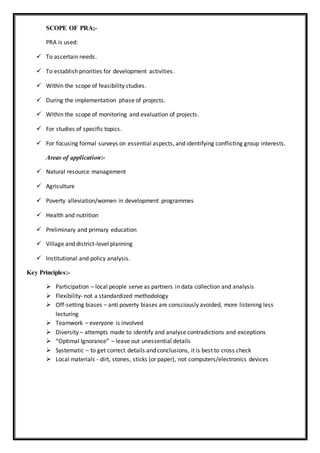
SCOPE OF PRA;-
PRA is used:
 To ascertain needs.
 To establish priorities for development activities.
 Within the scope of feasibility studies.
 During the implementation phase of projects.
 Within the scope of monitoring and evaluation of projects.
 For studies of specific topics.
 For focusing formal surveys on essential aspects, and identifying conflicting group interests.
Areas of application:-
 Natural resource management
 Agriculture
 Poverty alleviation/women in development programmes
 Health and nutrition
 Preliminary and primary education
 Village and district-level planning
 Institutional and policy analysis.
Key Principles:-
 Participation – local people serve as partners in data collection and analysis
 Flexibility- not a standardized methodology
 Off-setting biases – anti poverty biases are consciously avoided, more listening less
lecturing
 Teamwork – everyone is involved
 Diversity – attempts made to identify and analyse contradictions and exceptions
 “Optimal Ignorance” – leave out unessential details
 Systematic – to get correct details and conclusions, it is best to cross check
 Local materials - dirt, stones, sticks (or paper), not computers/electronics devices
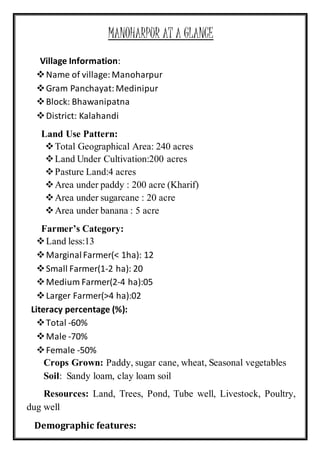
MANOHARPUR AT A GLANCE
Village Information:
Name of village:Manoharpur
Gram Panchayat:Medinipur
Block: Bhawanipatna
District: Kalahandi
Land Use Pattern:
Total Geographical Area: 240 acres
Land Under Cultivation:200 acres
Pasture Land:4 acres
Area under paddy : 200 acre (Kharif)
Area under sugarcane : 20 acre
Area under banana : 5 acre
Farmer’s Category:
Land less:13
MarginalFarmer(< 1ha): 12
Small Farmer(1-2 ha): 20
Medium Farmer(2-4 ha):05
Larger Farmer(>4 ha):02
Literacy percentage (%):
Total -60%
Male -70%
Female -50%
Crops Grown: Paddy, sugar cane, wheat, Seasonal vegetables
Soil: Sandy loam, clay loam soil
Resources: Land, Trees, Pond, Tube well, Livestock, Poultry,
dug well
Demographic features:
a. 52 families, 30farm families and 22 non farm families.
b. Total no of households:52, 50 kachha house and 2
pakka house.
Enterprises: Farming, Dairy, Poultry, Goatery, Kitchen garden
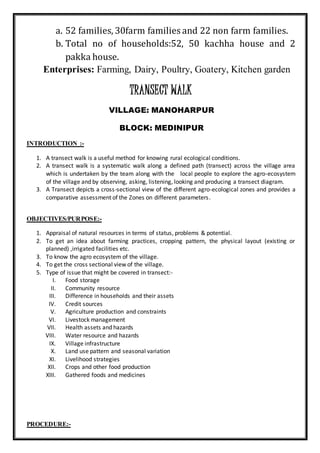
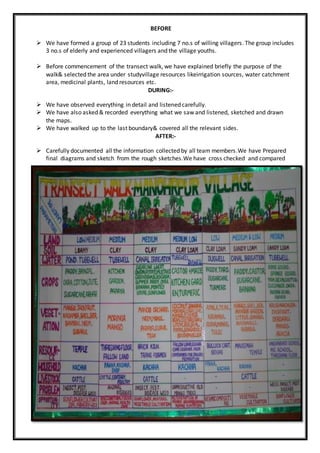
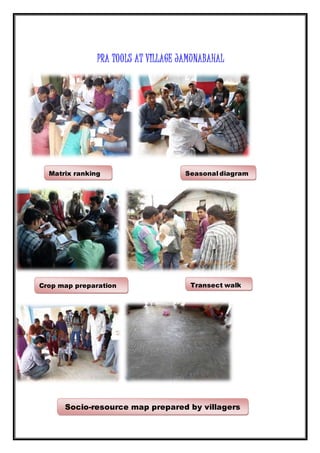
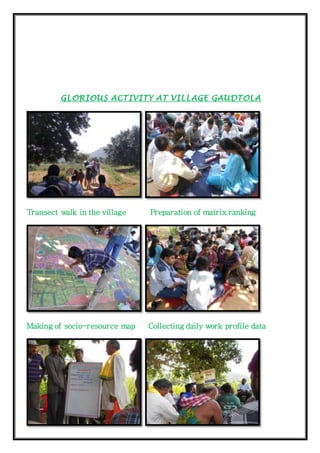
TRANSECT WALK
VILLAGE: MANOHARPUR
BLOCK: MEDINIPUR
INTRODUCTION :-
1. A transect walk is a useful method for knowing rural ecological conditions.
2. A transect walk is a systematic walk along a defined path (transect) across the village area
which is undertaken by the team along with the local people to explore the agro-ecosystem
of the village and by observing, asking, listening, looking and producing a transect diagram.
3. A Transect depicts a cross-sectional view of the different agro-ecological zones and provides a
comparative assessment of the Zones on different parameters.
OBJECTIVES/PURPOSE:-
1. Appraisal of natural resources in terms of status, problems & potential.
2. To get an idea about farming practices, cropping pattern, the physical layout (existing or
planned) ,irrigated facilities etc.
3. To know the agro ecosystem of the village.
4. To get the cross sectional view of the village.
5. Type of issue that might be covered in transect:-
I. Food storage
II. Community resource
III. Difference in households and their assets
IV. Credit sources
V. Agriculture production and constraints
VI. Livestock management
VII. Health assets and hazards
VIII. Water resource and hazards
IX. Village infrastructure
X. Land use pattern and seasonal variation
XI. Livelihood strategies
XII. Crops and other food production
XIII. Gathered foods and medicines
PROCEDURE:-
BEFORE
 We have formed a group of 23 students including 7 no.s of willing villagers. The group includes
3 no.s of elderly and experienced villagers and the village youths.
 Before commencement of the transect walk, we have explained briefly the purpose of the
walk& selected the area under studyvillage resources likeirrigation sources, water catchment
area, medicinal plants, land resources etc.
DURING:-
 We have observed everything in detail and listened carefully.
 We have also asked & recorded everything what we saw and listened, sketched and drawn
the maps.
 We have walked up to the last boundary& covered all the relevant sides.
AFTER:-
 Carefully documented all the information collected by all team members.We have Prepared
final diagrams and sketch from the rough sketches.We have cross checked and compared
the information by meeting other villagers & Recorded how things differ from one situation
to another.
CONCLUSION:
Through transect walk, the productive resources identified are –paddy, sugarcane,banana,vegetables,
water resources like tubewell, bore well, dug well, plant species like neem, mango, ber, livestock. The
various unused resources are –fallow land at 2 places, a large pond & broken brick kiln.
ACTION PLAN:
 There is opportunity for bee keeping, mango plantation, sunflower& vegetable cultivation.
 Large pond can be utilized for improved pisciculture.
 Poultry& mushroom cultivation can be taken up by the farm woman in the back yard of
household.
 FACILITATORS: PARTICIPANTS:-
 Group-2(RAWE 2013-14) Keshab Chandra Sa
Abhiram Biswal,
Subha Goud,
Bhaskar Goudtia
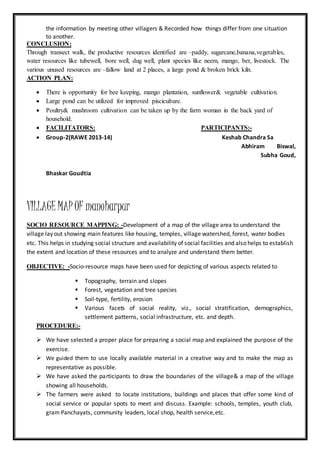
VILLAGE MAP OF manoharpur
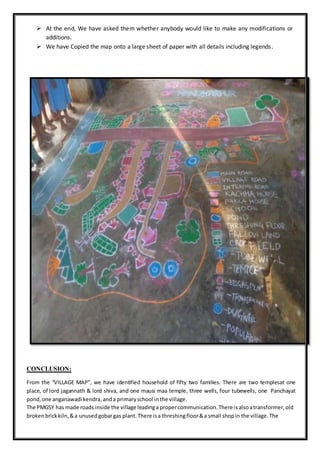
SOCIO RESOURCE MAPPING: -Development of a map of the village area to understand the
village lay out showing main features like housing, temples, village watershed, forest, water bodies
etc. This helps in studying social structure and availability of social facilities and also helps to establish
the extent and location of these resources and to analyze and understand them better.
OBJECTIVE: -Socio-resource maps have been used for depicting of various aspects related to
 Topography, terrain and slopes
 Forest, vegetation and tree species
 Soil-type, fertility, erosion
 Various facets of social reality, viz., social stratification, demographics,
settlement patterns, social infrastructure, etc. and depth.
PROCEDURE:-
 We have selected a proper place for preparing a social map and explained the purpose of the
exercise.
 We guided them to use locally available material in a creative way and to make the map as
representative as possible.
 We have asked the participants to draw the boundaries of the village& a map of the village
showing all households.
 The farmers were asked to locate institutions, buildings and places that offer some kind of
social service or popular spots to meet and discuss. Example: schools, temples, youth club,
gram Panchayats, community leaders, local shop, health service,etc.
 At the end, We have asked them whether anybody would like to make any modifications or
additions.
 We have Copied the map onto a large sheet of paper with all details including legends.
CONCLUSION:
From the “VILLAGE MAP”, we have identified household of fifty two families. There are two templesat one
place, of lord jagannath & lord shiva, and one mausi maa temple, three wells, four tubewells, one Panchayat
pond,one anganawadi kendra,anda primaryschool inthe village.
The PMGSY has made roads inside the village leadinga propercommunication.There isalsoatransformer,old
brokenbrickkiln,&a unusedgobargas plant.There isa threshingfloor&a small shopin the village.The
villagersfulfill theirirrigationneedsfromthe canal whichflowsalongthe northside of the village fromthe
Bhatangpadardam.
The most importantresourcesare the irrigatedlandswhere paddyandsugarcane are beingcultivated. The
villagersmostlydependsonthe forest resources tofulfill theirfuel needs.
FACILITATORS:- PARTICIPANTS:-
Group-2(RAWE 2013-14) Sudarsana Sa,
Bhawani Shankar Sa,
Anta Majhi,
Laxman
Gaud,
Keshab Chandra Sa
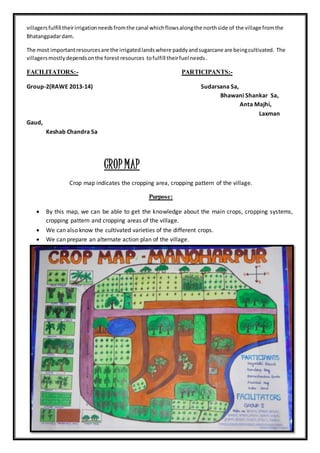
CROP MAP
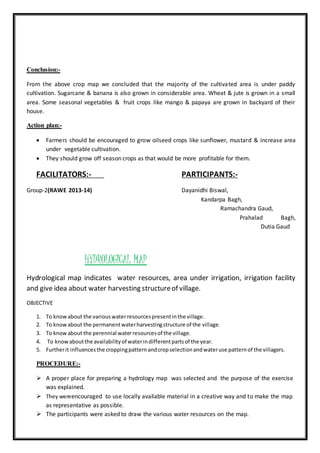
Crop map indicates the cropping area, cropping pattern of the village.
Purpose:
 By this map, we can be able to get the knowledge about the main crops, cropping systems,
cropping pattern and cropping areas of the village.
 We can also know the cultivated varieties of the different crops.
 We can prepare an alternate action plan of the village.
Conclusion:-
From the above crop map we concluded that the majority of the cultivated area is under paddy
cultivation. Sugarcane & banana is also grown in considerable area. Wheat & jute is grown in a small
area. Some seasonal vegetables & fruit crops like mango & papaya are grown in backyard of their
house.
Action plan:-
 Farmers should be encouraged to grow oilseed crops like sunflower, mustard & increase area
under vegetable cultivation.
 They should grow off season crops as that would be more profitable for them.
FACILITATORS:- PARTICIPANTS:-
Group-2(RAWE 2013-14) Dayanidhi Biswal,
Kandarpa Bagh,
Ramachandra Gaud,
Prahalad Bagh,
Dutia Gaud
HYDROLOGICAL MAP
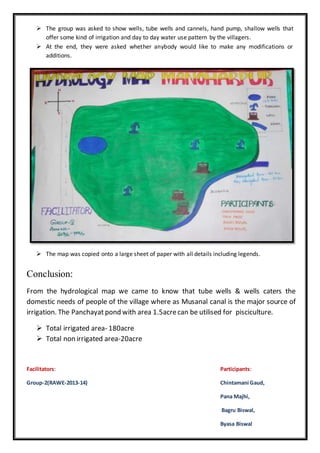
Hydrological map indicates water resources, area under irrigation, irrigation facility
and give idea about water harvesting structureof village.
OBJECTIVE
1. To knowabout the variouswaterresourcespresentinthe village.
2. To knowabout the permanentwaterharvestingstructure of the village.
3. To knowabout the perennial waterresourcesof the village.
4. To knowaboutthe availabilityof waterindifferentpartsof the year.
5. Furtherit influencesthe croppingpatternandcropselectionandwateruse patternof the villagers.
PROCEDURE:-
 A proper place for preparing a hydrology map was selected and the purpose of the exercise
was explained.
 They wereencouraged to use locally available material in a creative way and to make the map
as representative as possible.
 The participants were asked to draw the various water resources on the map.
 The group was asked to show wells, tube wells and cannels, hand pump, shallow wells that
offer some kind of irrigation and day to day water use pattern by the villagers.
 At the end, they were asked whether anybody would like to make any modifications or
additions.
 The map was copied onto a large sheet of paper with all details including legends.
Conclusion:
From the hydrological map we came to know that tube wells & wells caters the
domestic needs of people of the village where as Musanal canal is the major source of
irrigation. The Panchayat pond with area 1.5acrecan be utilised for pisciculture.
 Total irrigated area- 180acre
 Total non irrigated area-20acre
Facilitators: Participants:
Group-2(RAWE-2013-14) Chintamani Gaud,
Pana Majhi,
Bagru Biswal,
Byasa Biswal
ENTERPRISEMAP
VILLAGE-MANOHARPUR
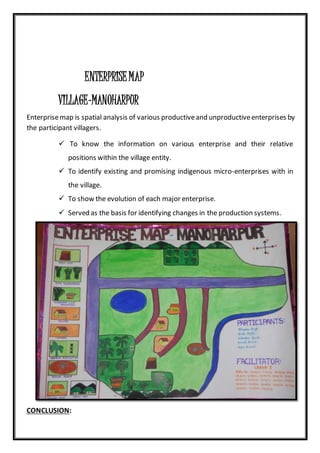
Enterprisemap is spatial analysis of various productiveand unproductiveenterprises by
the participant villagers.
 To know the information on various enterprise and their relative
positions within the village entity.
 To identify existing and promising indigenous micro-enterprises with in
the village.
 To show the evolution of each major enterprise.
 Served as the basis for identifying changes in the production systems.
CONCLUSION:
Fromthe enterprisemap, we found that the major productiveenterprise of the village
is jaggery production. Besides this other enterprises arepoultry, goatery & banana
plantation. There are also unproductiveenterprises like brick kiln & biogas plant.
ACTION PLAN:
The enterprises like mushroomcultivation, fish cultivation, development of broiler unit
can be taken up by the villagers from which they can generate income .
FACILITATOR: PARTICIPANTS:
Group-2(RAWE-2013-14) Shyama Bagh
Nilambar Goud
RameshBiswal
ArjunBiswal
TIME LINE OF VILLAGE MANOHARPUR
DEFINITION:-
A timeline is a list of key events, changes and landmarks in the past, presented in a
chronologicalorder.
OBJECTIVES:-
 To learn fromthe community what they consider being important past events.
 To understand fromthe community the historicalperspective on currentissues.
 To generate discussions on changes with respectto issues you areinterested in
e.g. education, health, food security, gender relations, economic conditions, etc.,
 To develop a rapportwith the villagers, since a discussion aboutthe past of the
village can be a good non-threatening and enjoyablestarting point.
PROCESS
BEFORE:-
 Set the climate for a participatory discussion.
 Encourageelderly people knowledgeable villagers to join the discussion as far as
possible.
 Carry sheets of paper and sketch pen.
DURING :-
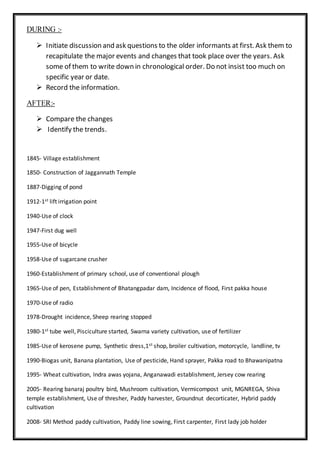
 Initiate discussion and ask questions to the older informants at first. Ask them to
recapitulate the major events and changes that took place over the years. Ask
some of them to write down in chronological order. Do not insist too much on
specific year or date.
 Record the information.
AFTER:-
 Compare the changes
 Identify the trends.
1845- Village establishment
1850- Construction of Jaggannath Temple
1887-Digging of pond
1912-1st lift irrigation point
1940-Use of clock
1947-First dug well
1955-Use of bicycle
1958-Use of sugarcane crusher
1960-Establishment of primary school, use of conventional plough
1965-Use of pen, Establishment of Bhatangpadar dam, Incidence of flood, First pakka house
1970-Use of radio
1978-Drought incidence, Sheep rearing stopped
1980-1st tube well, Pisciculture started, Swarna variety cultivation, use of fertilizer
1985-Use of kerosene pump, Synthetic dress,1st shop, broiler cultivation, motorcycle, landline, tv
1990-Biogas unit, Banana plantation, Use of pesticide, Hand sprayer, Pakka road to Bhawanipatna
1995- Wheat cultivation, Indra awas yojana, Anganawadi establishment, Jersey cow rearing
2005- Rearing banaraj poultry bird, Mushroom cultivation, Vermicompost unit, MGNREGA, Shiva
temple establishment, Use of thresher, Paddy harvester, Groundnut decorticater, Hybrid paddy
cultivation
2008- SRI Method paddy cultivation, Paddy line sowing, First carpenter, First lady job holder
2010- Use of sprayer, Weeder, Refrigeretor, Cooler, Mobile, TATA sky
2011- Establishment of Transformer
Facilitator- Participants-
GROUP-II(RAWE-2013-14) Krushna Chandra Biswal
Digambar Bagh
Budu Majhi
Trilochana Majhi
Biswambhar Biswal
VENN DIAGRAM OF manoharpur
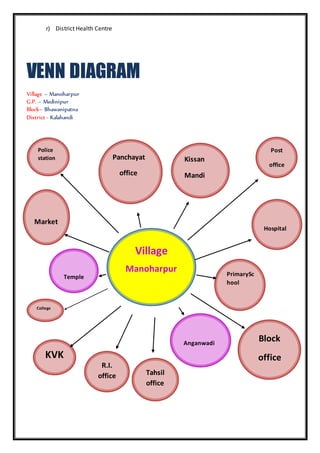
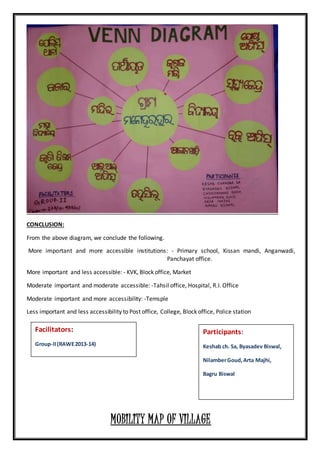
Definition: - The diagram which shows the relationship of various institutions, organizations,
programs or individuals with each other & with the village as perceived by the villagers is called as
Venn diagram.
Purpose:-
 To identify groups, institutes operating in the community & show their interactions.
 To discover the importance on decision making in community.
 To show the accessibility of the institutes.
The exercise is carried out by the help of villagers with use of different sizes of circle of
paper which indicates the relative importance or accessibility of a particular institution or
individual to that particular village.
 According to the opinion of villagers, various institutions those mostly influence them and
their activity are –
a) Primary school
b) Primary Health Centre
c) Kissan mandi
d) Block office
e) Gram panchayat
f) Police station
g) Bank
h) Temple
i) Post office
j) Local market
k) K.V.K.
l) Veterinary office
m) Anganwadi
n) R.I. Office
o) Youth club
p) Co-operative store
q) College
r) District Health Centre
VENN DIAGRAM
Village – Manoharpur
G.P. – Medinipur
Block– Bhawanipatna
District - Kalahandi
Village
Manoharpur
College
Panchayat
office
R.I.
office Tahsil
office
KVK
Block
office
Kissan
Mandi
Market
Post
office
Hospital
PrimarySc
hool
Police
station
Temple
Anganwadi
CONCLUSION:
From the above diagram, we conclude the following.
More important and more accessible institutions: - Primary school, Kissan mandi, Anganwadi,
Panchayat office.
More important and less accessible: - KVK, Block office, Market
Moderate important and moderate accessible: -Tahsil office, Hospital, R.I. Office
Moderate important and more accessibility: -Temsple
Less important and less accessibility to Post office, College, Block office, Police station
MOBILITY MAP OF VILLAGE
Facilitators:
Group-II(RAWE2013-14)
Participants:
Keshab ch. Sa, Byasadev Biswal,
NilamberGoud,Arta Majhi,
Bagru Biswal
manoharpur
 Mobility map is a PRA method used to explore the movement pattern of an individual, a group,
or the community.
 The focus is on where people go and for what.
 Other aspects, like the frequency of visits, distance, and the importance of the place visited,
may also be studied and depicted.
 It reflects the people’s perception of movement patterns and the reasons there of.
OBJECTIVES:-
 Understanding the mobility pattern of local people where they go and for what? Increasing
gender sensitivity and awareness by using them for highlighting the difference between the
mobility patterns of men and women.
 Evaluation of the impact of certain interventions in terms of their effects on mobility patterns.
 Planning for intervention and projects.
INFORMATION ELICITED FROM THE MOBILITY MAP:-
A. Places
B. Purpose
C. Direction
D. Distance
E. e. Mode
F. f. frequency
G. g. cost of transport to and from a village
PROCESS:-
 We have selected the person, group or community whose mobility pattern we are interested
in understanding.
 We have explained the purpose of the exercise and initiated a discussion on the places they
visit & the places are listed down. As they close the list, we have asked them whether they
would like to add some more or delete any of the places in the list.
 We have asked them to write the name of the places on small pieces of paper in bold letters&
encouraged them to depict the places using symbols or visuals, particularly if the participants
are non literate.
 We have drawn a circle in the middle of a paper or ground, representing the village/locality
and asked them to locate the pieces of paper with the names of the places they visit around
the circle in such a way that they are properly represented.
 We have asked them to link the cards representing the places visited with the circle depicting
their locality by lines & the thickness of the lines could represent a particular feature, such as,
the frequency of the visits.
 By following a similar process, for all other places that they visit done one by one.
 Also encouraged them to represent other aspects in the form of visuals, symbols or in writing.
 Brainstorm and arrive at the aspects which could be represented including.
- Purpose of visiting the places
- Importance of the places visited
- Distance of the places
- Mode of transport
- Frequency of visits
- Whether alone or with someone
 We have asked them whether they would like to make any alterations once the diagramis
ready&requested them to explain the map and their learning from it in detail.
 We have clarified your doubts by asking probing questions.
 We have listened carefully to their discussion and any necessary notes were taken.
 The diagram was copied in detail & triangulated the diagram and other details generated
during discussions with others in the locality.
CONCLUSION:-
The mobility map indicates that the villagers of Manoharpur mainly go to Bhawanipatna, Medinipur,
Sujanpur, Laxmipur & Kanakpur for their requirements like marketing, communication,
entertainment, medical facilities, study, banking etc. But Bhawanipatna seems to be the most
frequent place of visit for their requirement.
Facilitator: - Participants:-
GROUP-2(RAWE2013-14) khage Goud
Rita Biswal
Arta Majhi
Byasa Biswal
ShyamaBagh
SEASONALITY ANALYSIS
VILLAGE: MANOHARPUR
BLOCK: MEDINIPUR
Seasonality is an important and useful exercise to determine seasonal patterns in rural areas as
related to rainfall, farming practices, employment etc. In seasonality an attempt is made to determine
the seasonal calendar as understood and practiced by the villagers.
PURPOSE:
To get an insight into the seasonal variations in a number of parameters relevant in farmer’s lives e.g.
work, employment, income, and availability of food, fuel, fodders, health, migration and transport
facilities.
SEASONAL DIAGRAM OF MANOHARPUR VILLAGE
FACILITATORS:- PARTICIPANTS:-
Group-2(RAWE2013-14) Nilambar Biswal,
Kirtan Biswal,
Chintamani Goud,
Rajeswar Bagh,
SEASONAL DIAGRAM
CONCLUSION
The seasonal diagramreveals that they are doing cultivation round the year but kharif season is the
busiest time in the life of farmers .Their major crops are paddy & sugarcane.
Action plan: They can go for sunflower cultivation.
FACILITATORS:- PARTICIPANTS:-
Group-2(RAWE2013-14) Nilambar Biswal,
Kirtan Biswal,
Chintamani Goud,
Rajeswar Bagh,
SEASONAL DIAGRAM OF MANOHARPUR VILLAGE
SL.
NO
PARAMETERS JAN FE
B
MAR APR MAY JUN JUL AUG SEP OCT NOV DEC
1 Rainfall 2 _ 1 _ 9 10 10 9 8 6 6 4
2 Rice cultivation 5 1 2 3 1 10 10 9 8 7 8 7
3 Fodder availability 9 8 3 2 1 2 4 4 6 9 10 10
4 vegetable availability 10 8 6 6 4 2 4 6 7 9 8 10
5 Fruit availability 5 3 8 10 10 9 8 5 2 3 1 4
6 Pest and Disease of
rice
8 4 5 1 1 9 10 10 9 6 5 7
7 Pest and Disease of
vegetable
8 6 5 1 1 9 10 10 7 8 8 8
8 Cattle disease 3 1 2 1 1 7 10 10 9 8 5 4
9 Poultry disease 5 4 3 7 7 6 8 9 10 10 7 6
10 Goat disease 8 7 _ 1 _ 8 9 10 9 7 7 9
11 Human disease 4 2 3 1 2 10 10 10 8 7 7 5
12 Male engagement 8 7 6 5 4 10 10 9 8 9 10 10
13 Female engagement 8 7 6 3 2 10 10 9 8 7 9 10
14 Migration 8 5 3 _ _ _ _ 1 2 3 2 1
15 Monthly income 10 8 7 3 8 8 7 9 8 7 10 10
RATING:
Highest score=10
Lowest score=1
SEASONALITY MAP OF CROPS :-
SEASONALITY MAP OF VEGETABLES :-
0
1
2
3
4
5
6
7
8
9
10
VEGETABLE AVAILABILITY
FRUIT AVAILABILITY
FODDER AVAILABILITY
0
2
4
6
8
10
12
JAN FEB MAR APR MAY JUN JUL AUG SEP OCT NOV DEC
RICE
BANANA
SUGARCANE
SEASONALITY OF MALE & FEMALE ENGAGEMENT:-
MATRIX RANKING:
VILLAGE: MANOHARPUR BLOCK: BHAWANIPATANA
 Helps in understanding people’s choices and priorities in a particular situation and their
reasons for it
 Helps in determining the compatibility of certain items in a given environment of overall
perspective
PROCEDURE:-
 We identified the topic then a discussion was initiated with the individuals or group and
clearly explained them the purpose of the exercise.
 In next step we generated criteria for assessment and discussed them with the participants
and decided upon a few important ones.
 Then we sketched a matrix with the items/options top to bottom and criteria left to right. The
comparisons are made criterion-wise and not item-wise.
 Then, we ranked and scored against all the items according to the criterion had been chosen.
 Then it was repeated until all of the criteria have been ranked and scored in this way.
 Then these are recorded properly.
0
2
4
6
8
10
12
JAN FEB MAR APR MAY JUN JUL AUG SEP OCT NOV DEC
MALE ENGAGEMENT
FEMALE ENGAGEMENT
MATRIX RANKING FOR RICE VARIETY
CONCLUSION:-
 Matrix ranking of paddy variety shows that SWARNA variety is the most popular paddy variety due
to its yield, cooking quality and market demand in spite of more disease pest attack.
 Use of chemical pesticide with bio-pesticide to check disease & pest.
 A new high yielding variety Ranidhan may be suggested to the farmers.
MATRIX RANKING OF VEGETABLES
Vegetables/
parameters
Tomato Okra Ridgegourd Bean Cowpea Chilli Cucumber
Profit €€€€€€€€ €€€€€€ €€€ €€€€€€ €€€ €€€€ €€€€€
Market
demand
###### #### #### ##### ### #### #####
Domestic
demand
£££££ £££££ ££££ ££ ££ ££££ ££££
Total 19 15 11 13 8 12 14
Rank 1st 2nd 6th 4th 7th 5th 3rd
CONCLUSION:-
 Matrix ranking of vegetables shows that tomato followed by okra is preferred by the farmers,
but they grow it only in back-yard not in a large scale.
 Demonstration must be carried on for large scale cultivation of popular varieties of tomato &
other marketable vegetables.
PARAMETERS PRATIKHYA KONARK POOJA LALAT SWARNA KHANDAGIRI
YIELD @@@@@@@ @@@@ @@@ @@@@@
@@
@@@@@@
@@@@
@@@@@@
INSECT PEST
TOLERANCE
## ###### ##### ### # #####
MARKETABILITY $$$$$$$ $$$$$ $$$ $$$$$$$
$
$$$$$$$$$ $$$$$$
COOKING
QUALITY
********* ****** *******
*
****** ********** ********
DISEASE
RESISTANCE
©©©©© ©©©©©
©
©©©© ©©©©
©©
© ©©©©©©©
PARBOILED RICE ◊◊◊◊◊ ◊◊◊◊◊ ◊◊◊◊◊◊◊ ◊◊◊◊◊◊◊
◊
◊◊◊◊◊◊◊◊◊
◊
◊◊◊◊
PROCESSED
PRODUCT
҉҉ ҉҉҉҉
҉
҉҉҉ ҉҉҉҉
҉҉҉҉
҉
҉҉҉҉҉
҉
҉҉҉҉҉
STORAGE ƱƱƱƱƱƱ ƱƱ ƱƱƱ ƱƱƱƱ ƱƱƱƱƱƱƱ
Ʊ
ƱƱƱƱƱ
TOTAL 36 34 32 44 45 39
RANKING 4th 5th 6th 2nd 1st 3rd
Facilitator-Participants-
GROUP-II(RAWE-2013-14) Krushna Chandra Biswal
Digambar Bagh
Budu Majhi
Trilochana Majhi
Biswambhar Biswal
FARMING SYSTEM ANALYSIS OF MANOHARPUR
FARMING SYSTEM:
Itrepresentan appropriatecombination of farmenterprises viz. cropping
system, livestock, poultry, fisheries, forestry & the means available to the farmer to
raise them for increasing profitability.
Farming Component No. of Families
Agriculture 25
Agriculture+ Animal husbandry 11
Agriculture+ Labour 9
Agriculture. + Animalhusbandry +
Horticulture
7
Total = 52
COMPONENT:-
Agriculture: Paddy (Kharif & Summer)
Wheat, Jute, Sugarcane, Pulses (Rabi)
Horticulture:Vegetable (Okra, tomato, ridge gourd, brinjal)
Fruits (mango, banana, guava)
Animal husbandry:-Dairy (Improved crossbreeds & desi)
Goatery (Desi)
Poultry (Desi)
CONCLUSION:-
In the village Manoharpur there is existence of three type of farming system. Out
of total farm families 48% are solely depending upon agriculture as source of income.
This is followed by 21% families depends both on Agriculture and wage earning. Only 7
farm families adopt Agriculture, horticulture and animal husbandry components for
their income.
Agriculture
[]
Agriculture.+Animal
husbandry..
[]
Agricult.+Labour
[]
Agriculture.+Animal
hasbandry.
+Horticulture []
PIE CHART OF FARMING SYSTEM
FACILITATORS:- PARTICIPANTS:-
GROUP-III CHINTA MAJHI
(26B/10-48B/10) RAMESH CH. BISWAL
BHASKARGADTIYA
FARMING COMPONENT ANALYSIS OF MANOHARPUR VILLAGE
INTRODUCTION:
The analysis based on individual farm component which is involved in the farming system is known
as farming component analysis .With the help of this tool we can know what are the crops grown in
that village, what are the varieties of respective crops, breeds of animals and the economics of their
production.
FARMING
COMPONENT
VARIETY/ BREED AREA
(ACRE)
EXPENDITURE
(Rs/acre or
unit)
INCOME
(Rs/acre or
unit)
PROFIT
(Rs/acre or
unit)
B:C RATIO
RICE SWARNA, POOJA,
LALAT, KONARK,
RAMBHA, BASMATI
200 9,730 31,250 21,520 3.21 : 1
SUGARCANE CO 6200 20 20,000 1,00,000 80,000 5.0 : 1
WHEAT SAGARIKA,
SONALIKA
10 4,500 11,800 7,300 2.62 : 1
OKRA ARKA ANAMIKA &
DESI
3 3,500 8,000 4,500 2.28 : 1
BANANA GRAND NAINE 5 35,000 1,50,000 1,15,000 4.28 : 1
DAIRY JERSEY 4 No. 18,000 72,000 54,000 4.0 : 1
DESI 50 No. 10,000 36,000 26,000 3.6 : 1
POULTRY DESI 200-
250 No.
__ 80 80 __
GOATERY DESI 50-60
No.
500 3,000 2,500 6.0 : 1
CONCLUSION:
From the above analysis we have concluded that the area under cultivation of
paddy is highest in that village among other crop components. The major varieties of Rice
grown are SWARNA, LALAT, POOJA, KONARK, RAMBHA, BASMATI. The Benefit and Cost ratio is
highest in Goatery followed by Sugarcane & Banana. Higher income & profit is generated
through Banana cultivation. Lowest income is generated in Okra cultivation due to frequent
disease pest attack. Farmers are mainly rearing Desi breeds of cow, goat and poultry birds
which gives them low profit.
FACILITATORS:- PARTICIPANTS:-
GROUP-II Kandarp Gaur
(26B/10-48B/10) Nilambar Biswal
Dutiya Gaur
Trilochan Majhi
Trend analysis of VILLAGE manoharpur
Trend analysis is a popular PRA method used to explore temporal dimensions with a focus on change.
It captures and trends related to certain variables over different spans of time.
 It can provide a good idea of the quantitative changes over time in different
aspects of village life, such as yields, population, livestock population, the
number of trees, area under cultivation, rainfall, etc.
Procedure:
 We have explained to the villagers about the purpose of the exercise& discussed on the
present situation and set the climate for trend analysis.
 We have encouraged the local people to depict interested aspects for trend analysis&
facilitated the discussion further to arrive at the aspects of trend analysis.
 Also facilitated the selection of time landmarks across which the trends could be studied.
Encouraged the participants to depict the selected landmark years on cards preferably by
symbols of visuals and so on.
 We have asked participants to make the matrix on the ground, using chalk &to represent
from left to right the landmark years and from top to bottom various aspects like density of
trees, grass, wild animals, etc.,
 We have allowed the participants to use different symbols in the relevant cell like visuals,
seeds, sticks, sand, etc., according to their choice.
Objectives:-
 Learn from the community as to how they perceive change over time in various areas/aspects
of their live.
 Integrate significant changes in the village profile.
 Discuss village problems and any increase or decrease in the severity of the problems over the
years rather that asking direct questions.
Trend analysis of manoharpur
CONCLUSION:-
We concluded that villagers have started taking enterprises like poultry, & vegetable along with paddy
cultivation, which improves socio-economic status of the Villagers. No of school going children have
also increased which shows that they have started giving importance to education. The trend shows
that there is constant increase in fertilizer consumption which contributed increase in yield. There is
continuous increase in labour migration may be due to high wage rate outside the village. The
cultivated land area is seen to decrease due to increase in population and increase in household
area.
Facilitator: - Participants:-
GROUP-2 (RAWE 2013-14) Gagan Biswal
Janahavi Biswal
Sarat Biswal
DAILY WORK PROFILE
VILLAGE: MANOHARPUR
BLOCK: MEDINIPUR
Daily routine depicts how villagers (men and women) spend a day of 24 hours along with the kind of
activities and time allotted for the activities .Daily routine can be taken for men and women and both
the categories of farmers and farm labourers.
PURPOSE:
 To get an account of time spent by farmers and labourers, men and women for various
activities in day of 24 hours.
 Data on wage earning, rest and recreation hours.
 Data on leisure time which can be utilized by development workers.
DAILY WORK PROFILE OF WOMEN
REST AND LEISURE:(8 Hours)
1PM-2.30PM =REST
10PM-4AM=SLEEPING
5.30PM-6PM=SOCIAL GATHERING
FARMING ACTIVITY: (5.30 Hours)
8.30AM-12PM=CROP CULTIVATION
2.30PM-4PM=FIELD ACTIVITY
REST &LEISURE,
33.3%
FARMING
ACTIVITY, 22.91%
HOUSEHOLD
WORK, 20.83%
PERSONAL CARE,
16.67%
LIVESTOCK
ACTIVITY, 6.25%
HOUSEHOLD WORK: (5 Hours)
6AM-7.30AM=PREPARATION OF BREAKFAST & OFFERING PRAYER
7.30AM-9.30AM=COOKING(LUNCH)
6PM-7.30PM=COOKING(DINNER)
PERSONAL CARE: (4 Hours)
5AM-6AM = MORNING ACTIVITY
7AM-7.30AM=BREAKFAST
12PM-12.30PM=LUNCH
5PM-5.30PM=EVENING TEA & SNACKS
8PM-8.30PM=DINNER
9PM-10PM =WATCHING TV
LIVESTOCK ACTIVITIES: (1.30 Hours)
4AM-5AM=TAKING CARE OF LIVESTOCK
4.30PM-5PM=TAKING CARE OF LIVESTOCK
CONCLUSION:
The daily work profile of farm women shows that they contribute most of their time for caring their
family members & farm activities. So they are facing a lot of drudgery during their day to day
activities. Their contribution towards income is very negligible.
ACTION PLAN:
The farm women can be trained properly to take up enterprises like mushroom cultivation, making of
papad, pickles,etc by forming SHG groups & also take up backyard poultry by rearing Banaraja for
additional income.
FACILITATORS:- PARTICIPANTS:-
Group-2(RAWE2013-14) Kuntala Biswal
Rita Biswal
Janani Biswal
Janhavi Biswal
Rajani Goud
DAILY WORK PROFILE OF MEN
REST &LEISURE: (10.30 Hours)
1PM-2PM =TAKING REST
8PM- 8.30 PM= SOCIAL GATHERING
8.30PM- 9.30 PM= TV, FAMILY INTERACTION
10.00PM - 6.00PM =SLEEPING
FARMING ACTIVITY:(7 Hours)
8AM-12PM= CROP PRODUCTION
2PM-5PM= FIELD ACTIVITY
PERSONAL CARE: (3.30 Hours)
Rest & Leisure,
43.75%
FarmingActivity,
29.16%
Personal Care,
14.5%
Household
Activity, 8.33%
livestock Activity,
4.16%
6AM-7AM= MORNING ACTIVITY
7.30AM-8AM= BREAKFAST
12PM-1PM= LUNCH
6PM-6.30PM=EVENING TEA &SNACKS
9.30PM-10PM=DINNER
HOUSEHOLD ACTIVITY: (2 Hours)
6.30PM-7.30PM=MARKETING
5PM-6PM=COLLECTION OF FOREST MATERIAL
LIVESTOCK ACTIVITY: (1 Hour)
7AM-7.30AM=CARE OF LIVESTOCK
7.30PM-8PM=TAKING MILK TO OMFED
CONCLUSION:
The daily work profile of male shows that the men spend most of their time in rest and leisure
followed by farming activities.
ACTION PLAN:
The farmers in particular the rural youths can be encouraged to take up enterprises like poultry
farming, pisciculture, goatery, vermicomposting, bee keeping, and mushroomcultivation by reducing
their leisure time
FACILITATORS: - PARTICIPANTS:-
Group-2(RAWE2013-14) Dayanidhi Biswal
Kandarp Bag
Ramachandra Goud
Dutia Gour
Wealth Ranking
It is a technique to find out how people fromthe village itself would rank the different
families as rich, poor & very poor. Wealth ranking refers to placing people on the
different steps of the social ladder according to their own criteria.
The purposehere is to find out the people of the village who belong to
richest, middle income and poorestcategories as perceived by the villagers themselves.
Agriculturaldevelopment musttake in to account differences in wealth among farmers
in order to determine priorities for research and to develop interventions and technical
packages that are relevant to and adoptable by majority of the farmers.
By using wealth ranking revealed that morefocus needs to be given for enhancing
productivity of farms of the poor and very poor through more profitable and effective
technologies.
PROCESS:
Step1: we have collected the list of all households fromthe village panchayatoffice.
Then we have cross checked by having a transactwalk along with key informants of the
village to ensurethat all households were given numbers in same formor other. The
name of the head of each household to be written against each housenumber.
Step2: after collection of name of the head of each household were written in each
piece paper separately.
Step3: Then we asked the key informant to sortout the various piece of into
different wealth categories as they think were presentin the village .
Step4:Then weprepared a table on paper & recorded the responseof the key
informants.
Step5: after sorting by the key informants than we asked them to list out the wealth
criteria for each wealth category like land holding, income, housetype, transportetc
and the difference between the categories.
Criteria for Wealthranking
Category No. of families
Very rich:
Land: More than 10 acres.
Income:More than Rs.20,000 permonth
House: Pucca house
Livestock:6
Income and yield: Surplusinboth
Implements:powertiller,thresher,sprayer
Material possession:TV,refrigerator,mobile
Source of Income:Farming,buissness,service
Landing ability:More
2
Rich:
Land: 8-10 acres.
Income: BetweenRs.15,000–Rs.20000 permonth
House:Pucca&tile house
Livestock:8
Income and yield: Lessthan veryrich
Implements:Powertiller,thresher
Material possession:TV,mobile
Source of income:Farming,business
Landing ability:less
5
Medium:
Land: 5-8 acres
Income: About 8,000 per month
House: Tile &khapparhouse
Livestock: 4-5
Income and yield: Sufficient
Implements: sprayer
Material possession:mobile
Source of income:Farming
Landing ability:Sufficient
17
Poor :
Land: Lessthan 5 acre.
Income: Around5,000 permonth
House: Kaccha house
Livestock:8 – 9(Goats)
Income and yield: Notsufficient
Implements:No
Material possession:Mobile
Source of Income:farming, wage earning
Landing ability:No
15
Very poor :
Land: Landless,tenantfarmer&wage earner
Income: LessthanRs.3000 permonth
House:Kacchahouse
Livestock: 3 – 4 (Goats)
Income and yield: Lendingfromothers
Implements:No
Material possession:No
Source of income : wage earning
Landing ability: no
13
CONCLUSION :
Majority of the families belong to the medium (32.7%) followed by poor
category(26.47%). . Accordingly anti-Poverty Programme should be
implemented in the village, to improve the qualitative life of the people.
RESOURCE INFLOW & OUTFLOW OF manoharpur VILLAGE
The resource flow diagram is a schematic drawing of the resource inflow into the village and resource
out flow from the village. The diagram shows the flow of resources from the original source to the
final output and visualizes the use and control of the resources.
3.85
9.6
32.7
28.85
23.52
% family
Very rich
Rich
Medium
poor
Very poor
VILLAGE- MANOHARPUR
GRAM PANCHAYAT – MEDINIPUR
BLOCK- BHAWANIPATNA
INFLOWOUTFLOW
CONCLUSION:-
Resource inflow & outflow of Manoharpur village indicates that the seeds mainly vegetables,
paddy; pesticide, implement, tissue culture banana , etc. are procured from outside of the village. For
Medicine & grocery they have to depend on Bhawanipatna market.
M
A
N
O
H
A
R
P
U
R
AA
1. Seeds
11.Electricity
12.Fish, Goat
10.Tissue
Culture(Banana)
(
9.Power thresher
8.Fertiliser
7.Tractor
6.Medicine
s
5.Implements
4.Capital(loan)
3.Labour
2.Pesticides
13.Clothes
14.Grocery
10.Wheat
9.Papaya
8.Banana
7.Milk(cow)
90()
6.Vegetable
5.Cotton
4.Jaggery
3.Labour
2.Sugarcane
1.Rice
15.FYM
The villagers get their income by selling their produce like cotton, paddy, vegetable,banana, milk,
jaggery,etc. to the consumers/ traders in the nearby market. Most of the wage labourers migrated to
nearby villages & town to get their income.
FACILITATORS:- PARTICIPANTS:-
Group-2(RAWE2013-14) Abhiram Biswal,
Subha Goud,
Bhaskar Goudtia,
INDIGENOUS TECHNICAL KNOWLEDGE
VILLAGE-MANOHARPUR
GRAMPANCHAYAT-MEDINIPUR
BLOCK-BHAWANIPATNA
FOR CROP:-
1.Gundhibug(Leptocorsia acuta) in rice can be controlled by mixing cow urine with kerosene and
husk and then sprayed in field.
2. Jota is used for crushing the blackgram and greengram.
3.Kurlu(made up of wooden piece and stick)is used for heaping rice grains.
4.Thupi and Bisar are used in fishing.
5.Tenda is used for lifting the water and irrigating the field.
6.Danga (wooden tray)is used for cooling the freshly cooked jaggery(gur).
7.For protecting the sunflower crop from parrots ,tin drums are used.
8.Pualdanti(made up of wood)is used for removing the clods and leveling the field.
9. Dry Neem and Karang leaves are used for safe storage of rice.
10.Bullock cart is used for transporting and bringing the harvested crop.
11.For storing Rice,structure like Puduga is used.
FOR ANIMAL:-
1.For curing the livestock wound Custard apple leaf paste is used.
2. Kerosene is used for preventing ticks in cattle.
3.For controlling Fatua disease in cattle Mehendi leaves are used.
FOR HUMAN:-
1.Gangasiuli(Nyctanthes arbortis) leaves are used for curing fever and cold.
2.Lajakuli(Mimosa pudica)roots are used for curing fever.
3.For wound treatment Apamaranga(Acyranthes aspera) paste is used.
4. For snake bite curing Badichang seeds are used.
5.For curing scorpion bite Chakunda leaves paste is used.
6.For curing body pain Mustard oil and Sesamum oil are used.
7.For controlling chickenpox,Jhuna,Neem leaves and Haldi are used.
FACILITATORSPARTICIPANTS
Group-II Nirmal Gadtiya
(Adm.no.26B/10-48B/10) Didtiya Goud
Mahendra Majhi
Mantu Sa
Problem Prioritization
It is a chart showing different problems affecting a village which have been prioritized on the basis of
ranks that each of them obtain after taking into account parameters like problems, importance of
enterprise, frequency of problem, seriousness of each of the problems.
PROCESS:-
The main problems were prioritized by discussing with the villagers. The problems are listed the
importance of enterprise, seriousness of problem were given score according to the villagers
information. Then the score given to each parameter were added and the total score was
calculated. According to the total score the problems were prioritized & ranked.
SL.
NO
PROBLEM IMPORTANCE
OF
ENTERPRISE
FREQUENCY
OF PROBLEM
SERIOUSNESS
OF PROBLEM
TOTAL
SCORE
RANK
1 Sheath blight attack in Rice 8 9 9 26 I
2 Gundhi bug attack in Rice 8 8 9 25 II
3 Non availability of quality
planting material in
Sugarcane
7 9 7 23 IV
4 Non availability of quality
planting material in Banana
7 8 6 21 VI
5 Sigatoka & panama wilt in
Banana
7 8 8 23 IV
6 YMV in Okra 6 7 7 20 VII
7 Leaf curl in Tomato 7 8 7 22 V
8 Deterioation of soil fertility 8 8 8 24 III
9 High labour cost 8 6 5 19 VIII
10 Less marketing of Vegetables 8 6 5 19 VIII
11 Lack of storage facilitry 6 5 4 15 X
12 Inadequate nutrient
management
6 4 5 15 X
13 Lack of knowledge about HYV
wheat cultivation
7 5 6 18 IX
14 Shoot & fruit borer in Brinjal 7 8 9 24 III
15 Low income of Farm women 7 5 3 15 X
SCALE-1-10
Conclusion:-
From the table below we concluded that sheath blight in rice ranks first, gundhi bug attack in
rice ranks second, deteriotion of soil fertility & fruit and shot borer attack in brinjal ranks third.
FACILITATOR- PARTICIPANTS-
GROUP-2 Aditya Sa
Byasadev Biswal
Chintamani Bagh
Bhaskar Gaudtiya
Arta Majhi
Kesab Chandra Sa
ACTION PLAN FOR MANOHARPUR VILLAGE
SL.
NO.
ENTERPRIZE PROBLEM IDENTIFIED ACTION TO BE TAKEN TO BE
CARRIED OUT
BY
LINKAGE YEAR
1. Rice (Low
yield in
paddy)
a. Infestation of
sheath blight
& BLB
IDM in paddy to control
sheath blight &
Training/
Demonstration
KVK 1st
b. Incidence of
stem borer &
gundhi bug
IPM in paddy Training/
Demonstration
KVK/AT
MA
1st
c. Improper
nutrient
management
in paddy
INM in paddy FLD/ Training KVK 2nd
d. Unavailability
of new hybrid
Introduction of HYV of
paddy (Ranidhan) with
OFT/ Training KVK 3rd
paddy variety proper management &
practice
e. Sevier weed
infestation
IWM in paddy Training/Demo
stration
KVK/AT
MA
3rd
2. Sugarcane(Lo
w yield in
sugarcane)
a. Non
availability of
quality
planting
material
Introduction of QPM
for sugarcane with
proper management
practice
Training/
Demonstration
KVK/AT
MA
1st
b. Lack of
technical
knowledge
Improved method of
sugarcane cultivation
Training KVK 2nd
c. High incidence
of sugarcane
borer
IPM in sugarcane Demonstration KVK/
ATMA
3rd
d. Infestation of
red rot of
sugarcane
IDM in sugarcane Demonstration KVK/
ATMA
3rd
e. Improper
ratoon
management
Management of
ratooning
Training KVK/
ATMA
2nd
3. Wheat (Low
yield in
wheat )
a. Inadequate
nutrient
management
INM in wheat Training/
Demonstration
KVK/
ATMA
2nd
b. Lack of
technical
knowledge
Introduction of new
management practices
Training KVK/
ATMA
1st
c. Improper
disease
management
IDM in wheat Training/
Demonstration
KVK/
ATMA
2nd
d. Unavailability
of high
yielding wheat
variety
Introduction of high
yielding variety
(Sonalika)
FLD KVK 3rd
4. Okra (Low
yielding okra)
a. Incidence of
YMV
IDM in okra FLD/
Demonstration
ATMA
/KVK
1st
b. Incidence of
sucking pest
and fruit borer
in okra
IPM Training/
Demonstration
KVK 2nd
c. Indiscri inate
use of
pesticides
Improved management
practices
Training/
Demonstration
KVK 3rd
5. Pisciculture a. Unavailability
of yearlings in
proper time
Demonstration for
yearling production
Training/
Demonstration
KVK/DOF 1st
b. Lack of
technical
knowledge on
Training on pisciculture
technique
Training/
Demonstration
KVK/DOF 2nd
TRAINING AND DEMONSTRATION
Cultivation of SUMMER RICE
The mainobjective of summerrice istoincrease the fertilityof soil & productionof rice afterkharif paddy.
Generally,the fieldremainsfallowafterkharif rice,sothe fieldshouldbe properlyusedsothatthe production,
fertilityof soil,andincome canbe increased.
SEED:-Dependingonthe soil type,climaticcondition,insects&pestsattack,thesuitable varietyshouldbe
selected.About30kgseedisrequiredfor1acre of land.
EARLY VARIETY MEDIUM VARIETY LATE VARIETY
Parijata(90 Days) Lalat (125Days) Swarna(140Days)
pisciculture
c. High cost of
fish feeding
Fish feed production
technology
Training/
Demonstration
KVK/DOF 3rd
6. Low soil
fertility
a. Less
availability of
compost
Composting technique
about vermicomposting
and NADEP
Training/
Demonstration
KVK 1st
b. Inadequate
nutrient
management
in crops
INM technique Training/
Demonstration
ATMA/K
VK
2nd
7. Women
labour
Drudgery of women
during agricultural
operation
Mushroom cultivation,
Rearing of Banaraj
poultry bird ,Making of
Badi, Pampad, Baby
foods like Chhatua,
Chuda powder,
Preparation of Doll,
Toys by rural women
Training/
Demonstration
KVK/DO
A/DIC
2nd
8. Rural youth Unemployment of
rural youth
Establishment of agro-
service centre for farm
mechanization, Off
season raising of
vegetable seedlings in
polyhouse, Mushroom
spawn production,
Poultry, Goatery,
Vocational Training
on mushroom,
Vocational training on
poultry rearing.
Training/
Demonstration
KVK/DO
A/DOV
2nd
Khandagiri Konarka Padmini
Udayagiri Surendra
To remove the chaffymaterialsfromthe seed,165gmsalt solutionismade in1.0 lt of water.The
floatingseedandchaffymaterial isremovedfromthe solution&thenseedshouldbe cleanedproperlywith
freshwater.Thenthe seedissoakedinhot water forthe 2 hours& putin the polythene orwetgunnybag,so
that the seedscanbe germinate quickly
NURSERY BED PREPARATION:-400m2
isrequiredtoraise the seedlingfor1acre of land.The nurseryarea
shouldbe properlycleaned&the soil shouldbe ploughedtoafine tilth.For400m2
nurserybed,about40 basket
FYM, 12kg SSP,2kg MOP shouldbe appliedduringpreparationof field&mixedproperly.Thenthe pre
germinatedseedissowninthe nursery.
CARE OF NURSERY BED:-The nurseryshouldbe keptwet afterinitial periodof sowing.Whenthe seedlings
germinate toa heightof 2inches,the fieldshouldbe providedwithstandingwater.After15 Days 4Kg urea
shouldbe appliedin400m2
area.To preventfrominsectpest,the nurseryshouldbe appliedwith120gm
Carbofuran& 600gm Phorate before 1 weekof transplanting.
FIELD PREPARATION- The landshouldbe properlylabeled.Puddlingshouldbe done before 2-3weeksof
transplanting.About2tonnesof FYM,23 kg P2O5,15 kg K2Oand 12kg N shouldbe appliedin soil andlabeled
properly.
TRANSPLANTING-Transplantingshouldbe completedwithin2nd
weekof January.Seedlingshaving4-5leaves
aregoodfor transplanting.
INTERCULTURAL OPERATION:-2-3weedingcanbe done inbroadcastingmethodand2 weedingin
transplantingmethodrespectively.About24 kg of N shouldbe appliedafterweeding.Againabout12kg of N
shouldbe appliedafter2weeksof previousapplication.
IRRIGATION-Thoughrice needsmore water,about80-140 cm wateringshouldbe done.The critical stages for
irrigationinsummerrice are tillering,panicleinitiationandmilkingstage.Atthese stagesirrigationshouldbe
done.
PESTS AND DISEASES-The importantpestsare stemborer,blackheadedcaterpillar,suckingpestslike
hoppers,leaf foldersandgall midge.The importantdiseasesare blast,sheathrot,BLB,BLS, tungro,white tip,
ufra.
Control-about12 kg Carbofurancan be appliedforcontrol of stemborer,for control of suckingpestsand
hoppersabout400ml Chloropyriphosand800ml Carbaryl can be applied.Forcontrol of fungal diseaseslike
blast,sheathrot about300g Carbendazimcanbe applied.
HARVESTING:-Harvestingshouldbe done when80% of panicle areripened.Forstorage the grainsshouldbe
driedundersunlighttokeepgrainmoisture atabout lessthan12%. So that itremainsoutof pestattack and
the germinatingpowerwillnothampered.
YIELD:-About25-30 q of rice can be obtainedfromanacre of land
Pheromone trap
“A pheromone trap is a device used to attract opposite sex of organisms particularly the lepidopteran
insect moths. In pheromone trap pheromone lure is used to attract the male moths.
What is a pheromone trap?
A pheromone trap consists of:
 A Funnel with cover
 Funnel having a handle,one ring and long plasticbag.
 Below the cover there is place to fix the lure.
 Cover can easily fit into the funnel.
 The funnel is attached with a long polythene bag with opening at the other end.
 After fixing the lure the trap unit is installed with the help of a 8-10 ft long straight bamboo
pole inside the crop field.
 The open end of the polythene tied with either by rubber band thread.
 The lures should be changed in every 20 days interval.
 The pheromone trap is installed for monitoring of the insect activity as well as for mass
trapping of the male moths.
When and how to use pheromone trap?
 Pheromone trap installation in the field should be initiated depending upon the
infestation of different insect species at different growth stagesof crops.
 Pheromone lures are host specific i.e, only a particular species is attracted to the lure
used in the trap.
 The traps should be placed in the field 5m inside the border row and 40m apart.
 For oneacrethere is requirement of 2 pheromone traps for monitoring and at least 8
traps for mass trapping .
 The height of pheromone trap should 30 cm above the height of plant.The height
should be increased according to the growth of the plant.
ADVANTAGE:
 Pheromones are species specific have no hazard to non-target population and natural enemies.
 Minute quantities are needed to attract and kill large number of insects ,so they are
economical(0.01 microgram attract 1 billion males)
 They are non-pollutant and ecologically acceptable.
 Easy means to monitor the buildup of pest population.
DISADVANTAGE:
 Pheromones for all the pest are not yet know.
 Pheromones can attract one sex,the other sex could still be there to do the damage.
Quick results cannot be obtained with pheromones and hence they are not suitable as short term
control measures.
Female sex pheromone identified in the insects:
SL NO. NAME OF THE INSECT PHEROMONE
1 Silkworm, Bombyx mori Bombykol
2 Gypsy moth, Porthesia dispar Gyplure, disparlure
3 Pink bollworm, Pectinophora
gossypiella
Gossyplure
4 Cabbage looper, Trichoplusia ni Looplure
5 Tabbaco cutworm, Spodoptera litura Spodolure, litlure
6 Gram pod borer, Helicoverpa armigera Helilure
7 Honey bee queen, Apis spp Queen’s substance
8 Cotton boll weevil, Anthonomus
grandis
Grandlure
KITCHEN GARDEN
INTRODUCTION:
It is a type of garden where the vegetables and short duration fruit crops are grown in backyard of
the residential building to meet the requirement of family round the year.
For a human being per capita consumption of vegetables per day is 400gm.In Odisha although many
peoples take fish and meat in their diet they should take at least 250-300gm fresh vegetables. So to
meet quality fresh vegetables it is adviced to grow vegetables in the backyard of their buildings. This
practice is known as kitchen garden.
IMPORTANCE:
 It helps in supply fresh vegetables.
 BY working in garden their health remains good.
 It helps in lowering down the vegetable cost of the family.
 It provides more or less continous supply of vegetables throughout the year according to their
season.
 It provides family daily with fresh vegetable rich in nutrient and energy.
 Vegetables grown in the kitchen garden are free from insecticides and pesticides pollution.
 The unused materials viz. kitchen left over and water can be efficiently used.
PROCEDURE:
The people who should grow the garden have a good knowledge about the garden other wise they
should gain some knowledge about that. They must have knowledge about Seasonal cropping, mixed
cropping, cropping pattern, crop calendar, seed sowing, seed transplanting, irrigation, fertilizer and
application of insecticides and harvesting.
The size of the kitchen garden depends upon the availability of land, the no of person for whom
vegetables to be grow. For maintaining the demand of a 5-6 members of a family 200mm2 area is
sufficient. For protecting the garden from cattles, goats and sheeps. So fencing is best for this
purpose.
Following rules to be obeyed for good kitchen garden:
 For gardening the larger plot should be divided in to small plots. The plot should be of
3.5-2.5m.Drainage channel should be designed between each 2 plot for irrigation.
 The field does not remain fallow in any time of the year.
 Short duration crops like guava, pappya, drumstick are planted in backyard of the
house.
 Crops like pumpkin, ridge gourd, cucumber are grown in corner of the garden.
 Mostly used vegetables are given more emphasis.
 Vegetables are grown in line and the distance should less than general growing pattern
.
 Vegetables are grown in succession cropping.
 Cropping pattern should be maintained.
 Due to intensive farming fertilizer requirement is more.
 In kitchen garden different types of vegetables mostly hybrid seeds are used.
 The waste materials of the house should be composted in a compost pit . Vermi
composting also done.
 Generally organic practices are followed.
DEMONSTRATION OF KITCHEN GARDEN
AREA CALCULATION OF KITCHEN
(a) Let the total area required for vegetable= 140 sq.m
(b) Total area required for fruits=43 sq.m
(c) Area required for channels, ridges, path, compost pit etc=77 sq.m
Total= 260 sq.m
DIMENSION OF KITCHEN GARDEN
The total area required for kitchen garden for a family of 5 adult is 260 sq.m
Though 260 sq.m = 13m x 20 m
Therefore, let length of kitchen garden will be 20 m and 30 m respectively
CROP ROTATION TO BE FOLLOWED
There are all together 10 nos of plots of size 4mx3m are available in garden.
The crop rotations to be followed in the kitchen garden are given below:
1. Brinjal (July - February) + okra (march- June)
2. Chilli ( February- June ) + cucumber ( July - October) + radish ( Nov-January)
3. Onion(October- February) + Brinjal(march- September)
4. Potato(October-January)+ cowpea( Feb- may)+ cauliflower (early) (July- September)
5. French bean(July-sep) + tomato (Sep.- dec.)+radish(Jan.-feb) +cowpea (march-june)
6. Cabbage (sep.- dec.)+ bottlegourd( Jan.-april)+ amaranthus (april-june)+ basella( july-aug)
7. Sweet potato( aug. – dec.)+ cucumber (Jan- april)+amaranthus(may-june)
+ basella(june-july)
8. Spinach (October- december)+ brinjal(Jan.-June)+ okra(June-september)
9. Guar ( july- octo.)+ Carrot ( Nov- feb)+ pumpkin( feb - june)
10. Tomato( july- octo.)+ pea( nov.- Jan.) + bittergourd (February -june)
YIELD OF DIFFERENT CROPS IN THE KITCHEN GARDEN
PLOT NO. VEGETABLES YIELD
1 Brinjal 20kg
Okra 6kg
2 Chilli 6kg
Cucumber 15kg
Radish 20kg
3 Onion 25kg
Brinjal 20kg
4 Potato 20kg
Cowpea 7kg
Cauliflower(early) 12kg
5 French bean 7kg
Tomato 20kg
Radish 20kg
Cowpea 7kg
6 Cabbage 20kg
Bottle gourd 24kg
Amaranths 7kg
Basella 12kg
7 Sweet potato 20kg
Cucumber 15kg
Amaranths 7kg
Basella 12kg
8 Spinach 10kg
Brinjal 20kg
Okra 6kg
9 Guar 6kg
Carrot 16kg
Pumpkin 24kg
10 Tomato 20kg
Pea 5kg
Bitter gourd 24kg
Sub-total 453kg
Perennial plot(vegetables)
1.Yam-5 plants 15kg
2.Ridge gourd-4 hills 12kg
3.Drumstick-4 plants 40kg
4.Curry leaf-1 plant -
SUB-TOTAL 67kg
GRAND TOTAL 520kg
Perennial plot(Fruits)
1.Papaya-4 plants 160kg
2.Banana(Ripe)-3plants 51kg
3.Lemon-2 plants 8kg
TOTAL 219Kg
TRAINING ON RODENT CONTROL
Rodents (rats) possess a great problem for the farmers either in field or store house. They are
the threat to the household properties, crops as well as to the human health. They transmit pleg,
jaundice like diseases. They accounts for about 33% loss of food grains.
Generally, 2 types of rats are seen. They are
1. House rat (Rattus rattus) –seen in house
2. Field rat-(Bandicota benghalensis) – seen in field.
(HOUSE RAT) (FIELD RAT)
Rodent control
Generally 2 methods are used for controlling the rodents.
1- Non-chemical method
2- Chemical method
1-Non chemical method
A.Physical method
a. Construction of rat proof store house
-The store house should be far from the rat habitat.
-It should have sufficient plinth.
-There should not be water logging condition near the store house.
-The floor of store house should be cement concreted.
-The widows should be well bounded by wire net (24 gauge).
b. Creating unfavourable condition for rodents.
Two things are generally essential for multiplication of rats.
1. Food 2.Habitat
In the absence of any of these they are not able to multiply properly. In order to check their
population,
-The rat repellents can be used for this.
-The foods should be kept in a safety place.
B. Mechanical method:
-Use of ultrasonic sound.
-Rat traps like wood box trap, banana leaf trap, metallic trap, bamboo trap etc.
-Glued ribbon can be used.
C. Cultural method:
-Deep ploughing of field to destroy the rat holes.
-Proper cleaning of the store house.
-Flooding irrigation.
D. Biological control:-Salmonella biocontrol agent is used.
2-Chemical method-
Rat poisons are of three types
a. Single dose poison-Zn-phosphide, Berium carbonate, Attu etc.
b. Multi dose poison-Warfarin, Cumachlor, Paival, Difasion, Fumarin, P.S.P, Rhodofairin, Ratafin,
Bromadiolan, Bodyfax etc.
c. Fumigants-Al phosphide, TEPA, METEPA etc. it creates sterility in male rats.
(Trainingon rodent control)
(Training on rat trap)
(Demonstration on applicationof multidose poison)
Fdggsl l
(MOVEMENTOF RAT) (TYPE OF RATS)
(RAT TRAPS)
DEMONSTRATION ON APPLICATION OF MULTIDOSE POISON
Poison bait preparation
Zn phosphide- 6g
Cereal powder – 92g
Edible oil- 2
Total- 100g
1ST DAY- Add 2g edible oil with 92g cereal powder and divide it into 5 parts. Keep each part on the way of
rat; so as the rat can easily eat it.
2ND DAY- Again the bait is given without adding poison in it, as because the rat may not eat it by doubt.
3RD DAY- After giving 2 prebaiting at the 3rd day the poison bait is given. The Zn phosphide poison is
prepared; it is made into a no. of balls and kept at different places.
4TH DAY- The remaining poison is made underground and the dead rat is collected and dug underground.
5TH DAY- Again the poison less bait is repeated.
6TH DAY- If the rats eat the bait, then again poison less bait is given.
7TH AND 8TH DAY-The poison bait is applied at night and the dead rat with remaining poison baits are dug
underground.
PRECAUTION-
1. The children should be kept away from the poison baits.
2. Use globe on hand at the time of application.
3. After application of poison bait, the hand should be washed properly.
INTER CULTURE OPERATION IN
RICE
Paddy is one of the important cereal crops of India. Maximum production depends on paddy.The
production and productivity of paddy declines upto 44-47% due to weed infestation.To control weeds a
good intercultural operation method should be adopted.The major weeds of paddy field are:-
Echinochloa crusgalli
E.glaberescens
E.colona
Eleusine indica
Ischaemum rugosum
Cyperus rotundus
Initial 50 DAS is the main period for
critical crop weed competition. In upland:-Initial 40 DAS is critical period for crop weed
competition. Generally paddy is sown by broadcasting method . Apply N2 at 15-20 DAS. Manual
weeding can also be done. Hoeing should be done at 40 day after seedling emergence. In upland
apply alachlor or machet @ 4.5t/ha as pre-emergence herbicide. At medium and lowland if
broadcasting is done the weed infestation will be more. If proper control measures aren”t adopted
yield reduction was upto 50-70%. In upland 30% in irrigated land and 20-27% in transplanted rice
field. Mechanical weeding should be done at 35-45 DAS . Beushaning and khelua operation
practiced at 30 DAS. Top dressing of ½ N2 should be done at that time . Propanil @3kg a.i/ha or
Echinochloa colona
MCPA@0.8kg ai/ha should be applied.
A .INTERCULTURE IN SRI:-Hand weeding, connow weeder , Mandua weeder is used for weed control
operation. Weeding should be done at 10-12 DAT for 1st time and subsequent weeding should be
done at 10-12 days interval.
B. INTERCULTURE IN HYBRID RICE:- 2 weeding at 21 DAT and 35 DAT should be done.Top dressing of
rest 30 kg N2 should be done at that time.Chemical weedicide should be applied.
C. INTERCULTURE IN IMPROVED METHOD:-2 weeding at 3 week after transplanting and 5weeks after
transplanting .Apply butachlor 1lt at 4DAT or pretilachlor 600 ml in 20kg sand/acre.Top dressing of
rest N2 should be done at that time. Weed control can be done by 3 methods:-
1.Preventive Method:-Weeds can be controlled by proper crop management practices.By sowing
more seeds weed infestation can be less.clean cultivation should be practiced.
2.Mechanical Method:-Weeds can be controlled by summer ploughing, hoeing ,earthing up ,manual
weeding, flooding, smoother crops.Different weeder are now available.
CONNOW WEEDER
3.CHEMICAL METHOD:-In upland 800 ml butachlor/acre or 250 ml ronstar or 500 ml goal in 400 lt
water should be applied as pre emergence.
1. In medium land 1lt satern/acre or 1330 ml stomp or 500 ml erosion in 400 lit water should be
sprayed.In lowland 1500ml stomp or 1200ml satern in 400 lt water should be sprayed.The can
also be broadcasted with 20 kg sand with little standing water in the field.
HERBICIDE APPLICATION IN RICE
Pre-emergence application of herbicide is applied in case of
Direct sown is 0-3 DAS and in
Transplanted condition:-10 DAT
After 4 weeks physical weeding is done. Sometimes safener is used.
APPLICATION TECHNIQUE:- In transplanted condition butachlor @ 1-1.5kg/ha was applied. Applied
as granular-form and broadcasted in flooded condition , settles in soil cuts on germinating weed.
Echinochloa and some broadleaved weeds can be controlled by this.
SPRAYING OF WEEDICIDE
TRAINING ON INTERCULTUREOPERATION IN RICE
RICE
UPLAND PADDY:- Aqueous spray develop tolerant to bacterial leaf blight. For weed sedges,
application of oxadiargyl and anilphos was done. Oxidizon (500-750g/ha) is a wide spectrum herbicide
in direct sown rice. Combination of 2-3 herbicide , supplement with 1-2 hard inter row tillage.
NURSERY:- Pyrazosulfuron - 15-20 g/ha
Thiobencarb - 1-1.5 kg/ha
Butachlor - 1-1.5 kg/ha
Butachlor , pretilachlor , suitable safener was mixed in the tank and was applied to germinating
seedling. Pyrazosulfuron and sand was mixed and applied after seeding is effective in nursery.
DEMONSTRATIONON HERBICIDE APPLICATION
Wel-come
To
Dda,
KalahandI
DDA KALAHANDI
HISTORY & BACKGROUND OF ITS ESTABLISHMENT:-
 Deputy Director of Agriculture, Kalahandi Range, and Bhawanipatna is an office under the Government of
Odisha, Agril. Deptt. Named as Deputy Director of Agriculture, Kalahandi Range, Bhawanipatna, having its
jurisdiction in Kalahandi and Nuapada Revenue Districts (Un-divided Kalahandi district). The main functions
and duties,assignedbythe Government,are:
 To transfersthe improvedtechnologiesforupliftmentof the Agril.Productioninthe Range.
 Distributionof improvedandqualityAgril. Seedstothe cultivatorsof the Range,dulycertifiedbythe
State SeedCertificationAgencyinordertogetbetterproductions.
 Integratedpestmanagementinthe farmer'sfield,tocombatthe pestsituation.
 Balanceduse of Chemical Fertilizersbythe cultivatorsfor boostup the Agril.Productioninthe District.
 Providingthe latestproductiontechnologiesthroughfarmerstrainingprogrammes,exposure visitsof the
farmersto the outside/inside state tostudythe performance of certaincropsof those areas.
 Supplyof improvedAgril.Implementstothe cultivatorsforimprovementof the qualityof the cultivation.
FARM MECHANIZATION UNDER DIFFERENT SCHEME FOR KALAHANDI DISTRICT
(UPTO-2012):-
S.L .NO IMPLIMENTS NO.OF
IMPLIMENTS
1 Tractor 208
2 Power tiller 563
3 Self propelled transplanter 4
4 Hydraulic trolly 123
5 Axil flour thresher 65
6 Power thresher 9
7 Combine thresher 1
8 Manual & bullock drawn set 620
9 Power operated impliments 42
10 Rotavator 5
11 Diesel pump 200
12 Self propelled reaper 12
PLANT PROTECTION PROGRAMME BY D.D.A. KALAHANDI:-
S.L.NO CONTROL MEASURES Area (ha)
1 Seed treatment 66039
2 Intensive & epidemic control 1569
3 Weed control 9062
4 Rodent control 11,000
5 Biological control 1,000
6 Pesticide and bio pesticide consumption(a.i.in.mt) 32
FERTILIZER DISTRIBUTION THROUGH DDA:-
S.L.NO NAME OF FERTILIZERS
1 Urea
2 Ammonium sulphate
3 Single super phosphate(SSP)
4 Murate of potash(MOP)
5 Di ammonium phosphate(DAP)
6 10:26:26
7 28:28:00
8 20:20:00:13
9 15:15:15
10 14:35:14
SOIL FERTILITYSTATUS OF KALAHANDI:-
S.L.NO COMPONENTS AMOUNTS
1 Organic carbon Low to medium
2 Phosphorous Low to medium
3 Potash Medium to high
Soil reaction
1 Acidic <25%
2 Neutral >50%
3 Alkali <25%
Component under N.F.S.M:-
1. Seeds:-
Distribution of certified seeds.
2. Integrated nutrient management:
a) Lime& gypsum
b) Micronutrients
c) Assistance for rhizobium culture & PSB distribution.
3. Integrated pest management.
4. Assistance for distroburion of sub-tropical IPM.
5. Assistance for weedicide.
6. Incentive for knapsack sprayer.
7. Distribution of rotavator.
8. Distribution of sprinkler set
9. Incentive for pumpset.
10. Extension training.
11. Training on pattern of FFS.
12. Local initiative.
a) Incentive for line sowing&Incentive for phosphatic fertilizer application.
Components under R.K.V.Y in D.D.A:-
1) Hybrid maize cultivation.
2) Introduction & explosion of improve pigeonpea production technology.
3) E-pest surveillance.
4) State wide soil testing campaign.
5) In situ farm pond.
6) Hybrid mustard demonstration.
7) Hybrid sunflower demonstration.
8) Hybrid maize demonstration.
Total training underthe scheme “extension & training for rural women & VAWs is 8.
SEED DIVERSION BY DDA FOR RICE:-
TOTAL LATE TOTAL MEDIUM TOTAL EARLY
MTU-7029 Lalat Naveen
Ramchandi Konark Khandagiri
Jaral Surendra
Pooja MTU-1001
CR-1009 MTU-1010
CR-1018 RGL-2538
RGL-2537
Bansadhan
Moti
CR-1014
Pratikshya
BPT-5024
Gintajali
Jajati
Diversification of cropping system in kharif by DDA:-
Arhar,Ground nut,Maize,Cotton,Fruit crop,Black gram,Vegetables,Tuber crops
MIXED CROPPING:-
a) Paddy+Arhar
b) Arhar+Black gram/Green gram
c) Ground nut+Arhar
d) Cotton+ Arhar
e) Paddy+Black gram/Green garm
f) Cotton+Black gram
g) Maize+Arhar
IRRIGATION POTENTIAL PROJECT UNDER DDA:-
i. MAJOR I.P-1
ii. MAJORI.P-1
iii. MINOR I.P-21
iv. LIP GOVT.-534
v. BORE WELL-694
vi. SHALLOW TUBEWELL-105
vii. LIP(OAIC)-52
viii. DUG WELL-15237
TRAINING PROGRAMME UNDER AGRICULTURAL SECTOR BY DDA:-
VILLAGE LEVEL TRAINING:
 Awareness programme on soil sample collection /FAO in paddy, post harvest technology &
orientation programme on ATMA.
 Hybrid sun flower cultivation/hybrid sugarcane/hybrid cotton production technology.
INSIDE STATE PROGRAMME:-Farm mechanization & Sugar cane cultivation
OUT SIDE STATE TRAINING:-Technique for high tech agriculture
Schemes running under DDA:
a) Rice development
b) SRI(state plan)
c) Ragi development
d) Sugar cane development
e) Jute technology mission(JTM)
f) ISOPOM(oil seed)
g) ISOPOM(maize)
h) ICDP(cotton)
i) NFSM(rice)
j) NFSM(pulses)
k) ATMA
l) Extension & training for rural women
m) RKVY
FARMERS TRAINING UNDER ANIMAL HUSBENDARY BY DDA:-
Village level training:
 Popularization of A.I in desi cattle.
 Normal animal health camp cum awareness camp.
 Infertility animal health camp cum awareness camp.
Inside state training programme on a.h activities:
 Back yard poultry farming
 Duckery farming
Outside state training programme:
 Back yard poultry farming.
 Dairy management.
TRAINING UNDER HORTICULTURAL SECTOR:
Village level training;-
Onioncultivation,Vermi composting,Mushroomtechnique,Tubercrops,Fruits&vegetables
Inside state:
Mushroomcultivation,tubercrops,fruit&vegetables
Outside state:
Honeybee cultivation
Crop coverage by DDA kalahandi:
a) Paddy,other cereals,pulses,oilseeds,vegetables, spices,tobacco & sugarcane
Training under fishery sector by DDA:-
 Village level training on yearling production
 Inside state training on yearling production
Welcome to OTELP
Programme focusesonempoweringthe tribalsandenablingthemtoenhance theirfood security,increase
theirincomesandimprove theiroverall qualityof life throughmore efficientnatural resource management
basedon the principlesof improvedwatershedmanagementandmore productive environmentallysound
agricultural practicesandthroughoff-farm/non-farmenterprisedevelopment.
Programme Goal
Empoweringthe tribalsandenablingthemtoenhance theirfoodsecurity,toincrease theirincome and
improve overall qualityof theirlivelihood.
PROGRAMME OBJECTIVES
 Buildingcapacityof the communities
 Enhance access & productivityof land,water&Forests
 Encourage off farm enterprise
 Ensure foodsecurity
 Strengtheninstitutional capacityof Govt.agencies&others.
 Buildonindigenousknowledgeandblendwithtechnological innovations
 Encourage developmentof pro-tribalenvironment
Strategy
The overall strategyof the Programme focusesonempowering the tribalsandenablingthemtoenhance their
foodsecurity,increase theirincomesandimprove theiroverall qualityof life throughmore efficientnatural
resource managementbasedonthe principlesof improvedwatershedmanagementandmore productive
environmentallysoundagricultural practicesandthroughoff-farm/non-farmenterprisedevelopment.A strong
emphasisisplacedonpromotingparticipatoryprocesses,buildingcommunityinstitutions,fosteringself-
reliance,andrespectingthe indigenousknowledge andvaluesof tribals.The Programme wouldadopta
flexible,non-prescriptive,process-orientedapproachtoenable the stakeholderstodetermine the scope of
Programme activities,theirtiming,pace andsequencing
Programme area
The programme area consistsof 30 blocksineightdistrictsandhas a total rural populationof 1.4 million
belongingtoover390 000 households.Some 61% of the total populationare tribals,and12% are scheduled
castes.In thislight,the programme will adoptan‘inclusive approach’,targetingall householdslivinginthe
participatingvillagesandhamletsinthe selectedmicro-watersheds.Tobe eligible,awatershedwill have to
have a populationcomprisingatleast60% tribalsandscheduledcastes.Withinthisframework,the programme
will seektodevelopmechanismstoensure thatspecial attentionispaidtomarginalizedgroups,namely
women,children,un(der)employedyouth,primitivetribal groups,hill cultivators,landlessandmarginal farmers
and scheduledcastes.Extensive participatoryrural appraisal (PRA) exercisesforpovertymapping,the
identificationof self-targetedactivitiesandintensivesensitizationprogrammesare some of the toolsthatwill
be usedto achieve thisgoal
Objective
To achieve this,the programme will:(i) buildthe capacityof marginal groups(landlessandmarginal farmers,
women),workingeitherwithindividualsortheirgrass-rootsinstitutions,sothattheyare betterable toplan,
implementandmanage theirowndevelopmentandtonegotiate improvedentitlements;(ii) enhancepoor
tribal people’saccesstoland,waterandforestsandincrease the productivityof theseresourcesin
environmentallysustainable andsociallyequitableways;(iii) encourage andfacilitate off-farmenterprise
developmentfocusedonthe needsof poortribal households;(iv) monitorthe basicfoodentitlementsof tribal
householdsandensure theiraccesstopublicfoodsupplies;(v) strengthenthe institutional capacityof
governmentorganizations,panchayatraj institutions(PRIs –local self governmentinstitutions),NGOs,etc.;(vi)
buildonindigenousknowledge andvaluesandblendthese withtechnological innovationstospeedup
development;and(vii) encouragethe developmentof anenabling,pro-tribal policy environment.
Components
Capacity-buildingforempowerment
The main objectivesof thiscomponentare to:(i) create effective mechanismsforfosteringreal community-
level decision-making;(ii) strengthenthe capabilitiesof communitiesandspecial interestgroupssothat they
can handle the launchingand managementof theirowndevelopmentandevenassistothercommunitiestodo
the same;and(iii) strengthenthe capabilitiesof the supportagencies,bothgovernmentandnongovernmental,
responsible forassistingthe communitiesintheirdevelopmenteffort
Livelihoodenhancement.Thiscomponentwill consistinthe followingsub-components:
(i) landandwater management;(ii) participatoryforestmanagement;(iii) productionsystemsenhancement;
and (iv) communityinfrastructure.The programme will establishalandandwatermanagementfundthatwill
finance watersheddevelopmentworksselectedbythe communitieswiththe guidance of technical experts
Agricultural/horticultural development will be promotedthroughtraininganddemonstrationsinimproved
cultural practices,improvedvarieties,changesincroppingsequencesandrotation,andthroughconversionof
shiftingcultivation(podu) tosettledcultivationonpodusitesthroughmixedtree andannual crops
Support for policy initiatives.Since the identificationof the programme,the governmentof Orissahastaken
some importantstepstoaddressa numberof keypolicyissues.Throughitssupportforpolicyinitiatives
component,therefore,the programme will supportthe operationalizationof these initiativesby:(i) providinga
legal defence fundtoassisttribalsandNGOsinpursuitof landalienation/restorationcases;(ii) establishing
mobile squadsfordetectionof casesandenforcementof landrestoration;and(iii) fundinglandsurveying.
Developmentinitiativesfund(DIF). The programme makesprovisionforaDIF to provide the flexibilitytomove
additional fundstoareasof demandas expressedbycommunitiesthroughaparticipatoryplanningprocess.It
will alsopermitthe implementationof otherrelevantactivitiesthatmaybecome feasible andattractive inthe
course of programme implementation.
Programme management.Underthiscomponent,the programme will finance (i) operating expensesforthe
programme supportunitat the state level andthe ITDAs;(ii) staff trainingcosts;(iii) orientationandannual
reviewworkshops,includingstakeholderworkshops;(iv) setting-upof amonitoringandevaluation(M&E)
systemincludingprocessdocumentation;(v) developmentof appropriate communicationsmethodologies
takingaccount of local languagesandfolklore;and(vi) documentationof indigenousknowledge,focusing
particularlyonnatural resource management.
Food handling.Thiscomponentwill coverthe costof transport,storage and distributionof the WorldFood
Programme (WFP) foodassistance andthe monitoringof itsuse.
Organization and Managementand M&E
The Ministryof Tribal Affairs(MTA) at the central level andthe Scheduled Tribesand
ScheduledCastesDevelopmentDepartment(ST/SCDD)atthe state level willbe nodal agenciesforthe
programme.
At the state level,the programme willhave athree-tiermanagementstructure asfollows:(i) the SHGsand
VDCsas the mainimplementingagenciesatthe grass-rootslevel;(ii) the ITDAsatthe districtlevel;and(iii)a
PSU withinthe ST/SCDDat the state level.Eachblockwill generallybe assignedtoafacilitatingNGOcharged
withprovidingsupporttoSHGsand VDCsfor capacity-building,micro-planningandsupervision.
At the communitylevel,the pallisabha(village assembly) atthe natural village level will generallybe the basic
unitfor planning,implementingandmonitoringprogramme activities.Twothirdsof the membersof the VDC
will be drawnfromthe office bearersof the SHGs/use groups/committees,withthe remainderselectedbythe
palli sabhato include twomembersof PRIs.
In some watersheds,there maybe a needforcross-communitycommitteestomanage sharedresourcesor
collective activities.A teamof villagevolunteerswillprovide technical servicestocommunitymembersandwill
interface withthe supportagencies.
At the districtlevel,existingITDAs,one perprogramme district,will be strengthenedtocoordinate
implementationof the programme.Theiroperational flexibilityandautonomyasregisteredsocietieswill be
restoredandtheirmanagementbroadenedbyincludingnon-governmentalmembersonthe managingbody.
The restorationof ITDA autonomywill include empoweringthe ITDAstooperate bankaccounts,establishtheir
ownfinancial andpersonnel rules,andenterintocontractswithNGOsandotherservice providers.ITDAswill
contract NGOs to assistthe programme villagesinsocial mobilization,capacity-buildingandparticipatory
planning.NGOswill engagevillage animators.The responsibilitiesof the facilitatingNGOwill be spelledoutina
memorandumof understanding(MOU) tobe enteredintobetweenthe ITDA andNGO,in a formand substance
approvedbyIFAD/DFID.Inthe eventthatITDA and the PSU determine thatcompetentfacilitating
NGOs are not available toact as programme partnersforsocial mobilization,the PSUwill submitaproposal to
IFAD/DFIDforapproval to allowthe ITDA to be directlyinvolved ininitiatingcommunityempowermentand
capacity-buildingactivities.The facilitatingNGOswillbe supportedbyresource NGOs,otherprivate-sector
providersand/orthe line departmentsfortrainingandtechnical andothersupport.
At the state level,aprogramme steeringcommittee(PSC) will be established,chairedbythe chief secretary(or
alternate) withrepresentationof the KBKadministrator,8 keyline departments,the WatershedMission,
independentdevelopmentexperts,the National BankforAgriculture andRural Development,the Small
IndustriesDevelopmentBankof India,NGOsandresearchinstitutes,withthe commissioner(ST/SC),as
membersecretary,toprovide overallpolicyguidance tothe programme.Similarly,the PSUwithinST/SCDDwill
be headedbya full-timeprogramme director,responsible tothe commissioner/secretary,ST/SC.The PSUwill
have a small teamof full-time professional staff.
The programme will be monitoredandevaluatedfromthe perspective of input,outputandimpact.A specialist
M&E agencywill be contractedto designthe managementinformationsystem.
Emphasiswill be placedonparticipatoryM&Eto assistthe communitiesinmonitoringtheirownprogress,
evaluatingperformance andidentifyingimplementationissues.Similarly,qualifiedserviceproviderswill be
recruitedtocarry out periodicimpactassessments,thematicanddiagnosticstudies,nutritionsurveysand
environmental monitoring.
The Orissa tribal empowerment&livelihoodprogramme
Is beingimplementedby Scheduledtribe andscheduledcaste developmentdepartmentof govtof Orissawith
financial assistance fromthe DFID,IFAD&WFP.
Programme costand sourcesof fund
Sl no Sourcesof fund percentage
1 IFADloan 22
2 DFID assistance 44
3 WFP(bywayof food assistance) 14
4 State govt 11
We have visitedthe followingvillagesof thualmul Rampurblockbythe guidance of SMS(agriculture),ITDA,
kalahandi on13/12/2013
1)semelpadar-takenbyprayashcooperative(womenSHGs) .vegetablenurseryandchilli,field pearadishcrops
fieldswere seen
2)Mantriguda-tubere cropsandturmericandhydramfor irrigation.
3)Dakakota-WADI,Dripirrigationandintercropping
4)Mardiguda-Originof Indrabati andvegetable crops
5)Kumadobahal GramVikashCampus-Spicesandvegetablecrops
Alsointhe above villagesothercomponentsare takenforoverall developmentslike
i. Land and watermanagement
ii. Agriculture andHorticulture development
iii. LivestockandAqua-culture development
iv. Rural Finance Services(RFS)
v. CommunityInfrastructure Fund(CIF)
vi. DevelopmentInitiative Fund(DIF)
vii. ParticipatoryForestManagement(PFM)
viii. CapacityBuilding(CB)
ix. Supportfor policyinitiatives
VISIT TO SOIL TESTING LABORATORY
District level soil testing laboratory was established in 1976-77 in kalahandi. From that period the
laboratory done soil testing for 18 blocks that is for both Kalahandi and Nuapada. After Nuapada is a
new district now the lab works for 13 blocks of kalahandi. DDA,Kalahandi is the head of the
laboratory. Total no. of post 22, 14 offcial members of the lab are
one soil chemist-Sri Birendranath Mishra
Two AAO- Sasmita Mishra
Narayana Panda
Three JRA( Junior research assistant), three lab assistant
Collection of soil sample from rural farmer:-
 Samples come for testing by two way either through govvt. Office(Block level) or through
NGOs
 Sample collected by farmers, are taken by VAW(Both in Kharif & rabi season)
 Each Panchayat has 1 VAWs.
 Then all the sample are collected from VAWs, than submitted in Block office are coded. (When
farmer collected their sample they pack 150gm of sample in a thick polythene bag with their
name in a paper in side polythene with soil.)
 From block office sample are bringing to laboratory.
 Then drying hammering and sieving are done and powdered samples are taken in with a cups
with code no. and then testing is progress.
Instrument in soil testing laboratory :-
1. pH meter:- It is used to know the pH of soil i.e., acidic / alkaline soil. It is done by making a
solution of 10gm soil+20ml of Distilled water and set in machine and result is obtained.
2. Conductive meter:- It is used to measuresalt concentration.
3. Spectrphotometer:- It is used to measure organic matter and P-concentration in soil.
Price taken for soil testing:-
Test Sample through Govt. Price Sample through NGOs
pH, EC, OC, NPK Rs5/- per sample Rs15/- Per Sample
Secondary Mineral(Ca, Mg, S) Rs10/- per Sample Rs50/- Per sample
Micronutrient(Fe, Cu, Zn, B,Mo, ) Rs150/- Per sample Rs150/- Sample
Time taken for soil testing:-
 For pH testing:- Result can be given within 30 minute.
 For other test like EC, OC, NPK, Secondary mineral, Micronutrient:- Result can be given
within 3days.
At last the soil health card is provided to the farmer through the block office.
In Kalahandi, Kesingha, and sadar block dominated with black cotton soil.
Block like T.Rampur, Lanjigarh, Jayapatna dominated with red soil.
VISIT TO SEED PROCESSING PLANT
It provide quality seeds to farmers in right time and quantity state government of odisha with
collaboration of state seed corporation and state seed certification agency. Various seed processing
plants are working in different districts of odisha.
 Seed processing plant in Kalahandi working only for paddy processing.
 The capacity of plant is 20000 quintal/year having processing capacity of 4 TPH.
 There is no storage facility inside the plant so the processed seed bags shifted to nearby FCI
godown.
 Efficiency of the machine 25-30%.
 The seeds are taken from registered farmer and processed in plant.
 The fee taken by plant officials RS.15/quintal from farmers.
 The farmers have to pay the transfer, unloading and downloading costs.
 The plant also help for seed marketing. The odisha govt. purchase the processed seed from
the plant.
 For 1 quintal of certified seed farmer can get Rs.1850 in 2 phases
1st phase-1200/-
2nd phase-650/-
 For 1 quintal of foundation seed 2000/-
 The paddy varieties processed inside the plant are Khandagiri, MTU-1001, MTU-7029(Swarna),
Konark, Lalat, Pratikhya, Pooja.
 After processing seeds are bagged.
Bags are given by seed testing laboratory, Bargarh.
Tags are given by seed certification officer, Balangir.
ABOUT SEED PROCESSING MACHINE-
 The machine is air screen cleaner with feeder, elevator, blower and 3 screens.
 The screens are working based on sieving mechanism according to particle size like pebbles,
chaffs and grains.
 The pure grains,chaffs and pebbles are collected in 3 outlets.
GRAM VIKASH, TH.RAMPUR
 To provide the villagers improved life style.
 To include 100% household under water and clean program.
 It is started in 1979 and first work on tribal development.
 Biogas plants are taken to hand in 10 districts through this program.
 Gender development and SHG formation.
 Social forestry work.
 Rural Health Environment Project(RHEP)
 Integrated Tribal Development Project(ITDP), girl child education and school opening.
 2004-OTELP(PHASE-I)
 2008-OTELP(PHASE-II)
 2012-OTELP+ITDP+KKS
 5 Projects in Th.rampur
 Livelihood project-Agriculture and horticulture development-drip irrigation system,kantabanjhi
and ghutiguda-hydrolic ram,mantiguda and ghutiguda
 Agriculture development-polyhouse, vermicompost, yellow pot, biofertilizer use,SRI, line
sowing,intercropping system
 Support to- ICRISAT,Hyderabad-for pulses and oil seeds
 DPI(dipped pipe irrigation) system-5 villages(mandiguda,kantabanjhi,paladumer,
melkundel,pindapadar)
 Microhydro project-electricity from water and irrigation-5 villages(karlapat,
purneaguma,aonthaguda,karnibel,bijapadar)
 300 acre-WARDY-mango and litchi plantation
 Backyard kitchen garden-827 families
Training on ipm cotton
What is IPM(Integrated Pest Management)?
IPM is a sustainable approach to managing pests by combining biological,cultural,mechanical &
chemical tools in a way that minimizes economic, health & environmental risk.
AIMS OF IPM:
i. Reduce the use of synthetic organic pesticides.
ii. That is environmentally sound.
iii. Pest minimal risk of human health
iv. Re-useable return on investment.
v. Provide consumable safe food.
Principles of IPM:
1. Identification of key pests and beneficial organisms.
2. Defining the management unit, the Agro ecosystem.
3. Development of management strategy.
4. Establishment of Economic thresholds (loss & risk)
5. Development of assessment techniques.
6. Evolving description of predictive pest models.
PRACTICES OF IPM:
A. Deep summer ploughing for exposing the soil inhabiting stages of insect, pathogens and
nematode population to sunlight at least for 2-3 weeks and followed by stubble burning.
B. Grazing by animals after last picking of cotton is recommended for checking the carry
overpopulation of boll worm.
C. Sowing should be done timely within 10 to 15 days in a village or block in the season.
D. Broadcasting of sun hemp @ 6 kg per ac in between cotton / arhar rows followed by its
incorporation at 21 to 30 days of germination to suppress weed growth and to made valuable
organic matter.
E. Seed treatment with imidacloprid 70WS @ 7 gm /kg of seeds.
F. Use pheromone traps for monitoring of American boll worm, spotted boll worm, pink boll
worm and spodoptera. Install pheromone traps at a distance of 50 m @ 5 traps per hect. For
each ninse3ct pest. Use specific lures for each insect pest species and change it after every 15
to 20 days. Trapped months should be removed daily. ETL for pink boll worm is 80 months per
day per trap consecutively for three days. ETL for American boll worms is 4-5 months per day
per trap.
G. Spraying of NSKE 5% at 45 and 100 days after germination.
H. To release3 of Trichogramma chilonis @ 1.5 lakh pe4r hect. At 60 and 70 days after
germination.
I. Spraying of HaNPV @ 500 LE /ha during 70 days after germination.
J. Need based spraying of Endosulfanb 30 EC@ 1 litre per hect. During 60 to 90 days after
germination.
K. Need based spraying of Prophenophus @ 1 LT. / hect. during 90-120 days after germination.
L. Growing castor and marigold around the cotton + arhar field (border crops) as trap crops for
trapping Spodoptera ( leaf cutting caterpillar and Heliothis (American boll worm) leaf eating
caterpillar lays a colony of eggs beneath the leaf surface and such leaves should be removed
and destroyed regularly.
M. Growing o0f eco feast crops such as maize around the cotton + arhar field for harboring
beneficial such as Crysoperla and lady bird beetle which feeds on aphids. Growing arhar as and
intercrops as 8:2 row ratios are cotton: arhar.
N. Installation of birds perches @ 20 no.s per hect.
O. Setup yellow pan / sticky traps for monitoring white fly @ 25 yellow pans /sticky tarps per
hect. Locally availably empty yellow palmoline tins coated with grease / Vaseline / castor oil on
oute3r surface may also be used.
P. Hand collection and destruction of harmful larvae at weekly interval.
PHOTOS DURING TRAINING ON IPM COTTON AT JAMUNABAHAL
DELEVERING SPEECH ABOUT IPM DELEVERING SPEECH ABOUT IPM
DEMONSTRATION OF PHEREMONE TRAPDEMOSTRATION OF YELLOW STICKY TRAP
QUESTIONARIES DURING TRAINING TRAINING GROUND
JAMUNABAHAL
Collection of Villageinformation from thevillagers
GLORIOUS ACTIVITY AT VILLAGE JAMUNABAHAL
Problem identification Preparation of hydrological map
Preparation of wealth ranking Collecting village information
Tools under construction our group photo (Gr. 3, RAWE: 2012-13)
Madam guiding for the tools Venn diagram
Transect walk in the village Interview schedule preparation
Training on SRI method of cultivation
PRA TOOLS AT VILLAGE JAMUNABAHAL
Matrix ranking Seasonal diagram
Crop map preparation Transect walk
Socio-resource map prepared by villagers
DIFFERENT ACTIVITIES AT GOUDTOLA
GLORIOUS ACTIVITY AT VILLAGE GAUDTOLA
Transect walk in the village Preparation of matrix ranking
Making of socio-resource map Collecting daily work profile data
Offeringweatherinfo.Board by PC,KVK CelebrationofWORLD FOOD DAY
PRA TOOLS AT VILLAGE goudtola
Time line preparation
Attending Farmers meeting conducted
by KVK Kalahandi
Weather report board provided
to villagers by KVK
Socio-resource map of
Goudtola
Exposure visit to KVK,kalahandi
KVK, KALAHANDI DR.R.K.TARAI SHOWING QUALITY PLANTING MATERIALS.
VERMICOPMOSTING UNIT UTTAM SIR WITH US AT KVK
POULTRY UNIT SHADE NET
DHINGRI MUSHROOM/OYSTER MUSHROOM CULTIVATION
TECHNOLOGY FOR CULTIVATION:-
The oyster mushroom is known as wood fungus or Dhingri
belongs to genus pleuratus. The fruiting body of this mushroom is distinctly shell ,fan or
spatula shaped with different sets of white ,cream, grey or light brown depending upon
the species. These are popular edible fungus easy to cultivate and cost of production is
low. Besides this oyster mushroomcan be sun dried and stored for sale.
COMMONLY CULTIVATED SPECIES:-
1. Pleuratusflorida
2. Pleuratussapidus
3. Pleuratussajorcaju
4. Pleuratusostreatus
5. Pleuratusflabellatus
TAXONOMIC POSITION:-
Sub division- Basidomycotina
Class-Hynenomycetes
Order- Agaricales
Family-Tricholomataceae
Genus-Pleuratus
SUBSTRACTUSED FOR CULTIVATION:-
CULTIVATION OF MUSHROOM
It is commonly grown on paddy straw ,wheat straw ,cotton waste and corn cobs .Other
agricultural waste which can be used are banana pseudostems ,rice husk ,saw dust of
broad leaf trees ,coconut waste,sugarcanebaggage,sun flower stalks can be used.
MATERIALS REQUIRED:-
1. Clean chopped straw-2Kg
2. Spawn bottle-1 no.
3. Polythene bag-1 no.
4. Wheat seed-200 gm.
5. Thread
6. Rose cane
PROCEDURE:-
Remove the panicle portion of the straw and then cut it into pieces of 5 cm. size.
Wash it in clean water and soak for 12-24 hrs in water.
Remove the soaked straw and put it in boiled Water for steaming .Drain the
water from the straw and spread it in shade so that 60-65% moisture will be
retained in the straw.
Polythene of 55x35 cm. size is taken whose bottom portion is to be tied and
closed by thread.
200 gm. of wheat seed soaked for 6-12 hrs. Or boiled for 15 minutes in clean
water and dried under shadefor draining the water for 15 minutes.
Divide the spawn into 5 equal parts also the boiled wheat seed into 5 equal
parts .Put 1 layer of chopped straw in 2 inch height inside the polythene.
Over this one part spawn and one part wheat seed are distributed equally
.Likewise 5 layers are made and finally 1 inch layer of straw is given on top
portion and little pressuregiven by palm on the bed to make the bed compact.
Holes are made previously in polythene to drain out of excess water, for aeration
and diffusion of heat, generated inside.
Keep the polythene bag in dark and cool place for 15 days and then see whether
the mycelia development has completed or not.
If it is completed then remove the polythene bag .By this period the mass of
straw is converted to a cake. Keep the whole cake in racks or in clean place or
can be hanged with help of ropes in mushroomhouse.
Then after light spraying of water is done over the beds .Sprouting will come out
within a week which is harvested after 3 days.
Nearly 500 gm. of mushroom can be harvested from a bed at a time. After
harvestkeep the bed undisturbed and spray water every day.
Again after 5-7 days another flush will come out which may be harvested,
likewise 3-4 harvestaredone. A bed can yield more than 1.5 Kg of mushroom.
PRECAUTION:-
1. Sterilization of mushroom chambers for commercial cultivation ,by spraying
formalin water(50 partwater and 1 partFormalin)
2. Hands should be washed thoroughly while working.
3. Do not take shoes inside the mushroomhouse.
4. Before bed making the straw may also be sterilized by dipping the straw in a
solution of Bavistin or Palantomycin @ 1 gm/ltr.of water.
5. Boiling or steaming of straw is also a good practice for killing the contaminants.
6. To maintain humidity in room 2-3 inch sand layers should be given on the floor.
Optimum temperature required is 25-280
C with relative humidity more than 80
%.This mushroom can even grow better in 16-23 0
C. To lower down the temp. and
to keep the room humid gunny bags or straw seeds may be hanged on walls over
which water is sprinkled to providehumidity and cooling effect.
7. Harvesting is done with a clean hand smoothly or can be cut with a blade so that the
mycellial mat will not be disturbed.
8. Everything should be done in neat and clean manner so that the contamination can
be checked.
ECONOMICS (cost of cultivationfor one bed):-
SL. NO ITEM QUANTITY COST(Rs.)
1 Paddy straw 2 kg 3.00
2 Spawn(1 bottle) 200gm 10.00
3 Polythene bag 1no 3.00
4 Labour charge 5.00
5 Other
miscellaneous
expenditure
4.00
TOTAL 25.00
RETURN:-
Cost of cultivation=25.00
Yield=1.5kg
Cost of produce @ 40.00 /kg=60.00
Gross return=60.00
Profit=60-25=35.00
B.C ratio= (gross return-costof cultivation)/Cost of cultivation
= (60-25)/25=1.4
................END...............
STEPS INVOLVED IN MUSHROOMING
Collected straw cutting of straw by straw cutter
Cleaning of soaking tank soaked straw ready for bedding
Punching the poly bag collecting the spawn from the
bottle
Spawns ready for bedding Filling the poly bag with straw & spawn
Pressing the straws in poly bag Teaching about Mushroom house

RAWE

  • 1.
    SUBMITTED BY: SUBMITTEDTO: GROUP– 2(RAWE 2013-14) Dr.P. M. Mohapatra P.C.RAWE(2013-14) COLLEGEOF AGRICULTURE BHAWANIPATNA
  • 2.
  • 3.
    ACKNOWLEDGEMENT IT IS APROUD PRIVILEGE TO EXPRESS OUR DEEPEST SENSE OF GRATITUDE TO DR. R. K. PATNAIK, ASSOCIATE DEAN, COLLEGE OF AGRICULTURE, BHAWANIPATNA VALUABLE GUIDANCE AND CONSTANT SUPERVISION, CONSTRUCTIVE CRITICISM AND ENCOURAGEMENTTHROUGHOUT THE RAWEPROGRAMME. WE DO EXPRESS OUR INDEBTEDNESS TO DR. P. M. MOHAPATRA, ASSOC. PROF.(PBG) & PROGRAMME CO- COORDINATOR, RAWE FOR PROVIDING GUIDANCE, UNFAILING INTEREST, PAINSTAKING AND INVALUABLE HELPS FOR COORDINATING THE ENTIRE RAWE PROGRAMME & DURING THE PREPARATION OF THE PROJECT REPORT. HIS INSPIRING ASSISTANCEENABLEDUS TO COMPLETERAWEPROGRAMMESUCCESSFULLY. WE WOULD LIKE TO EXTEND OUR PROFOUND GRATEFULNESS TO MR. SUJIT MAJHI, ASST. PROF.(EXT. EDUCATION), DR. R. K. TARAI, PC, KVK & MISS MADHUMITA JENA, SMS(EXT.), KVK, KALAHANDI FOR HIS PAINSTAKING INTEREST AND PARTICIPATION DURING THE ENTIRE RAWE PROGRAMME. WE ARE ALSO GRATEFUL TO DR. S. C. SWAIN, ASSOC. PROF.(HORT), DR. DIPIKA SAHOO, ASST. PROF.(HORT),MR. U. K. BEHERA, ASST. PROF.(ENTO.), MR. ARABINDA DHAL, ASST. PROF.(PL. PATHO.) FOR THEIR HELP AND CO-OPERATION DURING THE VILLAGE ATTACHMENT PROGRAMME AND OTHER ACTIVITIES OF RAWE. WE ARE VERY MUCH THANKFUL TO DR. P. MAHAPATRA, ASSOC. PROF.( SOIL SC.), MR. B. SINHA, ASST. PROF.(SOIL SC.), DR. S. K. NAYAK, ASSOC. PROF.(ENTO.), DR. L. K. DAS, ASSOC. PROF.(AGRO), MR. B. P. GANTAYAT, ASST. PROF(AGRO), DR. P. MANDAL, FARM SUPERINTENDENT, MRS. J. KAR, ASST. PROF(PBG), DR. D. KHULBE, ASSOC. PROF.( PL. PATHO.), DR. K. K. SARANGI, ASST PROF(AG. ECON.), MISS SMRITI HANSDA, ASST. PROF(SWCE), DR. LIPISMITA SAMAL, ASST PROF.(ANIMAL SC.), MR. R. K.. PANDA, ASST. PROF.(PL. PHYSIOLOGY) FOR THEIR HELP AND COOPERATION DURING RAWEPROGRAMME, OUR SINCERE THANKS ARE DUE TO DR. L. N. MOHAPATRA, ADR, RRTTS, DR. G.C. MISHRA, SR. SCIENTIST(AGRO), MR. B. S. NAYAK, JR. SCIENTIST(AGRO), MR. NIRANJAN CHINARA, JR. SCIENTIST(PL. PATHO.), MR. ANSUMAN NAYAK, TECHNICAL OFFICER(AAS) AND MR. S. K. MOHANTY, JR. BREEDER(CASTOR) OF RRTTS, BHAWANIPATNA, MR. G.C. SAHOO, SMS(SOIL SC.), MR. G. R. SAHOO, SMS(FORESTRY) OF KVK, MR. A. MISHRA, DDA, KALAHANDI, MR. N. UPADHAYA, SMS(COTTON),MR B. MOHAPATRA,SPO FORTHEIR HELP DURING FIELDVISIT ANDINVOLVEMENTIN RAWEPROGRAMME. WE ARE ALSO THANKFUL TO DR. RAMANA, DIRECTOR AND DR. S. K. CHOUDHURY, SR. SCIENTIST, MSSRF, JEYPORE, DR. P. SIAL, SR. SCIENTIST (PBG), HARS, POTTANGI, DR. R. K. TRIPATHY, SR. SCIENTIST AND MR. B. B. DALEI, JR AGRONOMIST RRTTS, SEMILIGUDA, DR. SUBRATA BEHERA, P.C. & MRS. J. MAHARANA, SMS (HORT) OF KVK, SEMILIGUDA AND MR. P. DAS, SPORTS OFFICER, CA, BHAWANIPATNA FOR THEIR HELP DURING EXPOSURE VISIT. THANKS ARE ALSO DUE TO MR. B. MISHRA, SOIL CHEMIST, SOIL TESTING LABORATORY, BHAWANIPATNA, MR. AJIT PATNAIK, PROGRESSIVE FARMER OF VILLAGENUAGAON FORTHEIR HELP DURING EXPERIENTIAL LEARNINGPROGRAMME. LAST BUT NOT THE LEAST, WE ARE VERY MUCH THANKFUL TO THE FARMERS OF JAMUNABAHAL AND GOUDTOLA VILLAGES, STAFFS AND STUDENTS OF OUR COLLEGE, KVK, RRTTS AND OTHERS WHO ARE DIRECTLY OR INDIRECTLY INVOLVED IN RAWEPROGRAMME. STUDENTS UNDERRAWEPROGRAMME2012-13
  • 4.
    GROUP LIST SL.NO NAMEADM.NO SIGNATURE 1 ReetanjaliMeher 26B/10 2 Prakash Dash 27B/10 3 Munmun Mohapatra 28B/10 4 Jagadish Jena 29B/10 5 Swati SwayampravaPradhan 30B/10 6 Anuesha Dalbehera 31B/10 7 Subhasish Patra 32B/10 8 Kshirod Chandra Sahoo 33B/10 9 Pradyot Nalini 34B/10 10 KalandiParida 35B/10 11 Sambit Mohanty 36B/10 12 Twinkle Jena 37B/10 13 Dipti Sagarika Sahoo 38B/10 14 MitaliMadhusmitaBiswal 39B/10 15 Asit Mishra 40B/10 16 MaithilishPrasad Nanda 41B/10 17 JagamohanDebata 42B/10 18 ManojKumar Das 43B/10 19 Amiya Jena 44B/10 20 MinakshiPadhi 45B/10 21 ChinmayeeKumari Sahoo 46B/10 22 Ipsit Sampad Dash 47B/10 23 Laxmipriya Swain 48B/10
  • 6.
    INDEX 1. Introduction toRAWE 2. College information 3. District information 4. KVK, Kalahandi 5. RRTTS, Kalahandi 6. PRA & PRA Tools 7. PRA Activities conducted in Different villages o MANOHARPUR  Action plan  Training& Demonstration o kANAKPUR  Action plan  Training& Demonstration 8. DDA, Kalahandi 9. OTELP, Kalahandi 10. Exposure visit o SOIL TESTING LABORATORY, BHAWANIPATNA o SEED PROCESSING UNIT, BHAWANIPATNA o GRAMVIKASH, THUAMUL RAMPUR 11. Experiential Learning Programme Annexure Interview schedule Village information Experience gained during RAWE programme RURAL AGRICULTURAL WORK EXPERIANCE
  • 7.
    Agricultural Education isan important tool in ensuring increased agricultural productivity, sustainability, environmental and ecological security, profitability, job security & equity. In India, Randhawa Committee (1992) recommended the Rural Agriculture Work Experience (RAWE) programme for imparting quality, practical and production oriented education for agriculture degree programme. The World Bank (1975) stated that there was little emphasis on curricula on preparing the agricultural graduates for bette r career in agriculture or agribusiness outside govt. jobs. Therefore, the agenda for the 21st century in agricultural education should be drawn on the basis of the challenges it has to meet in the near future. RAWE programme provides significant hands on experience in acquiring knowledge and skill. WHAT IS RAWE:- RAWE (Rural Agricultural Work Experience) is a programme for imparting quality, practical and production oriented education for agriculture degree IMPORTANCE OF RAWE:-  Preparing Agricultural Graduates for better career in agriculture/ agribusiness  Preparing Agricultural Graduates to face the challenges by acquiring knowledge & skill through hands on experience OBJECTIVES: RAWE:- • Understanding of rural life by students • Familiarity with the socio-economic situation of village • Opportunity for practical training • Development of Communication skill in Transfer of Technology • Understanding of technologies followed by farmers • Preparation of production plan suitable for local situation • Development of confidence and competency for facing problematic situation and finding solutions SURVEY & FARM PLANNING:- • Make PRA survey of the villages (both irrigated and non-irrigated), preparation of report and presentation • Collection of data on socio-economic condition, population, cropping pattern, irrigation facilities, resources available, labour, employment etc. • Preparation of alternate farm plans including family system approach for the host farmer and village in consultation with both govt. & local Research/ Extension scientists of the University for reorganization of farm business for higher income and sustainable production • Identify the constraints in marketing of Agril. Produce, institutional credit facilities, input supply agencies and co-op. enterprises • Student shall record family budgets of host farmers and two other families’ one agril. Labourer & one rural artisan.
  • 8.
    EXTENSION EDUCATION:- • Identificationof agricultural problems of village • Conducting method demonstrations and result demonstration • Field visit and group discussion with farmers on need based agricultural topics • Organization of agricultural exhibitions for visual publicity of improved practices • Study of on-going agricultural programmes in the village & their impact • Organization of farmers training programme and participation in programmes conducted by govt. Agril. & allied depts. • Visit to local institutions to study their role in development programmes and research work. • Study the role of mass media in transfer of technology • Participation in village social work - conduct survey on youth problems, initiation of youth clubs, working with youth & youth specific projects • Submissionof reportonextensionactivities RESEARCH STATION ACTIVITIES:- • Visit to different research schemes and research stations under OUAT and ICAR. • Acquaintance with various research activities of the concerned research scheme/ stations. • Knowledge on the methodologies involved in conducting different types of experimental, trials, analysis of experimental data, maintenance of farm records and project files. • Observe closely the different aspects of research programmes. • Interaction with the research scientists of different disciplines on the ongoing experiments and trials. • Note down weather data during their period of study at the Research Station. • Awareness on various methodologies involved in conducting research trials. • Observation of different aspects of research programmes. • Recording the titles and technical programmes of research projects and research procedures shown to them. IMPLICATION OF RAWE PROGRAMME:-  Sensitization towards field agriculture.  Hands-on experience in village condition.  Development of favourable & required skill & attitude among agricultural graduates.  Development of human resource in agriculture education.
  • 9.
    Brief report ofCollege of Agriculture, (OUAT) Bhawanipatna 2012-13
  • 10.
    The College ofAgriculture, Bhawanipatna is the 3rd Agriculture College established in the year 2009-10 under Odisha University of Agriculture and Technology, Bhubaneswar. The college is situated atlatitude: - 19°55'6"N 83°9'33"E.The total student enrolment of the college per year is 50 including two in-service candidates. The students are selected on the basis of All Odisha entrance test conducted by OUAT, Bhubaneswar and All India entrance conducted by Indian Council of Agricultural Research (ICAR) New Delhi. At present there are 184students, the college is functioning in the Research Station Campus of OUAT, Bhawanipatna. Students are accommodated in two hostels namely Bhawanishankar for boys and Manikeswari for girls. The construction works of college building, guest house, dispensary and staff quarters are under progress. The college has total sanctioned staff strength of 52. Out of which23 are teaching posts, 17 are filled up and 1 in the cadre of Associate Professor and 5 in the cadre of Asst. Professor are lying vacant one each in the discipline ofSoil Science, Nematology, Seed Sci. &Technology, Agril. Statistics&Biotechnology. Out of the 16 non-teaching positions, 8 are filled up and 8 are lying vacant. Our college is well equipped with all the modern equipments for undertaking UG practical classes. The second batch (2010-11) students of our college are now in 4th year and are being offered experiential learning and RAWE programme in this college. However our students are actively involved in conducting field experiments at Instructional farm of the college, identification of pests and diseases of well diversified crops in the adjoining areas of Bhawanipatna. Student exposure visits are organized by the college from time to time to enhance their practical knowledge and Participatory Rural Appraisal (PRA) exercises are being conducted by the students in different villages. In addition to the routine activities our students participated in sports and literary activity at University level and district level conducted by the Department of Environment and Forests, Vivekananda Seva Sangha, Mahavir Sankrutika Anusthana, Department of Tourism etc. First athletic meet, literary competition and annual function were held during the year under report. Our faculty members were involved in capacity building of farmers and extension functionaries in different training programmes mentioned below- i. Water management in rainfed cropping systems ii. ISOPOM on oilseeds and pulses iii. Water management practices in Rice and Maize iv. Technology week programme of KVK v. Post harvest management and value addition in horticultural crops vi. Improved production technology for onion cultivation vii. Integrated cotton development programme (ICDP), Govt. of India viii. Regular Radio and Doordarshan Programmes ix. Regular Advisory services at college campus.. OTHER FACILITIES LIBRARY:- A total no of 2782 books have are available in the library. NURSERY:-Here seedlings of different crops are raised by the students in the nursery beds & other ornamental crops are grown in pots also. STUDENT PLOT:-student plot is situated behind the girl’s hostel where a number of field crops & horticultural crops are grown by the students which improves the field exposure knowledge. ACHIEVEMENTS OF College of Agriculture, Bhawanipatna (2013-14)
  • 11.
     OUAT hasranked 3rdwith respect to qualifying students in the ICAR's 18th All India Entrance Examination (AIEEA-PG-2013) and College of Agriculture, Bhawanipatna is emerged as best constituent colleges of OUAT. The students are pursuing Master degree programmes in agriculture in SAUs and ICAR institutes such as Karnal, Solan,faizabad, Hissar, Santiketan, Allahabad, Gujarat, Bhubaneswar .  Miss Aswathy Rani was placed as Girls’ University champion in the University Annual Meet-2012- 13.  Pallavi Mishra was awarded with Chancellor’s and Vice Chancellor’schampion cup in the inter University Odia debate.  Pallavi Mishra and Lopamudra Singha were awarded cash prizes of Rs.30,000/- and Rs.20,000/- respectively as 1st and 2nd Prizes in the ONGC essay competition.  30 nos of students and 5 faculty members along with the Associate Dean, CA, Bhawanipatna donated blood in a blood donation camp organised by SAMBAD in coordination with Red Cross Society on 18th August 2011.  On 24th August 2011, on the eve of OUAT foundation day celebration “BANA MAHOTSHAV” was organised in the College premises and essay as well as Art competition were held among the students to mark the occasion.  The students participated in literary activities at district level conducted by the Department of Environment and Forests, Vivekananda Seva Sangha, Mahavir Sankrutika Anusthana, Department of Tourism etc during 2012-13.  90 % of students s are presently availing various scholarships such as O.U.A.T UG merit, O.U.A.T UG Free ship, LIC,Post Matric & merit scholarships for SC & ST (PRERANA), CAFAS, NTS and Medhabruti  All the students, teaching and non-teaching staff members of College of Agriculture actively participated in organizing Golden Jubilee Regional Kishan Mela & Plant/Animal Health Camp, Frontier Technologies for enhancing farm productivity in rainfed agro-ecosystems and farmer scientist interaction on 23rd April, 2012.  Student-Teacher Ratio: 8:1
  • 12.
  • 13.
    WELCOME TO KALAHANDI DISTRICT Kalahandi district ata glance Kalahandi (Oriya: କଳାହାଣ୍ଡି), is a district of Orissa in India. It is believed that the lands of Kalahandi district and Koraput district were the ancient places where people started cultivation of paddy. In ancient time it was known as Mahakantara (meaning Great Forest) and Karunda Mandal, which means treasure of precious stones like karandam (Manik), Garnet (red stone), Beruz, Neelam (blue stone), and Alexandra etc. Manikeswari (the goddess of Manikya or Karandam) is the clan deity of Kalahandi may also signify its historical name. After Independence of the Country, merger of princely state took place on 1st January,
  • 14.
    1948. The princelystate of Kalahandi was merged in Orissa along with other princely states in the 1st November, 1949. Subsequently, in 1962, Kashipur Police Station was taken out from this District and merged with Koraput. Geography: -Kalahandi district occupies the South-western portion of Orissa and is situated between 19 degree 3' N and 21 degree 5' N latitude and 82 degree 30 E and 83 Degree 74' E longitude. It is bounded in the North by the District of Bolangir and Nuapara, on the South by the District of Rayagada, on the West by the District of Nabarangpur and Raipur (Chhatisgarh) and on the East by the District of Rayagada and Boudh. The District Headquarters is at Bhawanipatna town which stands almost to the Eastern border. Kalahandi district has an area of 8,364.89 sq.km and ranks 7th among the 30 districts of Orissa. Forest occupies 4,964 of the total geographical area of the district, i.e. not cultivated area of the District in the year 1993 is 375752 ha. In the same year, 11,602 hectors were left as fallow lands or cultivable wasteland. Topography:- The District has two distinct physiographic regions, the plain lands and the hilly tracts. The plan region runs Southward up to Bhawanipatna and then westward through Junagarh and Dharmgarh and then further up to the boundary of the District. The plains cover about 59 percent of the total area of the District. The Hilly tracts are mostly located in the South western part of Bhawanipatna Subdivision. Some of the hilly regions are covered with dense forest. Physiography:- The District has two sub-divisions, 12 Police Stations, 13 Tahasils, 13 Blocks, 1 Municipality, two N.A.Cs., 1 Treasury, 5 Sub-Treasuries and 195 Gram Panchayats of 2185 villages Rainfall and Climate:- The climate of the District is of extreme type. It is dry except during monsoon. There are large varieties of day and night temperature. The average annual rainfall of the district is 1378.20 mm. The variation in the rainfall from year to year is not large. The monsoon starts late in June and generally lasts up to September. 90% of the rainfall received from June to September. August is the month with more number of rainy days. About 28% of rainfall is received during this month. Drought is normal feature of this district. Temperature and Humidity:- BLOCKS TAHASILS SUB-DIVISIONS 1. Bhawanipatna sadar 2. T.Rampur 3. Dharmagarh sadar 4. Jayapatana 5. Kalampur 6. Kaksora 7. Junagarh 8. Golmunda 9. Karlamunda 10. Madanpur-Rampur 11. Narla 12. Kesinga 13. Lanjigarh 1. Bhawanipatna sadar 2. T.Rampur 3. Dharmagarh sadar 4. Jayapatana 5. Kalampur 6. Kaksora 7. Junagarh 8. Golmunda 9. Karlamunda 10. Madanpur-Rampur 11. Narla 12. Kesinga 13. Lanjigarh 1. Bhawanipatna 2. Dharmagarh
  • 15.
    There are largevariations in the day and night temperature. The summer seasons starts from the beginning of March. May is the hottest month when the maximum temperature is about 45 C (82 degree F). The temperature drops down with the onset of monsoon towards the second week of June and throughout the monsoon the weather remains cool. December is the coldest month, as the mean daily minimum temperature is recorded at 11 degree C. Relative humidity is generally higher from June to December. It is lower (27%) in the non-monsoon months. During August, it is the highest i.e. 70% and March is the month lowest when it is lowest 27%. Northern plateau (at 2150 MSL) of Sunabeda in Komna Block of Nuapara district has a cooler climate so also the Rampur area (at 2700 Feet MSL). Soil of kalahandi:- The district has five types of soils broadly classified as under)Red soil. ii) Red & Yellow soil. iii) Mixed Red & Black soils. iv)Black soils and v) alluvial soil. Area covered is 38.5, 34.2, 11.1, 9.6 and 6.6 for red soils. Red & yellow soils, mixed red & black soils, black soils and alluvial soils, respectively. Rivers:- Tel, Indrāvati which from tributaries of large rivers like Mahanadi and Godavari may be mentioned amongst the principal rivers of Kalahandi. However, Tel is by far the longest and most important river of the District. The tributaries of river Tel and Moter, Hati, Sagada, Ret, Uttei, Raul, Sunday, Undanti lands are also the important other rivers. Most of the rivers are rained and go dry during summer. Indravati and Nagavali, two important rivers have their origin from Th-Rampur of this District. Forest:- Nearly half of the total Geographical area of Kalahandi District 4,962 Sq.Kms was covered with forest. In the recent times this has been a considerable shrinkage in forest areas due to denudation. Forest based products like Mahua, Kendu leaf, wood, timber and bamboos are also contribute local economy largely. Kalahandi supplied substantial raw materials to paper mills in neighboring Rayagada and Jeypore. Minerals:- Bauxite, Graphite, Manganese, Iron and Quartz are some of the minerals available in the district. Of these, only Bauxite and Graphite has been commercially exploited. Bauxite is found in Lanjigarh block at Niamgiri in large scale. Manganese deposits are found mostly in Khariar Plateau of Nuapara District and Iron ores in places adjoining Koraput district. But these ores are of poor grade and are not considered suitable for economy exploitation. According to the National Council of Applied Economic Research, the known deposits of minerals in the district cannot by themselves sustain heavy mineral based industry. Economy: - In 2006 the Ministry of Panchayati Raj named Kalahandi one of the country's 250 most backward districts (out of a total of 640). It is one of the 19 districts in Orissa currently receiving funds from the Backward Regions Grant Fund Programme (BRGF). Agriculture:-Kalahandi is largely an agriculture based economy. During Bengal famine Kalahandi alone had sent 100,000 tons of rice. During 1930s princely state of Kalahandi had proposed to build upper Indravati project but subsequent merger of princely state with India delayed the project. It got approved in 1978 and yet to be fully completed. In the mean time drought occurred in 1960s and lately in 1980s. In 1980s Kalahandi become infamous for drought, child selling, malnutrition and starvation death and social worker referred it as 'Kalahandi Syndrome. Though KBK project was announced in 1990s by central Government especially for undivided Kalahandi, Bolangir and Koraput districts primarily keeping poverty, backwardness and starvation death in mind, undivided Kalahandi district continued to remain politically ignored for various reasons. Kalahandi also is an example of disparity /contrasts that exist in many part of developing/underdeveloped world. On the one side, this district is famous for famine and starvation deaths: this is the same district that is rich with agriculture. Dharamgarh sub-division was historical known for rice production in Orissa. Since 2000s the Indravati Water Project, second biggest in the state has changed the landscape of southern
  • 16.
    Kalahandi, leading totwo crops in a year. Because of this, blocks like Kalampur, Jaipatna, Dharamgarh, Jungarh, Bhawanipatna etc. are witnessing rapid agricultural growth. This has boasted the Highest Number of Rice Mills in Kalahandi among districts in Orissa. The number of rice mills in the district was around 150 in the year 2004-05. More than 70% have been built in the five years after commissioning of the Indravati project. Industry:-Vedanta Alumina Limited (VAL), a subsidiary of Sterlite Industries, a major aluminium processor has made major investments by establishing an 1 MTPA Alumina Refinery and 75 MW Captive Power Plant at Lanjigarh. Though this project has received criticism from environmentalists, especially from outside groups; supporters of VAL claims it has brought significant changes in Socio-Economic scenario of Lanjigarh and Kalahandi. The Union Environment Ministry in August 2010, rejected earlier clearances granted to a joint venture led by the Vedanta Group company Sterlite Industries for mining bauxite from Niamgiri hills making the company to depend on bauxite from outside Orissa. The company's proposal for Expansion of the Refinery to 6 MTPA, which would have made it one of the largest refineries in the world, was halted by India's environment ministry. Demographics:-According to the 2011 census Kalahandi district has a population of 1,573,054. This gives it a ranking of 317th in India (out of a total of 640). The district has a population density of 199 inhabitants per square kilometre (520 /sq mi). Its population growth rate over the decade 2001-2011 was 17.79%. Kalahandi has a sex ratio of 1003 females for every 1000 males, and a literacy rate of 60.22%. NOTABLE PERSONALITIES:-  Rindo Majhi: Rindo Majhi was a freedom fighter in Orissa, India who started Kondha revolution against British in 1853.  Pratap Keshari Deo: Pratab Keshari Deo was Maharaja of princely state Kalahandi and represented Kalahandi Lok Sabha constituency from 1950 to 1979. He took initiative for Upper Indrāvati Irrigation Project in Kalahandi.  Professor Bhubaneswar Behera: A known engineer, academic, administrator and author from Kalahandi region.  Ram Chandra Patra, IAS (retd.): A known bureaucrat, social worker, and administrator from Kalahandi region who has been acknowledged for his simplicity.  Natyarashmi Prafulla Ratha: Prafulla Ratha has been bestowed with natyarashmi for his contribution to Oriya drama.  Dayanidhi Naik: Dayanidhi Naik was a dalit leader and former minister from Kalahandi who became popular for his honesty, public service and road infrastructure development in the region  Kishan Patnaik: One of the great socialist leaders of the nation was born in 1930 into a lower- middle-class family in Kalahandi. Mr Patnaik worked in the youth wing of Samajwadi Yuvjan Sabha and soon rose to become its National President.  Jayanta Kumar Behera: Jayata Kumar Behera is a social activist and artist. He is a Ghumura folk dance Guru and has been working for popularizing Ghumura in the state, national and international level since decades. Recently he was bestowed with Sarala Sanman. Basic Information about Kalahandi district 1. Agro climatic zone: Western Undulating 2. Geographical area: 8197 sq.km 3. Cultivated area: 3,72,000 ha
  • 17.
    I. High land: 2,32,000 ha II. Medium Land:71.000ha III. Low land: 68,000ha 4. Irrigated Area: Kharif: 27%, Rabi: 16% 5. Cropping intensity (%): 151 6. Population (2001 census) (in ‘000): 1131 i. Male: 566; Female: 565 ii Rural : 1053; Urban: 78 7. Population density: 138/ sq.km 8. No. of farm families; 1,68,000 Sl.No Holding Area (ha) Farmer category No. of farm families Area (ha) i < 1.0 Marginal Farmer 72,612 39545 ii 1.0-2.0 Small Farmer 50,127 69,545 iii 2.0-4.0 Small Medium Farmer 31,832 87,330 iv 4.0-10.0 Medium Farmer 12,710 73.315 v > 10.0 Large Farmer 1519 24,063 9. Climate: i. Maximum Temp.: 240 - 470 C; Minimum Temp.:40 – 28.50C Ii Rainfall: Normal rainfall- 1378.2mm iii. No. of rainy days: 65.4 10. Soil type: Red soil, Black soil, Red & black soil 11. Farming situation: Rainfed Dry land farming 12. Inception of KVK: February, 1994
  • 19.
    KVK, KALAHANDI A briefintroduction on KVK, Kalahandi Krishi Vigyan Kendra, Kalahandi, is a First Line Transfer of Technology Project sanctioned by the Indian Council of Agricultural Research to operate under Orissa University of Agriculture and Technology, Bhubaneswar in pursuance to the Council’s Office Order No. 5(9) 92-KVK, (AE-II) dt. 27.08.1993. This Kendra started functioning from 13.02.1994 in the Western Undulating Zone of Orissa with its headquarters at Bhawanipatna, with a prime aim to enhance the agricultural production of Kalahandii district with help of the mandatory activities like: On Farm Trials, Front Line Demonstrations, Vocational Trainings for farmers, In-service Trainings, different Extension Activities, Seed & Seedling productions and making KVK information hub. Krishi Vigyan Kendra, Kalahandi, is a First Line Transfer of Technology Project sanctioned by the Indian Council of Agricultural Research to operate under Orissa University of Agriculture and Technology, Bhubaneswar in pursuance to the Council’s Office Order No. 5(9) 92-KVK, (AE-II) dt. 27.08.1993. This Kendra of OUAT started functioning from 13.02.1994 in the Western Undulating Zone of Orissa, with its headquarters at Bhawanipatna, Kalahandi. Staff Position (as on 30.07.2013) Mandate of the KVK: Assessment, refinement and demonstration of the technology/products. Objectives of the KVK:  On Farm Testing to identify the location specific technology in various farming system.  Front Line Demonstration to establish production potentials of the technologies on the farmer’s fields.  Training of farmers and farmwomen to update their knowledge and skills in modern agriculture technologies and training extension personal to orient them in the frontier areas of technology development.  Work as resource and knowledge centre of agricultural technology for supporting initiatives of public, private and voluntary sector for improving the agricultural economy of the district.  Create awareness about frontier technologies through large number of extension activities like farmers Fair, Field Day, strategic campaign and ex-trainees Meet etc.  Production of quality seeds and planting materials to make it easily available to the farmers. Problem identification: The KVK identify farmers’ problem through PRA (Participatory Rural appraisal) method. In this method farmers and farm related problems are identified by the farmers. Scientists from KVK act as facilitator for the programme. Problems identified by the farmer representatives are prioritised based on the marks obtained and then ranked accordingly. Some of the common problems of the district identified by the KVK are:
  • 20.
     Low profitfrom cultivation of traditional old rice varieties susceptible to pest and diseases  Heavy weed infestation in cereals  High incidence of insect pest results in poor yield of different field crops  Low profit from imbalance fertilizer application without soil testing  Bacterial and fungal wilt in solanaceous vegetables  Low profit from traditional variety of vegetable cultivation  Wastage of paddy straw and cotton stubbles in the field  Decline of cattle population due to unavailability of fodder and low yield of milk from indigenous milch cow  Broadcasting of sunflower in pulses with poor nutrient management leading to low yield  Poor egg laying capacity and high mortality of indigenous poultry bird  Inadequate pre and post stocking management practice in aquaculture Thrust area identified: Major thrust area where KVK is working are  Crop substitution replacing mono cropping of paddy particularly in upland  IPM strategies for paddy, cotton and vegetables  Integrated crop management practices for vegetables  Weed management in crops  Varietal evaluation  Introduction of low cost improved agricultural implements for small and marginal farmers  Backyard poultry and duckery for income generation  Production management in aquaculture  Drudgery reduction for farmwomen  Value addition Major areas of training 1. Integrated crop management 2. Integrated weed management 3. Integrated nutrient management 4. Mushroom production 5. Fish pond management 6. Value addition 7. Drudgery reduction 8. Crop diversification 9. Fish Nursery management 10. Agro-forestry management
  • 21.
    Achievements of theKVK 1. Trainings Sl. No. Year Farmers training Rural youth Extension functionaries No. Beneficiary No. Beneficiary No Beneficiary 1 2008-09 53 1325 06 150 03 75 2 2009-10 53 1325 07 105 06 60 3 2010-11 63 1575 12 180 14 140 4 2011-12 60 1500 10 150 12 120 5 2012-13 53 1325 09 135 12 120 On Farm Testing and Front Line Demonstration Sl. No. Year On Farm testing FLD(general) FLD (Oil seed & pulses) No. Beneficiary No. Beneficiary No Beneficiar y 1 2009-10 12 130 13 125 2 26 2 2010-11 16 120 20 90 2 24 3 2011-12 15 110 17 145 2 24 4 2012-13 15 110 17 152 3 30
  • 22.
    ACHIEVEMENTS OF KVK,KALAHANDI DURING THE YEAR , 2012-13 ON FARM TESTING Sl. No. Thematic area OFT Title No. of trials 1 Varietal Evaluation Assessment of Ranidhan in lowland 10 2 Weed management Assessment of Atrazine in sugarcane 05 3 Varietal evaluation Assessment of Toria var- Parbati in medium lowland 05 4 Varietal evaluation Assessment of castor var. Jwala (48-1) 05 5 Soil fertility management Assessment of Azotobacter and Azospirillum in Okra 10 6 Micronutrient management Assessment of Mo and Co in Green gram 10 7 Micronutrient management Assessment of boron and molybdenum in G.Nut 10 8 Soil fertility management Assessment of leaf colour chart based fertilizer application in rice 10 9 Varietal Evaluation Assessment of pumpkin var. Arkachandan 05 10 Varietal Evaluation Assessment of okra var. Arka Anamika 05 11 Varietal evaluation Assessment tomato var. Utkal raja 05 12 Varietal evaluation Assessment of onion var. Bhima shakti 05 13 Varietal evaluation Assessment of K-7 var. of Subabul 5 14 Varietal evaluation Assessment of Sesamum var-Uma in Teak plantation 5 15 Production technology Assessment of performance of Bambusa nutans in western undulating region 5
  • 23.
    FRONT LINE DEMONSTRATIONS (April2012 to March 2013) Sl. No. Thematic area FLD Title Area (ha) 1 Varietal substitution Cultivation of Swarna Sub-1 under flash flood situation 2.1 2 Varietal evaluation Performance of Ragi var- Bharavi 2.0 3 Integrated Nutrient Management Green manuring in cotton with sunhemp 4.0 4 Integrated Nutrient Management Application of Azospirilium in rice 4.0 5 Integrated Nutrient Management INM in black gram 4.0 6 Varietal evaluation Introduction of HYV Brinjal var. Utkal Tarini 0.4 7 Varietal evaluation Introduction of HYV Papaya var. FS- 1 0.4 8 Production technology Performance of binodal culm cutting of bamboo 0.2 9 Integrated Farming System Bund plantation of (Acacia mangium) 0.2 10 Integrated Farming System Performance of sarpagandha under teak plantation 0.2 11 Varietal evaluation Performance of green gram var- Durga 1.0 12 Weed management Performance of pretilachlor in paddy 4.0 13 varietal evaluation Performance of chilly var-Utkal Rashmi 0.4 14 Integrated Nutrient Management Performance of combined application Mo and rhizobium in green gram 4.0 15 Production management INM in cauliflower 0.25 16 Small scale income generation Performance of Rangini lac in palas and ber trees 10 nos of trees
  • 24.
    TRAINING PROGRAMMES FORTHE YEAR 2013-2014 Discipline Training F/FW RY IS T A T A T A Agronomy 1 6 06 0 2 01 02 -- Soil science 1 6 04 0 2 01 02 01 Horticulture 1 6 05 0 2 01 02 -- Forestry 1 6 05 0 2 02 02 01 Extension - - 0 4 01 07 03 TOTAL 6 4 20 1 2 06 15 05
  • 26.
    All India CoordinatedCottonImprovement Project Bhawanipatna, Kalahandi, Odisha (O.U.A.T.) INTRODUCTION: Cotton is grown as a non-traditional commercial crop in the western and southern parts of Odisha under upland rainfed conditions. The crop occupied 101.76 thousand ha during the year 2011-12 with a production of 130 thousand ton of seed cotton (231.65 thousand bales of 170 kg each) and productivity of 425 kg lint/ha. The area under cotton has gone up considerably from 9.79 thousand ha in the year 1950 to 63,294 thousand ha in the year 2001-02 but later declined to 29.49 thousand ha during 2002-03 and increased to 101.76 thousand ha in the year 2011-12. (Source: Department of Agriculture, Govt. of Odisha). The area under cotton during the year 2011-12 has increased by 60 % over the year 2001-02 when AICCIP centre, Bhawanipatna started under OUAT. The area under cotton in India is 121.91 lakh ha with productivity of 481 kg lint/ ha in the year 2011-12. The productivity of cotton in Odisha is far below the world average (754 kg lint/ha). (Source: AICCIP-Annual Report, 2011-12). The major cotton growing districts of Odisha are Kalahandi, Bolangir and Rayagada, but it is also grown to a lesser extent in the districts of Nuapara, Ganjam, Sonepore, Gajapati, Boudh and Koraput. The Department of Agriculture is giving emphasis for the major districts with respect to procurement and marketing. The district wise area, production and productivity of cotton in Odisha. CROP PEST AND DISEASE SCENARIO: During the season sowing of cotton crop was done in the third week of June to first week of July. As regards to sucking pest population aphid was first observed during first week of August followed by jassids. The incidence of Spodoptera litura was observed during the early vegetative stage. Other pests which attacked the cotton crop were thrips, white fly and leaf folders but their population was negligible. Among the major diseases that infected the cotton crop were Bacterial blight and Myrothecium leaf spot and Grey mildew. PROFORMA FOR MONITORING OF AICCIP TRIALS A. General Information
  • 27.
    1. Name ofthe ParticipatingCentre AICCIP,Bhawanipatna, 2. Address OUAT Centre,RRTTS,Bhawanipatna Dist:Kalahandi.Odisha,PIN-766001 3. Numberanddetails of AICCIPTrialsundertaken i) Main centre Breeding - 6 Agronomy - 5 Entomology - 5 Stationtrial- 3 Total - 19 4. Soil type Black cotton 5. Soil depth Shallow 6. Soil texture Clayloam 7. Soil pH 6.3-6.7 8. Soil fertility Low inN & P, MediuminK 9. Previouscrop Fallow 10. WhetherIrrigated/Rainfed Irrigated 11. Agro climaticregionnumber a) Rainfall b) No.of rainydays Below normal 58 RainyDays Agronomic requirementofpromisingpre-releasedhirsutumgenotype ofcotton. Var: NH635, BS-30, PH-1060. Weedmanagementincotton variety:bunny(NCH145) Technologyfor organic cotton production.Var: SK-235 Company trial: effectofRatchet on cotton ( bio yieldenhancer) for 2nd year. Var: Bunny ( NCH-145) Finalisationofoptimum date of sowingfor pre releasedcotton hybridsdevelopedinAICCIP<Bhawanipatna(station trial) var: BHH-16, BHH-24, BHH-326 HDPS-1: standardisationof p[lant population/ plantinggeometryfor promisinggenotype under HDPS. Var: BS-279, BS-277,BS_144-1, suraj. HDPS-2: evaluationofsoil moisture conservationmeasures and fertiliserrequirementsforHDPS. Finalizationofoptimal date of sowingfor pre releasedcotton cultivarsdevelopedinAICCIP,bhawanipatana(station trail) Var: BS- 39,BS-30,BS-37
  • 28.
    Ent-1: screeningof breedingmaterials(Br03a,Br04a,Br05aand Br06a) for resistance to insectpests( Zonal trail) Ent-2: population dynamicsto developsuitable forecastingmodel. Var- DCH-32 Ent-3: revalidationof existingrecommendationof insecticidesagainstsucking pestsin cotton ecosystem. Var- BS-30 Ent-4: integratedcotton crop managementwith emphasison biotic stress. Var- BS-79  Maintenance of resistant variety.  Br03a-preliminary varietal trail of Gossipium hirsutum(irrigated)  Coordinatedvarietal trail of Gossipiumhirsutum (irrigated)  Br05a(national trail) preliminaryIntra hirsutum hybridtrail(irrigated)  Br05a(zonal trail ) coordinatedhybrid trail Intra hirsutum(irrigated)  Br06a(national trail) Initial evaluationtrail of compact genotype under irrigatedcondition  Br06a(zonal trail)Initial evaluationtrail ofcompact genotype underirrigated condition.  Maintenance of germplasam.  Evaluation of single cross.  Evaluation of backcross (4) AICRP ON CASTOR, BHAWANIPATNA Year of Commencement of the Project: 1987 at Semiliguda Shifted to Bhawanipatna from Kharif, 1994 Mandates: • Evaluation of genetic resources • To develop region-specific high yielding varieties/hybrids with resistance to biotic and abiotic stresses • To develop economically viable production and protection technologies to augment the production. • To evaluate the varieties/hybrids and the technologies of national and regional importance through multilocation testing. • Transfer of technology Objectives of the Project;
  • 29.
     To identify/ develop early maturing, high yielding drought tolerant varieties / hybrids with high oil content and resistance to biotic stress.  To develop improved package of practices for maximization of yield.  To conduct co-ordinated trials for evaluation of different varieties/hybrids suitable for the zone.  To popularize the high yielding variety/hybrids and production technology among the farmers by conducting Frontline demonstrations. Thrust areas identified during XI plan:  Development of varieties/hybrids with resistance to wilt, botrytis and capsule borer  Development of early duration varieties/hybrids for rainfed and non-traditional areas Major achievements 1. Among different high yielding varieties of castor tested over years the variety ‘48-1’ (Jwala), DCS-9 was found suitable for growing under rainfed upland eco-system in Odisha during kharif season. 2. Among different castor hybrids tested DCH-177 found suitable for cultivation in rainfed upland eco- system in Odisha during kharif season. 3. Among pre-released varieties tested under coordinated trials the entries JI-353,JI-368, SKI-307, SKI-324,SKI-333, SKI-337, MCI-3, MCI-11, JC-22, JC-26 and JC-24 were found promising. 4. Among pre-released hybrids tested under coordinated trials the entries RHC-231, RHC-199, RHC- 264, SHB-871, SHB-890 and SHB-875 were found promising. 5. Under breeding programme, seeds from F1 plants of 16 crosses were harvested through selfing for imposing selection in F2. 6. Twenty one RG lines and eighteen parental lines received from DOR, Hyderabad and seven local land races were maintained through selfing for their future use in breeding programmes. Major crop production technology developed and recommended:  Studies on optimization of production under resource constraints revealed that non adoption of weeding and non adoption of fertilizer application are the most critical factors limiting higher productivity in castor.  Out of different sources of Sulphur, application of 20 kg S through SSP or Gypsum was found beneficial for higher production in castor. It could give 27 - 32% higher yield than no sulphur application.  A spacing of 90cm x 60cm was found optimum for higher production in castor under rainfed upland eco-system during kharif season. Transferable TechnologiesDevelopedBy AICRP on Castor, Bhawanipatna
  • 30.
    Plant Breeding:  Amongdifferent high yielding varieties of castor ‘48-1’ (Jwala) and DCS-9 (Jyoti) were found suitable for growing under rainfed upland eco-system in Odisha during kharif season.  Among different castor hybrids tested, DCH-177 and DCH-519 were found suitable for cultivation in rainfed upland eco-system in Odisha during kharif season. Agronomy:  Sowing of castor should be done after onset of monsoon. In areas where late kharif/pre- rabi sowing is practiced, sowing should be done around 15th of August for getting higher yield.  Pre emergence application of Butachlor @ 1kg a.i. /ha is suitable in cotrolling weeds during initial growth stage of castor. Trials under AICRP CASTOR Initial hybrid trial(IHT)- 13 hybrids Initial varietal/hybrid trial(IVHT)- 15 entries Advanced varietal/hybrid trial(AVHT)- 11 entries Evaluation and identification of suitable hybrids/varieties of castor-15 entries Evaluation of newly developed hybrids-26 hybrids Maintenance of germplasm lines of castor- 60 nos Development of suitable male combiners in castor( generation F1)- 21 crosses and 7 parents Evaluation of paddy. Maizeand onion varieties: Integrated weed management in transplanted rice: Early post emergence application of Ethoxy sulfuron ethyl @ 15g/ha at 12 days after planting with one hand weeding at 35 DAS enhances the mean yield (47.76q/ha) and net return (Rs31618.00/ha) with suppression of weed population and dry matter accumulation. During non availability of labour force for weeding operation, pre emergence application of Pretilachlor @ 0.5 kg /ha at 3 to 5 DAT + 2,4-D Na salt@ 0.5 kg / ha at 28 DAT will be the suitable option to raise the economics(Rs31004.00/ha). 2. Studies on insect pest incidence in relation to meteorological parameters under rice agro- ecosystemin western undulating zone: Yellow stem borer, gallmidge, leaf folder, case worm, green leaf hopper, brown plant hopper and white backed plant hopper were found to be major insect pests of rice. Peak activity of yellow stem borer and gall midge was recorded during 40th std. week (1-7 Oct.) where as peak activity of brown plant hopper was observed during 41st std.week (8-14Oct.).Maximum temperature favoured the attack of gall midge where as minimum temperature favoured the attack of yellow stem borer. 3. Evaluation of location specific IPM module for sustainable rice production:
  • 31.
    Combined results overtwo years revealed that the location specific IPM module comprising of various components viz., seed treatment with carbendazim @ 1. 5grams /kg of seed, application of phorate 500g /10 cent in the nursery bed before 5 days of uprooting of seedling, release of Trichogramma japonicum @1lakhs/ha at 30 DAT,.40DAT and 50DAT , setting up pheromone traps @ 5nos/ha for yellow stem borer , installation of bird perches @ 25nos/ha, foliar spraying of neemazol @1ml /lt at 60DAT and 70DAT and foliar spraying of Buprofezin @ 1.5ml/lt at 85DAT at ETL afforded excellent control of major insect pests of rice viz., yellow stem borer, gall midge, leaf folder, case worm, green leaf hopper and brown plant hopper with higher grain yield of 31.86q/hq and monetary benefit of Rs11908/- per ha over the chemical control schedule(Non IPM). IPM plot also recorded significantly higher numbers of natural enemies in rice ecosystem. Technical Trials: agronomy trial: Integrated nutrient management in aromatic paddy varieties and its residual effect on paira cropping. Var: nua acharamati, geetanjali? Ketakijuha Integrated nutrient management in SRI rice. Var: ajaya Horticulture: Varietal evaluation of onion cultivars in weastern undulating zone, bhawanipatna, var: bhima super, bhima raj, agrifound light red, agrifound dark red, N53(yield check), arka kalian,arka niketan, arka pragati Varietal evaluation of tomato cultivars in weastern undunating zone bhawanipatna. Var: utkal pallavi( bacterial wilt resistant check), utkal dipti, utkal kumara( yield check), utkal urvashi, utkal raja. Utkal pragya, BT-106, BT-317, swarna lalima Entomology: Studies on insect pest incidence in relation to meteorological parameters under rice agro-ecosystem in western undulating zone. Var: swarna Management of insect pest of rice through ITKS. Var swarna. Company trail: MLT ON PADDY  Evaluation of 3 rice hybrids: BS-110G,BS-226,BS-6444G of Bayer bio science pvt. Ltd forwestern undulating zone.  Evaluation of rice hybrids: RH-664 plus,RH-1531,RH-10422,RH-10428 of Devgan seeds Crop tech. pvt. Ltd.  Evaluation of rice hybrids:SAVA-127,SAVA-134 of Savana seeds pvt. Ltd.  Evaluation of rice hybrids: US-312and US-382 of seed workinternational pvt. Ltd.  Evaluation of rice hybrids: NK- 5251 and NK-6302 of Syngenta india pvt. Ltd.  Evaluation of rice hybrids : R-6301,R-6451,R-6606 of Zuari seeds pvt. Ltd. MLT ON MAIZE  Evaluation on maize hybrids: MM-1107 and TMH-67705 of Dhanya seeds pvt. Ltd.  Evaluation of maize hybrids: Cyrus –G, Cyrus, Megan-G and PMH-495 of Prabardhan seeds pvt.Ltd. For western undulating zone of odisha.  Evaluation formaize hybrids : KMH-3646, KMH-6681 and KMH-3110 of M/S kaveri seeds pvt. ltd.
  • 32.
     Evaluation ofmaize hybrids: 3033,3591 and pro-agro-4558 of Rashi seed pvt. Ltd. Voluntary center on soybean Under rrtts, bhawanipatna It isa voluntary ceneron soybeanunder RRTTS,Bhawanipatna.Here trials are not compoulsoryit may or may not. Only agronomic trial are carriedount not the breedingtrial. Thereare 43 entries under initial varietal trail with one checkvariety, and 9 varieties under advancedvarietaltrial. WELCOME
  • 33.
    TO TECHNOLOGY MISSION ON COTTON TECHNOLOGY MISSIONON COTTON UNDER RKVY During our R.A.W.E. programme we visited sinangbhatta village where Cotton & Arhar intercropping are grown under the guidance of SMS cotton. Followings are the guideline by which this scheme is going on. Cotton ,though a non-traditional crop in the state of odisha has gained importance over the years due to its high net profit under drought prone rain fed up-land conditions prevailing in tribal dominated in land districts of Bolangir,Subarnapur,Kalahandi,Nuapada,Rayagarda,Koraput along with Ganjam ,Gajapati bargarh, phulbani and boudh .its comparable higher net profits over those of traditionally grown paddy and other crops under drought prone rainfed upland conditions,has attracted the poor tribal farmers on one hand and high quality of the produce varietal homogeneity and apparent organic nature of the crop has attracted a private traders / mill owners on the other,especiallyinpresenttimes. “Technology Mission on Cotton” will be operated in selected major cotton growing Districts of the state under RKVY 2012-2013 with the following objectives. 1. To enhance the area, production, productivity&fibre quality improvement. 2. To overcome drought situation by intercropping of cotton with arhar 3. To get more net profit, substituting less remunerative crops like Suan, Gulji,local paddy etc. 4. To enable optimum use of family labour (as cotton is a labour consuming crop) 5. To put into use the underutilized/fallow lands for cotton cultivation.
  • 34.
    6. To popularizethe technology of IPM module-cum-Inter Cropping in cotton. 7. To reduce the cost of cultivation and pesticide consumption. 8. To enhance the net farm income of cotton growers. 9. To build up the capacity of cotton growers for production of quality cotton. 10. To meet the domestic and export demands of the country. Ancillary projects to be implemented under “Technology Mission On Cotton” 1. IPM module-cum-intercropping in cotton crop. 2. Front Line Demonstration on cotton Varieties. IPM module-cum-intercropping in cotton crop This technology is developed by All India coordinated Cotton Improvement Project (AICCIP), Bhawanipatna for sustainable yield by reducing the cost of cultivation & environmental pollution. Principles / technology: a) Deep summer ploughing for exposing the soil inhibiting stages of insect, pathogens and nematode population to sunlight at least for 2-3 weeks and followed by stubble burning. b) Grazing by animals after last picking of cotton is recommended for checking the carry overpopulation of boll worm. c) Sowing should be done timely within 10 to 15 days in a village or block in the season. d) Broadcasting of sunhemp @ 6 kg per ac in between cotton / arhar rows followed by its incorporation at 21 to 30 days of germination to suppress weed growth and to made valuable organic matter. e) Seed treatment with imidacloprid 70WS @ 7 gm /kg of seeds. f) Use pheromone traps for monitoring of American boll worm, spotted boll worm, pink boll worm and spodoptera. Install pheromone traps at a distance of 50 m @ 5 traps per hect. For each ninse3ct pest. Use specific lures for each insect pest species and change it after every 15 to 20 days. Trapped months should be removed daily. ETL for pink boll worm is 80 months per day per trap consecutively for three days. ETL for American boll worms is 4-5 months per day per trap. g) Spraying of NSKE 5% at 45 and 100 days after germination. h) To release3 of Trichogramma chilonis @ 1.5 lakh pe4r hect. At 60 and 70 days after germination. i) Spraying of HaNPV @ 500 LE /ha during 70 days after germination. j) Need based spraying of Endosulfanb 30 EC@ 1 litre per hect. During 60 to 90 days after germination. k) Need based spraying of Prophenophus @ 1 lt. / hect. During 90-120 days after germination. l) Growing castor and marigold around the cotton + arhar field (border crops) as trap crops for trapping Spodoptera ( leaf cutting caterpillar and Heliothis (American boll worm) leaf eating caterpillar lays a colony of eggs beneath the leaf surface and such leaves should be removed and destroyed regularly. m) Growing o0f eco feast crops such as maize around the cotton + arhar field for harboring beneficial such as Crysoperla and lady bird beetle which feeds on aphids. Growing arhar as and intercrops as 8:2 row ratios are cotton: arhar. n) Installation of birds perches @ 20 no.s per hect. o) Setup yellow pan / sticky traps for monitoring white fly @ 25 yellow pans /sticky tarps per hect. Locally availably empty yellow palmoline tins coated with grease / Vaseline / castor oil on oute3r surface may also be used.
  • 35.
    p) Hand collectionand destruction of harmful larvae at weekly interval. Objective: With improvising the soil status not only the farmers are benefited from lesser fertilizer use but the weed control cost also overcome to minimize cost of cultivation to provide considerable profit per unit area. The scientific approach followed continuously over the years will definitely educate the farmers to visualize beneficiary insects feeding on harmful insects invading boarder crops like castor and marigold will provide impetus to judge and limit the pesticide use their by reducing the cost of cultivation. The quality is also influenced to provide better price for the product. The productivity is increased with user of chemical fertilizer if and only if the Bio-flora and fauna is Functional with the Presence of adequate organic matter and ecology, which is being taken care of. Strategy: To popularize this technology among the cotton growers of the state, it is decided to take up training cum demonstration programme for 3750 ha. With an estimated cost of Rs. 262.92 Lakh. For effective implementation of the programme cluster approach is to be taken up .The cluster size will be 30 ha. in continuous or continuous manner. So there will be 125 clusters covering 3750 ha. For each cluster there will be a training programme in 5 phases on IPM and INM, 30 IPM kits will be provided to the participating farmers during the training period for identification of beneficial and harmful insect pests. Frontline demonstration on cotton varieties: The cotton in odisha is grown under rain fed condition in various soil types. the deep soil condition rich in organic content can hold moisture for longer period to facilitate optimal use of other inputs to harness a satisfactory yield from hybrids. The crop is grown in shallow red laterite soils exhibits symptoms of water stress due to poor water holding capacity of the soil. It is observed that rainfall is erratic for the last few years. Moisture stress at the critical stages like square and boll formation drastically reduces yield. Hybrids have shallow root system but varieties have deep root system. So suitable varieties may be introduced in the areas where the soil is shallow. Productivity and cost of cultivation of varieties is very low compared to hybrids but yield is assured from varieties despite the adverse conditions of dry spell. With the introduction of a new vision of intensification of plant population with use of organic additives also enrich soil for a sustainable yield in future .Quality will be better for the assured phytosanitary condition the product. The scope collection of open pollinated seeds in case of varieties is possible without much reduction in yield .Farmers are now able to face any input stress (e.g. non avability of suitable varieties from market) in future to stabilize yield with plant population intensification and to ensure quality growing in organic environment for assured marketing to maximize net profit per unit area. Strategy To popularize this technology among the cotton growers of the state , it is proposed to take up Frontline Demonstration Program of 40 Ac with estimated cost of Rs2.40Lakh @ Rs6000 per Ac.The program will be taken up in two clusters(20 Ac in each )one at Bhawanipatna and another at Bolangir district. Benefits to a beneficiary are limited to one ac. Demonsration.NGO is available in the locality, which is competent enough regarding this technology, the programme may be taken up through NGO.
  • 36.
    ONGOING PROJECTS ONCOTTON Technology mission on cotton BAYLEAF COFFEE BLACK PEPPER
  • 37.
  • 38.
    Participatory Rural Appraisal Componentsof PRA:  People  Knowledge  Participation  Planning  Action It is a combination of different approaches to  Share  Enhance  Analyze  Plan  Act For the betterment of the rural people with their participation The secrets behind the success of PRA are  Decentralization  Empowerment OBJECTIVES OF PRA:- PRA aims to empower local people by encouraging them to share, enhance and analyze their knowledge of life and conditions and to plan, act, monitor and evaluate. WHAT IT IS?  Participatory research is not an alternative research method, but an approach that can be applied to any methodology – survey, experimental, qualitative (Lilja and Bellon 2008).  “PRA methods, as they are often called, are visual and tangible and usually performed by small groups of people”. (Chambers 2007)  PRA comprised of different research tools to facilitate local people in  Analyzing information  Practicing critical self-awareness  Taking responsibility  Sharing their knowledge of life and conditions to plan and to act.
  • 39.
    ORIGIN AND EVOLUTION:- FROMRRA TO PRA From 1970 onwards Participatory tools- for promoting and participation of the poor & marginalized in improving their wellbeing. These tools arose from two beliefs:  The knowledge & experience of poor and marginalized have value and not to be dismissed as irrelevant or wrong,  Poor and marginalized have the right to resources traditionally defined by them. EVOLUTION OF PRA:- Five streams which stand out as sources and parallels to PRA are, in alphabetical order:  Activist participatory research.  Agro-ecosystem analysis.  Applied anthropology.  Field research on farming systems. WHY PRA:- In its earlier version of PRA it emerged as a response to two major concerns of rural social research not adequately satisfied by conventional methods.  To develop local perspective by becoming more responsive to local people and local situations  To evolve a methodology which could provide timely and cost effective information BENEFITS OF PRA METHODS:- Empowerment of the local people  Securing active involvement of the community and appreciation of local knowledge, encouraging/enabling the expression and utilization of local diversity while building on ITK.  Creating a culture of open learning with each other and with community members other.  Setting research priorities.  Setting participatory extension program.  Policy review
  • 40.
    SCOPE OF PRA;- PRAis used:  To ascertain needs.  To establish priorities for development activities.  Within the scope of feasibility studies.  During the implementation phase of projects.  Within the scope of monitoring and evaluation of projects.  For studies of specific topics.  For focusing formal surveys on essential aspects, and identifying conflicting group interests. Areas of application:-  Natural resource management  Agriculture  Poverty alleviation/women in development programmes  Health and nutrition  Preliminary and primary education  Village and district-level planning  Institutional and policy analysis. Key Principles:-  Participation – local people serve as partners in data collection and analysis  Flexibility- not a standardized methodology  Off-setting biases – anti poverty biases are consciously avoided, more listening less lecturing  Teamwork – everyone is involved  Diversity – attempts made to identify and analyse contradictions and exceptions  “Optimal Ignorance” – leave out unessential details  Systematic – to get correct details and conclusions, it is best to cross check  Local materials - dirt, stones, sticks (or paper), not computers/electronics devices

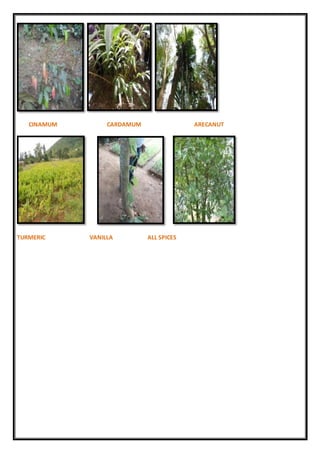
  • 42.
    MANOHARPUR AT AGLANCE Village Information: Name of village:Manoharpur Gram Panchayat:Medinipur Block: Bhawanipatna District: Kalahandi Land Use Pattern: Total Geographical Area: 240 acres Land Under Cultivation:200 acres Pasture Land:4 acres Area under paddy : 200 acre (Kharif) Area under sugarcane : 20 acre Area under banana : 5 acre Farmer’s Category: Land less:13 MarginalFarmer(< 1ha): 12 Small Farmer(1-2 ha): 20 Medium Farmer(2-4 ha):05 Larger Farmer(>4 ha):02 Literacy percentage (%): Total -60% Male -70% Female -50% Crops Grown: Paddy, sugar cane, wheat, Seasonal vegetables Soil: Sandy loam, clay loam soil Resources: Land, Trees, Pond, Tube well, Livestock, Poultry, dug well Demographic features:
  • 43.
    a. 52 families,30farm families and 22 non farm families. b. Total no of households:52, 50 kachha house and 2 pakka house. Enterprises: Farming, Dairy, Poultry, Goatery, Kitchen garden TRANSECT WALK VILLAGE: MANOHARPUR BLOCK: MEDINIPUR INTRODUCTION :- 1. A transect walk is a useful method for knowing rural ecological conditions. 2. A transect walk is a systematic walk along a defined path (transect) across the village area which is undertaken by the team along with the local people to explore the agro-ecosystem of the village and by observing, asking, listening, looking and producing a transect diagram. 3. A Transect depicts a cross-sectional view of the different agro-ecological zones and provides a comparative assessment of the Zones on different parameters. OBJECTIVES/PURPOSE:- 1. Appraisal of natural resources in terms of status, problems & potential. 2. To get an idea about farming practices, cropping pattern, the physical layout (existing or planned) ,irrigated facilities etc. 3. To know the agro ecosystem of the village. 4. To get the cross sectional view of the village. 5. Type of issue that might be covered in transect:- I. Food storage II. Community resource III. Difference in households and their assets IV. Credit sources V. Agriculture production and constraints VI. Livestock management VII. Health assets and hazards VIII. Water resource and hazards IX. Village infrastructure X. Land use pattern and seasonal variation XI. Livelihood strategies XII. Crops and other food production XIII. Gathered foods and medicines PROCEDURE:-
  • 44.
    BEFORE  We haveformed a group of 23 students including 7 no.s of willing villagers. The group includes 3 no.s of elderly and experienced villagers and the village youths.  Before commencement of the transect walk, we have explained briefly the purpose of the walk& selected the area under studyvillage resources likeirrigation sources, water catchment area, medicinal plants, land resources etc. DURING:-  We have observed everything in detail and listened carefully.  We have also asked & recorded everything what we saw and listened, sketched and drawn the maps.  We have walked up to the last boundary& covered all the relevant sides. AFTER:-  Carefully documented all the information collected by all team members.We have Prepared final diagrams and sketch from the rough sketches.We have cross checked and compared
  • 45.
    the information bymeeting other villagers & Recorded how things differ from one situation to another. CONCLUSION: Through transect walk, the productive resources identified are –paddy, sugarcane,banana,vegetables, water resources like tubewell, bore well, dug well, plant species like neem, mango, ber, livestock. The various unused resources are –fallow land at 2 places, a large pond & broken brick kiln. ACTION PLAN:  There is opportunity for bee keeping, mango plantation, sunflower& vegetable cultivation.  Large pond can be utilized for improved pisciculture.  Poultry& mushroom cultivation can be taken up by the farm woman in the back yard of household.  FACILITATORS: PARTICIPANTS:-  Group-2(RAWE 2013-14) Keshab Chandra Sa Abhiram Biswal, Subha Goud, Bhaskar Goudtia VILLAGE MAP OF manoharpur SOCIO RESOURCE MAPPING: -Development of a map of the village area to understand the village lay out showing main features like housing, temples, village watershed, forest, water bodies etc. This helps in studying social structure and availability of social facilities and also helps to establish the extent and location of these resources and to analyze and understand them better. OBJECTIVE: -Socio-resource maps have been used for depicting of various aspects related to  Topography, terrain and slopes  Forest, vegetation and tree species  Soil-type, fertility, erosion  Various facets of social reality, viz., social stratification, demographics, settlement patterns, social infrastructure, etc. and depth. PROCEDURE:-  We have selected a proper place for preparing a social map and explained the purpose of the exercise.  We guided them to use locally available material in a creative way and to make the map as representative as possible.  We have asked the participants to draw the boundaries of the village& a map of the village showing all households.  The farmers were asked to locate institutions, buildings and places that offer some kind of social service or popular spots to meet and discuss. Example: schools, temples, youth club, gram Panchayats, community leaders, local shop, health service,etc.
  • 46.
     At theend, We have asked them whether anybody would like to make any modifications or additions.  We have Copied the map onto a large sheet of paper with all details including legends. CONCLUSION: From the “VILLAGE MAP”, we have identified household of fifty two families. There are two templesat one place, of lord jagannath & lord shiva, and one mausi maa temple, three wells, four tubewells, one Panchayat pond,one anganawadi kendra,anda primaryschool inthe village. The PMGSY has made roads inside the village leadinga propercommunication.There isalsoatransformer,old brokenbrickkiln,&a unusedgobargas plant.There isa threshingfloor&a small shopin the village.The
  • 47.
    villagersfulfill theirirrigationneedsfromthe canalwhichflowsalongthe northside of the village fromthe Bhatangpadardam. The most importantresourcesare the irrigatedlandswhere paddyandsugarcane are beingcultivated. The villagersmostlydependsonthe forest resources tofulfill theirfuel needs. FACILITATORS:- PARTICIPANTS:- Group-2(RAWE 2013-14) Sudarsana Sa, Bhawani Shankar Sa, Anta Majhi, Laxman Gaud, Keshab Chandra Sa CROP MAP Crop map indicates the cropping area, cropping pattern of the village. Purpose:  By this map, we can be able to get the knowledge about the main crops, cropping systems, cropping pattern and cropping areas of the village.  We can also know the cultivated varieties of the different crops.  We can prepare an alternate action plan of the village.
  • 48.
    Conclusion:- From the abovecrop map we concluded that the majority of the cultivated area is under paddy cultivation. Sugarcane & banana is also grown in considerable area. Wheat & jute is grown in a small area. Some seasonal vegetables & fruit crops like mango & papaya are grown in backyard of their house. Action plan:-  Farmers should be encouraged to grow oilseed crops like sunflower, mustard & increase area under vegetable cultivation.  They should grow off season crops as that would be more profitable for them. FACILITATORS:- PARTICIPANTS:- Group-2(RAWE 2013-14) Dayanidhi Biswal, Kandarpa Bagh, Ramachandra Gaud, Prahalad Bagh, Dutia Gaud HYDROLOGICAL MAP Hydrological map indicates water resources, area under irrigation, irrigation facility and give idea about water harvesting structureof village. OBJECTIVE 1. To knowabout the variouswaterresourcespresentinthe village. 2. To knowabout the permanentwaterharvestingstructure of the village. 3. To knowabout the perennial waterresourcesof the village. 4. To knowaboutthe availabilityof waterindifferentpartsof the year. 5. Furtherit influencesthe croppingpatternandcropselectionandwateruse patternof the villagers. PROCEDURE:-  A proper place for preparing a hydrology map was selected and the purpose of the exercise was explained.  They wereencouraged to use locally available material in a creative way and to make the map as representative as possible.  The participants were asked to draw the various water resources on the map.
  • 49.
     The groupwas asked to show wells, tube wells and cannels, hand pump, shallow wells that offer some kind of irrigation and day to day water use pattern by the villagers.  At the end, they were asked whether anybody would like to make any modifications or additions.  The map was copied onto a large sheet of paper with all details including legends. Conclusion: From the hydrological map we came to know that tube wells & wells caters the domestic needs of people of the village where as Musanal canal is the major source of irrigation. The Panchayat pond with area 1.5acrecan be utilised for pisciculture.  Total irrigated area- 180acre  Total non irrigated area-20acre Facilitators: Participants: Group-2(RAWE-2013-14) Chintamani Gaud, Pana Majhi, Bagru Biswal, Byasa Biswal
  • 50.
    ENTERPRISEMAP VILLAGE-MANOHARPUR Enterprisemap is spatialanalysis of various productiveand unproductiveenterprises by the participant villagers.  To know the information on various enterprise and their relative positions within the village entity.  To identify existing and promising indigenous micro-enterprises with in the village.  To show the evolution of each major enterprise.  Served as the basis for identifying changes in the production systems. CONCLUSION:
  • 51.
    Fromthe enterprisemap, wefound that the major productiveenterprise of the village is jaggery production. Besides this other enterprises arepoultry, goatery & banana plantation. There are also unproductiveenterprises like brick kiln & biogas plant. ACTION PLAN: The enterprises like mushroomcultivation, fish cultivation, development of broiler unit can be taken up by the villagers from which they can generate income . FACILITATOR: PARTICIPANTS: Group-2(RAWE-2013-14) Shyama Bagh Nilambar Goud RameshBiswal ArjunBiswal TIME LINE OF VILLAGE MANOHARPUR DEFINITION:- A timeline is a list of key events, changes and landmarks in the past, presented in a chronologicalorder. OBJECTIVES:-  To learn fromthe community what they consider being important past events.  To understand fromthe community the historicalperspective on currentissues.  To generate discussions on changes with respectto issues you areinterested in e.g. education, health, food security, gender relations, economic conditions, etc.,  To develop a rapportwith the villagers, since a discussion aboutthe past of the village can be a good non-threatening and enjoyablestarting point. PROCESS BEFORE:-  Set the climate for a participatory discussion.  Encourageelderly people knowledgeable villagers to join the discussion as far as possible.  Carry sheets of paper and sketch pen.
  • 52.
    DURING :-  Initiatediscussion and ask questions to the older informants at first. Ask them to recapitulate the major events and changes that took place over the years. Ask some of them to write down in chronological order. Do not insist too much on specific year or date.  Record the information. AFTER:-  Compare the changes  Identify the trends. 1845- Village establishment 1850- Construction of Jaggannath Temple 1887-Digging of pond 1912-1st lift irrigation point 1940-Use of clock 1947-First dug well 1955-Use of bicycle 1958-Use of sugarcane crusher 1960-Establishment of primary school, use of conventional plough 1965-Use of pen, Establishment of Bhatangpadar dam, Incidence of flood, First pakka house 1970-Use of radio 1978-Drought incidence, Sheep rearing stopped 1980-1st tube well, Pisciculture started, Swarna variety cultivation, use of fertilizer 1985-Use of kerosene pump, Synthetic dress,1st shop, broiler cultivation, motorcycle, landline, tv 1990-Biogas unit, Banana plantation, Use of pesticide, Hand sprayer, Pakka road to Bhawanipatna 1995- Wheat cultivation, Indra awas yojana, Anganawadi establishment, Jersey cow rearing 2005- Rearing banaraj poultry bird, Mushroom cultivation, Vermicompost unit, MGNREGA, Shiva temple establishment, Use of thresher, Paddy harvester, Groundnut decorticater, Hybrid paddy cultivation 2008- SRI Method paddy cultivation, Paddy line sowing, First carpenter, First lady job holder
  • 53.
    2010- Use ofsprayer, Weeder, Refrigeretor, Cooler, Mobile, TATA sky 2011- Establishment of Transformer Facilitator- Participants- GROUP-II(RAWE-2013-14) Krushna Chandra Biswal Digambar Bagh Budu Majhi Trilochana Majhi Biswambhar Biswal VENN DIAGRAM OF manoharpur Definition: - The diagram which shows the relationship of various institutions, organizations, programs or individuals with each other & with the village as perceived by the villagers is called as Venn diagram. Purpose:-  To identify groups, institutes operating in the community & show their interactions.  To discover the importance on decision making in community.  To show the accessibility of the institutes. The exercise is carried out by the help of villagers with use of different sizes of circle of paper which indicates the relative importance or accessibility of a particular institution or individual to that particular village.  According to the opinion of villagers, various institutions those mostly influence them and their activity are – a) Primary school b) Primary Health Centre c) Kissan mandi d) Block office e) Gram panchayat f) Police station g) Bank h) Temple i) Post office j) Local market k) K.V.K. l) Veterinary office m) Anganwadi n) R.I. Office o) Youth club p) Co-operative store q) College
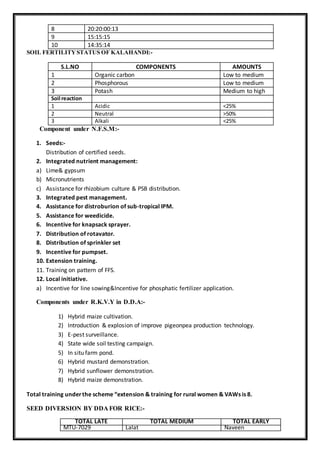
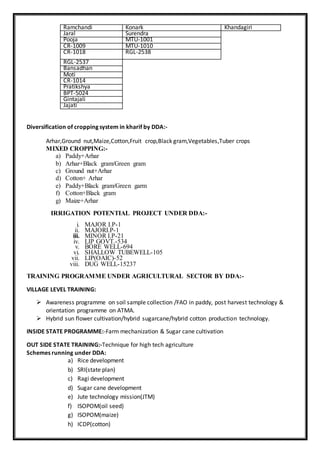
  • 54.
    r) District HealthCentre VENN DIAGRAM Village – Manoharpur G.P. – Medinipur Block– Bhawanipatna District - Kalahandi Village Manoharpur College Panchayat office R.I. office Tahsil office KVK Block office Kissan Mandi Market Post office Hospital PrimarySc hool Police station Temple Anganwadi
  • 55.
    CONCLUSION: From the abovediagram, we conclude the following. More important and more accessible institutions: - Primary school, Kissan mandi, Anganwadi, Panchayat office. More important and less accessible: - KVK, Block office, Market Moderate important and moderate accessible: -Tahsil office, Hospital, R.I. Office Moderate important and more accessibility: -Temsple Less important and less accessibility to Post office, College, Block office, Police station MOBILITY MAP OF VILLAGE Facilitators: Group-II(RAWE2013-14) Participants: Keshab ch. Sa, Byasadev Biswal, NilamberGoud,Arta Majhi, Bagru Biswal
  • 56.
    manoharpur  Mobility mapis a PRA method used to explore the movement pattern of an individual, a group, or the community.  The focus is on where people go and for what.  Other aspects, like the frequency of visits, distance, and the importance of the place visited, may also be studied and depicted.  It reflects the people’s perception of movement patterns and the reasons there of. OBJECTIVES:-  Understanding the mobility pattern of local people where they go and for what? Increasing gender sensitivity and awareness by using them for highlighting the difference between the mobility patterns of men and women.  Evaluation of the impact of certain interventions in terms of their effects on mobility patterns.  Planning for intervention and projects. INFORMATION ELICITED FROM THE MOBILITY MAP:- A. Places B. Purpose C. Direction D. Distance E. e. Mode F. f. frequency G. g. cost of transport to and from a village PROCESS:-  We have selected the person, group or community whose mobility pattern we are interested in understanding.  We have explained the purpose of the exercise and initiated a discussion on the places they visit & the places are listed down. As they close the list, we have asked them whether they would like to add some more or delete any of the places in the list.  We have asked them to write the name of the places on small pieces of paper in bold letters& encouraged them to depict the places using symbols or visuals, particularly if the participants are non literate.  We have drawn a circle in the middle of a paper or ground, representing the village/locality and asked them to locate the pieces of paper with the names of the places they visit around the circle in such a way that they are properly represented.  We have asked them to link the cards representing the places visited with the circle depicting their locality by lines & the thickness of the lines could represent a particular feature, such as, the frequency of the visits.  By following a similar process, for all other places that they visit done one by one.  Also encouraged them to represent other aspects in the form of visuals, symbols or in writing.  Brainstorm and arrive at the aspects which could be represented including. - Purpose of visiting the places
  • 57.
    - Importance ofthe places visited - Distance of the places - Mode of transport - Frequency of visits - Whether alone or with someone  We have asked them whether they would like to make any alterations once the diagramis ready&requested them to explain the map and their learning from it in detail.  We have clarified your doubts by asking probing questions.  We have listened carefully to their discussion and any necessary notes were taken.  The diagram was copied in detail & triangulated the diagram and other details generated during discussions with others in the locality. CONCLUSION:- The mobility map indicates that the villagers of Manoharpur mainly go to Bhawanipatna, Medinipur, Sujanpur, Laxmipur & Kanakpur for their requirements like marketing, communication, entertainment, medical facilities, study, banking etc. But Bhawanipatna seems to be the most frequent place of visit for their requirement. Facilitator: - Participants:- GROUP-2(RAWE2013-14) khage Goud Rita Biswal Arta Majhi
  • 58.
    Byasa Biswal ShyamaBagh SEASONALITY ANALYSIS VILLAGE:MANOHARPUR BLOCK: MEDINIPUR Seasonality is an important and useful exercise to determine seasonal patterns in rural areas as related to rainfall, farming practices, employment etc. In seasonality an attempt is made to determine the seasonal calendar as understood and practiced by the villagers. PURPOSE: To get an insight into the seasonal variations in a number of parameters relevant in farmer’s lives e.g. work, employment, income, and availability of food, fuel, fodders, health, migration and transport facilities.
  • 59.
    SEASONAL DIAGRAM OFMANOHARPUR VILLAGE FACILITATORS:- PARTICIPANTS:- Group-2(RAWE2013-14) Nilambar Biswal, Kirtan Biswal, Chintamani Goud, Rajeswar Bagh,
  • 60.
    SEASONAL DIAGRAM CONCLUSION The seasonaldiagramreveals that they are doing cultivation round the year but kharif season is the busiest time in the life of farmers .Their major crops are paddy & sugarcane. Action plan: They can go for sunflower cultivation.
  • 61.
    FACILITATORS:- PARTICIPANTS:- Group-2(RAWE2013-14) NilambarBiswal, Kirtan Biswal, Chintamani Goud, Rajeswar Bagh, SEASONAL DIAGRAM OF MANOHARPUR VILLAGE SL. NO PARAMETERS JAN FE B MAR APR MAY JUN JUL AUG SEP OCT NOV DEC 1 Rainfall 2 _ 1 _ 9 10 10 9 8 6 6 4 2 Rice cultivation 5 1 2 3 1 10 10 9 8 7 8 7 3 Fodder availability 9 8 3 2 1 2 4 4 6 9 10 10 4 vegetable availability 10 8 6 6 4 2 4 6 7 9 8 10 5 Fruit availability 5 3 8 10 10 9 8 5 2 3 1 4 6 Pest and Disease of rice 8 4 5 1 1 9 10 10 9 6 5 7 7 Pest and Disease of vegetable 8 6 5 1 1 9 10 10 7 8 8 8 8 Cattle disease 3 1 2 1 1 7 10 10 9 8 5 4 9 Poultry disease 5 4 3 7 7 6 8 9 10 10 7 6 10 Goat disease 8 7 _ 1 _ 8 9 10 9 7 7 9 11 Human disease 4 2 3 1 2 10 10 10 8 7 7 5 12 Male engagement 8 7 6 5 4 10 10 9 8 9 10 10 13 Female engagement 8 7 6 3 2 10 10 9 8 7 9 10 14 Migration 8 5 3 _ _ _ _ 1 2 3 2 1 15 Monthly income 10 8 7 3 8 8 7 9 8 7 10 10 RATING: Highest score=10 Lowest score=1
  • 62.
    SEASONALITY MAP OFCROPS :- SEASONALITY MAP OF VEGETABLES :- 0 1 2 3 4 5 6 7 8 9 10 VEGETABLE AVAILABILITY FRUIT AVAILABILITY FODDER AVAILABILITY 0 2 4 6 8 10 12 JAN FEB MAR APR MAY JUN JUL AUG SEP OCT NOV DEC RICE BANANA SUGARCANE
  • 63.
    SEASONALITY OF MALE& FEMALE ENGAGEMENT:- MATRIX RANKING: VILLAGE: MANOHARPUR BLOCK: BHAWANIPATANA  Helps in understanding people’s choices and priorities in a particular situation and their reasons for it  Helps in determining the compatibility of certain items in a given environment of overall perspective PROCEDURE:-  We identified the topic then a discussion was initiated with the individuals or group and clearly explained them the purpose of the exercise.  In next step we generated criteria for assessment and discussed them with the participants and decided upon a few important ones.  Then we sketched a matrix with the items/options top to bottom and criteria left to right. The comparisons are made criterion-wise and not item-wise.  Then, we ranked and scored against all the items according to the criterion had been chosen.  Then it was repeated until all of the criteria have been ranked and scored in this way.  Then these are recorded properly. 0 2 4 6 8 10 12 JAN FEB MAR APR MAY JUN JUL AUG SEP OCT NOV DEC MALE ENGAGEMENT FEMALE ENGAGEMENT
  • 64.
    MATRIX RANKING FORRICE VARIETY CONCLUSION:-  Matrix ranking of paddy variety shows that SWARNA variety is the most popular paddy variety due to its yield, cooking quality and market demand in spite of more disease pest attack.  Use of chemical pesticide with bio-pesticide to check disease & pest.  A new high yielding variety Ranidhan may be suggested to the farmers. MATRIX RANKING OF VEGETABLES Vegetables/ parameters Tomato Okra Ridgegourd Bean Cowpea Chilli Cucumber Profit €€€€€€€€ €€€€€€ €€€ €€€€€€ €€€ €€€€ €€€€€ Market demand ###### #### #### ##### ### #### ##### Domestic demand £££££ £££££ ££££ ££ ££ ££££ ££££ Total 19 15 11 13 8 12 14 Rank 1st 2nd 6th 4th 7th 5th 3rd CONCLUSION:-  Matrix ranking of vegetables shows that tomato followed by okra is preferred by the farmers, but they grow it only in back-yard not in a large scale.  Demonstration must be carried on for large scale cultivation of popular varieties of tomato & other marketable vegetables. PARAMETERS PRATIKHYA KONARK POOJA LALAT SWARNA KHANDAGIRI YIELD @@@@@@@ @@@@ @@@ @@@@@ @@ @@@@@@ @@@@ @@@@@@ INSECT PEST TOLERANCE ## ###### ##### ### # ##### MARKETABILITY $$$$$$$ $$$$$ $$$ $$$$$$$ $ $$$$$$$$$ $$$$$$ COOKING QUALITY ********* ****** ******* * ****** ********** ******** DISEASE RESISTANCE ©©©©© ©©©©© © ©©©© ©©©© ©© © ©©©©©©© PARBOILED RICE ◊◊◊◊◊ ◊◊◊◊◊ ◊◊◊◊◊◊◊ ◊◊◊◊◊◊◊ ◊ ◊◊◊◊◊◊◊◊◊ ◊ ◊◊◊◊ PROCESSED PRODUCT ҉҉ ҉҉҉҉ ҉ ҉҉҉ ҉҉҉҉ ҉҉҉҉ ҉ ҉҉҉҉҉ ҉ ҉҉҉҉҉ STORAGE ƱƱƱƱƱƱ ƱƱ ƱƱƱ ƱƱƱƱ ƱƱƱƱƱƱƱ Ʊ ƱƱƱƱƱ TOTAL 36 34 32 44 45 39 RANKING 4th 5th 6th 2nd 1st 3rd
  • 65.
    Facilitator-Participants- GROUP-II(RAWE-2013-14) Krushna ChandraBiswal Digambar Bagh Budu Majhi Trilochana Majhi Biswambhar Biswal FARMING SYSTEM ANALYSIS OF MANOHARPUR FARMING SYSTEM: Itrepresentan appropriatecombination of farmenterprises viz. cropping system, livestock, poultry, fisheries, forestry & the means available to the farmer to raise them for increasing profitability. Farming Component No. of Families Agriculture 25 Agriculture+ Animal husbandry 11 Agriculture+ Labour 9 Agriculture. + Animalhusbandry + Horticulture 7 Total = 52
  • 66.
    COMPONENT:- Agriculture: Paddy (Kharif& Summer) Wheat, Jute, Sugarcane, Pulses (Rabi) Horticulture:Vegetable (Okra, tomato, ridge gourd, brinjal) Fruits (mango, banana, guava) Animal husbandry:-Dairy (Improved crossbreeds & desi) Goatery (Desi) Poultry (Desi) CONCLUSION:- In the village Manoharpur there is existence of three type of farming system. Out of total farm families 48% are solely depending upon agriculture as source of income. This is followed by 21% families depends both on Agriculture and wage earning. Only 7 farm families adopt Agriculture, horticulture and animal husbandry components for their income. Agriculture [] Agriculture.+Animal husbandry.. [] Agricult.+Labour [] Agriculture.+Animal hasbandry. +Horticulture [] PIE CHART OF FARMING SYSTEM
  • 67.
    FACILITATORS:- PARTICIPANTS:- GROUP-III CHINTAMAJHI (26B/10-48B/10) RAMESH CH. BISWAL BHASKARGADTIYA FARMING COMPONENT ANALYSIS OF MANOHARPUR VILLAGE INTRODUCTION: The analysis based on individual farm component which is involved in the farming system is known as farming component analysis .With the help of this tool we can know what are the crops grown in that village, what are the varieties of respective crops, breeds of animals and the economics of their production. FARMING COMPONENT VARIETY/ BREED AREA (ACRE) EXPENDITURE (Rs/acre or unit) INCOME (Rs/acre or unit) PROFIT (Rs/acre or unit) B:C RATIO RICE SWARNA, POOJA, LALAT, KONARK, RAMBHA, BASMATI 200 9,730 31,250 21,520 3.21 : 1 SUGARCANE CO 6200 20 20,000 1,00,000 80,000 5.0 : 1 WHEAT SAGARIKA, SONALIKA 10 4,500 11,800 7,300 2.62 : 1 OKRA ARKA ANAMIKA & DESI 3 3,500 8,000 4,500 2.28 : 1 BANANA GRAND NAINE 5 35,000 1,50,000 1,15,000 4.28 : 1 DAIRY JERSEY 4 No. 18,000 72,000 54,000 4.0 : 1 DESI 50 No. 10,000 36,000 26,000 3.6 : 1 POULTRY DESI 200- 250 No. __ 80 80 __ GOATERY DESI 50-60 No. 500 3,000 2,500 6.0 : 1 CONCLUSION: From the above analysis we have concluded that the area under cultivation of paddy is highest in that village among other crop components. The major varieties of Rice grown are SWARNA, LALAT, POOJA, KONARK, RAMBHA, BASMATI. The Benefit and Cost ratio is highest in Goatery followed by Sugarcane & Banana. Higher income & profit is generated through Banana cultivation. Lowest income is generated in Okra cultivation due to frequent
  • 68.
    disease pest attack.Farmers are mainly rearing Desi breeds of cow, goat and poultry birds which gives them low profit. FACILITATORS:- PARTICIPANTS:- GROUP-II Kandarp Gaur (26B/10-48B/10) Nilambar Biswal Dutiya Gaur Trilochan Majhi Trend analysis of VILLAGE manoharpur Trend analysis is a popular PRA method used to explore temporal dimensions with a focus on change. It captures and trends related to certain variables over different spans of time.  It can provide a good idea of the quantitative changes over time in different aspects of village life, such as yields, population, livestock population, the number of trees, area under cultivation, rainfall, etc. Procedure:  We have explained to the villagers about the purpose of the exercise& discussed on the present situation and set the climate for trend analysis.  We have encouraged the local people to depict interested aspects for trend analysis& facilitated the discussion further to arrive at the aspects of trend analysis.  Also facilitated the selection of time landmarks across which the trends could be studied. Encouraged the participants to depict the selected landmark years on cards preferably by symbols of visuals and so on.  We have asked participants to make the matrix on the ground, using chalk &to represent from left to right the landmark years and from top to bottom various aspects like density of trees, grass, wild animals, etc.,  We have allowed the participants to use different symbols in the relevant cell like visuals, seeds, sticks, sand, etc., according to their choice. Objectives:-  Learn from the community as to how they perceive change over time in various areas/aspects of their live.  Integrate significant changes in the village profile.  Discuss village problems and any increase or decrease in the severity of the problems over the years rather that asking direct questions.
  • 69.
    Trend analysis ofmanoharpur CONCLUSION:- We concluded that villagers have started taking enterprises like poultry, & vegetable along with paddy cultivation, which improves socio-economic status of the Villagers. No of school going children have also increased which shows that they have started giving importance to education. The trend shows that there is constant increase in fertilizer consumption which contributed increase in yield. There is continuous increase in labour migration may be due to high wage rate outside the village. The cultivated land area is seen to decrease due to increase in population and increase in household area. Facilitator: - Participants:- GROUP-2 (RAWE 2013-14) Gagan Biswal Janahavi Biswal
  • 70.
    Sarat Biswal DAILY WORKPROFILE VILLAGE: MANOHARPUR BLOCK: MEDINIPUR Daily routine depicts how villagers (men and women) spend a day of 24 hours along with the kind of activities and time allotted for the activities .Daily routine can be taken for men and women and both the categories of farmers and farm labourers. PURPOSE:  To get an account of time spent by farmers and labourers, men and women for various activities in day of 24 hours.  Data on wage earning, rest and recreation hours.  Data on leisure time which can be utilized by development workers. DAILY WORK PROFILE OF WOMEN REST AND LEISURE:(8 Hours) 1PM-2.30PM =REST 10PM-4AM=SLEEPING 5.30PM-6PM=SOCIAL GATHERING FARMING ACTIVITY: (5.30 Hours) 8.30AM-12PM=CROP CULTIVATION 2.30PM-4PM=FIELD ACTIVITY REST &LEISURE, 33.3% FARMING ACTIVITY, 22.91% HOUSEHOLD WORK, 20.83% PERSONAL CARE, 16.67% LIVESTOCK ACTIVITY, 6.25%
  • 71.
    HOUSEHOLD WORK: (5Hours) 6AM-7.30AM=PREPARATION OF BREAKFAST & OFFERING PRAYER 7.30AM-9.30AM=COOKING(LUNCH) 6PM-7.30PM=COOKING(DINNER) PERSONAL CARE: (4 Hours) 5AM-6AM = MORNING ACTIVITY 7AM-7.30AM=BREAKFAST 12PM-12.30PM=LUNCH 5PM-5.30PM=EVENING TEA & SNACKS 8PM-8.30PM=DINNER 9PM-10PM =WATCHING TV LIVESTOCK ACTIVITIES: (1.30 Hours) 4AM-5AM=TAKING CARE OF LIVESTOCK 4.30PM-5PM=TAKING CARE OF LIVESTOCK
  • 72.
    CONCLUSION: The daily workprofile of farm women shows that they contribute most of their time for caring their family members & farm activities. So they are facing a lot of drudgery during their day to day activities. Their contribution towards income is very negligible. ACTION PLAN: The farm women can be trained properly to take up enterprises like mushroom cultivation, making of papad, pickles,etc by forming SHG groups & also take up backyard poultry by rearing Banaraja for additional income. FACILITATORS:- PARTICIPANTS:- Group-2(RAWE2013-14) Kuntala Biswal Rita Biswal Janani Biswal Janhavi Biswal Rajani Goud DAILY WORK PROFILE OF MEN REST &LEISURE: (10.30 Hours) 1PM-2PM =TAKING REST 8PM- 8.30 PM= SOCIAL GATHERING 8.30PM- 9.30 PM= TV, FAMILY INTERACTION 10.00PM - 6.00PM =SLEEPING FARMING ACTIVITY:(7 Hours) 8AM-12PM= CROP PRODUCTION 2PM-5PM= FIELD ACTIVITY PERSONAL CARE: (3.30 Hours) Rest & Leisure, 43.75% FarmingActivity, 29.16% Personal Care, 14.5% Household Activity, 8.33% livestock Activity, 4.16%
  • 73.
    6AM-7AM= MORNING ACTIVITY 7.30AM-8AM=BREAKFAST 12PM-1PM= LUNCH 6PM-6.30PM=EVENING TEA &SNACKS 9.30PM-10PM=DINNER HOUSEHOLD ACTIVITY: (2 Hours) 6.30PM-7.30PM=MARKETING 5PM-6PM=COLLECTION OF FOREST MATERIAL LIVESTOCK ACTIVITY: (1 Hour) 7AM-7.30AM=CARE OF LIVESTOCK 7.30PM-8PM=TAKING MILK TO OMFED CONCLUSION:
  • 74.
    The daily workprofile of male shows that the men spend most of their time in rest and leisure followed by farming activities. ACTION PLAN: The farmers in particular the rural youths can be encouraged to take up enterprises like poultry farming, pisciculture, goatery, vermicomposting, bee keeping, and mushroomcultivation by reducing their leisure time FACILITATORS: - PARTICIPANTS:- Group-2(RAWE2013-14) Dayanidhi Biswal Kandarp Bag Ramachandra Goud Dutia Gour Wealth Ranking It is a technique to find out how people fromthe village itself would rank the different families as rich, poor & very poor. Wealth ranking refers to placing people on the different steps of the social ladder according to their own criteria. The purposehere is to find out the people of the village who belong to richest, middle income and poorestcategories as perceived by the villagers themselves. Agriculturaldevelopment musttake in to account differences in wealth among farmers in order to determine priorities for research and to develop interventions and technical packages that are relevant to and adoptable by majority of the farmers. By using wealth ranking revealed that morefocus needs to be given for enhancing productivity of farms of the poor and very poor through more profitable and effective technologies. PROCESS: Step1: we have collected the list of all households fromthe village panchayatoffice. Then we have cross checked by having a transactwalk along with key informants of the village to ensurethat all households were given numbers in same formor other. The name of the head of each household to be written against each housenumber. Step2: after collection of name of the head of each household were written in each piece paper separately. Step3: Then we asked the key informant to sortout the various piece of into different wealth categories as they think were presentin the village .
  • 75.
    Step4:Then weprepared atable on paper & recorded the responseof the key informants. Step5: after sorting by the key informants than we asked them to list out the wealth criteria for each wealth category like land holding, income, housetype, transportetc and the difference between the categories. Criteria for Wealthranking
  • 76.
    Category No. offamilies Very rich: Land: More than 10 acres. Income:More than Rs.20,000 permonth House: Pucca house Livestock:6 Income and yield: Surplusinboth Implements:powertiller,thresher,sprayer Material possession:TV,refrigerator,mobile Source of Income:Farming,buissness,service Landing ability:More 2 Rich: Land: 8-10 acres. Income: BetweenRs.15,000–Rs.20000 permonth House:Pucca&tile house Livestock:8 Income and yield: Lessthan veryrich Implements:Powertiller,thresher Material possession:TV,mobile Source of income:Farming,business Landing ability:less 5 Medium: Land: 5-8 acres Income: About 8,000 per month House: Tile &khapparhouse Livestock: 4-5 Income and yield: Sufficient Implements: sprayer Material possession:mobile Source of income:Farming Landing ability:Sufficient 17 Poor : Land: Lessthan 5 acre. Income: Around5,000 permonth House: Kaccha house Livestock:8 – 9(Goats) Income and yield: Notsufficient Implements:No Material possession:Mobile Source of Income:farming, wage earning Landing ability:No 15 Very poor : Land: Landless,tenantfarmer&wage earner Income: LessthanRs.3000 permonth House:Kacchahouse Livestock: 3 – 4 (Goats) Income and yield: Lendingfromothers Implements:No Material possession:No Source of income : wage earning Landing ability: no 13
  • 77.
    CONCLUSION : Majority ofthe families belong to the medium (32.7%) followed by poor category(26.47%). . Accordingly anti-Poverty Programme should be implemented in the village, to improve the qualitative life of the people. RESOURCE INFLOW & OUTFLOW OF manoharpur VILLAGE The resource flow diagram is a schematic drawing of the resource inflow into the village and resource out flow from the village. The diagram shows the flow of resources from the original source to the final output and visualizes the use and control of the resources. 3.85 9.6 32.7 28.85 23.52 % family Very rich Rich Medium poor Very poor VILLAGE- MANOHARPUR GRAM PANCHAYAT – MEDINIPUR BLOCK- BHAWANIPATNA
  • 78.
    INFLOWOUTFLOW CONCLUSION:- Resource inflow &outflow of Manoharpur village indicates that the seeds mainly vegetables, paddy; pesticide, implement, tissue culture banana , etc. are procured from outside of the village. For Medicine & grocery they have to depend on Bhawanipatna market. M A N O H A R P U R AA 1. Seeds 11.Electricity 12.Fish, Goat 10.Tissue Culture(Banana) ( 9.Power thresher 8.Fertiliser 7.Tractor 6.Medicine s 5.Implements 4.Capital(loan) 3.Labour 2.Pesticides 13.Clothes 14.Grocery 10.Wheat 9.Papaya 8.Banana 7.Milk(cow) 90() 6.Vegetable 5.Cotton 4.Jaggery 3.Labour 2.Sugarcane 1.Rice 15.FYM
  • 79.
    The villagers gettheir income by selling their produce like cotton, paddy, vegetable,banana, milk, jaggery,etc. to the consumers/ traders in the nearby market. Most of the wage labourers migrated to nearby villages & town to get their income. FACILITATORS:- PARTICIPANTS:- Group-2(RAWE2013-14) Abhiram Biswal, Subha Goud, Bhaskar Goudtia, INDIGENOUS TECHNICAL KNOWLEDGE VILLAGE-MANOHARPUR GRAMPANCHAYAT-MEDINIPUR BLOCK-BHAWANIPATNA FOR CROP:- 1.Gundhibug(Leptocorsia acuta) in rice can be controlled by mixing cow urine with kerosene and husk and then sprayed in field. 2. Jota is used for crushing the blackgram and greengram. 3.Kurlu(made up of wooden piece and stick)is used for heaping rice grains.
  • 80.
    4.Thupi and Bisarare used in fishing. 5.Tenda is used for lifting the water and irrigating the field. 6.Danga (wooden tray)is used for cooling the freshly cooked jaggery(gur). 7.For protecting the sunflower crop from parrots ,tin drums are used. 8.Pualdanti(made up of wood)is used for removing the clods and leveling the field. 9. Dry Neem and Karang leaves are used for safe storage of rice.
  • 81.
    10.Bullock cart isused for transporting and bringing the harvested crop. 11.For storing Rice,structure like Puduga is used. FOR ANIMAL:- 1.For curing the livestock wound Custard apple leaf paste is used. 2. Kerosene is used for preventing ticks in cattle. 3.For controlling Fatua disease in cattle Mehendi leaves are used. FOR HUMAN:- 1.Gangasiuli(Nyctanthes arbortis) leaves are used for curing fever and cold. 2.Lajakuli(Mimosa pudica)roots are used for curing fever. 3.For wound treatment Apamaranga(Acyranthes aspera) paste is used. 4. For snake bite curing Badichang seeds are used. 5.For curing scorpion bite Chakunda leaves paste is used. 6.For curing body pain Mustard oil and Sesamum oil are used. 7.For controlling chickenpox,Jhuna,Neem leaves and Haldi are used. FACILITATORSPARTICIPANTS Group-II Nirmal Gadtiya (Adm.no.26B/10-48B/10) Didtiya Goud Mahendra Majhi Mantu Sa
  • 82.
    Problem Prioritization It isa chart showing different problems affecting a village which have been prioritized on the basis of ranks that each of them obtain after taking into account parameters like problems, importance of enterprise, frequency of problem, seriousness of each of the problems. PROCESS:- The main problems were prioritized by discussing with the villagers. The problems are listed the importance of enterprise, seriousness of problem were given score according to the villagers information. Then the score given to each parameter were added and the total score was calculated. According to the total score the problems were prioritized & ranked. SL. NO PROBLEM IMPORTANCE OF ENTERPRISE FREQUENCY OF PROBLEM SERIOUSNESS OF PROBLEM TOTAL SCORE RANK 1 Sheath blight attack in Rice 8 9 9 26 I 2 Gundhi bug attack in Rice 8 8 9 25 II 3 Non availability of quality planting material in Sugarcane 7 9 7 23 IV 4 Non availability of quality planting material in Banana 7 8 6 21 VI 5 Sigatoka & panama wilt in Banana 7 8 8 23 IV 6 YMV in Okra 6 7 7 20 VII 7 Leaf curl in Tomato 7 8 7 22 V 8 Deterioation of soil fertility 8 8 8 24 III 9 High labour cost 8 6 5 19 VIII 10 Less marketing of Vegetables 8 6 5 19 VIII 11 Lack of storage facilitry 6 5 4 15 X 12 Inadequate nutrient management 6 4 5 15 X 13 Lack of knowledge about HYV wheat cultivation 7 5 6 18 IX 14 Shoot & fruit borer in Brinjal 7 8 9 24 III 15 Low income of Farm women 7 5 3 15 X SCALE-1-10
  • 83.
    Conclusion:- From the tablebelow we concluded that sheath blight in rice ranks first, gundhi bug attack in rice ranks second, deteriotion of soil fertility & fruit and shot borer attack in brinjal ranks third. FACILITATOR- PARTICIPANTS- GROUP-2 Aditya Sa Byasadev Biswal Chintamani Bagh Bhaskar Gaudtiya Arta Majhi Kesab Chandra Sa ACTION PLAN FOR MANOHARPUR VILLAGE SL. NO. ENTERPRIZE PROBLEM IDENTIFIED ACTION TO BE TAKEN TO BE CARRIED OUT BY LINKAGE YEAR 1. Rice (Low yield in paddy) a. Infestation of sheath blight & BLB IDM in paddy to control sheath blight & Training/ Demonstration KVK 1st b. Incidence of stem borer & gundhi bug IPM in paddy Training/ Demonstration KVK/AT MA 1st c. Improper nutrient management in paddy INM in paddy FLD/ Training KVK 2nd d. Unavailability of new hybrid Introduction of HYV of paddy (Ranidhan) with OFT/ Training KVK 3rd
  • 84.
    paddy variety propermanagement & practice e. Sevier weed infestation IWM in paddy Training/Demo stration KVK/AT MA 3rd 2. Sugarcane(Lo w yield in sugarcane) a. Non availability of quality planting material Introduction of QPM for sugarcane with proper management practice Training/ Demonstration KVK/AT MA 1st b. Lack of technical knowledge Improved method of sugarcane cultivation Training KVK 2nd c. High incidence of sugarcane borer IPM in sugarcane Demonstration KVK/ ATMA 3rd d. Infestation of red rot of sugarcane IDM in sugarcane Demonstration KVK/ ATMA 3rd e. Improper ratoon management Management of ratooning Training KVK/ ATMA 2nd 3. Wheat (Low yield in wheat ) a. Inadequate nutrient management INM in wheat Training/ Demonstration KVK/ ATMA 2nd b. Lack of technical knowledge Introduction of new management practices Training KVK/ ATMA 1st c. Improper disease management IDM in wheat Training/ Demonstration KVK/ ATMA 2nd d. Unavailability of high yielding wheat variety Introduction of high yielding variety (Sonalika) FLD KVK 3rd 4. Okra (Low yielding okra) a. Incidence of YMV IDM in okra FLD/ Demonstration ATMA /KVK 1st b. Incidence of sucking pest and fruit borer in okra IPM Training/ Demonstration KVK 2nd c. Indiscri inate use of pesticides Improved management practices Training/ Demonstration KVK 3rd 5. Pisciculture a. Unavailability of yearlings in proper time Demonstration for yearling production Training/ Demonstration KVK/DOF 1st b. Lack of technical knowledge on Training on pisciculture technique Training/ Demonstration KVK/DOF 2nd
  • 85.
    TRAINING AND DEMONSTRATION Cultivationof SUMMER RICE The mainobjective of summerrice istoincrease the fertilityof soil & productionof rice afterkharif paddy. Generally,the fieldremainsfallowafterkharif rice,sothe fieldshouldbe properlyusedsothatthe production, fertilityof soil,andincome canbe increased. SEED:-Dependingonthe soil type,climaticcondition,insects&pestsattack,thesuitable varietyshouldbe selected.About30kgseedisrequiredfor1acre of land. EARLY VARIETY MEDIUM VARIETY LATE VARIETY Parijata(90 Days) Lalat (125Days) Swarna(140Days) pisciculture c. High cost of fish feeding Fish feed production technology Training/ Demonstration KVK/DOF 3rd 6. Low soil fertility a. Less availability of compost Composting technique about vermicomposting and NADEP Training/ Demonstration KVK 1st b. Inadequate nutrient management in crops INM technique Training/ Demonstration ATMA/K VK 2nd 7. Women labour Drudgery of women during agricultural operation Mushroom cultivation, Rearing of Banaraj poultry bird ,Making of Badi, Pampad, Baby foods like Chhatua, Chuda powder, Preparation of Doll, Toys by rural women Training/ Demonstration KVK/DO A/DIC 2nd 8. Rural youth Unemployment of rural youth Establishment of agro- service centre for farm mechanization, Off season raising of vegetable seedlings in polyhouse, Mushroom spawn production, Poultry, Goatery, Vocational Training on mushroom, Vocational training on poultry rearing. Training/ Demonstration KVK/DO A/DOV 2nd
  • 86.
    Khandagiri Konarka Padmini UdayagiriSurendra To remove the chaffymaterialsfromthe seed,165gmsalt solutionismade in1.0 lt of water.The floatingseedandchaffymaterial isremovedfromthe solution&thenseedshouldbe cleanedproperlywith freshwater.Thenthe seedissoakedinhot water forthe 2 hours& putin the polythene orwetgunnybag,so that the seedscanbe germinate quickly NURSERY BED PREPARATION:-400m2 isrequiredtoraise the seedlingfor1acre of land.The nurseryarea shouldbe properlycleaned&the soil shouldbe ploughedtoafine tilth.For400m2 nurserybed,about40 basket FYM, 12kg SSP,2kg MOP shouldbe appliedduringpreparationof field&mixedproperly.Thenthe pre germinatedseedissowninthe nursery. CARE OF NURSERY BED:-The nurseryshouldbe keptwet afterinitial periodof sowing.Whenthe seedlings germinate toa heightof 2inches,the fieldshouldbe providedwithstandingwater.After15 Days 4Kg urea shouldbe appliedin400m2 area.To preventfrominsectpest,the nurseryshouldbe appliedwith120gm Carbofuran& 600gm Phorate before 1 weekof transplanting. FIELD PREPARATION- The landshouldbe properlylabeled.Puddlingshouldbe done before 2-3weeksof transplanting.About2tonnesof FYM,23 kg P2O5,15 kg K2Oand 12kg N shouldbe appliedin soil andlabeled properly. TRANSPLANTING-Transplantingshouldbe completedwithin2nd weekof January.Seedlingshaving4-5leaves aregoodfor transplanting. INTERCULTURAL OPERATION:-2-3weedingcanbe done inbroadcastingmethodand2 weedingin transplantingmethodrespectively.About24 kg of N shouldbe appliedafterweeding.Againabout12kg of N shouldbe appliedafter2weeksof previousapplication. IRRIGATION-Thoughrice needsmore water,about80-140 cm wateringshouldbe done.The critical stages for irrigationinsummerrice are tillering,panicleinitiationandmilkingstage.Atthese stagesirrigationshouldbe done.
  • 87.
    PESTS AND DISEASES-Theimportantpestsare stemborer,blackheadedcaterpillar,suckingpestslike hoppers,leaf foldersandgall midge.The importantdiseasesare blast,sheathrot,BLB,BLS, tungro,white tip, ufra. Control-about12 kg Carbofurancan be appliedforcontrol of stemborer,for control of suckingpestsand hoppersabout400ml Chloropyriphosand800ml Carbaryl can be applied.Forcontrol of fungal diseaseslike blast,sheathrot about300g Carbendazimcanbe applied. HARVESTING:-Harvestingshouldbe done when80% of panicle areripened.Forstorage the grainsshouldbe driedundersunlighttokeepgrainmoisture atabout lessthan12%. So that itremainsoutof pestattack and the germinatingpowerwillnothampered. YIELD:-About25-30 q of rice can be obtainedfromanacre of land Pheromone trap “A pheromone trap is a device used to attract opposite sex of organisms particularly the lepidopteran insect moths. In pheromone trap pheromone lure is used to attract the male moths. What is a pheromone trap? A pheromone trap consists of:  A Funnel with cover  Funnel having a handle,one ring and long plasticbag.  Below the cover there is place to fix the lure.
  • 88.
     Cover caneasily fit into the funnel.  The funnel is attached with a long polythene bag with opening at the other end.  After fixing the lure the trap unit is installed with the help of a 8-10 ft long straight bamboo pole inside the crop field.  The open end of the polythene tied with either by rubber band thread.  The lures should be changed in every 20 days interval.  The pheromone trap is installed for monitoring of the insect activity as well as for mass trapping of the male moths. When and how to use pheromone trap?  Pheromone trap installation in the field should be initiated depending upon the infestation of different insect species at different growth stagesof crops.  Pheromone lures are host specific i.e, only a particular species is attracted to the lure used in the trap.  The traps should be placed in the field 5m inside the border row and 40m apart.  For oneacrethere is requirement of 2 pheromone traps for monitoring and at least 8 traps for mass trapping .  The height of pheromone trap should 30 cm above the height of plant.The height should be increased according to the growth of the plant.
  • 89.
    ADVANTAGE:  Pheromones arespecies specific have no hazard to non-target population and natural enemies.  Minute quantities are needed to attract and kill large number of insects ,so they are economical(0.01 microgram attract 1 billion males)  They are non-pollutant and ecologically acceptable.  Easy means to monitor the buildup of pest population. DISADVANTAGE:  Pheromones for all the pest are not yet know.  Pheromones can attract one sex,the other sex could still be there to do the damage. Quick results cannot be obtained with pheromones and hence they are not suitable as short term control measures. Female sex pheromone identified in the insects: SL NO. NAME OF THE INSECT PHEROMONE 1 Silkworm, Bombyx mori Bombykol 2 Gypsy moth, Porthesia dispar Gyplure, disparlure 3 Pink bollworm, Pectinophora gossypiella Gossyplure 4 Cabbage looper, Trichoplusia ni Looplure 5 Tabbaco cutworm, Spodoptera litura Spodolure, litlure 6 Gram pod borer, Helicoverpa armigera Helilure 7 Honey bee queen, Apis spp Queen’s substance 8 Cotton boll weevil, Anthonomus grandis Grandlure
  • 90.
    KITCHEN GARDEN INTRODUCTION: It isa type of garden where the vegetables and short duration fruit crops are grown in backyard of the residential building to meet the requirement of family round the year. For a human being per capita consumption of vegetables per day is 400gm.In Odisha although many peoples take fish and meat in their diet they should take at least 250-300gm fresh vegetables. So to meet quality fresh vegetables it is adviced to grow vegetables in the backyard of their buildings. This practice is known as kitchen garden. IMPORTANCE:  It helps in supply fresh vegetables.  BY working in garden their health remains good.  It helps in lowering down the vegetable cost of the family.  It provides more or less continous supply of vegetables throughout the year according to their season.  It provides family daily with fresh vegetable rich in nutrient and energy.  Vegetables grown in the kitchen garden are free from insecticides and pesticides pollution.  The unused materials viz. kitchen left over and water can be efficiently used. PROCEDURE: The people who should grow the garden have a good knowledge about the garden other wise they should gain some knowledge about that. They must have knowledge about Seasonal cropping, mixed cropping, cropping pattern, crop calendar, seed sowing, seed transplanting, irrigation, fertilizer and application of insecticides and harvesting. The size of the kitchen garden depends upon the availability of land, the no of person for whom vegetables to be grow. For maintaining the demand of a 5-6 members of a family 200mm2 area is sufficient. For protecting the garden from cattles, goats and sheeps. So fencing is best for this purpose. Following rules to be obeyed for good kitchen garden:  For gardening the larger plot should be divided in to small plots. The plot should be of 3.5-2.5m.Drainage channel should be designed between each 2 plot for irrigation.  The field does not remain fallow in any time of the year.  Short duration crops like guava, pappya, drumstick are planted in backyard of the house.  Crops like pumpkin, ridge gourd, cucumber are grown in corner of the garden.  Mostly used vegetables are given more emphasis.  Vegetables are grown in line and the distance should less than general growing pattern .  Vegetables are grown in succession cropping.
  • 91.
     Cropping patternshould be maintained.  Due to intensive farming fertilizer requirement is more.  In kitchen garden different types of vegetables mostly hybrid seeds are used.  The waste materials of the house should be composted in a compost pit . Vermi composting also done.  Generally organic practices are followed. DEMONSTRATION OF KITCHEN GARDEN AREA CALCULATION OF KITCHEN (a) Let the total area required for vegetable= 140 sq.m (b) Total area required for fruits=43 sq.m (c) Area required for channels, ridges, path, compost pit etc=77 sq.m Total= 260 sq.m DIMENSION OF KITCHEN GARDEN The total area required for kitchen garden for a family of 5 adult is 260 sq.m Though 260 sq.m = 13m x 20 m Therefore, let length of kitchen garden will be 20 m and 30 m respectively CROP ROTATION TO BE FOLLOWED There are all together 10 nos of plots of size 4mx3m are available in garden. The crop rotations to be followed in the kitchen garden are given below: 1. Brinjal (July - February) + okra (march- June) 2. Chilli ( February- June ) + cucumber ( July - October) + radish ( Nov-January) 3. Onion(October- February) + Brinjal(march- September) 4. Potato(October-January)+ cowpea( Feb- may)+ cauliflower (early) (July- September) 5. French bean(July-sep) + tomato (Sep.- dec.)+radish(Jan.-feb) +cowpea (march-june) 6. Cabbage (sep.- dec.)+ bottlegourd( Jan.-april)+ amaranthus (april-june)+ basella( july-aug) 7. Sweet potato( aug. – dec.)+ cucumber (Jan- april)+amaranthus(may-june) + basella(june-july) 8. Spinach (October- december)+ brinjal(Jan.-June)+ okra(June-september)
  • 92.
    9. Guar (july- octo.)+ Carrot ( Nov- feb)+ pumpkin( feb - june) 10. Tomato( july- octo.)+ pea( nov.- Jan.) + bittergourd (February -june) YIELD OF DIFFERENT CROPS IN THE KITCHEN GARDEN PLOT NO. VEGETABLES YIELD 1 Brinjal 20kg Okra 6kg 2 Chilli 6kg Cucumber 15kg Radish 20kg 3 Onion 25kg Brinjal 20kg 4 Potato 20kg Cowpea 7kg Cauliflower(early) 12kg 5 French bean 7kg Tomato 20kg Radish 20kg Cowpea 7kg 6 Cabbage 20kg Bottle gourd 24kg Amaranths 7kg Basella 12kg 7 Sweet potato 20kg Cucumber 15kg Amaranths 7kg Basella 12kg 8 Spinach 10kg Brinjal 20kg Okra 6kg 9 Guar 6kg Carrot 16kg Pumpkin 24kg 10 Tomato 20kg Pea 5kg Bitter gourd 24kg Sub-total 453kg Perennial plot(vegetables) 1.Yam-5 plants 15kg 2.Ridge gourd-4 hills 12kg 3.Drumstick-4 plants 40kg 4.Curry leaf-1 plant - SUB-TOTAL 67kg GRAND TOTAL 520kg Perennial plot(Fruits) 1.Papaya-4 plants 160kg 2.Banana(Ripe)-3plants 51kg
  • 93.
    3.Lemon-2 plants 8kg TOTAL219Kg TRAINING ON RODENT CONTROL Rodents (rats) possess a great problem for the farmers either in field or store house. They are the threat to the household properties, crops as well as to the human health. They transmit pleg, jaundice like diseases. They accounts for about 33% loss of food grains. Generally, 2 types of rats are seen. They are 1. House rat (Rattus rattus) –seen in house 2. Field rat-(Bandicota benghalensis) – seen in field. (HOUSE RAT) (FIELD RAT) Rodent control Generally 2 methods are used for controlling the rodents. 1- Non-chemical method 2- Chemical method
  • 94.
    1-Non chemical method A.Physicalmethod a. Construction of rat proof store house -The store house should be far from the rat habitat. -It should have sufficient plinth. -There should not be water logging condition near the store house. -The floor of store house should be cement concreted. -The widows should be well bounded by wire net (24 gauge). b. Creating unfavourable condition for rodents. Two things are generally essential for multiplication of rats. 1. Food 2.Habitat In the absence of any of these they are not able to multiply properly. In order to check their population, -The rat repellents can be used for this. -The foods should be kept in a safety place. B. Mechanical method: -Use of ultrasonic sound. -Rat traps like wood box trap, banana leaf trap, metallic trap, bamboo trap etc. -Glued ribbon can be used. C. Cultural method: -Deep ploughing of field to destroy the rat holes. -Proper cleaning of the store house. -Flooding irrigation. D. Biological control:-Salmonella biocontrol agent is used. 2-Chemical method- Rat poisons are of three types a. Single dose poison-Zn-phosphide, Berium carbonate, Attu etc.
  • 95.
    b. Multi dosepoison-Warfarin, Cumachlor, Paival, Difasion, Fumarin, P.S.P, Rhodofairin, Ratafin, Bromadiolan, Bodyfax etc. c. Fumigants-Al phosphide, TEPA, METEPA etc. it creates sterility in male rats. (Trainingon rodent control) (Training on rat trap) (Demonstration on applicationof multidose poison) Fdggsl l
  • 96.
    (MOVEMENTOF RAT) (TYPEOF RATS) (RAT TRAPS) DEMONSTRATION ON APPLICATION OF MULTIDOSE POISON Poison bait preparation Zn phosphide- 6g Cereal powder – 92g Edible oil- 2 Total- 100g
  • 97.
    1ST DAY- Add2g edible oil with 92g cereal powder and divide it into 5 parts. Keep each part on the way of rat; so as the rat can easily eat it. 2ND DAY- Again the bait is given without adding poison in it, as because the rat may not eat it by doubt. 3RD DAY- After giving 2 prebaiting at the 3rd day the poison bait is given. The Zn phosphide poison is prepared; it is made into a no. of balls and kept at different places. 4TH DAY- The remaining poison is made underground and the dead rat is collected and dug underground. 5TH DAY- Again the poison less bait is repeated. 6TH DAY- If the rats eat the bait, then again poison less bait is given. 7TH AND 8TH DAY-The poison bait is applied at night and the dead rat with remaining poison baits are dug underground. PRECAUTION- 1. The children should be kept away from the poison baits. 2. Use globe on hand at the time of application. 3. After application of poison bait, the hand should be washed properly.
  • 98.
    INTER CULTURE OPERATIONIN RICE Paddy is one of the important cereal crops of India. Maximum production depends on paddy.The production and productivity of paddy declines upto 44-47% due to weed infestation.To control weeds a good intercultural operation method should be adopted.The major weeds of paddy field are:- Echinochloa crusgalli E.glaberescens E.colona Eleusine indica Ischaemum rugosum Cyperus rotundus Initial 50 DAS is the main period for critical crop weed competition. In upland:-Initial 40 DAS is critical period for crop weed competition. Generally paddy is sown by broadcasting method . Apply N2 at 15-20 DAS. Manual weeding can also be done. Hoeing should be done at 40 day after seedling emergence. In upland apply alachlor or machet @ 4.5t/ha as pre-emergence herbicide. At medium and lowland if broadcasting is done the weed infestation will be more. If proper control measures aren”t adopted yield reduction was upto 50-70%. In upland 30% in irrigated land and 20-27% in transplanted rice field. Mechanical weeding should be done at 35-45 DAS . Beushaning and khelua operation practiced at 30 DAS. Top dressing of ½ N2 should be done at that time . Propanil @3kg a.i/ha or Echinochloa colona
  • 99.
    MCPA@0.8kg ai/ha shouldbe applied. A .INTERCULTURE IN SRI:-Hand weeding, connow weeder , Mandua weeder is used for weed control operation. Weeding should be done at 10-12 DAT for 1st time and subsequent weeding should be done at 10-12 days interval. B. INTERCULTURE IN HYBRID RICE:- 2 weeding at 21 DAT and 35 DAT should be done.Top dressing of rest 30 kg N2 should be done at that time.Chemical weedicide should be applied. C. INTERCULTURE IN IMPROVED METHOD:-2 weeding at 3 week after transplanting and 5weeks after transplanting .Apply butachlor 1lt at 4DAT or pretilachlor 600 ml in 20kg sand/acre.Top dressing of rest N2 should be done at that time. Weed control can be done by 3 methods:- 1.Preventive Method:-Weeds can be controlled by proper crop management practices.By sowing more seeds weed infestation can be less.clean cultivation should be practiced. 2.Mechanical Method:-Weeds can be controlled by summer ploughing, hoeing ,earthing up ,manual weeding, flooding, smoother crops.Different weeder are now available. CONNOW WEEDER
  • 100.
    3.CHEMICAL METHOD:-In upland800 ml butachlor/acre or 250 ml ronstar or 500 ml goal in 400 lt water should be applied as pre emergence. 1. In medium land 1lt satern/acre or 1330 ml stomp or 500 ml erosion in 400 lit water should be sprayed.In lowland 1500ml stomp or 1200ml satern in 400 lt water should be sprayed.The can also be broadcasted with 20 kg sand with little standing water in the field. HERBICIDE APPLICATION IN RICE Pre-emergence application of herbicide is applied in case of Direct sown is 0-3 DAS and in Transplanted condition:-10 DAT After 4 weeks physical weeding is done. Sometimes safener is used. APPLICATION TECHNIQUE:- In transplanted condition butachlor @ 1-1.5kg/ha was applied. Applied as granular-form and broadcasted in flooded condition , settles in soil cuts on germinating weed. Echinochloa and some broadleaved weeds can be controlled by this. SPRAYING OF WEEDICIDE TRAINING ON INTERCULTUREOPERATION IN RICE RICE
  • 101.
    UPLAND PADDY:- Aqueousspray develop tolerant to bacterial leaf blight. For weed sedges, application of oxadiargyl and anilphos was done. Oxidizon (500-750g/ha) is a wide spectrum herbicide in direct sown rice. Combination of 2-3 herbicide , supplement with 1-2 hard inter row tillage. NURSERY:- Pyrazosulfuron - 15-20 g/ha Thiobencarb - 1-1.5 kg/ha Butachlor - 1-1.5 kg/ha Butachlor , pretilachlor , suitable safener was mixed in the tank and was applied to germinating seedling. Pyrazosulfuron and sand was mixed and applied after seeding is effective in nursery. DEMONSTRATIONON HERBICIDE APPLICATION
  • 102.
    Wel-come To Dda, KalahandI DDA KALAHANDI HISTORY &BACKGROUND OF ITS ESTABLISHMENT:-
  • 103.
     Deputy Directorof Agriculture, Kalahandi Range, and Bhawanipatna is an office under the Government of Odisha, Agril. Deptt. Named as Deputy Director of Agriculture, Kalahandi Range, Bhawanipatna, having its jurisdiction in Kalahandi and Nuapada Revenue Districts (Un-divided Kalahandi district). The main functions and duties,assignedbythe Government,are:  To transfersthe improvedtechnologiesforupliftmentof the Agril.Productioninthe Range.  Distributionof improvedandqualityAgril. Seedstothe cultivatorsof the Range,dulycertifiedbythe State SeedCertificationAgencyinordertogetbetterproductions.  Integratedpestmanagementinthe farmer'sfield,tocombatthe pestsituation.  Balanceduse of Chemical Fertilizersbythe cultivatorsfor boostup the Agril.Productioninthe District.  Providingthe latestproductiontechnologiesthroughfarmerstrainingprogrammes,exposure visitsof the farmersto the outside/inside state tostudythe performance of certaincropsof those areas.  Supplyof improvedAgril.Implementstothe cultivatorsforimprovementof the qualityof the cultivation. FARM MECHANIZATION UNDER DIFFERENT SCHEME FOR KALAHANDI DISTRICT (UPTO-2012):- S.L .NO IMPLIMENTS NO.OF IMPLIMENTS 1 Tractor 208 2 Power tiller 563 3 Self propelled transplanter 4 4 Hydraulic trolly 123 5 Axil flour thresher 65 6 Power thresher 9 7 Combine thresher 1 8 Manual & bullock drawn set 620 9 Power operated impliments 42 10 Rotavator 5 11 Diesel pump 200 12 Self propelled reaper 12 PLANT PROTECTION PROGRAMME BY D.D.A. KALAHANDI:- S.L.NO CONTROL MEASURES Area (ha) 1 Seed treatment 66039 2 Intensive & epidemic control 1569 3 Weed control 9062 4 Rodent control 11,000 5 Biological control 1,000 6 Pesticide and bio pesticide consumption(a.i.in.mt) 32 FERTILIZER DISTRIBUTION THROUGH DDA:- S.L.NO NAME OF FERTILIZERS 1 Urea 2 Ammonium sulphate 3 Single super phosphate(SSP) 4 Murate of potash(MOP) 5 Di ammonium phosphate(DAP) 6 10:26:26 7 28:28:00
  • 104.
    8 20:20:00:13 9 15:15:15 1014:35:14 SOIL FERTILITYSTATUS OF KALAHANDI:- S.L.NO COMPONENTS AMOUNTS 1 Organic carbon Low to medium 2 Phosphorous Low to medium 3 Potash Medium to high Soil reaction 1 Acidic <25% 2 Neutral >50% 3 Alkali <25% Component under N.F.S.M:- 1. Seeds:- Distribution of certified seeds. 2. Integrated nutrient management: a) Lime& gypsum b) Micronutrients c) Assistance for rhizobium culture & PSB distribution. 3. Integrated pest management. 4. Assistance for distroburion of sub-tropical IPM. 5. Assistance for weedicide. 6. Incentive for knapsack sprayer. 7. Distribution of rotavator. 8. Distribution of sprinkler set 9. Incentive for pumpset. 10. Extension training. 11. Training on pattern of FFS. 12. Local initiative. a) Incentive for line sowing&Incentive for phosphatic fertilizer application. Components under R.K.V.Y in D.D.A:- 1) Hybrid maize cultivation. 2) Introduction & explosion of improve pigeonpea production technology. 3) E-pest surveillance. 4) State wide soil testing campaign. 5) In situ farm pond. 6) Hybrid mustard demonstration. 7) Hybrid sunflower demonstration. 8) Hybrid maize demonstration. Total training underthe scheme “extension & training for rural women & VAWs is 8. SEED DIVERSION BY DDA FOR RICE:- TOTAL LATE TOTAL MEDIUM TOTAL EARLY MTU-7029 Lalat Naveen
  • 105.
    Ramchandi Konark Khandagiri JaralSurendra Pooja MTU-1001 CR-1009 MTU-1010 CR-1018 RGL-2538 RGL-2537 Bansadhan Moti CR-1014 Pratikshya BPT-5024 Gintajali Jajati Diversification of cropping system in kharif by DDA:- Arhar,Ground nut,Maize,Cotton,Fruit crop,Black gram,Vegetables,Tuber crops MIXED CROPPING:- a) Paddy+Arhar b) Arhar+Black gram/Green gram c) Ground nut+Arhar d) Cotton+ Arhar e) Paddy+Black gram/Green garm f) Cotton+Black gram g) Maize+Arhar IRRIGATION POTENTIAL PROJECT UNDER DDA:- i. MAJOR I.P-1 ii. MAJORI.P-1 iii. MINOR I.P-21 iv. LIP GOVT.-534 v. BORE WELL-694 vi. SHALLOW TUBEWELL-105 vii. LIP(OAIC)-52 viii. DUG WELL-15237 TRAINING PROGRAMME UNDER AGRICULTURAL SECTOR BY DDA:- VILLAGE LEVEL TRAINING:  Awareness programme on soil sample collection /FAO in paddy, post harvest technology & orientation programme on ATMA.  Hybrid sun flower cultivation/hybrid sugarcane/hybrid cotton production technology. INSIDE STATE PROGRAMME:-Farm mechanization & Sugar cane cultivation OUT SIDE STATE TRAINING:-Technique for high tech agriculture Schemes running under DDA: a) Rice development b) SRI(state plan) c) Ragi development d) Sugar cane development e) Jute technology mission(JTM) f) ISOPOM(oil seed) g) ISOPOM(maize) h) ICDP(cotton)
  • 106.
    i) NFSM(rice) j) NFSM(pulses) k)ATMA l) Extension & training for rural women m) RKVY FARMERS TRAINING UNDER ANIMAL HUSBENDARY BY DDA:- Village level training:  Popularization of A.I in desi cattle.  Normal animal health camp cum awareness camp.  Infertility animal health camp cum awareness camp. Inside state training programme on a.h activities:  Back yard poultry farming  Duckery farming Outside state training programme:  Back yard poultry farming.  Dairy management. TRAINING UNDER HORTICULTURAL SECTOR: Village level training;- Onioncultivation,Vermi composting,Mushroomtechnique,Tubercrops,Fruits&vegetables Inside state: Mushroomcultivation,tubercrops,fruit&vegetables Outside state: Honeybee cultivation Crop coverage by DDA kalahandi: a) Paddy,other cereals,pulses,oilseeds,vegetables, spices,tobacco & sugarcane Training under fishery sector by DDA:-  Village level training on yearling production  Inside state training on yearling production Welcome to OTELP Programme focusesonempoweringthe tribalsandenablingthemtoenhance theirfood security,increase theirincomesandimprove theiroverall qualityof life throughmore efficientnatural resource management
  • 107.
    basedon the principlesofimprovedwatershedmanagementandmore productive environmentallysound agricultural practicesandthroughoff-farm/non-farmenterprisedevelopment. Programme Goal Empoweringthe tribalsandenablingthemtoenhance theirfoodsecurity,toincrease theirincome and improve overall qualityof theirlivelihood. PROGRAMME OBJECTIVES  Buildingcapacityof the communities  Enhance access & productivityof land,water&Forests  Encourage off farm enterprise  Ensure foodsecurity  Strengtheninstitutional capacityof Govt.agencies&others.  Buildonindigenousknowledgeandblendwithtechnological innovations  Encourage developmentof pro-tribalenvironment Strategy The overall strategyof the Programme focusesonempowering the tribalsandenablingthemtoenhance their foodsecurity,increase theirincomesandimprove theiroverall qualityof life throughmore efficientnatural resource managementbasedonthe principlesof improvedwatershedmanagementandmore productive environmentallysoundagricultural practicesandthroughoff-farm/non-farmenterprisedevelopment.A strong emphasisisplacedonpromotingparticipatoryprocesses,buildingcommunityinstitutions,fosteringself- reliance,andrespectingthe indigenousknowledge andvaluesof tribals.The Programme wouldadopta flexible,non-prescriptive,process-orientedapproachtoenable the stakeholderstodetermine the scope of Programme activities,theirtiming,pace andsequencing Programme area The programme area consistsof 30 blocksineightdistrictsandhas a total rural populationof 1.4 million belongingtoover390 000 households.Some 61% of the total populationare tribals,and12% are scheduled castes.In thislight,the programme will adoptan‘inclusive approach’,targetingall householdslivinginthe participatingvillagesandhamletsinthe selectedmicro-watersheds.Tobe eligible,awatershedwill have to have a populationcomprisingatleast60% tribalsandscheduledcastes.Withinthisframework,the programme will seektodevelopmechanismstoensure thatspecial attentionispaidtomarginalizedgroups,namely women,children,un(der)employedyouth,primitivetribal groups,hill cultivators,landlessandmarginal farmers and scheduledcastes.Extensive participatoryrural appraisal (PRA) exercisesforpovertymapping,the identificationof self-targetedactivitiesandintensivesensitizationprogrammesare some of the toolsthatwill be usedto achieve thisgoal Objective To achieve this,the programme will:(i) buildthe capacityof marginal groups(landlessandmarginal farmers, women),workingeitherwithindividualsortheirgrass-rootsinstitutions,sothattheyare betterable toplan,
  • 108.
    implementandmanage theirowndevelopmentandtonegotiate improvedentitlements;(ii)enhancepoor tribal people’saccesstoland,waterandforestsandincrease the productivityof theseresourcesin environmentallysustainable andsociallyequitableways;(iii) encourage andfacilitate off-farmenterprise developmentfocusedonthe needsof poortribal households;(iv) monitorthe basicfoodentitlementsof tribal householdsandensure theiraccesstopublicfoodsupplies;(v) strengthenthe institutional capacityof governmentorganizations,panchayatraj institutions(PRIs –local self governmentinstitutions),NGOs,etc.;(vi) buildonindigenousknowledge andvaluesandblendthese withtechnological innovationstospeedup development;and(vii) encouragethe developmentof anenabling,pro-tribal policy environment. Components Capacity-buildingforempowerment The main objectivesof thiscomponentare to:(i) create effective mechanismsforfosteringreal community- level decision-making;(ii) strengthenthe capabilitiesof communitiesandspecial interestgroupssothat they can handle the launchingand managementof theirowndevelopmentandevenassistothercommunitiestodo the same;and(iii) strengthenthe capabilitiesof the supportagencies,bothgovernmentandnongovernmental, responsible forassistingthe communitiesintheirdevelopmenteffort Livelihoodenhancement.Thiscomponentwill consistinthe followingsub-components: (i) landandwater management;(ii) participatoryforestmanagement;(iii) productionsystemsenhancement; and (iv) communityinfrastructure.The programme will establishalandandwatermanagementfundthatwill finance watersheddevelopmentworksselectedbythe communitieswiththe guidance of technical experts Agricultural/horticultural development will be promotedthroughtraininganddemonstrationsinimproved cultural practices,improvedvarieties,changesincroppingsequencesandrotation,andthroughconversionof shiftingcultivation(podu) tosettledcultivationonpodusitesthroughmixedtree andannual crops Support for policy initiatives.Since the identificationof the programme,the governmentof Orissahastaken some importantstepstoaddressa numberof keypolicyissues.Throughitssupportforpolicyinitiatives component,therefore,the programme will supportthe operationalizationof these initiativesby:(i) providinga legal defence fundtoassisttribalsandNGOsinpursuitof landalienation/restorationcases;(ii) establishing mobile squadsfordetectionof casesandenforcementof landrestoration;and(iii) fundinglandsurveying. Developmentinitiativesfund(DIF). The programme makesprovisionforaDIF to provide the flexibilitytomove additional fundstoareasof demandas expressedbycommunitiesthroughaparticipatoryplanningprocess.It will alsopermitthe implementationof otherrelevantactivitiesthatmaybecome feasible andattractive inthe course of programme implementation. Programme management.Underthiscomponent,the programme will finance (i) operating expensesforthe programme supportunitat the state level andthe ITDAs;(ii) staff trainingcosts;(iii) orientationandannual reviewworkshops,includingstakeholderworkshops;(iv) setting-upof amonitoringandevaluation(M&E) systemincludingprocessdocumentation;(v) developmentof appropriate communicationsmethodologies takingaccount of local languagesandfolklore;and(vi) documentationof indigenousknowledge,focusing particularlyonnatural resource management. Food handling.Thiscomponentwill coverthe costof transport,storage and distributionof the WorldFood Programme (WFP) foodassistance andthe monitoringof itsuse. Organization and Managementand M&E
  • 109.
    The Ministryof TribalAffairs(MTA) at the central level andthe Scheduled Tribesand ScheduledCastesDevelopmentDepartment(ST/SCDD)atthe state level willbe nodal agenciesforthe programme. At the state level,the programme willhave athree-tiermanagementstructure asfollows:(i) the SHGsand VDCsas the mainimplementingagenciesatthe grass-rootslevel;(ii) the ITDAsatthe districtlevel;and(iii)a PSU withinthe ST/SCDDat the state level.Eachblockwill generallybe assignedtoafacilitatingNGOcharged withprovidingsupporttoSHGsand VDCsfor capacity-building,micro-planningandsupervision. At the communitylevel,the pallisabha(village assembly) atthe natural village level will generallybe the basic unitfor planning,implementingandmonitoringprogramme activities.Twothirdsof the membersof the VDC will be drawnfromthe office bearersof the SHGs/use groups/committees,withthe remainderselectedbythe palli sabhato include twomembersof PRIs. In some watersheds,there maybe a needforcross-communitycommitteestomanage sharedresourcesor collective activities.A teamof villagevolunteerswillprovide technical servicestocommunitymembersandwill interface withthe supportagencies. At the districtlevel,existingITDAs,one perprogramme district,will be strengthenedtocoordinate implementationof the programme.Theiroperational flexibilityandautonomyasregisteredsocietieswill be restoredandtheirmanagementbroadenedbyincludingnon-governmentalmembersonthe managingbody. The restorationof ITDA autonomywill include empoweringthe ITDAstooperate bankaccounts,establishtheir ownfinancial andpersonnel rules,andenterintocontractswithNGOsandotherservice providers.ITDAswill contract NGOs to assistthe programme villagesinsocial mobilization,capacity-buildingandparticipatory planning.NGOswill engagevillage animators.The responsibilitiesof the facilitatingNGOwill be spelledoutina memorandumof understanding(MOU) tobe enteredintobetweenthe ITDA andNGO,in a formand substance approvedbyIFAD/DFID.Inthe eventthatITDA and the PSU determine thatcompetentfacilitating NGOs are not available toact as programme partnersforsocial mobilization,the PSUwill submitaproposal to IFAD/DFIDforapproval to allowthe ITDA to be directlyinvolved ininitiatingcommunityempowermentand capacity-buildingactivities.The facilitatingNGOswillbe supportedbyresource NGOs,otherprivate-sector providersand/orthe line departmentsfortrainingandtechnical andothersupport. At the state level,aprogramme steeringcommittee(PSC) will be established,chairedbythe chief secretary(or alternate) withrepresentationof the KBKadministrator,8 keyline departments,the WatershedMission, independentdevelopmentexperts,the National BankforAgriculture andRural Development,the Small IndustriesDevelopmentBankof India,NGOsandresearchinstitutes,withthe commissioner(ST/SC),as membersecretary,toprovide overallpolicyguidance tothe programme.Similarly,the PSUwithinST/SCDDwill be headedbya full-timeprogramme director,responsible tothe commissioner/secretary,ST/SC.The PSUwill have a small teamof full-time professional staff. The programme will be monitoredandevaluatedfromthe perspective of input,outputandimpact.A specialist M&E agencywill be contractedto designthe managementinformationsystem. Emphasiswill be placedonparticipatoryM&Eto assistthe communitiesinmonitoringtheirownprogress, evaluatingperformance andidentifyingimplementationissues.Similarly,qualifiedserviceproviderswill be recruitedtocarry out periodicimpactassessments,thematicanddiagnosticstudies,nutritionsurveysand environmental monitoring.
  • 110.
    The Orissa tribalempowerment&livelihoodprogramme Is beingimplementedby Scheduledtribe andscheduledcaste developmentdepartmentof govtof Orissawith financial assistance fromthe DFID,IFAD&WFP. Programme costand sourcesof fund Sl no Sourcesof fund percentage 1 IFADloan 22 2 DFID assistance 44 3 WFP(bywayof food assistance) 14 4 State govt 11 We have visitedthe followingvillagesof thualmul Rampurblockbythe guidance of SMS(agriculture),ITDA, kalahandi on13/12/2013 1)semelpadar-takenbyprayashcooperative(womenSHGs) .vegetablenurseryandchilli,field pearadishcrops fieldswere seen 2)Mantriguda-tubere cropsandturmericandhydramfor irrigation. 3)Dakakota-WADI,Dripirrigationandintercropping 4)Mardiguda-Originof Indrabati andvegetable crops 5)Kumadobahal GramVikashCampus-Spicesandvegetablecrops Alsointhe above villagesothercomponentsare takenforoverall developmentslike i. Land and watermanagement ii. Agriculture andHorticulture development iii. LivestockandAqua-culture development iv. Rural Finance Services(RFS) v. CommunityInfrastructure Fund(CIF)
  • 111.
    vi. DevelopmentInitiative Fund(DIF) vii.ParticipatoryForestManagement(PFM) viii. CapacityBuilding(CB) ix. Supportfor policyinitiatives VISIT TO SOIL TESTING LABORATORY District level soil testing laboratory was established in 1976-77 in kalahandi. From that period the laboratory done soil testing for 18 blocks that is for both Kalahandi and Nuapada. After Nuapada is a new district now the lab works for 13 blocks of kalahandi. DDA,Kalahandi is the head of the laboratory. Total no. of post 22, 14 offcial members of the lab are one soil chemist-Sri Birendranath Mishra Two AAO- Sasmita Mishra Narayana Panda Three JRA( Junior research assistant), three lab assistant Collection of soil sample from rural farmer:-  Samples come for testing by two way either through govvt. Office(Block level) or through NGOs  Sample collected by farmers, are taken by VAW(Both in Kharif & rabi season)  Each Panchayat has 1 VAWs.  Then all the sample are collected from VAWs, than submitted in Block office are coded. (When farmer collected their sample they pack 150gm of sample in a thick polythene bag with their name in a paper in side polythene with soil.)  From block office sample are bringing to laboratory.  Then drying hammering and sieving are done and powdered samples are taken in with a cups with code no. and then testing is progress. Instrument in soil testing laboratory :- 1. pH meter:- It is used to know the pH of soil i.e., acidic / alkaline soil. It is done by making a solution of 10gm soil+20ml of Distilled water and set in machine and result is obtained. 2. Conductive meter:- It is used to measuresalt concentration. 3. Spectrphotometer:- It is used to measure organic matter and P-concentration in soil. Price taken for soil testing:- Test Sample through Govt. Price Sample through NGOs pH, EC, OC, NPK Rs5/- per sample Rs15/- Per Sample Secondary Mineral(Ca, Mg, S) Rs10/- per Sample Rs50/- Per sample Micronutrient(Fe, Cu, Zn, B,Mo, ) Rs150/- Per sample Rs150/- Sample Time taken for soil testing:-  For pH testing:- Result can be given within 30 minute.
  • 112.
     For othertest like EC, OC, NPK, Secondary mineral, Micronutrient:- Result can be given within 3days. At last the soil health card is provided to the farmer through the block office. In Kalahandi, Kesingha, and sadar block dominated with black cotton soil. Block like T.Rampur, Lanjigarh, Jayapatna dominated with red soil. VISIT TO SEED PROCESSING PLANT It provide quality seeds to farmers in right time and quantity state government of odisha with collaboration of state seed corporation and state seed certification agency. Various seed processing plants are working in different districts of odisha.  Seed processing plant in Kalahandi working only for paddy processing.  The capacity of plant is 20000 quintal/year having processing capacity of 4 TPH.  There is no storage facility inside the plant so the processed seed bags shifted to nearby FCI godown.  Efficiency of the machine 25-30%.  The seeds are taken from registered farmer and processed in plant.  The fee taken by plant officials RS.15/quintal from farmers.  The farmers have to pay the transfer, unloading and downloading costs.  The plant also help for seed marketing. The odisha govt. purchase the processed seed from the plant.  For 1 quintal of certified seed farmer can get Rs.1850 in 2 phases 1st phase-1200/- 2nd phase-650/-  For 1 quintal of foundation seed 2000/-  The paddy varieties processed inside the plant are Khandagiri, MTU-1001, MTU-7029(Swarna), Konark, Lalat, Pratikhya, Pooja.  After processing seeds are bagged. Bags are given by seed testing laboratory, Bargarh. Tags are given by seed certification officer, Balangir. ABOUT SEED PROCESSING MACHINE-  The machine is air screen cleaner with feeder, elevator, blower and 3 screens.  The screens are working based on sieving mechanism according to particle size like pebbles, chaffs and grains.  The pure grains,chaffs and pebbles are collected in 3 outlets.
  • 113.
    GRAM VIKASH, TH.RAMPUR To provide the villagers improved life style.  To include 100% household under water and clean program.  It is started in 1979 and first work on tribal development.  Biogas plants are taken to hand in 10 districts through this program.  Gender development and SHG formation.  Social forestry work.  Rural Health Environment Project(RHEP)  Integrated Tribal Development Project(ITDP), girl child education and school opening.  2004-OTELP(PHASE-I)  2008-OTELP(PHASE-II)  2012-OTELP+ITDP+KKS  5 Projects in Th.rampur  Livelihood project-Agriculture and horticulture development-drip irrigation system,kantabanjhi and ghutiguda-hydrolic ram,mantiguda and ghutiguda  Agriculture development-polyhouse, vermicompost, yellow pot, biofertilizer use,SRI, line sowing,intercropping system  Support to- ICRISAT,Hyderabad-for pulses and oil seeds  DPI(dipped pipe irrigation) system-5 villages(mandiguda,kantabanjhi,paladumer, melkundel,pindapadar)  Microhydro project-electricity from water and irrigation-5 villages(karlapat, purneaguma,aonthaguda,karnibel,bijapadar)  300 acre-WARDY-mango and litchi plantation  Backyard kitchen garden-827 families
  • 115.
    Training on ipmcotton What is IPM(Integrated Pest Management)? IPM is a sustainable approach to managing pests by combining biological,cultural,mechanical & chemical tools in a way that minimizes economic, health & environmental risk. AIMS OF IPM: i. Reduce the use of synthetic organic pesticides. ii. That is environmentally sound. iii. Pest minimal risk of human health iv. Re-useable return on investment. v. Provide consumable safe food. Principles of IPM: 1. Identification of key pests and beneficial organisms. 2. Defining the management unit, the Agro ecosystem. 3. Development of management strategy. 4. Establishment of Economic thresholds (loss & risk) 5. Development of assessment techniques. 6. Evolving description of predictive pest models. PRACTICES OF IPM: A. Deep summer ploughing for exposing the soil inhabiting stages of insect, pathogens and nematode population to sunlight at least for 2-3 weeks and followed by stubble burning. B. Grazing by animals after last picking of cotton is recommended for checking the carry overpopulation of boll worm. C. Sowing should be done timely within 10 to 15 days in a village or block in the season. D. Broadcasting of sun hemp @ 6 kg per ac in between cotton / arhar rows followed by its incorporation at 21 to 30 days of germination to suppress weed growth and to made valuable organic matter. E. Seed treatment with imidacloprid 70WS @ 7 gm /kg of seeds. F. Use pheromone traps for monitoring of American boll worm, spotted boll worm, pink boll worm and spodoptera. Install pheromone traps at a distance of 50 m @ 5 traps per hect. For each ninse3ct pest. Use specific lures for each insect pest species and change it after every 15 to 20 days. Trapped months should be removed daily. ETL for pink boll worm is 80 months per day per trap consecutively for three days. ETL for American boll worms is 4-5 months per day per trap. G. Spraying of NSKE 5% at 45 and 100 days after germination. H. To release3 of Trichogramma chilonis @ 1.5 lakh pe4r hect. At 60 and 70 days after germination. I. Spraying of HaNPV @ 500 LE /ha during 70 days after germination.
  • 116.
    J. Need basedspraying of Endosulfanb 30 EC@ 1 litre per hect. During 60 to 90 days after germination. K. Need based spraying of Prophenophus @ 1 LT. / hect. during 90-120 days after germination. L. Growing castor and marigold around the cotton + arhar field (border crops) as trap crops for trapping Spodoptera ( leaf cutting caterpillar and Heliothis (American boll worm) leaf eating caterpillar lays a colony of eggs beneath the leaf surface and such leaves should be removed and destroyed regularly. M. Growing o0f eco feast crops such as maize around the cotton + arhar field for harboring beneficial such as Crysoperla and lady bird beetle which feeds on aphids. Growing arhar as and intercrops as 8:2 row ratios are cotton: arhar. N. Installation of birds perches @ 20 no.s per hect. O. Setup yellow pan / sticky traps for monitoring white fly @ 25 yellow pans /sticky tarps per hect. Locally availably empty yellow palmoline tins coated with grease / Vaseline / castor oil on oute3r surface may also be used. P. Hand collection and destruction of harmful larvae at weekly interval. PHOTOS DURING TRAINING ON IPM COTTON AT JAMUNABAHAL DELEVERING SPEECH ABOUT IPM DELEVERING SPEECH ABOUT IPM DEMONSTRATION OF PHEREMONE TRAPDEMOSTRATION OF YELLOW STICKY TRAP
  • 117.
    QUESTIONARIES DURING TRAININGTRAINING GROUND JAMUNABAHAL Collection of Villageinformation from thevillagers
  • 118.
    GLORIOUS ACTIVITY ATVILLAGE JAMUNABAHAL Problem identification Preparation of hydrological map Preparation of wealth ranking Collecting village information
  • 119.
    Tools under constructionour group photo (Gr. 3, RAWE: 2012-13) Madam guiding for the tools Venn diagram Transect walk in the village Interview schedule preparation Training on SRI method of cultivation
  • 120.
    PRA TOOLS ATVILLAGE JAMUNABAHAL Matrix ranking Seasonal diagram Crop map preparation Transect walk Socio-resource map prepared by villagers
  • 121.
  • 122.
    GLORIOUS ACTIVITY ATVILLAGE GAUDTOLA Transect walk in the village Preparation of matrix ranking Making of socio-resource map Collecting daily work profile data
  • 123.
    Offeringweatherinfo.Board by PC,KVKCelebrationofWORLD FOOD DAY PRA TOOLS AT VILLAGE goudtola Time line preparation Attending Farmers meeting conducted by KVK Kalahandi Weather report board provided to villagers by KVK Socio-resource map of Goudtola
  • 124.
    Exposure visit toKVK,kalahandi KVK, KALAHANDI DR.R.K.TARAI SHOWING QUALITY PLANTING MATERIALS. VERMICOPMOSTING UNIT UTTAM SIR WITH US AT KVK POULTRY UNIT SHADE NET
  • 126.
    DHINGRI MUSHROOM/OYSTER MUSHROOMCULTIVATION TECHNOLOGY FOR CULTIVATION:- The oyster mushroom is known as wood fungus or Dhingri belongs to genus pleuratus. The fruiting body of this mushroom is distinctly shell ,fan or spatula shaped with different sets of white ,cream, grey or light brown depending upon the species. These are popular edible fungus easy to cultivate and cost of production is low. Besides this oyster mushroomcan be sun dried and stored for sale. COMMONLY CULTIVATED SPECIES:- 1. Pleuratusflorida 2. Pleuratussapidus 3. Pleuratussajorcaju 4. Pleuratusostreatus 5. Pleuratusflabellatus TAXONOMIC POSITION:- Sub division- Basidomycotina Class-Hynenomycetes Order- Agaricales Family-Tricholomataceae Genus-Pleuratus SUBSTRACTUSED FOR CULTIVATION:- CULTIVATION OF MUSHROOM
  • 127.
    It is commonlygrown on paddy straw ,wheat straw ,cotton waste and corn cobs .Other agricultural waste which can be used are banana pseudostems ,rice husk ,saw dust of broad leaf trees ,coconut waste,sugarcanebaggage,sun flower stalks can be used. MATERIALS REQUIRED:- 1. Clean chopped straw-2Kg 2. Spawn bottle-1 no. 3. Polythene bag-1 no. 4. Wheat seed-200 gm. 5. Thread 6. Rose cane PROCEDURE:- Remove the panicle portion of the straw and then cut it into pieces of 5 cm. size. Wash it in clean water and soak for 12-24 hrs in water. Remove the soaked straw and put it in boiled Water for steaming .Drain the water from the straw and spread it in shade so that 60-65% moisture will be retained in the straw. Polythene of 55x35 cm. size is taken whose bottom portion is to be tied and closed by thread. 200 gm. of wheat seed soaked for 6-12 hrs. Or boiled for 15 minutes in clean water and dried under shadefor draining the water for 15 minutes. Divide the spawn into 5 equal parts also the boiled wheat seed into 5 equal parts .Put 1 layer of chopped straw in 2 inch height inside the polythene. Over this one part spawn and one part wheat seed are distributed equally .Likewise 5 layers are made and finally 1 inch layer of straw is given on top portion and little pressuregiven by palm on the bed to make the bed compact. Holes are made previously in polythene to drain out of excess water, for aeration and diffusion of heat, generated inside. Keep the polythene bag in dark and cool place for 15 days and then see whether the mycelia development has completed or not. If it is completed then remove the polythene bag .By this period the mass of straw is converted to a cake. Keep the whole cake in racks or in clean place or can be hanged with help of ropes in mushroomhouse. Then after light spraying of water is done over the beds .Sprouting will come out within a week which is harvested after 3 days. Nearly 500 gm. of mushroom can be harvested from a bed at a time. After harvestkeep the bed undisturbed and spray water every day. Again after 5-7 days another flush will come out which may be harvested, likewise 3-4 harvestaredone. A bed can yield more than 1.5 Kg of mushroom. PRECAUTION:-
  • 128.
    1. Sterilization ofmushroom chambers for commercial cultivation ,by spraying formalin water(50 partwater and 1 partFormalin) 2. Hands should be washed thoroughly while working. 3. Do not take shoes inside the mushroomhouse. 4. Before bed making the straw may also be sterilized by dipping the straw in a solution of Bavistin or Palantomycin @ 1 gm/ltr.of water. 5. Boiling or steaming of straw is also a good practice for killing the contaminants. 6. To maintain humidity in room 2-3 inch sand layers should be given on the floor. Optimum temperature required is 25-280 C with relative humidity more than 80 %.This mushroom can even grow better in 16-23 0 C. To lower down the temp. and to keep the room humid gunny bags or straw seeds may be hanged on walls over which water is sprinkled to providehumidity and cooling effect. 7. Harvesting is done with a clean hand smoothly or can be cut with a blade so that the mycellial mat will not be disturbed. 8. Everything should be done in neat and clean manner so that the contamination can be checked. ECONOMICS (cost of cultivationfor one bed):- SL. NO ITEM QUANTITY COST(Rs.) 1 Paddy straw 2 kg 3.00 2 Spawn(1 bottle) 200gm 10.00 3 Polythene bag 1no 3.00 4 Labour charge 5.00 5 Other miscellaneous expenditure 4.00 TOTAL 25.00 RETURN:- Cost of cultivation=25.00 Yield=1.5kg Cost of produce @ 40.00 /kg=60.00 Gross return=60.00 Profit=60-25=35.00 B.C ratio= (gross return-costof cultivation)/Cost of cultivation = (60-25)/25=1.4 ................END...............
  • 129.
    STEPS INVOLVED INMUSHROOMING Collected straw cutting of straw by straw cutter Cleaning of soaking tank soaked straw ready for bedding Punching the poly bag collecting the spawn from the bottle
  • 130.
    Spawns ready forbedding Filling the poly bag with straw & spawn Pressing the straws in poly bag Teaching about Mushroom house