Navsari Agricultural University, NavsariNavsari Agricultural University, Navsari
Special Horticultural Practices for Vegetable crops
under Protected cultivation
Seminar on
Speaker
Parmar Manishkumar N.
Reg. no. 2020217018
M. Sc.(Horti) Vegetable Science
MINOR GUIDE:
Dr. A. K. Pandey
Assistant Professor
Department of Fruit Science,
ACHF, NAU, Navsari -396 450
MINOR GUIDE:
Dr. A. K. Pandey
Assistant Professor
Department of Fruit Science,
ACHF, NAU, Navsari -396 450
Speaker
Parmar Manishkumar N.
Reg. no. 2020217018
M. Sc.(Horti) Vegetable Science
MAJOR GUIDE:
Dr. S. Y. Patel
Assistant Professor
Department of Vegetable Science
ACHF, NAU, Navsari -396 450
MAJOR GUIDE:
Dr. S. Y. Patel
Assistant Professor
Department of Vegetable Science
ACHF, NAU, Navsari -396 450
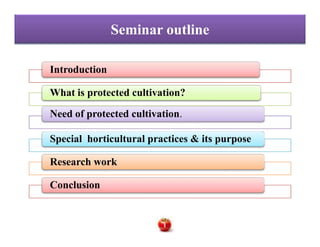
Seminar outline
Introduction
What is protected cultivation?
Need of protected cultivation.
Special horticultural practices & its purpose
Research work
Conclusion
1
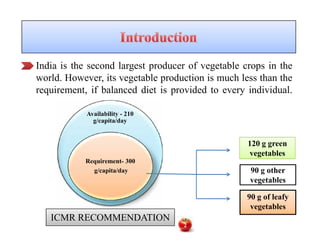
India is the second largest producer of vegetable crops in the
world. However, its vegetable production is much less than the
requirement, if balanced diet is provided to every individual.
Availability - 210
g/capita/day
Availability - 210
g/capita/day
Requirement- 300
g/capita/day
120 g green
vegetables
120 g green
vegetables
ICMR RECOMMENDATIONICMR RECOMMENDATION
90 g other
vegetables
2
90 g of leafy
vegetables
90 g of leafy
vegetables
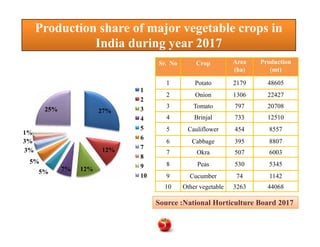
Production share of major vegetable crops in
India during year 2017
Production share of major vegetable crops in
India during year 2017
Sr. No Crop Area
(ha)
Production
(mt)
1 Potato 2179 48605
2 Onion 1306 22427
3 Tomato 797 20708
4 Brinjal 733 12510
5 Cauliflower 454 8557
27%25%
1
2
3
4
5 Cauliflower 454 8557
6 Cabbage 395 8807
7 Okra 507 6003
8 Peas 530 5345
9 Cucumber 74 1142
10 Other vegetable 3263 44068
Source :National Horticulture Board 2017Source :National Horticulture Board 2017
3
12%
12%7%5%
5%
3%
3%
1%
5
6
7
8
9
10
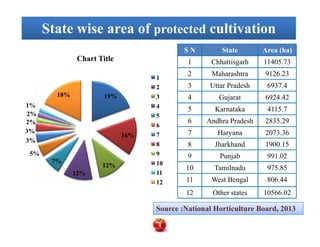
State wise area of protected cultivationState wise area of protected cultivation
S N State Area (ha)
1 Chhattisgarh 11405.73
2 Maharashtra 9126.23
3 Uttar Pradesh 6937.4
4 Gujarat 6924.42
5 Karnataka 4115.7
6 Andhra Pradesh 2835.29
19%
2%
2%
1%
18%
Chart Title
1
2
3
4
5
6
6 Andhra Pradesh 2835.29
7 Haryana 2073.36
8 Jharkhand 1900.15
9 Punjab 991.02
10 Tamilnadu 975.85
11 West Bengal 806.44
12 Other states 10566.02
Source :National Horticulture Board, 2013Source :National Horticulture Board, 2013
4
16%
12%
12%
7%
5%
3%
3%
2% 6
7
8
9
10
11
12
Why protected cultivation?Why protected cultivation?
In the changing scenario of increasing
population, decreasing cultivable land / water
resources, increasing urbanization/industrialization there
is need to produce more from available resources.
Further, with globalization of markets and global
climate change, greenhouse cultivation of high value
crops has emerged as the only top most important
technology for ensuring high productivity, improved
quality, lucrative return and continue supply.
In the changing scenario of increasing
population, decreasing cultivable land / water
resources, increasing urbanization/industrialization there
is need to produce more from available resources.
Further, with globalization of markets and global
climate change, greenhouse cultivation of high value
crops has emerged as the only top most important
technology for ensuring high productivity, improved
quality, lucrative return and continue supply.
5
What is Protected cultivation?
Protected cultivation can be defined as a cropping
technique where in the micro environment surrounding
the plant body is controlled partially / fully as per plant
need during their period of growth to maximize the
yield and resource saving.
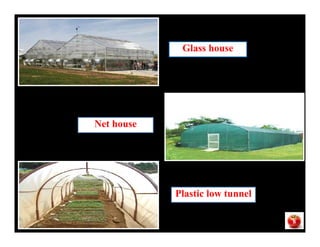
They are different type of protected structure :
Poly house
Glass house
Net house
Plastic low tunnel
Protected cultivation can be defined as a cropping
technique where in the micro environment surrounding
the plant body is controlled partially / fully as per plant
need during their period of growth to maximize the
yield and resource saving.
They are different type of protected structure :
Poly house
Glass house
Net house
Plastic low tunnel
6
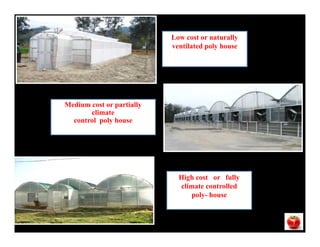
Medium cost or partially
climate
control poly house
Low cost or naturally
ventilated poly house
Medium cost or partially
climate
control poly house
High cost or fully
climate controlled
poly- house
7
Glass house
Net houseNet house
Plastic low tunnel
8
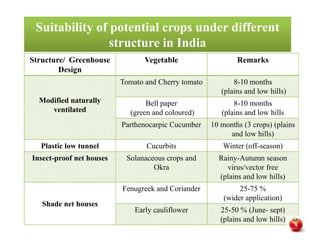
Suitability of potential crops under different
structure in India
Suitability of potential crops under different
structure in India
Structure/ Greenhouse
Design
Vegetable Remarks
Modified naturally
ventilated
Tomato and Cherry tomato 8-10 months
(plains and low hills)
Bell paper
(green and coloured)
8-10 months
(plains and low hills
Parthenocarpic Cucumber 10 months (3 crops) (plains
and low hills)
Parthenocarpic Cucumber 10 months (3 crops) (plains
and low hills)
Plastic low tunnel Cucurbits Winter (off-season)
Insect-proof net houses Solanaceous crops and
Okra
Rainy-Autumn season
virus/vector free
(plains and low hills)
Shade net houses
Fenugreek and Coriander 25-75 %
(wider application)
Early cauliflower 25-50 % (June- sept)
(plains and low hills)
9
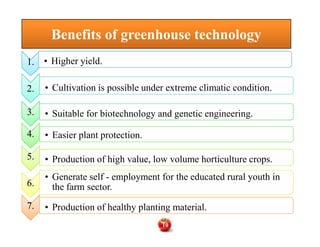
Benefits of greenhouse technologyBenefits of greenhouse technology
1.1. • Higher yield.
2.2. • Cultivation is possible under extreme climatic condition.
3.3. • Suitable for biotechnology and genetic engineering.
4.
3.
4.4. • Easier plant protection.
5.5. • Production of high value, low volume horticulture crops.
6.6.
• Generate self - employment for the educated rural youth in
the farm sector.
7.7. • Production of healthy planting material.
10
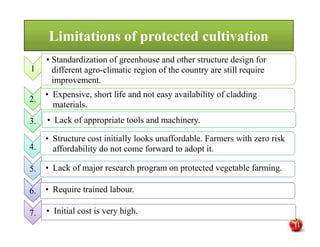
Limitations of protected cultivationLimitations of protected cultivation
11
• Standardization of greenhouse and other structure design for
different agro-climatic region of the country are still require
improvement.
2.2.
• Expensive, short life and not easy availability of cladding
materials.
3.3. • Lack of appropriate tools and machinery.
11
3.3. • Lack of appropriate tools and machinery.
4.4.
• Structure cost initially looks unaffordable. Farmers with zero risk
affordability do not come forward to adopt it.
5.5. • Lack of major research program on protected vegetable farming.
6.6. • Require trained labour.
7.7. • Initial cost is very high.
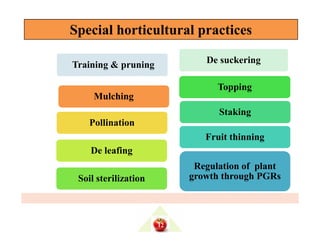
Training & pruning De suckering
Staking
Topping
Pollination
Mulching
Special horticultural practicesSpecial horticultural practices
Regulation of plant
growth through PGRs
Fruit thinning
Soil sterilization
De leafing
Pollination
12
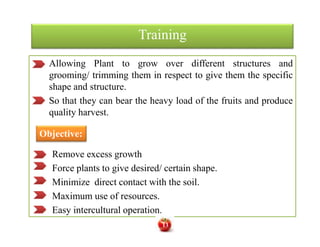
Training
Allowing Plant to grow over different structures and
grooming/ trimming them in respect to give them the specific
shape and structure.
So that they can bear the heavy load of the fruits and produce
quality harvest.
Remove excess growth
Force plants to give desired/ certain shape.
Minimize direct contact with the soil.
Maximum use of resources.
Easy intercultural operation.
Allowing Plant to grow over different structures and
grooming/ trimming them in respect to give them the specific
shape and structure.
So that they can bear the heavy load of the fruits and produce
quality harvest.
Remove excess growth
Force plants to give desired/ certain shape.
Minimize direct contact with the soil.
Maximum use of resources.
Easy intercultural operation.
Objective:
13
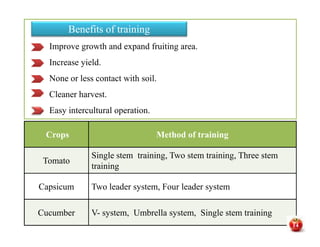
Improve growth and expand fruiting area.
Increase yield.
None or less contact with soil.
Cleaner harvest.
Easy intercultural operation.
Benefits of training
Crops Method of training
Tomato
Single stem training, Two stem training, Three stem
training
Capsicum Two leader system, Four leader system
Cucumber V- system, Umbrella system, Single stem training
14
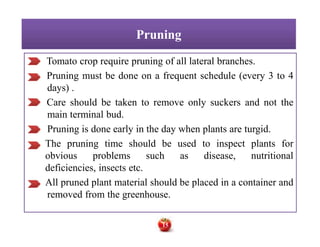
PruningPruning
Tomato crop require pruning of all lateral branches.
Pruning must be done on a frequent schedule (every 3 to 4
days) .
Care should be taken to remove only suckers and not the
main terminal bud.
Pruning is done early in the day when plants are turgid.
The pruning time should be used to inspect plants for
obvious problems such as disease, nutritional
deficiencies, insects etc.
All pruned plant material should be placed in a container and
removed from the greenhouse.
Tomato crop require pruning of all lateral branches.
Pruning must be done on a frequent schedule (every 3 to 4
days) .
Care should be taken to remove only suckers and not the
main terminal bud.
Pruning is done early in the day when plants are turgid.
The pruning time should be used to inspect plants for
obvious problems such as disease, nutritional
deficiencies, insects etc.
All pruned plant material should be placed in a container and
removed from the greenhouse.
15
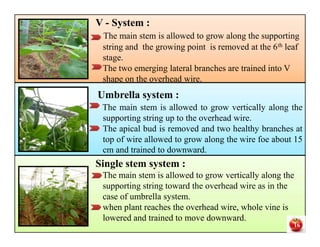
• V - System :
The main stem is allowed to grow along the supporting
string and the growing point is removed at the 6th leaf
stage.
• The two emerging lateral branches are trained into V
shape on the overhead wire.
• V - System :
The main stem is allowed to grow along the supporting
string and the growing point is removed at the 6th leaf
stage.
• The two emerging lateral branches are trained into V
shape on the overhead wire.
Umbrella system :
The main stem is allowed to grow vertically along the
supporting string up to the overhead wire.
The apical bud is removed and two healthy branches at
top of wire allowed to grow along the wire foe about 15
cm and trained to downward.
Umbrella system :
The main stem is allowed to grow vertically along the
supporting string up to the overhead wire.
The apical bud is removed and two healthy branches at
top of wire allowed to grow along the wire foe about 15
cm and trained to downward.
Umbrella system :
The main stem is allowed to grow vertically along the
supporting string up to the overhead wire.
The apical bud is removed and two healthy branches at
top of wire allowed to grow along the wire foe about 15
cm and trained to downward.
Umbrella system :
The main stem is allowed to grow vertically along the
supporting string up to the overhead wire.
The apical bud is removed and two healthy branches at
top of wire allowed to grow along the wire foe about 15
cm and trained to downward.
Single stem system :
The main stem is allowed to grow vertically along the
supporting string toward the overhead wire as in the
case of umbrella system.
when plant reaches the overhead wire, whole vine is
lowered and trained to move downward.
Single stem system :
The main stem is allowed to grow vertically along the
supporting string toward the overhead wire as in the
case of umbrella system.
when plant reaches the overhead wire, whole vine is
lowered and trained to move downward.
16
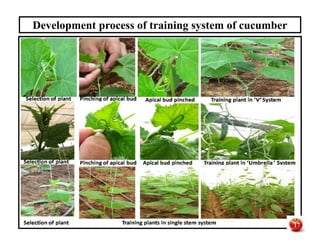
Development process of training system of cucumber
17
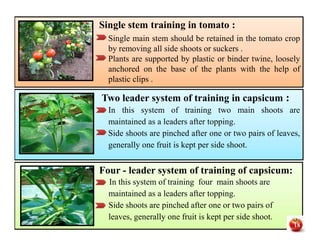
Single stem training in tomato :
Single main stem should be retained in the tomato crop
by removing all side shoots or suckers .
Plants are supported by plastic or binder twine, loosely
anchored on the base of the plants with the help of
plastic clips .
Single stem training in tomato :
Single main stem should be retained in the tomato crop
by removing all side shoots or suckers .
Plants are supported by plastic or binder twine, loosely
anchored on the base of the plants with the help of
plastic clips .
Two leader system of training in capsicum :
In this system of training two main shoots are
maintained as a leaders after topping.
Side shoots are pinched after one or two pairs of leaves,
generally one fruit is kept per side shoot.
Two leader system of training in capsicum :
In this system of training two main shoots are
maintained as a leaders after topping.
Side shoots are pinched after one or two pairs of leaves,
generally one fruit is kept per side shoot.
Two leader system of training in capsicum :
In this system of training two main shoots are
maintained as a leaders after topping.
Side shoots are pinched after one or two pairs of leaves,
generally one fruit is kept per side shoot.
Two leader system of training in capsicum :
In this system of training two main shoots are
maintained as a leaders after topping.
Side shoots are pinched after one or two pairs of leaves,
generally one fruit is kept per side shoot.
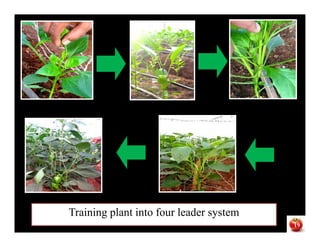
Four - leader system of training of capsicum:
In this system of training four main shoots are
maintained as a leaders after topping.
Side shoots are pinched after one or two pairs of
leaves, generally one fruit is kept per side shoot.
Four - leader system of training of capsicum:
In this system of training four main shoots are
maintained as a leaders after topping.
Side shoots are pinched after one or two pairs of
leaves, generally one fruit is kept per side shoot.
18
Training plant into four leader system
19
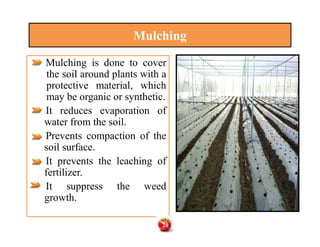
Mulching
Mulching is done to cover
the soil around plants with a
protective material, which
may be organic or synthetic.
It reduces evaporation of
water from the soil.
Prevents compaction of the
soil surface.
It prevents the leaching of
fertilizer.
It suppress the weed
growth.
Mulching is done to cover
the soil around plants with a
protective material, which
may be organic or synthetic.
It reduces evaporation of
water from the soil.
Prevents compaction of the
soil surface.
It prevents the leaching of
fertilizer.
It suppress the weed
growth.
20
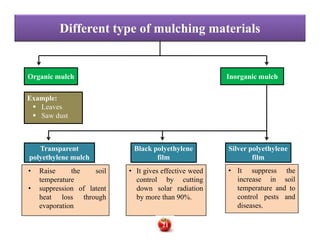
Different type of mulching materials
Organic mulch Inorganic mulch
Example:
 Leaves
 Saw dust
Transparent
polyethylene mulch
• Raise the soil
temperature
• suppression of latent
heat loss through
evaporation
• Raise the soil
temperature
• suppression of latent
heat loss through
evaporation
Black polyethylene
film
• It gives effective weed
control by cutting
down solar radiation
by more than 90%.
• It gives effective weed
control by cutting
down solar radiation
by more than 90%.
Silver polyethylene
film
• It suppress the
increase in soil
temperature and to
control pests and
diseases.
• It suppress the
increase in soil
temperature and to
control pests and
diseases.
21
POLLINATION
In the green­house, wind is not strong enough to
shake the flowers sufficiently to transfer the pollen.
The optimum temperature for pollination is within
the range 21 to 27° C.
Optimum relative humidity is 70 percent. Above 80
percent relative humidity, pollen grains are not
dispersed well.
Different methods are used for effective
pollination and good quality yield.
1. Hand pollination
2. Battery operated vibrator
3. Air blowers
4. Bumble bees
In the green­house, wind is not strong enough to
shake the flowers sufficiently to transfer the pollen.
The optimum temperature for pollination is within
the range 21 to 27° C.
Optimum relative humidity is 70 percent. Above 80
percent relative humidity, pollen grains are not
dispersed well.
Different methods are used for effective
pollination and good quality yield.
1. Hand pollination
2. Battery operated vibrator
3. Air blowers
4. Bumble bees
22
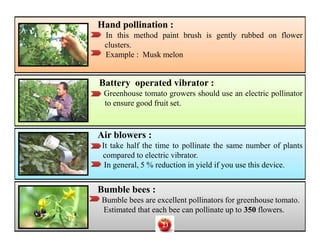
Hand pollination :
In this method paint brush is gently rubbed on flower
clusters.
Example : Musk melon
Hand pollination :
In this method paint brush is gently rubbed on flower
clusters.
Example : Musk melon
Battery operated vibrator :
Greenhouse tomato growers should use an electric pollinator
to ensure good fruit set.
Battery operated vibrator :
Greenhouse tomato growers should use an electric pollinator
to ensure good fruit set.
Battery operated vibrator :
Greenhouse tomato growers should use an electric pollinator
to ensure good fruit set.
Battery operated vibrator :
Greenhouse tomato growers should use an electric pollinator
to ensure good fruit set.
Air blowers :
It take half the time to pollinate the same number of plants
compared to electric vibrator.
In general, 5 % reduction in yield if you use this device.
Air blowers :
It take half the time to pollinate the same number of plants
compared to electric vibrator.
In general, 5 % reduction in yield if you use this device.
Bumble bees :
Bumble bees are excellent pollinators for greenhouse tomato.
Estimated that each bee can pollinate up to 350 flowers.
Bumble bees :
Bumble bees are excellent pollinators for greenhouse tomato.
Estimated that each bee can pollinate up to 350 flowers.
23
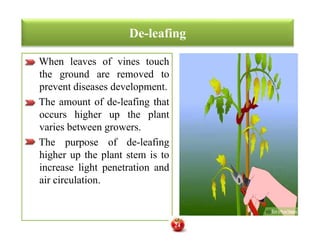
De-leafing
When leaves of vines touch
the ground are removed to
prevent diseases development.
The amount of de-leafing that
occurs higher up the plant
varies between growers.
The purpose of de-leafing
higher up the plant stem is to
increase light penetration and
air circulation.
When leaves of vines touch
the ground are removed to
prevent diseases development.
The amount of de-leafing that
occurs higher up the plant
varies between growers.
The purpose of de-leafing
higher up the plant stem is to
increase light penetration and
air circulation.
24
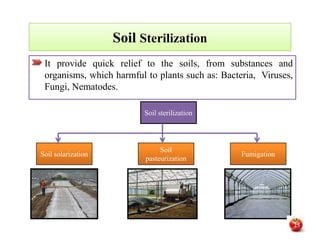
Soil SterilizationSoil Sterilization
Soil sterilization
It provide quick relief to the soils, from substances and
organisms, which harmful to plants such as: Bacteria, Viruses,
Fungi, Nematodes.
Soil solarizationSoil solarization
Soil
pasteurization
Soil
pasteurization
FumigationFumigation
25
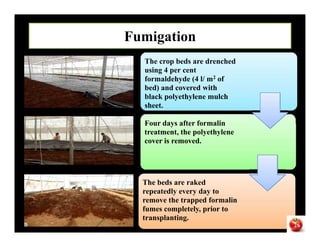
The crop beds are drenched
using 4 per cent
formaldehyde (4 l/ m2 of
bed) and covered with
black polyethylene mulch
sheet.
Four days after formalin
treatment, the polyethylene
cover is removed.
Fumigation
Four days after formalin
treatment, the polyethylene
cover is removed.
The beds are raked
repeatedly every day to
remove the trapped formalin
fumes completely, prior to
transplanting.
26
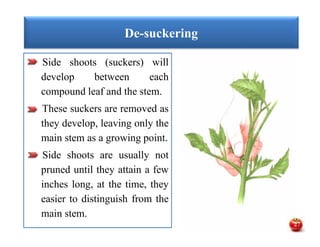
Side shoots (suckers) will
develop between each
compound leaf and the stem.
These suckers are removed as
they develop, leaving only the
main stem as a growing point.
Side shoots are usually not
pruned until they attain a few
inches long, at the time, they
easier to distinguish from the
main stem.
De-suckering
Side shoots (suckers) will
develop between each
compound leaf and the stem.
These suckers are removed as
they develop, leaving only the
main stem as a growing point.
Side shoots are usually not
pruned until they attain a few
inches long, at the time, they
easier to distinguish from the
main stem.
27
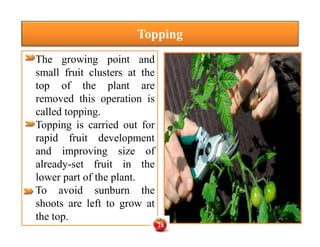
The growing point and
small fruit clusters at the
top of the plant are
removed this operation is
called topping.
Topping is carried out for
rapid fruit development
and improving size of
already-set fruit in the
lower part of the plant.
To avoid sunburn the
shoots are left to grow at
the top.
Topping
The growing point and
small fruit clusters at the
top of the plant are
removed this operation is
called topping.
Topping is carried out for
rapid fruit development
and improving size of
already-set fruit in the
lower part of the plant.
To avoid sunburn the
shoots are left to grow at
the top.
28
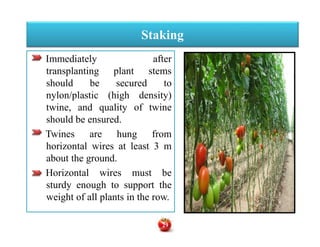
Staking
Immediately after
transplanting plant stems
should be secured to
nylon/plastic (high density)
twine, and quality of twine
should be ensured.
Twines are hung from
horizontal wires at least 3 m
about the ground.
Horizontal wires must be
sturdy enough to support the
weight of all plants in the row.
Immediately after
transplanting plant stems
should be secured to
nylon/plastic (high density)
twine, and quality of twine
should be ensured.
Twines are hung from
horizontal wires at least 3 m
about the ground.
Horizontal wires must be
sturdy enough to support the
weight of all plants in the row.
29
Fruit thinningFruit thinning
Small, undersized fruit are always removed, as these
will generally not grow to marketable size and reduce
the size of the other fruit.
This technique is powerful, so use it with great caution.
The optimum number of fruits per plant varies with the
cultivar and even more or less, with the growing
conditions.
Farmer may decide to remove too many fruits and
ultimately unnecessarily limit the production.
Fruit must be pruned or removed as soon as it can be
handled, before it grows too large.
Small, undersized fruit are always removed, as these
will generally not grow to marketable size and reduce
the size of the other fruit.
This technique is powerful, so use it with great caution.
The optimum number of fruits per plant varies with the
cultivar and even more or less, with the growing
conditions.
Farmer may decide to remove too many fruits and
ultimately unnecessarily limit the production.
Fruit must be pruned or removed as soon as it can be
handled, before it grows too large.
30
Regulation of flowering and fruiting by using
growth regulators
Regulation of flowering and fruiting by using
growth regulators
The growth regulators can be used to increase fruit set
at high and low temperature.
The flower dipping in PCPA (Parachloro- Phenoxy
acetic acid) 30 ppm at fully open stage, to increase the
fruit set at low and high temperature.
The application of cycocel (500 ppm) on the plants to
increase flower bud stimulation and increase fruit set.
The growth regulators can be used to increase fruit set
at high and low temperature.
The flower dipping in PCPA (Parachloro- Phenoxy
acetic acid) 30 ppm at fully open stage, to increase the
fruit set at low and high temperature.
The application of cycocel (500 ppm) on the plants to
increase flower bud stimulation and increase fruit set.
31
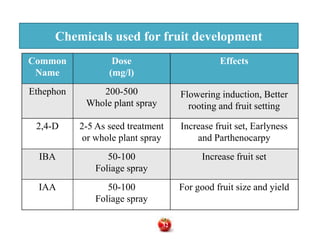
Chemicals used for fruit development
Common
Name
Dose
(mg/l)
Effects
Ethephon 200-500
Whole plant spray
Flowering induction, Better
rooting and fruit setting
2,4-D 2-5 As seed treatment
or whole plant spray
Increase fruit set, Earlyness
and Parthenocarpy
2,4-D 2-5 As seed treatment
or whole plant spray
Increase fruit set, Earlyness
and Parthenocarpy
IBA 50-100
Foliage spray
Increase fruit set
IAA 50-100
Foliage spray
For good fruit size and yield
32
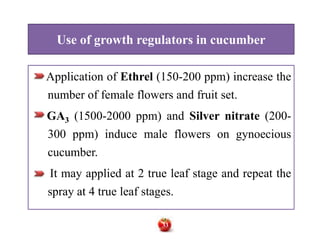
Use of growth regulators in cucumber
Application of Ethrel (150-200 ppm) increase the
number of female flowers and fruit set.
GA3 (1500-2000 ppm) and Silver nitrate (200-
300 ppm) induce male flowers on gynoecious
cucumber.
It may applied at 2 true leaf stage and repeat the
spray at 4 true leaf stages.
Application of Ethrel (150-200 ppm) increase the
number of female flowers and fruit set.
GA3 (1500-2000 ppm) and Silver nitrate (200-
300 ppm) induce male flowers on gynoecious
cucumber.
It may applied at 2 true leaf stage and repeat the
spray at 4 true leaf stages.
33
ReviewReview ofof
literatureliterature
ReviewReview ofof
literatureliterature
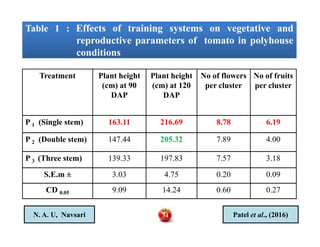
Table 1 : Effects of training systems on vegetative and
reproductive parameters of tomato in polyhouse
conditions
Table 1 : Effects of training systems on vegetative and
reproductive parameters of tomato in polyhouse
conditions
Treatment Plant height
(cm) at 90
DAP
Plant height
(cm) at 120
DAP
No of flowers
per cluster
No of fruits
per cluster
P 1 (Single stem) 163.11 216.69 8.78 6.19
N. A. U, Navsari Patel et al., (2016)
P 1 (Single stem) 163.11 216.69 8.78 6.19
P 2 (Double stem) 147.44 205.32 7.89 4.00
P 3 (Three stem) 139.33 197.83 7.57 3.18
S.E.m ± 3.03 4.75 0.20 0.09
CD 0.05 9.09 14.24 0.60 0.27
34
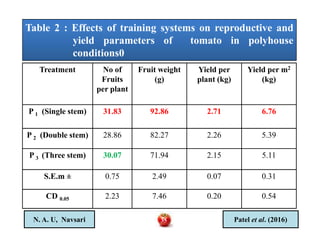
Table 2 : Effects of training systems on reproductive and
yield parameters of tomato in polyhouse
conditions0
Table 2 : Effects of training systems on reproductive and
yield parameters of tomato in polyhouse
conditions0
Treatment No of
Fruits
per plant
Fruit weight
(g)
Yield per
plant (kg)
Yield per m2
(kg)
P 1 (Single stem) 31.83 92.86 2.71 6.76
P 2 (Double stem) 28.86 82.27 2.26 5.39
P 3 (Three stem) 30.07 71.94 2.15 5.11
S.E.m ± 0.75 2.49 0.07 0.31
CD 0.05 2.23 7.46 0.20 0.54
N. A. U, Navsari Patel et al. (2016)35
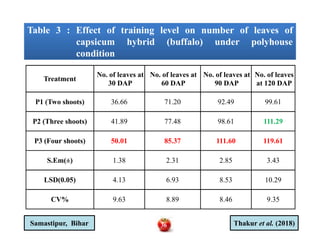
Table 3 : Effect of training level on number of leaves of
capsicum hybrid (buffalo) under polyhouse
condition
Table 3 : Effect of training level on number of leaves of
capsicum hybrid (buffalo) under polyhouse
condition
Treatment
No. of leaves at
30 DAP
No. of leaves at
60 DAP
No. of leaves at
90 DAP
No. of leaves
at 120 DAP
P1 (Two shoots) 36.66 71.20 92.49 99.61
P2 (Three shoots) 41.89 77.48 98.61 111.29P2 (Three shoots) 41.89 77.48 98.61 111.29
P3 (Four shoots) 50.01 85.37 111.60 119.61
S.Em(±) 1.38 2.31 2.85 3.43
LSD(0.05) 4.13 6.93 8.53 10.29
CV% 9.63 8.89 8.46 9.35
Thakur et al. (2018)Samastipur, Bihar 36
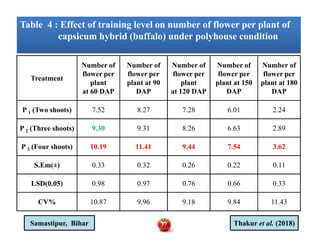
Table 4 : Effect of training level on number of flower per plant of
capsicum hybrid (buffalo) under polyhouse condition
Table 4 : Effect of training level on number of flower per plant of
capsicum hybrid (buffalo) under polyhouse condition
Treatment
Number of
flower per
plant
at 60 DAP
Number of
flower per
plant at 90
DAP
Number of
flower per
plant
at 120 DAP
Number of
flower per
plant at 150
DAP
Number of
flower per
plant at 180
DAP
P 1 (Two shoots) 7.52 8.27 7.28 6.01 2.24
P 2 (Three shoots) 9.30 9.31 8.26 6.63 2.89P 2 (Three shoots) 9.30 9.31 8.26 6.63 2.89
P 3 (Four shoots) 10.19 11.41 9.44 7.54 3.62
S.Em(±) 0.33 0.32 0.26 0.22 0.11
LSD(0.05) 0.98 0.97 0.76 0.66 0.33
CV% 10.87 9.96 9.18 9.84 11.43
Thakur et al. (2018)Samastipur, Bihar 37
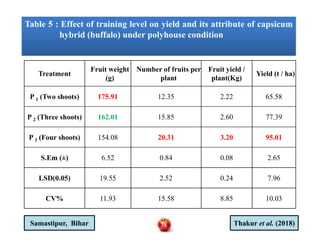
Table 5 : Effect of training level on yield and its attribute of capsicum
hybrid (buffalo) under polyhouse condition
Table 5 : Effect of training level on yield and its attribute of capsicum
hybrid (buffalo) under polyhouse condition
Treatment
Fruit weight
(g)
Number of fruits per
plant
Fruit yield /
plant(Kg)
Yield (t / ha)
P 1 (Two shoots) 175.91 12.35 2.22 65.58
P 2 (Three shoots) 162.01 15.85 2.60 77.39
P 3 (Four shoots) 154.08 20.31 3.20 95.01
S.Em (±) 6.52 0.84 0.08 2.65
LSD(0.05) 19.55 2.52 0.24 7.96
CV% 11.93 15.58 8.85 10.03
38 Thakur et al. (2018)Samastipur, Bihar
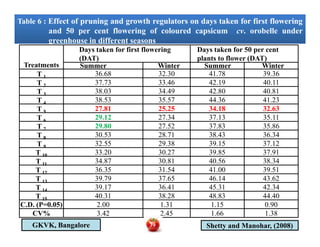
Table 6 : Effect of pruning and growth regulators on days taken for first flowering
and 50 per cent flowering of coloured capsicum cv. orobelle under
greenhouse in different seasons
Table 6 : Effect of pruning and growth regulators on days taken for first flowering
and 50 per cent flowering of coloured capsicum cv. orobelle under
greenhouse in different seasons
Treatments
Days taken for first flowering
(DAT)
Days taken for 50 per cent
plants to flower (DAT)
Summer Winter Summer Winter
T 1 36.68 32.30 41.78 39.36
T 2 37.73 33.46 42.19 40.11
T 3 38.03 34.49 42.80 40.81
T 4 38.53 35.57 44.36 41.23
T 5 27.81 25.25 34.18 32.63
T 6 29.12 27.34 37.13 35.11
T 7 29.80 27.52 37.83 35.86T 7 29.80 27.52 37.83 35.86
T 8 30.53 28.71 38.43 36.34
T 9 32.55 29.38 39.15 37.12
T 10 33.20 30.27 39.85 37.91
T 11 34.87 30.81 40.56 38.34
T 12 36.35 31.54 41.00 39.51
T 13 39.79 37.65 46.14 43.62
T 14 39.17 36.41 45.31 42.34
T 15 40.31 38.28 48.83 44.40
C.D. (P=0.05) 2.00 1.31 1.15 0.90
CV% 3.42 2.45 1.66 1.38
GKVK, Bangalore Shetty and Manohar, (2008)39
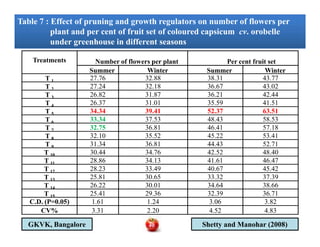
Table 7 : Effect of pruning and growth regulators on number of flowers per
plant and per cent of fruit set of coloured capsicum cv. orobelle
under greenhouse in different seasons
Table 7 : Effect of pruning and growth regulators on number of flowers per
plant and per cent of fruit set of coloured capsicum cv. orobelle
under greenhouse in different seasons
Treatments Number of flowers per plant Per cent fruit set
Summer Winter Summer Winter
T 1 27.76 32.88 38.31 43.77
T 2 27.24 32.18 36.67 43.02
T 3 26.82 31.87 36.21 42.44
T 4 26.37 31.01 35.59 41.51
T 5 34.34 39.41 52.37 63.51
T 6 33.34 37.53 48.43 58.53
T 7 32.75 36.81 46.41 57.18T 7 32.75 36.81 46.41 57.18
T 8 32.10 35.52 45.22 53.41
T 9 31.34 36.81 44.43 52.71
T 10 30.44 34.76 42.52 48.40
T 11 28.86 34.13 41.61 46.47
T 12 28.23 33.49 40.67 45.42
T 13 25.81 30.65 33.32 37.39
T 14 26.22 30.01 34.64 38.66
T 15 25.41 29.36 32.39 36.71
C.D. (P=0.05) 1.61 1.24 3.06 3.82
CV% 3.31 2.20 4.52 4.83
GKVK, Bangalore Shetty and Manohar (2008)40
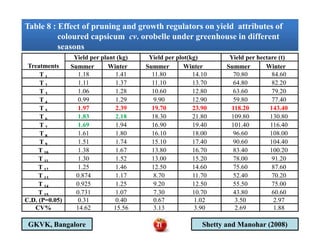
Table 8 : Effect of pruning and growth regulators on yield attributes of
coloured capsicum cv. orobelle under greenhouse in different
seasons
Table 8 : Effect of pruning and growth regulators on yield attributes of
coloured capsicum cv. orobelle under greenhouse in different
seasons
Treatments
Yield per plant (kg) Yield per plot(kg) Yield per hectare (t)
Summer Winter Summer Winter Summer Winter
T 1 1.18 1.41 11.80 14.10 70.80 84.60
T 2 1.11 1.37 11.10 13.70 64.80 82.20
T 3 1.06 1.28 10.60 12.80 63.60 79.20
T 4 0.99 1.29 9.90 12.90 59.80 77.40
T 5 1.97 2.39 19.70 23.90 118.20 143.40
T 6 1.83 2.18 18.30 21.80 109.80 130.80
T 7 1.69 1.94 16.90 19.40 101.40 116.40T 7 1.69 1.94 16.90 19.40 101.40 116.40
T 8 1.61 1.80 16.10 18.00 96.60 108.00
T 9 1.51 1.74 15.10 17.40 90.60 104.40
T 10 1.38 1.67 13.80 16.70 83.40 100.20
T 11 1.30 1.52 13.00 15.20 78.00 91.20
T 12 1.25 1.46 12.50 14.60 75.60 87.60
T 13 0.874 1.17 8.70 11.70 52.40 70.20
T 14 0.925 1.25 9.20 12.50 55.50 75.00
T 15 0.731 1.07 7.30 10.70 43.80 60.60
C.D. (P=0.05) 0.31 0.40 0.67 1.02 3.50 2.97
CV% 14.62 15.56 3.13 3.90 2.69 1.88
GKVK, Bangalore Shetty and Manohar (2008)41
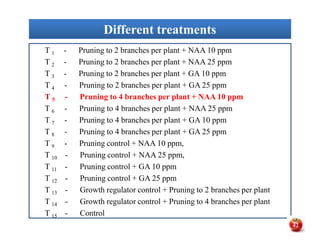
Different treatmentsDifferent treatments
T 1 - Pruning to 2 branches per plant + NAA 10 ppm
T 2 - Pruning to 2 branches per plant + NAA 25 ppm
T 3 - Pruning to 2 branches per plant + GA 10 ppm
T 4 - Pruning to 2 branches per plant + GA 25 ppm
T 5 - Pruning to 4 branches per plant + NAA 10 ppm
T 6 - Pruning to 4 branches per plant + NAA 25 ppm
T 7 - Pruning to 4 branches per plant + GA 10 ppm
T 8 - Pruning to 4 branches per plant + GA 25 ppm
T 9 - Pruning control + NAA 10 ppm,
T 10 - Pruning control + NAA 25 ppm,
T 11 - Pruning control + GA 10 ppm
T 12 - Pruning control + GA 25 ppm
T 13 - Growth regulator control + Pruning to 2 branches per plant
T 14 - Growth regulator control + Pruning to 4 branches per plant
T 15 - Control
T 1 - Pruning to 2 branches per plant + NAA 10 ppm
T 2 - Pruning to 2 branches per plant + NAA 25 ppm
T 3 - Pruning to 2 branches per plant + GA 10 ppm
T 4 - Pruning to 2 branches per plant + GA 25 ppm
T 5 - Pruning to 4 branches per plant + NAA 10 ppm
T 6 - Pruning to 4 branches per plant + NAA 25 ppm
T 7 - Pruning to 4 branches per plant + GA 10 ppm
T 8 - Pruning to 4 branches per plant + GA 25 ppm
T 9 - Pruning control + NAA 10 ppm,
T 10 - Pruning control + NAA 25 ppm,
T 11 - Pruning control + GA 10 ppm
T 12 - Pruning control + GA 25 ppm
T 13 - Growth regulator control + Pruning to 2 branches per plant
T 14 - Growth regulator control + Pruning to 4 branches per plant
T 15 - Control
42
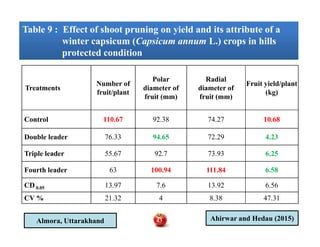
Table 9 : Effect of shoot pruning on yield and its attribute of a
winter capsicum (Capsicum annum L.) crops in hills
protected condition
Table 9 : Effect of shoot pruning on yield and its attribute of a
winter capsicum (Capsicum annum L.) crops in hills
protected condition
Treatments
Number of
fruit/plant
Polar
diameter of
fruit (mm)
Radial
diameter of
fruit (mm)
Fruit yield/plant
(kg)
Control 110.67 92.38 74.27 10.68
Double leader 76.33 94.65 72.29 4.23
Triple leader 55.67 92.7 73.93 6.25
Fourth leader 63 100.94 111.84 6.58
CD 0.05 13.97 7.6 13.92 6.56
CV % 21.32 4 8.38 47.31
Ahirwar and Hedau (2015)Almora, Uttarakhand 43
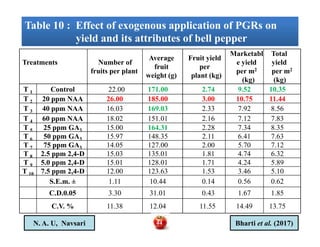
Table 10 : Effect of exogenous application of PGRs on
yield and its attributes of bell pepper
Table 10 : Effect of exogenous application of PGRs on
yield and its attributes of bell pepper
Treatments Number of
fruits per plant
Average
fruit
weight (g)
Fruit yield
per
plant (kg)
Marketabl
e yield
per m2
(kg)
Total
yield
per m2
(kg)
T 1 Control 22.00 171.00 2.74 9.52 10.35
T 2 20 ppm NAA 26.00 185.00 3.00 10.75 11.44
T 3 40 ppm NAA 16.03 169.03 2.33 7.92 8.56
T 4 60 ppm NAA 18.02 151.01 2.16 7.12 7.83
T 5 25 ppm GA3 15.00 164.31 2.28 7.34 8.35T 5 25 ppm GA3 15.00 164.31 2.28 7.34 8.35
T 6 50 ppm GA3 15.97 148.35 2.11 6.41 7.63
T 7 75 ppm GA3 14.05 127.00 2.00 5.70 7.12
T 8 2.5 ppm 2,4-D 15.03 135.01 1.81 4.74 6.32
T 9 5.0 ppm 2,4-D 15.01 128.01 1.71 4.24 5.89
T 10 7.5 ppm 2,4-D 12.00 123.63 1.53 3.46 5.10
S.E.m. ± 1.11 10.44 0.14 0.56 0.62
C.D.0.05 3.30 31.01 0.43 1.67 1.85
C.V. % 11.38 12.04 11.55 14.49 13.75
Bharti et al. (2017)N. A. U, Navsari 44
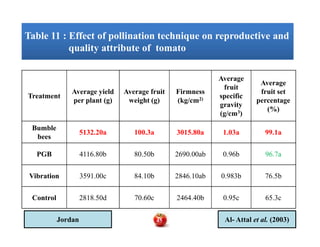
Table 11 : Effect of pollination technique on reproductive and
quality attribute of tomato
Table 11 : Effect of pollination technique on reproductive and
quality attribute of tomato
Treatment
Average yield
per plant (g)
Average fruit
weight (g)
Firmness
(kg/cm2)
Average
fruit
specific
gravity
(g/cm3)
Average
fruit set
percentage
(%)
Bumble
bees
Bumble
bees
5132.20a 100.3a 3015.80a 1.03a 99.1a
PGB 4116.80b 80.50b 2690.00ab 0.96b 96.7a
Vibration 3591.00c 84.10b 2846.10ab 0.983b 76.5b
Control 2818.50d 70.60c 2464.40b 0.95c 65.3c
Al- Attal et al. (2003)Jordan 45
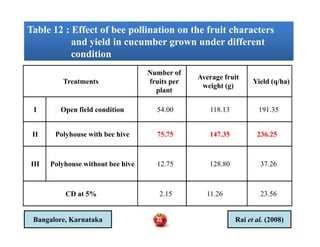
Table 12 : Effect of bee pollination on the fruit characters
and yield in cucumber grown under different
condition
Table 12 : Effect of bee pollination on the fruit characters
and yield in cucumber grown under different
condition
Treatments
Number of
fruits per
plant
Average fruit
weight (g)
Yield (q/ha)
I Open field condition 54.00 118.13 191.35
II Polyhouse with bee hive 75.75 147.35 236.25
III Polyhouse without bee hive 12.75 128.80 37.26
CD at 5% 2.15 11.26 23.56
Rai et al. (2008)Bangalore, Karnataka 46
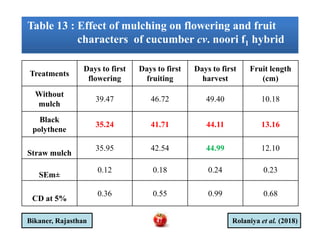
Table 13 : Effect of mulching on flowering and fruit
characters of cucumber cv. noori f1 hybrid
Table 13 : Effect of mulching on flowering and fruit
characters of cucumber cv. noori f1 hybrid
Treatments
Days to first
flowering
Days to first
fruiting
Days to first
harvest
Fruit length
(cm)
Without
mulch
39.47 46.72 49.40 10.18
Black
polythene
35.24 41.71 44.11 13.16
Black
polythene
35.24 41.71 44.11 13.16
Straw mulch
35.95 42.54 44.99 12.10
SEm±
0.12 0.18 0.24 0.23
CD at 5%
0.36 0.55 0.99 0.68
Rolaniya et al. (2018)Bikaner, Rajasthan 47
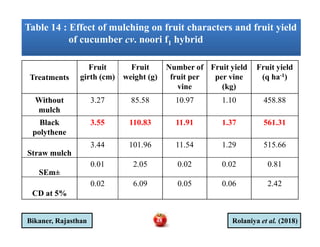
Table 14 : Effect of mulching on fruit characters and fruit yield
of cucumber cv. noori f1 hybrid
Table 14 : Effect of mulching on fruit characters and fruit yield
of cucumber cv. noori f1 hybrid
Treatments
Fruit
girth (cm)
Fruit
weight (g)
Number of
fruit per
vine
Fruit yield
per vine
(kg)
Fruit yield
(q ha-1)
Without
mulch
3.27 85.58 10.97 1.10 458.88
Black
polythene
3.55 110.83 11.91 1.37 561.31Black
polythene
3.55 110.83 11.91 1.37 561.31
Straw mulch
3.44 101.96 11.54 1.29 515.66
SEm±
0.01 2.05 0.02 0.02 0.81
CD at 5%
0.02 6.09 0.05 0.06 2.42
Rolaniya et al. (2018)Bikaner, Rajasthan 48
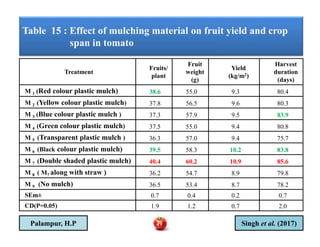
Table 15 : Effect of mulching material on fruit yield and crop
span in tomato
Treatment
Fruits/
plant
Fruit
weight
(g)
Yield
(kg/m2)
Harvest
duration
(days)
M 1 (Red colour plastic mulch) 38.6 55.0 9.3 80.4
M 2 (Yellow colour plastic mulch) 37.8 56.5 9.6 80.3
M 3 (Blue colour plastic mulch ) 37.3 57.9 9.5 83.9
M 4 (Green colour plastic mulch) 37.5 55.0 9.4 80.8M 4 (Green colour plastic mulch) 37.5 55.0 9.4 80.8
M 5 (Transparent plastic mulch ) 36.3 57.0 9.4 75.7
M 6 (Black colour plastic mulch) 39.5 58.3 10.2 83.8
M 7 (Double shaded plastic mulch) 40.4 60.2 10.9 85.6
M 8 ( M7 along with straw ) 36.2 54.7 8.9 79.8
M 9 (No mulch) 36.5 53.4 8.7 78.2
SEm± 0.7 0.4 0.2 0.7
CD(P=0.05) 1.9 1.2 0.7 2.0
Singh et al. (2017)Palampur, H.P 49
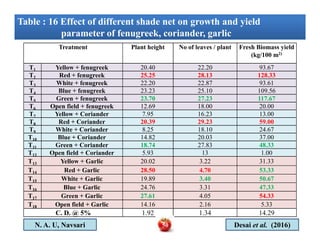
Treatment Plant height No of leaves / plant Fresh Biomass yield
(kg/100 m2)
T1 Yellow + fenugreek 20.40 22.20 93.67
T2 Red + fenugreek 25.25 28.13 128.33
T3 White + fenugreek 22.20 22.87 93.61
T4 Blue + fenugreek 23.23 25.10 109.56
T5 Green + fenugreek 23.70 27.23 117.67
T6 Open field + fenugreek 12.69 18.00 20.00
T7 Yellow + Coriander 7.95 16.23 13.00
T8 Red + Coriander 20.39 29.23 59.00
T9 White + Coriander 8.25 18.10 24.67
Table : 16 Effect of different shade net on growth and yield
parameter of fenugreek, coriander, garlic
Table : 16 Effect of different shade net on growth and yield
parameter of fenugreek, coriander, garlic
T8 Red + Coriander 20.39 29.23 59.00
T9 White + Coriander 8.25 18.10 24.67
T10 Blue + Coriander 14.82 20.03 37.00
T11 Green + Coriander 18.74 27.83 48.33
T12 Open field + Coriander 5.93 13 1.00
T13 Yellow + Garlic 20.02 3.22 31.33
T14 Red + Garlic 28.50 4.70 53.33
T15 White + Garlic 19.89 3.40 50.67
T16 Blue + Garlic 24.76 3.31 47.33
T17 Green + Garlic 27.61 4.05 54.33
T18 Open field + Garlic 14.16 2.16 5.33
C. D. @ 5% 1.92 1.34 14.29
N. A. U, Navsari Desai et al. (2016)50
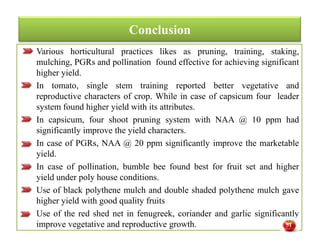
Conclusion
Various horticultural practices likes as pruning, training, staking,
mulching, PGRs and pollination found effective for achieving significant
higher yield.
In tomato, single stem training reported better vegetative and
reproductive characters of crop. While in case of capsicum four leader
system found higher yield with its attributes.
In capsicum, four shoot pruning system with NAA @ 10 ppm had
significantly improve the yield characters.
In case of PGRs, NAA @ 20 ppm significantly improve the marketable
yield.
In case of pollination, bumble bee found best for fruit set and higher
yield under poly house conditions.
Use of black polythene mulch and double shaded polythene mulch gave
higher yield with good quality fruits
Use of the red shed net in fenugreek, coriander and garlic significantly
improve vegetative and reproductive growth.
Various horticultural practices likes as pruning, training, staking,
mulching, PGRs and pollination found effective for achieving significant
higher yield.
In tomato, single stem training reported better vegetative and
reproductive characters of crop. While in case of capsicum four leader
system found higher yield with its attributes.
In capsicum, four shoot pruning system with NAA @ 10 ppm had
significantly improve the yield characters.
In case of PGRs, NAA @ 20 ppm significantly improve the marketable
yield.
In case of pollination, bumble bee found best for fruit set and higher
yield under poly house conditions.
Use of black polythene mulch and double shaded polythene mulch gave
higher yield with good quality fruits
Use of the red shed net in fenugreek, coriander and garlic significantly
improve vegetative and reproductive growth. 51
Horticultural practices in vegetable crops

Horticultural practices in vegetable crops

  • 1.
    Navsari Agricultural University,NavsariNavsari Agricultural University, Navsari Special Horticultural Practices for Vegetable crops under Protected cultivation Seminar on Speaker Parmar Manishkumar N. Reg. no. 2020217018 M. Sc.(Horti) Vegetable Science MINOR GUIDE: Dr. A. K. Pandey Assistant Professor Department of Fruit Science, ACHF, NAU, Navsari -396 450 MINOR GUIDE: Dr. A. K. Pandey Assistant Professor Department of Fruit Science, ACHF, NAU, Navsari -396 450 Speaker Parmar Manishkumar N. Reg. no. 2020217018 M. Sc.(Horti) Vegetable Science MAJOR GUIDE: Dr. S. Y. Patel Assistant Professor Department of Vegetable Science ACHF, NAU, Navsari -396 450 MAJOR GUIDE: Dr. S. Y. Patel Assistant Professor Department of Vegetable Science ACHF, NAU, Navsari -396 450
  • 2.
    Seminar outline Introduction What isprotected cultivation? Need of protected cultivation. Special horticultural practices & its purpose Research work Conclusion 1
  • 3.
    India is thesecond largest producer of vegetable crops in the world. However, its vegetable production is much less than the requirement, if balanced diet is provided to every individual. Availability - 210 g/capita/day Availability - 210 g/capita/day Requirement- 300 g/capita/day 120 g green vegetables 120 g green vegetables ICMR RECOMMENDATIONICMR RECOMMENDATION 90 g other vegetables 2 90 g of leafy vegetables 90 g of leafy vegetables
  • 4.
    Production share ofmajor vegetable crops in India during year 2017 Production share of major vegetable crops in India during year 2017 Sr. No Crop Area (ha) Production (mt) 1 Potato 2179 48605 2 Onion 1306 22427 3 Tomato 797 20708 4 Brinjal 733 12510 5 Cauliflower 454 8557 27%25% 1 2 3 4 5 Cauliflower 454 8557 6 Cabbage 395 8807 7 Okra 507 6003 8 Peas 530 5345 9 Cucumber 74 1142 10 Other vegetable 3263 44068 Source :National Horticulture Board 2017Source :National Horticulture Board 2017 3 12% 12%7%5% 5% 3% 3% 1% 5 6 7 8 9 10
  • 5.
    State wise areaof protected cultivationState wise area of protected cultivation S N State Area (ha) 1 Chhattisgarh 11405.73 2 Maharashtra 9126.23 3 Uttar Pradesh 6937.4 4 Gujarat 6924.42 5 Karnataka 4115.7 6 Andhra Pradesh 2835.29 19% 2% 2% 1% 18% Chart Title 1 2 3 4 5 6 6 Andhra Pradesh 2835.29 7 Haryana 2073.36 8 Jharkhand 1900.15 9 Punjab 991.02 10 Tamilnadu 975.85 11 West Bengal 806.44 12 Other states 10566.02 Source :National Horticulture Board, 2013Source :National Horticulture Board, 2013 4 16% 12% 12% 7% 5% 3% 3% 2% 6 7 8 9 10 11 12
  • 6.
    Why protected cultivation?Whyprotected cultivation? In the changing scenario of increasing population, decreasing cultivable land / water resources, increasing urbanization/industrialization there is need to produce more from available resources. Further, with globalization of markets and global climate change, greenhouse cultivation of high value crops has emerged as the only top most important technology for ensuring high productivity, improved quality, lucrative return and continue supply. In the changing scenario of increasing population, decreasing cultivable land / water resources, increasing urbanization/industrialization there is need to produce more from available resources. Further, with globalization of markets and global climate change, greenhouse cultivation of high value crops has emerged as the only top most important technology for ensuring high productivity, improved quality, lucrative return and continue supply. 5
  • 7.
    What is Protectedcultivation? Protected cultivation can be defined as a cropping technique where in the micro environment surrounding the plant body is controlled partially / fully as per plant need during their period of growth to maximize the yield and resource saving. They are different type of protected structure : Poly house Glass house Net house Plastic low tunnel Protected cultivation can be defined as a cropping technique where in the micro environment surrounding the plant body is controlled partially / fully as per plant need during their period of growth to maximize the yield and resource saving. They are different type of protected structure : Poly house Glass house Net house Plastic low tunnel 6
  • 8.
    Medium cost orpartially climate control poly house Low cost or naturally ventilated poly house Medium cost or partially climate control poly house High cost or fully climate controlled poly- house 7
  • 9.
    Glass house Net houseNethouse Plastic low tunnel 8
  • 10.
    Suitability of potentialcrops under different structure in India Suitability of potential crops under different structure in India Structure/ Greenhouse Design Vegetable Remarks Modified naturally ventilated Tomato and Cherry tomato 8-10 months (plains and low hills) Bell paper (green and coloured) 8-10 months (plains and low hills Parthenocarpic Cucumber 10 months (3 crops) (plains and low hills) Parthenocarpic Cucumber 10 months (3 crops) (plains and low hills) Plastic low tunnel Cucurbits Winter (off-season) Insect-proof net houses Solanaceous crops and Okra Rainy-Autumn season virus/vector free (plains and low hills) Shade net houses Fenugreek and Coriander 25-75 % (wider application) Early cauliflower 25-50 % (June- sept) (plains and low hills) 9
  • 11.
    Benefits of greenhousetechnologyBenefits of greenhouse technology 1.1. • Higher yield. 2.2. • Cultivation is possible under extreme climatic condition. 3.3. • Suitable for biotechnology and genetic engineering. 4. 3. 4.4. • Easier plant protection. 5.5. • Production of high value, low volume horticulture crops. 6.6. • Generate self - employment for the educated rural youth in the farm sector. 7.7. • Production of healthy planting material. 10
  • 12.
    Limitations of protectedcultivationLimitations of protected cultivation 11 • Standardization of greenhouse and other structure design for different agro-climatic region of the country are still require improvement. 2.2. • Expensive, short life and not easy availability of cladding materials. 3.3. • Lack of appropriate tools and machinery. 11 3.3. • Lack of appropriate tools and machinery. 4.4. • Structure cost initially looks unaffordable. Farmers with zero risk affordability do not come forward to adopt it. 5.5. • Lack of major research program on protected vegetable farming. 6.6. • Require trained labour. 7.7. • Initial cost is very high.
  • 13.
    Training & pruningDe suckering Staking Topping Pollination Mulching Special horticultural practicesSpecial horticultural practices Regulation of plant growth through PGRs Fruit thinning Soil sterilization De leafing Pollination 12
  • 14.
    Training Allowing Plant togrow over different structures and grooming/ trimming them in respect to give them the specific shape and structure. So that they can bear the heavy load of the fruits and produce quality harvest. Remove excess growth Force plants to give desired/ certain shape. Minimize direct contact with the soil. Maximum use of resources. Easy intercultural operation. Allowing Plant to grow over different structures and grooming/ trimming them in respect to give them the specific shape and structure. So that they can bear the heavy load of the fruits and produce quality harvest. Remove excess growth Force plants to give desired/ certain shape. Minimize direct contact with the soil. Maximum use of resources. Easy intercultural operation. Objective: 13
  • 15.
    Improve growth andexpand fruiting area. Increase yield. None or less contact with soil. Cleaner harvest. Easy intercultural operation. Benefits of training Crops Method of training Tomato Single stem training, Two stem training, Three stem training Capsicum Two leader system, Four leader system Cucumber V- system, Umbrella system, Single stem training 14
  • 16.
    PruningPruning Tomato crop requirepruning of all lateral branches. Pruning must be done on a frequent schedule (every 3 to 4 days) . Care should be taken to remove only suckers and not the main terminal bud. Pruning is done early in the day when plants are turgid. The pruning time should be used to inspect plants for obvious problems such as disease, nutritional deficiencies, insects etc. All pruned plant material should be placed in a container and removed from the greenhouse. Tomato crop require pruning of all lateral branches. Pruning must be done on a frequent schedule (every 3 to 4 days) . Care should be taken to remove only suckers and not the main terminal bud. Pruning is done early in the day when plants are turgid. The pruning time should be used to inspect plants for obvious problems such as disease, nutritional deficiencies, insects etc. All pruned plant material should be placed in a container and removed from the greenhouse. 15
  • 17.
    • V -System : The main stem is allowed to grow along the supporting string and the growing point is removed at the 6th leaf stage. • The two emerging lateral branches are trained into V shape on the overhead wire. • V - System : The main stem is allowed to grow along the supporting string and the growing point is removed at the 6th leaf stage. • The two emerging lateral branches are trained into V shape on the overhead wire. Umbrella system : The main stem is allowed to grow vertically along the supporting string up to the overhead wire. The apical bud is removed and two healthy branches at top of wire allowed to grow along the wire foe about 15 cm and trained to downward. Umbrella system : The main stem is allowed to grow vertically along the supporting string up to the overhead wire. The apical bud is removed and two healthy branches at top of wire allowed to grow along the wire foe about 15 cm and trained to downward. Umbrella system : The main stem is allowed to grow vertically along the supporting string up to the overhead wire. The apical bud is removed and two healthy branches at top of wire allowed to grow along the wire foe about 15 cm and trained to downward. Umbrella system : The main stem is allowed to grow vertically along the supporting string up to the overhead wire. The apical bud is removed and two healthy branches at top of wire allowed to grow along the wire foe about 15 cm and trained to downward. Single stem system : The main stem is allowed to grow vertically along the supporting string toward the overhead wire as in the case of umbrella system. when plant reaches the overhead wire, whole vine is lowered and trained to move downward. Single stem system : The main stem is allowed to grow vertically along the supporting string toward the overhead wire as in the case of umbrella system. when plant reaches the overhead wire, whole vine is lowered and trained to move downward. 16
  • 18.
    Development process oftraining system of cucumber 17
  • 19.
    Single stem trainingin tomato : Single main stem should be retained in the tomato crop by removing all side shoots or suckers . Plants are supported by plastic or binder twine, loosely anchored on the base of the plants with the help of plastic clips . Single stem training in tomato : Single main stem should be retained in the tomato crop by removing all side shoots or suckers . Plants are supported by plastic or binder twine, loosely anchored on the base of the plants with the help of plastic clips . Two leader system of training in capsicum : In this system of training two main shoots are maintained as a leaders after topping. Side shoots are pinched after one or two pairs of leaves, generally one fruit is kept per side shoot. Two leader system of training in capsicum : In this system of training two main shoots are maintained as a leaders after topping. Side shoots are pinched after one or two pairs of leaves, generally one fruit is kept per side shoot. Two leader system of training in capsicum : In this system of training two main shoots are maintained as a leaders after topping. Side shoots are pinched after one or two pairs of leaves, generally one fruit is kept per side shoot. Two leader system of training in capsicum : In this system of training two main shoots are maintained as a leaders after topping. Side shoots are pinched after one or two pairs of leaves, generally one fruit is kept per side shoot. Four - leader system of training of capsicum: In this system of training four main shoots are maintained as a leaders after topping. Side shoots are pinched after one or two pairs of leaves, generally one fruit is kept per side shoot. Four - leader system of training of capsicum: In this system of training four main shoots are maintained as a leaders after topping. Side shoots are pinched after one or two pairs of leaves, generally one fruit is kept per side shoot. 18
  • 20.
    Training plant intofour leader system 19
  • 21.
    Mulching Mulching is doneto cover the soil around plants with a protective material, which may be organic or synthetic. It reduces evaporation of water from the soil. Prevents compaction of the soil surface. It prevents the leaching of fertilizer. It suppress the weed growth. Mulching is done to cover the soil around plants with a protective material, which may be organic or synthetic. It reduces evaporation of water from the soil. Prevents compaction of the soil surface. It prevents the leaching of fertilizer. It suppress the weed growth. 20
  • 22.
    Different type ofmulching materials Organic mulch Inorganic mulch Example:  Leaves  Saw dust Transparent polyethylene mulch • Raise the soil temperature • suppression of latent heat loss through evaporation • Raise the soil temperature • suppression of latent heat loss through evaporation Black polyethylene film • It gives effective weed control by cutting down solar radiation by more than 90%. • It gives effective weed control by cutting down solar radiation by more than 90%. Silver polyethylene film • It suppress the increase in soil temperature and to control pests and diseases. • It suppress the increase in soil temperature and to control pests and diseases. 21
  • 23.
    POLLINATION In the green­house,wind is not strong enough to shake the flowers sufficiently to transfer the pollen. The optimum temperature for pollination is within the range 21 to 27° C. Optimum relative humidity is 70 percent. Above 80 percent relative humidity, pollen grains are not dispersed well. Different methods are used for effective pollination and good quality yield. 1. Hand pollination 2. Battery operated vibrator 3. Air blowers 4. Bumble bees In the green­house, wind is not strong enough to shake the flowers sufficiently to transfer the pollen. The optimum temperature for pollination is within the range 21 to 27° C. Optimum relative humidity is 70 percent. Above 80 percent relative humidity, pollen grains are not dispersed well. Different methods are used for effective pollination and good quality yield. 1. Hand pollination 2. Battery operated vibrator 3. Air blowers 4. Bumble bees 22
  • 24.
    Hand pollination : Inthis method paint brush is gently rubbed on flower clusters. Example : Musk melon Hand pollination : In this method paint brush is gently rubbed on flower clusters. Example : Musk melon Battery operated vibrator : Greenhouse tomato growers should use an electric pollinator to ensure good fruit set. Battery operated vibrator : Greenhouse tomato growers should use an electric pollinator to ensure good fruit set. Battery operated vibrator : Greenhouse tomato growers should use an electric pollinator to ensure good fruit set. Battery operated vibrator : Greenhouse tomato growers should use an electric pollinator to ensure good fruit set. Air blowers : It take half the time to pollinate the same number of plants compared to electric vibrator. In general, 5 % reduction in yield if you use this device. Air blowers : It take half the time to pollinate the same number of plants compared to electric vibrator. In general, 5 % reduction in yield if you use this device. Bumble bees : Bumble bees are excellent pollinators for greenhouse tomato. Estimated that each bee can pollinate up to 350 flowers. Bumble bees : Bumble bees are excellent pollinators for greenhouse tomato. Estimated that each bee can pollinate up to 350 flowers. 23
  • 25.
    De-leafing When leaves ofvines touch the ground are removed to prevent diseases development. The amount of de-leafing that occurs higher up the plant varies between growers. The purpose of de-leafing higher up the plant stem is to increase light penetration and air circulation. When leaves of vines touch the ground are removed to prevent diseases development. The amount of de-leafing that occurs higher up the plant varies between growers. The purpose of de-leafing higher up the plant stem is to increase light penetration and air circulation. 24
  • 26.
    Soil SterilizationSoil Sterilization Soilsterilization It provide quick relief to the soils, from substances and organisms, which harmful to plants such as: Bacteria, Viruses, Fungi, Nematodes. Soil solarizationSoil solarization Soil pasteurization Soil pasteurization FumigationFumigation 25
  • 27.
    The crop bedsare drenched using 4 per cent formaldehyde (4 l/ m2 of bed) and covered with black polyethylene mulch sheet. Four days after formalin treatment, the polyethylene cover is removed. Fumigation Four days after formalin treatment, the polyethylene cover is removed. The beds are raked repeatedly every day to remove the trapped formalin fumes completely, prior to transplanting. 26
  • 28.
    Side shoots (suckers)will develop between each compound leaf and the stem. These suckers are removed as they develop, leaving only the main stem as a growing point. Side shoots are usually not pruned until they attain a few inches long, at the time, they easier to distinguish from the main stem. De-suckering Side shoots (suckers) will develop between each compound leaf and the stem. These suckers are removed as they develop, leaving only the main stem as a growing point. Side shoots are usually not pruned until they attain a few inches long, at the time, they easier to distinguish from the main stem. 27
  • 29.
    The growing pointand small fruit clusters at the top of the plant are removed this operation is called topping. Topping is carried out for rapid fruit development and improving size of already-set fruit in the lower part of the plant. To avoid sunburn the shoots are left to grow at the top. Topping The growing point and small fruit clusters at the top of the plant are removed this operation is called topping. Topping is carried out for rapid fruit development and improving size of already-set fruit in the lower part of the plant. To avoid sunburn the shoots are left to grow at the top. 28
  • 30.
    Staking Immediately after transplanting plantstems should be secured to nylon/plastic (high density) twine, and quality of twine should be ensured. Twines are hung from horizontal wires at least 3 m about the ground. Horizontal wires must be sturdy enough to support the weight of all plants in the row. Immediately after transplanting plant stems should be secured to nylon/plastic (high density) twine, and quality of twine should be ensured. Twines are hung from horizontal wires at least 3 m about the ground. Horizontal wires must be sturdy enough to support the weight of all plants in the row. 29
  • 31.
    Fruit thinningFruit thinning Small,undersized fruit are always removed, as these will generally not grow to marketable size and reduce the size of the other fruit. This technique is powerful, so use it with great caution. The optimum number of fruits per plant varies with the cultivar and even more or less, with the growing conditions. Farmer may decide to remove too many fruits and ultimately unnecessarily limit the production. Fruit must be pruned or removed as soon as it can be handled, before it grows too large. Small, undersized fruit are always removed, as these will generally not grow to marketable size and reduce the size of the other fruit. This technique is powerful, so use it with great caution. The optimum number of fruits per plant varies with the cultivar and even more or less, with the growing conditions. Farmer may decide to remove too many fruits and ultimately unnecessarily limit the production. Fruit must be pruned or removed as soon as it can be handled, before it grows too large. 30
  • 32.
    Regulation of floweringand fruiting by using growth regulators Regulation of flowering and fruiting by using growth regulators The growth regulators can be used to increase fruit set at high and low temperature. The flower dipping in PCPA (Parachloro- Phenoxy acetic acid) 30 ppm at fully open stage, to increase the fruit set at low and high temperature. The application of cycocel (500 ppm) on the plants to increase flower bud stimulation and increase fruit set. The growth regulators can be used to increase fruit set at high and low temperature. The flower dipping in PCPA (Parachloro- Phenoxy acetic acid) 30 ppm at fully open stage, to increase the fruit set at low and high temperature. The application of cycocel (500 ppm) on the plants to increase flower bud stimulation and increase fruit set. 31
  • 33.
    Chemicals used forfruit development Common Name Dose (mg/l) Effects Ethephon 200-500 Whole plant spray Flowering induction, Better rooting and fruit setting 2,4-D 2-5 As seed treatment or whole plant spray Increase fruit set, Earlyness and Parthenocarpy 2,4-D 2-5 As seed treatment or whole plant spray Increase fruit set, Earlyness and Parthenocarpy IBA 50-100 Foliage spray Increase fruit set IAA 50-100 Foliage spray For good fruit size and yield 32
  • 34.
    Use of growthregulators in cucumber Application of Ethrel (150-200 ppm) increase the number of female flowers and fruit set. GA3 (1500-2000 ppm) and Silver nitrate (200- 300 ppm) induce male flowers on gynoecious cucumber. It may applied at 2 true leaf stage and repeat the spray at 4 true leaf stages. Application of Ethrel (150-200 ppm) increase the number of female flowers and fruit set. GA3 (1500-2000 ppm) and Silver nitrate (200- 300 ppm) induce male flowers on gynoecious cucumber. It may applied at 2 true leaf stage and repeat the spray at 4 true leaf stages. 33
  • 35.
  • 36.
    Table 1 :Effects of training systems on vegetative and reproductive parameters of tomato in polyhouse conditions Table 1 : Effects of training systems on vegetative and reproductive parameters of tomato in polyhouse conditions Treatment Plant height (cm) at 90 DAP Plant height (cm) at 120 DAP No of flowers per cluster No of fruits per cluster P 1 (Single stem) 163.11 216.69 8.78 6.19 N. A. U, Navsari Patel et al., (2016) P 1 (Single stem) 163.11 216.69 8.78 6.19 P 2 (Double stem) 147.44 205.32 7.89 4.00 P 3 (Three stem) 139.33 197.83 7.57 3.18 S.E.m ± 3.03 4.75 0.20 0.09 CD 0.05 9.09 14.24 0.60 0.27 34
  • 37.
    Table 2 :Effects of training systems on reproductive and yield parameters of tomato in polyhouse conditions0 Table 2 : Effects of training systems on reproductive and yield parameters of tomato in polyhouse conditions0 Treatment No of Fruits per plant Fruit weight (g) Yield per plant (kg) Yield per m2 (kg) P 1 (Single stem) 31.83 92.86 2.71 6.76 P 2 (Double stem) 28.86 82.27 2.26 5.39 P 3 (Three stem) 30.07 71.94 2.15 5.11 S.E.m ± 0.75 2.49 0.07 0.31 CD 0.05 2.23 7.46 0.20 0.54 N. A. U, Navsari Patel et al. (2016)35
  • 38.
    Table 3 :Effect of training level on number of leaves of capsicum hybrid (buffalo) under polyhouse condition Table 3 : Effect of training level on number of leaves of capsicum hybrid (buffalo) under polyhouse condition Treatment No. of leaves at 30 DAP No. of leaves at 60 DAP No. of leaves at 90 DAP No. of leaves at 120 DAP P1 (Two shoots) 36.66 71.20 92.49 99.61 P2 (Three shoots) 41.89 77.48 98.61 111.29P2 (Three shoots) 41.89 77.48 98.61 111.29 P3 (Four shoots) 50.01 85.37 111.60 119.61 S.Em(±) 1.38 2.31 2.85 3.43 LSD(0.05) 4.13 6.93 8.53 10.29 CV% 9.63 8.89 8.46 9.35 Thakur et al. (2018)Samastipur, Bihar 36
  • 39.
    Table 4 :Effect of training level on number of flower per plant of capsicum hybrid (buffalo) under polyhouse condition Table 4 : Effect of training level on number of flower per plant of capsicum hybrid (buffalo) under polyhouse condition Treatment Number of flower per plant at 60 DAP Number of flower per plant at 90 DAP Number of flower per plant at 120 DAP Number of flower per plant at 150 DAP Number of flower per plant at 180 DAP P 1 (Two shoots) 7.52 8.27 7.28 6.01 2.24 P 2 (Three shoots) 9.30 9.31 8.26 6.63 2.89P 2 (Three shoots) 9.30 9.31 8.26 6.63 2.89 P 3 (Four shoots) 10.19 11.41 9.44 7.54 3.62 S.Em(±) 0.33 0.32 0.26 0.22 0.11 LSD(0.05) 0.98 0.97 0.76 0.66 0.33 CV% 10.87 9.96 9.18 9.84 11.43 Thakur et al. (2018)Samastipur, Bihar 37
  • 40.
    Table 5 :Effect of training level on yield and its attribute of capsicum hybrid (buffalo) under polyhouse condition Table 5 : Effect of training level on yield and its attribute of capsicum hybrid (buffalo) under polyhouse condition Treatment Fruit weight (g) Number of fruits per plant Fruit yield / plant(Kg) Yield (t / ha) P 1 (Two shoots) 175.91 12.35 2.22 65.58 P 2 (Three shoots) 162.01 15.85 2.60 77.39 P 3 (Four shoots) 154.08 20.31 3.20 95.01 S.Em (±) 6.52 0.84 0.08 2.65 LSD(0.05) 19.55 2.52 0.24 7.96 CV% 11.93 15.58 8.85 10.03 38 Thakur et al. (2018)Samastipur, Bihar
  • 41.
    Table 6 :Effect of pruning and growth regulators on days taken for first flowering and 50 per cent flowering of coloured capsicum cv. orobelle under greenhouse in different seasons Table 6 : Effect of pruning and growth regulators on days taken for first flowering and 50 per cent flowering of coloured capsicum cv. orobelle under greenhouse in different seasons Treatments Days taken for first flowering (DAT) Days taken for 50 per cent plants to flower (DAT) Summer Winter Summer Winter T 1 36.68 32.30 41.78 39.36 T 2 37.73 33.46 42.19 40.11 T 3 38.03 34.49 42.80 40.81 T 4 38.53 35.57 44.36 41.23 T 5 27.81 25.25 34.18 32.63 T 6 29.12 27.34 37.13 35.11 T 7 29.80 27.52 37.83 35.86T 7 29.80 27.52 37.83 35.86 T 8 30.53 28.71 38.43 36.34 T 9 32.55 29.38 39.15 37.12 T 10 33.20 30.27 39.85 37.91 T 11 34.87 30.81 40.56 38.34 T 12 36.35 31.54 41.00 39.51 T 13 39.79 37.65 46.14 43.62 T 14 39.17 36.41 45.31 42.34 T 15 40.31 38.28 48.83 44.40 C.D. (P=0.05) 2.00 1.31 1.15 0.90 CV% 3.42 2.45 1.66 1.38 GKVK, Bangalore Shetty and Manohar, (2008)39
  • 42.
    Table 7 :Effect of pruning and growth regulators on number of flowers per plant and per cent of fruit set of coloured capsicum cv. orobelle under greenhouse in different seasons Table 7 : Effect of pruning and growth regulators on number of flowers per plant and per cent of fruit set of coloured capsicum cv. orobelle under greenhouse in different seasons Treatments Number of flowers per plant Per cent fruit set Summer Winter Summer Winter T 1 27.76 32.88 38.31 43.77 T 2 27.24 32.18 36.67 43.02 T 3 26.82 31.87 36.21 42.44 T 4 26.37 31.01 35.59 41.51 T 5 34.34 39.41 52.37 63.51 T 6 33.34 37.53 48.43 58.53 T 7 32.75 36.81 46.41 57.18T 7 32.75 36.81 46.41 57.18 T 8 32.10 35.52 45.22 53.41 T 9 31.34 36.81 44.43 52.71 T 10 30.44 34.76 42.52 48.40 T 11 28.86 34.13 41.61 46.47 T 12 28.23 33.49 40.67 45.42 T 13 25.81 30.65 33.32 37.39 T 14 26.22 30.01 34.64 38.66 T 15 25.41 29.36 32.39 36.71 C.D. (P=0.05) 1.61 1.24 3.06 3.82 CV% 3.31 2.20 4.52 4.83 GKVK, Bangalore Shetty and Manohar (2008)40
  • 43.
    Table 8 :Effect of pruning and growth regulators on yield attributes of coloured capsicum cv. orobelle under greenhouse in different seasons Table 8 : Effect of pruning and growth regulators on yield attributes of coloured capsicum cv. orobelle under greenhouse in different seasons Treatments Yield per plant (kg) Yield per plot(kg) Yield per hectare (t) Summer Winter Summer Winter Summer Winter T 1 1.18 1.41 11.80 14.10 70.80 84.60 T 2 1.11 1.37 11.10 13.70 64.80 82.20 T 3 1.06 1.28 10.60 12.80 63.60 79.20 T 4 0.99 1.29 9.90 12.90 59.80 77.40 T 5 1.97 2.39 19.70 23.90 118.20 143.40 T 6 1.83 2.18 18.30 21.80 109.80 130.80 T 7 1.69 1.94 16.90 19.40 101.40 116.40T 7 1.69 1.94 16.90 19.40 101.40 116.40 T 8 1.61 1.80 16.10 18.00 96.60 108.00 T 9 1.51 1.74 15.10 17.40 90.60 104.40 T 10 1.38 1.67 13.80 16.70 83.40 100.20 T 11 1.30 1.52 13.00 15.20 78.00 91.20 T 12 1.25 1.46 12.50 14.60 75.60 87.60 T 13 0.874 1.17 8.70 11.70 52.40 70.20 T 14 0.925 1.25 9.20 12.50 55.50 75.00 T 15 0.731 1.07 7.30 10.70 43.80 60.60 C.D. (P=0.05) 0.31 0.40 0.67 1.02 3.50 2.97 CV% 14.62 15.56 3.13 3.90 2.69 1.88 GKVK, Bangalore Shetty and Manohar (2008)41
  • 44.
    Different treatmentsDifferent treatments T1 - Pruning to 2 branches per plant + NAA 10 ppm T 2 - Pruning to 2 branches per plant + NAA 25 ppm T 3 - Pruning to 2 branches per plant + GA 10 ppm T 4 - Pruning to 2 branches per plant + GA 25 ppm T 5 - Pruning to 4 branches per plant + NAA 10 ppm T 6 - Pruning to 4 branches per plant + NAA 25 ppm T 7 - Pruning to 4 branches per plant + GA 10 ppm T 8 - Pruning to 4 branches per plant + GA 25 ppm T 9 - Pruning control + NAA 10 ppm, T 10 - Pruning control + NAA 25 ppm, T 11 - Pruning control + GA 10 ppm T 12 - Pruning control + GA 25 ppm T 13 - Growth regulator control + Pruning to 2 branches per plant T 14 - Growth regulator control + Pruning to 4 branches per plant T 15 - Control T 1 - Pruning to 2 branches per plant + NAA 10 ppm T 2 - Pruning to 2 branches per plant + NAA 25 ppm T 3 - Pruning to 2 branches per plant + GA 10 ppm T 4 - Pruning to 2 branches per plant + GA 25 ppm T 5 - Pruning to 4 branches per plant + NAA 10 ppm T 6 - Pruning to 4 branches per plant + NAA 25 ppm T 7 - Pruning to 4 branches per plant + GA 10 ppm T 8 - Pruning to 4 branches per plant + GA 25 ppm T 9 - Pruning control + NAA 10 ppm, T 10 - Pruning control + NAA 25 ppm, T 11 - Pruning control + GA 10 ppm T 12 - Pruning control + GA 25 ppm T 13 - Growth regulator control + Pruning to 2 branches per plant T 14 - Growth regulator control + Pruning to 4 branches per plant T 15 - Control 42
  • 45.
    Table 9 :Effect of shoot pruning on yield and its attribute of a winter capsicum (Capsicum annum L.) crops in hills protected condition Table 9 : Effect of shoot pruning on yield and its attribute of a winter capsicum (Capsicum annum L.) crops in hills protected condition Treatments Number of fruit/plant Polar diameter of fruit (mm) Radial diameter of fruit (mm) Fruit yield/plant (kg) Control 110.67 92.38 74.27 10.68 Double leader 76.33 94.65 72.29 4.23 Triple leader 55.67 92.7 73.93 6.25 Fourth leader 63 100.94 111.84 6.58 CD 0.05 13.97 7.6 13.92 6.56 CV % 21.32 4 8.38 47.31 Ahirwar and Hedau (2015)Almora, Uttarakhand 43
  • 46.
    Table 10 :Effect of exogenous application of PGRs on yield and its attributes of bell pepper Table 10 : Effect of exogenous application of PGRs on yield and its attributes of bell pepper Treatments Number of fruits per plant Average fruit weight (g) Fruit yield per plant (kg) Marketabl e yield per m2 (kg) Total yield per m2 (kg) T 1 Control 22.00 171.00 2.74 9.52 10.35 T 2 20 ppm NAA 26.00 185.00 3.00 10.75 11.44 T 3 40 ppm NAA 16.03 169.03 2.33 7.92 8.56 T 4 60 ppm NAA 18.02 151.01 2.16 7.12 7.83 T 5 25 ppm GA3 15.00 164.31 2.28 7.34 8.35T 5 25 ppm GA3 15.00 164.31 2.28 7.34 8.35 T 6 50 ppm GA3 15.97 148.35 2.11 6.41 7.63 T 7 75 ppm GA3 14.05 127.00 2.00 5.70 7.12 T 8 2.5 ppm 2,4-D 15.03 135.01 1.81 4.74 6.32 T 9 5.0 ppm 2,4-D 15.01 128.01 1.71 4.24 5.89 T 10 7.5 ppm 2,4-D 12.00 123.63 1.53 3.46 5.10 S.E.m. ± 1.11 10.44 0.14 0.56 0.62 C.D.0.05 3.30 31.01 0.43 1.67 1.85 C.V. % 11.38 12.04 11.55 14.49 13.75 Bharti et al. (2017)N. A. U, Navsari 44
  • 47.
    Table 11 :Effect of pollination technique on reproductive and quality attribute of tomato Table 11 : Effect of pollination technique on reproductive and quality attribute of tomato Treatment Average yield per plant (g) Average fruit weight (g) Firmness (kg/cm2) Average fruit specific gravity (g/cm3) Average fruit set percentage (%) Bumble bees Bumble bees 5132.20a 100.3a 3015.80a 1.03a 99.1a PGB 4116.80b 80.50b 2690.00ab 0.96b 96.7a Vibration 3591.00c 84.10b 2846.10ab 0.983b 76.5b Control 2818.50d 70.60c 2464.40b 0.95c 65.3c Al- Attal et al. (2003)Jordan 45
  • 48.
    Table 12 :Effect of bee pollination on the fruit characters and yield in cucumber grown under different condition Table 12 : Effect of bee pollination on the fruit characters and yield in cucumber grown under different condition Treatments Number of fruits per plant Average fruit weight (g) Yield (q/ha) I Open field condition 54.00 118.13 191.35 II Polyhouse with bee hive 75.75 147.35 236.25 III Polyhouse without bee hive 12.75 128.80 37.26 CD at 5% 2.15 11.26 23.56 Rai et al. (2008)Bangalore, Karnataka 46
  • 49.
    Table 13 :Effect of mulching on flowering and fruit characters of cucumber cv. noori f1 hybrid Table 13 : Effect of mulching on flowering and fruit characters of cucumber cv. noori f1 hybrid Treatments Days to first flowering Days to first fruiting Days to first harvest Fruit length (cm) Without mulch 39.47 46.72 49.40 10.18 Black polythene 35.24 41.71 44.11 13.16 Black polythene 35.24 41.71 44.11 13.16 Straw mulch 35.95 42.54 44.99 12.10 SEm± 0.12 0.18 0.24 0.23 CD at 5% 0.36 0.55 0.99 0.68 Rolaniya et al. (2018)Bikaner, Rajasthan 47
  • 50.
    Table 14 :Effect of mulching on fruit characters and fruit yield of cucumber cv. noori f1 hybrid Table 14 : Effect of mulching on fruit characters and fruit yield of cucumber cv. noori f1 hybrid Treatments Fruit girth (cm) Fruit weight (g) Number of fruit per vine Fruit yield per vine (kg) Fruit yield (q ha-1) Without mulch 3.27 85.58 10.97 1.10 458.88 Black polythene 3.55 110.83 11.91 1.37 561.31Black polythene 3.55 110.83 11.91 1.37 561.31 Straw mulch 3.44 101.96 11.54 1.29 515.66 SEm± 0.01 2.05 0.02 0.02 0.81 CD at 5% 0.02 6.09 0.05 0.06 2.42 Rolaniya et al. (2018)Bikaner, Rajasthan 48
  • 51.
    Table 15 :Effect of mulching material on fruit yield and crop span in tomato Treatment Fruits/ plant Fruit weight (g) Yield (kg/m2) Harvest duration (days) M 1 (Red colour plastic mulch) 38.6 55.0 9.3 80.4 M 2 (Yellow colour plastic mulch) 37.8 56.5 9.6 80.3 M 3 (Blue colour plastic mulch ) 37.3 57.9 9.5 83.9 M 4 (Green colour plastic mulch) 37.5 55.0 9.4 80.8M 4 (Green colour plastic mulch) 37.5 55.0 9.4 80.8 M 5 (Transparent plastic mulch ) 36.3 57.0 9.4 75.7 M 6 (Black colour plastic mulch) 39.5 58.3 10.2 83.8 M 7 (Double shaded plastic mulch) 40.4 60.2 10.9 85.6 M 8 ( M7 along with straw ) 36.2 54.7 8.9 79.8 M 9 (No mulch) 36.5 53.4 8.7 78.2 SEm± 0.7 0.4 0.2 0.7 CD(P=0.05) 1.9 1.2 0.7 2.0 Singh et al. (2017)Palampur, H.P 49
  • 52.
    Treatment Plant heightNo of leaves / plant Fresh Biomass yield (kg/100 m2) T1 Yellow + fenugreek 20.40 22.20 93.67 T2 Red + fenugreek 25.25 28.13 128.33 T3 White + fenugreek 22.20 22.87 93.61 T4 Blue + fenugreek 23.23 25.10 109.56 T5 Green + fenugreek 23.70 27.23 117.67 T6 Open field + fenugreek 12.69 18.00 20.00 T7 Yellow + Coriander 7.95 16.23 13.00 T8 Red + Coriander 20.39 29.23 59.00 T9 White + Coriander 8.25 18.10 24.67 Table : 16 Effect of different shade net on growth and yield parameter of fenugreek, coriander, garlic Table : 16 Effect of different shade net on growth and yield parameter of fenugreek, coriander, garlic T8 Red + Coriander 20.39 29.23 59.00 T9 White + Coriander 8.25 18.10 24.67 T10 Blue + Coriander 14.82 20.03 37.00 T11 Green + Coriander 18.74 27.83 48.33 T12 Open field + Coriander 5.93 13 1.00 T13 Yellow + Garlic 20.02 3.22 31.33 T14 Red + Garlic 28.50 4.70 53.33 T15 White + Garlic 19.89 3.40 50.67 T16 Blue + Garlic 24.76 3.31 47.33 T17 Green + Garlic 27.61 4.05 54.33 T18 Open field + Garlic 14.16 2.16 5.33 C. D. @ 5% 1.92 1.34 14.29 N. A. U, Navsari Desai et al. (2016)50
  • 53.
    Conclusion Various horticultural practiceslikes as pruning, training, staking, mulching, PGRs and pollination found effective for achieving significant higher yield. In tomato, single stem training reported better vegetative and reproductive characters of crop. While in case of capsicum four leader system found higher yield with its attributes. In capsicum, four shoot pruning system with NAA @ 10 ppm had significantly improve the yield characters. In case of PGRs, NAA @ 20 ppm significantly improve the marketable yield. In case of pollination, bumble bee found best for fruit set and higher yield under poly house conditions. Use of black polythene mulch and double shaded polythene mulch gave higher yield with good quality fruits Use of the red shed net in fenugreek, coriander and garlic significantly improve vegetative and reproductive growth. Various horticultural practices likes as pruning, training, staking, mulching, PGRs and pollination found effective for achieving significant higher yield. In tomato, single stem training reported better vegetative and reproductive characters of crop. While in case of capsicum four leader system found higher yield with its attributes. In capsicum, four shoot pruning system with NAA @ 10 ppm had significantly improve the yield characters. In case of PGRs, NAA @ 20 ppm significantly improve the marketable yield. In case of pollination, bumble bee found best for fruit set and higher yield under poly house conditions. Use of black polythene mulch and double shaded polythene mulch gave higher yield with good quality fruits Use of the red shed net in fenugreek, coriander and garlic significantly improve vegetative and reproductive growth. 51