PROTECTED CULTIVATION OF
CAPSICUM
Submitted by
S.ADHIYAMAAN (2017603401)
I-M.Sc. VEGETABLE SCIENCE
DEPT. OF VEGETABLE CROPS
HC & RI, TNAU, CBE.- 641 003
Introduction
• Capsicum (Capsicum annuum var. grossum) also known as bell
pepper or sweet pepper , leading vegetable grown in green houses
• It is rich in vitamin A, C and minerals
• Gaining popularity in peri-urban production systems because of easy
access to urban markets
• Yield gap between (field 20-40 t/ha) and (greenhouse 100-120 t/ha)
• Superior quality, substantial reduction in the use of pesticides and eco-
friendly proposition
• Mainly grown in HP, UP, MH, KA and hilly regions of TN
Climate
• Capsicum is a cool season crop and day temperature less
than 30°C is favourable
• Higher temperature results in rapid plant growth and affects
fruit set
• Ideal temperature for flowering is 26-28°C day and 16-18°C
night
• Shading is required during summer to avoid temperature
build up in the greenhouses and moderately high RH
(50-60%) is preferred
Soil
• Red or sandy loam soil
• Soil with pH of 5.5-6.8 is ideal
• High acidic soil reclaimed by using lime
• Capsicum has bidirectional root system, so soil
should be loose
Hybrids
• Hybrids with indeterminate growth habit, as these hybrids
grow to a height of 2 m and above
• Commercial hybrids with a yield potential up to 100t/ha
and more are suitable for greenhouse cultivation.
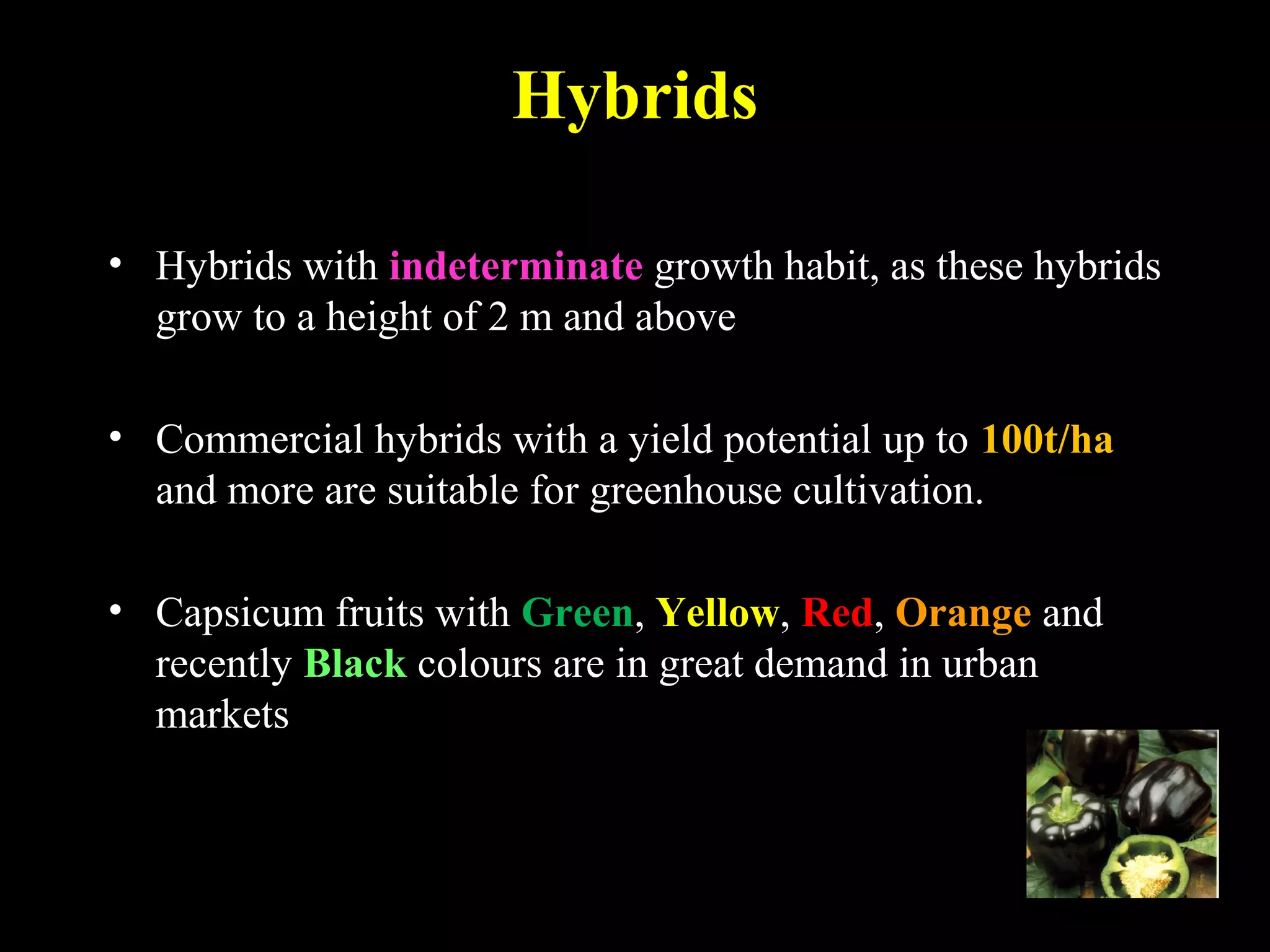
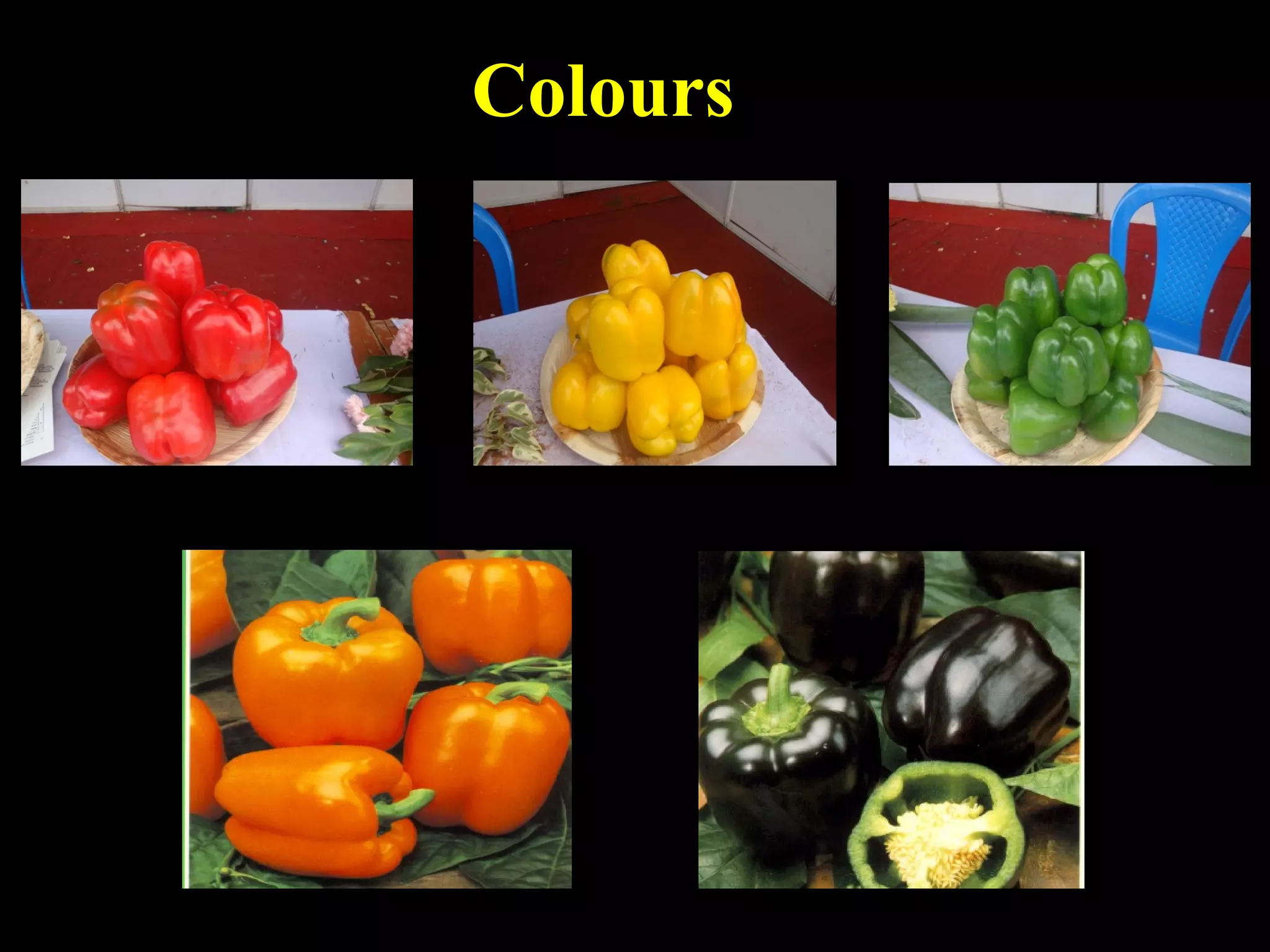
• Capsicum fruits with Green, Yellow, Red, Orange and
recently Black colours are in great demand in urban
markets
Colours
SELECTION OF VARIETIES
• Thick fleshed best for roasting and cooking,
• thinner - suitable for eating as raw.
• Four lobbed peppers with square shapes are more suitable
• Green and violet are the strongest in flavour
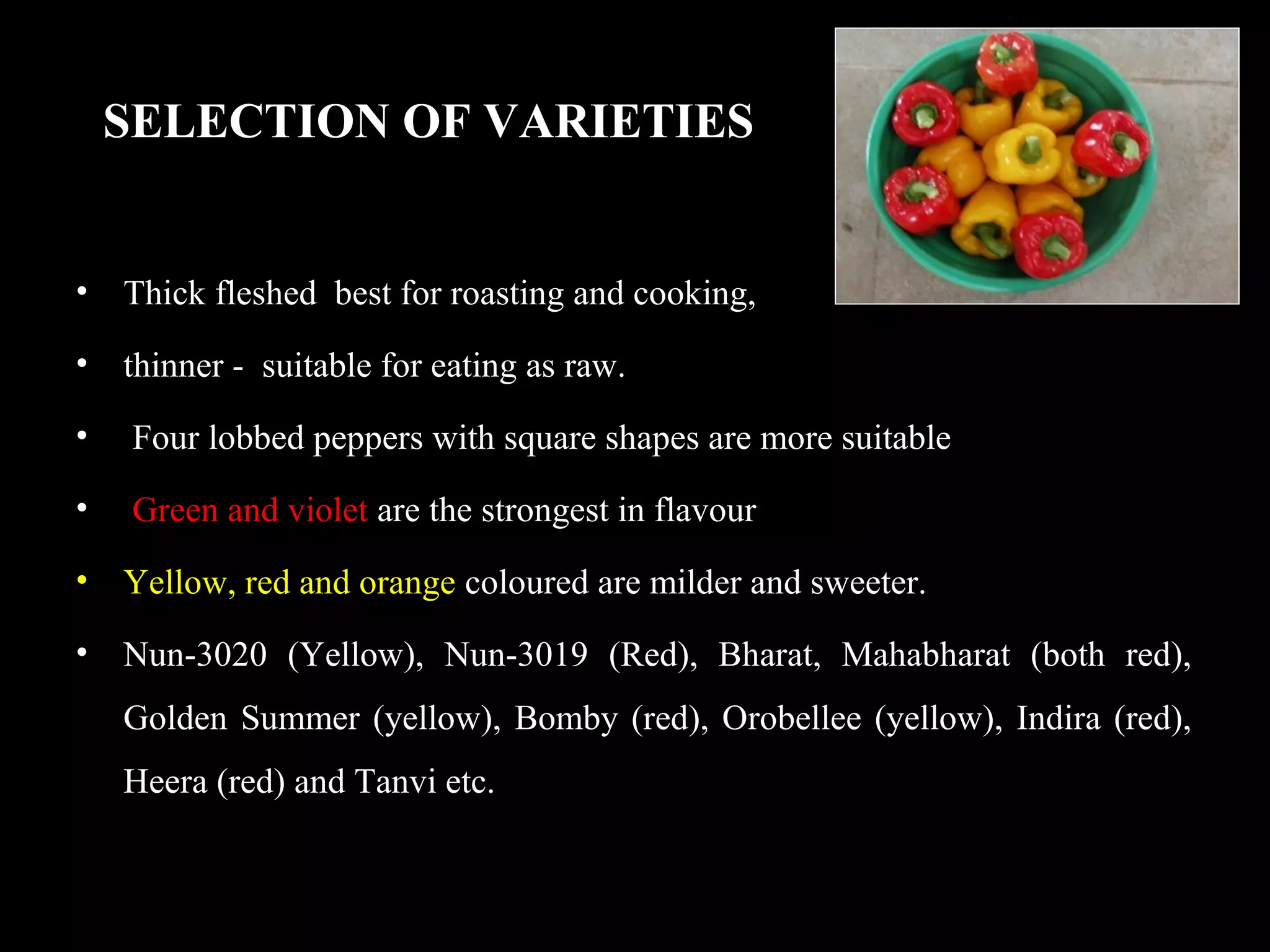
• Yellow, red and orange coloured are milder and sweeter.
• Nun-3020 (Yellow), Nun-3019 (Red), Bharat, Mahabharat (both red),
Golden Summer (yellow), Bomby (red), Orobellee (yellow), Indira (red),
Heera (red) and Tanvi etc.
IIHR, Bangalore
• Indeterminate plant habit
• Thick fleshed, 2-3 lobed conical
fruits
• Average fruit weight 50-80 g
• Yield potential -16 t/ha
• Duration -150 days.
• Suitable for long distance
transport
• Indeterminate plant habit with
green foliage
• Thick fleshed, 3-4 lobed green
blocky fruits
• Average fruit weight 130-150 g
• Fruits erect which turn orange
yellow on ripening
• Yield potential -16 t/ha
• Duration -150 days
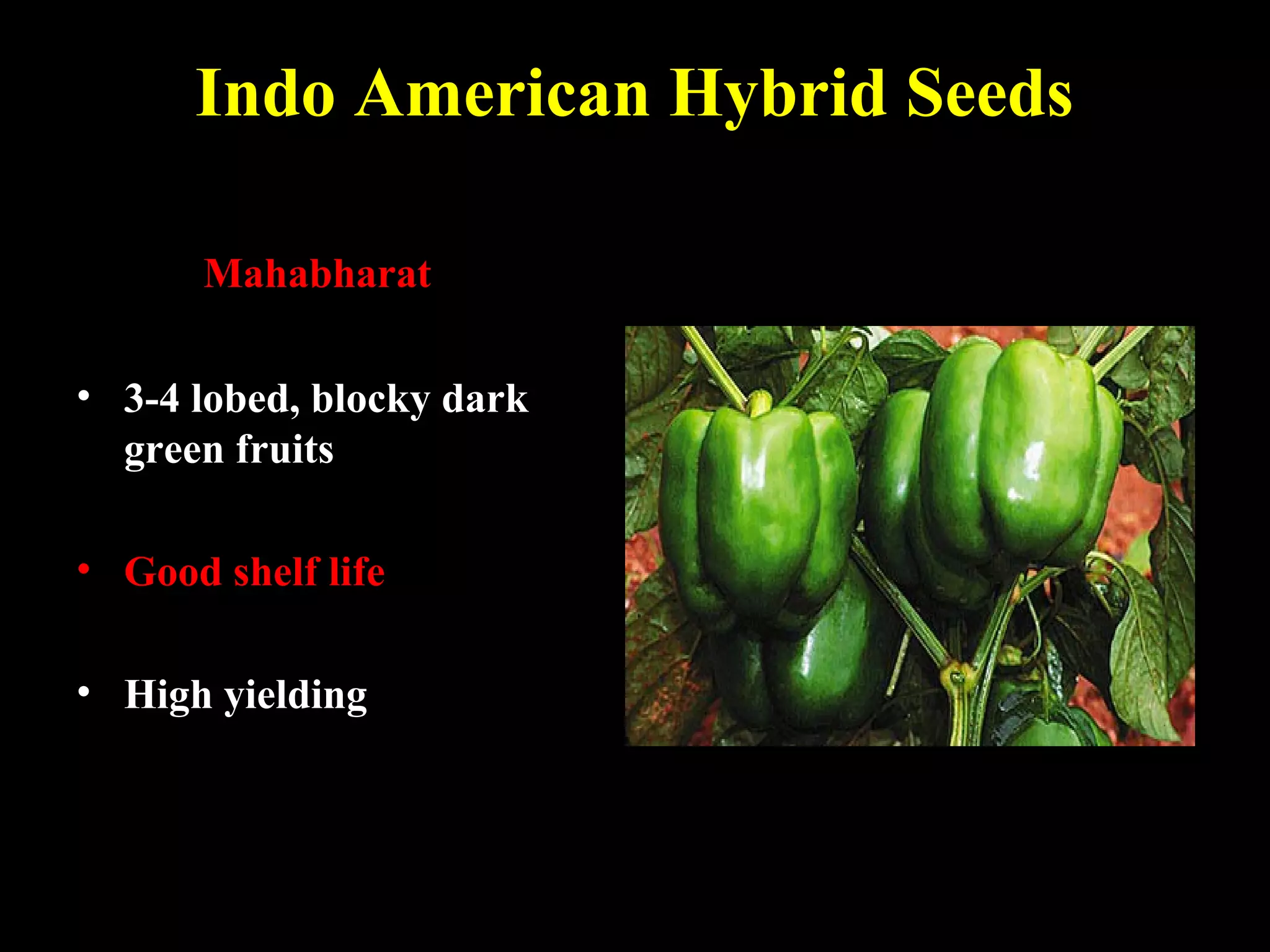
Indo American Hybrid Seeds
Mahabharat
• 3-4 lobed, blocky dark
green fruits
• Good shelf life
• High yielding
INDIRA
• Fruit is dark green, thick-walled and glossy
• Average weight 170 g (12 x 10 cm)
• Having 3 - 4 lobes
• Longer shelf life
• Ideal for long distance transportation
• High export potential
OROBELLE
• Fruits are blocky, almost square (10 x 9 cm) with a
medium-thick wall.
• Average fruit weight is 150 g
• Suitable for green house cultivation
syngenta
NS 280
Relative days to
maturity
: 70 - 75
Fruit colour : Green to red
Fruit size (g) : 200-230
Fruit shape : blocky
Plant habit : vigorous
Remarks : Very good quality
fruits, suitable for
Red fruit harvest
Namdhari seeds
NS 281
Relative days to
maturity
: 65 - 70
Fruit colour : Green to Yellow
Fruit size (g) : 200-220
Fruit shape : blocky
Plant habit : vigorous
Remarks : Very good keeping
quality, turns to
Yellow on maturity
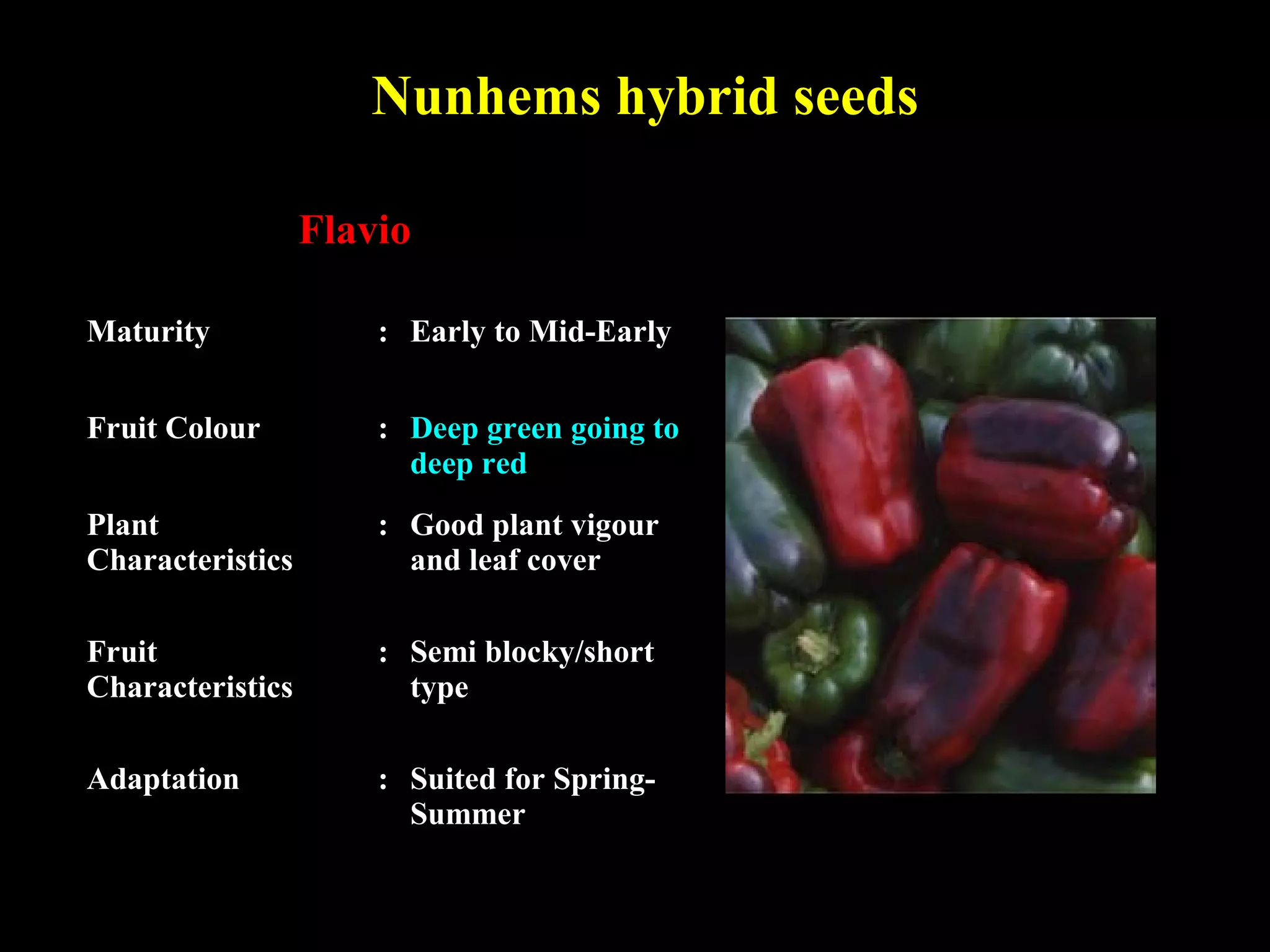
Nunhems hybrid seeds
Flavio
Maturity : Early to Mid-Early
Fruit Colour : Deep green going to
deep red
Plant
Characteristics
: Good plant vigour
and leaf cover
Fruit
Characteristics
: Semi blocky/short
type
Adaptation : Suited for Spring-
Summer
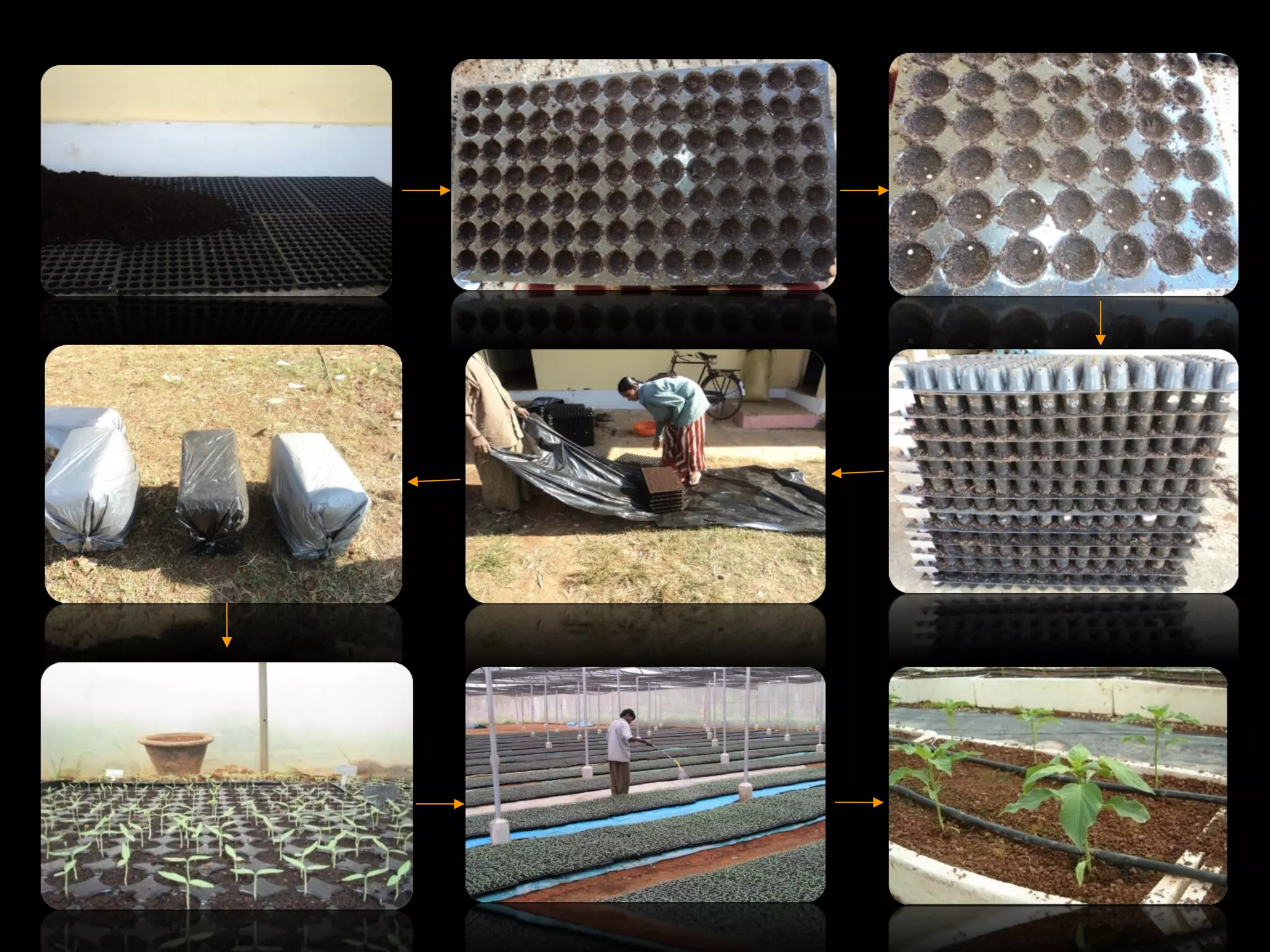
Nursery
• Pro-trays (98 cells) are filled with growing medium and tapped
gently to fill the cells properly
• Shallow depressions of about 5mm depth are made in each cell
• Commercial cocopeat having enough moisture is used, no
irrigation is required till seeds germinate
• Filled trays are staked one above the other and covered with a
plastic sheet to create warmth and humidity require for
germination
• Seedlings are raised in seedling trays placed inside a net house
or polyhouse
Growing beds
• Digging loosens the soil, then clods are broken and soil is
brought to fine tilth
• Beds of 100 cm width and 15 cm height are prepared leaving
50 cm working space between the beds
• Well decomposed organic manure, at the rate of one bamboo
basket per square meter of the bed is added, mixed
thoroughly and the beds are levelled
• In heavy soils mixing sand up to 25% is required to
provide aeration at the root zone
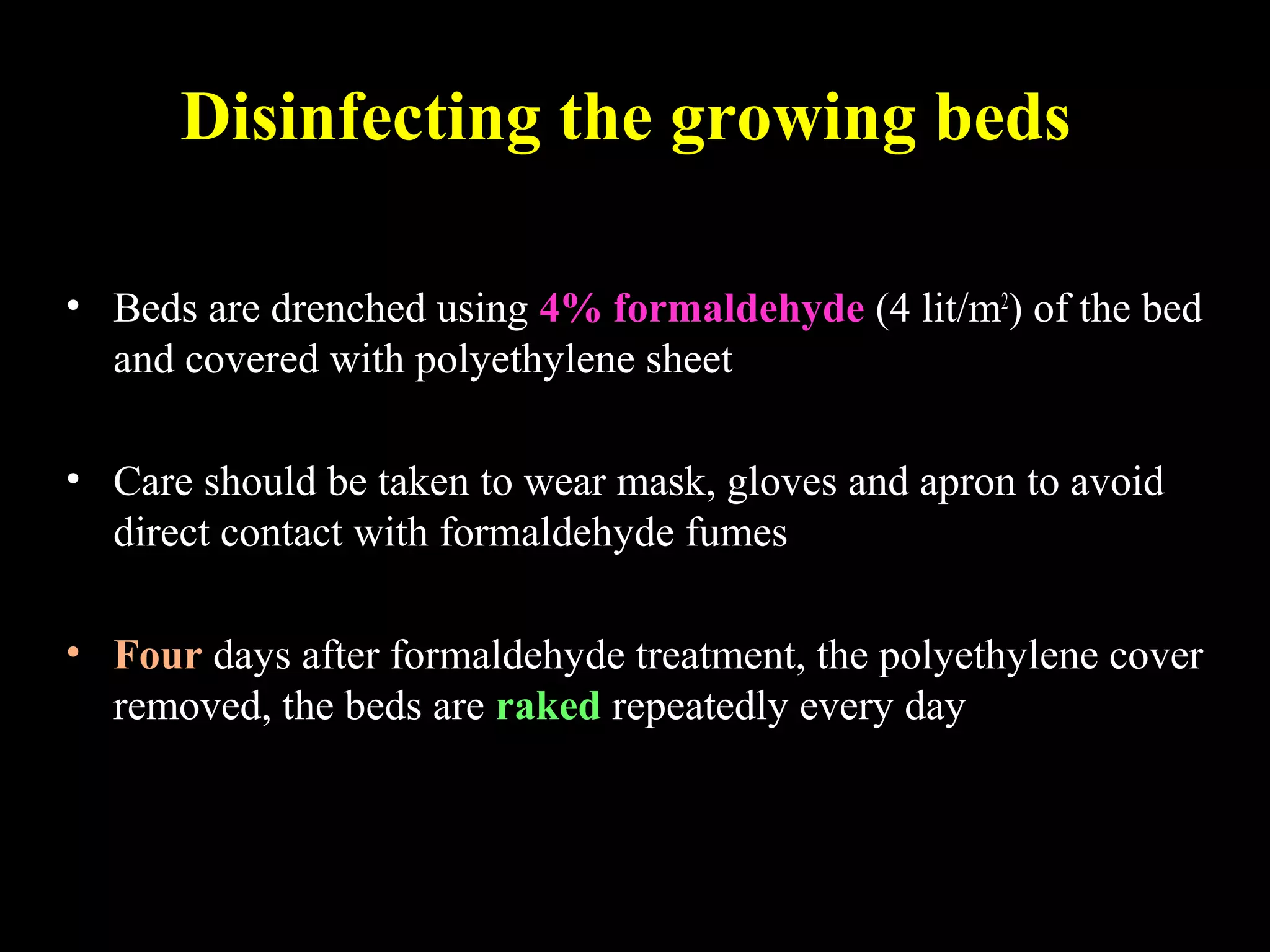
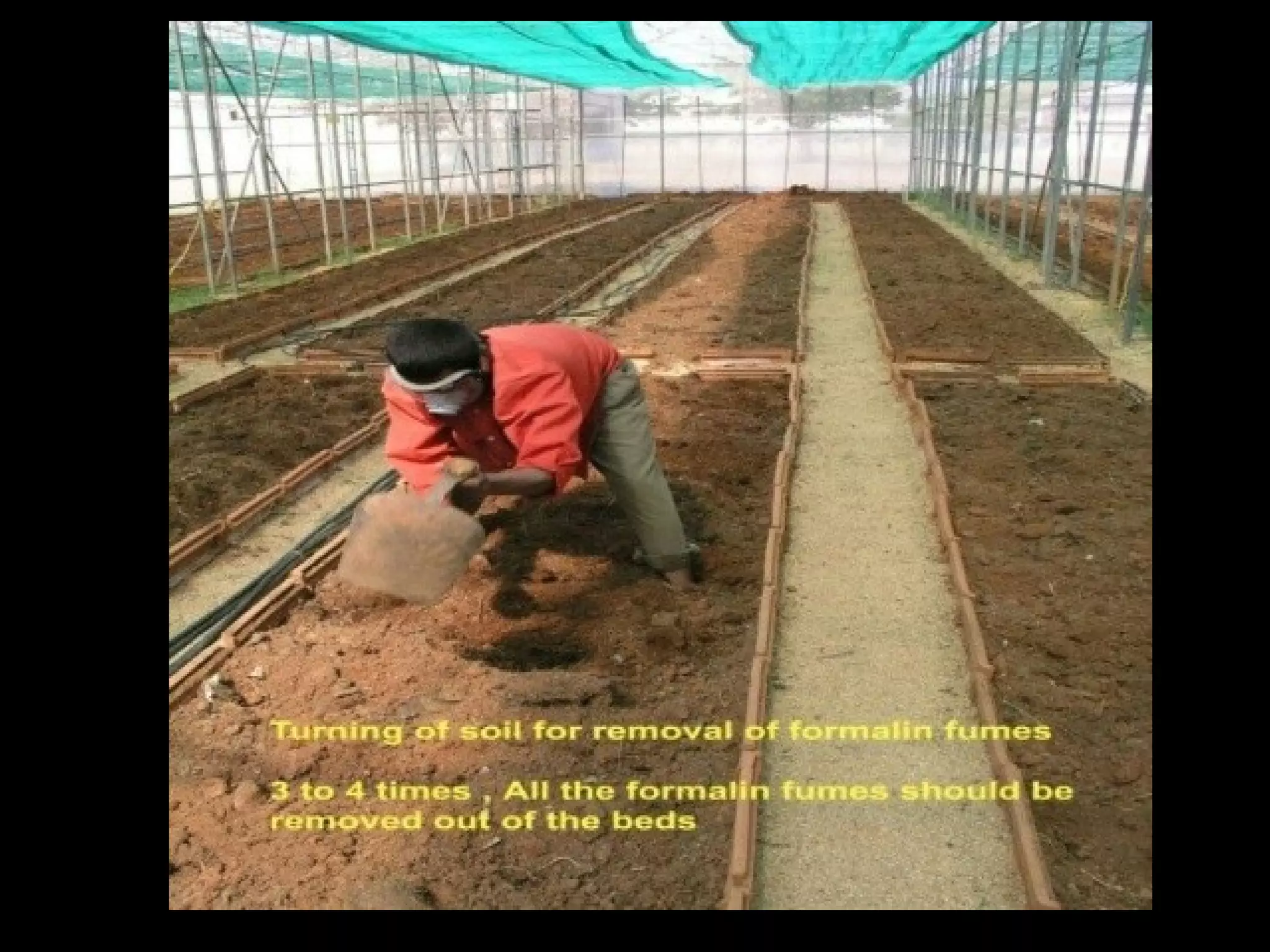
Disinfecting the growing beds
• Beds are drenched using 4% formaldehyde (4 lit/m2
) of the bed
and covered with polyethylene sheet
• Care should be taken to wear mask, gloves and apron to avoid
direct contact with formaldehyde fumes
• Four days after formaldehyde treatment, the polyethylene cover
removed, the beds are raked repeatedly every day
Application of neem cake and Trichoderma
• Neem cake is slightly watered to moisten and kept for two days,
and then it is mixed with Trichoderma formulation at the rate of
1 kg/100kg neem cake
• Mixture is closed with plastic sheet and turned thoroughly on
alternate days
• After 15 days, the neem cake + Trichoderma formulation will be
ready for application
• Neem cake plus Trichoderma formulation is applied before
planting but after formaldehyde fumes are exhausted completely
@ of 200 g/ m2
Fertilizer application
• Commercial fertilizers supplying 50:50:50 N:P2O5:K2O
kg/ha, are applied to the growing beds
• Two furrows are opened in the growing beds and
fertilizer mixture is applied in the furrows and furrows
are closed
Laying of drip line
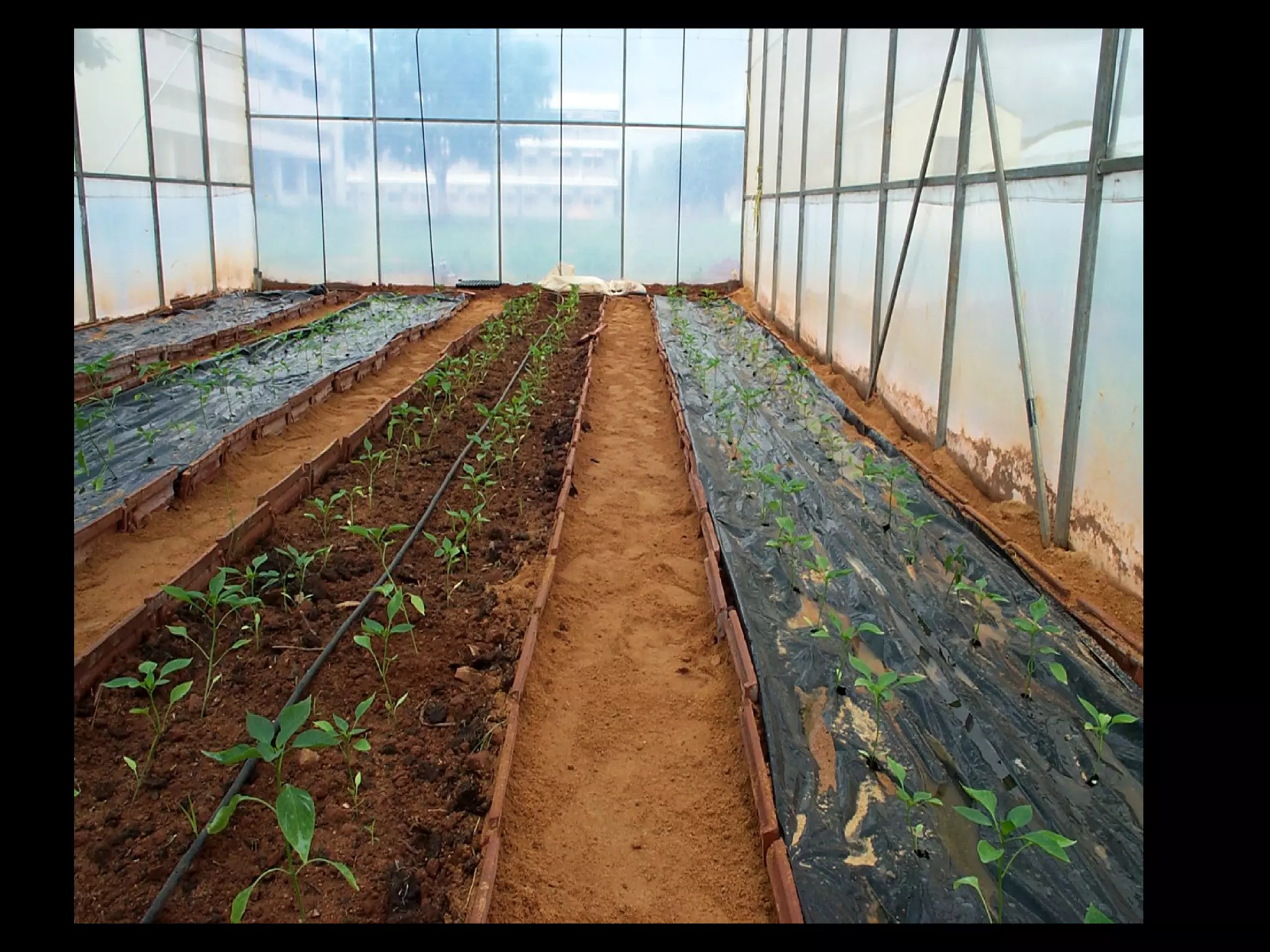
• Place one inline drip lateral at the centre of the bed
• Inline lateral having an emitting point for every 30
cm interval with discharge of 2 L/hr.
• Run drip system with water to check each emitting
points for uniform discharge of water
Mulching
• 100 micron thick polyethylene mulch film of 1.2 m width is
used to cover the planting bed
• Holes of 5 cm diameter are made on the mulch film as per
recommended spacing (45 x 30 cm)
• The planting beds are covered with the mulch by securing the
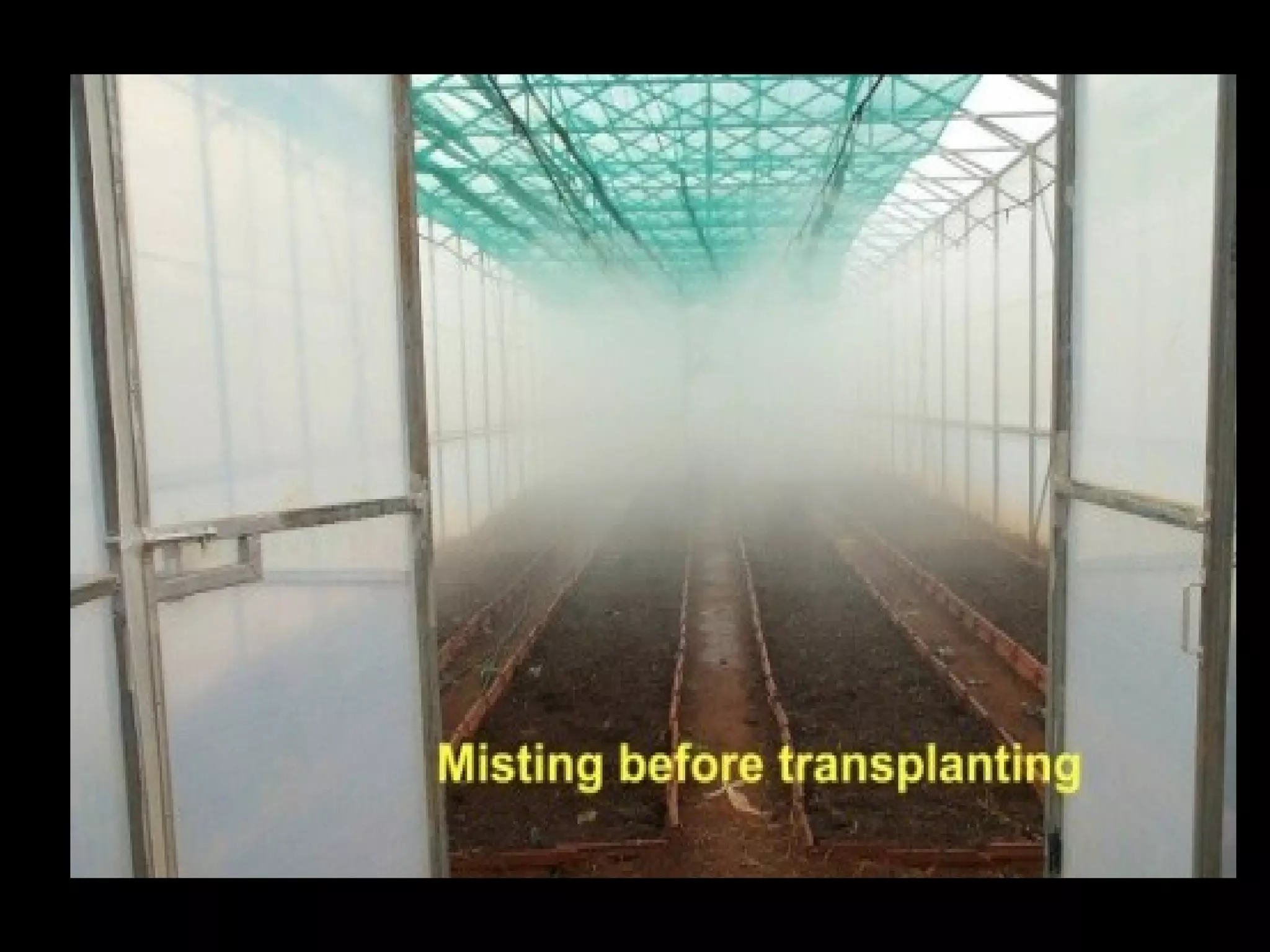
edges of the sheet firmly in the soil
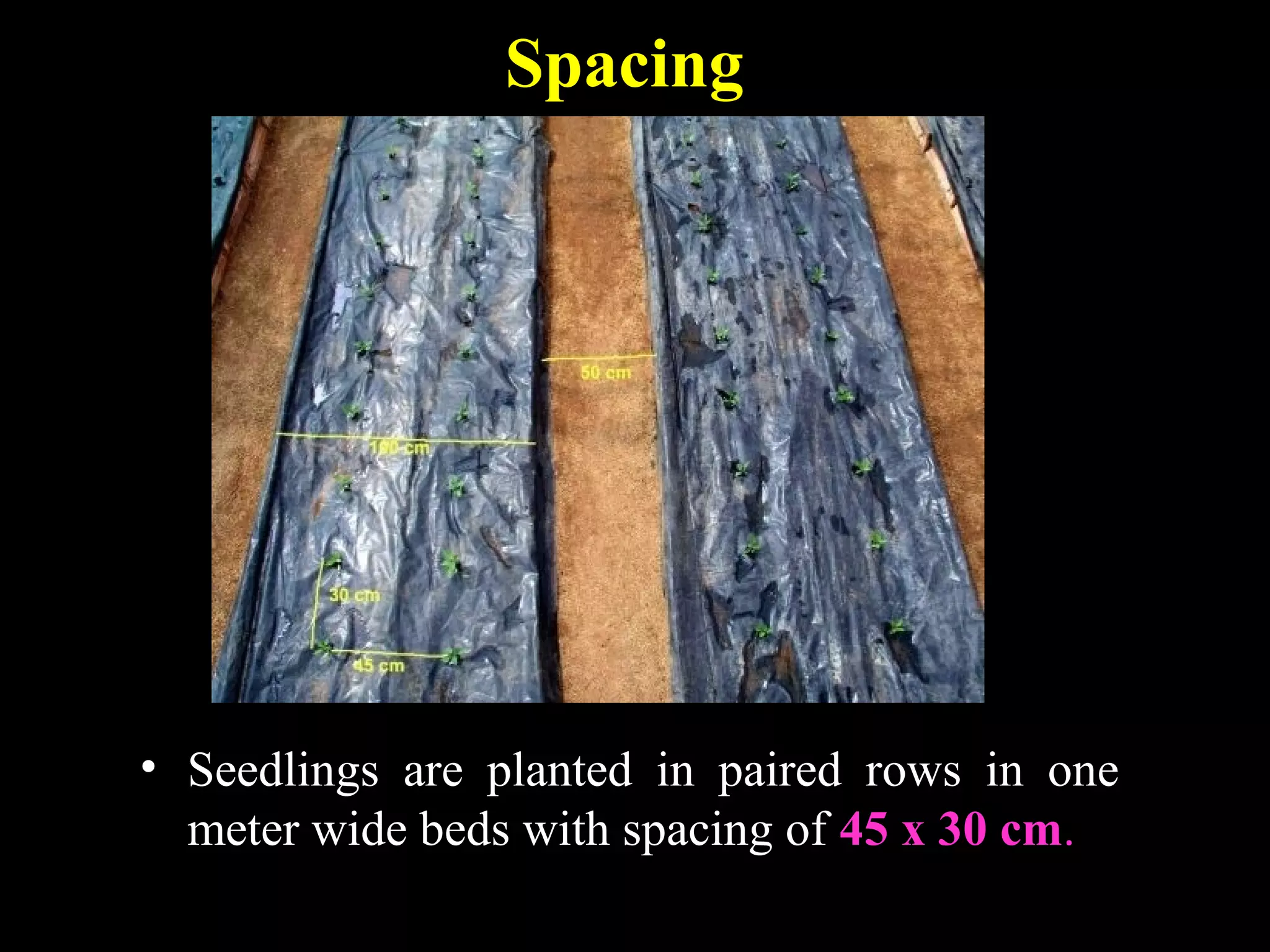
Spacing
• Seedlings are planted in paired rows in one
meter wide beds with spacing of 45 x 30 cm.
Transplanting
• Seedlings of 30-35 days old, vigorous and uniform sized are selected
• Early morning hours or preferably in the evening
• Capsicum seedlings are planted in the holes made in the polyethylene
mulch film so that the seedlings do not touch the film
• Watering the beds is done daily with a rose can till the seedlings get
established well
• Drenching with 0.3% COC if mortality of the seedlings is noticed
Irrigation
• Drip irrigation starts 10 days after transplanting
• Drip irrigation is given daily to supply 2-3 litres of water per
square meter per day depending on local weather condition
• Capsicum extract 70-80% of water used from a depth of
0-30 cm
• Bell pepper requires 110 cm of water (Hedge, 1993)
Fertigation
• Water soluble fertilizers supplying 19% each of N, P2O5
andK2O is used at the rate of 2.25 g/m2
for every
fertigation, given twice a week
• Capsicum crop is sprayed with micronutrient formulation
(3g/l) 2-3 times once in 30 days starting from 60 days after
transplanting
• Capsicum is found to be susceptible to calcium deficiency
• The crop is fertigated 2-3 times with CaNO3once in 15
days if calcium deficiency is noticed
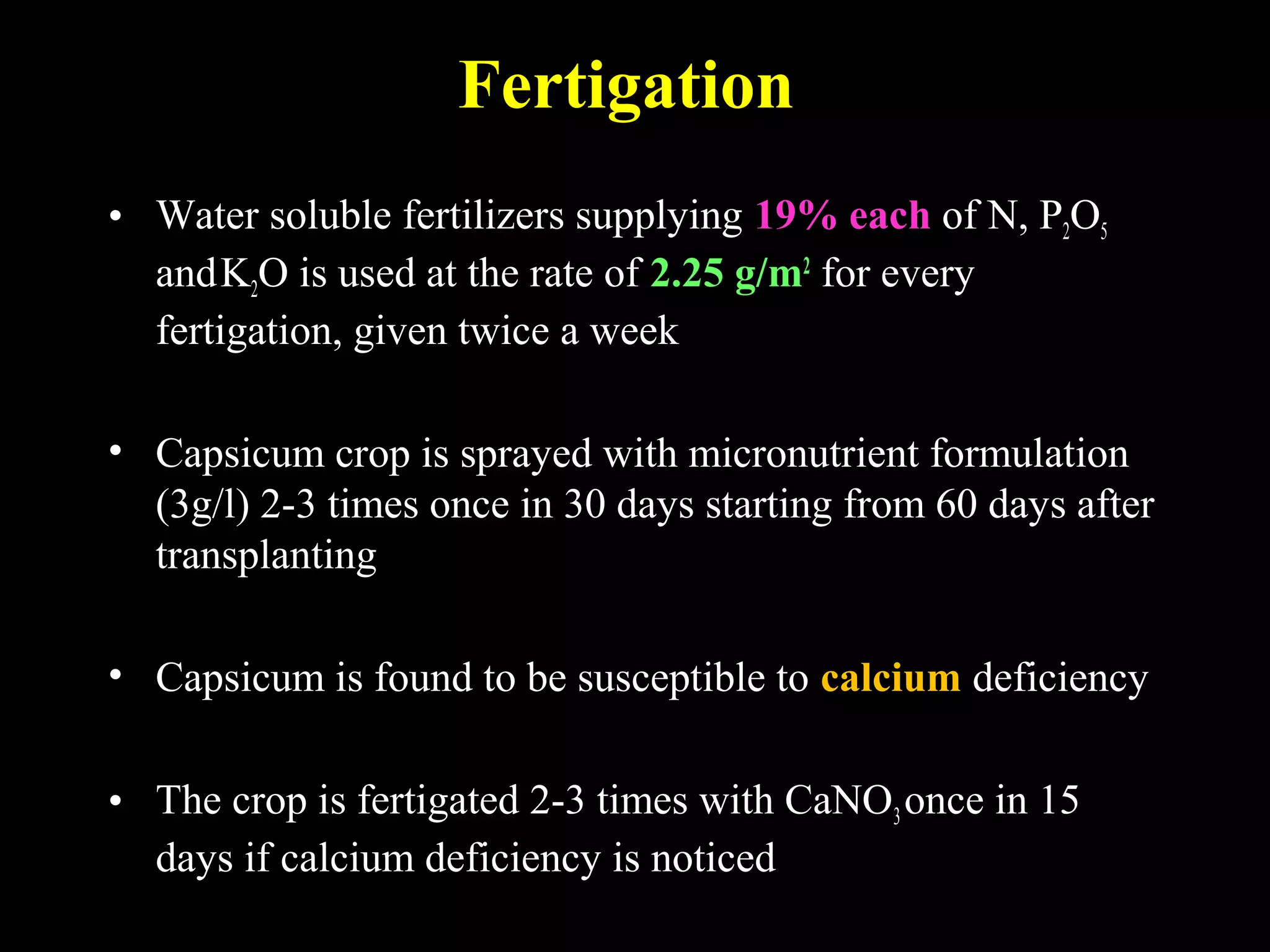
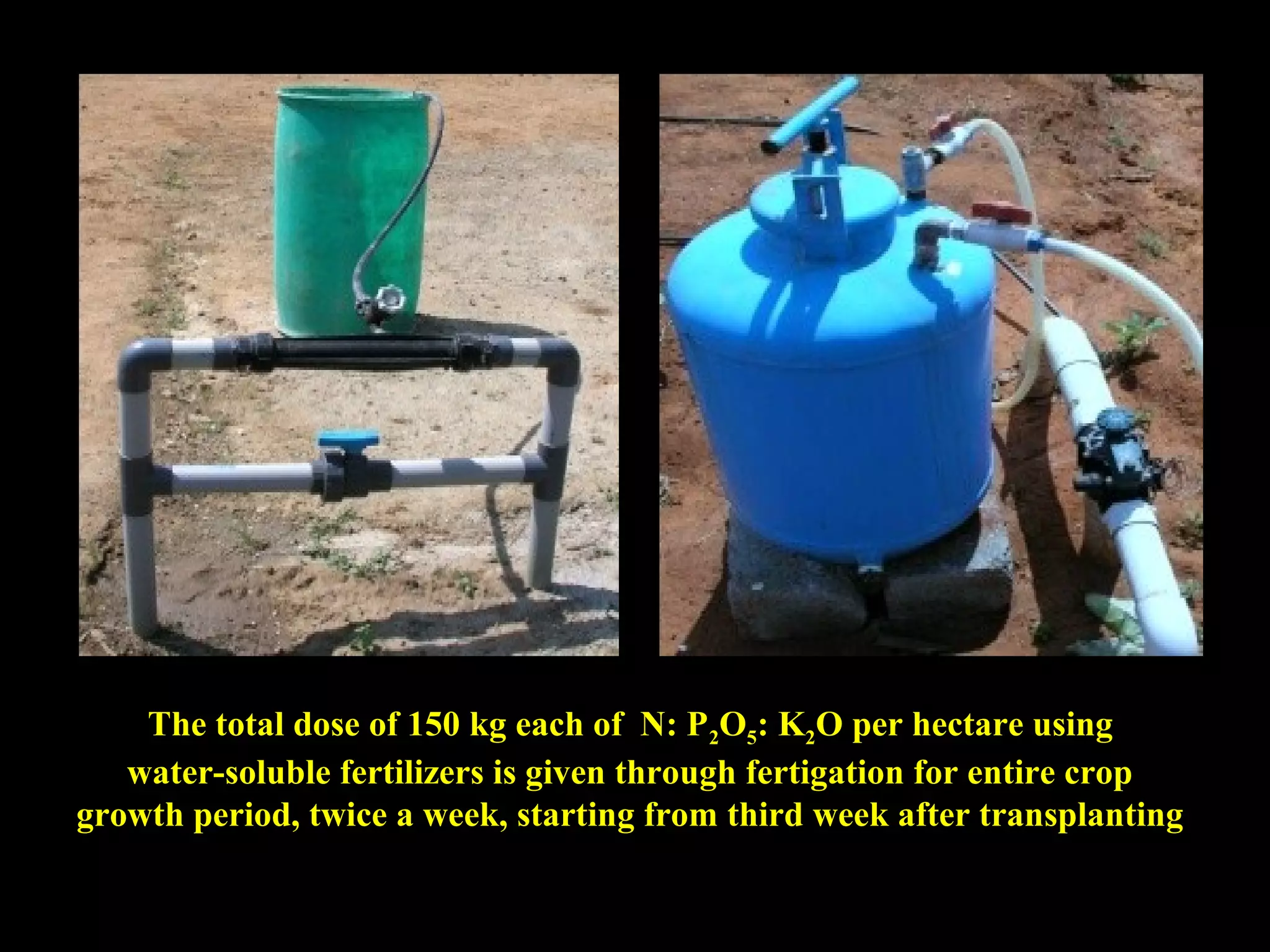
The total dose of 150 kg each of N: P2O5: K2O per hectare using
water-soluble fertilizers is given through fertigation for entire crop
growth period, twice a week, starting from third week after transplanting
Other methOds Of cultivatiOn
Cultivation of capsicum in polybags
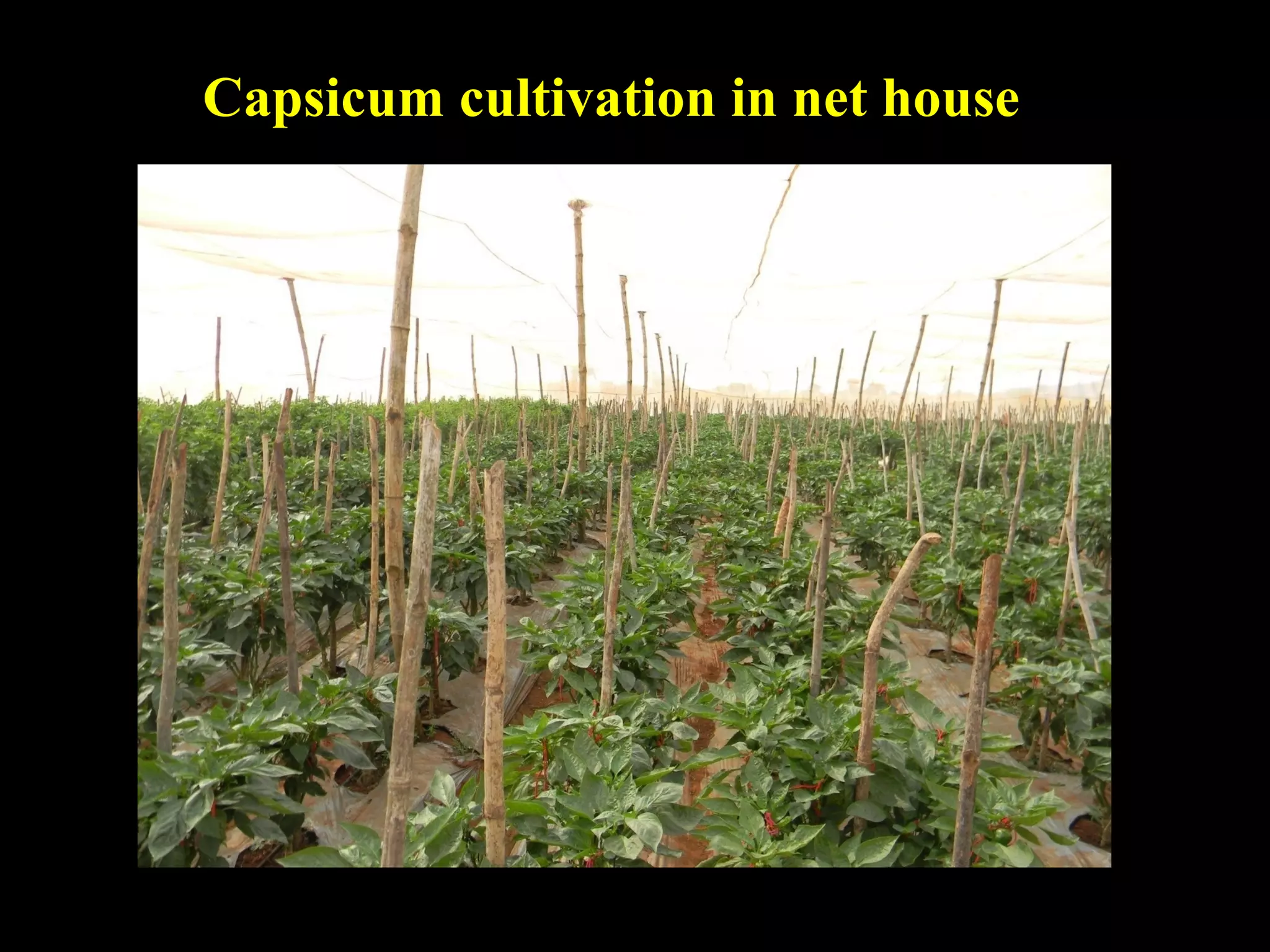
Capsicum cultivation in net house
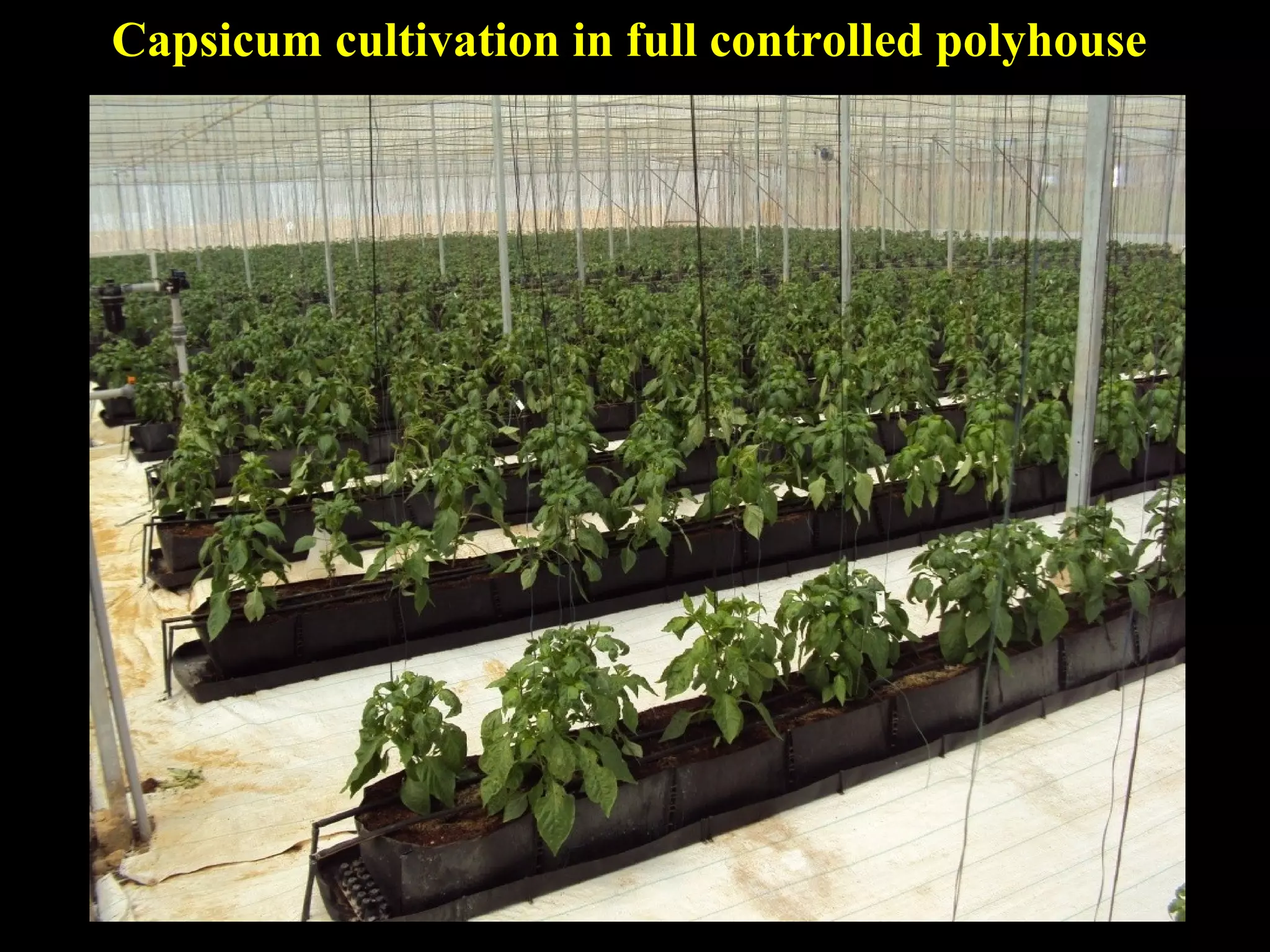
Capsicum cultivation in full controlled polyhouse
The nutrient film technique
(NFT)
The closed insulated pallet system
(CIPS)
Pruning
• Capsicum plants are pruned to retain four stems.
• Pruning is done at weekly interval starting from 15 to 20 days
after transplanting. From 4th month onwards once in 10 days.
• Plants show dichotomous branching.
• The tip of the plant splits into two at 5th or 6th node on 15
to 20 days after transplanting (DAT). These two branches
again split into two giving rise to four branches by 25 to 30
DAT.
Operations
Pruning
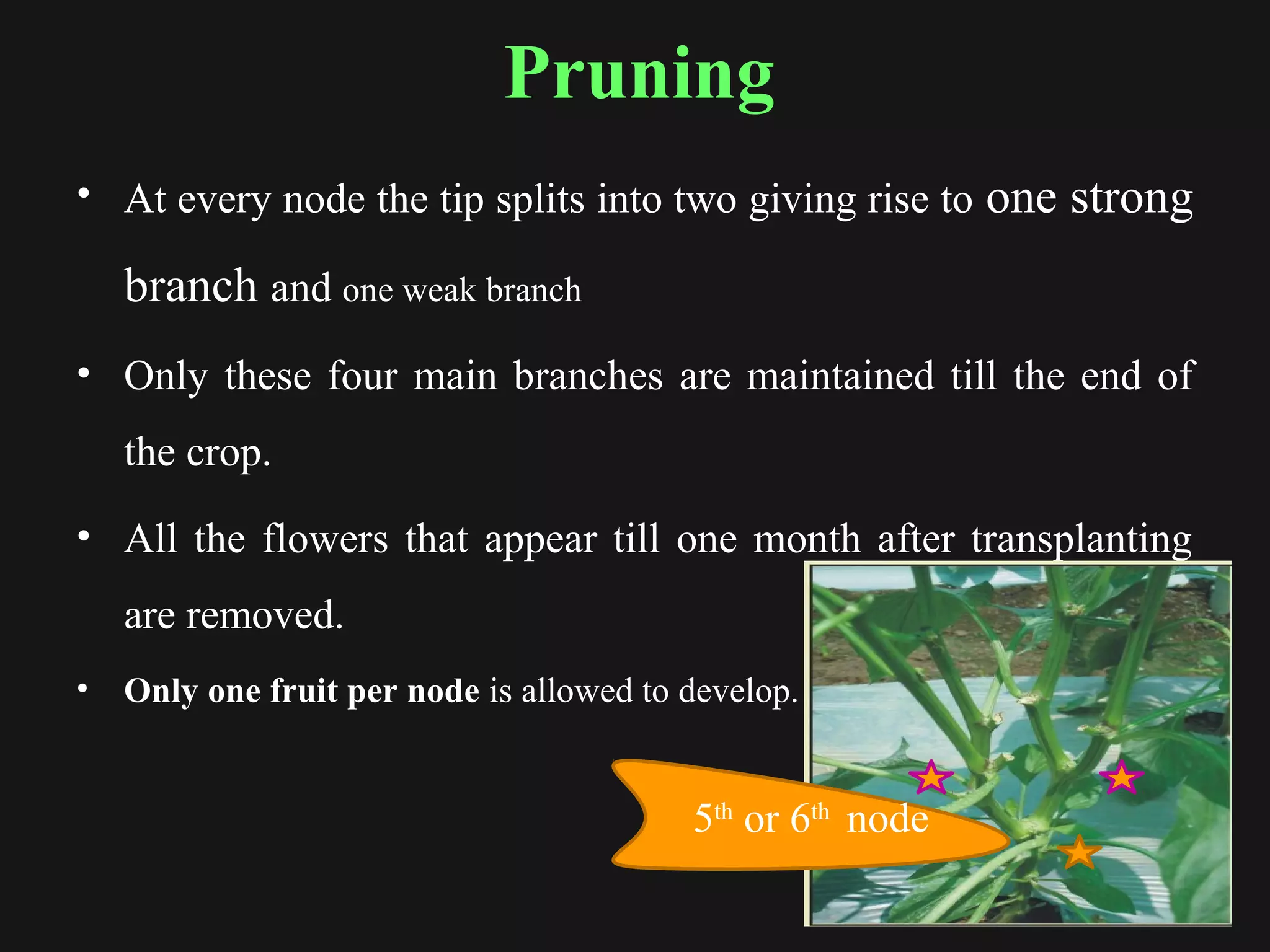
• At every node the tip splits into two giving rise to one strong
branch and one weak branch
• Only these four main branches are maintained till the end of
the crop.
• All the flowers that appear till one month after transplanting
are removed.
• Only one fruit per node is allowed to develop.
5th
or 6th
node
PRUNING IN CAPSICUM
All the shoots appearing at the base of the plants are removed, as they are
not productive.
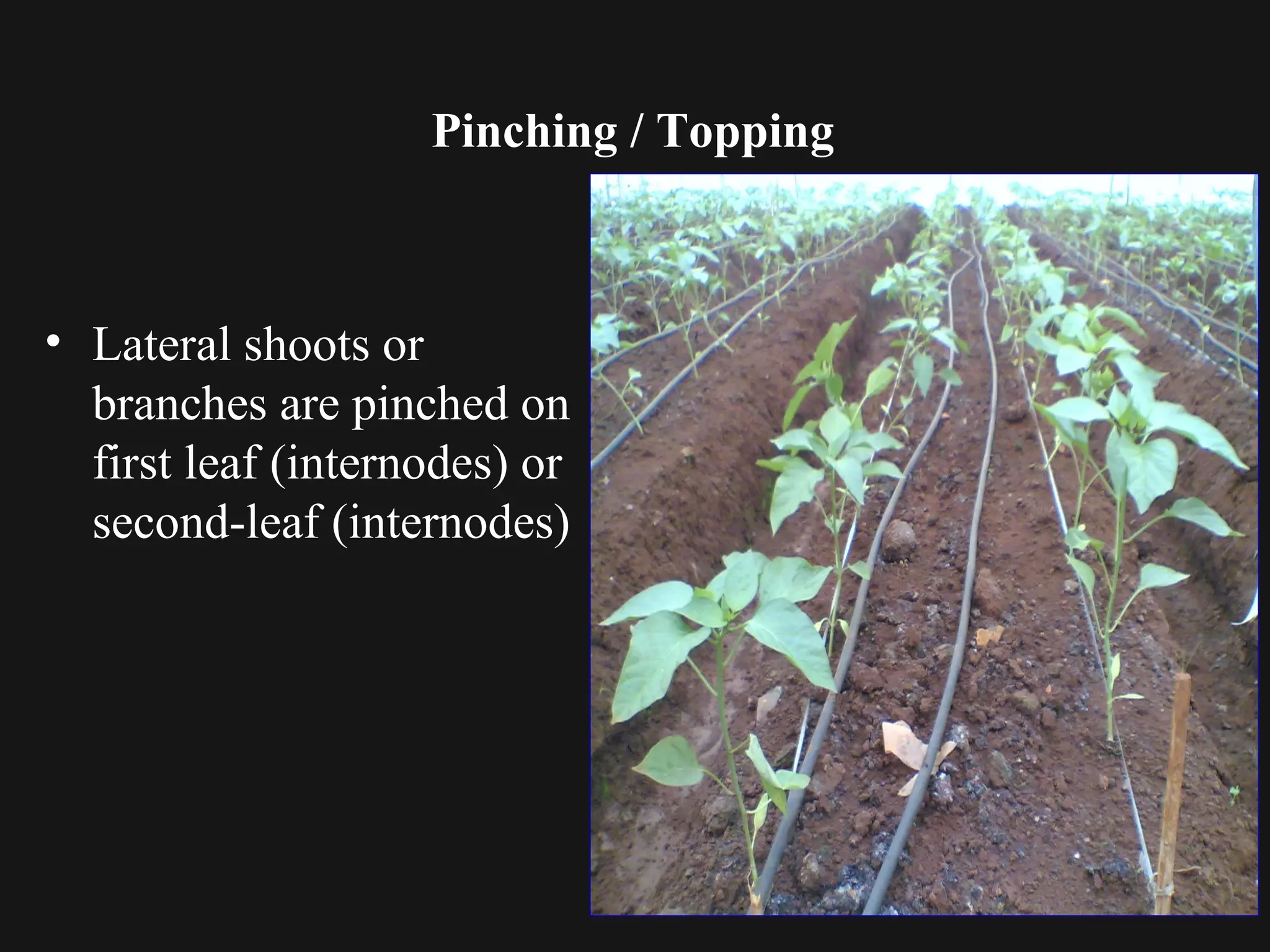
Pinching / Topping
• Lateral shoots or
branches are pinched on
first leaf (internodes) or
second-leaf (internodes)
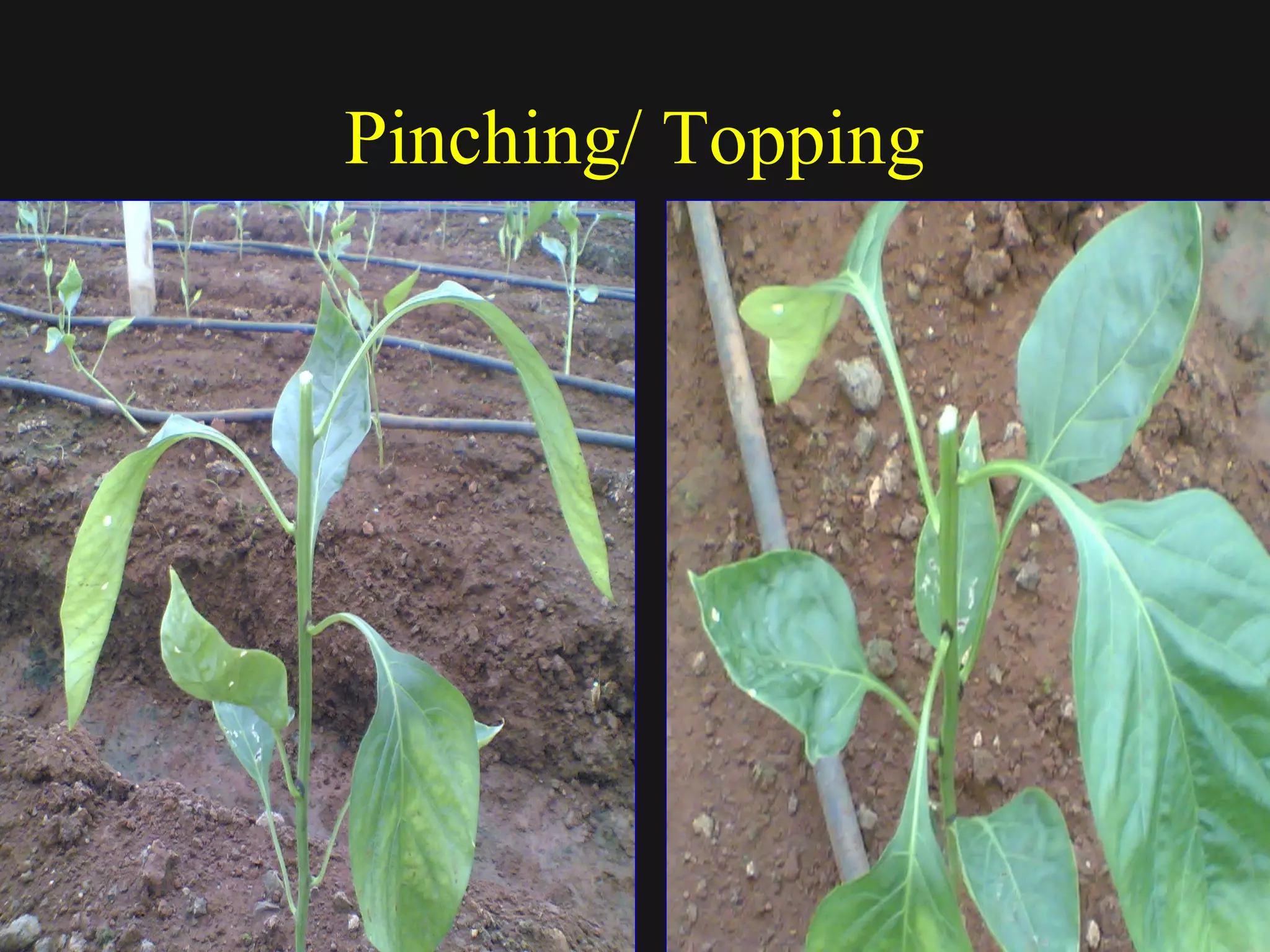
Pinching/ Topping
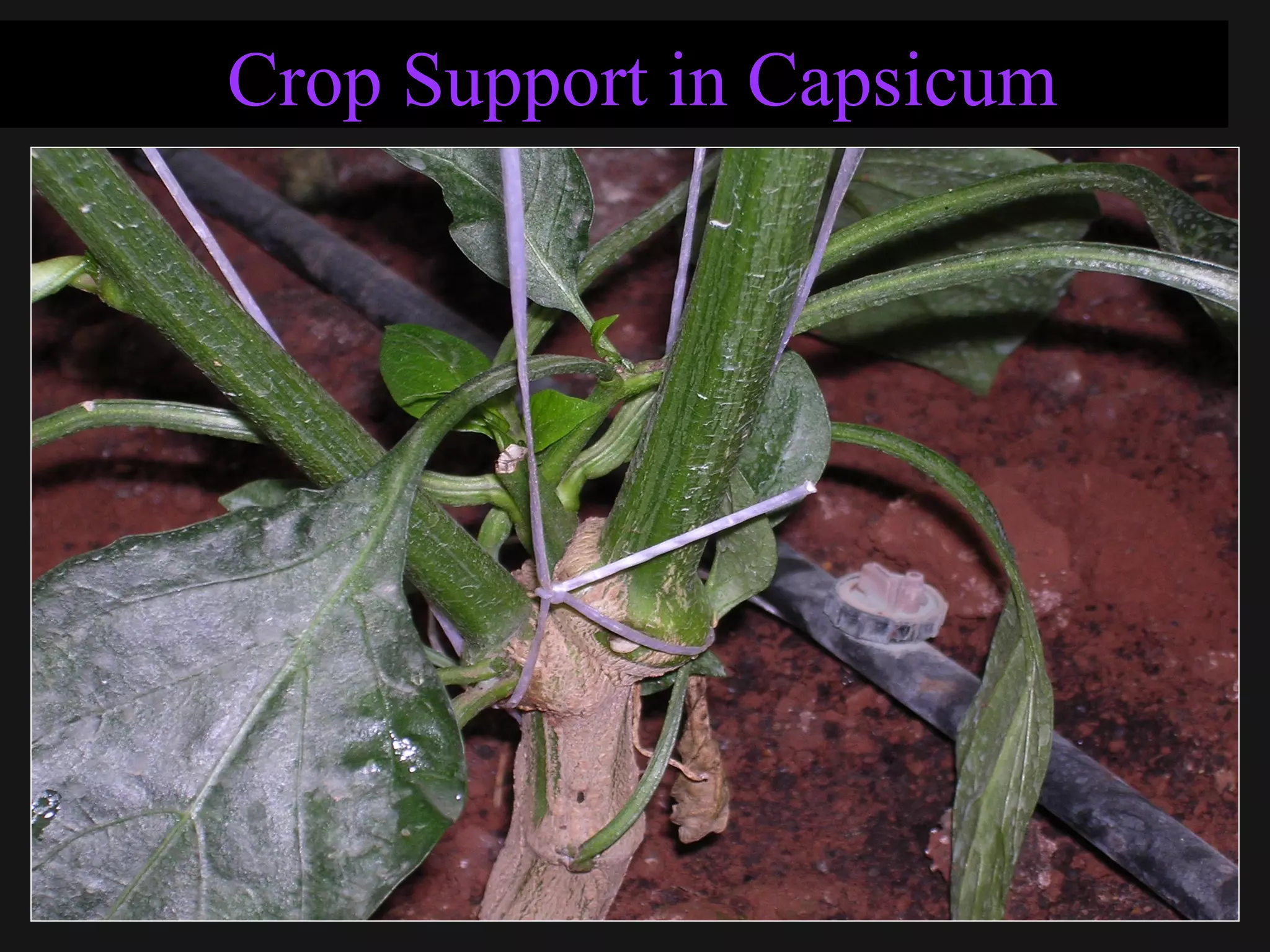
Crop Support in Capsicum
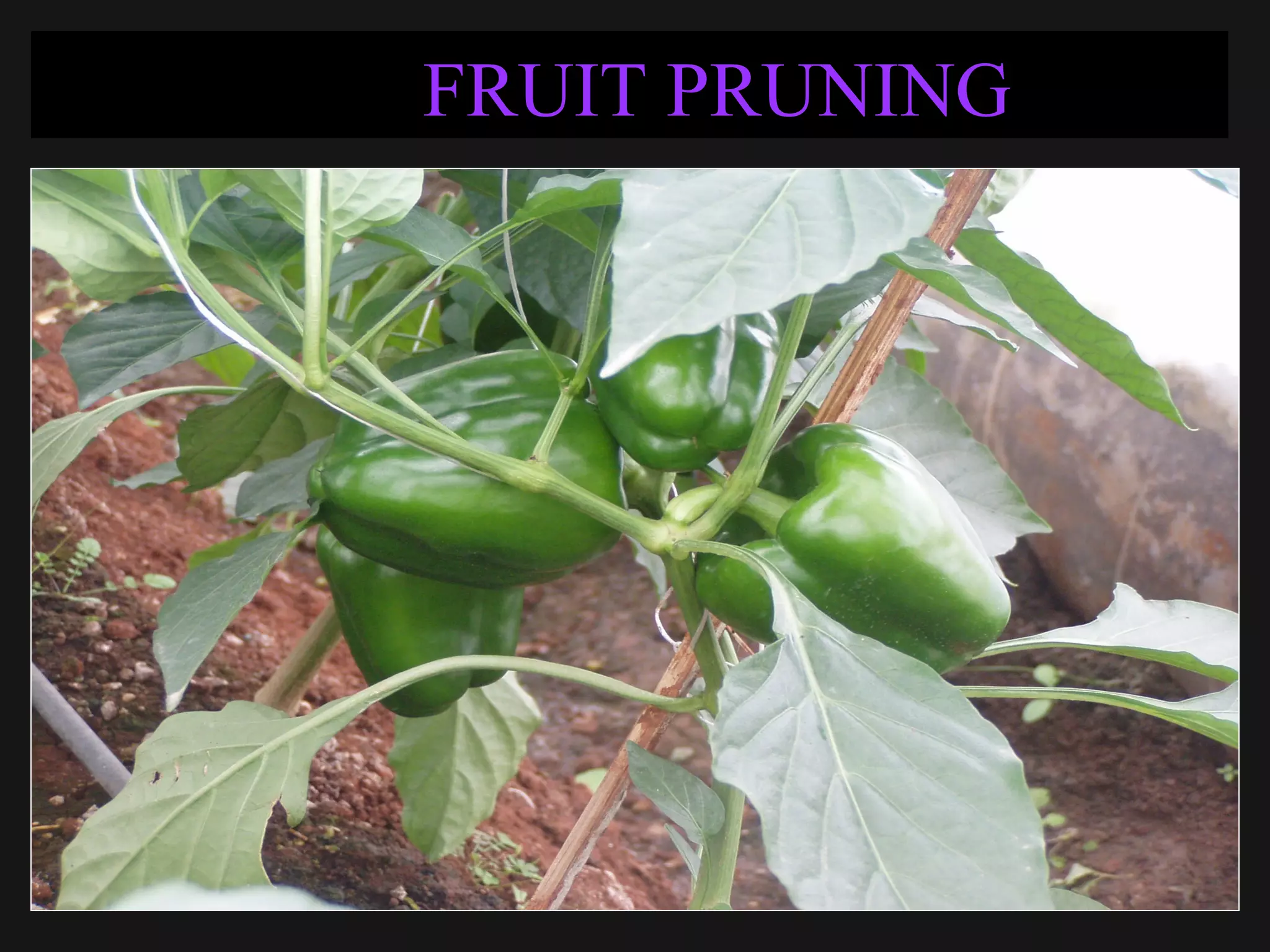
FRUIT PRUNING
Training
• The plants are trained along a plastic twine. Each branch
should have a separate plastic twine to train along.
• The plastic twines are tied to the GI wire grid provided at 2.5
to 3.0 meter height and then to the base of the plant.
• Tying plants to the plastic twine starts from 6th week after
planting at 20 days interval.
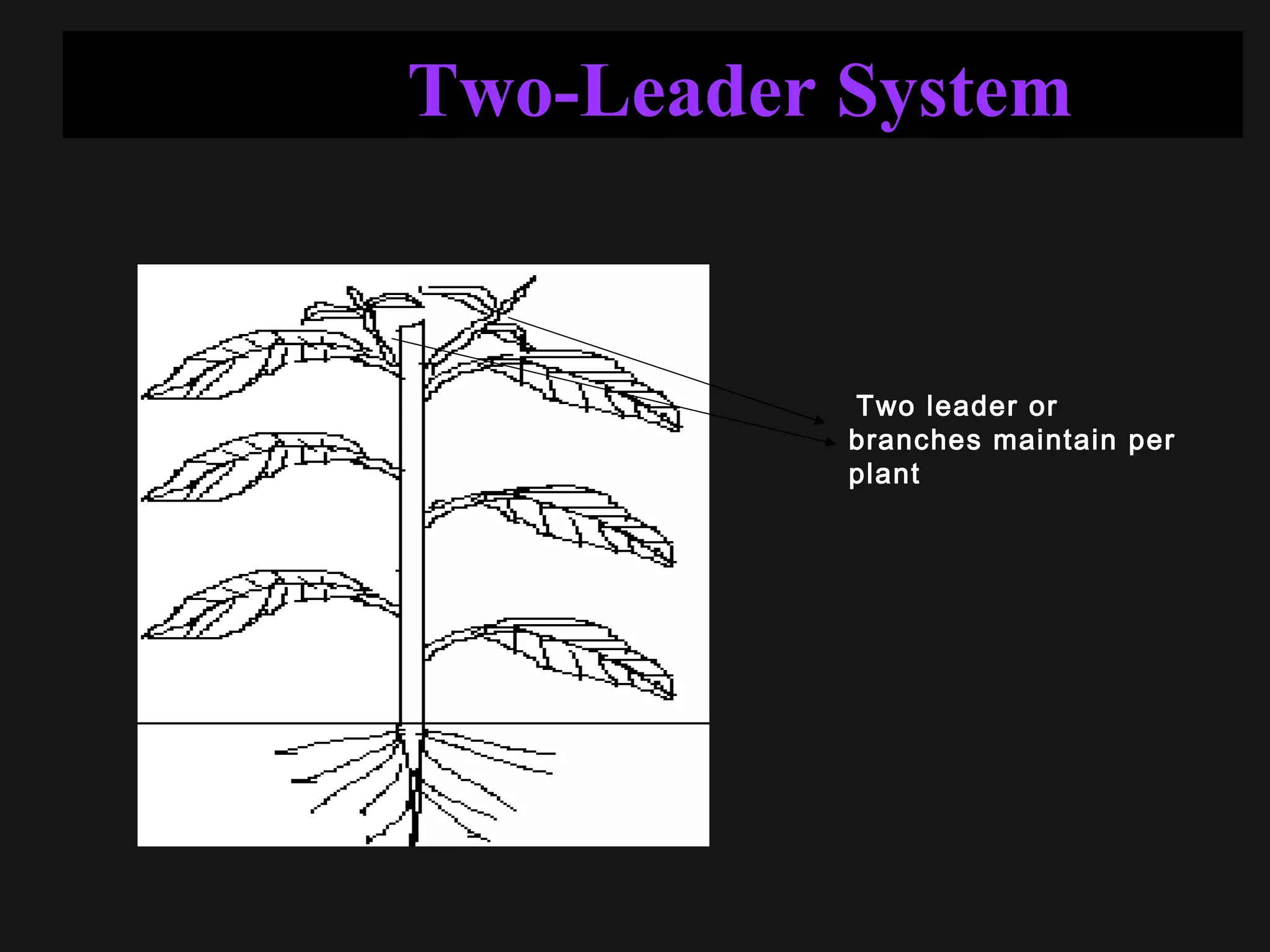
Two-Leader System
Two leader or
branches maintain per
plant
Four-Leader System
Four leader or branches
maintain per plant
Diff. Between Four & Two Leaders
Two growing conditions
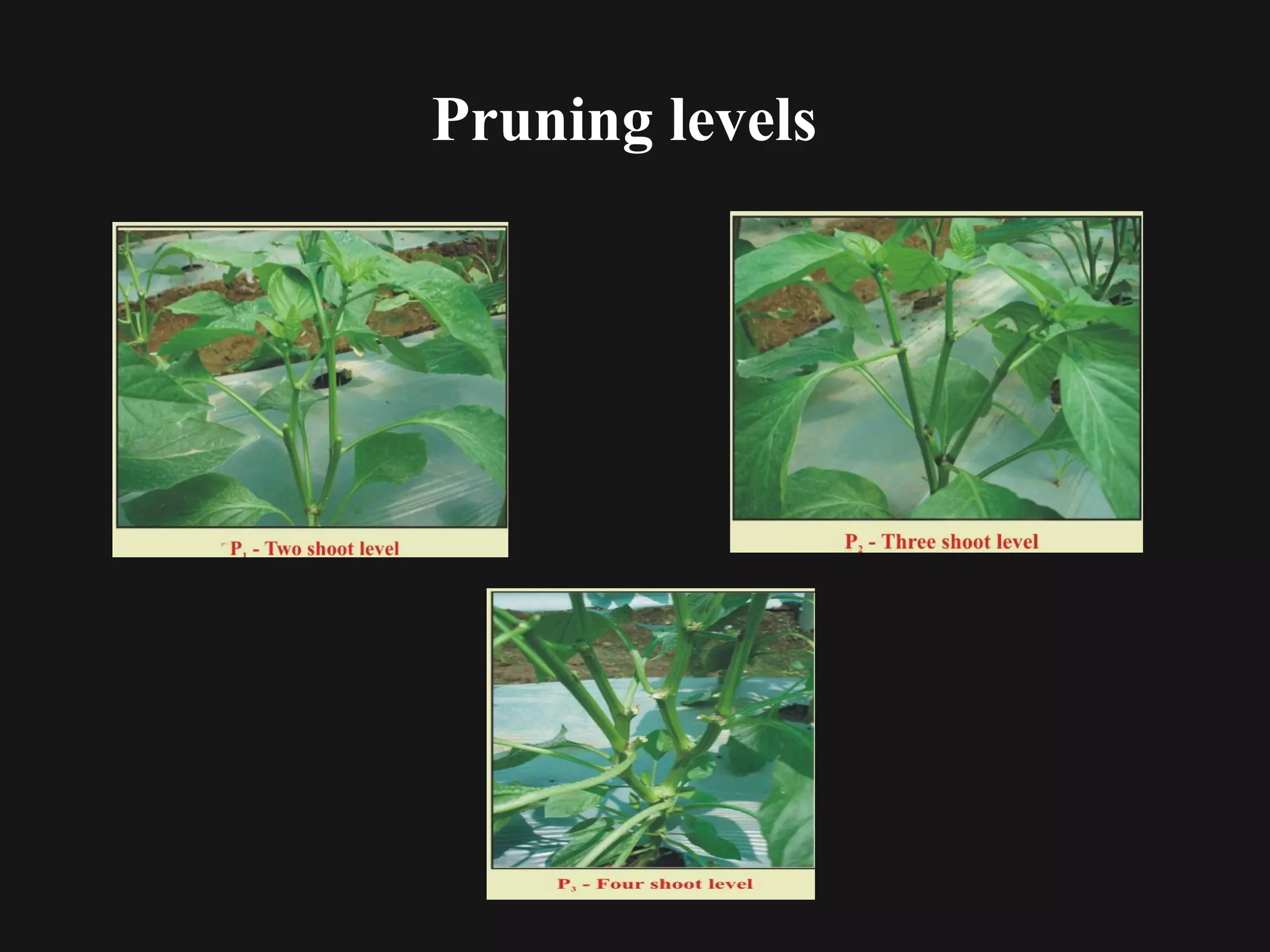
Pruning levels
Number of fruits in different training levels under naturally ventilated
polyhouse
Number of fruits in different training levels under shade house
• 60 days after transplanting - green,
• 80 to 90 - yellow and red fruited hybrids.
• continues up to 170 to 180 days at 10 days interval in green
• up to 240 to 270 days
• Mature green
• Yellow when it is 75% yellow
• Red when it is 100% red
Harvesting
Yield
•100 to 120 t/ha
•10 to 12 kg / m2, 2.25 to 2.70 kg / plant
•Average individual fruit weight 180 g in initial harvests, 100 g in last harvests.
Packing
•Packed in card board boxes/trays using paper shreds as the padding material.
Post harvest handling and storage
•Shrink wrapping each fruit and storing at 7 to 80
C- storability up to 45 to 60
days.
Packing
Disorders
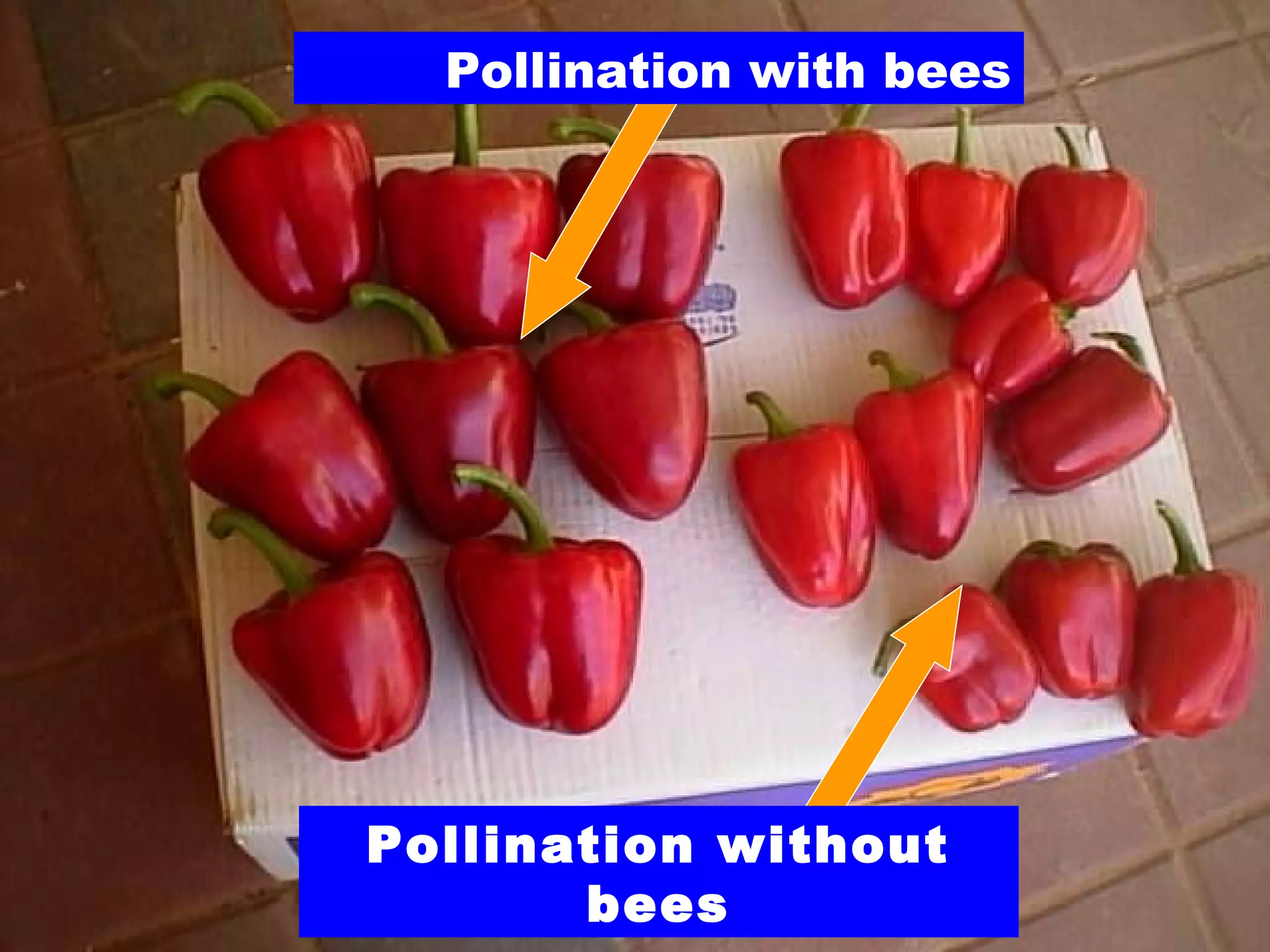
Flat fruits
• Caused by low temperature
• Night temperatures of around
18°C ensure an ideal seed set and
fruit shape
• Low-night temperatures decrease
pollen viability
• Modify flower structure making
self pollination less effective
• Bumblebees for pollination -help
greatly to improve fruit shape
Pollination without
bees
Pollination with bees
Blossom end rot
• Excess of nitrogen &
water stress
• Water soaked area near
blossom end
• Later become light
brown and leathery
• Spraying of 2% CaCl2
Fruit load and fruit growth
• Excess fruit load –cause decaying of roots
• Number of fruits/plant –light, temperature & plant size
• Good light condition - 20 to24 fruits/m²
• Poor light condition - 10 to12 fruits/m²
• 5-9 weeks after fruit set - reach full size
• After 3-4 weeks - full colour
• Total period (full bloom to coloured fruit) -7-12 weeks (45 days)
Flower to Fruit (45 days)
you can see within 4.5 min
Sanitation
• Removal of old and diseased leaves
• Polyhouse or net house and the structure is kept clean without
any plant debries or weeds
• Allowing visitors is discouraged inside the protected structure
as it may allow insect pests and vectors to enter into the
greenhouse
• Provision is made to wash the foot and the hands with KMnO4
solution (0.5%) at the entrance of the protected structure
Diseases of capsicum under protected condition and their management
Disease Symptoms Control
Powdery mildew:
Laveillula taurica
Whitish patches appear on the
leaves, stem and rarely on
fruit.
Karathane (0.1%) Calixin (0.1%)
Sulfex (0.3%)
Fungal Downy Mildew
Peronospora tabacini
pale yellow areas on the upper
sides of the leaves. On the
lower side of the leaf the
downy growth appears in cool
moist weather.
Karathane (0.1%) Calixin (0.1%)
contaf(0.05%),Rubigon(0.025%)
Bacterial diseases
a) Soft rot (Erwinia carotovora)
b) Bacterial spot (Xanthomonas
versicatoria)
Which causes a soft slimy rot.
Which forms a raised rough
pimply area on the fruit, On
the leaves, the spot is first
raised and wart like, and
becomes necrotic spots with
dark margins. The affected
leaves turn yellow and drop.
*Hot water treatments, clean
cultivation
*Streptomycin spray
Viral diseases
a)Leaf curl virus
b) CMV
Yellowing, curling, mottling of
leaves and ultimately death of
plant is seen.
Clean cultivation, vector control,
etc…
Fusarium wilt
Fusarium oxysporum
Yellowing of leaves, Wilting, coller
rot, death of root
COC drench, Carbendizim,
Dithane M-45
Pests of capsicum under protected condition and their management
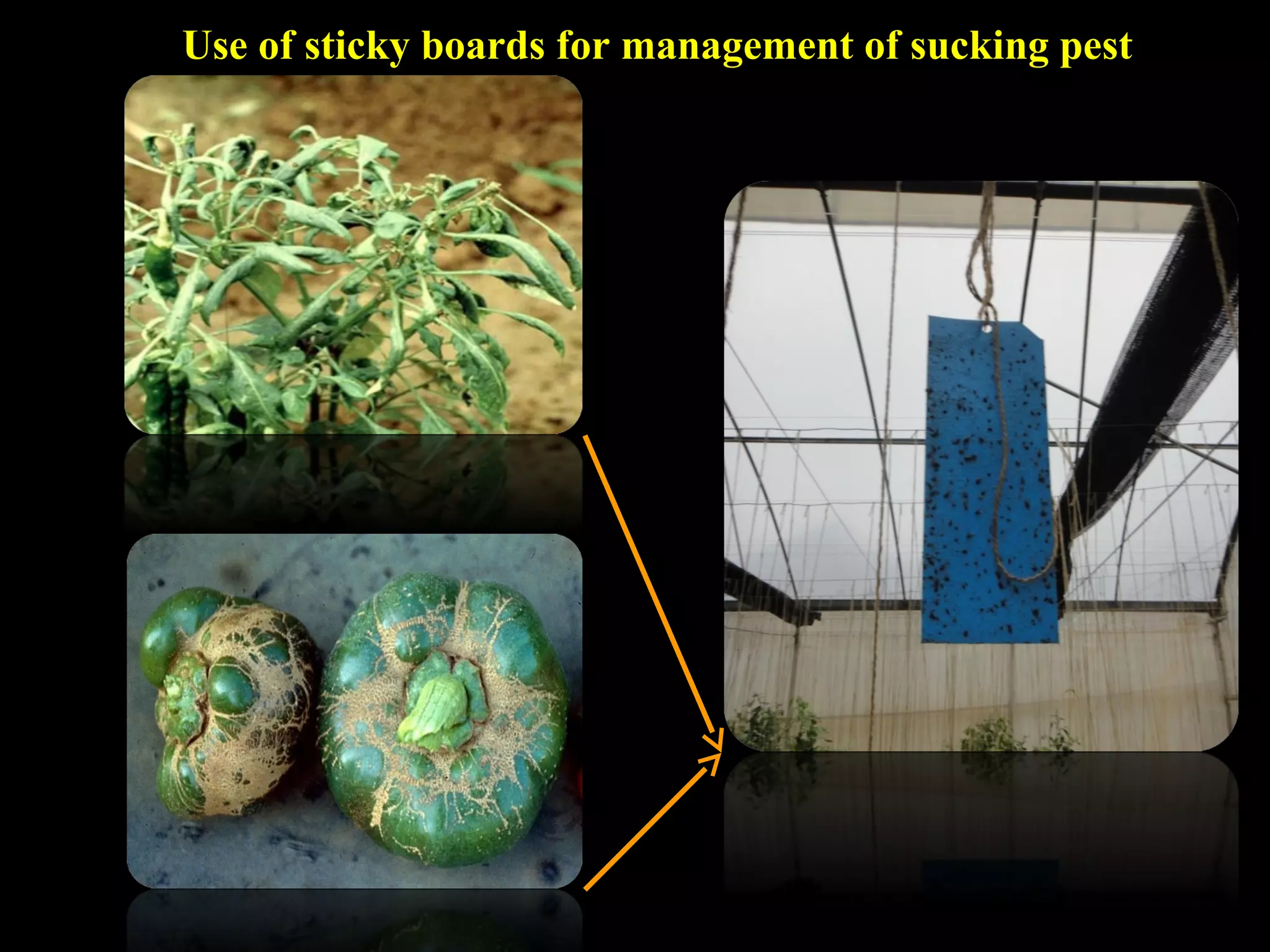
Pest Symptoms and damage Management
Thrips:
Scirtothrips dorsalis
serious during dry periods, Both adult
and nymphs suck the sap from
developing leaves. Affected leaves
curl upwards along the margin and
are reduced in size.
Acephate (Starthane 75WP) 1.5g/ or
Imidacloprid (confidor)0.5ml/l
-Application of Neem cake 250 kg/ha
to kill pupae
White or
yellow mite:
Polyphgotersonemus
latus
Damage is more in hot and humid
seasons and greenhouse (when
temperature is high).
Spray Abamectin (Vertimec) (0.5ml/l)
or Dicofol (Kelthane) (2ml/l)
4% (NSKE) in rotation.
Aphids: Aphis
gossypi,
Myzus persicae
Minute insects, colonies of aphids
suck the sap from tender leaves and
flower buds.
Aphids act as a vector for
transmitting mosaic virus disease
-Remove all the virus affected plants
and destroy.
-Spray Imidacloprid (Confidor)
(0.5ml/l) or
Dimethoate (Rogor) 1 ml/l in rotation
Fruit borer,
Helicoverpa armigera
This pest is not serious in greenhouse. Spray Nuclear PolyhedrosisVirus
(NPV) (Helicoverpa NPV)
250 LE/ha + teepol or any sticker1%
during evening to protect NPV from
UV rays
Use of sticky boards for management of sucking pest
References
• Singh D.K and K.V. Peter. (2013). Protected Cultivation of
Horticultural crops. New India Publishing Agency. New
Delhi.
• Swain S.C. (2014). Precision Farming in Horticulture
Approaches and Strategies. Narendra Publishing House.
New Delhi.
• Selvakumar R. (2014). A textbook of Glaustas
Olericulture. New Vishal Publications. New Delhi
Thank you

PROTECTED CULTIVATION OF CAPSICUM

  • 1.
    PROTECTED CULTIVATION OF CAPSICUM Submittedby S.ADHIYAMAAN (2017603401) I-M.Sc. VEGETABLE SCIENCE DEPT. OF VEGETABLE CROPS HC & RI, TNAU, CBE.- 641 003
  • 2.
    Introduction • Capsicum (Capsicumannuum var. grossum) also known as bell pepper or sweet pepper , leading vegetable grown in green houses • It is rich in vitamin A, C and minerals • Gaining popularity in peri-urban production systems because of easy access to urban markets • Yield gap between (field 20-40 t/ha) and (greenhouse 100-120 t/ha) • Superior quality, substantial reduction in the use of pesticides and eco- friendly proposition • Mainly grown in HP, UP, MH, KA and hilly regions of TN
  • 3.
    Climate • Capsicum isa cool season crop and day temperature less than 30°C is favourable • Higher temperature results in rapid plant growth and affects fruit set • Ideal temperature for flowering is 26-28°C day and 16-18°C night • Shading is required during summer to avoid temperature build up in the greenhouses and moderately high RH (50-60%) is preferred
  • 4.
    Soil • Red orsandy loam soil • Soil with pH of 5.5-6.8 is ideal • High acidic soil reclaimed by using lime • Capsicum has bidirectional root system, so soil should be loose
  • 5.
    Hybrids • Hybrids withindeterminate growth habit, as these hybrids grow to a height of 2 m and above • Commercial hybrids with a yield potential up to 100t/ha and more are suitable for greenhouse cultivation. • Capsicum fruits with Green, Yellow, Red, Orange and recently Black colours are in great demand in urban markets
  • 6.
  • 7.
    SELECTION OF VARIETIES •Thick fleshed best for roasting and cooking, • thinner - suitable for eating as raw. • Four lobbed peppers with square shapes are more suitable • Green and violet are the strongest in flavour • Yellow, red and orange coloured are milder and sweeter. • Nun-3020 (Yellow), Nun-3019 (Red), Bharat, Mahabharat (both red), Golden Summer (yellow), Bomby (red), Orobellee (yellow), Indira (red), Heera (red) and Tanvi etc.
  • 8.
    IIHR, Bangalore • Indeterminateplant habit • Thick fleshed, 2-3 lobed conical fruits • Average fruit weight 50-80 g • Yield potential -16 t/ha • Duration -150 days. • Suitable for long distance transport
  • 9.
    • Indeterminate planthabit with green foliage • Thick fleshed, 3-4 lobed green blocky fruits • Average fruit weight 130-150 g • Fruits erect which turn orange yellow on ripening • Yield potential -16 t/ha • Duration -150 days
  • 10.
    Indo American HybridSeeds Mahabharat • 3-4 lobed, blocky dark green fruits • Good shelf life • High yielding
  • 11.
    INDIRA • Fruit isdark green, thick-walled and glossy • Average weight 170 g (12 x 10 cm) • Having 3 - 4 lobes • Longer shelf life • Ideal for long distance transportation • High export potential OROBELLE • Fruits are blocky, almost square (10 x 9 cm) with a medium-thick wall. • Average fruit weight is 150 g • Suitable for green house cultivation syngenta
  • 12.
    NS 280 Relative daysto maturity : 70 - 75 Fruit colour : Green to red Fruit size (g) : 200-230 Fruit shape : blocky Plant habit : vigorous Remarks : Very good quality fruits, suitable for Red fruit harvest Namdhari seeds
  • 13.
    NS 281 Relative daysto maturity : 65 - 70 Fruit colour : Green to Yellow Fruit size (g) : 200-220 Fruit shape : blocky Plant habit : vigorous Remarks : Very good keeping quality, turns to Yellow on maturity
  • 14.
    Nunhems hybrid seeds Flavio Maturity: Early to Mid-Early Fruit Colour : Deep green going to deep red Plant Characteristics : Good plant vigour and leaf cover Fruit Characteristics : Semi blocky/short type Adaptation : Suited for Spring- Summer
  • 15.
    Nursery • Pro-trays (98cells) are filled with growing medium and tapped gently to fill the cells properly • Shallow depressions of about 5mm depth are made in each cell • Commercial cocopeat having enough moisture is used, no irrigation is required till seeds germinate • Filled trays are staked one above the other and covered with a plastic sheet to create warmth and humidity require for germination • Seedlings are raised in seedling trays placed inside a net house or polyhouse
  • 17.
    Growing beds • Diggingloosens the soil, then clods are broken and soil is brought to fine tilth • Beds of 100 cm width and 15 cm height are prepared leaving 50 cm working space between the beds • Well decomposed organic manure, at the rate of one bamboo basket per square meter of the bed is added, mixed thoroughly and the beds are levelled • In heavy soils mixing sand up to 25% is required to provide aeration at the root zone
  • 18.
    Disinfecting the growingbeds • Beds are drenched using 4% formaldehyde (4 lit/m2 ) of the bed and covered with polyethylene sheet • Care should be taken to wear mask, gloves and apron to avoid direct contact with formaldehyde fumes • Four days after formaldehyde treatment, the polyethylene cover removed, the beds are raked repeatedly every day
  • 23.
    Application of neemcake and Trichoderma • Neem cake is slightly watered to moisten and kept for two days, and then it is mixed with Trichoderma formulation at the rate of 1 kg/100kg neem cake • Mixture is closed with plastic sheet and turned thoroughly on alternate days • After 15 days, the neem cake + Trichoderma formulation will be ready for application • Neem cake plus Trichoderma formulation is applied before planting but after formaldehyde fumes are exhausted completely @ of 200 g/ m2
  • 24.
    Fertilizer application • Commercialfertilizers supplying 50:50:50 N:P2O5:K2O kg/ha, are applied to the growing beds • Two furrows are opened in the growing beds and fertilizer mixture is applied in the furrows and furrows are closed
  • 26.
    Laying of dripline • Place one inline drip lateral at the centre of the bed • Inline lateral having an emitting point for every 30 cm interval with discharge of 2 L/hr. • Run drip system with water to check each emitting points for uniform discharge of water
  • 28.
    Mulching • 100 micronthick polyethylene mulch film of 1.2 m width is used to cover the planting bed • Holes of 5 cm diameter are made on the mulch film as per recommended spacing (45 x 30 cm) • The planting beds are covered with the mulch by securing the edges of the sheet firmly in the soil
  • 29.
    Spacing • Seedlings areplanted in paired rows in one meter wide beds with spacing of 45 x 30 cm.
  • 31.
    Transplanting • Seedlings of30-35 days old, vigorous and uniform sized are selected • Early morning hours or preferably in the evening • Capsicum seedlings are planted in the holes made in the polyethylene mulch film so that the seedlings do not touch the film • Watering the beds is done daily with a rose can till the seedlings get established well • Drenching with 0.3% COC if mortality of the seedlings is noticed
  • 33.
    Irrigation • Drip irrigationstarts 10 days after transplanting • Drip irrigation is given daily to supply 2-3 litres of water per square meter per day depending on local weather condition • Capsicum extract 70-80% of water used from a depth of 0-30 cm • Bell pepper requires 110 cm of water (Hedge, 1993)
  • 34.
    Fertigation • Water solublefertilizers supplying 19% each of N, P2O5 andK2O is used at the rate of 2.25 g/m2 for every fertigation, given twice a week • Capsicum crop is sprayed with micronutrient formulation (3g/l) 2-3 times once in 30 days starting from 60 days after transplanting • Capsicum is found to be susceptible to calcium deficiency • The crop is fertigated 2-3 times with CaNO3once in 15 days if calcium deficiency is noticed

  • 35.
    The total doseof 150 kg each of N: P2O5: K2O per hectare using water-soluble fertilizers is given through fertigation for entire crop growth period, twice a week, starting from third week after transplanting
  • 36.
    Other methOds OfcultivatiOn
  • 37.
  • 38.
  • 39.
    Capsicum cultivation infull controlled polyhouse
  • 40.
    The nutrient filmtechnique (NFT) The closed insulated pallet system (CIPS)
  • 41.
    Pruning • Capsicum plantsare pruned to retain four stems. • Pruning is done at weekly interval starting from 15 to 20 days after transplanting. From 4th month onwards once in 10 days. • Plants show dichotomous branching. • The tip of the plant splits into two at 5th or 6th node on 15 to 20 days after transplanting (DAT). These two branches again split into two giving rise to four branches by 25 to 30 DAT. Operations
  • 42.
    Pruning • At everynode the tip splits into two giving rise to one strong branch and one weak branch • Only these four main branches are maintained till the end of the crop. • All the flowers that appear till one month after transplanting are removed. • Only one fruit per node is allowed to develop. 5th or 6th node
  • 43.
    PRUNING IN CAPSICUM Allthe shoots appearing at the base of the plants are removed, as they are not productive.
  • 44.
    Pinching / Topping •Lateral shoots or branches are pinched on first leaf (internodes) or second-leaf (internodes)
  • 45.
  • 46.
  • 47.
  • 48.
  • 49.
    Training • The plantsare trained along a plastic twine. Each branch should have a separate plastic twine to train along. • The plastic twines are tied to the GI wire grid provided at 2.5 to 3.0 meter height and then to the base of the plant. • Tying plants to the plastic twine starts from 6th week after planting at 20 days interval.
  • 50.
    Two-Leader System Two leaderor branches maintain per plant
  • 51.
    Four-Leader System Four leaderor branches maintain per plant
  • 52.
    Diff. Between Four& Two Leaders
  • 53.
  • 54.
  • 55.
    Number of fruitsin different training levels under naturally ventilated polyhouse Number of fruits in different training levels under shade house
  • 56.
    • 60 daysafter transplanting - green, • 80 to 90 - yellow and red fruited hybrids. • continues up to 170 to 180 days at 10 days interval in green • up to 240 to 270 days • Mature green • Yellow when it is 75% yellow • Red when it is 100% red Harvesting
  • 57.
    Yield •100 to 120t/ha •10 to 12 kg / m2, 2.25 to 2.70 kg / plant •Average individual fruit weight 180 g in initial harvests, 100 g in last harvests. Packing •Packed in card board boxes/trays using paper shreds as the padding material. Post harvest handling and storage •Shrink wrapping each fruit and storing at 7 to 80 C- storability up to 45 to 60 days.
  • 58.
  • 59.
  • 60.
    Flat fruits • Causedby low temperature • Night temperatures of around 18°C ensure an ideal seed set and fruit shape • Low-night temperatures decrease pollen viability • Modify flower structure making self pollination less effective • Bumblebees for pollination -help greatly to improve fruit shape
  • 61.
  • 62.
    Blossom end rot •Excess of nitrogen & water stress • Water soaked area near blossom end • Later become light brown and leathery • Spraying of 2% CaCl2
  • 63.
    Fruit load andfruit growth • Excess fruit load –cause decaying of roots • Number of fruits/plant –light, temperature & plant size • Good light condition - 20 to24 fruits/m² • Poor light condition - 10 to12 fruits/m² • 5-9 weeks after fruit set - reach full size • After 3-4 weeks - full colour • Total period (full bloom to coloured fruit) -7-12 weeks (45 days)
  • 64.
    Flower to Fruit(45 days) you can see within 4.5 min
  • 65.
    Sanitation • Removal ofold and diseased leaves • Polyhouse or net house and the structure is kept clean without any plant debries or weeds • Allowing visitors is discouraged inside the protected structure as it may allow insect pests and vectors to enter into the greenhouse • Provision is made to wash the foot and the hands with KMnO4 solution (0.5%) at the entrance of the protected structure
  • 66.
    Diseases of capsicumunder protected condition and their management Disease Symptoms Control Powdery mildew: Laveillula taurica Whitish patches appear on the leaves, stem and rarely on fruit. Karathane (0.1%) Calixin (0.1%) Sulfex (0.3%) Fungal Downy Mildew Peronospora tabacini pale yellow areas on the upper sides of the leaves. On the lower side of the leaf the downy growth appears in cool moist weather. Karathane (0.1%) Calixin (0.1%) contaf(0.05%),Rubigon(0.025%) Bacterial diseases a) Soft rot (Erwinia carotovora) b) Bacterial spot (Xanthomonas versicatoria) Which causes a soft slimy rot. Which forms a raised rough pimply area on the fruit, On the leaves, the spot is first raised and wart like, and becomes necrotic spots with dark margins. The affected leaves turn yellow and drop. *Hot water treatments, clean cultivation *Streptomycin spray Viral diseases a)Leaf curl virus b) CMV Yellowing, curling, mottling of leaves and ultimately death of plant is seen. Clean cultivation, vector control, etc… Fusarium wilt Fusarium oxysporum Yellowing of leaves, Wilting, coller rot, death of root COC drench, Carbendizim, Dithane M-45
  • 67.
    Pests of capsicumunder protected condition and their management Pest Symptoms and damage Management Thrips: Scirtothrips dorsalis serious during dry periods, Both adult and nymphs suck the sap from developing leaves. Affected leaves curl upwards along the margin and are reduced in size. Acephate (Starthane 75WP) 1.5g/ or Imidacloprid (confidor)0.5ml/l -Application of Neem cake 250 kg/ha to kill pupae White or yellow mite: Polyphgotersonemus latus Damage is more in hot and humid seasons and greenhouse (when temperature is high). Spray Abamectin (Vertimec) (0.5ml/l) or Dicofol (Kelthane) (2ml/l) 4% (NSKE) in rotation. Aphids: Aphis gossypi, Myzus persicae Minute insects, colonies of aphids suck the sap from tender leaves and flower buds. Aphids act as a vector for transmitting mosaic virus disease -Remove all the virus affected plants and destroy. -Spray Imidacloprid (Confidor) (0.5ml/l) or Dimethoate (Rogor) 1 ml/l in rotation Fruit borer, Helicoverpa armigera This pest is not serious in greenhouse. Spray Nuclear PolyhedrosisVirus (NPV) (Helicoverpa NPV) 250 LE/ha + teepol or any sticker1% during evening to protect NPV from UV rays
  • 68.
    Use of stickyboards for management of sucking pest
  • 69.
    References • Singh D.Kand K.V. Peter. (2013). Protected Cultivation of Horticultural crops. New India Publishing Agency. New Delhi. • Swain S.C. (2014). Precision Farming in Horticulture Approaches and Strategies. Narendra Publishing House. New Delhi. • Selvakumar R. (2014). A textbook of Glaustas Olericulture. New Vishal Publications. New Delhi
  • 70.