BEE HIVES AND BEE KEEPING
EQUIPMENTS
Presented
BY
DR. L.N.MOHAPATRA
ASSOCIATE DIRECTOR OF RESEARCH
Presented
BY
DR. L.N.MOHAPATRA
ASSOCIATE DIRECTOR OF RESEARCH
GIONAL RESEARCH & TECHNOLOGY TRANSFER STATI
BHAWANIPATNA
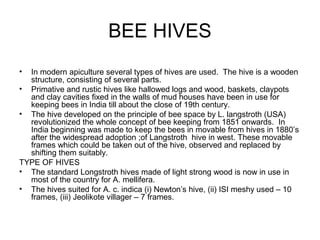
BEE HIVES
• In modern apiculture several types of hives are used. The hive is a wooden
structure, consisting of several parts.
• Primative and rustic hives like hallowed logs and wood, baskets, claypots
and clay cavities fixed in the walls of mud houses have been in use for
keeping bees in India till about the close of 19th century.
• The hive developed on the principle of bee space by L. langstroth (USA)
revolutionized the whole concept of bee keeping from 1851 onwards. In
India beginning was made to keep the bees in movable from hives in 1880’s
after the widespread adoption ;of Langstroth hive in west. These movable
frames which could be taken out of the hive, observed and replaced by
shifting them suitably.
TYPE OF HIVES
• The standard Longstroth hives made of light strong wood is now in use in
most of the country for A. mellifera.
• The hives suited for A. c. indica (i) Newton’s hive, (ii) ISI meshy used – 10
frames, (iii) Jeolikote villager – 7 frames.
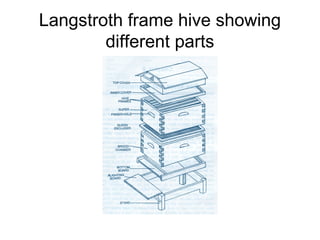
Langstroth frame hive showing
different parts
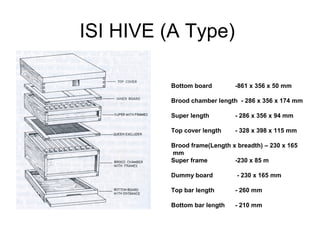
ISI HIVE (A Type)
Bottom board -861 x 356 x 50 mm
Brood chamber length - 286 x 356 x 174 mm
Super length - 286 x 356 x 94 mm
Top cover length - 328 x 398 x 115 mm
Brood frame(Length x breadth) – 230 x 165
mm
Super frame -230 x 85 m
Dummy board - 230 x 165 mm
Top bar length - 260 mm
Bottom bar length - 210 mm
Bee veil
It is worn over the face for
protection against bee stings.
It should be made black colour
mosquito nylon netting, top
and botton portion with cloth.
The bottom cloth should have
a rim with an elastic to make it
stick to the neck.
Gloves
They are usually made of
heavy canvas or supple
leather or rubberized
cloth and are useful for
beginners to develop
confidence. There is
arrangement of elastic in
the wrist which will
protect the ;hands from
the bee stings.
Overall
It is a protective garment worn over the
clothes, so that the bees cannot get
under them to sting. It should be
made ;of white cloth. Blue or black cloth
should be avoided as the bees are
attracted to them.
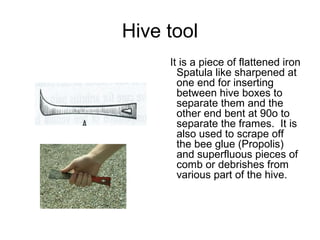
Hive tool
It is a piece of flattened iron
Spatula like sharpened at
one end for inserting
between hive boxes to
separate them and the
other end bent at 90o to
separate the frames. It is
also used to scrape off
the bee glue (Propolis)
and superfluous pieces of
comb or debrishes from
various part of the hive.
Smoker

A bellows type smoker is used to drive
the bees out of superous or from brood
box after lifting top cover for easy
handling.
 It consists of a tin can provided with a
spout for directing smoke from
smoouldering material inside it with the
help of leather, bellow attachment.
 The smoke should be without heat and
flame.
 Bees ;should be smoked gently and not
blasted.
 Pieces of discarded sac are best for a
cool smoke.
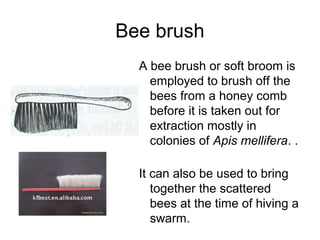
Bee brush
A bee brush or soft broom is
employed to brush off the
bees from a honey comb
before it is taken out for
extraction mostly in
colonies of Apis mellifera. .
It can also be used to bring
together the scattered
bees at the time of hiving a
swarm.
The uncapping knife
It is a flat sharp long edged
knife used for cutting the
wax capping of ;sealed
honey cells at time of
honey extraction then the
frames are placed in the
extractor.
The knife is heated by steam
or electric heated knife
with thermostatically
controlled temperature
are used for the purpose.
Honey extractor
It is hand or motor operated
centrifugal machine with
revolving chamber into
which the frames fit with
which the honey is extracted
in its purest form from the
honey comb. As the
;handle is worked, honey
flows out of the frames by
centrifugal force without
breaking the comb.
The Queen’s cage
Various types of queen cages viz. rectangular and
conical are used in bee keeping.
• Rectangular queen cage :- It is a small
rectangular cage made of wire gauge (Zinc
sheet) closed at one end and open at the other
• It is used when a new queen is required to be
introduced into a queenless ;clolonmy. The
aperature in the wire gauage should be as large
as possible but not so large as to allow entry of
worker bees.
• A laying queen with 5-6 workers is confined to
this cage, along with a little candy (dry sugar)
and the opened end is closed withbn a piece of
wood.
• The cage is then suspended along side a frame
in the colony. Within 24 -48 hours when the
queen has acquired the odour of the colony or
the workers of the colony have adopted to the
queens’ odour, then she is accepted by the
workers as the
Queen cell protector
 It is a cone shaped
structure made of up of a
piece of wire would
spirally.
 It fits around a queen cell
giving protection to the
developing queen inside.
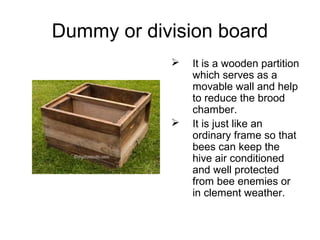
Dummy or division board
 It is a wooden partition
which serves as a
movable wall and help
to reduce the brood
chamber.
 It is just like an
ordinary frame so that
bees can keep the
hive air conditioned
and well protected
from bee enemies or
in clement weather.
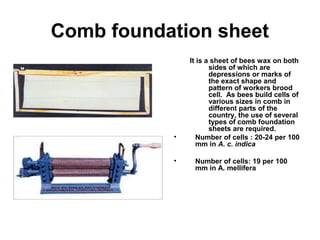
Comb foundation sheet
It is a sheet of bees wax on both
sides of which are
depressions or marks of
the exact shape and
pattern of workers brood
cell. As bees build cells of
various sizes in comb in
different parts of the
country, the use of several
types of comb foundation
sheets are required.
• Number of cells : 20-24 per 100
mm in A. c. indica
• Number of cells: 19 per 100
mm in A. mellifera
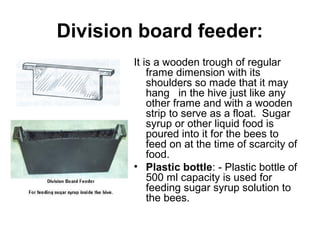
Division board feeder:
It is a wooden trough of regular
frame dimension with its
shoulders so made that it may
hang in the hive just like any
other frame and with a wooden
strip to serve as a float. Sugar
syrup or other liquid food is
poured into it for the bees to
feed on at the time of scarcity of
food.
• Plastic bottle: - Plastic bottle of
500 ml capacity is used for
feeding sugar syrup solution to
the bees.
Queen gate (Wire entrance guard)
This wire gate is placed
in front to the hive
entrance so as to
confine the queen
inside and thus helps
to prevent swarming.
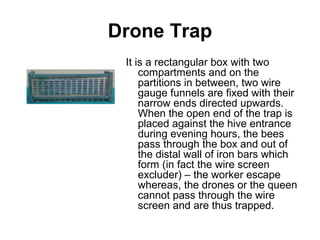
Drone Trap
It is a rectangular box with two
compartments and on the
partitions in between, two wire
gauge funnels are fixed with their
narrow ends directed upwards.
When the open end of the trap is
placed against the hive entrance
during evening hours, the bees
pass through the box and out of
the distal wall of iron bars which
form (in fact the wire screen
excluder) – the worker escape
whereas, the drones or the queen
cannot pass through the wire
screen and are thus trapped.
Queen excluder
It is a perforated (2.3-3.5mm)
zinc sheet placed on the top of
frames, then separating brood
chamber from super. The
workers can pass through
spaces, whereas the queen and
drones can’t. The queen will be
obliged to stay with the brood
box and spare the supers of the
eggs and brood.
Nucleus hive (Capturing hive)
Nucleus hives are used at
the time of colony division
or capturing of a swarm
colony.
For A. c. indica the nucleus
hive consists of four frames
while for A. mellifera it
consists of five frames.
•
Pollen trap:
Pollens can be collected from the
bees using pollen trap fixed in front
of the hive entrance when available
in abundance. The bees while
passing through the grid, losses the
pollen she carries, the pollen
pellets drop into the grid and down
into pollen trap.
It consists of a plastic strip of 1.5 mm
thickness which serves as a vertical
pollen trapping screen in which
circular hole of 4.5 mm dia. are
made. The pollen balls gets
detached when such bees pass
through the holes.
Bee keeping equipments

Bee keeping equipments

  • 1.
    BEE HIVES ANDBEE KEEPING EQUIPMENTS Presented BY DR. L.N.MOHAPATRA ASSOCIATE DIRECTOR OF RESEARCH Presented BY DR. L.N.MOHAPATRA ASSOCIATE DIRECTOR OF RESEARCH GIONAL RESEARCH & TECHNOLOGY TRANSFER STATI BHAWANIPATNA
  • 2.
    BEE HIVES • Inmodern apiculture several types of hives are used. The hive is a wooden structure, consisting of several parts. • Primative and rustic hives like hallowed logs and wood, baskets, claypots and clay cavities fixed in the walls of mud houses have been in use for keeping bees in India till about the close of 19th century. • The hive developed on the principle of bee space by L. langstroth (USA) revolutionized the whole concept of bee keeping from 1851 onwards. In India beginning was made to keep the bees in movable from hives in 1880’s after the widespread adoption ;of Langstroth hive in west. These movable frames which could be taken out of the hive, observed and replaced by shifting them suitably. TYPE OF HIVES • The standard Longstroth hives made of light strong wood is now in use in most of the country for A. mellifera. • The hives suited for A. c. indica (i) Newton’s hive, (ii) ISI meshy used – 10 frames, (iii) Jeolikote villager – 7 frames.
  • 3.
    Langstroth frame hiveshowing different parts
  • 4.
    ISI HIVE (AType) Bottom board -861 x 356 x 50 mm Brood chamber length - 286 x 356 x 174 mm Super length - 286 x 356 x 94 mm Top cover length - 328 x 398 x 115 mm Brood frame(Length x breadth) – 230 x 165 mm Super frame -230 x 85 m Dummy board - 230 x 165 mm Top bar length - 260 mm Bottom bar length - 210 mm
  • 5.
    Bee veil It isworn over the face for protection against bee stings. It should be made black colour mosquito nylon netting, top and botton portion with cloth. The bottom cloth should have a rim with an elastic to make it stick to the neck.
  • 6.
    Gloves They are usuallymade of heavy canvas or supple leather or rubberized cloth and are useful for beginners to develop confidence. There is arrangement of elastic in the wrist which will protect the ;hands from the bee stings.
  • 7.
    Overall It is aprotective garment worn over the clothes, so that the bees cannot get under them to sting. It should be made ;of white cloth. Blue or black cloth should be avoided as the bees are attracted to them.
  • 8.
    Hive tool It isa piece of flattened iron Spatula like sharpened at one end for inserting between hive boxes to separate them and the other end bent at 90o to separate the frames. It is also used to scrape off the bee glue (Propolis) and superfluous pieces of comb or debrishes from various part of the hive.
  • 9.
    Smoker  A bellows typesmoker is used to drive the bees out of superous or from brood box after lifting top cover for easy handling.  It consists of a tin can provided with a spout for directing smoke from smoouldering material inside it with the help of leather, bellow attachment.  The smoke should be without heat and flame.  Bees ;should be smoked gently and not blasted.  Pieces of discarded sac are best for a cool smoke.
  • 10.
    Bee brush A beebrush or soft broom is employed to brush off the bees from a honey comb before it is taken out for extraction mostly in colonies of Apis mellifera. . It can also be used to bring together the scattered bees at the time of hiving a swarm.
  • 11.
    The uncapping knife Itis a flat sharp long edged knife used for cutting the wax capping of ;sealed honey cells at time of honey extraction then the frames are placed in the extractor. The knife is heated by steam or electric heated knife with thermostatically controlled temperature are used for the purpose.
  • 12.
    Honey extractor It ishand or motor operated centrifugal machine with revolving chamber into which the frames fit with which the honey is extracted in its purest form from the honey comb. As the ;handle is worked, honey flows out of the frames by centrifugal force without breaking the comb.
  • 14.
    The Queen’s cage Varioustypes of queen cages viz. rectangular and conical are used in bee keeping. • Rectangular queen cage :- It is a small rectangular cage made of wire gauge (Zinc sheet) closed at one end and open at the other • It is used when a new queen is required to be introduced into a queenless ;clolonmy. The aperature in the wire gauage should be as large as possible but not so large as to allow entry of worker bees. • A laying queen with 5-6 workers is confined to this cage, along with a little candy (dry sugar) and the opened end is closed withbn a piece of wood. • The cage is then suspended along side a frame in the colony. Within 24 -48 hours when the queen has acquired the odour of the colony or the workers of the colony have adopted to the queens’ odour, then she is accepted by the workers as the
  • 15.
    Queen cell protector It is a cone shaped structure made of up of a piece of wire would spirally.  It fits around a queen cell giving protection to the developing queen inside.
  • 16.
    Dummy or divisionboard  It is a wooden partition which serves as a movable wall and help to reduce the brood chamber.  It is just like an ordinary frame so that bees can keep the hive air conditioned and well protected from bee enemies or in clement weather.
  • 17.
    Comb foundation sheet Itis a sheet of bees wax on both sides of which are depressions or marks of the exact shape and pattern of workers brood cell. As bees build cells of various sizes in comb in different parts of the country, the use of several types of comb foundation sheets are required. • Number of cells : 20-24 per 100 mm in A. c. indica • Number of cells: 19 per 100 mm in A. mellifera
  • 18.
    Division board feeder: Itis a wooden trough of regular frame dimension with its shoulders so made that it may hang in the hive just like any other frame and with a wooden strip to serve as a float. Sugar syrup or other liquid food is poured into it for the bees to feed on at the time of scarcity of food. • Plastic bottle: - Plastic bottle of 500 ml capacity is used for feeding sugar syrup solution to the bees.
  • 19.
    Queen gate (Wireentrance guard) This wire gate is placed in front to the hive entrance so as to confine the queen inside and thus helps to prevent swarming.
  • 20.
    Drone Trap It isa rectangular box with two compartments and on the partitions in between, two wire gauge funnels are fixed with their narrow ends directed upwards. When the open end of the trap is placed against the hive entrance during evening hours, the bees pass through the box and out of the distal wall of iron bars which form (in fact the wire screen excluder) – the worker escape whereas, the drones or the queen cannot pass through the wire screen and are thus trapped.
  • 21.
    Queen excluder It isa perforated (2.3-3.5mm) zinc sheet placed on the top of frames, then separating brood chamber from super. The workers can pass through spaces, whereas the queen and drones can’t. The queen will be obliged to stay with the brood box and spare the supers of the eggs and brood.
  • 22.
    Nucleus hive (Capturinghive) Nucleus hives are used at the time of colony division or capturing of a swarm colony. For A. c. indica the nucleus hive consists of four frames while for A. mellifera it consists of five frames. •
  • 23.
    Pollen trap: Pollens canbe collected from the bees using pollen trap fixed in front of the hive entrance when available in abundance. The bees while passing through the grid, losses the pollen she carries, the pollen pellets drop into the grid and down into pollen trap. It consists of a plastic strip of 1.5 mm thickness which serves as a vertical pollen trapping screen in which circular hole of 4.5 mm dia. are made. The pollen balls gets detached when such bees pass through the holes.