Principles of Seed
Technology
Topic - Steps involve in seed processing
Submitted to- Submitted by
Dinesh
Outline
• Introduction
• Advantages
• Seed processing steps
① pre conditioning and precleaning
②Cleaning
③Grading and cleaning
Introduction
• Seed processing is a vital part of the seed production
needed to move the improved genetic materials of the
plant breeder into commercial channels for feeding the
rapidly expanding world population. The farmer must
get the quality seed that is free from all undesired
materials because farmers entire crop depends on it.
• Seed processing is that segment of the seed industry
responsible for upgrading seed (Fig. 1), improving
planting condition of seed, and applying chemical
protectants to the seed.
Advantages
• Make possible more uniform planting rates by proper
sizing
• Improve seed marketing by improving seed quality
• Prevent spread of weed seed
• Prevent crops from disease by applying chemical
protectants
• Reduces seed losses by drying
• Facilitate uniform marketing by providing storage from
harvest time until the seed is needed for planting.
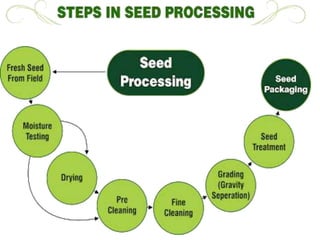
Steps involve in seed processing
• Step 1- Pre-conditioning and pre-cleaning
• Step 2- Cleaning
• Step 3-Cleaning and Grading
Step-1 -Pre conditioning and pre
cleaning
• Pre conditioning:- Isolation of seed from plant parts
with which it was harvested. e.g. Shelling
• Pre cleaning:- Removal of external materials like
trash, stones, clods which are either in larger size or
lighter in weight. No pre cleaning is required for
hand harvested and winnowed seeds
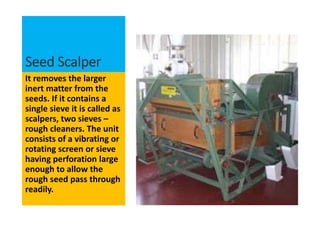
Seed Scalper
It removes the larger
inert matter from the
seeds. If it contains a
single sieve it is called as
scalpers, two sieves –
rough cleaners. The unit
consists of a vibrating or
rotating screen or sieve
having perforation large
enough to allow the
rough seed pass through
readily.
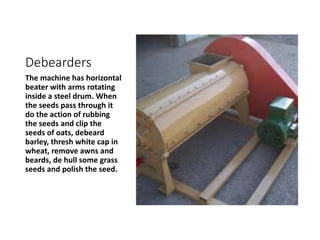
Debearders
The machine has horizontal
beater with arms rotating
inside a steel drum. When
the seeds pass through it
do the action of rubbing
the seeds and clip the
seeds of oats, debeard
barley, thresh white cap in
wheat, remove awns and
beards, de hull some grass
seeds and polish the seed.
Other equipments
Step-2-Cleaning
• The second stage of cleaning is carried out with air
blasts and vibrating screens and is applicable to all
kinds of seeds. It is essentially the same as scalping
but more refined. It is performed mostly by one
machine known as air-screen cleaner.
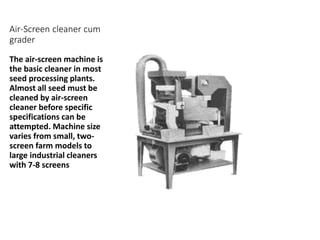
Air-Screen cleaner cum
grader
The air-screen machine is
the basic cleaner in most
seed processing plants.
Almost all seed must be
cleaned by air-screen
cleaner before specific
specifications can be
attempted. Machine size
varies from small, two-
screen farm models to
large industrial cleaners
with 7-8 screens
Step-3- Cleaning and Grading
• To obtain quality seed, it is necessary to clean the seed
obtained from the farm to get rid of inert materials,
weed seeds, other crop seeds, other variety seeds,
damaged and deteriorated seed. Different kinds of
seeds can be separated when they differ in one or more
physical characteristics. Physical characteristics
normally used to separate seeds are size, shape, length,
weight, colour, surface texture, affinity to liquids,
electrical conductivity, etc. The problem lies in
identifying the most important property and use the
machine that separates seed using the identified
property.
upgrading
• Seed lots require further cleaning treatment to
remove adulterants that are similar to pure seed in
size and shape, to be separated by air screen
cleaner. Removal of seeds larger or smaller than
required size (sizing) and removal of cracked,
damaged or otherwise defective seeds (grading) is
accomplished in this final stage of processing.
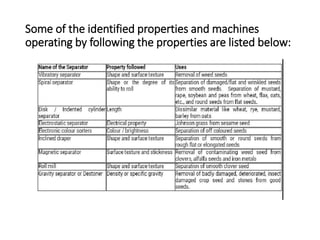
Some of the identified properties and machines
operating by following the properties are listed below:
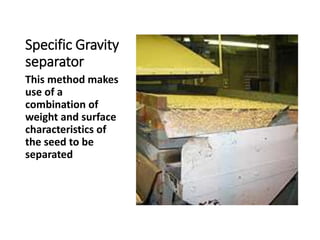
Specific Gravity
separator
This method makes
use of a
combination of
weight and surface
characteristics of
the seed to be
separated
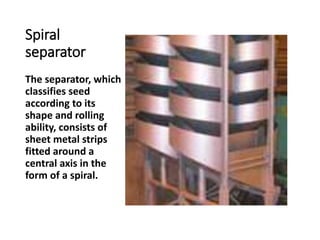
Spiral
separator
The separator, which
classifies seed
according to its
shape and rolling
ability, consists of
sheet metal strips
fitted around a
central axis in the
form of a spiral.
Other useful equipments
• Colour separator
• Magnetic separator
• Intended cylinder etc.
THANKS YOU

Steps involve in Seed processing

  • 1.
    Principles of Seed Technology Topic- Steps involve in seed processing Submitted to- Submitted by Dinesh
  • 2.
    Outline • Introduction • Advantages •Seed processing steps ① pre conditioning and precleaning ②Cleaning ③Grading and cleaning
  • 3.
    Introduction • Seed processingis a vital part of the seed production needed to move the improved genetic materials of the plant breeder into commercial channels for feeding the rapidly expanding world population. The farmer must get the quality seed that is free from all undesired materials because farmers entire crop depends on it. • Seed processing is that segment of the seed industry responsible for upgrading seed (Fig. 1), improving planting condition of seed, and applying chemical protectants to the seed.
  • 4.
    Advantages • Make possiblemore uniform planting rates by proper sizing • Improve seed marketing by improving seed quality • Prevent spread of weed seed • Prevent crops from disease by applying chemical protectants • Reduces seed losses by drying • Facilitate uniform marketing by providing storage from harvest time until the seed is needed for planting.
  • 5.
    Steps involve inseed processing • Step 1- Pre-conditioning and pre-cleaning • Step 2- Cleaning • Step 3-Cleaning and Grading
  • 7.
    Step-1 -Pre conditioningand pre cleaning • Pre conditioning:- Isolation of seed from plant parts with which it was harvested. e.g. Shelling • Pre cleaning:- Removal of external materials like trash, stones, clods which are either in larger size or lighter in weight. No pre cleaning is required for hand harvested and winnowed seeds
  • 8.
    Seed Scalper It removesthe larger inert matter from the seeds. If it contains a single sieve it is called as scalpers, two sieves – rough cleaners. The unit consists of a vibrating or rotating screen or sieve having perforation large enough to allow the rough seed pass through readily.
  • 9.
    Debearders The machine hashorizontal beater with arms rotating inside a steel drum. When the seeds pass through it do the action of rubbing the seeds and clip the seeds of oats, debeard barley, thresh white cap in wheat, remove awns and beards, de hull some grass seeds and polish the seed.
  • 10.
  • 11.
    Step-2-Cleaning • The secondstage of cleaning is carried out with air blasts and vibrating screens and is applicable to all kinds of seeds. It is essentially the same as scalping but more refined. It is performed mostly by one machine known as air-screen cleaner.
  • 12.
    Air-Screen cleaner cum grader Theair-screen machine is the basic cleaner in most seed processing plants. Almost all seed must be cleaned by air-screen cleaner before specific specifications can be attempted. Machine size varies from small, two- screen farm models to large industrial cleaners with 7-8 screens
  • 13.
    Step-3- Cleaning andGrading • To obtain quality seed, it is necessary to clean the seed obtained from the farm to get rid of inert materials, weed seeds, other crop seeds, other variety seeds, damaged and deteriorated seed. Different kinds of seeds can be separated when they differ in one or more physical characteristics. Physical characteristics normally used to separate seeds are size, shape, length, weight, colour, surface texture, affinity to liquids, electrical conductivity, etc. The problem lies in identifying the most important property and use the machine that separates seed using the identified property.
  • 14.
    upgrading • Seed lotsrequire further cleaning treatment to remove adulterants that are similar to pure seed in size and shape, to be separated by air screen cleaner. Removal of seeds larger or smaller than required size (sizing) and removal of cracked, damaged or otherwise defective seeds (grading) is accomplished in this final stage of processing.
  • 15.
    Some of theidentified properties and machines operating by following the properties are listed below:
  • 16.
    Specific Gravity separator This methodmakes use of a combination of weight and surface characteristics of the seed to be separated
  • 17.
    Spiral separator The separator, which classifiesseed according to its shape and rolling ability, consists of sheet metal strips fitted around a central axis in the form of a spiral.
  • 18.
    Other useful equipments •Colour separator • Magnetic separator • Intended cylinder etc. THANKS YOU