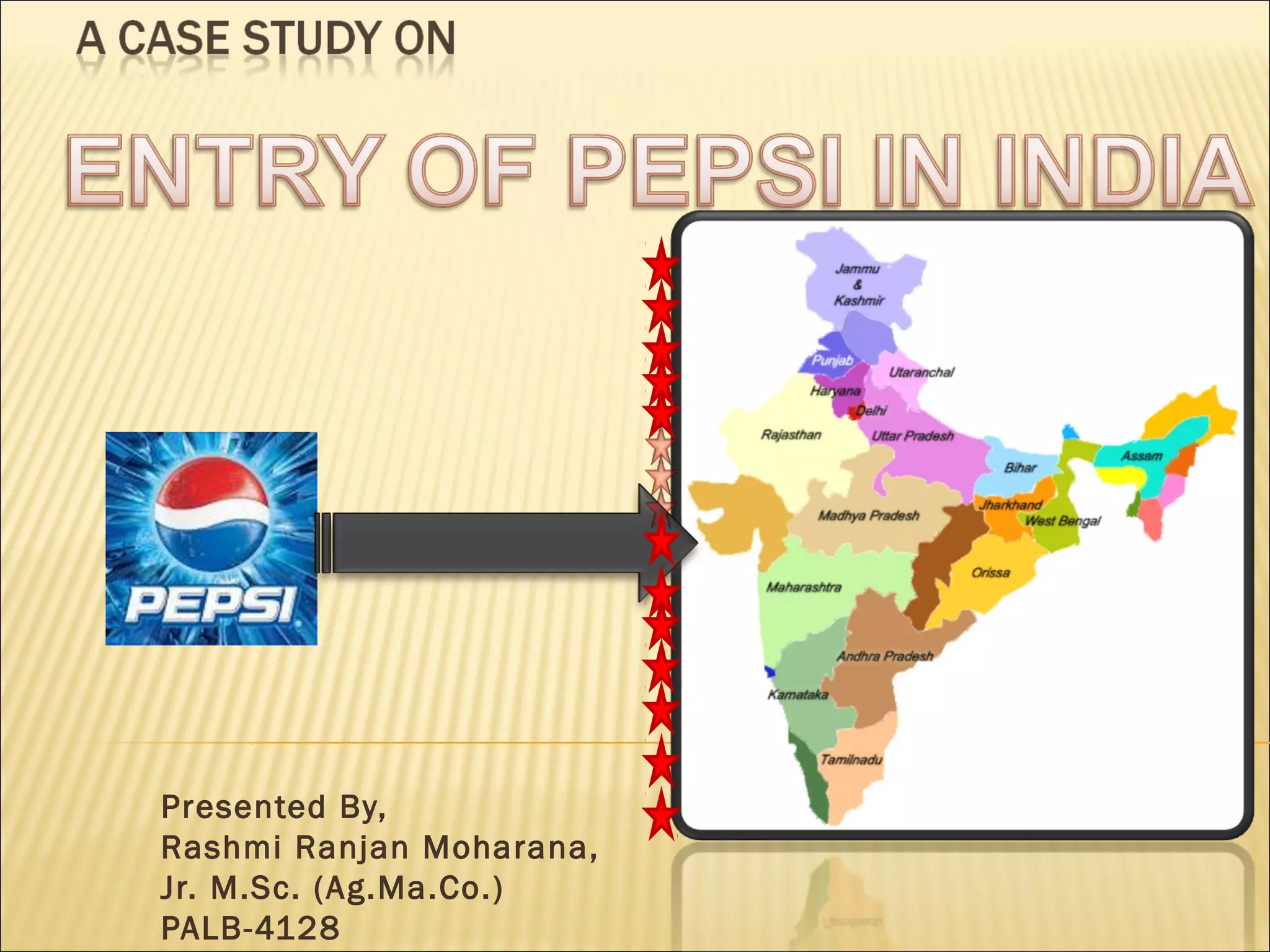

Presented By,
Rashmi Ranjan Moharana,
Jr. M.Sc. (Ag.Ma.Co.)
PALB-4128
It tookIt took half decade of negotiating, 20 debates inhalf decade of negotiating, 20 debates in
Parliament and a monumental public relations campaignParliament and a monumental public relations campaign
for Pepsi to enter India.for Pepsi to enter India.
Not exactly Pepsi-Cola, it was calledNot exactly Pepsi-Cola, it was called Lehar PepsiLehar Pepsi, a, a
concession to the anti-foreign lobby.concession to the anti-foreign lobby.
It appeared only inIt appeared only in Jaipur, Kanpur, Bangalore andJaipur, Kanpur, Bangalore and
PunjabPunjab..
Christopher Sinclair, the President of Pepsi-ColaChristopher Sinclair, the President of Pepsi-Cola
International, called his company’s venture in India “International, called his company’s venture in India “ AnAn
Historic AgreementHistoric Agreement .”.”
PepsiCo’s move into the Indian market was madePepsiCo’s move into the Indian market was made
possible by the company’s willingness to take apossible by the company’s willingness to take a 36.9%36.9%
share in a conglomerate called “Pepsi Foods Privateshare in a conglomerate called “Pepsi Foods Private
Limited”Limited”
 In 1988, the New York office of the 
President of the multi­billion cola 
company PepsiCo received a letter from 
India.
 The company had been trying for some 
time to enter the Indian market ­ without 
much success.
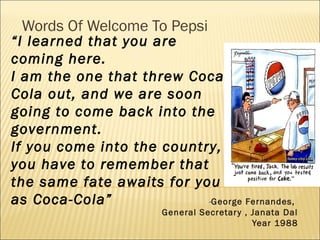
Words Of Welcome To Pepsi
-George Fernandes,
General Secretary , Janata Dal
Year 1988
“I learned that you are
coming here.
I am the one that threw Coca-
Cola out, and we are soon
going to come back into the
government.
If you come into the country,
you have to remember that
the same fate awaits for you
as Coca-Cola”
 Before this, Coca-cola had been thrown out
of India in1977.
 Even in 1980’s economy was marked by
high government interventions.
 Pepsi though, was looking India for couple
of reasons,
1.India was always a market that every MNC
wanted to enter . .( reason very vast
population).
2.Urbanization familiarized Indians with global
brands.
3.Low per capita consumption of soft drink, 3
bottles p.a. as compared to 63 for Egypt, 38
for Thailand and 13 for Pakistan.
* India being a closed economy till 1991, there was
high level of intervention by the government in the
corporate sector
* Low awareness, demand and consumption for soft
drinks. The per capita consumption was only 3 per
annum
* Foreign brand name could not be used
* There was no liberalization and this not even 1% FDI
was allowed.
* Sensitive political and social problems in the country
like terrorism
* Cola concentrate – the major ingredient to make
Pepsi soft drink could not be imported
* Agriculture sector was the priority and thus Pepsi
had to win the government by making promises of
 Political environment
 Intent of development of local players only
 Opposition to promotion of carbonated drinks
 Fear of invasion of foreign brand
 Legal environment
 Severe restrictions in equity through FERA
 Dispute in relation to ownership of brand
name( foreign name not allowed)
 Economic environment
 Closed and starved or narrow economy
 Cold drink industry in nascent or embryo stage
 Socio cultural environment
 Fear of invasion of MNC culture
 Fear of impact on Health/diet
"Convincing India that it needs"Convincing India that it needs
Western junk has not been easy."Western junk has not been easy."
- A New Internationalist Magazine Article, commenting on
Pepsi's struggle to enter India, in August 1988
• The thirst for global presence made Pepsi to
venture in India with already inroads in 150
countries before India.
• The huge consumer base of 850 million in India
can never be ignored, in spite of all the odds
 Due to the fate of Coke in India the market entry
had to be prepared carefully.
 PepsiCo teamed up with Agro Product Export Ltd., a company
owned by R. P. Goenka (RPG groups) to begin operations in the
north Indian state of Punjab.
 Objectives put forward to sought permission from the central
government
a. to promote the development and export of Indian made
and agro-based product
b. to import cola concentrate and to sell a PepsiCo brand
soft drink in the Indian market
 The government rejected this proposal primarily on two grounds:
1. Did not accept the clause regarding the import
 Proposal:
 'Green Revolution' in Punjab, which would end
stagnation in Punjab's rural sector and would help
in promoting small and middle farmers.
 Argument:
 This project will create ample employment
opportunities for the unemployed youth who has
taken the path of terrorism and thereby will help in
restoration of peace in Punjab
 Outcome:
 Argument very well received in the political circles
in Delhi and Punjab which finally led to PepsiCo's
entry into India in the form of a joint venture with
PAIC and Voltas as its partners
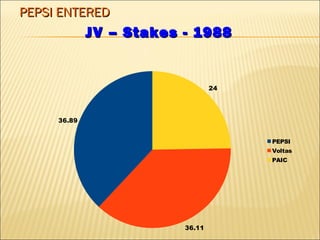
PEPSI ENTERED
 Govt. Quite impressed with T&C
Proposed
 In 1988 Finally Cleared by the Govt.
 JV – PAIC (Punjab Agro Ind. Corp.) &
Voltas India Ltd. (TATA)
 JV Stake PEPSI – 36.89, Voltas –
36.11% & PAIC – 24%
 In 1989 Launched the Soft Drinks with
Great Fanfare & Multi-Media
advertising and Campaining
PEPSI ENTEREDPEPSI ENTERED
36.89
36.11
24
PEPSI
Voltas
PAIC
JV – Stakes - 1988JV – Stakes - 1988
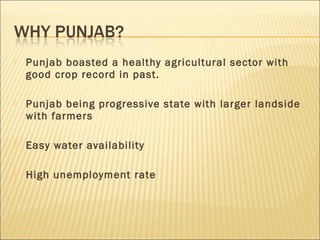
 Punjab boasted a healthy agricultural sector with
good crop record in past.
 Punjab being progressive state with larger landside
with farmers
 Easy water availability
 High unemployment rate
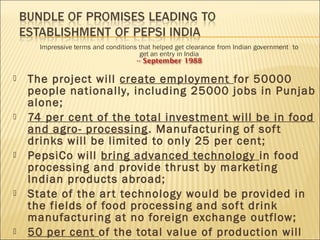
 The project will create employment for 50000
people nationally, including 25000 jobs in Punjab
alone;
 74 per cent of the total investment will be in food
and agro- processing. Manufacturing of soft
drinks will be limited to only 25 per cent;
 PepsiCo will bring advanced technology in food
processing and provide thrust by marketing
Indian products abroad;
 State of the art technology would be provided in
the fields of food processing and soft drink
manufacturing at no foreign exchange outflow;
 50 per cent of the total value of production will
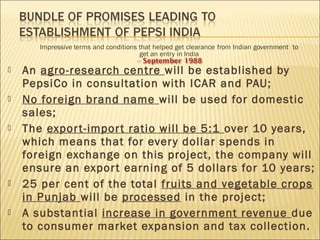
 An agro-research centre will be established by
PepsiCo in consultation with ICAR and PAU;
 No foreign brand name will be used for domestic
sales;
 The export-import ratio will be 5:1 over 10 years,
which means that for every dollar spends in
foreign exchange on this project, the company will
ensure an export earning of 5 dollars for 10 years;
 25 per cent of the total fruits and vegetable crops
in Punjab will be processed in the project;
 A substantial increase in government revenue due
to consumer market expansion and tax collection.
• Evidence showed that right from the beginning, Pepsi had
no intention of diversification in Punjab but the real motive
was to sell soft drinks.
• It was a tactics played by PepsiCo to get entry in the
domestic market of India
• Thus, Pepsi with its strong market instinct and research
become the powerful player of Indian beverages and soft
drink industry with implying their funda of GLOCALISATION.
GLOBAL + LOCALISATION = GLOCALISATION
 Fruit and vegetable plant set up in Punjab
 Focus: Processing tomatoes to make tomato
paste
 Soft drink business launched.
 Promised 24000 jobs, actual 909 in first four
years
 Research Centre still waiting
 Pepsi no longer a joint venture company with its
Indian partners.
 Zahura Village formers still awaiting their
compensation of 25 lakhs
PROMISES ARE MEANT TO BE BROKENPROMISES ARE MEANT TO BE BROKEN
 On payments by cheque, found out that 80% of the farmers
did not even have a bank account..!
Plant not been made operational Farmer had to bear losses of
2.5 Millions in 1990 harvest of crops.
 Pepsi paid Rs. 0.75/Kg & Market Price was Rs. 2.00/Kg for
tomatoes
 Fails to Create Jobs, Promised for 50000 Jobs but by 1991 -
783 Employed, 1992 – 909, & By 1996 – 2400 people as
Direct Employees. Pepsi Claimed Employed 26000 as Indirect
Employment
 Industry Commented company included the small vendors who
sold soft drinks as indirect employees. It could not be regarded
as the employees of Pepsi
 Information revealed that more than 50% employees working
in its bottling business and not for food processing activities.
Promises Keep Some, Break Some!
 It also had major holding in Futura Polymers Ltd. Recyling
plastic – a capital intensive firm.
 The use of name “Lehar Pepsi” also attracted much
controversey.
 Pepsi also failed to adhere its commitment to export 50% of
its production.
 It began exporting tea, rice, shrimps, glass bottles, leather
products, champagne as against fruit or vegetable based
products has always been exported.
 There was even a show cause notice to Pepsi company by
Ministry of Commerce, to which company paid no attention.
 Luckily for Pepsi, it did not have to face criticism for long
 Product
 Price
 Place
 Promotion
 Politics
 Public Image
 In the early 1990s, the Government of India was
facing a foreign exchange crisis.
 Organizations like the International Monetary Fund
agreed to help the government.
 Condition that it liberalized the Indian economy.
 The Process included: removal of numerous
restriction on foreign trade and increased the role
of Private Equity in Indian market.
 Pepsi benefited from the economic changes in
many ways.
 The Company took full Adavantage of New
Economic Policy
 Bought off its partners in Joint Venture. A Wholly-
Owned subsidairy.
 PepsiCo Holdings India Pvt. Ltd. (PHI) – Devoted Soft
Drinks Business. Changed Cola Name from Lehar Pepsi
to Pepsi.
 Decision to sell off its Tomato Paste Plant to the Indian
FMCG major, Hindustan Lever Ltd. (HLL).
 1995 – Beverages business grew by as much as 50%
 1996 – PHI – Pepsi's turnover by Rs. 1.25 Billion, 1.5%
Fruit & Vegetable Exports & 67% Plastic Exports
 1997 – The Agro Research Center promised by the
Company was now here in sight.
 Though Pepsi attracted a lot of criticism, many people felt
there was a positive side to the company's entry into India.
 Pepsi’s tomato farming project shot up India’s tomato
production from 4.25mn tonnes in 1991-92 to 5.44mn tonnes
in 1995-96.
 Punjab’s overall tomato productivity went up from 28,000
tonnes to 250,000 tonnes and per hectare from 16 tonnes to
50 tonnes.
 The company offered its contract farmers, free of cost,
some advanced equipments such as transplanters and
seedling machines.
 It also set up agriculture research centers in Jallowal and
Chano (Punjab) and Nelamangala(Karnataka).
 Though “Pepsi Agri Backward Integration Programme” the
company encouraged Punjab farmers to cultivate potatoes
with low sugar content.
AFTER ALL PEPSI WASN’T THAT BAD PEPSI’SAFTER ALL PEPSI WASN’T THAT BAD PEPSI’S
ENTRY-INDIAN BENEFITSENTRY-INDIAN BENEFITS
 It extended it contracts farming initiatives toIt extended it contracts farming initiatives to
groundnuts in the year 2000.groundnuts in the year 2000.
 The project initiated in Punjab and then inThe project initiated in Punjab and then in
Gujarat.Gujarat.
 By using improved technology from China, theBy using improved technology from China, the
per hectare yield improve from 1 tonne to 3.5-4.5per hectare yield improve from 1 tonne to 3.5-4.5
tonnes.tonnes.
 Pepsi invested additional Rs. 3.75bn in spreadPepsi invested additional Rs. 3.75bn in spread
over 3 years (2000-2002) in Karnataka over andover 3 years (2000-2002) in Karnataka over and
above the existing investment of Rs.1.4 bnabove the existing investment of Rs.1.4 bn
8000 people were working for the Company8000 people were working for the Company
 In 2000 Pepsi’s export added up to Rs. 3bn.In 2000 Pepsi’s export added up to Rs. 3bn.
 It included processed foods, basmati rice, guar gumsIt included processed foods, basmati rice, guar gums
and even soft drink concentrate.and even soft drink concentrate.
 In 2002, company entered into various contractIn 2002, company entered into various contract
farming deals.farming deals.
 It joined hands with Punjab Agri Export CorporationIt joined hands with Punjab Agri Export Corporation
to process citrus fruits for its Tropicana project into process citrus fruits for its Tropicana project in
August 2002.August 2002.
 Initiated, first of its kind, organized and commercialInitiated, first of its kind, organized and commercial
seaweed farming in Tamilnadu.seaweed farming in Tamilnadu.
 By 2003, Pepsi’s soft drinks, snacks, fruit juices andBy 2003, Pepsi’s soft drinks, snacks, fruit juices and
mineral water business had established themselvesmineral water business had established themselves
firmly in India.firmly in India.
* Expand Sales- Increase the market for their
production by tapping potential new countries
* Minimize Risks- Globalization and International
trade also helps in minimizing risks.
* To leverage on technology
* To increase production efficiencies
* For diversification so as to reduce risks
* To counter foreign investments by competitors
* Minimize Costs and optimal resource utilization- By
shifting operations in areas with cheaper labour and
resources.
* Export – Direct & Indirect
* JV - Joint Ventures
* Mergers and Acquisitions
* Licensing, Franchising
* Strategic Alliances
* Management Contracts
* Contract Manufacturing
* FDI – Foreign Direct Investments
 Promoting and developing the export of
Indian Agro-based products, though it got
rejected.
 Each cola import would be in return of
exporting juice concentrate from Punjab.
 Development and Welfare of State.
 Bringing about Agriculture Revolution in
state.
 Creating Employments.
 Terrorists to return to society.
 Punjab boasted a healthy agricultural
sector
 Development of Areas it planned to
operate in
 Directing major (75%) investment
towards agricultural sector
 Focusing on food and Agro-processing.
 Boosting the image of Indian products in
foreign market.
 Establishing Agricultural Research
Centre.
 More emphasis on Exports than imports
to improvise the balance of payment.
Most of the commitments were
related with Punjab , therefore it is
the biggest factor responsible for
acceptance of Pepsi.
PEPSI's Entry into India_UAS,Bengaluru

PEPSI's Entry into India_UAS,Bengaluru

  • 1.
    Presented By, Rashmi RanjanMoharana, Jr. M.Sc. (Ag.Ma.Co.) PALB-4128
  • 2.
    It tookIt tookhalf decade of negotiating, 20 debates inhalf decade of negotiating, 20 debates in Parliament and a monumental public relations campaignParliament and a monumental public relations campaign for Pepsi to enter India.for Pepsi to enter India. Not exactly Pepsi-Cola, it was calledNot exactly Pepsi-Cola, it was called Lehar PepsiLehar Pepsi, a, a concession to the anti-foreign lobby.concession to the anti-foreign lobby. It appeared only inIt appeared only in Jaipur, Kanpur, Bangalore andJaipur, Kanpur, Bangalore and PunjabPunjab.. Christopher Sinclair, the President of Pepsi-ColaChristopher Sinclair, the President of Pepsi-Cola International, called his company’s venture in India “International, called his company’s venture in India “ AnAn Historic AgreementHistoric Agreement .”.” PepsiCo’s move into the Indian market was madePepsiCo’s move into the Indian market was made possible by the company’s willingness to take apossible by the company’s willingness to take a 36.9%36.9% share in a conglomerate called “Pepsi Foods Privateshare in a conglomerate called “Pepsi Foods Private Limited”Limited”
  • 3.
  • 4.
    Words Of WelcomeTo Pepsi -George Fernandes, General Secretary , Janata Dal Year 1988 “I learned that you are coming here. I am the one that threw Coca- Cola out, and we are soon going to come back into the government. If you come into the country, you have to remember that the same fate awaits for you as Coca-Cola”
  • 5.
     Before this,Coca-cola had been thrown out of India in1977.  Even in 1980’s economy was marked by high government interventions.  Pepsi though, was looking India for couple of reasons, 1.India was always a market that every MNC wanted to enter . .( reason very vast population). 2.Urbanization familiarized Indians with global brands. 3.Low per capita consumption of soft drink, 3 bottles p.a. as compared to 63 for Egypt, 38 for Thailand and 13 for Pakistan.
  • 6.
    * India beinga closed economy till 1991, there was high level of intervention by the government in the corporate sector * Low awareness, demand and consumption for soft drinks. The per capita consumption was only 3 per annum * Foreign brand name could not be used * There was no liberalization and this not even 1% FDI was allowed. * Sensitive political and social problems in the country like terrorism * Cola concentrate – the major ingredient to make Pepsi soft drink could not be imported * Agriculture sector was the priority and thus Pepsi had to win the government by making promises of
  • 7.
     Political environment Intent of development of local players only  Opposition to promotion of carbonated drinks  Fear of invasion of foreign brand  Legal environment  Severe restrictions in equity through FERA  Dispute in relation to ownership of brand name( foreign name not allowed)  Economic environment  Closed and starved or narrow economy  Cold drink industry in nascent or embryo stage  Socio cultural environment  Fear of invasion of MNC culture  Fear of impact on Health/diet
  • 8.
    "Convincing India thatit needs"Convincing India that it needs Western junk has not been easy."Western junk has not been easy." - A New Internationalist Magazine Article, commenting on Pepsi's struggle to enter India, in August 1988
  • 9.
    • The thirstfor global presence made Pepsi to venture in India with already inroads in 150 countries before India. • The huge consumer base of 850 million in India can never be ignored, in spite of all the odds  Due to the fate of Coke in India the market entry had to be prepared carefully.
  • 10.
     PepsiCo teamedup with Agro Product Export Ltd., a company owned by R. P. Goenka (RPG groups) to begin operations in the north Indian state of Punjab.  Objectives put forward to sought permission from the central government a. to promote the development and export of Indian made and agro-based product b. to import cola concentrate and to sell a PepsiCo brand soft drink in the Indian market  The government rejected this proposal primarily on two grounds: 1. Did not accept the clause regarding the import
  • 11.
     Proposal:  'GreenRevolution' in Punjab, which would end stagnation in Punjab's rural sector and would help in promoting small and middle farmers.  Argument:  This project will create ample employment opportunities for the unemployed youth who has taken the path of terrorism and thereby will help in restoration of peace in Punjab  Outcome:  Argument very well received in the political circles in Delhi and Punjab which finally led to PepsiCo's entry into India in the form of a joint venture with PAIC and Voltas as its partners
  • 12.
    PEPSI ENTERED  Govt.Quite impressed with T&C Proposed  In 1988 Finally Cleared by the Govt.  JV – PAIC (Punjab Agro Ind. Corp.) & Voltas India Ltd. (TATA)  JV Stake PEPSI – 36.89, Voltas – 36.11% & PAIC – 24%  In 1989 Launched the Soft Drinks with Great Fanfare & Multi-Media advertising and Campaining
  • 13.
  • 14.
     Punjab boasteda healthy agricultural sector with good crop record in past.  Punjab being progressive state with larger landside with farmers  Easy water availability  High unemployment rate
  • 15.
     The projectwill create employment for 50000 people nationally, including 25000 jobs in Punjab alone;  74 per cent of the total investment will be in food and agro- processing. Manufacturing of soft drinks will be limited to only 25 per cent;  PepsiCo will bring advanced technology in food processing and provide thrust by marketing Indian products abroad;  State of the art technology would be provided in the fields of food processing and soft drink manufacturing at no foreign exchange outflow;  50 per cent of the total value of production will
  • 16.
     An agro-researchcentre will be established by PepsiCo in consultation with ICAR and PAU;  No foreign brand name will be used for domestic sales;  The export-import ratio will be 5:1 over 10 years, which means that for every dollar spends in foreign exchange on this project, the company will ensure an export earning of 5 dollars for 10 years;  25 per cent of the total fruits and vegetable crops in Punjab will be processed in the project;  A substantial increase in government revenue due to consumer market expansion and tax collection.
  • 17.
    • Evidence showedthat right from the beginning, Pepsi had no intention of diversification in Punjab but the real motive was to sell soft drinks. • It was a tactics played by PepsiCo to get entry in the domestic market of India • Thus, Pepsi with its strong market instinct and research become the powerful player of Indian beverages and soft drink industry with implying their funda of GLOCALISATION. GLOBAL + LOCALISATION = GLOCALISATION
  • 18.
     Fruit andvegetable plant set up in Punjab  Focus: Processing tomatoes to make tomato paste  Soft drink business launched.  Promised 24000 jobs, actual 909 in first four years  Research Centre still waiting  Pepsi no longer a joint venture company with its Indian partners.  Zahura Village formers still awaiting their compensation of 25 lakhs
  • 19.
    PROMISES ARE MEANTTO BE BROKENPROMISES ARE MEANT TO BE BROKEN  On payments by cheque, found out that 80% of the farmers did not even have a bank account..! Plant not been made operational Farmer had to bear losses of 2.5 Millions in 1990 harvest of crops.  Pepsi paid Rs. 0.75/Kg & Market Price was Rs. 2.00/Kg for tomatoes  Fails to Create Jobs, Promised for 50000 Jobs but by 1991 - 783 Employed, 1992 – 909, & By 1996 – 2400 people as Direct Employees. Pepsi Claimed Employed 26000 as Indirect Employment  Industry Commented company included the small vendors who sold soft drinks as indirect employees. It could not be regarded as the employees of Pepsi  Information revealed that more than 50% employees working in its bottling business and not for food processing activities.
  • 20.
    Promises Keep Some,Break Some!  It also had major holding in Futura Polymers Ltd. Recyling plastic – a capital intensive firm.  The use of name “Lehar Pepsi” also attracted much controversey.  Pepsi also failed to adhere its commitment to export 50% of its production.  It began exporting tea, rice, shrimps, glass bottles, leather products, champagne as against fruit or vegetable based products has always been exported.  There was even a show cause notice to Pepsi company by Ministry of Commerce, to which company paid no attention.  Luckily for Pepsi, it did not have to face criticism for long
  • 21.
     Product  Price Place  Promotion  Politics  Public Image
  • 22.
     In theearly 1990s, the Government of India was facing a foreign exchange crisis.  Organizations like the International Monetary Fund agreed to help the government.  Condition that it liberalized the Indian economy.  The Process included: removal of numerous restriction on foreign trade and increased the role of Private Equity in Indian market.  Pepsi benefited from the economic changes in many ways.  The Company took full Adavantage of New Economic Policy
  • 23.
     Bought offits partners in Joint Venture. A Wholly- Owned subsidairy.  PepsiCo Holdings India Pvt. Ltd. (PHI) – Devoted Soft Drinks Business. Changed Cola Name from Lehar Pepsi to Pepsi.  Decision to sell off its Tomato Paste Plant to the Indian FMCG major, Hindustan Lever Ltd. (HLL).  1995 – Beverages business grew by as much as 50%  1996 – PHI – Pepsi's turnover by Rs. 1.25 Billion, 1.5% Fruit & Vegetable Exports & 67% Plastic Exports  1997 – The Agro Research Center promised by the Company was now here in sight.
  • 24.
     Though Pepsiattracted a lot of criticism, many people felt there was a positive side to the company's entry into India.  Pepsi’s tomato farming project shot up India’s tomato production from 4.25mn tonnes in 1991-92 to 5.44mn tonnes in 1995-96.  Punjab’s overall tomato productivity went up from 28,000 tonnes to 250,000 tonnes and per hectare from 16 tonnes to 50 tonnes.  The company offered its contract farmers, free of cost, some advanced equipments such as transplanters and seedling machines.  It also set up agriculture research centers in Jallowal and Chano (Punjab) and Nelamangala(Karnataka).  Though “Pepsi Agri Backward Integration Programme” the company encouraged Punjab farmers to cultivate potatoes with low sugar content.
  • 25.
    AFTER ALL PEPSIWASN’T THAT BAD PEPSI’SAFTER ALL PEPSI WASN’T THAT BAD PEPSI’S ENTRY-INDIAN BENEFITSENTRY-INDIAN BENEFITS  It extended it contracts farming initiatives toIt extended it contracts farming initiatives to groundnuts in the year 2000.groundnuts in the year 2000.  The project initiated in Punjab and then inThe project initiated in Punjab and then in Gujarat.Gujarat.  By using improved technology from China, theBy using improved technology from China, the per hectare yield improve from 1 tonne to 3.5-4.5per hectare yield improve from 1 tonne to 3.5-4.5 tonnes.tonnes.  Pepsi invested additional Rs. 3.75bn in spreadPepsi invested additional Rs. 3.75bn in spread over 3 years (2000-2002) in Karnataka over andover 3 years (2000-2002) in Karnataka over and above the existing investment of Rs.1.4 bnabove the existing investment of Rs.1.4 bn 8000 people were working for the Company8000 people were working for the Company
  • 26.
     In 2000Pepsi’s export added up to Rs. 3bn.In 2000 Pepsi’s export added up to Rs. 3bn.  It included processed foods, basmati rice, guar gumsIt included processed foods, basmati rice, guar gums and even soft drink concentrate.and even soft drink concentrate.  In 2002, company entered into various contractIn 2002, company entered into various contract farming deals.farming deals.  It joined hands with Punjab Agri Export CorporationIt joined hands with Punjab Agri Export Corporation to process citrus fruits for its Tropicana project into process citrus fruits for its Tropicana project in August 2002.August 2002.  Initiated, first of its kind, organized and commercialInitiated, first of its kind, organized and commercial seaweed farming in Tamilnadu.seaweed farming in Tamilnadu.  By 2003, Pepsi’s soft drinks, snacks, fruit juices andBy 2003, Pepsi’s soft drinks, snacks, fruit juices and mineral water business had established themselvesmineral water business had established themselves firmly in India.firmly in India.
  • 27.
    * Expand Sales-Increase the market for their production by tapping potential new countries * Minimize Risks- Globalization and International trade also helps in minimizing risks. * To leverage on technology * To increase production efficiencies * For diversification so as to reduce risks * To counter foreign investments by competitors * Minimize Costs and optimal resource utilization- By shifting operations in areas with cheaper labour and resources.
  • 28.
    * Export –Direct & Indirect * JV - Joint Ventures * Mergers and Acquisitions * Licensing, Franchising * Strategic Alliances * Management Contracts * Contract Manufacturing * FDI – Foreign Direct Investments
  • 29.
     Promoting anddeveloping the export of Indian Agro-based products, though it got rejected.  Each cola import would be in return of exporting juice concentrate from Punjab.  Development and Welfare of State.  Bringing about Agriculture Revolution in state.  Creating Employments.  Terrorists to return to society.  Punjab boasted a healthy agricultural sector
  • 30.
     Development ofAreas it planned to operate in  Directing major (75%) investment towards agricultural sector  Focusing on food and Agro-processing.  Boosting the image of Indian products in foreign market.  Establishing Agricultural Research Centre.  More emphasis on Exports than imports to improvise the balance of payment.
  • 31.
    Most of thecommitments were related with Punjab , therefore it is the biggest factor responsible for acceptance of Pepsi.