DR.L.N.MOHAPATRA
ASSOCIATE DITRECTOR OF RESEARCH
REGIONAL RESEARCH AND TECHNOLOGY TRANSFER STATION
BHAWANIPATNA
BEE ENEMIES
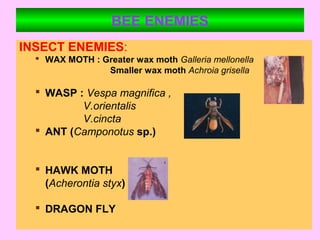
INSECT ENEMIES:
 WAX MOTH : Greater wax moth Galleria mellonella
Smaller wax moth Achroia grisella
 WASP : Vespa magnifica ,
V.orientalis
V.cincta
 ANT (Camponotus sp.)
 HAWK MOTH
(Acherontia styx)
 DRAGON FLY
BEE ENEMIES
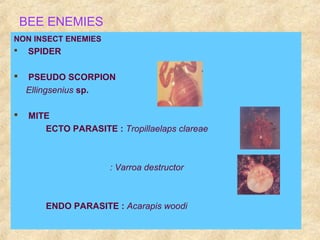
NON INSECT ENEMIES
 SPIDER
 PSEUDO SCORPION
Ellingsenius sp.
 MITE
ECTO PARASITE : Tropillaelaps clareae
: Varroa destructor
ENDO PARASITE : Acarapis woodi
BEE ENEMIES
 TOADS
 SQUIRREL
 LIZARDS
 RAT
 SNAKE
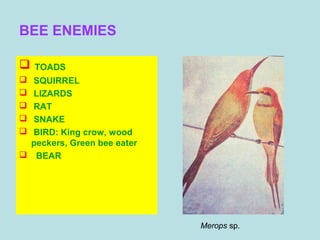
 BIRD: King crow, wood
peckers, Green bee eater
 BEAR
Merops sp.
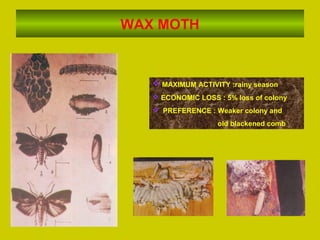
WAX MOTH
 MAXIMUM ACTIVITY :rainy season
 ECONOMIC LOSS : 5% loss of colony
 PREFERENCE : Weaker colony and
old blackened comb
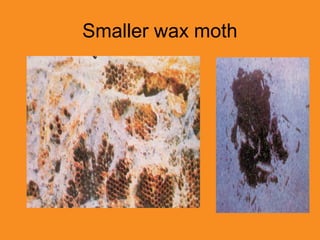
Smaller wax moth
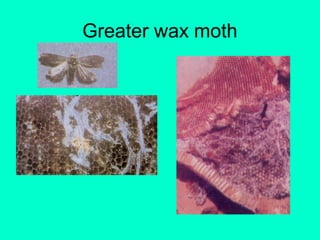
Greater wax moth
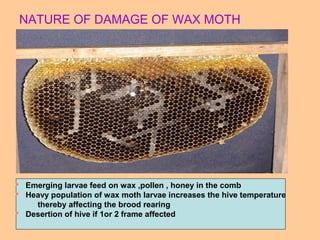
NATURE OF DAMAGE OF WAX MOTH
 Emerging larvae feed on wax ,pollen , honey in the comb
 Heavy population of wax moth larvae increases the hive temperature
thereby affecting the brood rearing
 Desertion of hive if 1or 2 frame affected
Management of wax moth
 Remove the infested comb and destroy either by
burning or digging inside the soil
 Unite the weaker colonies
 Clean the bottom board at fortnight interval
 Adequate food supply to maintain a strong colony
(sugar feeding)
 Always maintain healthy comb
 While staking the super chamber place 1/3rd
Tablet
of Aluminium phosphide for every cubic ft or 2-4
table spoon of PDB between every other super in
a stack
 Spray of B- 401 a formulation of Bacillus
thuringiensis @ 1.5 ml / 10cm2
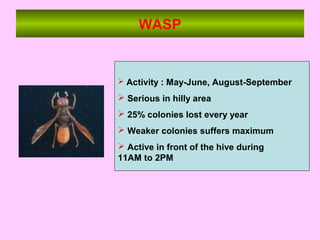
WASP
 Activity : May-June, August-September
 Serious in hilly area
 25% colonies lost every year
 Weaker colonies suffers maximum
 Active in front of the hive during
11AM to 2PM
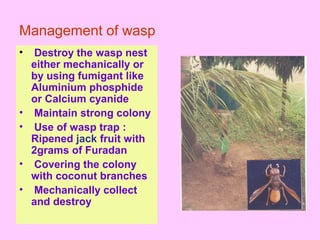
Management of wasp
• Destroy the wasp nest
either mechanically or
by using fumigant like
Aluminium phosphide
or Calcium cyanide
• Maintain strong colony
• Use of wasp trap :
Ripened jack fruit with
2grams of Furadan
• Covering the colony
with coconut branches
• Mechanically collect
and destroy
ANT
Nature of damage: Take away the honey,
pollen, eggs of honey bee from weaker
colony
MANAGEMENT :
 Swab the stand with used mobil
 Legs of hive placed in cups of water
 Clean the bottom board at fortnight interval
ENDO PARASITIC MITE
Acarapis woodi :
 Cause acarine disease
 Both nymphs and adults feed the haemolymph
from the young worker bee by entering through the
spiracles
SYMPTOM
 Presence of crawler bee in front of hives
 For wing and hind wing get separated resembling K shaped
wing
 Yellow dropping due to dysentry
 Distended and shinning abdomen
MANAGEMENT
 Smoke fumigation with chlorobenzilate (FOLBEX) @ one strip /
hive
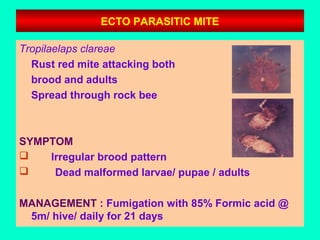
ECTO PARASITIC MITE
Tropilaelaps clareae
Rust red mite attacking both
brood and adults
Spread through rock bee
SYMPTOM
 Irregular brood pattern
 Dead malformed larvae/ pupae / adults
MANAGEMENT : Fumigation with 85% Formic acid @
5m/ hive/ daily for 21 days
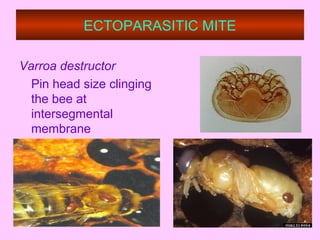
ECTOPARASITIC MITE
Varroa destructor
Pin head size clinging
the bee at
intersegmental
membrane
Symptom:
• Presence of perforated brood
• Unsealed brood and dead pupae
• Dead adults with malformed wing
• Presence of large no. dead and live mite on
bottom board
• Susceptible to robbing
MANAGEMENT;
 Destruction of infested comb
 Destruction of unwanted drone brood
 Fumigation with formic acid (85%) @ 5ml/box for 21days
 Use of Apistan (Fluvalinate)@ 1strip/box
 Caging the queen for 21 days
 Dusting powder sugar/ flour @ 20grams/ 10 frame during
evening
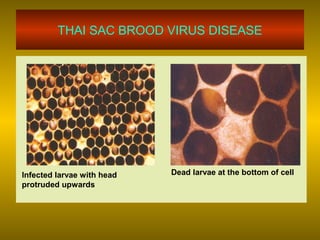
THAI SAC BROOD VIRUS DISEASE
Infected larvae with head
protruded upwards
Dead larvae at the bottom of cell
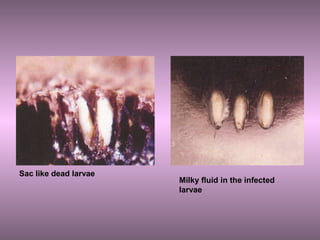
Sac like dead larvae
Milky fluid in the infected
larvae
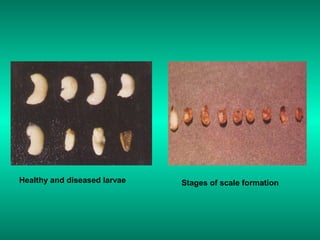
Healthy and diseased larvae Stages of scale formation
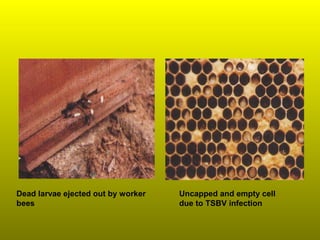
Dead larvae ejected out by worker
bees
Uncapped and empty cell
due to TSBV infection
MANAGEMENT :
 Destroy all affected frame by burning
 Maintain strong and vigorous colony
 Sterilization of all beekeeping equipments with Potassium
permanganate @ 50g/lt of water followed by hot water dipping
 Fumigation of hive with formic acid(85%) @ 5ml / hive for 21
days to control mite which acts as carrier
 Caging the queen for 21 days to create broodlessness
conditions
 Inspect brood comb at regular intervals for any disease
symptom
 Avoid overcrowding and exchanging of brood from one colony
to another
 Ensure complete check on robber bees which spread infection
DYSENTRY
SYMPTOM
Yellow dropping on bottom board with
smell during rainy season
 Presence of weak dying adults in front of
hive
MANGEMENT
feed the colony with Metron @ 5mg along
with honey / sugar solution daily for 3 days
/ hive
Bee enemies and diseases

Bee enemies and diseases

  • 1.
    DR.L.N.MOHAPATRA ASSOCIATE DITRECTOR OFRESEARCH REGIONAL RESEARCH AND TECHNOLOGY TRANSFER STATION BHAWANIPATNA
  • 2.
    BEE ENEMIES INSECT ENEMIES: WAX MOTH : Greater wax moth Galleria mellonella Smaller wax moth Achroia grisella  WASP : Vespa magnifica , V.orientalis V.cincta  ANT (Camponotus sp.)  HAWK MOTH (Acherontia styx)  DRAGON FLY
  • 3.
    BEE ENEMIES NON INSECTENEMIES  SPIDER  PSEUDO SCORPION Ellingsenius sp.  MITE ECTO PARASITE : Tropillaelaps clareae : Varroa destructor ENDO PARASITE : Acarapis woodi
  • 4.
    BEE ENEMIES  TOADS SQUIRREL  LIZARDS  RAT  SNAKE  BIRD: King crow, wood peckers, Green bee eater  BEAR Merops sp.
  • 5.
    WAX MOTH  MAXIMUMACTIVITY :rainy season  ECONOMIC LOSS : 5% loss of colony  PREFERENCE : Weaker colony and old blackened comb
  • 6.
  • 7.
  • 8.
    NATURE OF DAMAGEOF WAX MOTH  Emerging larvae feed on wax ,pollen , honey in the comb  Heavy population of wax moth larvae increases the hive temperature thereby affecting the brood rearing  Desertion of hive if 1or 2 frame affected
  • 9.
    Management of waxmoth  Remove the infested comb and destroy either by burning or digging inside the soil  Unite the weaker colonies  Clean the bottom board at fortnight interval  Adequate food supply to maintain a strong colony (sugar feeding)  Always maintain healthy comb  While staking the super chamber place 1/3rd Tablet of Aluminium phosphide for every cubic ft or 2-4 table spoon of PDB between every other super in a stack  Spray of B- 401 a formulation of Bacillus thuringiensis @ 1.5 ml / 10cm2
  • 10.
    WASP  Activity :May-June, August-September  Serious in hilly area  25% colonies lost every year  Weaker colonies suffers maximum  Active in front of the hive during 11AM to 2PM
  • 11.
    Management of wasp •Destroy the wasp nest either mechanically or by using fumigant like Aluminium phosphide or Calcium cyanide • Maintain strong colony • Use of wasp trap : Ripened jack fruit with 2grams of Furadan • Covering the colony with coconut branches • Mechanically collect and destroy
  • 12.
    ANT Nature of damage:Take away the honey, pollen, eggs of honey bee from weaker colony MANAGEMENT :  Swab the stand with used mobil  Legs of hive placed in cups of water  Clean the bottom board at fortnight interval
  • 13.
    ENDO PARASITIC MITE Acarapiswoodi :  Cause acarine disease  Both nymphs and adults feed the haemolymph from the young worker bee by entering through the spiracles SYMPTOM  Presence of crawler bee in front of hives  For wing and hind wing get separated resembling K shaped wing  Yellow dropping due to dysentry  Distended and shinning abdomen MANAGEMENT  Smoke fumigation with chlorobenzilate (FOLBEX) @ one strip / hive
  • 14.
    ECTO PARASITIC MITE Tropilaelapsclareae Rust red mite attacking both brood and adults Spread through rock bee SYMPTOM  Irregular brood pattern  Dead malformed larvae/ pupae / adults MANAGEMENT : Fumigation with 85% Formic acid @ 5m/ hive/ daily for 21 days
  • 15.
    ECTOPARASITIC MITE Varroa destructor Pinhead size clinging the bee at intersegmental membrane
  • 16.
    Symptom: • Presence ofperforated brood • Unsealed brood and dead pupae • Dead adults with malformed wing • Presence of large no. dead and live mite on bottom board • Susceptible to robbing MANAGEMENT;  Destruction of infested comb  Destruction of unwanted drone brood  Fumigation with formic acid (85%) @ 5ml/box for 21days  Use of Apistan (Fluvalinate)@ 1strip/box  Caging the queen for 21 days  Dusting powder sugar/ flour @ 20grams/ 10 frame during evening
  • 17.
    THAI SAC BROODVIRUS DISEASE Infected larvae with head protruded upwards Dead larvae at the bottom of cell
  • 18.
    Sac like deadlarvae Milky fluid in the infected larvae
  • 19.
    Healthy and diseasedlarvae Stages of scale formation
  • 20.
    Dead larvae ejectedout by worker bees Uncapped and empty cell due to TSBV infection
  • 21.
    MANAGEMENT :  Destroyall affected frame by burning  Maintain strong and vigorous colony  Sterilization of all beekeeping equipments with Potassium permanganate @ 50g/lt of water followed by hot water dipping  Fumigation of hive with formic acid(85%) @ 5ml / hive for 21 days to control mite which acts as carrier  Caging the queen for 21 days to create broodlessness conditions  Inspect brood comb at regular intervals for any disease symptom  Avoid overcrowding and exchanging of brood from one colony to another  Ensure complete check on robber bees which spread infection
  • 22.
    DYSENTRY SYMPTOM Yellow dropping onbottom board with smell during rainy season  Presence of weak dying adults in front of hive MANGEMENT feed the colony with Metron @ 5mg along with honey / sugar solution daily for 3 days / hive