SUBMITTED TO: SUBMITTED BY:
CO-ORDINATOR INDER KUMAR
(RAWE PROGRAMME) (2012A36BIV)
2
TEACHERS ASSOCIATED
 Dr. R .K. Pannu (Dean, COA)
 Dr. Naresh Mehta(Associate Dean, COA)
 Dr. Jagdev Singh( HOD, Agronomy)
 Dr. S.K. Thakral (RAWE Co-ordinator)
 Dr. Anil Kumar Dhaka( Agronomy)
 Dr. B.R. Kamboj(sr. Coordinator, KVK, Damla, Yamuna Nagar)
 Dr. R.S Kadian(economics)
 Dr. Jitender Kumar(economics)
 Dr. P. S. Shehrawat(extension)
 Dr. J.S Malik(extension)
 Dr. Bharat singh(extension)
 Dr. Suresh kumar(agronomy)
 Dr. V.S. Hooda(agronomy)
 Dr. Bhagat Singh(agronomy)
 Dr. R. K Goyal(horticulture)
 Dr. D.S. Dahiya(horticulture)
 Dr. A.K. Bhatia(vegetable)
 Dr. Vijay Pal(vegetable)
 Dr. B.S. Duhan(soil science)
 Dr. Ram parkash(soil science)
 Dr. S.S. Yadav(entomology)
 Dr. Harish kumar(entomology)
 Dr. Kushal raj(plant pathology)
 Dr. Narender Yadav(plant pathology)
 Mr. Satpal(plant breeding, forage section)
3
I
DEDICATED
THIS TO
ALMIGHTY
AND
MY LOVABLE
PARENTS
4
CONTENTS
SR.No. Particulars Page
No.
1. Acknowledge 6
2. Preface 7
3. Introduction 8
4. Objectives Of RAWE 10
5. Probable Results of RAWE Programme 11
6. Important Dates In Rawe Programme 14
7. A Glance At Haryana
 Area, Production and Productivity of Rabi Crops
 Area, Production and Productivity of Kharif Crops
 Area, Production and Productivity of Commercial Crops
15
8. Yamunanagar At A Glance
 Statistic Data of Yamuna Nagar
17
18
9. About Krishi Vigyan Kendre, Damla 19
10. About Village NAGAL 20
11. Demography of Nagal 21
12 Training and Kisan Goshthi organized in village 25
13. Techno-Economic Survey of Host Farmer 29
14. Contribution in improvement of Agriculture in Nagal 37
15 On Farm Problems observed in village 38
16 Success stories of few Progressive Farmers 39
17 Benefits of RAWE 41
18 Conclusion 41
19 Special thanks 42
5
GROUP MEMBERS:-
1.INDER KUMAR (2012A36BIV)(GROUPLEADER)
2.DEEPAK KOCHAR(2012A24BIV)
3.ANUJ KUMAR(2012A14BIV)
4.NARESH KUMAR(2012A53BIV)
5.DIGEMBER DHULL(2012A32BIV)
6.DHEERAJ KUMAR(2012A31BIV)
7.SHANTANU MISHRA(2012A103BIV)
6
ACKNOWLEDGEMENT
I feel too short of my vocabulary to express my feelings at this very moment while writing a
report of my RAWE (Rural Agricultural Work Experience) programme. This programme is not
an endeavour of a single individual. It takes the co-operation and effort of many other people
who have directly or indirectly been involved in the work. I hereby take this blissful opportunity
to thank all those who have helped me in the successful completion of this task without any
terms and condition.
With great pleasure and deep sense of unwavering gratitude , I express my sincere
appreciation & indebtedness to Dr.S.K.Thakral and Dr.Anil Dhaka (Co-ordinator, RAWE
Programme), Dr.Jagdev Singh (HOD, Agronomy)whose initiative, interest, personal
supervision, creative suggestions and valuable guidance at every step provided me a constant
source of energetic inspiration and encouragement for intensive studies and help me to
understand the true value of this Program.
I express my gratitude to our honorable Vice chancellor, Dr. K.S.Khokhar, for taking
interest in this RAWE Programme. Nevertheless, most humbly, I express my sincere and deep-
felt sense of gratitude & obligation to our dean Dr.R.K.Pannu to give us chance for preparing
this manuscript in degree programme to get Practical knowledge.
I would like to extend my deep sense of sincere gratitude & indebtedness to all the HODs
and professors of different departments for their co-operation, moral support and magnanimous
help during the orientation period.
My profound thanks to Dr. B. R. Kamboj (sr. coordinator, KVK, Damla), Dr. N.K.
Goyal & Dr. Taya, faculty for their keen interest as an instructor, evaluator & mentors of our
trainings and who elevated our knowledge and helped us to solve the problems of farmers
during this programme.
I am obliged to host of our group of village NAGAL, Shri. Surinder kumar (Sarpanch) & my
Host farmer who helped us a lot in every step and acted as a local guardian .We are indebted
to all the farmers of village Nagal and especially to my host farmer, who participated and
supported in our work experience program.
Last but not least I wish to acknowledge the help, support & co-operation that I received from
my group mates Shantanu Mishra , Digamber , Deepak , Dheeraj , Anuj , Naresh.
PLACE: NAGAL, YAMUNA NAGAR INDER KUMAR
DATE: 20TH MARCH.2016 (2012A36BIV)
7
PREFACE
Agriculture is backbone of Indian economy. It has been a main stay of human beings
since time immemorial.
Its importance can be truly felt from the words of India’s first Prime Minister
Jawaharlal Nehru-
“EVERYTHING CAN WAIT BUT AGRICULTURE CAN NOT”
Agricultural education is an important means of ensuring increased agricultural productivity,
sustainability, environmental and ecological security, profitability, job security and equity.
With the rising agricultural production in the country and introduction of modern
technology in the production and processing of agricultural produce, the concept of farming is
shifting from survival and growth to value added agri - business approach. During 2014-15,
agricultural sector contributed to approx. 13.5% of India’ GDP and 10.23% of total exports,
besides providing employment to around 600 million of the work force.
This will lead to major opportunities in high growth, mass - based, high volume markets
generating enormous opportunities for the corporate sector.
The third Dean's Committee (1995) suggested model academic regulations and curricula
for agriculture graduates. Special emphasis was given to practical training to inculcate skill and
confidence among the undergraduates to enable them to meet the new challenges. To achieve
this goal, RAWE PROGRAMME in actual farming situation has been included in the course
curriculum of the B.Sc. Agri. students in addition to the on -going programme of practical
training at this university. Such a programme will provide and opportunity to the agricultural
graduates to develop self - confidence in farming and better understanding of the practical
problems faced in the field by the farmers as well as socio - economic aspects of the village life
more closely.
The main objective of RAWE is to teach the student practically which the student learnt
theoretically in college. It is the opportunity to gain the experience of problem faced by the
farmers in growing crops and other enterprises. This report owes its preparation to the sincere
and meticulous analysis of situation of village Nagal. This report contains the information on
area, population, culture, cropping pattern, economic status, adoption of crop varieties etc.
8
INTRODUCTION
Introduction of Rural Agricultural Work Experience (RAWE) Programme
With the introduction of green revolution in India, agriculture in India has faced a
number of turns, success stories and of course failures at certain steps too. With the ever
increasing population of India, need for space and food has increased several times. Area under
agriculture is limited and decreasing day by day, but demand for more production is increasing.
So India has felt need of boost in agriculture, for this India has to depend on students of
agriculture and farmers. Because the scientists and researchers we see today were students of
yesterday and vice-versa. So as agriculture depends on these scientists, researchers and farmers
so alternately agriculture depends on students. Hence it is obvious that bright agriculture of
future means bright students of today. ICAR has felt this necessity for making its students future
bright because not only agriculture but whole Indian economy and hence India depends on it.
An important step in this connection was taken by the ICAR by appointing 2nd Dean's
Committee in April 1979. The Dean's Committee pointed out weakness in terms of need of
practical training in the Curricula of agriculture graduate degree. The committee also
recommended that the practical training should be in production-oriented aspects, internship
(IAP) and work experience in village.
The third Dean's Committee (1995) suggested model academic regulations and
Curricula for agriculture graduates. Special emphasis was given to practical training to inculcate
skill and confidence among the undergraduates to enable them to meet the new challenges. To
achieve this goal, RAWE PROGRAMME in actual farming situation has been included in the
course curriculum of the B.Sc. Agriculture Students in addition to the ongoing programme of
practical training at this university. Such a programme will provide an opportunity to be
agricultural graduates to develop self -confidence in farming and better understanding of the
practical problems faced in the field by farmers as well as socio-economic aspects of the village
life more closely.
With the rising agricultural production in the country and introduction of modern
technology and processing in the production and processing of agricultural produce, the concept
9
of farming in shifting from survival and growth to value added agri-business approach. The food
industry in India is a very high multiplier (2.4), which is greater than that of power and telecome
sector. Today, the food industry is India is worth Rs. 250,000 crores, which is expected to rise to
Rs.680, 000 crores by the year 2008. This will lead to major opportunities for the corporate
sector.
In this backdrop, there will change will the market i.e. job in government public sector
will recede and tremendous job opportunities will emerge in corporate sector as well as the
opportunities of self-employment. Obviously, there is need to reorient RAWE PROGRAMME
to the new challenges in agriculture, it is felt that there is need to depute items for imparting
them a short training in various agro-industrial units. This will add to their knowledge and give
them an impetus. This will also help in developing competency among agricultural graduates in
the areas of technology managerial skill, agri-business as well as to face future challenges of
employment.
The RAWE PROGRAMME is offered in the second semester of final year, to only
those B.Sc.(Hons.) Agri.Students who have already completed all the course work and other
prescribed requirements for the B.Sc. (Hons) Agri.Degree.
RAWE is aimed at total development of students in agriculture both theoretically and
practically. It makes its student to analyze and find possible solutions to rural agriculture on their
own. So students are tested for their knowledge and it gives students a moral and confidence
which is helpful to them in future. RAWE actually is aimed at connecting students to agriculture
by their soul and mind. So in end of this programme students are of agriculture, for agriculture,
and by agriculture. Many or say most of these work in future in areas of agri research and rest in
other areas of agriculture. RAWE hence provides bright future to agriculture research in INDIA.
This programme hence never ends in a students life who has faced this programme once in his
life. For students of B.Sc (hons.) Agri. in CCS HAU, RAWE is integral part of their life. So
hats off to this great programme and thanks to CCS HAU for making us to face it.
10
Objectives of RAWE
 To gain knowledge and experience on the operational aspects of agricultural technology
being used by farmers.
 To develop communication skills in interns by effective use of extension methods to make
them better extension workers.
 To help the interns to understand and appreciate the agricultural problems of village with
special reference to the constraints in the application of latest farm technology.
 To acquaint the interns with the functioning of various researches, development, agro - based
marketing industries, extension agencies and other allied organizations involved in rural
development.
11
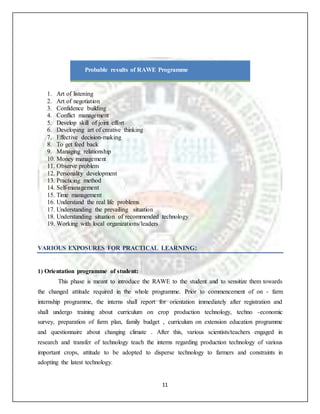
Probable results of RAWE Programme
1. Art of listening
2. Art of negotiation
3. Confidence building
4. Conflict management
5. Develop skill of joint effort
6. Developing art of creative thinking
7. Effective decision-making
8. To get feed back
9. Managing relationship
10. Money management
11. Observe problem
12. Personality development
13. Practicing method
14. Self-management
15. Time management
16. Understand the real life problems
17. Understanding the prevailing situation
18. Understanding situation of recommended technology
19. Working with local organizations/leaders
VARIOUS EXPOSURES FOR PRACTICAL LEARNING:
1) Orientation programme of student:
This phase is meant to introduce the RAWE to the student and to sensitize them towards
the changed attitude required in the whole programme. Prior to commencement of on - farm
internship programme, the interns shall report for orientation immediately after registration and
shall undergo training about curriculum on crop production technology, techno -economic
survey, preparation of farm plan, family budget , curriculum on extension education programme
and questionnaire about changing climate . After this, various scientists/teachers engaged in
research and transfer of technology teach the interns regarding production technology of various
important crops, attitude to be adopted to disperse technology to farmers and constraints in
adopting the latest technology.
12
Expected outcome:
 Better understanding of basic agriculture
 Changed attitude towards learning
 Development of team work
 Understanding of the RAWE programme
2) Agriculture technology information centre:
It is to help them to understand what is going on in the training and research centres, the need
of today’s farmers and the role of trainers and researchers. In short, this period helps them to
know the middle segment between the academic and ground level agriculture better.
Expected outcome:
 Building research and extension competence
 Building confidence as an individual
 Information of recent advancement in training and research
 Handling practical work.
 Knowledge of collection, compilation and analysis of experimental data
 Knowledge of research techniques
 Knowledge of working methodology
 Revelation of administration and management
3) High-Tech cell:
It helps the students to be conversant to work with the modern gadgets like computer and the
other machines we need for tissue culture and biotechnology.
Expected outcome:
 Having awareness about the latest technology
 Understanding of green house, tissue culture and bio-technology
 Updating and collecting information through internet
 Working and surfing with computers
4) Farm families in villages:
To understand the first hand experience of rural life. The ways by which farming profession
impacts the family life and their standard of living.
Expected outcome:
 Ability to plan out strategy to work in villages
 Real field experience
13
 Understanding real-life of farmers.
 Understanding the gap between the rural and urban people
 Understanding the mundane work and problems of agriculture.
5) Official authorities
Collecting data from various authorities give a sense of understanding of the district
and village and a rare opportunity in college life to understand administrative hierarchy.
Expected outcome:
 Understanding official working system
 To understand power vested in different authorities
6) Agro-based Industries and Co-operatives:
This phase helps students to understand the meaning, nature and working of existing co-
operatives and how to be entrepreneurs through the agro-based business.
Expected outcome
 Creating solution-finding atmosphere
 Impact on agricultural development
 Management of different components
 Managing Economic crisis
 People’s participation
 Problem-solving attitude
 Team work development
 Working with people organization
7)Training on Self Employment -
A opportunity to become self dependent even in time of crisis by helping to build confidence
and by improving personality. We come to know what it takes to become self dependent.
Expected outcome-
 Personality development
 Confidence build-up
 A step towards secure future.
Thus, RAWE is a learner-centered approach of exposing undergraduate students of
college of Agriculture by using principles of “learning by doing” and “seeing is believing” to
provide direction to think and act on their own. It offers a course to students to learn how to be
competent, confident, capable, skillful and able to do work in real life situations. This
experimental system in agricultural education has a strong potential to prepare a better
agricultural technocrats with high level of skill in combination with the modern out-look and
management capacity. RAWE is one of the best means to produce well trained agricultural
graduates with broad based knowledge and techniques to meet the emerging challenges of
agriculture.
14
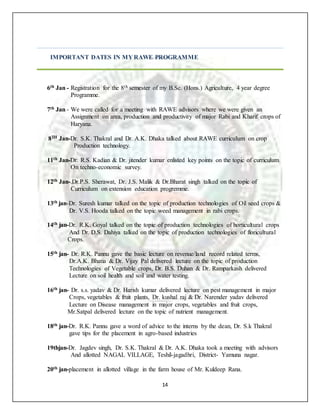
IMPORTANT DATES IN MY RAWE PROGRAMME
6th Jan - Registration for the 8th semester of my B.Sc. (Hons.) Agriculture, 4 year degree
Programme.
7th Jan - We were called for a meeting with RAWE advisors where we were given an
Assignment on area, production and productivity of major Rabi and Kharif crops of
Haryana.
8TH Jan-Dr. S.K. Thakral and Dr. A.K. Dhaka talked about RAWE curriculum on crop
Production technology.
11th Jan-Dr. R.S. Kadian & Dr. jitender kumar enlisted key points on the topic of curriculum
On techno-economic survey.
12th Jan-.Dr.P.S. Sherawat, Dr. J.S. Malik & Dr.Bharat singh talked on the topic of
Curriculum on extension education progremme.
13th jan-Dr. Suresh kumar talked on the topic of production technologies of Oil seed crops &
Dr. V.S. Hooda talked on the topic weed management in rabi crops.
14th jan-Dr. R.K. Goyal talked on the topic of production technologies of horticultural crops
And Dr. D.S. Dahiya talked on the topic of production technologies of floricultural
Crops.
15th jan- Dr. R.K. Pannu gave the basic lecture on revenue/land record related terms,
Dr.A.K. Bhatia & Dr. Vijay Pal delivered lecture on the topic of production
Technologies of Vegetable crops, Dr. B.S. Duhan & Dr. Ramparkash delivered
Lecture on soil health and soil and water testing.
16th jan- Dr. s.s. yadav & Dr. Harish kumar delivered lecture on pest management in major
Crops, vegetables & fruit plants, Dr. kushal raj & Dr. Narender yadav delivered
Lecture on Disease management in major crops, vegetables and fruit crops,
Mr.Satpal delivered lecture on the topic of nutrient management.
18th jan-Dr. R.K. Pannu gave a word of advice to the interns by the dean, Dr. S.k Thakral
gave tips for the placement in agro-based industries
19thjan-Dr. Jagdev singh, Dr. S.K. Thakral & Dr. A.K. Dhaka took a meeting with advisors
And allotted NAGAL VILLAGE, Teshil-jagadhri, District- Yamuna nagar.
20th jan-placement in allotted village in the farm house of Mr. Kuldeep Rana.
15
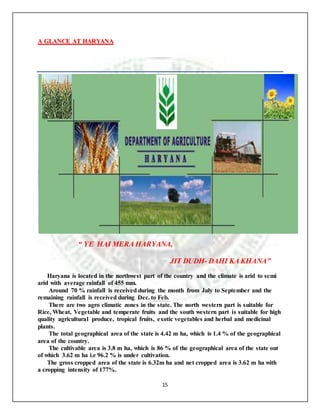
AA GGLLAANNCCEE AATT HHAARRYYAANNAA
“ YE HAI MERA HARYANA,
JIT DUDH- DAHI KA KHANA”
Haryana is located in the northwest part of the country and the climate is arid to semi
arid with average rainfall of 455 mm.
Around 70 % rainfall is received during the month from July to September and the
remaining rainfall is received during Dec. to Feb.
There are two agro climatic zones in the state. The north western part is suitable for
Rice, Wheat, Vegetable and temperate fruits and the south western part is suitable for high
quality agricultural produce, tropical fruits, exotic vegetables and herbal and medicinal
plants.
The total geographical area of the state is 4.42 m ha, which is 1.4 % of the geographical
area of the country.
The cultivable area is 3.8 m ha, which is 86 % of the geographical area of the state out
of which 3.62 m ha i.e 96.2 % is under cultivation.
The gross cropped area of the state is 6.32m ha and net cropped area is 3.62 m ha with
a cropping intensity of 177%.
16
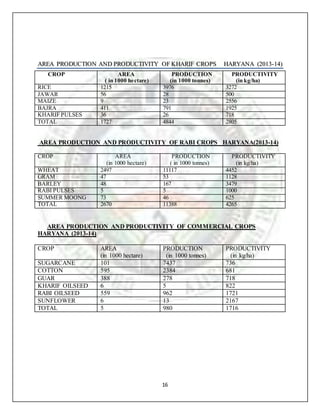
AARREEAA PPRROODDUUCCTTIIOONN AANNDD PPRROODDUUCCTTIIVVIITTYY OOFF KKHHAARRIIFF CCRROOPPSS HHAARRYYAANNAA ((22001133--1144))
CROP AREA
( in 1000 hectare)
PRODUCTION
(in 1000 tonnes)
PRODUCTIVITY
(in kg/ha)
RICE 1215 3976 3272
JAWAR 56 28 500
MAIZE 9 23 2556
BAJRA 411 791 1925
KHARIF PULSES 36 26 718
TOTAL 1727 4844 2805
AREA PRODUCTION AND PRODUCTIVITY OF RABI CROPS HARYANA(2013-14)
CROP AREA
(in 1000 hectare)
PRODUCTION
( in 1000 tonnes)
PRODUCTIVITY
(in kg/ha)
WHEAT 2497 11117 4452
GRAM 47 53 1128
BARLEY 48 167 3479
RABI PULSES 5 5 1000
SUMMER MOONG 73 46 625
TOTAL 2670 11388 4265
AREA PRODUCTION AND PRODUCTIVITY OF COMMERCIAL CROPS
HARYANA (2013-14)
CROP AREA
(in 1000 hectare)
PRODUCTION
(in 1000 tonnes)
PRODUCTIVITY
(in kg/ha)
SUGARCANE 101 7437 736
COTTON 595 2384 681
GUAR 388 278 718
KHARIF OILSEED 6 5 822
RABI OILSEED 559 962 1721
SUNFLOWER 6 13 2167
TOTAL 5 980 1716
17
YYAAMMUUNNAA NNAAGGAARR AATT AA GGLLAANNCCEE
HISTORY
This town became the new home of the refugees who migrated to this part of the country
on the partition of the country in 1947 .Rampura Colony, Model Colony, Model Town and
Gandhi Camp areas of modern city were reserved for them, the position remained as such up to
1970s. The place was earlier known as 'Abdullahpur' which was later renamed by the city's
eminent people as Jamnanagar and later on as Yamunanagar. Till 1947, it was a small hamlet of
6000 people, mostly population concentrated around Jagadhri Railway Station and Yamuna
Gali, Old Radaur Road area. After partition of India, many migrants from Punjab in Pakistan
chose to make Yamuna Nagar/Jagadhri their new home, and in the process. adding to the
culture of the town. The area where land was allocated to the migrants, later developed into
the Model Town area of Yamuna Nagar, the centre of the city area. The Topra Asokan pillar of
Delhi was found in the village Topra Kalan, about 20 km from yamunanagar. Archaeological
survey of India has found many Harrapan bricks and stones from the area.
AGRICULTURE
Due to the abundantpresence of water,fertile soil,andwarmclimate,farmingis animportantpart
of YamunaNagar. Some of the more commonlygrowncropsare sugarcane,rice,wheat,andgarlic.In
additiontoconventional farming,manyfarmersof YamunaNagaralsoparticipate inagroforestry;
poplaror eucalyptustreesare oftenincludedinthese projects.
INDUSTRY
Yamuna Nagar iswell knownforitsindustries.Ithasemergedasan importantindustrial destination
inthe state.Thishas beendespiteitsrelativelyisolatedlocationfromrestof the state.Due to expanding
industries, the citykeptonextendinggeographically.Thisisprimarilydue toan increasingnumberof
immigrants.Thisledtoan intermixingof diverse culture.Italsohasto do withthe rural ambiance which
isreportedto have undergone alotof change.With increasingpopulation,the tradingaspectsbecame
brighterandthe city wentonbecomingthe secondhighestrevenue generatorof Haryana,immediately
afterFaridabadthat owesitspositionlargelytoitsprime location.The cityhasa paper manufacturer
giant.BallarpurIndustriesLimited(BILT) isaflagshipof the US$ 4 bnAvanthaGroup and India'slargest
manufacturerof writingandprinting(W&P) paper.The cityproducessugarmachinery,papermachinery
alongwithhighlyefficientequipmentsforpetrochemical plants,whichare shippedtovariousrefineries
across the country.The cityisalsoknownfor itsplywoodindustries,GMPlywoodIndustries.whichis
attributedtothe easyaccessibilityof primaryraw material –poplartree.Ithas alsoone of India'slargest
railwaycarriage and wagonrepairworkshops.Recently,Reliance Infrastructurehasalsoinstalled
DeenbandhuChhotuRamThermal PowerStationinthe town.HaryanaUrban DevelopmentAuthority
has done majordevelopmentworkinthe land-stretchlinkingthe citywithJagadhri,the otherpartof
twincity.Jagadhri isas also knownasthe 'Brass City',andfamousfor itsbrass and stainlesssteel
utensils.
18
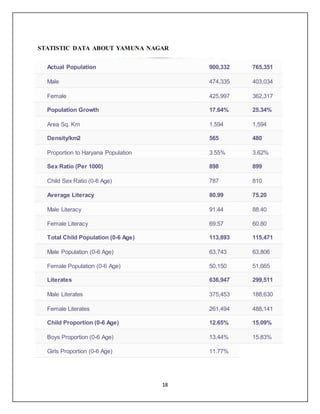
STATISTIC DATA ABOUT YAMUNA NAGAR
Actual Population 900,332 765,351
Male 474,335 403,034
Female 425,997 362,317
Population Growth 17.64% 25.34%
Area Sq. Km 1,594 1,594
Density/km2 565 480
Proportion to Haryana Population 3.55% 3.62%
Sex Ratio (Per 1000) 898 899
Child Sex Ratio (0-6 Age) 787 810
Average Literacy 80.99 75.20
Male Literacy 91.44 88.40
Female Literacy 69.57 60.80
Total Child Population (0-6 Age) 113,893 115,471
Male Population (0-6 Age) 63,743 63,806
Female Population (0-6 Age) 50,150 51,665
Literates 636,947 299,511
Male Literates 375,453 188,630
Female Literates 261,494 488,141
Child Proportion (0-6 Age) 12.65% 15.09%
Boys Proportion (0-6 Age) 13.44% 15.83%
Girls Proportion (0-6 Age) 11.77%
19
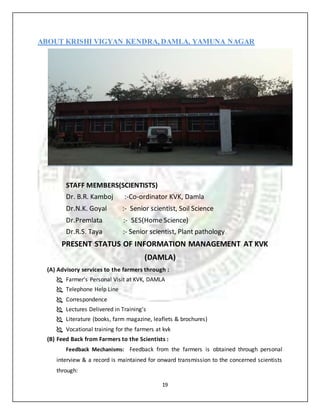
ABOUT KRISHI VIGYAN KENDRA, DAMLA, YAMUNA NAGAR
STAFF MEMBERS(SCIENTISTS)
Dr. B.R. Kamboj :-Co-ordinator KVK, Damla
Dr.N.K. Goyal :- Senior scientist, Soil Science
Dr.Premlata :- SES(Home Science)
Dr.R.S. Taya :- Senior scientist, Plant pathology
PRESENT STATUS OF INFORMATION MANAGEMENT AT KVK
(DAMLA)
(A) Advisory services to the farmers through :
 Farmer’s Personal Visit at KVK, DAMLA
 Telephone Help Line
 Correspondence
 Lectures Delivered in Training’s
 Literature (books, farm magazine, leaflets & brochures)
 Vocational training for the farmers at kvk
(B) Feed Back from Farmers to the Scientists :
Feedback Mechanisms: Feedback from the farmers is obtained through personal
interview & a record is maintained for onward transmission to the concerned scientists
through:
20
ABOUT VILLAGE:
Nagal is a medium size village located in Jagadhri of Yamunanagar district, Haryana with
total 281 families residing. The Nagal village has population of 1638 of which 855 are males
while 783 are females as per Population Census 2011.
In Nagal village population of children with age 0-6 is 200 which makes up 12.21 % of total
population of village. Average Sex Ratio of Nagal village is 916 which is higher than Haryana
state average of 879. Child Sex Ratio for the Nagal as per census is 786, lower than Haryana
average of 834.
Nagal village has higher literacy rate compared to Haryana. In 2011, literacy rate of Nagal
village was 82.68 % compared to 75.55 % of Haryana. In Nagal Male literacy stands at 88.43 %
while female literacy rate was 76.55 %.
As per constitution of India and Panchyati Raaj Act, Nagal village is administrated by
Sarpanch (Head of Village) who is elected representative of village.
Caste Factor
Schedule Caste (SC) constitutes18.68 % of total populationinNagal village.The village Nagal
currentlydoesn’thave anySchedule Tribe(ST) population.
Work Profile
In Nagal village outof total population,450were engagedinworkactivities.100.00 % of workers
describe theirworkasMain Work (EmploymentorEarningmore than 6 Months) while 0.00 % were
involvedinMarginal activityprovidinglivelihoodforlessthan6 months.Of 450 workersengagedin
Main Work, 150 were cultivators(ownerorco-owner) while56were Agricultural labourer.
SURVEY AND STUDY OF THE VILLAGE(NAGAL)
NAME OF VILLAGE : NAGAL
BLOCK : JAGADHRI
TALUK : JAGADHRI
DISTRICT : YAMUNA NAGAR
HADBASTTH NO. : 158
21
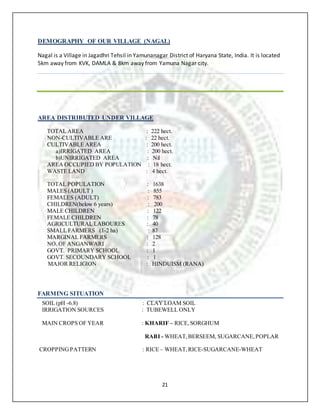
DEMOGRAPHY OF OUR VILLAGE (NAGAL)
Nagal is a Village in Jagadhri Tehsil in Yamunanagar District of Haryana State, India. It is located
5km away from KVK, DAMLA & 8km away from Yamuna Nagar city.
AREA DISTRIBUTED UNDER VILLAGE
TOTAL AREA : 222 hect.
NON-CULTIVABLE ARE : 22 hect.
CULTIVABLE AREA : 200 hect.
a)IRRIGATED AREA : 200 hect.
b)UNIRRIGATED AREA : Nil
AREA OCCUPIED BY POPULATION : 18 hect.
WASTE LAND : 4 hect.
TOTAL POPULATION : 1638
MALES (ADULT ) : 855
FEMALES (ADULT) : 783
CHILDREN(below 6 years) : 200
MALE CHILDREN : 122
FEMALE CHILDREN : 78
AGRICULTURAL LABOURES : 40
SMALL FARMERS (1-2 ha) : 87
MARGINAL FARMERS : 128
NO. OF ANGANWARI : 2
GOVT. PRIMARY SCHOOL : 1
GOVT. SECOUNDARY SCHOOL : 1
MAJOR RELIGION : HINDUISM (RANA)
FARMING SITUATION
SOIL (pH -6.8) : CLAY LOAM SOIL
IRRIGATION SOURCES : TUBEWELL ONLY
MAIN CROPS OF YEAR : KHARIF – RICE,SORGHUM
RABI - WHEAT,BERSEEM, SUGARCANE,POPLAR
CROPPINGPATTERN : RICE – WHEAT,RICE-SUGARCANE-WHEAT
22
LOCATION OF INFRASTRUCTURE
RAILWAY STATION : 7 KM
POLICE STATION : 4 KM
DISPENSERY HEALTH CENTRE : 1 KM
VETERINERY HOSPITAL : 3 KM
SEED/FERTILIZER/PESTICIDE STORE : 2 KM
POST OFFICE : WITHIN VILLAGE
SCHOOLS : WITHIN VILLAGE
AGANWADI : 1
PANCHAYATBHAWAN : 2
WATER WORKS : 1
GRAVEYARD : 1
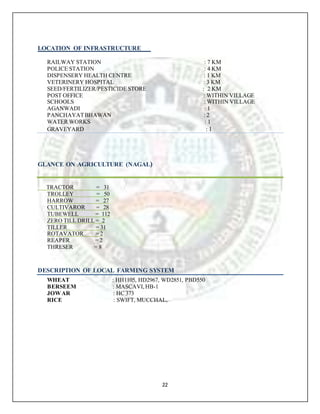
GLANCE ON AGRICULTURE (NAGAL)
TRACTOR = 31
TROLLEY = 50
HARROW = 27
CULTIVAROR = 28
TUBEWELL = 112
ZERO TILL DRILL = 2
TILLER = 31
ROTAVATOR = 2
REAPER = 2
THRESER = 8
DESCRIPTION OF LOCAL FARMING SYSTEM
WHEAT : HH1105, HD2967, WD2851, PBD550
BERSEEM : MASCAVI,HB-1
JOWAR : HC 373
RICE : SWIFT, MUCCHAL,
23
STORAGE
 Grains are stored in open covered with polyethene sheet.
 Farmers store on the basis of their average requirements.
 Most of the farmers tried to sell their produce immediately after harvest.
 There is no much loss in storage.
 To protect grains from pest and diseases, neem leaf is kept along with grains ,rarely
aluminium phosphide tablets are used seeds are stored at optimum moisture level after
treatments.
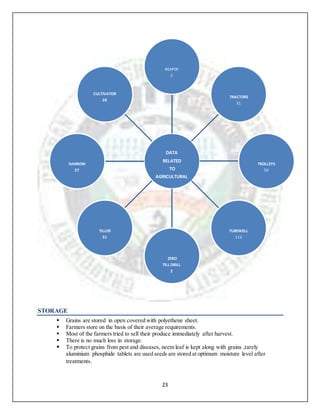
DATA
RELATED
TO
AGRICULTURAL
REAPER
2
TRACTORS
31
TROLLEYS
50
TUBEWELL
112
ZERO
TILL DRILL
2
TILLER
31
HARROW
27
CULTIVATOR
28
24
NEAREST AGRICULTURAL RESEARCH FACILITIES
KRISHI VIGYAN KENDRA,DAMLA:5KM
DIFFICULTIES EXPERIENCED BY FARMERS
SEEDS : SEEDS IN GOVT. DEPOT
LIMITED
PRIVATE SEEDS ARE
EXPENSIVE
GOVT. SPONSRED MATERIAL : UNABLE TO GET IN TIME
FERTILIZERS : SOME TIMES NOT
AVAILABLE
PESTICIDES : COSTLY AND LACK OF
KNOWLEDGE
FARM IMPLEMENTS AND MACHINERY :LITTLE BIT COSTLY
GENERAL PROBLEMS RELATED TO THE VILAGE
SOIL TYPE : CLAY LOAM
IRRIGATION : NO WATER FROM CANAL,ONLY
TUBEWELL WATER IS AVAILABLE
WHICH IS EXPENSIVE.
MAIN INCIDENCEOF PESTS AND :APHID IN WHEATANDMUSTARD,
DISEASES HOPPER AND STEM BORER IN RICE,
YELLOW RUST IN WHEAT,
BLAST IN RICE
AGRICULTURAL LABOURERS : DIFFICULT TO GET IN PEAK PERIOD
AND COSTLY (RS 500/LABOUR/DAY)
FARM MACHINERY : DIFFICULT TO HIRE IN PEAK PERIOD
ELECTRICITY : SUPPLY WITH HEAVYFLUCTUATION
LACK OF KNOWLEDGE : UNAWARE ABOUT BENEFITS OF
FIXED DEPOSITS AND P.P.F
25
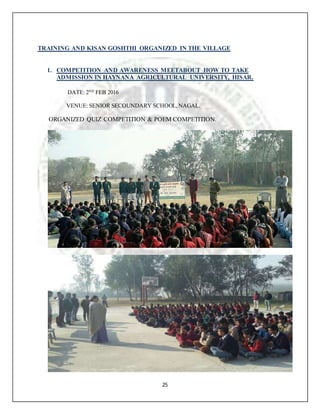
TRAINING AND KISAN GOSHTHI ORGANIZED IN THE VILLAGE
1. COMPETITION AND AWARENESS MEETABOUT HOW TO TAKE
ADMISSION IN HAYNANA AGRICULTURAL UNIVERSITY, HISAR.
DATE: 2ND
FEB 2016
VENUE: SENIOR SECOUNDARY SCHOOL,NAGAL.
ORGANIZED QUIZ COMPETITION & POEM COMPETITION.
26
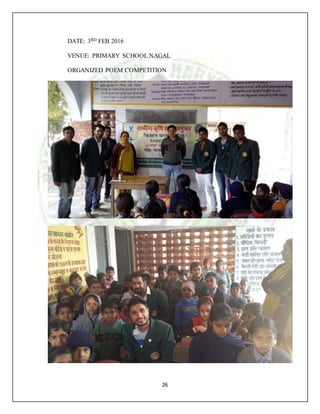
DATE: 3RD FEB 2016
VENUE: PRIMARY SCHOOL NAGAL
ORGANIZED POEM COMPETITION
27
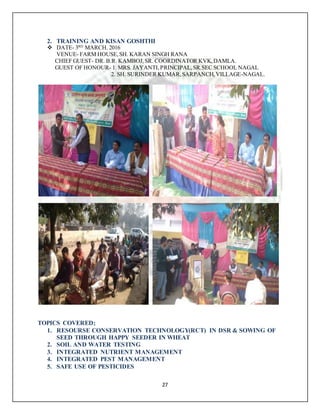
2. TRAINING AND KISAN GOSHTHI
 DATE- 3RD
MARCH. 2016
VENUE- FARM HOUSE,SH. KARAN SINGH RANA
CHIEF GUEST- DR. B.R. KAMBOJ,SR. COORDINATOR KVK,DAMLA.
GUEST OF HONOUR- 1. MRS. JAYANTI,PRINCIPAL,SR.SEC SCHOOL NAGAL
2. SH. SURINDER KUMAR,SARPANCH,VILLAGE-NAGAL.
TOPICS COVERED;
1. RESOURSE CONSERVATION TECHNOLOGY(RCT) IN DSR & SOWING OF
SEED THROUGH HAPPY SEEDER IN WHEAT
2. SOIL AND WATER TESTING
3. INTEGRATED NUTRIENT MANAGEMENT
4. INTEGRATED PEST MANAGEMENT
5. SAFE USE OF PESTICIDES
28
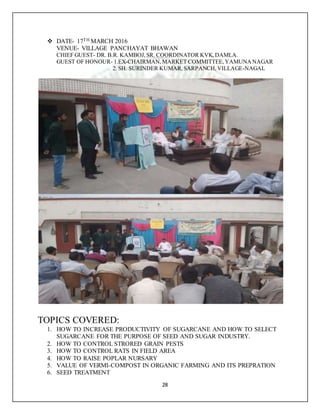
 DATE- 17TH MARCH 2016
VENUE- VILLAGE PANCHAYAT BHAWAN
CHIEF GUEST- DR. B.R. KAMBOJ,SR. COORDINATOR KVK,DAMLA.
GUEST OF HONOUR- 1.EX-CHAIRMAN,MARKET COMMITTEE,YAMUNANAGAR
2. SH. SURINDER KUMAR,SARPANCH,VILLAGE-NAGAL
TOPICS COVERED:
1. HOW TO INCREASE PRODUCTIVITY OF SUGARCANE AND HOW TO SELECT
SUGARCANE FOR THE PURPOSE OF SEED AND SUGAR INDUSTRY.
2. HOW TO CONTROL STRORED GRAIN PESTS
3. HOW TO CONTROL RATS IN FIELD AREA
4. HOW TO RAISE POPLAR NURSARY
5. VALUE OF VERMI-COMPOST IN ORGANIC FARMING AND ITS PREPRATION
6. SEED TREATMENT
29
TECHNO-ECONOMIC SURVEY
Name of cultivator: surinder singh
Education : graduation, B.A
Village : Nagal
Area owned : 9 acre
Source of irrigation: tubewell
Main occupation : manager on petrol pump(earns 5000/month)
Subsidiary business : Farming
Details of family:
Adult Male -4
Adult Female- 4
Children -2
 Permanent labour hired: 1(cash payement-5000)
 Cow owned- 3[expenditure- 6000each/month, income-5000each/month]
CROP- PADDY VARIETY- SWIFT AREA – 4.5 ACRE
ITEM QUANTITY VALUE (RS.)
TOTAL
PREPRATORYTILLAGE 5 5000
PRE-SOWING
IRRIGATION
- -
RIDGING - -
SEED (Kg) 3.5 350
SEED TREATMENT 1 100
SOWING 1 2000
30
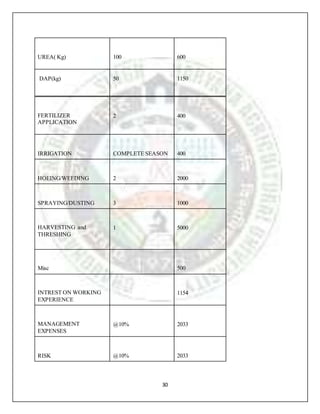
UREA( Kg) 100 600
DAP(kg) 50 1150
FERTILIZER
APPLICATION
2 400
IRRIGATION COMPLETE SEASON 400
HOEING/WEEDING 2 2000
SPRAYING/DUSTING 3 1000
HARVESTING and
THRESHING
1 5000
Misc 500
INTREST ON WORKING
EXPERIENCE
1154
MANAGEMENT
EXPENSES
@10% 2033
RISK @10% 2033
31
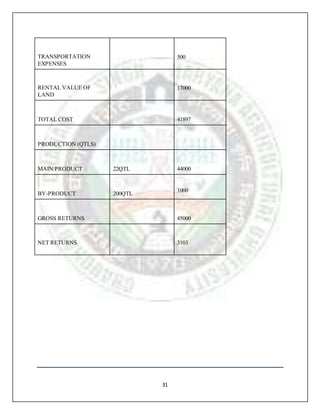
TRANSPORTATION
EXPENSES
500
RENTAL VALUE OF
LAND
17000
TOTAL COST 41897
PRODUCTION (QTLS)
MAIN PRODUCT 22QTL 44000
BY-PRODUCT 200QTL
1000
GROSS RETURNS 45000
NET RETURNS 3103
32
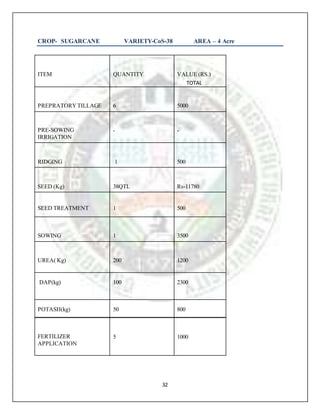
CROP- SUGARCANE VARIETY-CoS-38 AREA – 4 Acre
ITEM QUANTITY VALUE (RS.)
TOTAL
PREPRATORYTILLAGE 6 5000
PRE-SOWING
IRRIGATION
- -
RIDGING 1 500
SEED (Kg) 38QTL Rs-11780
SEED TREATMENT 1 500
SOWING 1 3500
UREA( Kg) 200 1200
DAP(kg) 100 2300
POTASH(kg) 50 800
FERTILIZER
APPLICATION
5 1000
33
IRRIGATION 15 12600
HOEING/WEEDING 3 7500
SPRAYING/DUSTING 2 550/spray
HARVESTING and
THRESHING
1 14000
Misc[WRAPPING] 6000
INTREST ON WORKING
EXPERIENCE
@12% 7361
MANAGEMENT
EXPENSES
@10% 6870
RISK
TRANSPORTATION
EXPENSES
7500
RENTAL VALUE OF
LAND
34000
TOTAL COST 34000
PRODUCTION (QTLS)
34
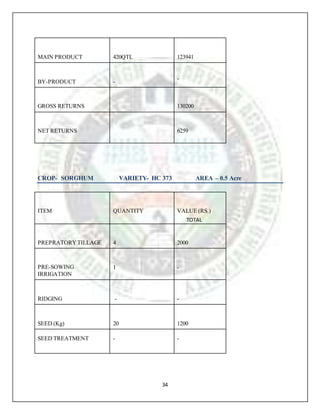
CROP- SORGHUM VARIETY- HC 373 AREA – 0.5 Acre
ITEM QUANTITY VALUE (RS.)
TOTAL
PREPRATORYTILLAGE 4 2000
PRE-SOWING
IRRIGATION
1 -
RIDGING - -
SEED (Kg) 20 1200
SEED TREATMENT - -
MAIN PRODUCT 420QTL 123941
BY-PRODUCT -
-
GROSS RETURNS 130200
NET RETURNS 6259
35
SOWING 1 200
UREA( Kg) 150 900
DAP(kg) 50 1150
FERTILIZER
APPLICATION
3 600
IRRIGATION 4 630
HOEING/WEEDING - -
SPRAYING/DUSTING 1 500
HARVESTING and
THRESHING
-
Misc
INTREST ON WORKING
EXPERIENCE
@6% 551
MANAGEMENT
EXPENSES
@10% 973
RISK 973
36
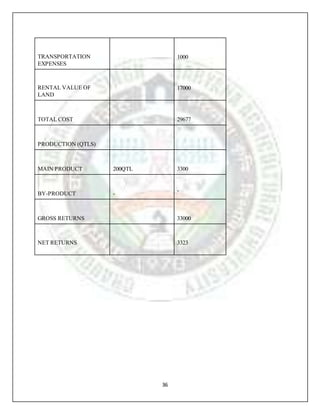
TRANSPORTATION
EXPENSES
1000
RENTAL VALUE OF
LAND
17000
TOTAL COST 29677
PRODUCTION (QTLS)
MAIN PRODUCT 200QTL 3300
BY-PRODUCT -
-
GROSS RETURNS 33000
NET RETURNS 3323
37
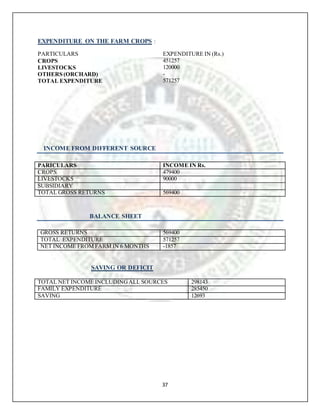
EXPENDITURE ON THE FARM CROPS :
PARTICULARS EXPENDITURE IN (Rs.)
CROPS 451257
LIVESTOCKS 120000
OTHERS (ORCHARD) -
TOTAL EXPENDITURE 571257
INCOME FROM DIFFERENT SOURCE
PARICULARS INCOME IN Rs.
CROPS 479400
LIVESTOCKS 90000
SUBSIDIARY
TOTAL GROSS RETURNS 569400
BALANCE SHEET
GROSS RETURNS 569400
TOTAL EXPENDITURE 571257
NET INCOME FROM FARM IN 6 MONTHS -1857
SAVING OR DEFICIT
TOTAL NET INCOME INCLUDINGALL SOURCES 298143
FAMILY EXPENDITURE 285450
SAVING 12693
38
MYCONTRIBUTION IN IMPROVEMENT OF AGRICULTUREIN NAGAL
 Informed farmers about the scientific methods of taking soil and water sample from their
field and tubewell respectively.
 suggested farmer not to use same variety of crops year after year and also same crop year after
year on same land to reduce weed population and insect pest incidence.
 Suggested farmers that fertilizers should only be applied as recommended in the soil test report
.
 Informed farmers about applying of farm yard manure in fields is beneficial for maintaining
fertility,texture of soil and soil microorganisms.
 suggested farmers to use seed treatment with fungicide and culture to increase
production and reduce disease infestation.
 Told farmers about the benefits of growing field pea or some other crop instead of taking wheat
in wheat-rice crop rotation
 Advised farmers to adopt kitchen gardening system in their home and its financial and health
benefits
 Informed farmers about the new varities of rice ,berseem , jawar and wheat. Especially the
WH1105 variety of wheat
 Give information about new weedicide like Topic, Point of controling mandusi in wheat, as in
Yamuna Nagar mandusi has developed resistance against IsoproturoN.
 Advised farmers not to use same type of insecticide and fungicide year after year as it result in
development of resistance.
 Suggested some points about how to care milch animals
39
 Informed farmers how to drain to drain out the extra logging during continuous and heavy
rainfall.
 Told farmer ways of safely store grains to avoid infeatation of stored grains pests
 Suggested the farmers to establish Biogas plant to prepare compost..
40
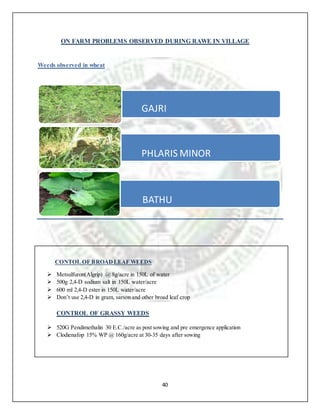
ON FARM PROBLEMS OBSERVED DURING RAWE IN VILLAGE
Weeds observed in wheat
CONTOL OF BROADLEAF WEEDS
 Metsulfuron(Algrip) @ 8g/acre in 150L of water
 500g 2,4-D sodium salt in 150L water/acre
 600 ml 2,4-D ester in 150L water/acre
 Don’t use 2,4-D in gram, sarson and other broad leaf crop
CONTROL OF GRASSY WEEDS
 520G Pendimethalin 30 E.C./acre as post sowing and pre emergence application
 Clodienafop 15% WP @ 160g/acre at 30-35 days after sowing
GAJRI
•
• PHLARIS MINOR
• BATHU
41
SUCCESS STORIES OF FEW PROGRESSIVE FARMERS
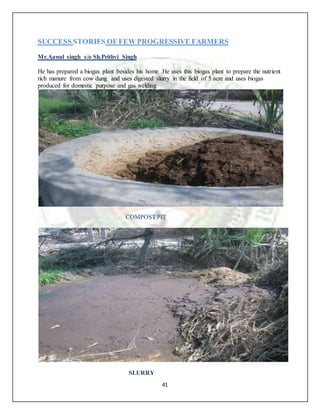
Mr.Aawal singh s/o Sh.Prithvi Singh
He has prepared a biogas plant besides his home .He uses this biogas plant to prepare the nutrient
rich manure from cow dung and uses digested slurry in the field of 5 acre and uses biogas
produced for domestic purpose and gas welding
COMPOST PIT
SLURRY
42
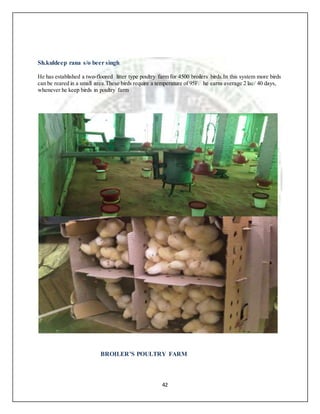
Sh.kuldeep rana s/o beer singh
He has established a two-floored litter type poultry farm for 4500 broilers birds.In this system more birds
can be reared in a small area.These birds require a temperature of 95F. he earns average 2 lac/ 40 days,
whenever he keep birds in poultry farm
BROILER’S POULTRY FARM
43
BENEFITS OF RAWE
‘If you provide food to a person, he will be contented for the day and if you teach him how to
grow the crops, he can maintain himself throughout his life and his generations.’
Our population is increasing day by day; therefore, it is necessary to grow more crops that are
productive. Agriculturists are trying for this in multidirectional way having galloping speed and rapid
spread with respect to time and space.
The practical training knowledge and skills required for increasing the productivity of crop to
achieve the goal CCSHAU, Hisar have implemented the Rural Agriculture Work Experience (RAWE)
included in the course curriculum of the B.Sc. (Hons.) Agriculture in addition to on going programme of
practical training of the university. Such an opportunity to us provide the self confidence in farming and
to better understand the practical problem faced in the field by the farmers and also help us to understand
the socio-economic aspects of the village life more closely and constraints pertaining to adoption of new
technology developed by our scientists.
CONCLUSION
Villagers accept that our rural agricultural work experience programme is useful for both of us.
Villagers used to take us for different field visits with great enthusiasm and use to feelproud in
relating their successfulmanagement techniques of field problems.
The work experience in the village was very useful to us.
We learnt about practical difficulties in propagating a new technology
We observed and experienced practical field situation
We study the crops while farmer cultivate the crops. our aim is to gain knowledge and
experience, while their aim is to run their livelihood and maintain their social status. This course
tries to link the two objectives :
We studied about village infrastructure, characteristics of the farming community, and problem
faced by them .in this course we were able to apply our theoretical knowledge into practical
situation.
This course combines the essence of the research from all the department of agriculture and tries
to make us a full fledged practically oriented agricultural graduate.
We are able to experience the agricultural extension system at state level and its linkage with the
agricultural university.
44
:
Mrs.Jayanti, principal, Sr. Sec. School and other staff members of Government secoundary
School, Nagal for allowing us to held training and appreciating for our endeavour.
Sh.Kuldeep Rana for making a better arrangement for my stay in village.
Sh.Pradeep Rana who help us to interact with farmers.
Sh.surinder Rana for providing us all the facilities while organizing the training and kisan
goshthi.
Smt. Renu Devi, Head, Aanganwari, Nagal village for providing us data of survey.
Patwariof Nagal for his sincere efforts to make us understand various aspects of village and the
maps
Sh.Dharamvir Singh, VLDA,GVD, Nagal for providing us information about livestock.
Sh.Sanjeev Rana for providing us detailed knowledge about poultry farming.
Dr.B. R. Kamboj, for guiding us throughout the RAWE programme.

INDER REPORT

  • 1.
    SUBMITTED TO: SUBMITTEDBY: CO-ORDINATOR INDER KUMAR (RAWE PROGRAMME) (2012A36BIV)
  • 2.
    2 TEACHERS ASSOCIATED  Dr.R .K. Pannu (Dean, COA)  Dr. Naresh Mehta(Associate Dean, COA)  Dr. Jagdev Singh( HOD, Agronomy)  Dr. S.K. Thakral (RAWE Co-ordinator)  Dr. Anil Kumar Dhaka( Agronomy)  Dr. B.R. Kamboj(sr. Coordinator, KVK, Damla, Yamuna Nagar)  Dr. R.S Kadian(economics)  Dr. Jitender Kumar(economics)  Dr. P. S. Shehrawat(extension)  Dr. J.S Malik(extension)  Dr. Bharat singh(extension)  Dr. Suresh kumar(agronomy)  Dr. V.S. Hooda(agronomy)  Dr. Bhagat Singh(agronomy)  Dr. R. K Goyal(horticulture)  Dr. D.S. Dahiya(horticulture)  Dr. A.K. Bhatia(vegetable)  Dr. Vijay Pal(vegetable)  Dr. B.S. Duhan(soil science)  Dr. Ram parkash(soil science)  Dr. S.S. Yadav(entomology)  Dr. Harish kumar(entomology)  Dr. Kushal raj(plant pathology)  Dr. Narender Yadav(plant pathology)  Mr. Satpal(plant breeding, forage section)
  • 3.
  • 4.
    4 CONTENTS SR.No. Particulars Page No. 1.Acknowledge 6 2. Preface 7 3. Introduction 8 4. Objectives Of RAWE 10 5. Probable Results of RAWE Programme 11 6. Important Dates In Rawe Programme 14 7. A Glance At Haryana  Area, Production and Productivity of Rabi Crops  Area, Production and Productivity of Kharif Crops  Area, Production and Productivity of Commercial Crops 15 8. Yamunanagar At A Glance  Statistic Data of Yamuna Nagar 17 18 9. About Krishi Vigyan Kendre, Damla 19 10. About Village NAGAL 20 11. Demography of Nagal 21 12 Training and Kisan Goshthi organized in village 25 13. Techno-Economic Survey of Host Farmer 29 14. Contribution in improvement of Agriculture in Nagal 37 15 On Farm Problems observed in village 38 16 Success stories of few Progressive Farmers 39 17 Benefits of RAWE 41 18 Conclusion 41 19 Special thanks 42
  • 5.
    5 GROUP MEMBERS:- 1.INDER KUMAR(2012A36BIV)(GROUPLEADER) 2.DEEPAK KOCHAR(2012A24BIV) 3.ANUJ KUMAR(2012A14BIV) 4.NARESH KUMAR(2012A53BIV) 5.DIGEMBER DHULL(2012A32BIV) 6.DHEERAJ KUMAR(2012A31BIV) 7.SHANTANU MISHRA(2012A103BIV)
  • 6.
    6 ACKNOWLEDGEMENT I feel tooshort of my vocabulary to express my feelings at this very moment while writing a report of my RAWE (Rural Agricultural Work Experience) programme. This programme is not an endeavour of a single individual. It takes the co-operation and effort of many other people who have directly or indirectly been involved in the work. I hereby take this blissful opportunity to thank all those who have helped me in the successful completion of this task without any terms and condition. With great pleasure and deep sense of unwavering gratitude , I express my sincere appreciation & indebtedness to Dr.S.K.Thakral and Dr.Anil Dhaka (Co-ordinator, RAWE Programme), Dr.Jagdev Singh (HOD, Agronomy)whose initiative, interest, personal supervision, creative suggestions and valuable guidance at every step provided me a constant source of energetic inspiration and encouragement for intensive studies and help me to understand the true value of this Program. I express my gratitude to our honorable Vice chancellor, Dr. K.S.Khokhar, for taking interest in this RAWE Programme. Nevertheless, most humbly, I express my sincere and deep- felt sense of gratitude & obligation to our dean Dr.R.K.Pannu to give us chance for preparing this manuscript in degree programme to get Practical knowledge. I would like to extend my deep sense of sincere gratitude & indebtedness to all the HODs and professors of different departments for their co-operation, moral support and magnanimous help during the orientation period. My profound thanks to Dr. B. R. Kamboj (sr. coordinator, KVK, Damla), Dr. N.K. Goyal & Dr. Taya, faculty for their keen interest as an instructor, evaluator & mentors of our trainings and who elevated our knowledge and helped us to solve the problems of farmers during this programme. I am obliged to host of our group of village NAGAL, Shri. Surinder kumar (Sarpanch) & my Host farmer who helped us a lot in every step and acted as a local guardian .We are indebted to all the farmers of village Nagal and especially to my host farmer, who participated and supported in our work experience program. Last but not least I wish to acknowledge the help, support & co-operation that I received from my group mates Shantanu Mishra , Digamber , Deepak , Dheeraj , Anuj , Naresh. PLACE: NAGAL, YAMUNA NAGAR INDER KUMAR DATE: 20TH MARCH.2016 (2012A36BIV)
  • 7.
    7 PREFACE Agriculture is backboneof Indian economy. It has been a main stay of human beings since time immemorial. Its importance can be truly felt from the words of India’s first Prime Minister Jawaharlal Nehru- “EVERYTHING CAN WAIT BUT AGRICULTURE CAN NOT” Agricultural education is an important means of ensuring increased agricultural productivity, sustainability, environmental and ecological security, profitability, job security and equity. With the rising agricultural production in the country and introduction of modern technology in the production and processing of agricultural produce, the concept of farming is shifting from survival and growth to value added agri - business approach. During 2014-15, agricultural sector contributed to approx. 13.5% of India’ GDP and 10.23% of total exports, besides providing employment to around 600 million of the work force. This will lead to major opportunities in high growth, mass - based, high volume markets generating enormous opportunities for the corporate sector. The third Dean's Committee (1995) suggested model academic regulations and curricula for agriculture graduates. Special emphasis was given to practical training to inculcate skill and confidence among the undergraduates to enable them to meet the new challenges. To achieve this goal, RAWE PROGRAMME in actual farming situation has been included in the course curriculum of the B.Sc. Agri. students in addition to the on -going programme of practical training at this university. Such a programme will provide and opportunity to the agricultural graduates to develop self - confidence in farming and better understanding of the practical problems faced in the field by the farmers as well as socio - economic aspects of the village life more closely. The main objective of RAWE is to teach the student practically which the student learnt theoretically in college. It is the opportunity to gain the experience of problem faced by the farmers in growing crops and other enterprises. This report owes its preparation to the sincere and meticulous analysis of situation of village Nagal. This report contains the information on area, population, culture, cropping pattern, economic status, adoption of crop varieties etc.
  • 8.
    8 INTRODUCTION Introduction of RuralAgricultural Work Experience (RAWE) Programme With the introduction of green revolution in India, agriculture in India has faced a number of turns, success stories and of course failures at certain steps too. With the ever increasing population of India, need for space and food has increased several times. Area under agriculture is limited and decreasing day by day, but demand for more production is increasing. So India has felt need of boost in agriculture, for this India has to depend on students of agriculture and farmers. Because the scientists and researchers we see today were students of yesterday and vice-versa. So as agriculture depends on these scientists, researchers and farmers so alternately agriculture depends on students. Hence it is obvious that bright agriculture of future means bright students of today. ICAR has felt this necessity for making its students future bright because not only agriculture but whole Indian economy and hence India depends on it. An important step in this connection was taken by the ICAR by appointing 2nd Dean's Committee in April 1979. The Dean's Committee pointed out weakness in terms of need of practical training in the Curricula of agriculture graduate degree. The committee also recommended that the practical training should be in production-oriented aspects, internship (IAP) and work experience in village. The third Dean's Committee (1995) suggested model academic regulations and Curricula for agriculture graduates. Special emphasis was given to practical training to inculcate skill and confidence among the undergraduates to enable them to meet the new challenges. To achieve this goal, RAWE PROGRAMME in actual farming situation has been included in the course curriculum of the B.Sc. Agriculture Students in addition to the ongoing programme of practical training at this university. Such a programme will provide an opportunity to be agricultural graduates to develop self -confidence in farming and better understanding of the practical problems faced in the field by farmers as well as socio-economic aspects of the village life more closely. With the rising agricultural production in the country and introduction of modern technology and processing in the production and processing of agricultural produce, the concept
  • 9.
    9 of farming inshifting from survival and growth to value added agri-business approach. The food industry in India is a very high multiplier (2.4), which is greater than that of power and telecome sector. Today, the food industry is India is worth Rs. 250,000 crores, which is expected to rise to Rs.680, 000 crores by the year 2008. This will lead to major opportunities for the corporate sector. In this backdrop, there will change will the market i.e. job in government public sector will recede and tremendous job opportunities will emerge in corporate sector as well as the opportunities of self-employment. Obviously, there is need to reorient RAWE PROGRAMME to the new challenges in agriculture, it is felt that there is need to depute items for imparting them a short training in various agro-industrial units. This will add to their knowledge and give them an impetus. This will also help in developing competency among agricultural graduates in the areas of technology managerial skill, agri-business as well as to face future challenges of employment. The RAWE PROGRAMME is offered in the second semester of final year, to only those B.Sc.(Hons.) Agri.Students who have already completed all the course work and other prescribed requirements for the B.Sc. (Hons) Agri.Degree. RAWE is aimed at total development of students in agriculture both theoretically and practically. It makes its student to analyze and find possible solutions to rural agriculture on their own. So students are tested for their knowledge and it gives students a moral and confidence which is helpful to them in future. RAWE actually is aimed at connecting students to agriculture by their soul and mind. So in end of this programme students are of agriculture, for agriculture, and by agriculture. Many or say most of these work in future in areas of agri research and rest in other areas of agriculture. RAWE hence provides bright future to agriculture research in INDIA. This programme hence never ends in a students life who has faced this programme once in his life. For students of B.Sc (hons.) Agri. in CCS HAU, RAWE is integral part of their life. So hats off to this great programme and thanks to CCS HAU for making us to face it.
  • 10.
    10 Objectives of RAWE To gain knowledge and experience on the operational aspects of agricultural technology being used by farmers.  To develop communication skills in interns by effective use of extension methods to make them better extension workers.  To help the interns to understand and appreciate the agricultural problems of village with special reference to the constraints in the application of latest farm technology.  To acquaint the interns with the functioning of various researches, development, agro - based marketing industries, extension agencies and other allied organizations involved in rural development.
  • 11.
    11 Probable results ofRAWE Programme 1. Art of listening 2. Art of negotiation 3. Confidence building 4. Conflict management 5. Develop skill of joint effort 6. Developing art of creative thinking 7. Effective decision-making 8. To get feed back 9. Managing relationship 10. Money management 11. Observe problem 12. Personality development 13. Practicing method 14. Self-management 15. Time management 16. Understand the real life problems 17. Understanding the prevailing situation 18. Understanding situation of recommended technology 19. Working with local organizations/leaders VARIOUS EXPOSURES FOR PRACTICAL LEARNING: 1) Orientation programme of student: This phase is meant to introduce the RAWE to the student and to sensitize them towards the changed attitude required in the whole programme. Prior to commencement of on - farm internship programme, the interns shall report for orientation immediately after registration and shall undergo training about curriculum on crop production technology, techno -economic survey, preparation of farm plan, family budget , curriculum on extension education programme and questionnaire about changing climate . After this, various scientists/teachers engaged in research and transfer of technology teach the interns regarding production technology of various important crops, attitude to be adopted to disperse technology to farmers and constraints in adopting the latest technology.
  • 12.
    12 Expected outcome:  Betterunderstanding of basic agriculture  Changed attitude towards learning  Development of team work  Understanding of the RAWE programme 2) Agriculture technology information centre: It is to help them to understand what is going on in the training and research centres, the need of today’s farmers and the role of trainers and researchers. In short, this period helps them to know the middle segment between the academic and ground level agriculture better. Expected outcome:  Building research and extension competence  Building confidence as an individual  Information of recent advancement in training and research  Handling practical work.  Knowledge of collection, compilation and analysis of experimental data  Knowledge of research techniques  Knowledge of working methodology  Revelation of administration and management 3) High-Tech cell: It helps the students to be conversant to work with the modern gadgets like computer and the other machines we need for tissue culture and biotechnology. Expected outcome:  Having awareness about the latest technology  Understanding of green house, tissue culture and bio-technology  Updating and collecting information through internet  Working and surfing with computers 4) Farm families in villages: To understand the first hand experience of rural life. The ways by which farming profession impacts the family life and their standard of living. Expected outcome:  Ability to plan out strategy to work in villages  Real field experience
  • 13.
    13  Understanding real-lifeof farmers.  Understanding the gap between the rural and urban people  Understanding the mundane work and problems of agriculture. 5) Official authorities Collecting data from various authorities give a sense of understanding of the district and village and a rare opportunity in college life to understand administrative hierarchy. Expected outcome:  Understanding official working system  To understand power vested in different authorities 6) Agro-based Industries and Co-operatives: This phase helps students to understand the meaning, nature and working of existing co- operatives and how to be entrepreneurs through the agro-based business. Expected outcome  Creating solution-finding atmosphere  Impact on agricultural development  Management of different components  Managing Economic crisis  People’s participation  Problem-solving attitude  Team work development  Working with people organization 7)Training on Self Employment - A opportunity to become self dependent even in time of crisis by helping to build confidence and by improving personality. We come to know what it takes to become self dependent. Expected outcome-  Personality development  Confidence build-up  A step towards secure future. Thus, RAWE is a learner-centered approach of exposing undergraduate students of college of Agriculture by using principles of “learning by doing” and “seeing is believing” to provide direction to think and act on their own. It offers a course to students to learn how to be competent, confident, capable, skillful and able to do work in real life situations. This experimental system in agricultural education has a strong potential to prepare a better agricultural technocrats with high level of skill in combination with the modern out-look and management capacity. RAWE is one of the best means to produce well trained agricultural graduates with broad based knowledge and techniques to meet the emerging challenges of agriculture.
  • 14.
    14 IMPORTANT DATES INMY RAWE PROGRAMME 6th Jan - Registration for the 8th semester of my B.Sc. (Hons.) Agriculture, 4 year degree Programme. 7th Jan - We were called for a meeting with RAWE advisors where we were given an Assignment on area, production and productivity of major Rabi and Kharif crops of Haryana. 8TH Jan-Dr. S.K. Thakral and Dr. A.K. Dhaka talked about RAWE curriculum on crop Production technology. 11th Jan-Dr. R.S. Kadian & Dr. jitender kumar enlisted key points on the topic of curriculum On techno-economic survey. 12th Jan-.Dr.P.S. Sherawat, Dr. J.S. Malik & Dr.Bharat singh talked on the topic of Curriculum on extension education progremme. 13th jan-Dr. Suresh kumar talked on the topic of production technologies of Oil seed crops & Dr. V.S. Hooda talked on the topic weed management in rabi crops. 14th jan-Dr. R.K. Goyal talked on the topic of production technologies of horticultural crops And Dr. D.S. Dahiya talked on the topic of production technologies of floricultural Crops. 15th jan- Dr. R.K. Pannu gave the basic lecture on revenue/land record related terms, Dr.A.K. Bhatia & Dr. Vijay Pal delivered lecture on the topic of production Technologies of Vegetable crops, Dr. B.S. Duhan & Dr. Ramparkash delivered Lecture on soil health and soil and water testing. 16th jan- Dr. s.s. yadav & Dr. Harish kumar delivered lecture on pest management in major Crops, vegetables & fruit plants, Dr. kushal raj & Dr. Narender yadav delivered Lecture on Disease management in major crops, vegetables and fruit crops, Mr.Satpal delivered lecture on the topic of nutrient management. 18th jan-Dr. R.K. Pannu gave a word of advice to the interns by the dean, Dr. S.k Thakral gave tips for the placement in agro-based industries 19thjan-Dr. Jagdev singh, Dr. S.K. Thakral & Dr. A.K. Dhaka took a meeting with advisors And allotted NAGAL VILLAGE, Teshil-jagadhri, District- Yamuna nagar. 20th jan-placement in allotted village in the farm house of Mr. Kuldeep Rana.
  • 15.
    15 AA GGLLAANNCCEE AATTHHAARRYYAANNAA “ YE HAI MERA HARYANA, JIT DUDH- DAHI KA KHANA” Haryana is located in the northwest part of the country and the climate is arid to semi arid with average rainfall of 455 mm. Around 70 % rainfall is received during the month from July to September and the remaining rainfall is received during Dec. to Feb. There are two agro climatic zones in the state. The north western part is suitable for Rice, Wheat, Vegetable and temperate fruits and the south western part is suitable for high quality agricultural produce, tropical fruits, exotic vegetables and herbal and medicinal plants. The total geographical area of the state is 4.42 m ha, which is 1.4 % of the geographical area of the country. The cultivable area is 3.8 m ha, which is 86 % of the geographical area of the state out of which 3.62 m ha i.e 96.2 % is under cultivation. The gross cropped area of the state is 6.32m ha and net cropped area is 3.62 m ha with a cropping intensity of 177%.
  • 16.
    16 AARREEAA PPRROODDUUCCTTIIOONN AANNDDPPRROODDUUCCTTIIVVIITTYY OOFF KKHHAARRIIFF CCRROOPPSS HHAARRYYAANNAA ((22001133--1144)) CROP AREA ( in 1000 hectare) PRODUCTION (in 1000 tonnes) PRODUCTIVITY (in kg/ha) RICE 1215 3976 3272 JAWAR 56 28 500 MAIZE 9 23 2556 BAJRA 411 791 1925 KHARIF PULSES 36 26 718 TOTAL 1727 4844 2805 AREA PRODUCTION AND PRODUCTIVITY OF RABI CROPS HARYANA(2013-14) CROP AREA (in 1000 hectare) PRODUCTION ( in 1000 tonnes) PRODUCTIVITY (in kg/ha) WHEAT 2497 11117 4452 GRAM 47 53 1128 BARLEY 48 167 3479 RABI PULSES 5 5 1000 SUMMER MOONG 73 46 625 TOTAL 2670 11388 4265 AREA PRODUCTION AND PRODUCTIVITY OF COMMERCIAL CROPS HARYANA (2013-14) CROP AREA (in 1000 hectare) PRODUCTION (in 1000 tonnes) PRODUCTIVITY (in kg/ha) SUGARCANE 101 7437 736 COTTON 595 2384 681 GUAR 388 278 718 KHARIF OILSEED 6 5 822 RABI OILSEED 559 962 1721 SUNFLOWER 6 13 2167 TOTAL 5 980 1716
  • 17.
    17 YYAAMMUUNNAA NNAAGGAARR AATTAA GGLLAANNCCEE HISTORY This town became the new home of the refugees who migrated to this part of the country on the partition of the country in 1947 .Rampura Colony, Model Colony, Model Town and Gandhi Camp areas of modern city were reserved for them, the position remained as such up to 1970s. The place was earlier known as 'Abdullahpur' which was later renamed by the city's eminent people as Jamnanagar and later on as Yamunanagar. Till 1947, it was a small hamlet of 6000 people, mostly population concentrated around Jagadhri Railway Station and Yamuna Gali, Old Radaur Road area. After partition of India, many migrants from Punjab in Pakistan chose to make Yamuna Nagar/Jagadhri their new home, and in the process. adding to the culture of the town. The area where land was allocated to the migrants, later developed into the Model Town area of Yamuna Nagar, the centre of the city area. The Topra Asokan pillar of Delhi was found in the village Topra Kalan, about 20 km from yamunanagar. Archaeological survey of India has found many Harrapan bricks and stones from the area. AGRICULTURE Due to the abundantpresence of water,fertile soil,andwarmclimate,farmingis animportantpart of YamunaNagar. Some of the more commonlygrowncropsare sugarcane,rice,wheat,andgarlic.In additiontoconventional farming,manyfarmersof YamunaNagaralsoparticipate inagroforestry; poplaror eucalyptustreesare oftenincludedinthese projects. INDUSTRY Yamuna Nagar iswell knownforitsindustries.Ithasemergedasan importantindustrial destination inthe state.Thishas beendespiteitsrelativelyisolatedlocationfromrestof the state.Due to expanding industries, the citykeptonextendinggeographically.Thisisprimarilydue toan increasingnumberof immigrants.Thisledtoan intermixingof diverse culture.Italsohasto do withthe rural ambiance which isreportedto have undergone alotof change.With increasingpopulation,the tradingaspectsbecame brighterandthe city wentonbecomingthe secondhighestrevenue generatorof Haryana,immediately afterFaridabadthat owesitspositionlargelytoitsprime location.The cityhasa paper manufacturer giant.BallarpurIndustriesLimited(BILT) isaflagshipof the US$ 4 bnAvanthaGroup and India'slargest manufacturerof writingandprinting(W&P) paper.The cityproducessugarmachinery,papermachinery alongwithhighlyefficientequipmentsforpetrochemical plants,whichare shippedtovariousrefineries across the country.The cityisalsoknownfor itsplywoodindustries,GMPlywoodIndustries.whichis attributedtothe easyaccessibilityof primaryraw material –poplartree.Ithas alsoone of India'slargest railwaycarriage and wagonrepairworkshops.Recently,Reliance Infrastructurehasalsoinstalled DeenbandhuChhotuRamThermal PowerStationinthe town.HaryanaUrban DevelopmentAuthority has done majordevelopmentworkinthe land-stretchlinkingthe citywithJagadhri,the otherpartof twincity.Jagadhri isas also knownasthe 'Brass City',andfamousfor itsbrass and stainlesssteel utensils.
  • 18.
    18 STATISTIC DATA ABOUTYAMUNA NAGAR Actual Population 900,332 765,351 Male 474,335 403,034 Female 425,997 362,317 Population Growth 17.64% 25.34% Area Sq. Km 1,594 1,594 Density/km2 565 480 Proportion to Haryana Population 3.55% 3.62% Sex Ratio (Per 1000) 898 899 Child Sex Ratio (0-6 Age) 787 810 Average Literacy 80.99 75.20 Male Literacy 91.44 88.40 Female Literacy 69.57 60.80 Total Child Population (0-6 Age) 113,893 115,471 Male Population (0-6 Age) 63,743 63,806 Female Population (0-6 Age) 50,150 51,665 Literates 636,947 299,511 Male Literates 375,453 188,630 Female Literates 261,494 488,141 Child Proportion (0-6 Age) 12.65% 15.09% Boys Proportion (0-6 Age) 13.44% 15.83% Girls Proportion (0-6 Age) 11.77%
  • 19.
    19 ABOUT KRISHI VIGYANKENDRA, DAMLA, YAMUNA NAGAR STAFF MEMBERS(SCIENTISTS) Dr. B.R. Kamboj :-Co-ordinator KVK, Damla Dr.N.K. Goyal :- Senior scientist, Soil Science Dr.Premlata :- SES(Home Science) Dr.R.S. Taya :- Senior scientist, Plant pathology PRESENT STATUS OF INFORMATION MANAGEMENT AT KVK (DAMLA) (A) Advisory services to the farmers through :  Farmer’s Personal Visit at KVK, DAMLA  Telephone Help Line  Correspondence  Lectures Delivered in Training’s  Literature (books, farm magazine, leaflets & brochures)  Vocational training for the farmers at kvk (B) Feed Back from Farmers to the Scientists : Feedback Mechanisms: Feedback from the farmers is obtained through personal interview & a record is maintained for onward transmission to the concerned scientists through:
  • 20.
    20 ABOUT VILLAGE: Nagal isa medium size village located in Jagadhri of Yamunanagar district, Haryana with total 281 families residing. The Nagal village has population of 1638 of which 855 are males while 783 are females as per Population Census 2011. In Nagal village population of children with age 0-6 is 200 which makes up 12.21 % of total population of village. Average Sex Ratio of Nagal village is 916 which is higher than Haryana state average of 879. Child Sex Ratio for the Nagal as per census is 786, lower than Haryana average of 834. Nagal village has higher literacy rate compared to Haryana. In 2011, literacy rate of Nagal village was 82.68 % compared to 75.55 % of Haryana. In Nagal Male literacy stands at 88.43 % while female literacy rate was 76.55 %. As per constitution of India and Panchyati Raaj Act, Nagal village is administrated by Sarpanch (Head of Village) who is elected representative of village. Caste Factor Schedule Caste (SC) constitutes18.68 % of total populationinNagal village.The village Nagal currentlydoesn’thave anySchedule Tribe(ST) population. Work Profile In Nagal village outof total population,450were engagedinworkactivities.100.00 % of workers describe theirworkasMain Work (EmploymentorEarningmore than 6 Months) while 0.00 % were involvedinMarginal activityprovidinglivelihoodforlessthan6 months.Of 450 workersengagedin Main Work, 150 were cultivators(ownerorco-owner) while56were Agricultural labourer. SURVEY AND STUDY OF THE VILLAGE(NAGAL) NAME OF VILLAGE : NAGAL BLOCK : JAGADHRI TALUK : JAGADHRI DISTRICT : YAMUNA NAGAR HADBASTTH NO. : 158
  • 21.
    21 DEMOGRAPHY OF OURVILLAGE (NAGAL) Nagal is a Village in Jagadhri Tehsil in Yamunanagar District of Haryana State, India. It is located 5km away from KVK, DAMLA & 8km away from Yamuna Nagar city. AREA DISTRIBUTED UNDER VILLAGE TOTAL AREA : 222 hect. NON-CULTIVABLE ARE : 22 hect. CULTIVABLE AREA : 200 hect. a)IRRIGATED AREA : 200 hect. b)UNIRRIGATED AREA : Nil AREA OCCUPIED BY POPULATION : 18 hect. WASTE LAND : 4 hect. TOTAL POPULATION : 1638 MALES (ADULT ) : 855 FEMALES (ADULT) : 783 CHILDREN(below 6 years) : 200 MALE CHILDREN : 122 FEMALE CHILDREN : 78 AGRICULTURAL LABOURES : 40 SMALL FARMERS (1-2 ha) : 87 MARGINAL FARMERS : 128 NO. OF ANGANWARI : 2 GOVT. PRIMARY SCHOOL : 1 GOVT. SECOUNDARY SCHOOL : 1 MAJOR RELIGION : HINDUISM (RANA) FARMING SITUATION SOIL (pH -6.8) : CLAY LOAM SOIL IRRIGATION SOURCES : TUBEWELL ONLY MAIN CROPS OF YEAR : KHARIF – RICE,SORGHUM RABI - WHEAT,BERSEEM, SUGARCANE,POPLAR CROPPINGPATTERN : RICE – WHEAT,RICE-SUGARCANE-WHEAT
  • 22.
    22 LOCATION OF INFRASTRUCTURE RAILWAYSTATION : 7 KM POLICE STATION : 4 KM DISPENSERY HEALTH CENTRE : 1 KM VETERINERY HOSPITAL : 3 KM SEED/FERTILIZER/PESTICIDE STORE : 2 KM POST OFFICE : WITHIN VILLAGE SCHOOLS : WITHIN VILLAGE AGANWADI : 1 PANCHAYATBHAWAN : 2 WATER WORKS : 1 GRAVEYARD : 1 GLANCE ON AGRICULTURE (NAGAL) TRACTOR = 31 TROLLEY = 50 HARROW = 27 CULTIVAROR = 28 TUBEWELL = 112 ZERO TILL DRILL = 2 TILLER = 31 ROTAVATOR = 2 REAPER = 2 THRESER = 8 DESCRIPTION OF LOCAL FARMING SYSTEM WHEAT : HH1105, HD2967, WD2851, PBD550 BERSEEM : MASCAVI,HB-1 JOWAR : HC 373 RICE : SWIFT, MUCCHAL,
  • 23.
    23 STORAGE  Grains arestored in open covered with polyethene sheet.  Farmers store on the basis of their average requirements.  Most of the farmers tried to sell their produce immediately after harvest.  There is no much loss in storage.  To protect grains from pest and diseases, neem leaf is kept along with grains ,rarely aluminium phosphide tablets are used seeds are stored at optimum moisture level after treatments. DATA RELATED TO AGRICULTURAL REAPER 2 TRACTORS 31 TROLLEYS 50 TUBEWELL 112 ZERO TILL DRILL 2 TILLER 31 HARROW 27 CULTIVATOR 28
  • 24.
    24 NEAREST AGRICULTURAL RESEARCHFACILITIES KRISHI VIGYAN KENDRA,DAMLA:5KM DIFFICULTIES EXPERIENCED BY FARMERS SEEDS : SEEDS IN GOVT. DEPOT LIMITED PRIVATE SEEDS ARE EXPENSIVE GOVT. SPONSRED MATERIAL : UNABLE TO GET IN TIME FERTILIZERS : SOME TIMES NOT AVAILABLE PESTICIDES : COSTLY AND LACK OF KNOWLEDGE FARM IMPLEMENTS AND MACHINERY :LITTLE BIT COSTLY GENERAL PROBLEMS RELATED TO THE VILAGE SOIL TYPE : CLAY LOAM IRRIGATION : NO WATER FROM CANAL,ONLY TUBEWELL WATER IS AVAILABLE WHICH IS EXPENSIVE. MAIN INCIDENCEOF PESTS AND :APHID IN WHEATANDMUSTARD, DISEASES HOPPER AND STEM BORER IN RICE, YELLOW RUST IN WHEAT, BLAST IN RICE AGRICULTURAL LABOURERS : DIFFICULT TO GET IN PEAK PERIOD AND COSTLY (RS 500/LABOUR/DAY) FARM MACHINERY : DIFFICULT TO HIRE IN PEAK PERIOD ELECTRICITY : SUPPLY WITH HEAVYFLUCTUATION LACK OF KNOWLEDGE : UNAWARE ABOUT BENEFITS OF FIXED DEPOSITS AND P.P.F
  • 25.
    25 TRAINING AND KISANGOSHTHI ORGANIZED IN THE VILLAGE 1. COMPETITION AND AWARENESS MEETABOUT HOW TO TAKE ADMISSION IN HAYNANA AGRICULTURAL UNIVERSITY, HISAR. DATE: 2ND FEB 2016 VENUE: SENIOR SECOUNDARY SCHOOL,NAGAL. ORGANIZED QUIZ COMPETITION & POEM COMPETITION.
  • 26.
    26 DATE: 3RD FEB2016 VENUE: PRIMARY SCHOOL NAGAL ORGANIZED POEM COMPETITION
  • 27.
    27 2. TRAINING ANDKISAN GOSHTHI  DATE- 3RD MARCH. 2016 VENUE- FARM HOUSE,SH. KARAN SINGH RANA CHIEF GUEST- DR. B.R. KAMBOJ,SR. COORDINATOR KVK,DAMLA. GUEST OF HONOUR- 1. MRS. JAYANTI,PRINCIPAL,SR.SEC SCHOOL NAGAL 2. SH. SURINDER KUMAR,SARPANCH,VILLAGE-NAGAL. TOPICS COVERED; 1. RESOURSE CONSERVATION TECHNOLOGY(RCT) IN DSR & SOWING OF SEED THROUGH HAPPY SEEDER IN WHEAT 2. SOIL AND WATER TESTING 3. INTEGRATED NUTRIENT MANAGEMENT 4. INTEGRATED PEST MANAGEMENT 5. SAFE USE OF PESTICIDES
  • 28.
    28  DATE- 17THMARCH 2016 VENUE- VILLAGE PANCHAYAT BHAWAN CHIEF GUEST- DR. B.R. KAMBOJ,SR. COORDINATOR KVK,DAMLA. GUEST OF HONOUR- 1.EX-CHAIRMAN,MARKET COMMITTEE,YAMUNANAGAR 2. SH. SURINDER KUMAR,SARPANCH,VILLAGE-NAGAL TOPICS COVERED: 1. HOW TO INCREASE PRODUCTIVITY OF SUGARCANE AND HOW TO SELECT SUGARCANE FOR THE PURPOSE OF SEED AND SUGAR INDUSTRY. 2. HOW TO CONTROL STRORED GRAIN PESTS 3. HOW TO CONTROL RATS IN FIELD AREA 4. HOW TO RAISE POPLAR NURSARY 5. VALUE OF VERMI-COMPOST IN ORGANIC FARMING AND ITS PREPRATION 6. SEED TREATMENT
  • 29.
    29 TECHNO-ECONOMIC SURVEY Name ofcultivator: surinder singh Education : graduation, B.A Village : Nagal Area owned : 9 acre Source of irrigation: tubewell Main occupation : manager on petrol pump(earns 5000/month) Subsidiary business : Farming Details of family: Adult Male -4 Adult Female- 4 Children -2  Permanent labour hired: 1(cash payement-5000)  Cow owned- 3[expenditure- 6000each/month, income-5000each/month] CROP- PADDY VARIETY- SWIFT AREA – 4.5 ACRE ITEM QUANTITY VALUE (RS.) TOTAL PREPRATORYTILLAGE 5 5000 PRE-SOWING IRRIGATION - - RIDGING - - SEED (Kg) 3.5 350 SEED TREATMENT 1 100 SOWING 1 2000
  • 30.
    30 UREA( Kg) 100600 DAP(kg) 50 1150 FERTILIZER APPLICATION 2 400 IRRIGATION COMPLETE SEASON 400 HOEING/WEEDING 2 2000 SPRAYING/DUSTING 3 1000 HARVESTING and THRESHING 1 5000 Misc 500 INTREST ON WORKING EXPERIENCE 1154 MANAGEMENT EXPENSES @10% 2033 RISK @10% 2033
  • 31.
    31 TRANSPORTATION EXPENSES 500 RENTAL VALUE OF LAND 17000 TOTALCOST 41897 PRODUCTION (QTLS) MAIN PRODUCT 22QTL 44000 BY-PRODUCT 200QTL 1000 GROSS RETURNS 45000 NET RETURNS 3103
  • 32.
    32 CROP- SUGARCANE VARIETY-CoS-38AREA – 4 Acre ITEM QUANTITY VALUE (RS.) TOTAL PREPRATORYTILLAGE 6 5000 PRE-SOWING IRRIGATION - - RIDGING 1 500 SEED (Kg) 38QTL Rs-11780 SEED TREATMENT 1 500 SOWING 1 3500 UREA( Kg) 200 1200 DAP(kg) 100 2300 POTASH(kg) 50 800 FERTILIZER APPLICATION 5 1000
  • 33.
    33 IRRIGATION 15 12600 HOEING/WEEDING3 7500 SPRAYING/DUSTING 2 550/spray HARVESTING and THRESHING 1 14000 Misc[WRAPPING] 6000 INTREST ON WORKING EXPERIENCE @12% 7361 MANAGEMENT EXPENSES @10% 6870 RISK TRANSPORTATION EXPENSES 7500 RENTAL VALUE OF LAND 34000 TOTAL COST 34000 PRODUCTION (QTLS)
  • 34.
    34 CROP- SORGHUM VARIETY-HC 373 AREA – 0.5 Acre ITEM QUANTITY VALUE (RS.) TOTAL PREPRATORYTILLAGE 4 2000 PRE-SOWING IRRIGATION 1 - RIDGING - - SEED (Kg) 20 1200 SEED TREATMENT - - MAIN PRODUCT 420QTL 123941 BY-PRODUCT - - GROSS RETURNS 130200 NET RETURNS 6259
  • 35.
    35 SOWING 1 200 UREA(Kg) 150 900 DAP(kg) 50 1150 FERTILIZER APPLICATION 3 600 IRRIGATION 4 630 HOEING/WEEDING - - SPRAYING/DUSTING 1 500 HARVESTING and THRESHING - Misc INTREST ON WORKING EXPERIENCE @6% 551 MANAGEMENT EXPENSES @10% 973 RISK 973
  • 36.
    36 TRANSPORTATION EXPENSES 1000 RENTAL VALUE OF LAND 17000 TOTALCOST 29677 PRODUCTION (QTLS) MAIN PRODUCT 200QTL 3300 BY-PRODUCT - - GROSS RETURNS 33000 NET RETURNS 3323
  • 37.
    37 EXPENDITURE ON THEFARM CROPS : PARTICULARS EXPENDITURE IN (Rs.) CROPS 451257 LIVESTOCKS 120000 OTHERS (ORCHARD) - TOTAL EXPENDITURE 571257 INCOME FROM DIFFERENT SOURCE PARICULARS INCOME IN Rs. CROPS 479400 LIVESTOCKS 90000 SUBSIDIARY TOTAL GROSS RETURNS 569400 BALANCE SHEET GROSS RETURNS 569400 TOTAL EXPENDITURE 571257 NET INCOME FROM FARM IN 6 MONTHS -1857 SAVING OR DEFICIT TOTAL NET INCOME INCLUDINGALL SOURCES 298143 FAMILY EXPENDITURE 285450 SAVING 12693
  • 38.
    38 MYCONTRIBUTION IN IMPROVEMENTOF AGRICULTUREIN NAGAL  Informed farmers about the scientific methods of taking soil and water sample from their field and tubewell respectively.  suggested farmer not to use same variety of crops year after year and also same crop year after year on same land to reduce weed population and insect pest incidence.  Suggested farmers that fertilizers should only be applied as recommended in the soil test report .  Informed farmers about applying of farm yard manure in fields is beneficial for maintaining fertility,texture of soil and soil microorganisms.  suggested farmers to use seed treatment with fungicide and culture to increase production and reduce disease infestation.  Told farmers about the benefits of growing field pea or some other crop instead of taking wheat in wheat-rice crop rotation  Advised farmers to adopt kitchen gardening system in their home and its financial and health benefits  Informed farmers about the new varities of rice ,berseem , jawar and wheat. Especially the WH1105 variety of wheat  Give information about new weedicide like Topic, Point of controling mandusi in wheat, as in Yamuna Nagar mandusi has developed resistance against IsoproturoN.  Advised farmers not to use same type of insecticide and fungicide year after year as it result in development of resistance.  Suggested some points about how to care milch animals
  • 39.
    39  Informed farmershow to drain to drain out the extra logging during continuous and heavy rainfall.  Told farmer ways of safely store grains to avoid infeatation of stored grains pests  Suggested the farmers to establish Biogas plant to prepare compost..
  • 40.
    40 ON FARM PROBLEMSOBSERVED DURING RAWE IN VILLAGE Weeds observed in wheat CONTOL OF BROADLEAF WEEDS  Metsulfuron(Algrip) @ 8g/acre in 150L of water  500g 2,4-D sodium salt in 150L water/acre  600 ml 2,4-D ester in 150L water/acre  Don’t use 2,4-D in gram, sarson and other broad leaf crop CONTROL OF GRASSY WEEDS  520G Pendimethalin 30 E.C./acre as post sowing and pre emergence application  Clodienafop 15% WP @ 160g/acre at 30-35 days after sowing GAJRI • • PHLARIS MINOR • BATHU
  • 41.
    41 SUCCESS STORIES OFFEW PROGRESSIVE FARMERS Mr.Aawal singh s/o Sh.Prithvi Singh He has prepared a biogas plant besides his home .He uses this biogas plant to prepare the nutrient rich manure from cow dung and uses digested slurry in the field of 5 acre and uses biogas produced for domestic purpose and gas welding COMPOST PIT SLURRY
  • 42.
    42 Sh.kuldeep rana s/obeer singh He has established a two-floored litter type poultry farm for 4500 broilers birds.In this system more birds can be reared in a small area.These birds require a temperature of 95F. he earns average 2 lac/ 40 days, whenever he keep birds in poultry farm BROILER’S POULTRY FARM
  • 43.
    43 BENEFITS OF RAWE ‘Ifyou provide food to a person, he will be contented for the day and if you teach him how to grow the crops, he can maintain himself throughout his life and his generations.’ Our population is increasing day by day; therefore, it is necessary to grow more crops that are productive. Agriculturists are trying for this in multidirectional way having galloping speed and rapid spread with respect to time and space. The practical training knowledge and skills required for increasing the productivity of crop to achieve the goal CCSHAU, Hisar have implemented the Rural Agriculture Work Experience (RAWE) included in the course curriculum of the B.Sc. (Hons.) Agriculture in addition to on going programme of practical training of the university. Such an opportunity to us provide the self confidence in farming and to better understand the practical problem faced in the field by the farmers and also help us to understand the socio-economic aspects of the village life more closely and constraints pertaining to adoption of new technology developed by our scientists. CONCLUSION Villagers accept that our rural agricultural work experience programme is useful for both of us. Villagers used to take us for different field visits with great enthusiasm and use to feelproud in relating their successfulmanagement techniques of field problems. The work experience in the village was very useful to us. We learnt about practical difficulties in propagating a new technology We observed and experienced practical field situation We study the crops while farmer cultivate the crops. our aim is to gain knowledge and experience, while their aim is to run their livelihood and maintain their social status. This course tries to link the two objectives : We studied about village infrastructure, characteristics of the farming community, and problem faced by them .in this course we were able to apply our theoretical knowledge into practical situation. This course combines the essence of the research from all the department of agriculture and tries to make us a full fledged practically oriented agricultural graduate. We are able to experience the agricultural extension system at state level and its linkage with the agricultural university.
  • 44.
    44 : Mrs.Jayanti, principal, Sr.Sec. School and other staff members of Government secoundary School, Nagal for allowing us to held training and appreciating for our endeavour. Sh.Kuldeep Rana for making a better arrangement for my stay in village. Sh.Pradeep Rana who help us to interact with farmers. Sh.surinder Rana for providing us all the facilities while organizing the training and kisan goshthi. Smt. Renu Devi, Head, Aanganwari, Nagal village for providing us data of survey. Patwariof Nagal for his sincere efforts to make us understand various aspects of village and the maps Sh.Dharamvir Singh, VLDA,GVD, Nagal for providing us information about livestock. Sh.Sanjeev Rana for providing us detailed knowledge about poultry farming. Dr.B. R. Kamboj, for guiding us throughout the RAWE programme.