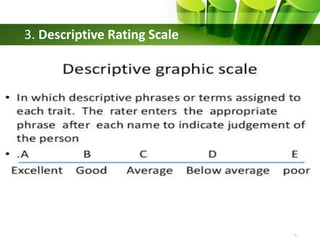
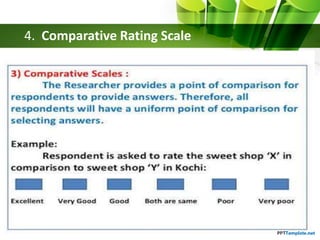
This document discusses rating scales, which are tools used to evaluate individuals. It defines rating scales as sets of categories designed to elicit quantitative or qualitative information. There are four main types of rating scales: numerical, graphic, descriptive, and comparative. Rating scales make quantitative judgments about qualitative attributes and provide flexibility in judging performance levels or attributes. They are commonly used to structure observations but can be subjective. The document outlines characteristics of effective rating scales, steps to develop them, advantages like measuring objectives and evaluating skills, and disadvantages such as difficulty rating many aspects of individuals and potential subjectivity.




![RATING SCALE AND CHECKLIST. [NURSING EDUCATION]](https://cdn.slidesharecdn.com/ss_thumbnails/pptratingscaleandchecklist-241205172701-528bd99c-thumbnail.jpg?width=640&height=640&fit=bounds)


