PERSONALITY:
Concept &
Measurement
Presented By
Dr. Roma Smart Joseph
Professor
B.Ed. Department
Isabella Thoburn College
Lucknow UP India
Table Of Contents
1. Personality
2. Nature of Personality
3. Traits Of Personality
4. Personality Assessment
5. High School Personality
Questionnaire (HSPQ)
6. Educational
Implications of HSPQ
7. Conclusion
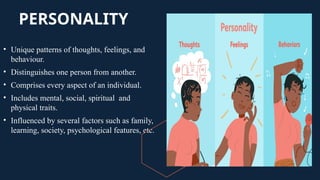
PERSONALITY
• Unique patterns of thoughts, feelings, and
behaviour.
• Distinguishes one person from another.
• Comprises every aspect of an individual.
• Includes mental, social, spiritual and
physical traits.
• Influenced by several factors such as family,
learning, society, psychological features, etc.
“Habits, attitudes, and other
social traits that are
characteristic of a given
individual’s behaviour.”
- Lundberg
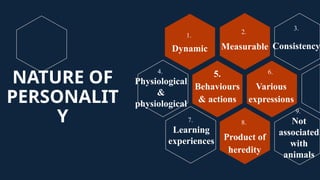
NATURE OF
PERSONALIT
Y
1.
Dynamic
2.
Measurable
5.
Behaviours
& actions
6.
Various
expressions
8.
Product of
heredity
3.
Consistency
4.
Physiological
&
physiological
7.
Learning
experiences
9.
Not
associated
with
animals
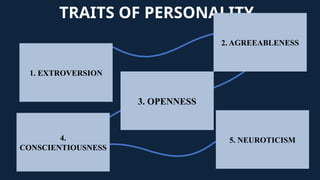
TRAITS OF PERSONALITY
1. EXTROVERSION
2. AGREEABLENESS
3. OPENNESS
4.
CONSCIENTIOUSNESS
5. NEUROTICISM
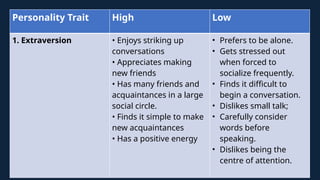
Personality Trait High Low
1. Extraversion • Enjoys striking up
conversations
• Appreciates making
new friends
• Has many friends and
acquaintances in a large
social circle.
• Finds it simple to make
new acquaintances
• Has a positive energy
• Prefers to be alone.
• Gets stressed out
when forced to
socialize frequently.
• Finds it difficult to
begin a conversation.
• Dislikes small talk;
• Carefully consider
words before
speaking.
• Dislikes being the
centre of attention.
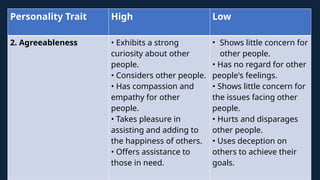
Personality Trait High Low
2. Agreeableness • Exhibits a strong
curiosity about other
people.
• Considers other people.
• Has compassion and
empathy for other
people.
• Takes pleasure in
assisting and adding to
the happiness of others.
• Offers assistance to
those in need.
• Shows little concern for
other people.
• Has no regard for other
people's feelings.
• Shows little concern for
the issues facing other
people.
• Hurts and disparages
other people.
• Uses deception on
others to achieve their
goals.
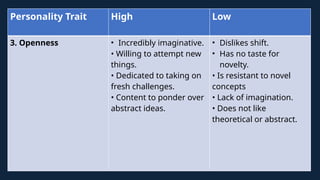
Personality Trait High Low
3. Openness • Incredibly imaginative.
• Willing to attempt new
things.
• Dedicated to taking on
fresh challenges.
• Content to ponder over
abstract ideas.
• Dislikes shift.
• Has no taste for
novelty.
• Is resistant to novel
concepts
• Lack of imagination.
• Does not like
theoretical or abstract.
Personality Trait High Low
4. Conscientiousness • Takes time to get ready
• Completes critical tasks
promptly
• Focuses on the details
• Appreciates a rigid
schedule
• Dislikes regimens and
organization.
• Ignores responsibilities
and creates a mess.
• Neglects to give items
back or place them in
their proper places.
• Puts off doing crucial
tasks.
• Is unable to finish tasks
that are required or
assigned.
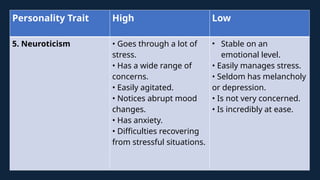
Personality Trait High Low
5. Neuroticism • Goes through a lot of
stress.
• Has a wide range of
concerns.
• Easily agitated.
• Notices abrupt mood
changes.
• Has anxiety.
• Difficulties recovering
from stressful situations.
• Stable on an
emotional level.
• Easily manages stress.
• Seldom has melancholy
or depression.
• Is not very concerned.
• Is incredibly at ease.
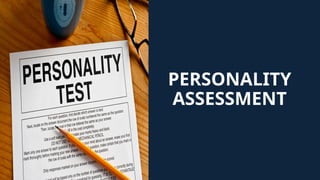
PERSONALITY
ASSESSMENT
ANNUAL
REVENUE
GROWTH
High School Personality
Questionnaire (HSPQ)
• In 1984, R.B. Catell developed this test.
• Human behaviour can be predicted and understood.
• Useful tool for Children ages 12 to 18.
• Self-report inventory.
• Assess 14 personality factors.
• Administered in groups or individually.
• Consists of 142 multiple-choice questions about the testee’s
reactions to social circumstances. as well as preferences for
leisure activities and potential careers.
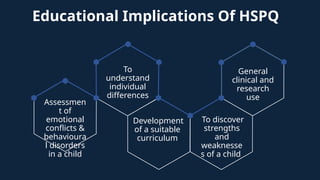
Educational Implications Of HSPQ
Assessmen
t of
emotional
conflicts &
behavioura
l disorders
in a child
To
understand
individual
differences
Development
of a suitable
curriculum
To discover
strengths
and
weaknesse
s of a child
General
clinical and
research
use
CONCLUSION
The development of personality is crucial if a person wants to leave a mark on
society. These days, personality development is a vital tool for enhancing an
individual's overall skill set. This would support his or her growth on both a
personal and professional level. Good grooming, speech, interpersonal skills, and
clothing sense are all components of a great personality. Additionally, having a
strong personality is essential for handling challenging circumstances.
REFERENCES
1.Cherry, K. (2023, May 01). Personality: Definition, Theories, Traits & Types. Retrieved from Verywell Mind:
https://www.verywellmind.com/what-is-personality-2795416
2. Chourasiya, S. (2022, November 10). Meaning, Definition, Nature, and Types Of Personality. Retrieved from Samar Education:
https://www.samareducation.com/2022/06/meaning-definitions-nature-and-types-of-personality.html
3. Lim, A. G. (2023, November 18). Big Five Personality Traits: The 5 Factor Model Of Personality. Retrieved from Simply
Psychology: https://www.simplypsychology.org/big-five-personality.html
4. Mangal, S. (2007). Essentials Of Educational Psychology. New Delhi: Prentice Hall Of India Private Limited.
5. Mangal, S. (2016). Advanced Educational Psychology. New Delhi: PHI Learning Private Limited.
6. Vershney, R. (2017). Perspectives Of Educational Psychology. New Delhi: Agrawal Publishers.
Image Sources
1. https://www.verywellmind.com/what-is-personality-2795416
2. https://learn.g2.com/personality-tests-for-hiring
3. https://www.verywellmind.com/the-big-five-personality-dimensions-2795422
PERSONALITY - CONCEPT AND MEASUREMENT.pptx

PERSONALITY - CONCEPT AND MEASUREMENT.pptx

  • 1.
    PERSONALITY: Concept & Measurement Presented By Dr.Roma Smart Joseph Professor B.Ed. Department Isabella Thoburn College Lucknow UP India
  • 2.
    Table Of Contents 1.Personality 2. Nature of Personality 3. Traits Of Personality 4. Personality Assessment 5. High School Personality Questionnaire (HSPQ) 6. Educational Implications of HSPQ 7. Conclusion
  • 3.
    PERSONALITY • Unique patternsof thoughts, feelings, and behaviour. • Distinguishes one person from another. • Comprises every aspect of an individual. • Includes mental, social, spiritual and physical traits. • Influenced by several factors such as family, learning, society, psychological features, etc.
  • 4.
    “Habits, attitudes, andother social traits that are characteristic of a given individual’s behaviour.” - Lundberg
  • 5.
    NATURE OF PERSONALIT Y 1. Dynamic 2. Measurable 5. Behaviours & actions 6. Various expressions 8. Productof heredity 3. Consistency 4. Physiological & physiological 7. Learning experiences 9. Not associated with animals
  • 6.
    TRAITS OF PERSONALITY 1.EXTROVERSION 2. AGREEABLENESS 3. OPENNESS 4. CONSCIENTIOUSNESS 5. NEUROTICISM
  • 7.
    Personality Trait HighLow 1. Extraversion • Enjoys striking up conversations • Appreciates making new friends • Has many friends and acquaintances in a large social circle. • Finds it simple to make new acquaintances • Has a positive energy • Prefers to be alone. • Gets stressed out when forced to socialize frequently. • Finds it difficult to begin a conversation. • Dislikes small talk; • Carefully consider words before speaking. • Dislikes being the centre of attention.
  • 8.
    Personality Trait HighLow 2. Agreeableness • Exhibits a strong curiosity about other people. • Considers other people. • Has compassion and empathy for other people. • Takes pleasure in assisting and adding to the happiness of others. • Offers assistance to those in need. • Shows little concern for other people. • Has no regard for other people's feelings. • Shows little concern for the issues facing other people. • Hurts and disparages other people. • Uses deception on others to achieve their goals.
  • 9.
    Personality Trait HighLow 3. Openness • Incredibly imaginative. • Willing to attempt new things. • Dedicated to taking on fresh challenges. • Content to ponder over abstract ideas. • Dislikes shift. • Has no taste for novelty. • Is resistant to novel concepts • Lack of imagination. • Does not like theoretical or abstract.
  • 10.
    Personality Trait HighLow 4. Conscientiousness • Takes time to get ready • Completes critical tasks promptly • Focuses on the details • Appreciates a rigid schedule • Dislikes regimens and organization. • Ignores responsibilities and creates a mess. • Neglects to give items back or place them in their proper places. • Puts off doing crucial tasks. • Is unable to finish tasks that are required or assigned.
  • 11.
    Personality Trait HighLow 5. Neuroticism • Goes through a lot of stress. • Has a wide range of concerns. • Easily agitated. • Notices abrupt mood changes. • Has anxiety. • Difficulties recovering from stressful situations. • Stable on an emotional level. • Easily manages stress. • Seldom has melancholy or depression. • Is not very concerned. • Is incredibly at ease.
  • 12.
  • 13.
    High School Personality Questionnaire(HSPQ) • In 1984, R.B. Catell developed this test. • Human behaviour can be predicted and understood. • Useful tool for Children ages 12 to 18. • Self-report inventory. • Assess 14 personality factors. • Administered in groups or individually. • Consists of 142 multiple-choice questions about the testee’s reactions to social circumstances. as well as preferences for leisure activities and potential careers.
  • 14.
    Educational Implications OfHSPQ Assessmen t of emotional conflicts & behavioura l disorders in a child To understand individual differences Development of a suitable curriculum To discover strengths and weaknesse s of a child General clinical and research use
  • 15.
    CONCLUSION The development ofpersonality is crucial if a person wants to leave a mark on society. These days, personality development is a vital tool for enhancing an individual's overall skill set. This would support his or her growth on both a personal and professional level. Good grooming, speech, interpersonal skills, and clothing sense are all components of a great personality. Additionally, having a strong personality is essential for handling challenging circumstances.
  • 16.
    REFERENCES 1.Cherry, K. (2023,May 01). Personality: Definition, Theories, Traits & Types. Retrieved from Verywell Mind: https://www.verywellmind.com/what-is-personality-2795416 2. Chourasiya, S. (2022, November 10). Meaning, Definition, Nature, and Types Of Personality. Retrieved from Samar Education: https://www.samareducation.com/2022/06/meaning-definitions-nature-and-types-of-personality.html 3. Lim, A. G. (2023, November 18). Big Five Personality Traits: The 5 Factor Model Of Personality. Retrieved from Simply Psychology: https://www.simplypsychology.org/big-five-personality.html 4. Mangal, S. (2007). Essentials Of Educational Psychology. New Delhi: Prentice Hall Of India Private Limited. 5. Mangal, S. (2016). Advanced Educational Psychology. New Delhi: PHI Learning Private Limited. 6. Vershney, R. (2017). Perspectives Of Educational Psychology. New Delhi: Agrawal Publishers. Image Sources 1. https://www.verywellmind.com/what-is-personality-2795416 2. https://learn.g2.com/personality-tests-for-hiring 3. https://www.verywellmind.com/the-big-five-personality-dimensions-2795422