TYPES OF ASSESSMENT TESTS AND
TECHNIQUES
Course Code: 8602 (Educational Assessment and
Evaluation)
Unit #3
Presented By:
Abdul Ghafoor Awan (Subject Specialist) English.
M.Phil (Education)
Cell# 0332-7630318
 It is developed to measure skills and knowledge
learned in a given grade level, usually through
planned instruction.
 Achievement test scores are often used in an
educational system to determine what level of
instruction for which a student is prepared.
 Results are generalized and replicable.
 Asses individual's mastery of a domain of
knowledge or skill.
 Administered to a large group
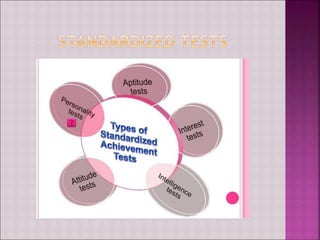
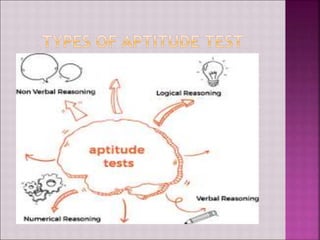
 Aptitude tests determine a person's ability to
learn a given set of information.
 Assess logical reasoning or thinking performance.
 They consist of multiple choice questions
 They are strictly timed.
 Excellent predictors
 Provide ways of comparing a child's performance
 Provide a profile of strengths and weaknesses
 Assess differences among individuals
 Uncovered hidden talents
 Instructional
 Administrative
 Guidance
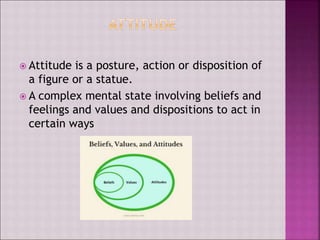
 Attitude is a posture, action or disposition of
a figure or a statue.
 A complex mental state involving beliefs and
feelings and values and dispositions to act in
certain ways
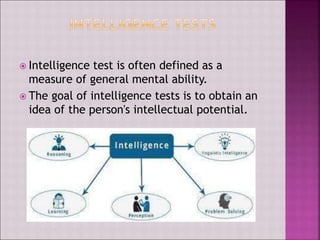
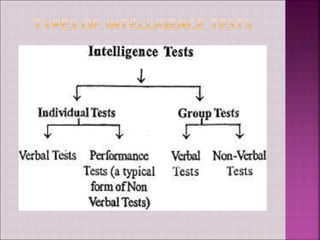
 Intelligence test is often defined as a
measure of general mental ability.
 The goal of intelligence tests is to obtain an
idea of the person's intellectual potential.
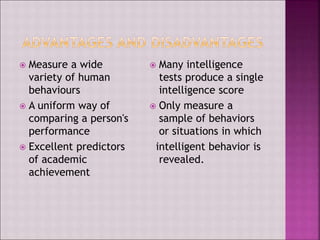
 Measure a wide
variety of human
behaviours
 A uniform way of
comparing a person's
performance
 Excellent predictors
of academic
achievement
 Many intelligence
tests produce a single
intelligence score
 Only measure a
sample of behaviors
or situations in which
intelligent behavior is
revealed.
 Questionnaire
 Observation
 Interview
 Rating Scale
 A questionnaire is an instrument consisting of
a series of questions and other prompts for
the purpose of gathering information from
respondents
 It contains list of written questions that can
be completed in one of two basic ways:
 Open Format Questions
 Closed Format Questions
 Leading Questions
 Importance Questions
 Likert Questions
 Dichotomous Questions
 Bipolar Questions
 Rating Scale Questions
 The visual study of something or someone in
order to gain information or learn about
behaviour, trends, or changes.
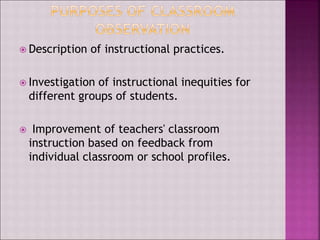
 Description of instructional practices.
 Investigation of instructional inequities for
different groups of students.
 Improvement of teachers' classroom
instruction based on feedback from
individual classroom or school profiles.
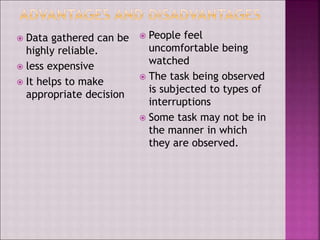
 Data gathered can be
highly reliable.
 less expensive
 It helps to make
appropriate decision
 People feel
uncomfortable being
watched
 The task being observed
is subjected to types of
interruptions
 Some task may not be in
the manner in which
they are observed.
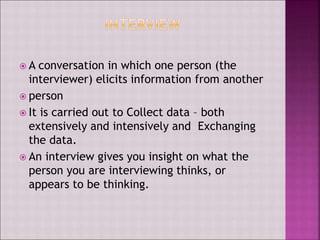
 A conversation in which one person (the
interviewer) elicits information from another
 person
 It is carried out to Collect data – both
extensively and intensively and Exchanging
the data.
 An interview gives you insight on what the
person you are interviewing thinks, or
appears to be thinking.
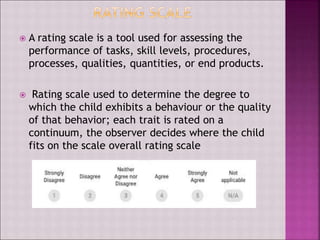
 A rating scale is a tool used for assessing the
performance of tasks, skill levels, procedures,
processes, qualities, quantities, or end products.
 Rating scale used to determine the degree to
which the child exhibits a behaviour or the quality
of that behavior; each trait is rated on a
continuum, the observer decides where the child
fits on the scale overall rating scale
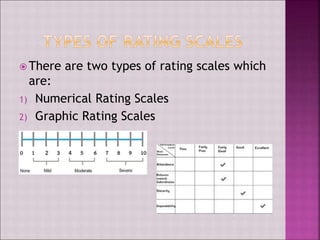
 There are two types of rating scales which
are:
1) Numerical Rating Scales
2) Graphic Rating Scales
Rating scale is an
important technique of
evaluation. Rating is the
assessments of a person by
another person. This is one
of the oldest methods of
personality assessment.
There are certain general
approaches to assess
personality like holistic or
overall approach,
projective test approach
and trait approach. In this
rating scales and
inventories come under the
trait approach.
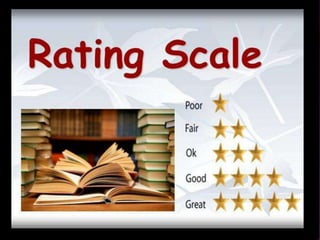
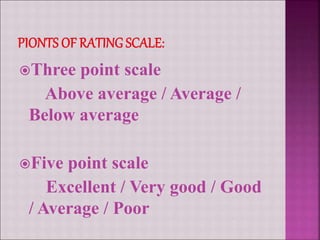
Three point scale
Above average / Average /
Below average
Five point scale
Excellent / Very good / Good
/ Average / Poor
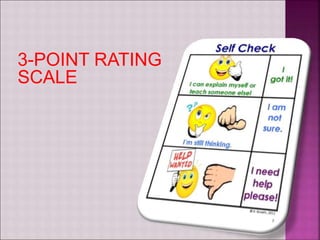
3-POINT RATING
SCALE
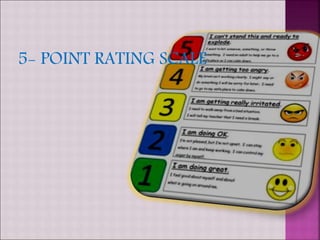
5- POINT RATING SCALE
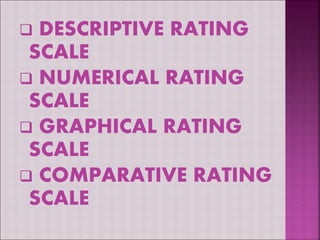
 DESCRIPTIVE RATING
SCALE
 NUMERICAL RATING
SCALE
 GRAPHICAL RATING
SCALE
 COMPARATIVE RATING
SCALE
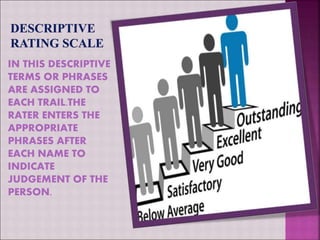
IN THIS DESCRIPTIVE
TERMS OR PHRASES
ARE ASSIGNED TO
EACH TRAIL.THE
RATER ENTERS THE
APPROPRIATE
PHRASES AFTER
EACH NAME TO
INDICATE
JUDGEMENT OF THE
PERSON.
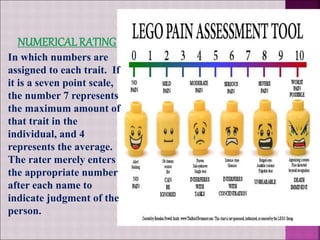
In which numbers are
assigned to each trait. If
it is a seven point scale,
the number 7 represents
the maximum amount of
that trait in the
individual, and 4
represents the average.
The rater merely enters
the appropriate number
after each name to
indicate judgment of the
person.
1. These are value judgements about
attributes of one person by another
person.
2.These are most commonly used tools to
carry out structured observations.
3. These are generally developed to make
qualitative judgement about qualitative
attributes.
4. Provide more flexibility to judge the
level of performance.
Types of assessment test and techniques

Types of assessment test and techniques

  • 2.
    TYPES OF ASSESSMENTTESTS AND TECHNIQUES Course Code: 8602 (Educational Assessment and Evaluation) Unit #3 Presented By: Abdul Ghafoor Awan (Subject Specialist) English. M.Phil (Education) Cell# 0332-7630318
  • 3.
     It isdeveloped to measure skills and knowledge learned in a given grade level, usually through planned instruction.  Achievement test scores are often used in an educational system to determine what level of instruction for which a student is prepared.
  • 6.
     Results aregeneralized and replicable.  Asses individual's mastery of a domain of knowledge or skill.  Administered to a large group
  • 7.
     Aptitude testsdetermine a person's ability to learn a given set of information.  Assess logical reasoning or thinking performance.  They consist of multiple choice questions  They are strictly timed.
  • 10.
     Excellent predictors Provide ways of comparing a child's performance  Provide a profile of strengths and weaknesses  Assess differences among individuals  Uncovered hidden talents  Instructional  Administrative  Guidance
  • 11.
     Attitude isa posture, action or disposition of a figure or a statue.  A complex mental state involving beliefs and feelings and values and dispositions to act in certain ways
  • 13.
     Intelligence testis often defined as a measure of general mental ability.  The goal of intelligence tests is to obtain an idea of the person's intellectual potential.
  • 15.
     Measure awide variety of human behaviours  A uniform way of comparing a person's performance  Excellent predictors of academic achievement  Many intelligence tests produce a single intelligence score  Only measure a sample of behaviors or situations in which intelligent behavior is revealed.
  • 18.
     Questionnaire  Observation Interview  Rating Scale
  • 19.
     A questionnaireis an instrument consisting of a series of questions and other prompts for the purpose of gathering information from respondents  It contains list of written questions that can be completed in one of two basic ways:
  • 20.
     Open FormatQuestions  Closed Format Questions  Leading Questions  Importance Questions  Likert Questions  Dichotomous Questions  Bipolar Questions  Rating Scale Questions
  • 21.
     The visualstudy of something or someone in order to gain information or learn about behaviour, trends, or changes.
  • 22.
     Description ofinstructional practices.  Investigation of instructional inequities for different groups of students.  Improvement of teachers' classroom instruction based on feedback from individual classroom or school profiles.
  • 23.
     Data gatheredcan be highly reliable.  less expensive  It helps to make appropriate decision  People feel uncomfortable being watched  The task being observed is subjected to types of interruptions  Some task may not be in the manner in which they are observed.
  • 24.
     A conversationin which one person (the interviewer) elicits information from another  person  It is carried out to Collect data – both extensively and intensively and Exchanging the data.  An interview gives you insight on what the person you are interviewing thinks, or appears to be thinking.
  • 26.
     A ratingscale is a tool used for assessing the performance of tasks, skill levels, procedures, processes, qualities, quantities, or end products.  Rating scale used to determine the degree to which the child exhibits a behaviour or the quality of that behavior; each trait is rated on a continuum, the observer decides where the child fits on the scale overall rating scale
  • 27.
     There aretwo types of rating scales which are: 1) Numerical Rating Scales 2) Graphic Rating Scales
  • 29.
    Rating scale isan important technique of evaluation. Rating is the assessments of a person by another person. This is one of the oldest methods of personality assessment. There are certain general approaches to assess personality like holistic or overall approach, projective test approach and trait approach. In this rating scales and inventories come under the trait approach.
  • 30.
    Three point scale Aboveaverage / Average / Below average Five point scale Excellent / Very good / Good / Average / Poor
  • 31.
  • 32.
  • 33.
     DESCRIPTIVE RATING SCALE NUMERICAL RATING SCALE  GRAPHICAL RATING SCALE  COMPARATIVE RATING SCALE
  • 34.
    IN THIS DESCRIPTIVE TERMSOR PHRASES ARE ASSIGNED TO EACH TRAIL.THE RATER ENTERS THE APPROPRIATE PHRASES AFTER EACH NAME TO INDICATE JUDGEMENT OF THE PERSON.
  • 35.
    In which numbersare assigned to each trait. If it is a seven point scale, the number 7 represents the maximum amount of that trait in the individual, and 4 represents the average. The rater merely enters the appropriate number after each name to indicate judgment of the person.
  • 36.
    1. These arevalue judgements about attributes of one person by another person. 2.These are most commonly used tools to carry out structured observations. 3. These are generally developed to make qualitative judgement about qualitative attributes. 4. Provide more flexibility to judge the level of performance.