Unlocking Intelligence:
A Comprehensive Introduction to AI & Its Tools
Artificial intelligence (AI) has transformed various
industries, and its impact on research
methodologies is profound.
From automating literature reviews to
revolutionizing data collection and analysis, AI
offers a wide array of tools that enhance efficiency
and decision-making in research.
This presentation aims to explore the key elements
of AI, its diverse applications in research, and the
innovative AI tools that are shaping the future of
research methodologies.
by Dr. Roma Smart Joseph
Prof. Dept. of B.Ed.
Isabella Thoburn College
Lucknow UP India
What is AI
• Artificial Intelligence (AI) refers to the simulation of human intelligence in machines.
• AI enables machines to perform tasks that would typically
require human intelligence, such as problem-solving,
learning, and decision-making.
• Machine Learning is a subset of AI that focuses on the
development of algorithms that allow machines to learn and
make predictions or decisions based on data.
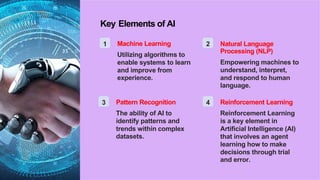
Key Elements of AI
1 Machine Learning
Utilizing algorithms to
enable systems to learn
and improve from
experience.
2 Natural Language
Processing (NLP)
Empowering machines to
understand, interpret,
and respond to human
language.
3 Pattern Recognition
The ability of AI to
identify patterns and
trends within complex
datasets.
4 Reinforcement Learning
Reinforcement Learning
is a key element in
Artificial Intelligence (AI)
that involves an agent
learning how to make
decisions through trial
and error.
Types of AI
Narrow or Weak AI
Narrow AI or Weak AI is designed to perform a specific task or a set of tasks.
It is the most common type of AI and is used in various applications such as speech recognition,
image recognition, and natural language processing. Some examples of Narrow AI include:
Virtual personal assistants like Siri, Alexa, and Google Assistant
Image recognition systems like Google Photos and Facebook's DeepFace
Recommendation systems like Netflix and Amazon's product recommendations
Self-driving cars that use computer vision and machine learning algorithms.
Types of AI
General or Strong AI
General AI or Strong AI is the type of AI that exhibits human-like intelligence and can handle a
wider range of tasks. It is still largely in the research phase and has not yet been fully developed.
Some potential applications of General AI include:
Robots that can perform a wide range of tasks in unstructured environments
Virtual assistants that can perform tasks beyond simple commands
Automated scientific discovery systems that can make breakthroughs in fields
like medicine and engineering
Autonomous weapons that can make decisions and take actions on their own
Role of AI in Research 1 Efficiency Enhancement
• Automated data collection and
analysis tools help researchers gather
and process large volumes of data
quickly.
2 Data-drivenInsights
• Predictive analytics models can
analyze historical data to forecast
trends and outcomes.
• Natural language processing
algorithms can extract meaningful
insights from unstructured text data.
3 Innovation Catalyst
• AI-powered simulations and modeling
techniques enable researchers to
simulate complex scenarios and test
hypotheses.
• Deep learning algorithms can discover
patterns and relationships in data that
may not be immediately apparent to
human researchers.
AI Tools for Literature Review
1 Elicit.ai
Elicit.ai is an AI-
powered tool
specifically
designed for
literature review.
• Extract key concepts
2 Semantic Scholar
It provides a refined
search experience for
relevant scholarly
articles and
publications.
• Discover and access
relevant scholarly
articles and
publications
3 Jenni
Jenni is an AI tool
designed to assist
researchers with
their literature
reviews.
• Discover and
access relevant
scholarly articles
and publications
AI Tools for Literature Review
Elicit.ai
Quickly identify
relevant studies
Gain valuable
insights from
large volumes of
scholarly content
Jenni
Jenni is an AI tool
designed to assist
researchers with
their literature
reviews.
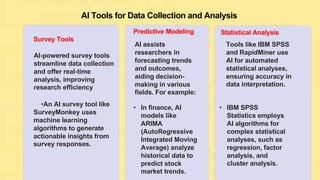
AI Tools for Data Collection and Analysis
Survey Tools
AI-powered survey tools
streamline data collection
and offer real-time
analysis, improving
research efficiency
•An AI survey tool like
SurveyMonkey uses
machine learning
algorithms to generate
actionable insights from
survey responses.
Predictive Modeling
AI assists
researchers in
forecasting trends
and outcomes,
aiding decision-
making in various
fields. For example:
• In finance, AI
models like
ARIMA
(AutoRegressive
Integrated Moving
Average) analyze
historical data to
predict stock
market trends.
Statistical Analysis
Tools like IBM SPSS
and RapidMiner use
AI for automated
statistical analyses,
ensuring accuracy in
data interpretation.
• IBM SPSS
Statistics employs
AI algorithms for
complex statistical
analyses, such as
regression, factor
analysis, and
cluster analysis.
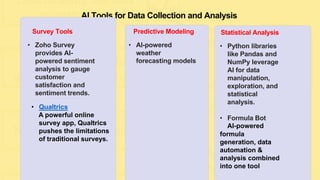
AI Tools for Data Collection and Analysis
Survey Tools
• Zoho Survey
provides AI-
powered sentiment
analysis to gauge
customer
satisfaction and
sentiment trends.
Predictive Modeling
• AI-powered
weather
forecasting models
Statistical Analysis
• Python libraries
like Pandas and
NumPy leverage
AI for data
manipulation,
exploration, and
statistical
analysis.
• Formula Bot
AI-powered
formula
generation, data
automation &
analysis combined
into one tool
• Qualtrics
A powerful online
survey app, Qualtrics
pushes the limitations
of traditional surveys.
Dynamic Survey Design
1 Adaptive Questionnaires
• Dynamic survey design
tools allow researchers
to create adaptive
questionnaires that
adjust the sequence and
content of questions
based on respondents'
previous answers.
2 Real-time Feedback
• Dynamic survey tools
allow researchers to
provide real-time
feedback to respondents
based on their answers,
enhancing engagement
and minimizing errors.
Dynamic Survey Design
1 Adaptive Questionnaires
• Example tool: Qualtrics
Research Core -
Qualtrics provides a
user-friendly platform
that enables
researchers to build
intelligent surveys with
skip logic and
branching features.
2 Real-time Feedback
• Example tool:
SurveyGizmo -
SurveyGizmo offers
features like custom
validations and error
messages to guide
respondents and
ensure accurate data
collection.
Dynamic Survey Design
3 Interactive Elements
• Dynamic survey design
enables the inclusion of
interactive elements like
sliders drag-and-drop
multimedia content to
enhance the respondent
experience.
4 Data Capture Automation
• Dynamic survey tools
automate data capture
from various sources,
such as CRM systems
or third-party APIs,
streamlining the
research data
collection process.
Dynamic Survey Design
3 Interactive Elements
• Example tool: Typeform
Typeform's intuitive
interface allows researchers
to create visually appealing
surveys with interactive
elements and multimedia
integration.
4 Data Capture Automation
• Example tool: Survey Monkey
SurveyMonkey offers integrations
with popular platforms, enabling
researchers to automatically
capture data from multiple
sources.
Automated Transcription Services
1 AI-Powered Transcription Tools
• AI-powered transcription tools leverage
advanced algorithms to convert spoken
words into text, enabling efficient and
accurate transcription of interviews or
focus group discussions.
• Example tool: Otter.ai - Otter.ai uses AI
technology to transcribe audio
recordings in real-time, providing users
with searchable and editable text
transcripts.
Collaborative Decision-Making
AI-Powered Collaborative Platforms
• Platforms like Wiscio utilize AI technology to support
collaborative decision-making among research teams.
• These platforms enable teams to analyze data together,
facilitating a collective understanding of research findings.
• By leveraging AI algorithms, these platforms can provide
insights and recommendations to help teams make informed
choices.
• Example platform: Wiscio - Wiscio offers a collaborative
environment where research teams can work together, analyze
data, and make decisions based on AI-driven insights.
Personalized Recommendations
AI-Enhanced Reference Management Tools such as Zotero with AI add-ons,
leverage artificial intelligence to provide personalized recommendations for relevant articles
based on a researcher's interests.
These tools analyze the researcher's reading history, preferences, and research topics to curate a list
of articles that are likely to be of interest. For example, Zotero with AI add-ons utilizes machine
learning algorithms to analyze article metadata, citation networks, and user behavior to generate
tailored recommendations.
By offering personalized recommendations, these AI-enhanced tools assist researchers in discovering
new and relevant articles,
saving time in the literature search process.
Privacy-Preserving Data Analysis
Implementing Federated Learning
• Federated learning is an AI technique that
enables multiple parties to collaborate on
data analysis without sharing sensitive
information.
• Each party trains a local machine learning
model using their own data, and only the
model updates are shared, not the raw data.
• This approach addresses privacy concerns
by keeping the data decentralized and
reducing the risk of data breaches or
privacy violations.
• For example, in healthcare, federated
learning can be used to analyze patient
data from multiple hospitals without
directly sharing patient records, ensuring
privacy compliance.
Smart Data Validation
Enhancing Data Validity and Reliability
• Tools like Trifacta use AI to identify and rectify
errors in datasets, enhancing the validity and
reliability of collected data.
• The AI algorithms analyze the dataset for anomalies,
inconsistencies, and missing values.
• They can automatically detect and fix common
errors such as data duplication, incorrect
formatting, and outliers.
Smart Data Validation
Enhancing Data Validity and Reliability
• By ensuring the accuracy and consistency of the
data, organizations can make more informed
decisions and avoid potential errors.
• For example, in a sales dataset, AI-powered data
validation can identify and correct any
discrepancies in pricing, quantity, or customer
information.
Intelligent Chatbots for Participant Interaction
Enhancing Participant Engagement in Research
• AI-powered chatbots go beyond traditional methods
of participant interaction in research.
• They can be used for participant recruitment, obtaining
informed consent, and answering queries.
• By leveraging natural language processing and machine
learning, chatbots create personalized and interactive
experiences for participants.
Intelligent Chatbots for Participant Interaction
Enhancing Participant Engagement in Research
• For example, during participant recruitment, chatbots
can engage potential participants through conversational
interfaces, providing information and answering
questions about the research study.
• Obtaining informed consent becomes more accessible
and engaging with chatbots, as participants can interact
with them to understand and acknowledge the study
requirements.
• Furthermore, chatbots can assist participants by
answering their queries promptly and accurately,
improving their overall research experience.
Dynamic Data Visualization
Unlocking Insights and Enhancing Communication
• Dynamic data visualization tools, powered by AI,
revolutionize the way researchers interpret and
communicate complex data.
• Tools like SciSpace and Tableau enable researchers to
create interactive and visually appealing visualizations.
• These dynamic visualizations allow researchers to explore
data from multiple angles, uncover hidden patterns, and
gain deeper insights.
Dynamic Data Visualization
Unlocking Insights and Enhancing Communication
• For example, using these tools, researchers can create
interactive charts, graphs, and maps that enable users to
drill down into the data, filter information, and visualize
trends in real-time.
• Dynamic data visualizations also enhance communication
by making complex data more accessible and engaging for
a wider audience.
• Researchers can present their findings through interactive
dashboards, animated charts, and storytelling techniques,
making it easier for stakeholders to understand and act
upon the information.
Adaptive Learning Systems
Personalized Recommendations for Researchers
• AI-enhanced platforms in the field of research offer adaptive
learning systems that cater to researchers' preferences.
• These systems utilize machine learning algorithms to analyze
researchers' behaviors, interests, and past activities.
• Based on this analysis, the platforms provide personalized
recommendations for methodologies, literature, and research
strategies.
Adaptive Learning Systems
Personalized Recommendations for Researchers
• For example, a researcher interested in qualitative research
methods may receive recommendations for relevant literature,
tools, and techniques in that domain.
• Similarly, if a researcher is exploring a specific topic, the
adaptive learning system can suggest relevant research
papers, conferences, or experts in that area.
• By tailoring the recommendations to individual needs,
researchers can save time and discover new resources that
align with their research goals.
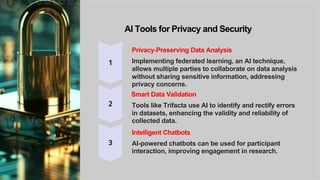
AI Tools for Privacy and Security
Privacy-Preserving Data Analysis
Implementing federated learning, an AI technique,
allows multiple parties to collaborate on data analysis
without sharing sensitive information, addressing
privacy concerns.
Smart Data Validation
Tools like Trifacta use AI to identify and rectify errors
in datasets, enhancing the validity and reliability of
collected data.
Intelligent Chatbots
AI-powered chatbots can be used for participant
interaction, improving engagement in research.
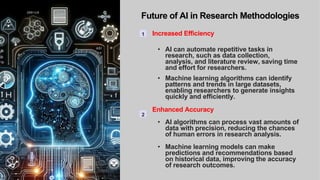
Future of AI in Research Methodologies
1 Increased Efficiency
• AI can automate repetitive tasks in
research, such as data collection,
analysis, and literature review, saving time
and effort for researchers.
• Machine learning algorithms can identify
patterns and trends in large datasets,
enabling researchers to generate insights
quickly and efficiently.
2
Enhanced Accuracy
• AI algorithms can process vast amounts of
data with precision, reducing the chances
of human errors in research analysis.
• Machine learning models can make
predictions and recommendations based
on historical data, improving the accuracy
of research outcomes.
Future of AI in Research Methodologies
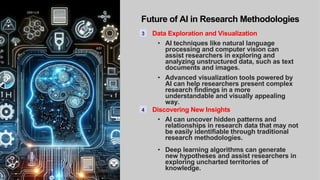
3 Data Exploration and Visualization
• AI techniques like natural language
processing and computer vision can
assist researchers in exploring and
analyzing unstructured data, such as text
documents and images.
• Advanced visualization tools powered by
AI can help researchers present complex
research findings in a more
understandable and visually appealing
way.
4 Discovering New Insights
• AI can uncover hidden patterns and
relationships in research data that may not
be easily identifiable through traditional
research methodologies.
• Deep learning algorithms can generate
new hypotheses and assist researchers in
exploring uncharted territories of
knowledge.
Understanding-Artificial-Intelligence-in-Research (1).pptx

Understanding-Artificial-Intelligence-in-Research (1).pptx

  • 1.
    Unlocking Intelligence: A ComprehensiveIntroduction to AI & Its Tools Artificial intelligence (AI) has transformed various industries, and its impact on research methodologies is profound. From automating literature reviews to revolutionizing data collection and analysis, AI offers a wide array of tools that enhance efficiency and decision-making in research. This presentation aims to explore the key elements of AI, its diverse applications in research, and the innovative AI tools that are shaping the future of research methodologies. by Dr. Roma Smart Joseph Prof. Dept. of B.Ed. Isabella Thoburn College Lucknow UP India
  • 2.
    What is AI •Artificial Intelligence (AI) refers to the simulation of human intelligence in machines. • AI enables machines to perform tasks that would typically require human intelligence, such as problem-solving, learning, and decision-making. • Machine Learning is a subset of AI that focuses on the development of algorithms that allow machines to learn and make predictions or decisions based on data.
  • 3.
    Key Elements ofAI 1 Machine Learning Utilizing algorithms to enable systems to learn and improve from experience. 2 Natural Language Processing (NLP) Empowering machines to understand, interpret, and respond to human language. 3 Pattern Recognition The ability of AI to identify patterns and trends within complex datasets. 4 Reinforcement Learning Reinforcement Learning is a key element in Artificial Intelligence (AI) that involves an agent learning how to make decisions through trial and error.
  • 4.
    Types of AI Narrowor Weak AI Narrow AI or Weak AI is designed to perform a specific task or a set of tasks. It is the most common type of AI and is used in various applications such as speech recognition, image recognition, and natural language processing. Some examples of Narrow AI include: Virtual personal assistants like Siri, Alexa, and Google Assistant Image recognition systems like Google Photos and Facebook's DeepFace Recommendation systems like Netflix and Amazon's product recommendations Self-driving cars that use computer vision and machine learning algorithms.
  • 5.
    Types of AI Generalor Strong AI General AI or Strong AI is the type of AI that exhibits human-like intelligence and can handle a wider range of tasks. It is still largely in the research phase and has not yet been fully developed. Some potential applications of General AI include: Robots that can perform a wide range of tasks in unstructured environments Virtual assistants that can perform tasks beyond simple commands Automated scientific discovery systems that can make breakthroughs in fields like medicine and engineering Autonomous weapons that can make decisions and take actions on their own
  • 6.
    Role of AIin Research 1 Efficiency Enhancement • Automated data collection and analysis tools help researchers gather and process large volumes of data quickly. 2 Data-drivenInsights • Predictive analytics models can analyze historical data to forecast trends and outcomes. • Natural language processing algorithms can extract meaningful insights from unstructured text data. 3 Innovation Catalyst • AI-powered simulations and modeling techniques enable researchers to simulate complex scenarios and test hypotheses. • Deep learning algorithms can discover patterns and relationships in data that may not be immediately apparent to human researchers.
  • 7.
    AI Tools forLiterature Review 1 Elicit.ai Elicit.ai is an AI- powered tool specifically designed for literature review. • Extract key concepts 2 Semantic Scholar It provides a refined search experience for relevant scholarly articles and publications. • Discover and access relevant scholarly articles and publications 3 Jenni Jenni is an AI tool designed to assist researchers with their literature reviews. • Discover and access relevant scholarly articles and publications
  • 8.
    AI Tools forLiterature Review Elicit.ai Quickly identify relevant studies Gain valuable insights from large volumes of scholarly content Jenni Jenni is an AI tool designed to assist researchers with their literature reviews.
  • 9.
    AI Tools forData Collection and Analysis Survey Tools AI-powered survey tools streamline data collection and offer real-time analysis, improving research efficiency •An AI survey tool like SurveyMonkey uses machine learning algorithms to generate actionable insights from survey responses. Predictive Modeling AI assists researchers in forecasting trends and outcomes, aiding decision- making in various fields. For example: • In finance, AI models like ARIMA (AutoRegressive Integrated Moving Average) analyze historical data to predict stock market trends. Statistical Analysis Tools like IBM SPSS and RapidMiner use AI for automated statistical analyses, ensuring accuracy in data interpretation. • IBM SPSS Statistics employs AI algorithms for complex statistical analyses, such as regression, factor analysis, and cluster analysis.
  • 10.
    AI Tools forData Collection and Analysis Survey Tools • Zoho Survey provides AI- powered sentiment analysis to gauge customer satisfaction and sentiment trends. Predictive Modeling • AI-powered weather forecasting models Statistical Analysis • Python libraries like Pandas and NumPy leverage AI for data manipulation, exploration, and statistical analysis. • Formula Bot AI-powered formula generation, data automation & analysis combined into one tool • Qualtrics A powerful online survey app, Qualtrics pushes the limitations of traditional surveys.
  • 11.
    Dynamic Survey Design 1Adaptive Questionnaires • Dynamic survey design tools allow researchers to create adaptive questionnaires that adjust the sequence and content of questions based on respondents' previous answers. 2 Real-time Feedback • Dynamic survey tools allow researchers to provide real-time feedback to respondents based on their answers, enhancing engagement and minimizing errors.
  • 12.
    Dynamic Survey Design 1Adaptive Questionnaires • Example tool: Qualtrics Research Core - Qualtrics provides a user-friendly platform that enables researchers to build intelligent surveys with skip logic and branching features. 2 Real-time Feedback • Example tool: SurveyGizmo - SurveyGizmo offers features like custom validations and error messages to guide respondents and ensure accurate data collection.
  • 13.
    Dynamic Survey Design 3Interactive Elements • Dynamic survey design enables the inclusion of interactive elements like sliders drag-and-drop multimedia content to enhance the respondent experience. 4 Data Capture Automation • Dynamic survey tools automate data capture from various sources, such as CRM systems or third-party APIs, streamlining the research data collection process.
  • 14.
    Dynamic Survey Design 3Interactive Elements • Example tool: Typeform Typeform's intuitive interface allows researchers to create visually appealing surveys with interactive elements and multimedia integration. 4 Data Capture Automation • Example tool: Survey Monkey SurveyMonkey offers integrations with popular platforms, enabling researchers to automatically capture data from multiple sources.
  • 15.
    Automated Transcription Services 1AI-Powered Transcription Tools • AI-powered transcription tools leverage advanced algorithms to convert spoken words into text, enabling efficient and accurate transcription of interviews or focus group discussions. • Example tool: Otter.ai - Otter.ai uses AI technology to transcribe audio recordings in real-time, providing users with searchable and editable text transcripts.
  • 16.
    Collaborative Decision-Making AI-Powered CollaborativePlatforms • Platforms like Wiscio utilize AI technology to support collaborative decision-making among research teams. • These platforms enable teams to analyze data together, facilitating a collective understanding of research findings. • By leveraging AI algorithms, these platforms can provide insights and recommendations to help teams make informed choices. • Example platform: Wiscio - Wiscio offers a collaborative environment where research teams can work together, analyze data, and make decisions based on AI-driven insights.
  • 17.
    Personalized Recommendations AI-Enhanced ReferenceManagement Tools such as Zotero with AI add-ons, leverage artificial intelligence to provide personalized recommendations for relevant articles based on a researcher's interests. These tools analyze the researcher's reading history, preferences, and research topics to curate a list of articles that are likely to be of interest. For example, Zotero with AI add-ons utilizes machine learning algorithms to analyze article metadata, citation networks, and user behavior to generate tailored recommendations. By offering personalized recommendations, these AI-enhanced tools assist researchers in discovering new and relevant articles, saving time in the literature search process.
  • 18.
    Privacy-Preserving Data Analysis ImplementingFederated Learning • Federated learning is an AI technique that enables multiple parties to collaborate on data analysis without sharing sensitive information. • Each party trains a local machine learning model using their own data, and only the model updates are shared, not the raw data. • This approach addresses privacy concerns by keeping the data decentralized and reducing the risk of data breaches or privacy violations. • For example, in healthcare, federated learning can be used to analyze patient data from multiple hospitals without directly sharing patient records, ensuring privacy compliance.
  • 19.
    Smart Data Validation EnhancingData Validity and Reliability • Tools like Trifacta use AI to identify and rectify errors in datasets, enhancing the validity and reliability of collected data. • The AI algorithms analyze the dataset for anomalies, inconsistencies, and missing values. • They can automatically detect and fix common errors such as data duplication, incorrect formatting, and outliers.
  • 20.
    Smart Data Validation EnhancingData Validity and Reliability • By ensuring the accuracy and consistency of the data, organizations can make more informed decisions and avoid potential errors. • For example, in a sales dataset, AI-powered data validation can identify and correct any discrepancies in pricing, quantity, or customer information.
  • 21.
    Intelligent Chatbots forParticipant Interaction Enhancing Participant Engagement in Research • AI-powered chatbots go beyond traditional methods of participant interaction in research. • They can be used for participant recruitment, obtaining informed consent, and answering queries. • By leveraging natural language processing and machine learning, chatbots create personalized and interactive experiences for participants.
  • 22.
    Intelligent Chatbots forParticipant Interaction Enhancing Participant Engagement in Research • For example, during participant recruitment, chatbots can engage potential participants through conversational interfaces, providing information and answering questions about the research study. • Obtaining informed consent becomes more accessible and engaging with chatbots, as participants can interact with them to understand and acknowledge the study requirements. • Furthermore, chatbots can assist participants by answering their queries promptly and accurately, improving their overall research experience.
  • 23.
    Dynamic Data Visualization UnlockingInsights and Enhancing Communication • Dynamic data visualization tools, powered by AI, revolutionize the way researchers interpret and communicate complex data. • Tools like SciSpace and Tableau enable researchers to create interactive and visually appealing visualizations. • These dynamic visualizations allow researchers to explore data from multiple angles, uncover hidden patterns, and gain deeper insights.
  • 24.
    Dynamic Data Visualization UnlockingInsights and Enhancing Communication • For example, using these tools, researchers can create interactive charts, graphs, and maps that enable users to drill down into the data, filter information, and visualize trends in real-time. • Dynamic data visualizations also enhance communication by making complex data more accessible and engaging for a wider audience. • Researchers can present their findings through interactive dashboards, animated charts, and storytelling techniques, making it easier for stakeholders to understand and act upon the information.
  • 25.
    Adaptive Learning Systems PersonalizedRecommendations for Researchers • AI-enhanced platforms in the field of research offer adaptive learning systems that cater to researchers' preferences. • These systems utilize machine learning algorithms to analyze researchers' behaviors, interests, and past activities. • Based on this analysis, the platforms provide personalized recommendations for methodologies, literature, and research strategies.
  • 26.
    Adaptive Learning Systems PersonalizedRecommendations for Researchers • For example, a researcher interested in qualitative research methods may receive recommendations for relevant literature, tools, and techniques in that domain. • Similarly, if a researcher is exploring a specific topic, the adaptive learning system can suggest relevant research papers, conferences, or experts in that area. • By tailoring the recommendations to individual needs, researchers can save time and discover new resources that align with their research goals.
  • 27.
    AI Tools forPrivacy and Security Privacy-Preserving Data Analysis Implementing federated learning, an AI technique, allows multiple parties to collaborate on data analysis without sharing sensitive information, addressing privacy concerns. Smart Data Validation Tools like Trifacta use AI to identify and rectify errors in datasets, enhancing the validity and reliability of collected data. Intelligent Chatbots AI-powered chatbots can be used for participant interaction, improving engagement in research.
  • 28.
    Future of AIin Research Methodologies 1 Increased Efficiency • AI can automate repetitive tasks in research, such as data collection, analysis, and literature review, saving time and effort for researchers. • Machine learning algorithms can identify patterns and trends in large datasets, enabling researchers to generate insights quickly and efficiently. 2 Enhanced Accuracy • AI algorithms can process vast amounts of data with precision, reducing the chances of human errors in research analysis. • Machine learning models can make predictions and recommendations based on historical data, improving the accuracy of research outcomes.
  • 29.
    Future of AIin Research Methodologies 3 Data Exploration and Visualization • AI techniques like natural language processing and computer vision can assist researchers in exploring and analyzing unstructured data, such as text documents and images. • Advanced visualization tools powered by AI can help researchers present complex research findings in a more understandable and visually appealing way. 4 Discovering New Insights • AI can uncover hidden patterns and relationships in research data that may not be easily identifiable through traditional research methodologies. • Deep learning algorithms can generate new hypotheses and assist researchers in exploring uncharted territories of knowledge.