PROBABILITY THEORY
Oyindamola Bidemi Yusuf
What is Probability?
Measurement of uncertainty
Theory of choice and chance
Allows intelligence guess about future
Helps to quantify risk
Predicts outcomes
PROBABILITY DEFINITION-
OBJECTIVE
Frequency Concept
Based on empirical observations
Number of times an event occurs in a
long series of trials
PROBABILITY DEFINITION -
SUBJECTIVE
Merely expresses degree of belief
Based on personal experience
Basic Terminologies
Experiment(Process of conducting
trials)
Trial (Act of an experiment.)
Outcome ( Result of a Particular
trial)
Event (Particular outcome or
single result of an experiment)
PROBABILITY CALCULATIONS
CLASSICAL PROBABILITY
Classical Probability
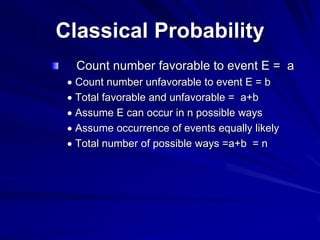
Count number favorable to event E = a
Count number unfavorable to event E = b
Total favorable and unfavorable = a+b
Assume E can occur in n possible ways
Assume occurrence of events equally likely
Total number of possible ways =a+b = n
Probability of an event-E
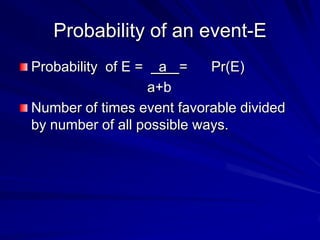
Probability of E = a = Pr(E)
a+b
Number of times event favorable divided
by number of all possible ways.
Probability Thermometer
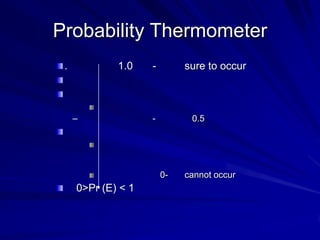
. 1.0 - sure to occur
– - 0.5
0- cannot occur
0>Pr (E) < 1
Type of Events
Simple events
Compound events
Mutually exclusive events
Independent events
Simple events
Events with single outcomes
tossing a fair coin
Compound events
Compound events is the combination of
two or more than two simple events.
Suppose two coins are tossed
simultaneously
Probability Rules
Addition rule
Multiplication rule
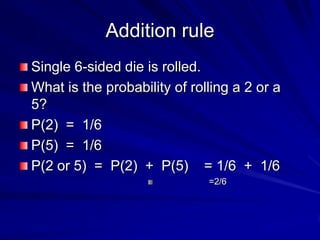
Addition rule
Single 6-sided die is rolled.
What is the probability of rolling a 2 or a
5?
P(2) = 1/6
P(5) = 1/6
P(2 or 5) = P(2) + P(5) = 1/6 + 1/6
=2/6
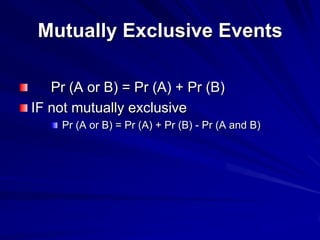
Mutually Exclusive Events
Pr (A or B) = Pr (A) + Pr (B)
IF not mutually exclusive
Pr (A or B) = Pr (A) + Pr (B) - Pr (A and B)
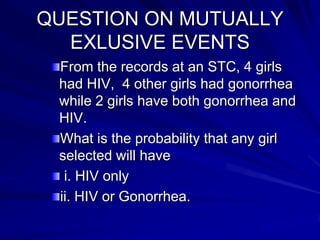
QUESTION ON MUTUALLY
EXLUSIVE EVENTS
From the records at an STC, 4 girls
had HIV, 4 other girls had gonorrhea
while 2 girls have both gonorrhea and
HIV.
What is the probability that any girl
selected will have
i. HIV only
ii. HIV or Gonorrhea.
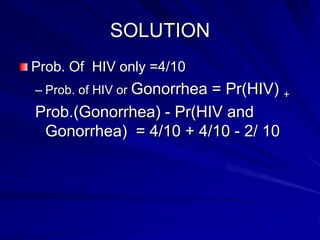
SOLUTION
Prob. Of HIV only =4/10
– Prob. of HIV or Gonorrhea = Pr(HIV) +
Prob.(Gonorrhea) - Pr(HIV and
Gonorrhea) = 4/10 + 4/10 - 2/ 10
Independent events
Choosing a marble from a jar AND landing
on heads after tossing a coin.
Choosing a 3 from a deck of cards,
replacing it, AND then choosing an ace as
the second card.
Rolling a 4 on a single 6-sided die, AND
then rolling a 1 on a second roll of the die.
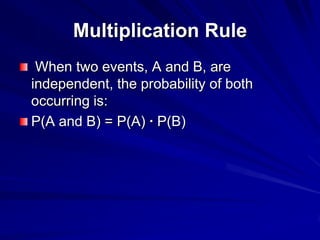
Multiplication Rule
When two events, A and B, are
independent, the probability of both
occurring is:
P(A and B) = P(A) · P(B)
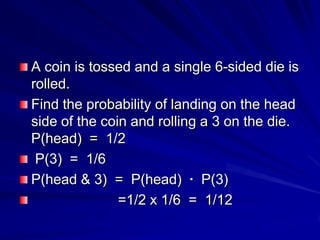
A coin is tossed and a single 6-sided die is
rolled.
Find the probability of landing on the head
side of the coin and rolling a 3 on the die.
P(head) = 1/2
P(3) = 1/6
P(head & 3) = P(head) · P(3)
=1/2 x 1/6 = 1/12
Conditional Probability
In probability theory, a conditional
probability is the probability that an event
will occur, when another event is known to
occur or to have occurred.
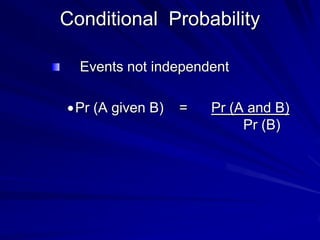
Conditional Probability
Events not independent
Pr (A given B) = Pr (A and B)
Pr (B)
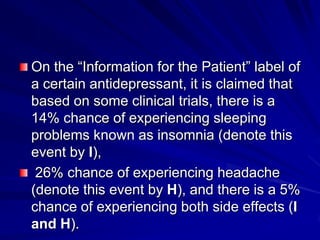
On the “Information for the Patient” label of
a certain antidepressant, it is claimed that
based on some clinical trials, there is a
14% chance of experiencing sleeping
problems known as insomnia (denote this
event by I),
26% chance of experiencing headache
(denote this event by H), and there is a 5%
chance of experiencing both side effects (I
and H).
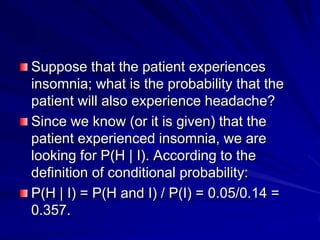
Suppose that the patient experiences
insomnia; what is the probability that the
patient will also experience headache?
Since we know (or it is given) that the
patient experienced insomnia, we are
looking for P(H | I). According to the
definition of conditional probability:
P(H | I) = P(H and I) / P(I) = 0.05/0.14 =
0.357.
Random Variables
A real valued function, defined over the
sample space of a random experiment is
called the random variable, associated to
that random experiment.
That is the values of the random variable
correspond to the outcomes of the random
experiment.
Random Variables
Take specified values with specified
probabilities
Discrete Random variable
–E.g. no of children in a family, no of
patients in a doctors surgery
Continuous Random variable
The probability distribution of a
discrete random variable is a list of
probabilities associated with each of its
possible values.
It is also sometimes called the
probability function or the probability
mass function
Continuous random variables are usually
measurements.
Examples include height, weight, the
amount of sugar in an orange, the time
required to run a mile, etc
DISCRETE PROBABILITY
DISTRIBUTION
Binomial
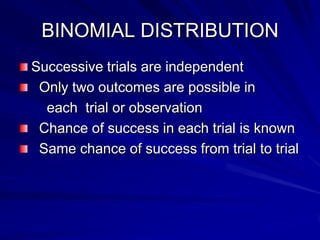
BINOMIAL DISTRIBUTION
Successive trials are independent
Only two outcomes are possible in
each trial or observation
Chance of success in each trial is known
Same chance of success from trial to trial
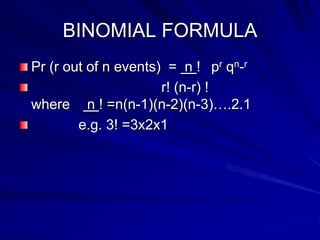
BINOMIAL FORMULA
Pr (r out of n events) = n ! pr qn-r
r! (n-r) !
where n ! =n(n-1)(n-2)(n-3)….2.1
e.g. 3! =3x2x1
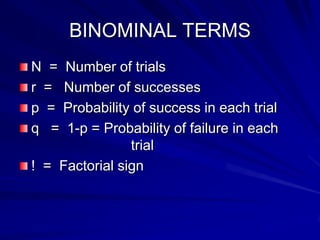
BINOMINAL TERMS
N = Number of trials
r = Number of successes
p = Probability of success in each trial
q = 1-p = Probability of failure in each
trial
! = Factorial sign
EXAMPLE BINOMINAL
It is known that 10% of patients
diagnosed to have a condition survive
following surgical treatment. What is
the chance of 2 people surviving out
of 5 diagnosed with the condition and
treated surgically.
Solution
Continuous Probability
Distribution
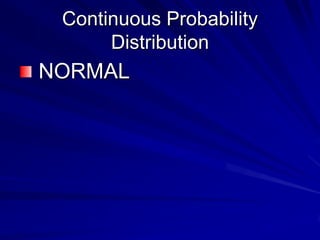
NORMAL
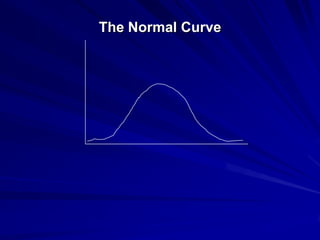
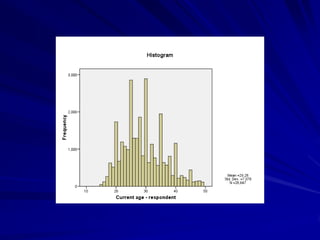
The Normal Curve
The Shape of a Distribution
Symmetrical
– can be divided at the center so that each half
is a mirror image of the other
Asymmetrical
Skewness
– If a distribution is asymmetric it is either
positively skewed or negatively skewed.
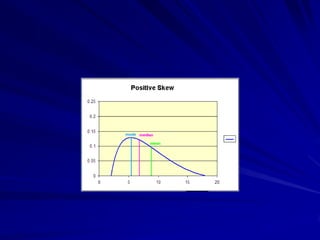
– A distribution is said to be positively skewed if
the values tend to cluster toward the lower
end of the scale (that is, the smaller numbers)
with increasingly fewer values at the upper
end of the scale (that is, the larger numbers).
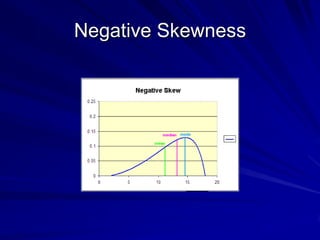
With a negatively skewed
distribution, most of the values tend to
occur toward the upper end of the scale
while increasingly fewer values occur
toward the lower end.
Negative Skewness
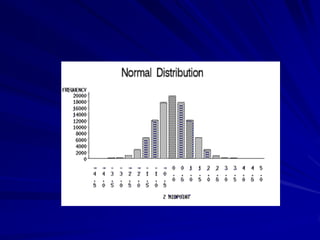
Properties of Normal Curve
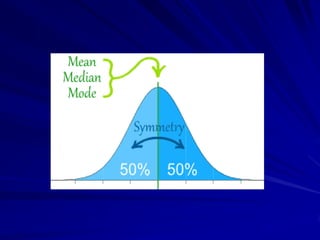
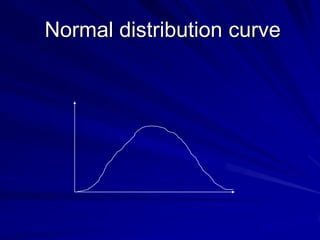
Bell shaped and symmetric about centre
Completely determined by its mean and standard
deviation
Mean, median and mode have same value
Total area under curve is 1 (100%).
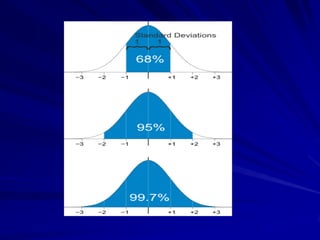
68% of all observations lie within one standard
deviations of the mean.
95% of observations lie within 1.96 standard
deviations of the mean value
Gives probability of falling within interval if data has
normal distribution.
Importance of Normal Distribution
Fits many practical distributions of variables in
medicine
If variables are not normally
distributed, transformation techniques to make
them normal exist.
Sampling distributions of means and proportions are
known to have normal distributions
It is the cornerstone of all parametric tests of
statistical significance.
Presentation of Normal Distribution.
As a mathematical equation
Graph
Table
-
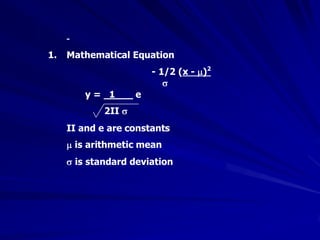
1. Mathematical Equation
- 1/2 (x - )2
y = 1___ e
2II
II and e are constants
is arithmetic mean
is standard deviation
Normal distribution curve
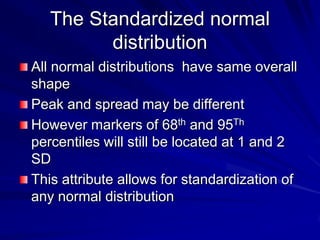
The Standardized normal
distribution
All normal distributions have same overall
shape
Peak and spread may be different
However markers of 68th and 95Th
percentiles will still be located at 1 and 2
SD
This attribute allows for standardization of
any normal distribution
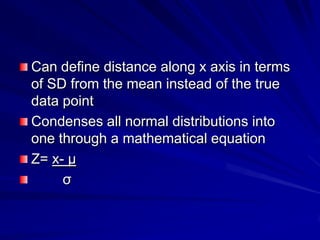
Can define distance along x axis in terms
of SD from the mean instead of the true
data point
Condenses all normal distributions into
one through a mathematical equation
Z= x- μ
σ
Each data point is converted into a
standardized value, and its new value is
called a Z score
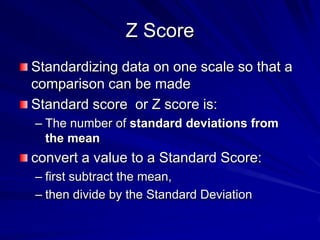
Z Score
Standardizing data on one scale so that a
comparison can be made
Standard score or Z score is:
– The number of standard deviations from
the mean
convert a value to a Standard Score:
– first subtract the mean,
– then divide by the Standard Deviation
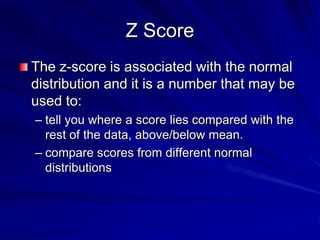
Z Score
The z-score is associated with the normal
distribution and it is a number that may be
used to:
– tell you where a score lies compared with the
rest of the data, above/below mean.
– compare scores from different normal
distributions
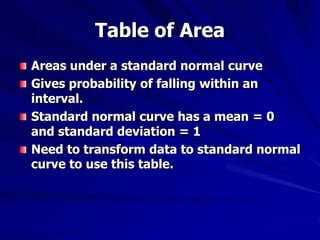
Table of Area
Areas under a standard normal curve
Gives probability of falling within an
interval.
Standard normal curve has a mean = 0
and standard deviation = 1
Need to transform data to standard normal
curve to use this table.
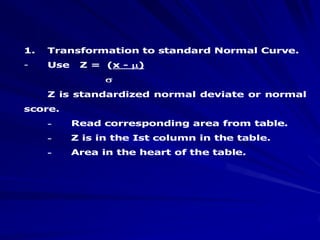
1. Transformation to standard Normal Curve.
- Use Z = (x - )
Z is standardized normal deviate or normal
score.
- Read corresponding area from table.
- Z is in the Ist column in the table.
- Area in the heart of the table.
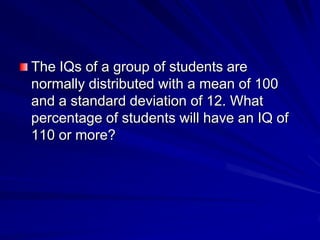
The IQs of a group of students are
normally distributed with a mean of 100
and a standard deviation of 12. What
percentage of students will have an IQ of
110 or more?
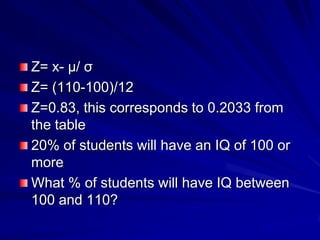
Z= x- μ/ σ
Z= (110-100)/12
Z=0.83, this corresponds to 0.2033 from
the table
20% of students will have an IQ of 100 or
more
What % of students will have IQ between
100 and 110?
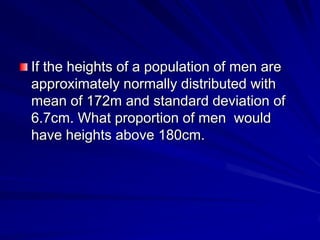
If the heights of a population of men are
approximately normally distributed with
mean of 172m and standard deviation of
6.7cm. What proportion of men would
have heights above 180cm.
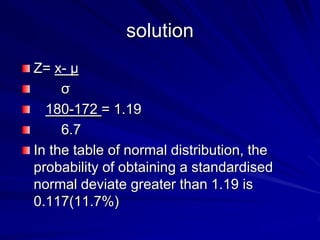
solution
Z= x- µ
σ
180-172 = 1.19
6.7
In the table of normal distribution, the
probability of obtaining a standardised
normal deviate greater than 1.19 is
0.117(11.7%)
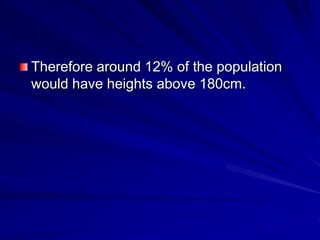
Therefore around 12% of the population
would have heights above 180cm.
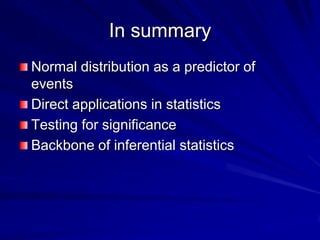
In summary
Normal distribution as a predictor of
events
Direct applications in statistics
Testing for significance
Backbone of inferential statistics
THANK YOU

RSS probability theory

  • 1.
  • 2.
    What is Probability? Measurementof uncertainty Theory of choice and chance Allows intelligence guess about future Helps to quantify risk Predicts outcomes
  • 3.
    PROBABILITY DEFINITION- OBJECTIVE Frequency Concept Basedon empirical observations Number of times an event occurs in a long series of trials
  • 4.
    PROBABILITY DEFINITION - SUBJECTIVE Merelyexpresses degree of belief Based on personal experience
  • 5.
    Basic Terminologies Experiment(Process ofconducting trials) Trial (Act of an experiment.) Outcome ( Result of a Particular trial) Event (Particular outcome or single result of an experiment)
  • 6.
  • 7.
    Classical Probability Count numberfavorable to event E = a Count number unfavorable to event E = b Total favorable and unfavorable = a+b Assume E can occur in n possible ways Assume occurrence of events equally likely Total number of possible ways =a+b = n
  • 8.
    Probability of anevent-E Probability of E = a = Pr(E) a+b Number of times event favorable divided by number of all possible ways.
  • 9.
    Probability Thermometer . 1.0- sure to occur – - 0.5 0- cannot occur 0>Pr (E) < 1
  • 10.
    Type of Events Simpleevents Compound events Mutually exclusive events Independent events
  • 11.
    Simple events Events withsingle outcomes tossing a fair coin
  • 12.
    Compound events Compound eventsis the combination of two or more than two simple events. Suppose two coins are tossed simultaneously
  • 13.
  • 14.
    Addition rule Single 6-sideddie is rolled. What is the probability of rolling a 2 or a 5? P(2) = 1/6 P(5) = 1/6 P(2 or 5) = P(2) + P(5) = 1/6 + 1/6 =2/6
  • 15.
    Mutually Exclusive Events Pr(A or B) = Pr (A) + Pr (B) IF not mutually exclusive Pr (A or B) = Pr (A) + Pr (B) - Pr (A and B)
  • 16.
    QUESTION ON MUTUALLY EXLUSIVEEVENTS From the records at an STC, 4 girls had HIV, 4 other girls had gonorrhea while 2 girls have both gonorrhea and HIV. What is the probability that any girl selected will have i. HIV only ii. HIV or Gonorrhea.
  • 17.
    SOLUTION Prob. Of HIVonly =4/10 – Prob. of HIV or Gonorrhea = Pr(HIV) + Prob.(Gonorrhea) - Pr(HIV and Gonorrhea) = 4/10 + 4/10 - 2/ 10
  • 18.
    Independent events Choosing amarble from a jar AND landing on heads after tossing a coin. Choosing a 3 from a deck of cards, replacing it, AND then choosing an ace as the second card. Rolling a 4 on a single 6-sided die, AND then rolling a 1 on a second roll of the die.
  • 19.
    Multiplication Rule When twoevents, A and B, are independent, the probability of both occurring is: P(A and B) = P(A) · P(B)
  • 20.
    A coin istossed and a single 6-sided die is rolled. Find the probability of landing on the head side of the coin and rolling a 3 on the die. P(head) = 1/2 P(3) = 1/6 P(head & 3) = P(head) · P(3) =1/2 x 1/6 = 1/12
  • 21.
    Conditional Probability In probabilitytheory, a conditional probability is the probability that an event will occur, when another event is known to occur or to have occurred.
  • 22.
    Conditional Probability Events notindependent Pr (A given B) = Pr (A and B) Pr (B)
  • 23.
    On the “Informationfor the Patient” label of a certain antidepressant, it is claimed that based on some clinical trials, there is a 14% chance of experiencing sleeping problems known as insomnia (denote this event by I), 26% chance of experiencing headache (denote this event by H), and there is a 5% chance of experiencing both side effects (I and H).
  • 24.
    Suppose that thepatient experiences insomnia; what is the probability that the patient will also experience headache? Since we know (or it is given) that the patient experienced insomnia, we are looking for P(H | I). According to the definition of conditional probability: P(H | I) = P(H and I) / P(I) = 0.05/0.14 = 0.357.
  • 25.
    Random Variables A realvalued function, defined over the sample space of a random experiment is called the random variable, associated to that random experiment. That is the values of the random variable correspond to the outcomes of the random experiment.
  • 26.
    Random Variables Take specifiedvalues with specified probabilities Discrete Random variable –E.g. no of children in a family, no of patients in a doctors surgery Continuous Random variable
  • 27.
    The probability distributionof a discrete random variable is a list of probabilities associated with each of its possible values. It is also sometimes called the probability function or the probability mass function
  • 28.
    Continuous random variablesare usually measurements. Examples include height, weight, the amount of sugar in an orange, the time required to run a mile, etc
  • 29.
  • 30.
    BINOMIAL DISTRIBUTION Successive trialsare independent Only two outcomes are possible in each trial or observation Chance of success in each trial is known Same chance of success from trial to trial
  • 31.
    BINOMIAL FORMULA Pr (rout of n events) = n ! pr qn-r r! (n-r) ! where n ! =n(n-1)(n-2)(n-3)….2.1 e.g. 3! =3x2x1
  • 32.
    BINOMINAL TERMS N =Number of trials r = Number of successes p = Probability of success in each trial q = 1-p = Probability of failure in each trial ! = Factorial sign
  • 33.
    EXAMPLE BINOMINAL It isknown that 10% of patients diagnosed to have a condition survive following surgical treatment. What is the chance of 2 people surviving out of 5 diagnosed with the condition and treated surgically.
  • 34.
  • 35.
  • 36.
  • 39.
    The Shape ofa Distribution Symmetrical – can be divided at the center so that each half is a mirror image of the other Asymmetrical
  • 41.
    Skewness – If adistribution is asymmetric it is either positively skewed or negatively skewed. – A distribution is said to be positively skewed if the values tend to cluster toward the lower end of the scale (that is, the smaller numbers) with increasingly fewer values at the upper end of the scale (that is, the larger numbers).
  • 43.
    With a negativelyskewed distribution, most of the values tend to occur toward the upper end of the scale while increasingly fewer values occur toward the lower end.
  • 44.
  • 45.
    Properties of NormalCurve Bell shaped and symmetric about centre Completely determined by its mean and standard deviation Mean, median and mode have same value Total area under curve is 1 (100%). 68% of all observations lie within one standard deviations of the mean. 95% of observations lie within 1.96 standard deviations of the mean value Gives probability of falling within interval if data has normal distribution.
  • 46.
    Importance of NormalDistribution Fits many practical distributions of variables in medicine If variables are not normally distributed, transformation techniques to make them normal exist. Sampling distributions of means and proportions are known to have normal distributions It is the cornerstone of all parametric tests of statistical significance.
  • 47.
    Presentation of NormalDistribution. As a mathematical equation Graph Table
  • 48.
    - 1. Mathematical Equation -1/2 (x - )2 y = 1___ e 2II II and e are constants is arithmetic mean is standard deviation
  • 49.
  • 51.
    The Standardized normal distribution Allnormal distributions have same overall shape Peak and spread may be different However markers of 68th and 95Th percentiles will still be located at 1 and 2 SD This attribute allows for standardization of any normal distribution
  • 52.
    Can define distancealong x axis in terms of SD from the mean instead of the true data point Condenses all normal distributions into one through a mathematical equation Z= x- μ σ
  • 53.
    Each data pointis converted into a standardized value, and its new value is called a Z score
  • 54.
    Z Score Standardizing dataon one scale so that a comparison can be made Standard score or Z score is: – The number of standard deviations from the mean convert a value to a Standard Score: – first subtract the mean, – then divide by the Standard Deviation
  • 55.
    Z Score The z-scoreis associated with the normal distribution and it is a number that may be used to: – tell you where a score lies compared with the rest of the data, above/below mean. – compare scores from different normal distributions
  • 56.
    Table of Area Areasunder a standard normal curve Gives probability of falling within an interval. Standard normal curve has a mean = 0 and standard deviation = 1 Need to transform data to standard normal curve to use this table.
  • 57.
    1. Transformation tostandard Normal Curve. - Use Z = (x - ) Z is standardized normal deviate or normal score. - Read corresponding area from table. - Z is in the Ist column in the table. - Area in the heart of the table.
  • 58.
    The IQs ofa group of students are normally distributed with a mean of 100 and a standard deviation of 12. What percentage of students will have an IQ of 110 or more?
  • 59.
    Z= x- μ/σ Z= (110-100)/12 Z=0.83, this corresponds to 0.2033 from the table 20% of students will have an IQ of 100 or more What % of students will have IQ between 100 and 110?
  • 60.
    If the heightsof a population of men are approximately normally distributed with mean of 172m and standard deviation of 6.7cm. What proportion of men would have heights above 180cm.
  • 61.
    solution Z= x- µ σ 180-172= 1.19 6.7 In the table of normal distribution, the probability of obtaining a standardised normal deviate greater than 1.19 is 0.117(11.7%)
  • 62.
    Therefore around 12%of the population would have heights above 180cm.
  • 63.
    In summary Normal distributionas a predictor of events Direct applications in statistics Testing for significance Backbone of inferential statistics
  • 64.