Unsupervised Learning
Supervisor: Dr. Murad Rassam Department : Software L(5)1
CLUSTERING
BLIND SIGNAL SEPARATION
CONTENT
INTRODUCTION
SELF-ORGANIZING MAPS(SOM)
2
 Unsupervised learning studies how systems can
learn to represent particular input patterns in a
way that reflects the statistical structure of the
overall collection of input patterns.
 There are no explicit target outputs rather the
unsupervised learner brings to bear prior biases as
to what aspects of the structure of the input should
be captured in the output.
 indeed structural and physiological properties of
synapses in the neocortex are known to be
substantially influenced by the patterns of activity
in sensory neurons that occur.
 essentially none of the information about the
contents of scenes is available during learning.
Introduction
3
 Unsupervised learning is important since it is likely
to be much more common in the brain than
supervised learning.
 For instance there are around 106 photoreceptors
in each eye whose activities are constantly
changing with the visual world and which provide
all the information that is available to indicate
what objects there are in the world, how they are
presented, what the lighting conditions are, etc.
4
 Horace Barlow (see Barlow, 1992), who sought ways
of characterizing neural codes,
 David Marr (1970), who made an early unsupervised
learning postulate about the goal of learning in his
model of the neocortex.
 The Hebb rule (Hebb, 1949), which links statistical
methods to neurophysiological experiments on
plasticity
 Geoffrey Hinton and Terrence Sejnowski in inventing
a model of learning called the Boltzmann machine
(1986)
 History
5
 Clustering.
 Blind signal separation.
 Self-organising maps
 Etc.
 Examples of unsupervised learning
approaches
6
CLUSTERING
BLIND SIGNAL SEPARATION
CONTENT
INTRODUCTION
SELF-ORGANIZING MAPS(SOM)
7
Clustering
is the task of grouping a set of objects in such a way
that objects in the same group (called a cluster) are
more similar to each there than to those in other
groups (clusters).
It is a main task of exploratory data mining , and a
common technique for statistical data analysis .
used in many fields, including machine
learning , pattern recognition image analysis.
8
 Clustering algorithms
 Hierarchical clustering
creating clusters that have a predetermined ordering
from top to bottom. For example, all files and folders
on the hard disk are organized in a hierarchy.
 Agglomerative algorithm.
 Divisive algorithm.
 Partitional clustering
Decompose the data set into a set of disjoint clusters
 K-mean algorithm.
9
 Hierarchical clustering
 Agglomerative clustering
 In this method we assign each observation to its
own cluster.
 Then, compute the similarity (e.g., distance) between
each of the clusters and join the two most similar
clusters.
 Finally, repeat steps 2 and 3 until there is only a
single cluster left. The related algorithm is shown
below.
 Divisive clustering
 In this method we assign all of the observations to a
single cluster and then partition the cluster to two
least similar clusters. Finally, we proceed recursively
on each cluster until there is one cluster for each
observation.10
11
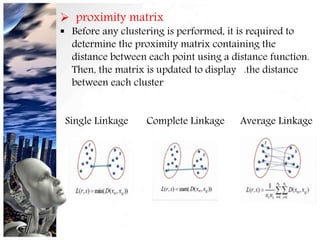
 proximity matrix
 Before any clustering is performed, it is required to
determine the proximity matrix containing the
distance between each point using a distance function.
Then, the matrix is updated to display .the distance
between each cluster
Single Linkage Complete Linkage Average Linkage
12
CLUSTERING
BLIND SIGNAL SEPARATION
CONTENT
INTRODUCTION
SELF-ORGANIZING MAPS(SOM)
13
Blind signal separation
 Blind signal separation, also known as blind
source separation.
 is the separation of a set of source signals from
a set of mixed signals, without the aid of
information (or with very little information)
about the source signals or the mixing process.
 methods for blind source separation generally
seek to narrow the set of possible solutions in a
way that is unlikely to exclude the desired
solution.
14
 Recently, blind source separation by Independent
Component Analysis (ICA) has received attention
because of its potential applications in signal
processing such as in speech recognition systems,
telecommunications and medical signal processing.
 The goal of ICA is to recover independent sources
given only sensor observations that are unknown
linear mixtures of the unobserved independent source
signals.
 ICA not only de correlates the signals (2nd-order
statistics) but also reduces higher-order statistical
dependencies, attempting to make the signals as
independent as possible.
15
 Partitionning techniques
16
CLUSTERING
BLIND SIGNAL SEPARATION
CONTENT
INTRODUCTION
SELF-ORGANIZING MAPS(SOM)
17
Self-organizing Maps(som)
 Self-Organizing Map (SOM) is an unsupervised
learning algorithm.
 SOM is a visualization method to represent higher
dimensional data in an usually 1-D, 2-D or 3-D
manner.
 SOMs have two phases:
 Learning phase: map is built, network organizes
using a competitive process using training set.
 Prediction phase: new vectors are quickly given
a location on the converged map, easily
classifying or categorizing the new data.
18
 SOMs are commonly used as visualization aids.
They can make it easy for us humans to see
relationships between vast amounts of data
19
 Applications of SOMs
 World Poverty Map
 Example: Data sets for poverty levels in different
countries.
 Data sets have many different statistics for each
country.
 SOM does not show poverty levels, rather it
shows how similar the poverty sets for different
countries are to each other.
20
Done by:-
Eng.Amal Ahmed Almathani
Eng.Ansam Mansour
Eng.Safia Moqbel
Eng.Somia Abdalhmeed
21
Thank you for your attention
22

Unsupervised learning

  • 1.
    Unsupervised Learning Supervisor: Dr.Murad Rassam Department : Software L(5)1
  • 2.
  • 3.
     Unsupervised learningstudies how systems can learn to represent particular input patterns in a way that reflects the statistical structure of the overall collection of input patterns.  There are no explicit target outputs rather the unsupervised learner brings to bear prior biases as to what aspects of the structure of the input should be captured in the output.  indeed structural and physiological properties of synapses in the neocortex are known to be substantially influenced by the patterns of activity in sensory neurons that occur.  essentially none of the information about the contents of scenes is available during learning. Introduction 3
  • 4.
     Unsupervised learningis important since it is likely to be much more common in the brain than supervised learning.  For instance there are around 106 photoreceptors in each eye whose activities are constantly changing with the visual world and which provide all the information that is available to indicate what objects there are in the world, how they are presented, what the lighting conditions are, etc. 4
  • 5.
     Horace Barlow(see Barlow, 1992), who sought ways of characterizing neural codes,  David Marr (1970), who made an early unsupervised learning postulate about the goal of learning in his model of the neocortex.  The Hebb rule (Hebb, 1949), which links statistical methods to neurophysiological experiments on plasticity  Geoffrey Hinton and Terrence Sejnowski in inventing a model of learning called the Boltzmann machine (1986)  History 5
  • 6.
     Clustering.  Blindsignal separation.  Self-organising maps  Etc.  Examples of unsupervised learning approaches 6
  • 7.
  • 8.
    Clustering is the taskof grouping a set of objects in such a way that objects in the same group (called a cluster) are more similar to each there than to those in other groups (clusters). It is a main task of exploratory data mining , and a common technique for statistical data analysis . used in many fields, including machine learning , pattern recognition image analysis. 8
  • 9.
     Clustering algorithms Hierarchical clustering creating clusters that have a predetermined ordering from top to bottom. For example, all files and folders on the hard disk are organized in a hierarchy.  Agglomerative algorithm.  Divisive algorithm.  Partitional clustering Decompose the data set into a set of disjoint clusters  K-mean algorithm. 9
  • 10.
     Hierarchical clustering Agglomerative clustering  In this method we assign each observation to its own cluster.  Then, compute the similarity (e.g., distance) between each of the clusters and join the two most similar clusters.  Finally, repeat steps 2 and 3 until there is only a single cluster left. The related algorithm is shown below.  Divisive clustering  In this method we assign all of the observations to a single cluster and then partition the cluster to two least similar clusters. Finally, we proceed recursively on each cluster until there is one cluster for each observation.10
  • 11.
  • 12.
     proximity matrix Before any clustering is performed, it is required to determine the proximity matrix containing the distance between each point using a distance function. Then, the matrix is updated to display .the distance between each cluster Single Linkage Complete Linkage Average Linkage 12
  • 13.
  • 14.
    Blind signal separation Blind signal separation, also known as blind source separation.  is the separation of a set of source signals from a set of mixed signals, without the aid of information (or with very little information) about the source signals or the mixing process.  methods for blind source separation generally seek to narrow the set of possible solutions in a way that is unlikely to exclude the desired solution. 14
  • 15.
     Recently, blindsource separation by Independent Component Analysis (ICA) has received attention because of its potential applications in signal processing such as in speech recognition systems, telecommunications and medical signal processing.  The goal of ICA is to recover independent sources given only sensor observations that are unknown linear mixtures of the unobserved independent source signals.  ICA not only de correlates the signals (2nd-order statistics) but also reduces higher-order statistical dependencies, attempting to make the signals as independent as possible. 15
  • 16.
  • 17.
  • 18.
    Self-organizing Maps(som)  Self-OrganizingMap (SOM) is an unsupervised learning algorithm.  SOM is a visualization method to represent higher dimensional data in an usually 1-D, 2-D or 3-D manner.  SOMs have two phases:  Learning phase: map is built, network organizes using a competitive process using training set.  Prediction phase: new vectors are quickly given a location on the converged map, easily classifying or categorizing the new data. 18
  • 19.
     SOMs arecommonly used as visualization aids. They can make it easy for us humans to see relationships between vast amounts of data 19  Applications of SOMs  World Poverty Map
  • 20.
     Example: Datasets for poverty levels in different countries.  Data sets have many different statistics for each country.  SOM does not show poverty levels, rather it shows how similar the poverty sets for different countries are to each other. 20
  • 21.
    Done by:- Eng.Amal AhmedAlmathani Eng.Ansam Mansour Eng.Safia Moqbel Eng.Somia Abdalhmeed 21
  • 22.
    Thank you foryour attention 22