Recurrent Neural Network (RNN)
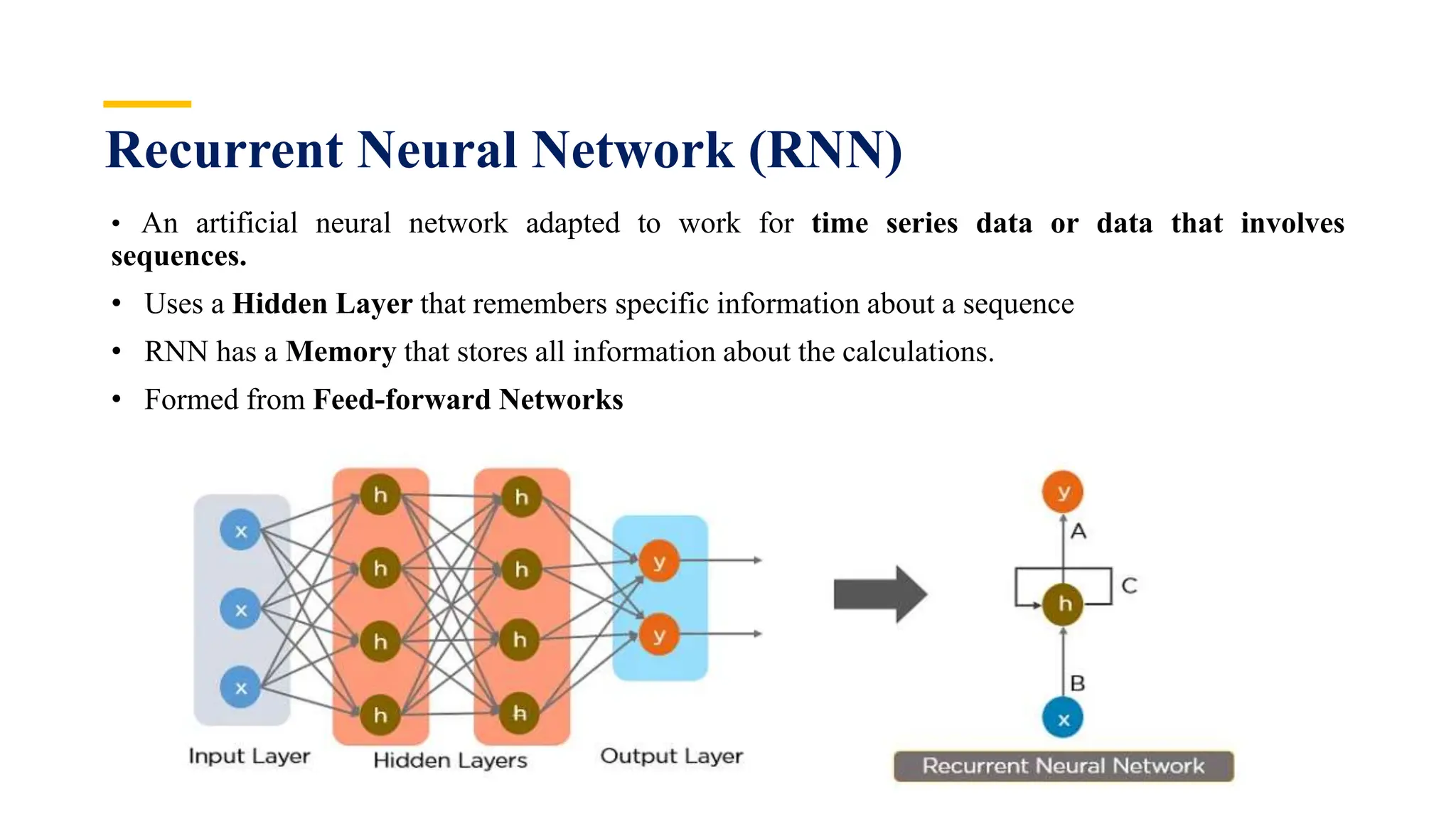
• An artificial neural network adapted to work for time series data or data that involves
sequences.
• Uses a Hidden Layer that remembers specific information about a sequence
• RNN has a Memory that stores all information about the calculations.
• Formed from Feed-forward Networks
Recurrent Neural Network (RNN)
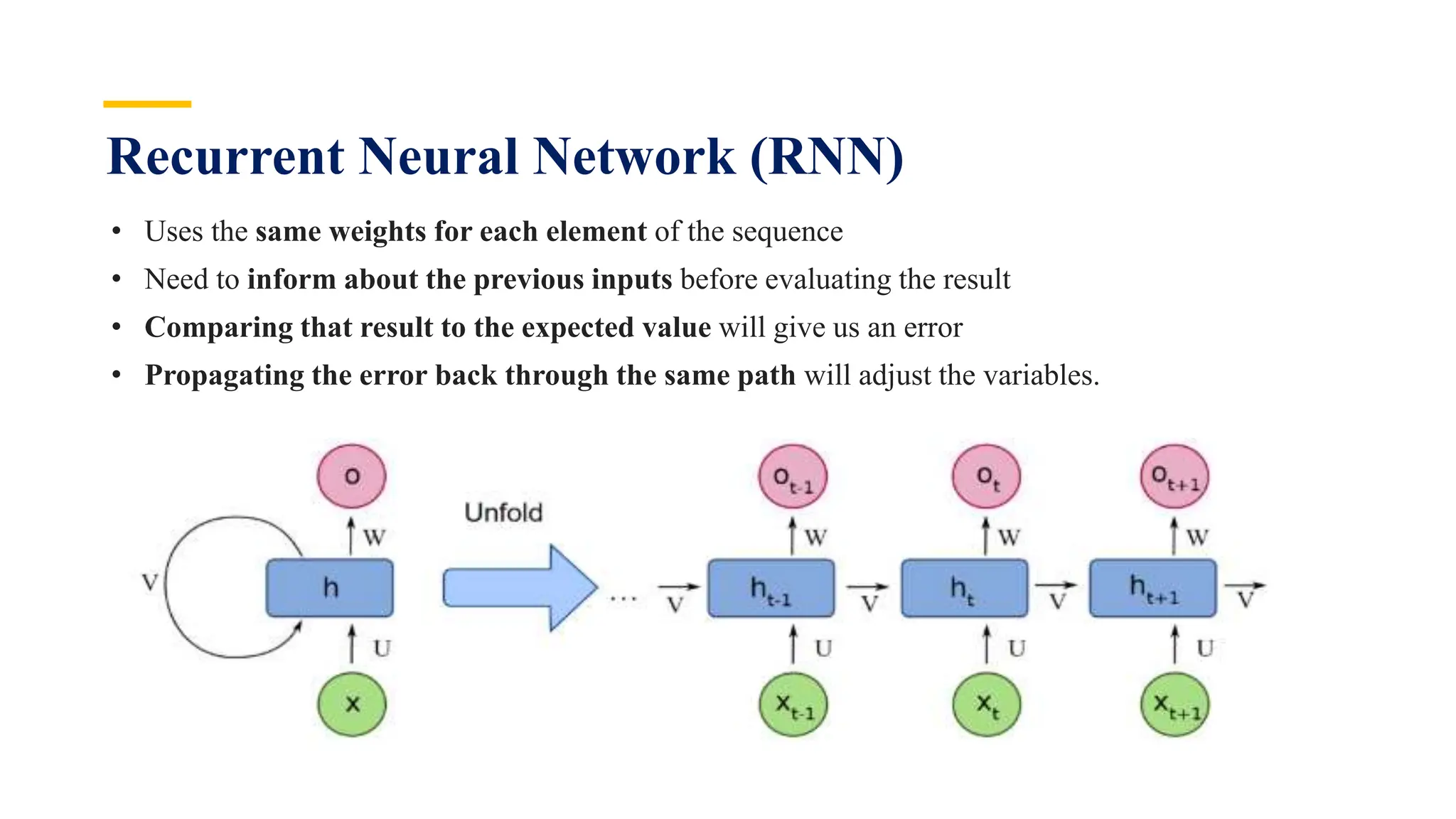
• Uses the same weights for each element of the sequence
• Need to inform about the previous inputs before evaluating the result
• Comparing that result to the expected value will give us an error
• Propagating the error back through the same path will adjust the variables.
Why Recurrent Neural Networks?
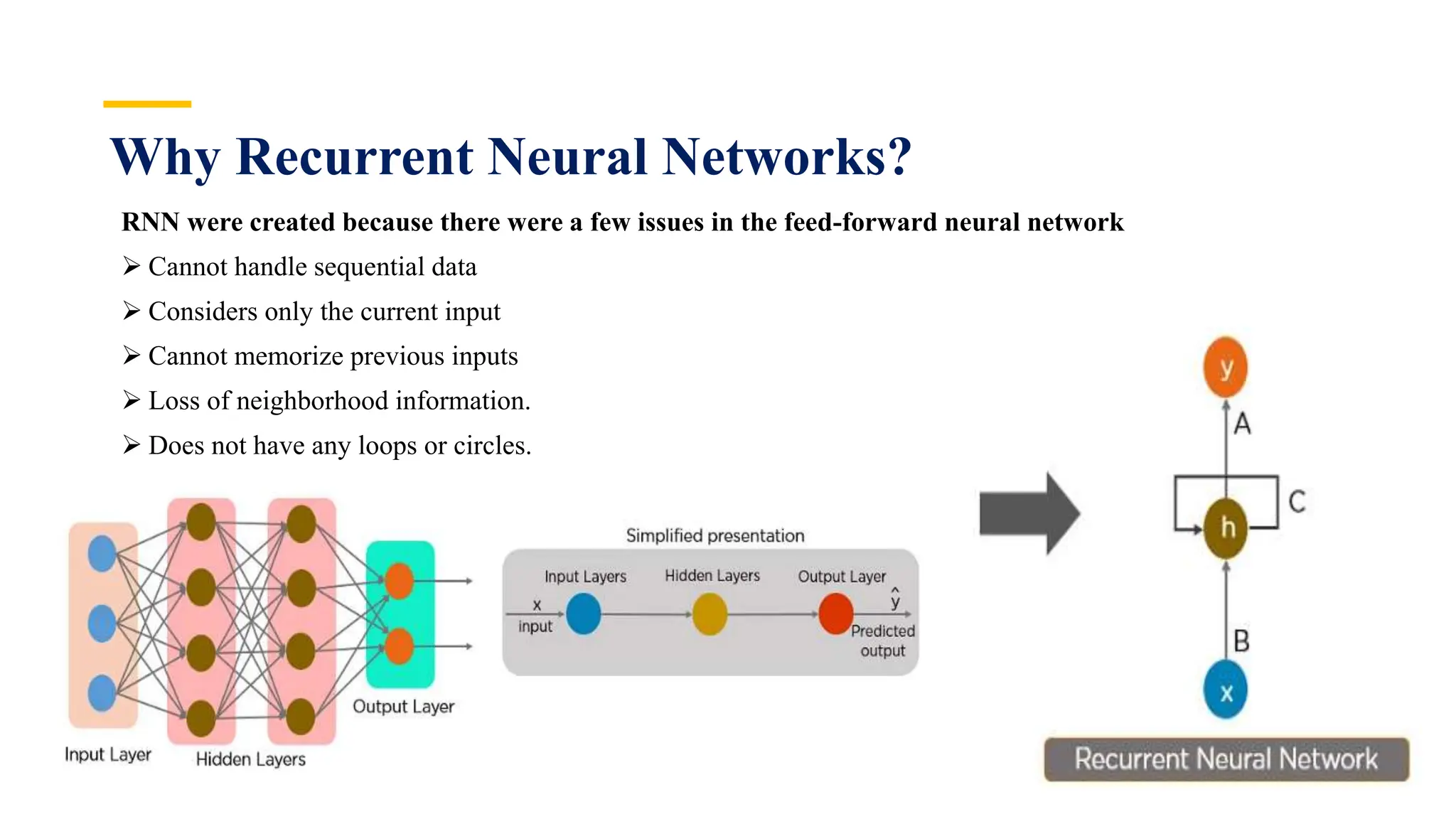
RNN were created because there were a few issues in the feed-forward neural network
 Cannot handle sequential data
 Considers only the current input
 Cannot memorize previous inputs
 Loss of neighborhood information.
 Does not have any loops or circles.
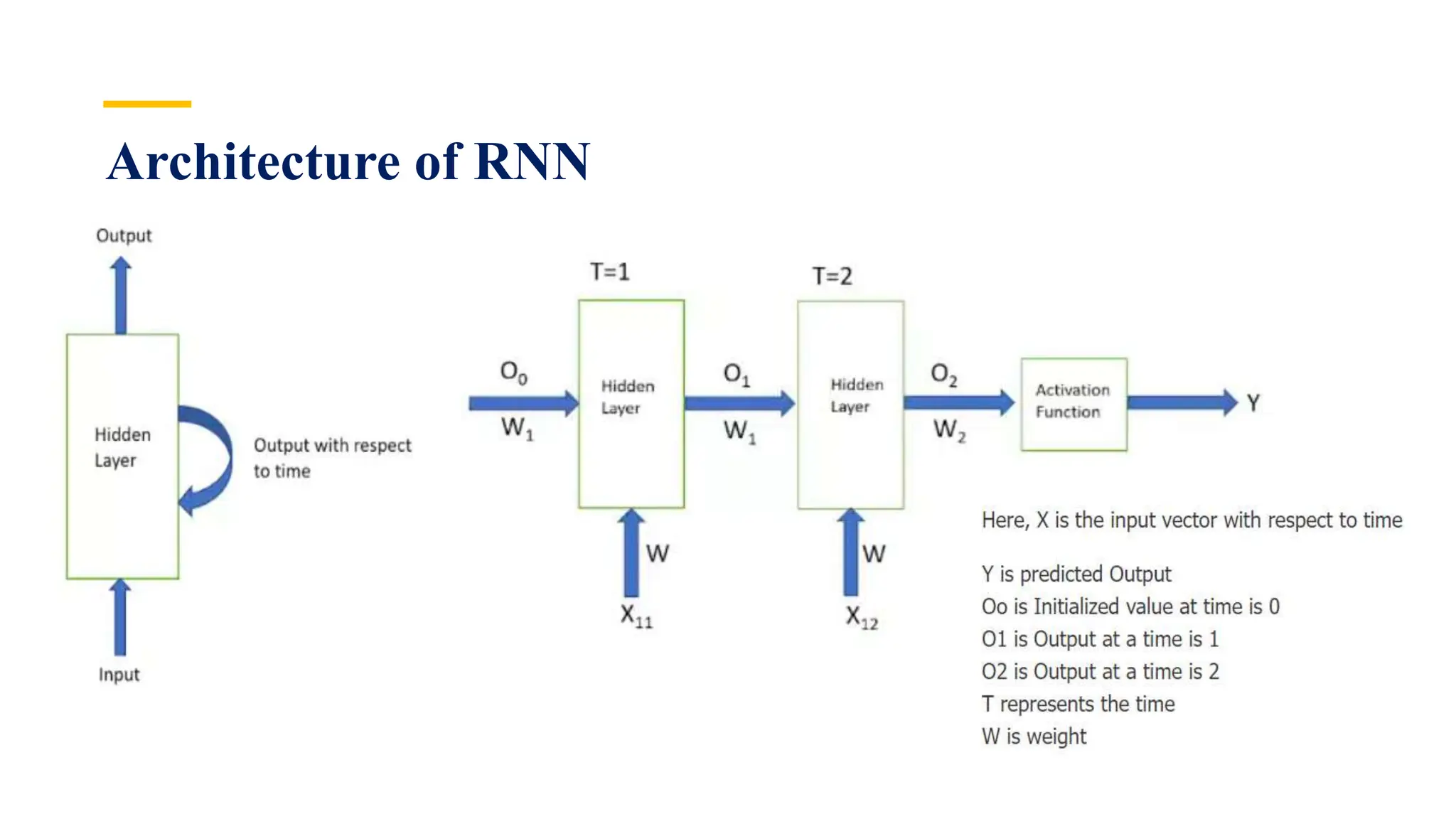
Architecture of RNN
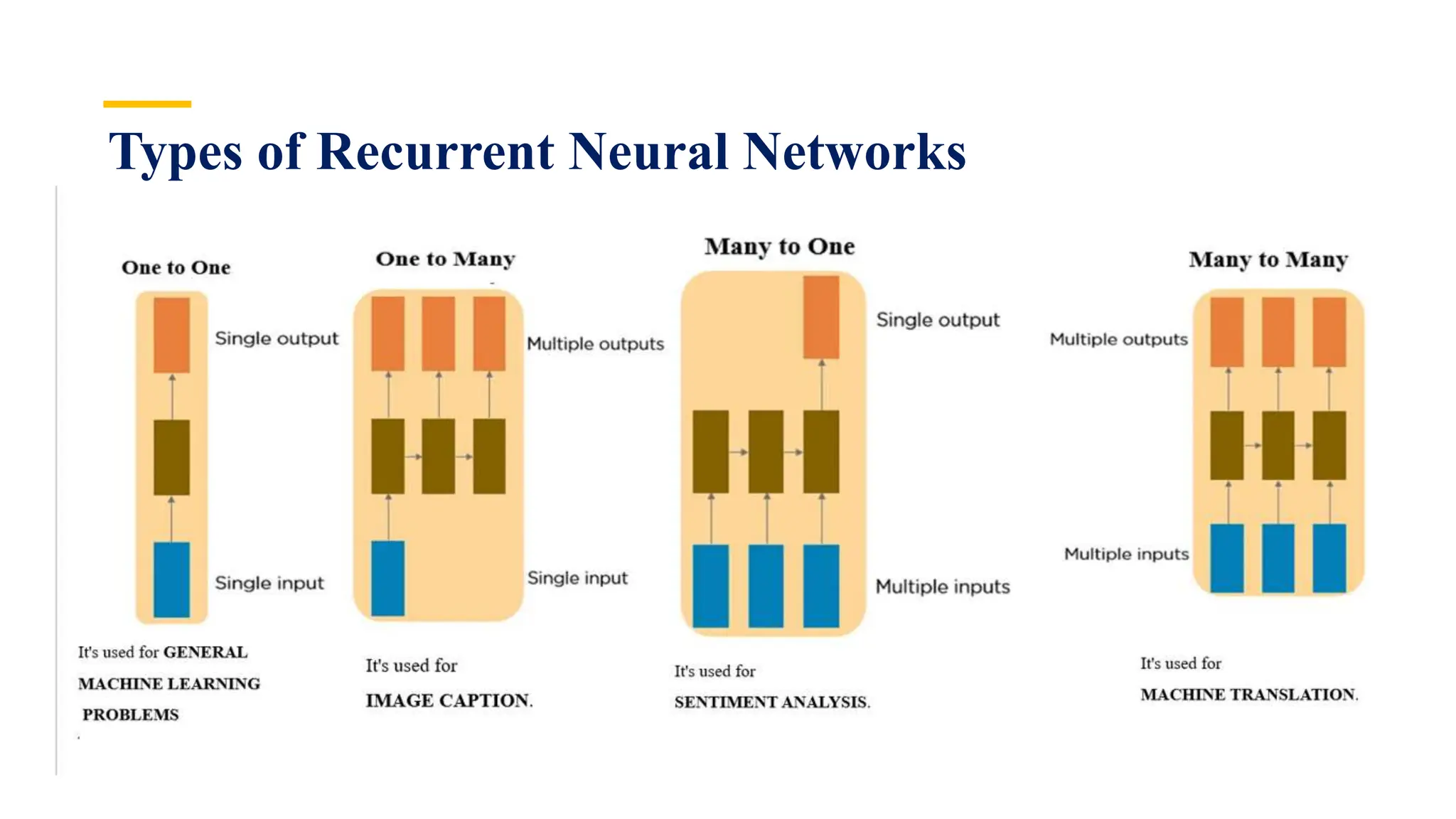
Types of Recurrent Neural Networks
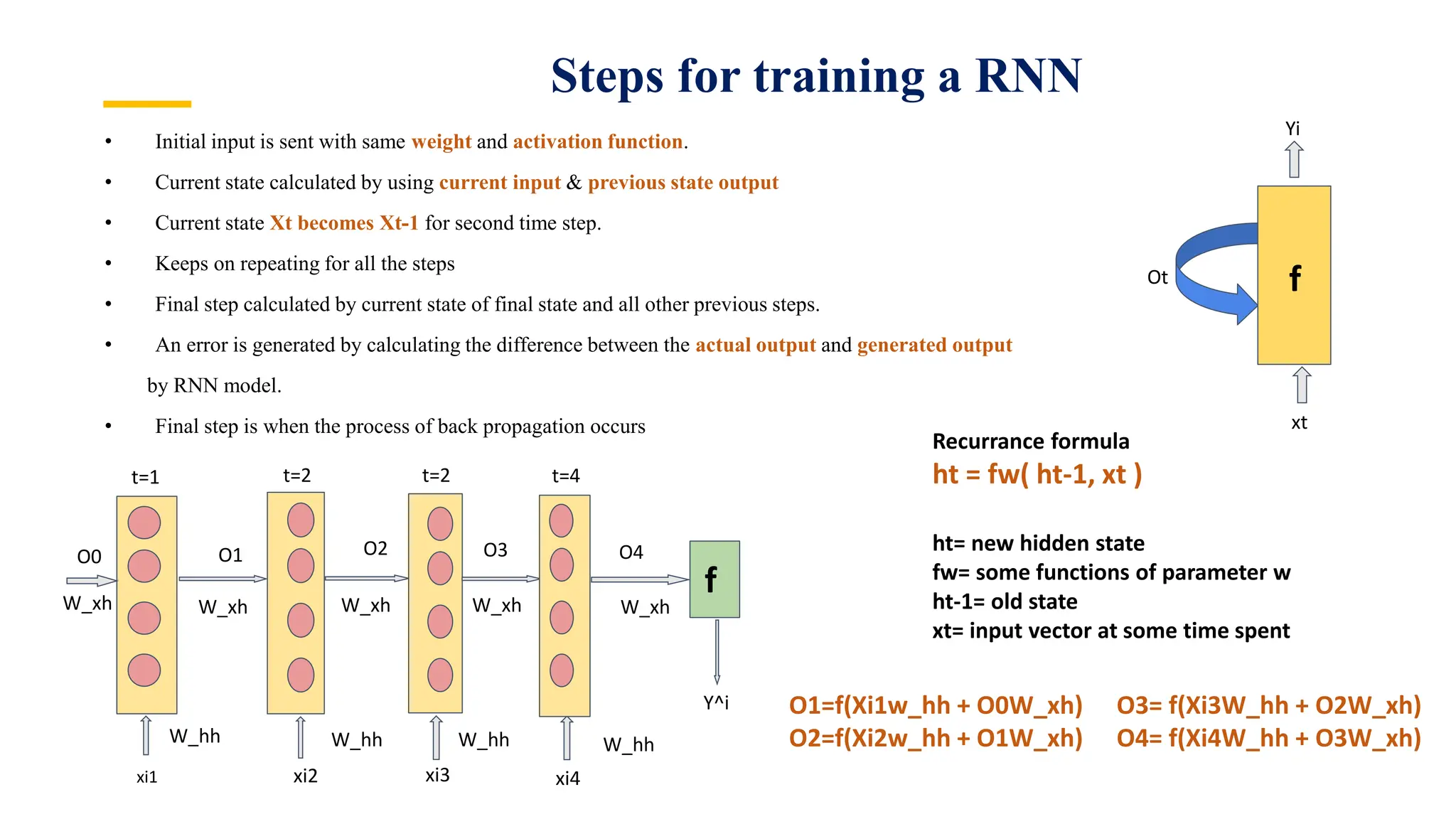
Steps for training a RNN
• Initial input is sent with same weight and activation function.
• Current state calculated by using current input & previous state output
• Current state Xt becomes Xt-1 for second time step.
• Keeps on repeating for all the steps
• Final step calculated by current state of final state and all other previous steps.
• An error is generated by calculating the difference between the actual output and generated output
by RNN model.
• Final step is when the process of back propagation occurs
xi1
O1
t=1
W_hh
xi2
O2
t=2
xi3
O3
t=2
O0
W_xh
W_hh W_hh W_hh
W_xh W_xh W_xh W_xh
f
Y^i
xi4
O4
t=4
f
Ot
xt
Yi
O1=f(Xi1w_hh + O0W_xh) O3= f(Xi3W_hh + O2W_xh)
O2=f(Xi2w_hh + O1W_xh) O4= f(Xi4W_hh + O3W_xh)
Recurrance formula
ht = fw( ht-1, xt )
ht= new hidden state
fw= some functions of parameter w
ht-1= old state
xt= input vector at some time spent
Example: Character-level Language Model
Vocabulary: [h,e,l,o]
Example training sequence: “hello”
Continued…
Vocabulary: [h,e,l,o]
At test-time sample characters
one at a time,
feed back to model
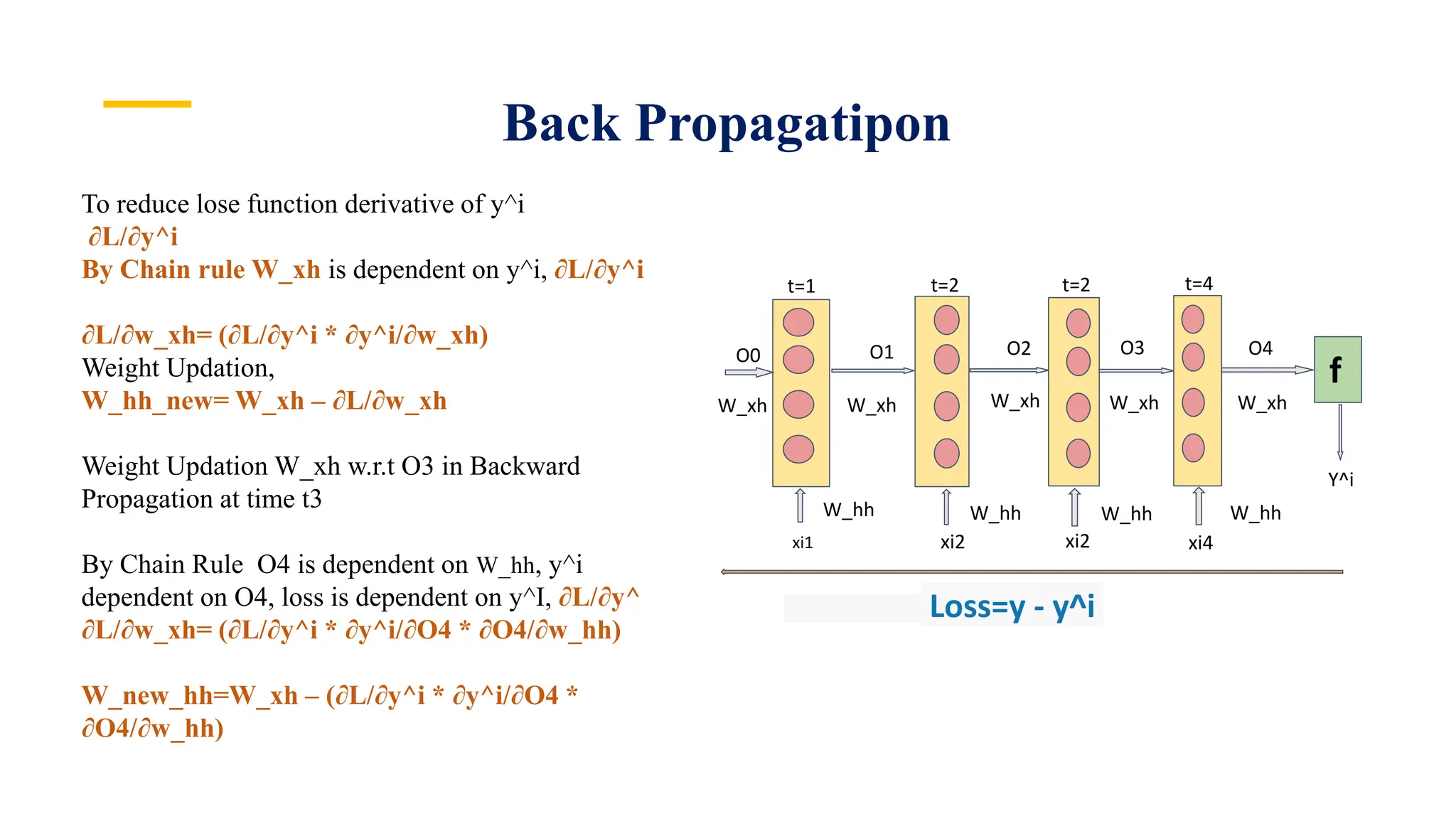
Back Propagatipon
To reduce lose function derivative of y^i
∂L/∂y^i
By Chain rule W_xh is dependent on y^i, ∂L/∂y^i
∂L/∂w_xh= (∂L/∂y^i * ∂y^i/∂w_xh)
Weight Updation,
W_hh_new= W_xh – ∂L/∂w_xh
Weight Updation W_xh w.r.t O3 in Backward
Propagation at time t3
By Chain Rule O4 is dependent on W_hh, y^i
dependent on O4, loss is dependent on y^I, ∂L/∂y^
∂L/∂w_xh= (∂L/∂y^i * ∂y^i/∂O4 * ∂O4/∂w_hh)
W_new_hh=W_xh – (∂L/∂y^i * ∂y^i/∂O4 *
∂O4/∂w_hh)
Loss=y - y^i
xi1
O1
t=1
W_hh
xi2
O2
t=2
xi2
O3
t=2
f
Y^i
xi4
O4
t=4
O0
W_xh W_xh W_xh W_xh W_xh
W_hh W_hh W_hh
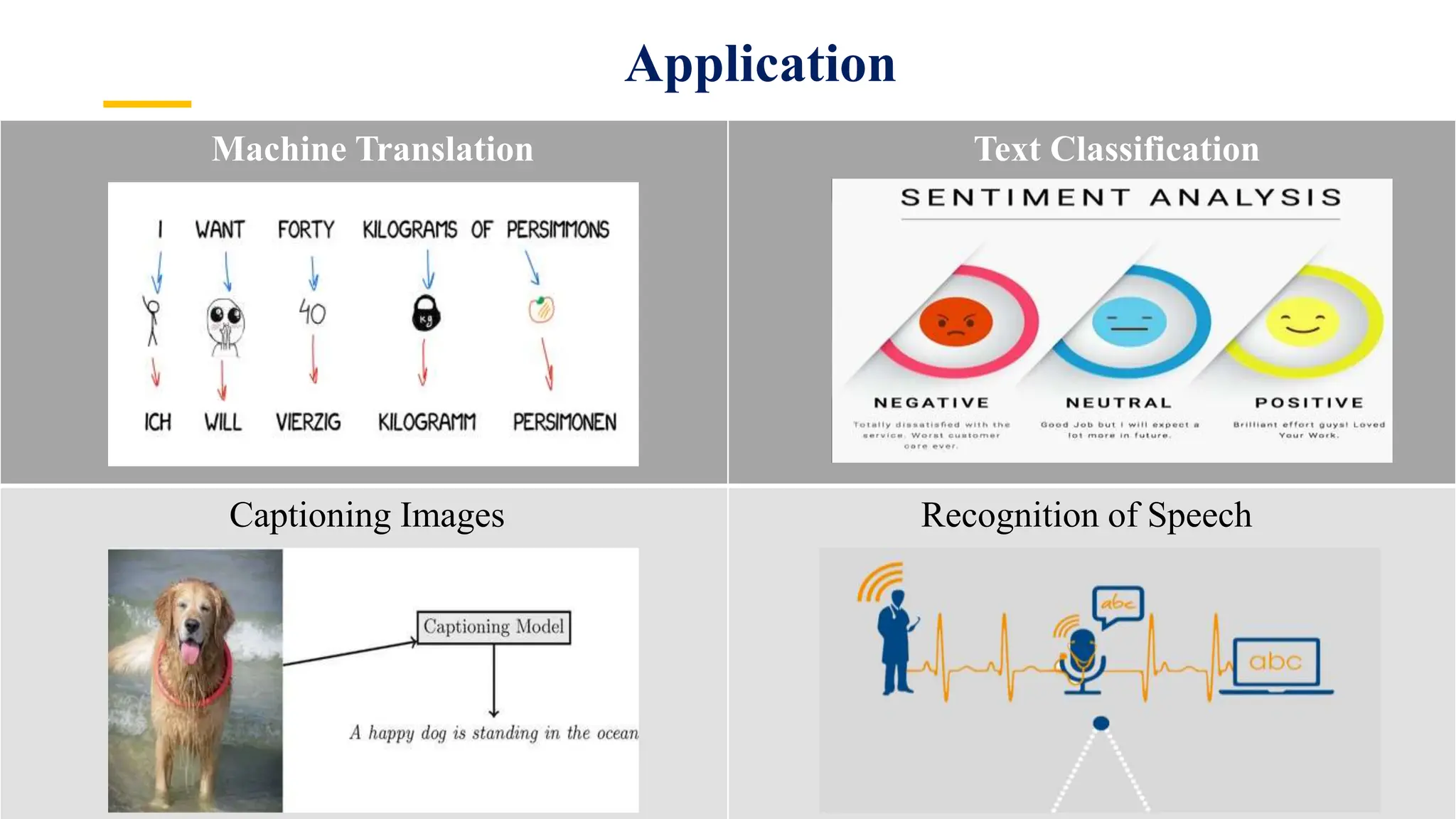
Application
Machine Translation Text Classification
Captioning Images Recognition of Speech
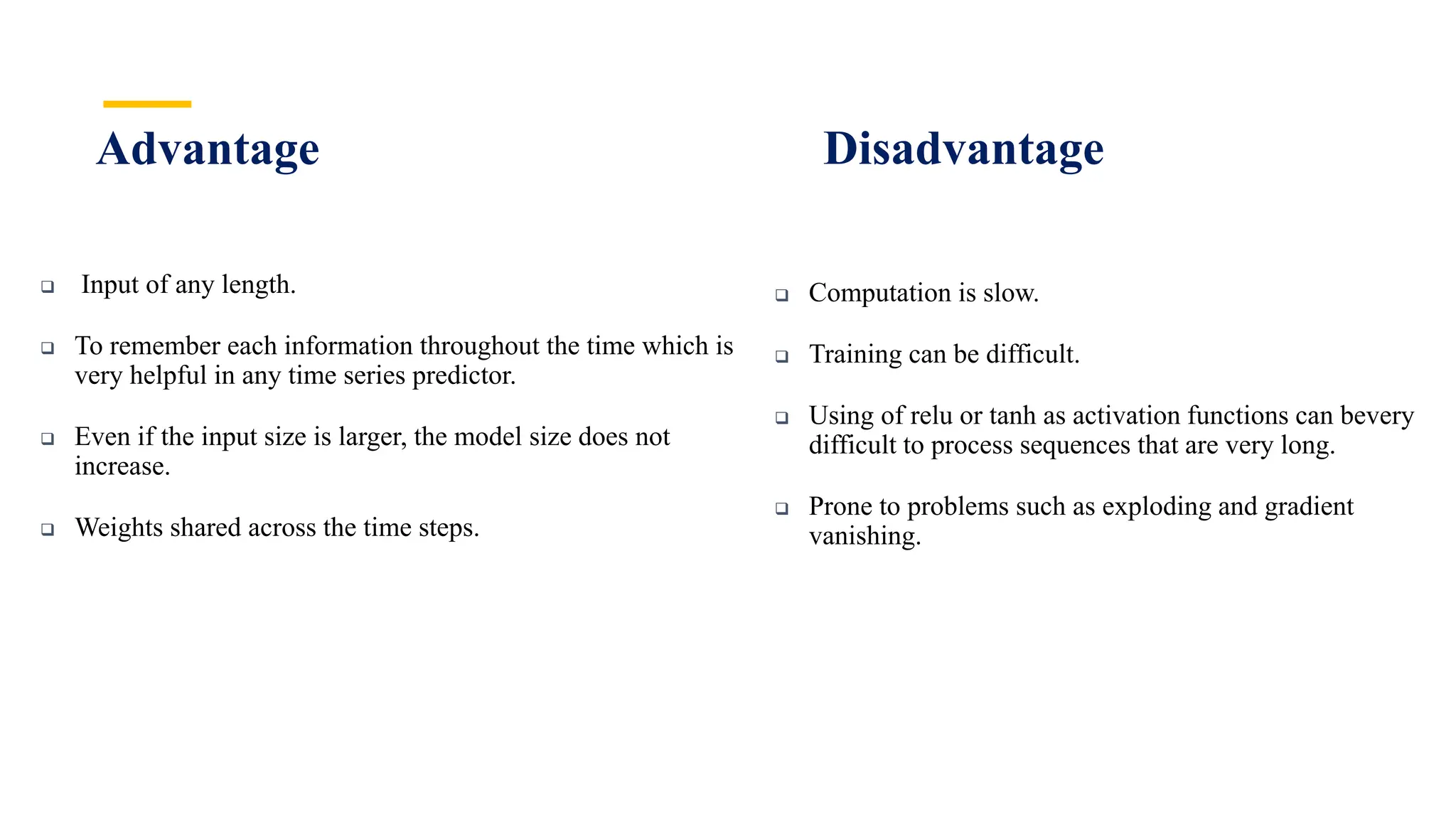
Advantage
 Computation is slow.
 Training can be difficult.
 Using of relu or tanh as activation functions can bevery
difficult to process sequences that are very long.
 Prone to problems such as exploding and gradient
vanishing.
 Input of any length.
 To remember each information throughout the time which is
very helpful in any time series predictor.
 Even if the input size is larger, the model size does not
increase.
 Weights shared across the time steps.
Disadvantage
Vanishing & Exploding
Gradient
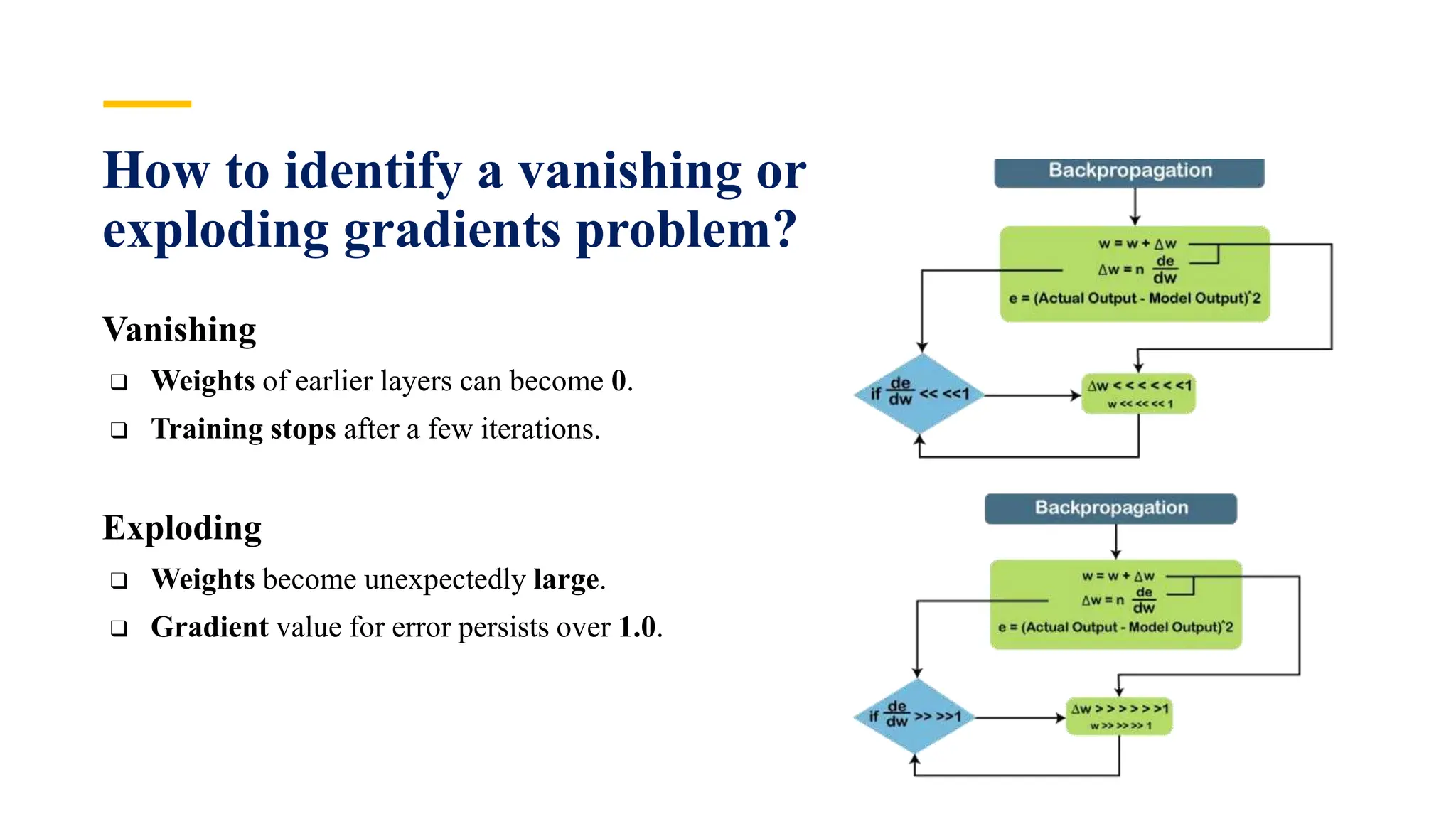
How to identify a vanishing or
exploding gradients problem?
Vanishing
❑ Weights of earlier layers can become 0.
❑ Training stops after a few iterations.
Exploding
❑ Weights become unexpectedly large.
❑ Gradient value for error persists over 1.0.
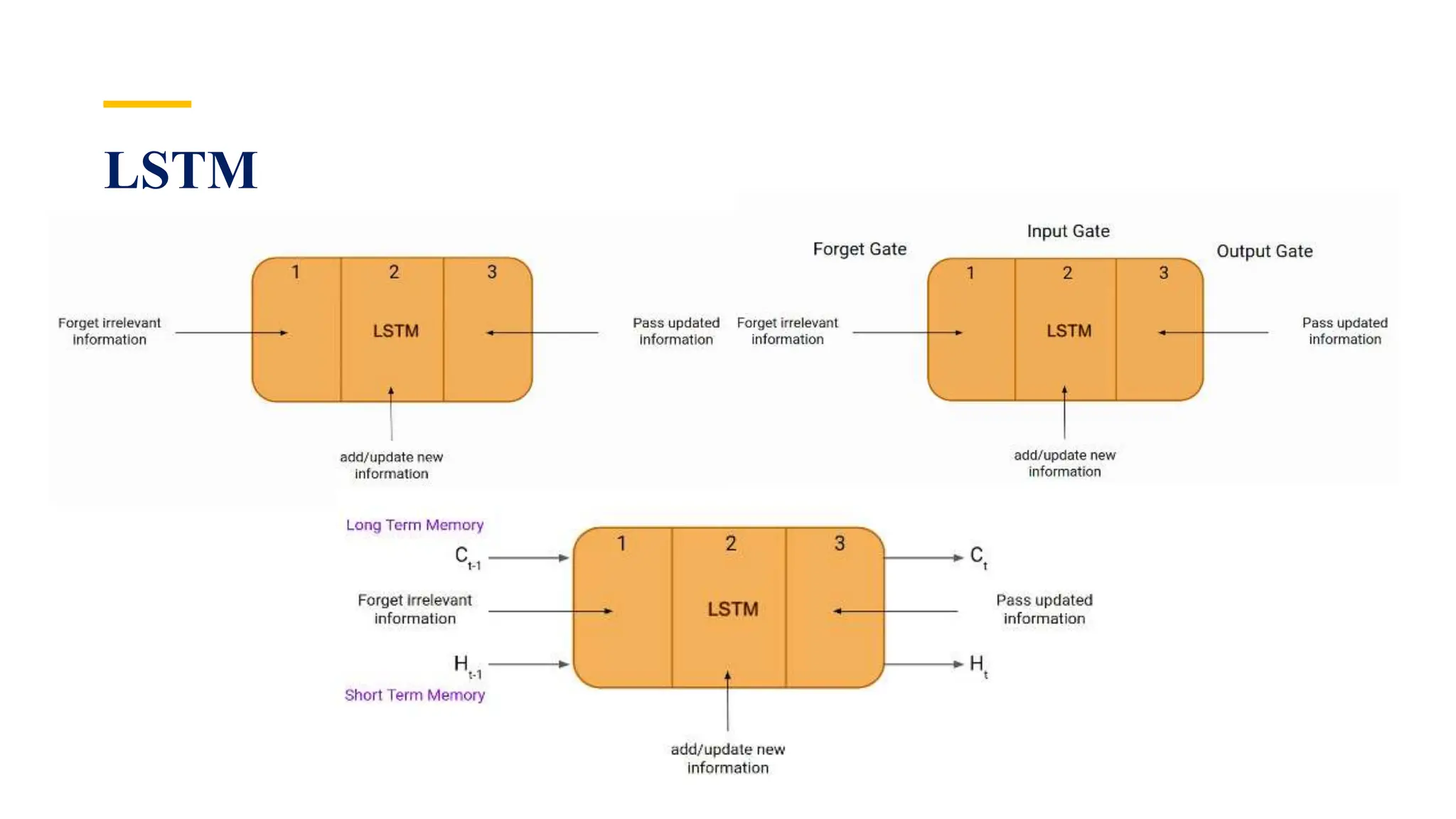
LSTM
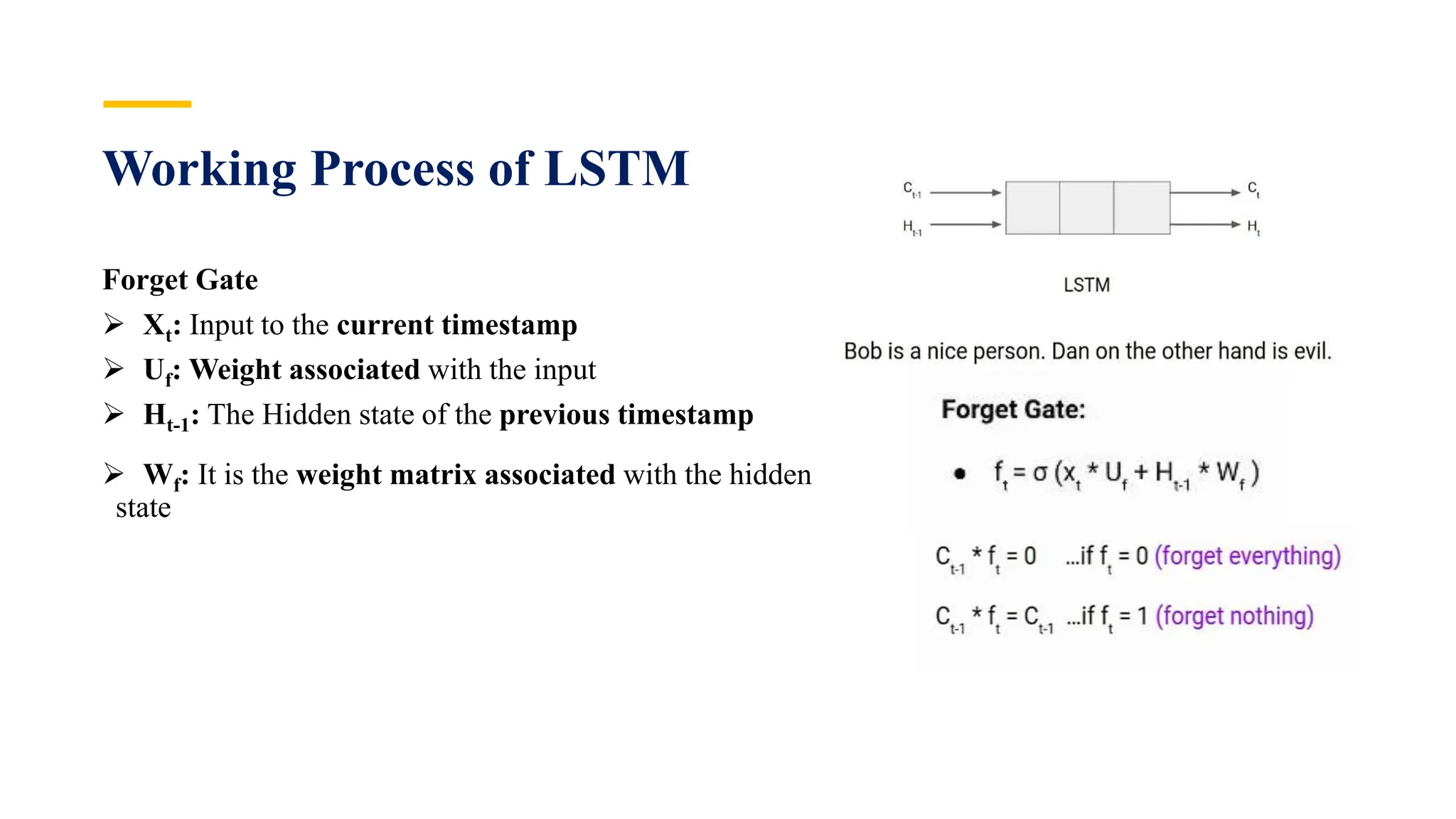
Working Process of LSTM
Forget Gate
 Xt: Input to the current timestamp
 Uf: Weight associated with the input
 Ht-1: The Hidden state of the previous timestamp
 Wf: It is the weight matrix associated with the hidden
state
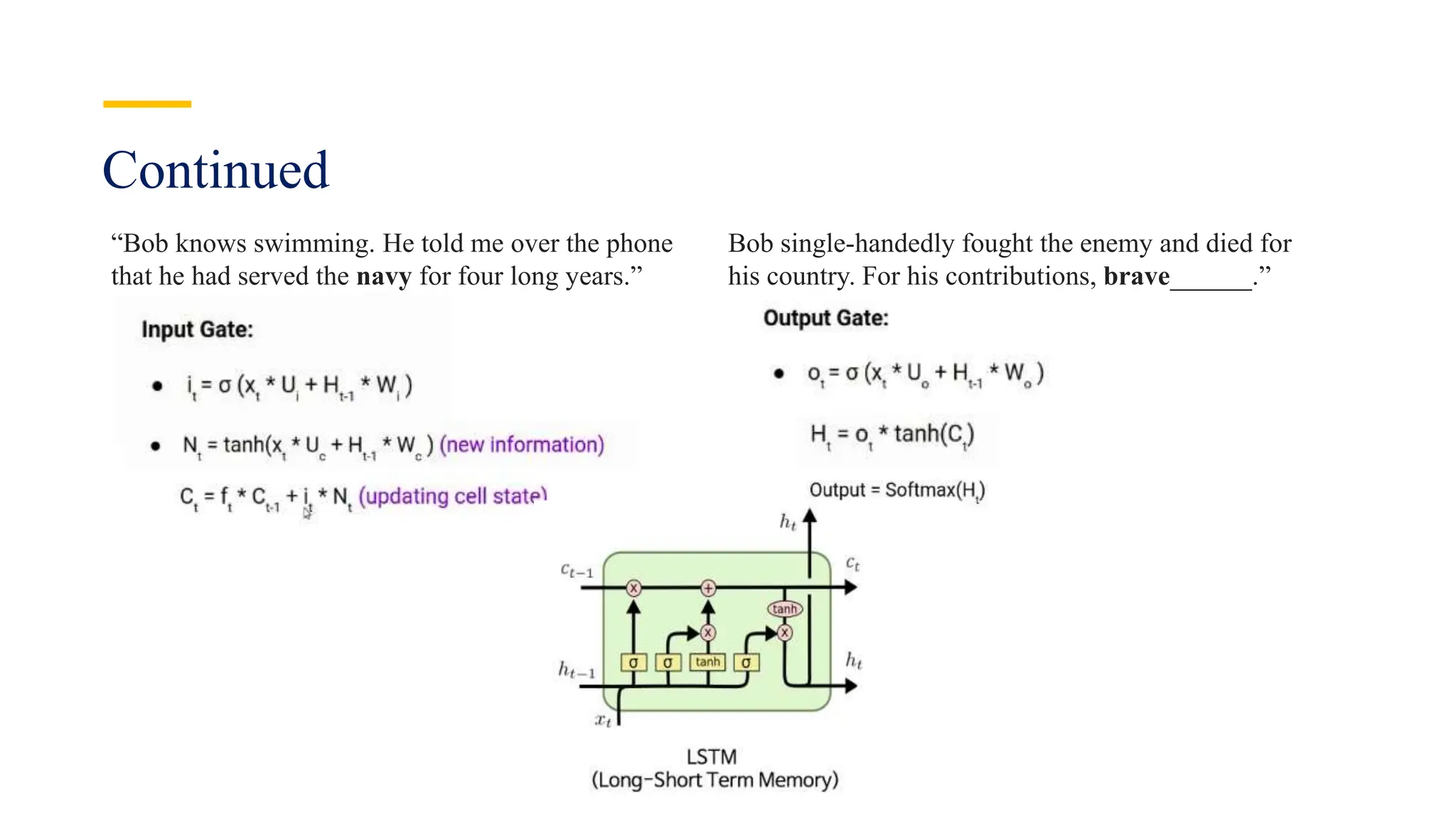
Continued
“Bob knows swimming. He told me over the phone
that he had served the navy for four long years.”
Bob single-handedly fought the enemy and died for
his country. For his contributions, brave______.”
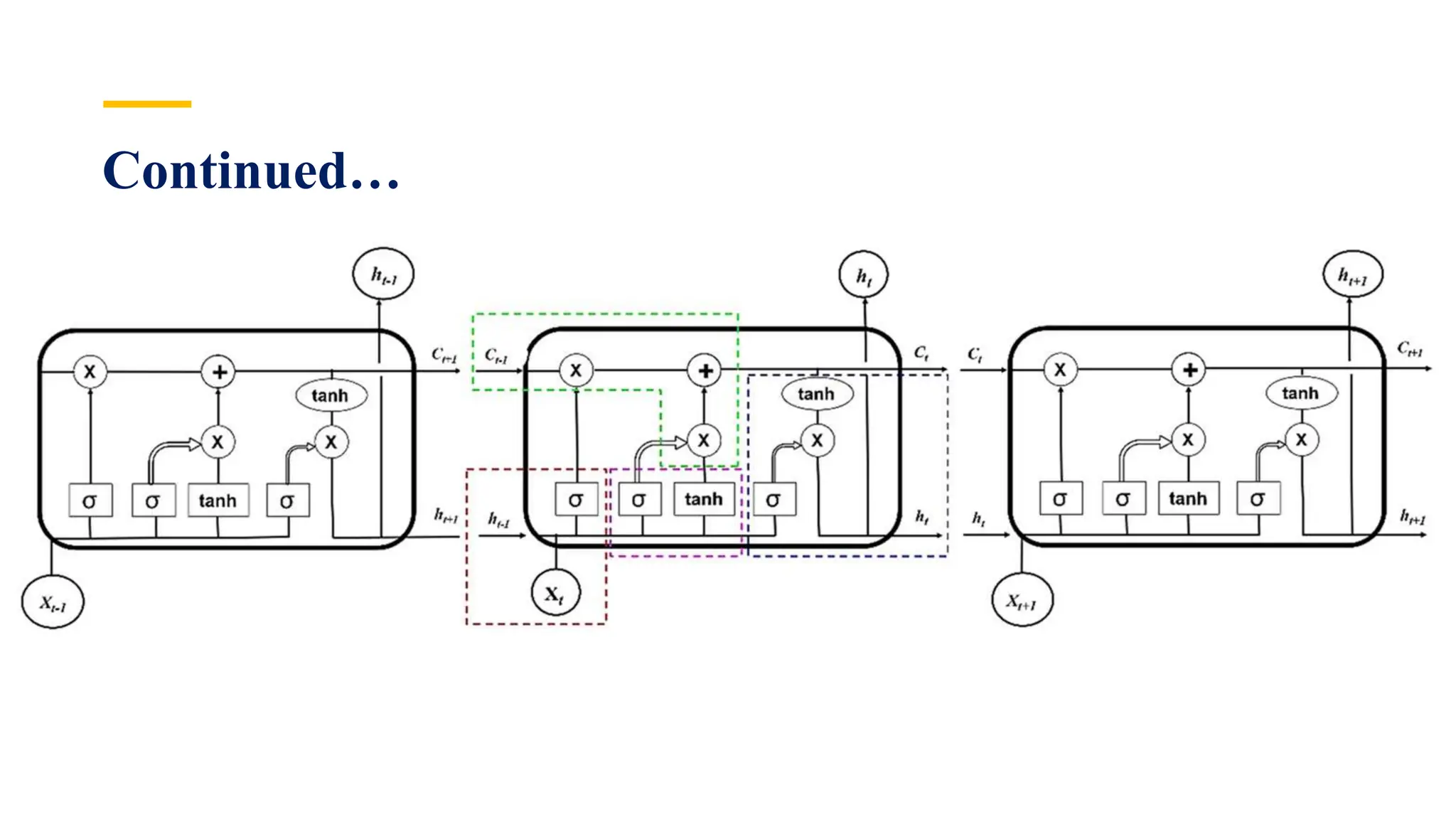
Continued…
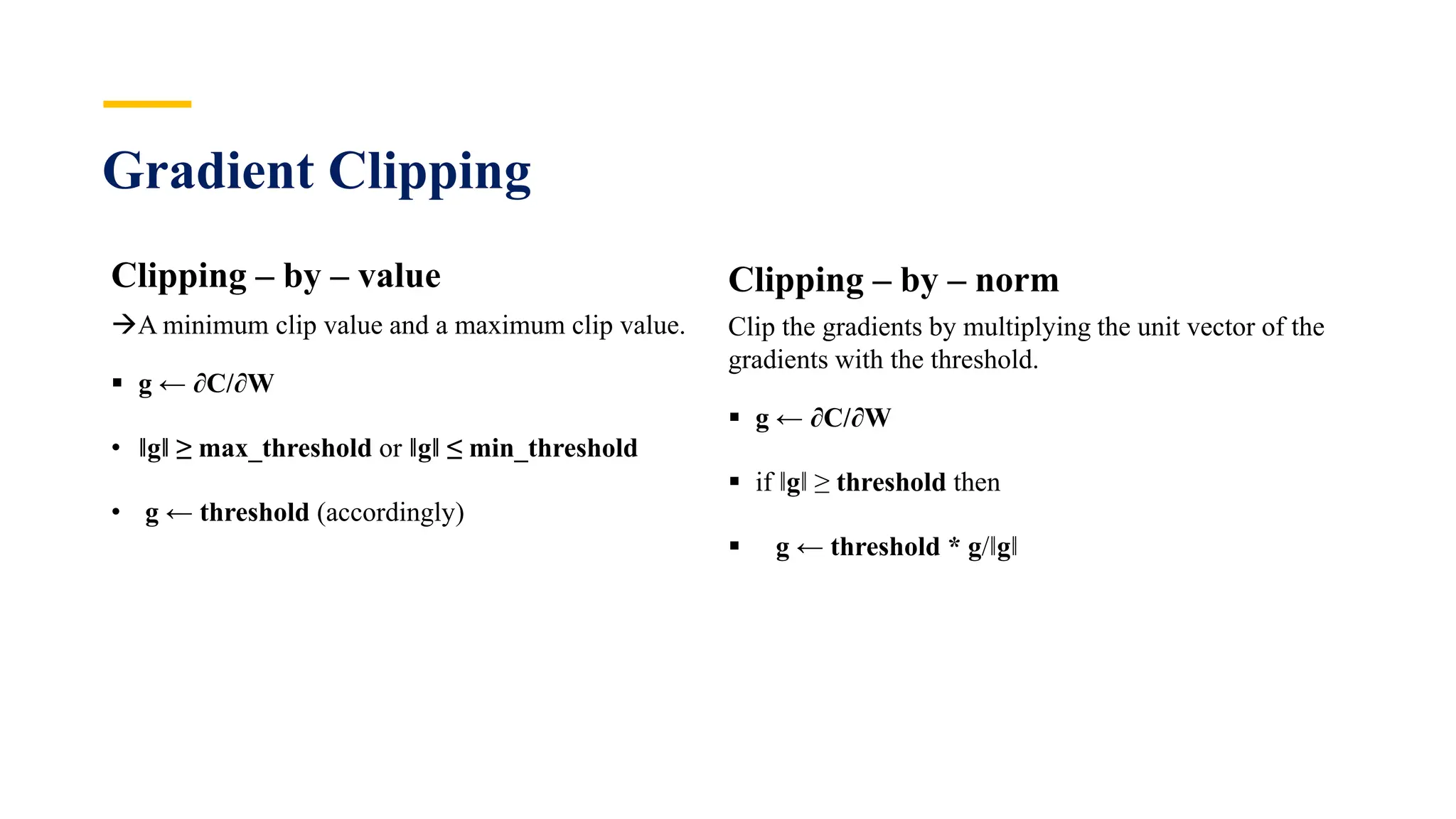
Gradient Clipping
Clipping – by – value
A minimum clip value and a maximum clip value.
 g ← ∂C/∂W
• ‖g‖ ≥ max_threshold or ‖g‖ ≤ min_threshold
• g ← threshold (accordingly)
Clipping – by – norm
Clip the gradients by multiplying the unit vector of the
gradients with the threshold.
 g ← ∂C/∂W
 if ‖g‖ ≥ threshold then
 g ← threshold * g/‖g‖
Thank You

Recurrent Neural Networks (RNNs)

  • 2.
    Recurrent Neural Network(RNN) • An artificial neural network adapted to work for time series data or data that involves sequences. • Uses a Hidden Layer that remembers specific information about a sequence • RNN has a Memory that stores all information about the calculations. • Formed from Feed-forward Networks
  • 3.
    Recurrent Neural Network(RNN) • Uses the same weights for each element of the sequence • Need to inform about the previous inputs before evaluating the result • Comparing that result to the expected value will give us an error • Propagating the error back through the same path will adjust the variables.
  • 4.
    Why Recurrent NeuralNetworks? RNN were created because there were a few issues in the feed-forward neural network  Cannot handle sequential data  Considers only the current input  Cannot memorize previous inputs  Loss of neighborhood information.  Does not have any loops or circles.
  • 5.
  • 6.
    Types of RecurrentNeural Networks
  • 7.
    Steps for traininga RNN • Initial input is sent with same weight and activation function. • Current state calculated by using current input & previous state output • Current state Xt becomes Xt-1 for second time step. • Keeps on repeating for all the steps • Final step calculated by current state of final state and all other previous steps. • An error is generated by calculating the difference between the actual output and generated output by RNN model. • Final step is when the process of back propagation occurs xi1 O1 t=1 W_hh xi2 O2 t=2 xi3 O3 t=2 O0 W_xh W_hh W_hh W_hh W_xh W_xh W_xh W_xh f Y^i xi4 O4 t=4 f Ot xt Yi O1=f(Xi1w_hh + O0W_xh) O3= f(Xi3W_hh + O2W_xh) O2=f(Xi2w_hh + O1W_xh) O4= f(Xi4W_hh + O3W_xh) Recurrance formula ht = fw( ht-1, xt ) ht= new hidden state fw= some functions of parameter w ht-1= old state xt= input vector at some time spent
  • 8.
    Example: Character-level LanguageModel Vocabulary: [h,e,l,o] Example training sequence: “hello”
  • 9.
    Continued… Vocabulary: [h,e,l,o] At test-timesample characters one at a time, feed back to model
  • 10.
    Back Propagatipon To reducelose function derivative of y^i ∂L/∂y^i By Chain rule W_xh is dependent on y^i, ∂L/∂y^i ∂L/∂w_xh= (∂L/∂y^i * ∂y^i/∂w_xh) Weight Updation, W_hh_new= W_xh – ∂L/∂w_xh Weight Updation W_xh w.r.t O3 in Backward Propagation at time t3 By Chain Rule O4 is dependent on W_hh, y^i dependent on O4, loss is dependent on y^I, ∂L/∂y^ ∂L/∂w_xh= (∂L/∂y^i * ∂y^i/∂O4 * ∂O4/∂w_hh) W_new_hh=W_xh – (∂L/∂y^i * ∂y^i/∂O4 * ∂O4/∂w_hh) Loss=y - y^i xi1 O1 t=1 W_hh xi2 O2 t=2 xi2 O3 t=2 f Y^i xi4 O4 t=4 O0 W_xh W_xh W_xh W_xh W_xh W_hh W_hh W_hh
  • 11.
    Application Machine Translation TextClassification Captioning Images Recognition of Speech
  • 12.
    Advantage  Computation isslow.  Training can be difficult.  Using of relu or tanh as activation functions can bevery difficult to process sequences that are very long.  Prone to problems such as exploding and gradient vanishing.  Input of any length.  To remember each information throughout the time which is very helpful in any time series predictor.  Even if the input size is larger, the model size does not increase.  Weights shared across the time steps. Disadvantage
  • 13.
  • 14.
    How to identifya vanishing or exploding gradients problem? Vanishing ❑ Weights of earlier layers can become 0. ❑ Training stops after a few iterations. Exploding ❑ Weights become unexpectedly large. ❑ Gradient value for error persists over 1.0.
  • 15.
  • 16.
    Working Process ofLSTM Forget Gate  Xt: Input to the current timestamp  Uf: Weight associated with the input  Ht-1: The Hidden state of the previous timestamp  Wf: It is the weight matrix associated with the hidden state
  • 17.
    Continued “Bob knows swimming.He told me over the phone that he had served the navy for four long years.” Bob single-handedly fought the enemy and died for his country. For his contributions, brave______.”
  • 18.
  • 19.
    Gradient Clipping Clipping –by – value A minimum clip value and a maximum clip value.  g ← ∂C/∂W • ‖g‖ ≥ max_threshold or ‖g‖ ≤ min_threshold • g ← threshold (accordingly) Clipping – by – norm Clip the gradients by multiplying the unit vector of the gradients with the threshold.  g ← ∂C/∂W  if ‖g‖ ≥ threshold then  g ← threshold * g/‖g‖
  • 20.