


Natural Language
Processing(NLP)
• What is NLP?
• Input and Output of NLP
• NLP Tools
• Components of NLP
• Broad Classification of NLP
• Natural Language Understanding (NLU)
• Natural Language Generation (NLG)
• Difficulties in NLU
• Steps of NLP
• Context Free Grammar
• Top-Down Parser
• Benefits of NLP
• Why NLP matters?
• How NLP works?
• Challenges of NLP
• NLP Pipeline
• Real World Applications of NLP
• Recent Developments in NLP
• Conclusion
• References
Outlines
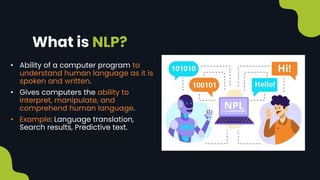
• Ability of a computer program to
understand human language as it is
spoken and written.
• Gives computers the ability to
interpret, manipulate, and
comprehend human language.
• Example: Language translation,
Search results, Predictive text.
What is NLP?
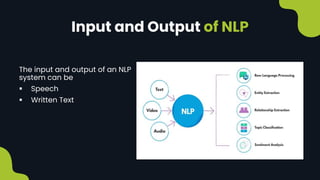
The input and output of an NLP
system can be
 Speech
 Written Text
Input and Output of NLP
NLP Tools:
MonkeyLearn:
• platform for text analysis, allowing users to get
actionable data from text.
• provides instant data visualizations and detailed insights
for when customers want to run analysis on their data.
• Customers can choose from a selection of ready-
machine machine learning models or build and train
their own.
OpenAI:
• used for NLP tasks such as text classification, sentiment
analysis, language translation, text generation, and
question answering.
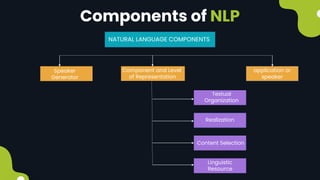
NATURAL LANGUAGE COMPONENTS
Speaker
Generator
Component and Level
of Representation
application or
speaker
Textual
Organization
Realization
Content Selection
Linguistic
Resource
Components of NLP
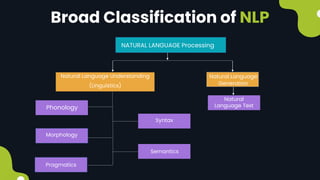
NATURAL LANGUAGE Processing
Natural Language Understanding
(Linguistics)
Natural
Language Text
Phonology
Morphology
Pragmatics
Syntax
Semantics
Natural Language
Generation
Broad Classification of NLP
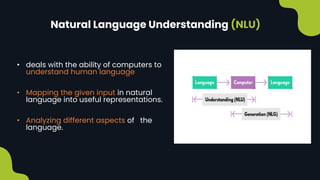
Natural Language Understanding (NLU)
• deals with the ability of computers to
understand human language
• Mapping the given input in natural
language into useful representations.
• Analyzing different aspects of the
language.
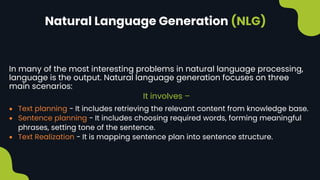
Natural Language Generation (NLG)
In many of the most interesting problems in natural language processing,
language is the output. Natural language generation focuses on three
main scenarios:
It involves –
 Text planning − It includes retrieving the relevant content from knowledge base.
 Sentence planning − It includes choosing required words, forming meaningful
phrases, setting tone of the sentence.
 Text Realization − It is mapping sentence plan into sentence structure.
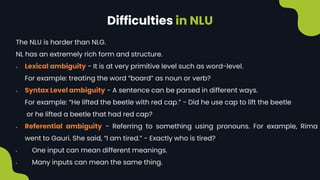
Difficulties in NLU
The NLU is harder than NLG.
NL has an extremely rich form and structure.
 Lexical ambiguity − It is at very primitive level such as word-level.
For example: treating the word “board” as noun or verb?
 Syntax Level ambiguity − A sentence can be parsed in different ways.
For example: “He lifted the beetle with red cap.” − Did he use cap to lift the beetle
or he lifted a beetle that had red cap?
 Referential ambiguity − Referring to something using pronouns. For example, Rima
went to Gauri. She said, “I am tired.” − Exactly who is tired?
• One input can mean different meanings.
• Many inputs can mean the same thing.
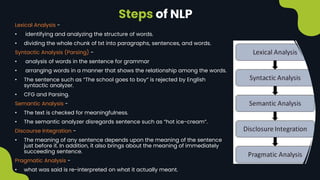
Steps of NLP
Lexical Analysis −
• identifying and analyzing the structure of words.
• dividing the whole chunk of txt into paragraphs, sentences, and words.
Syntactic Analysis (Parsing) −
• analysis of words in the sentence for grammar
• arranging words in a manner that shows the relationship among the words.
• The sentence such as “The school goes to boy” is rejected by English
syntactic analyzer.
• CFG and Parsing.
Semantic Analysis −
• The text is checked for meaningfulness.
• The semantic analyzer disregards sentence such as “hot ice-cream”.
Discourse Integration −
• The meaning of any sentence depends upon the meaning of the sentence
just before it. In addition, it also brings about the meaning of immediately
succeeding sentence.
Pragmatic Analysis −
• what was said is re-interpreted on what it actually meant.
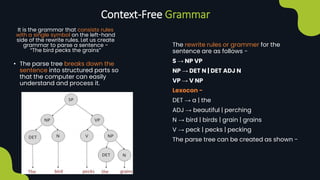
Context-Free Grammar
The rewrite rules or grammer for the
sentence are as follows −
S → NP VP
NP → DET N | DET ADJ N
VP → V NP
Lexocon −
DET → a | the
ADJ → beautiful | perching
N → bird | birds | grain | grains
V → peck | pecks | pecking
The parse tree can be created as shown −
It is the grammar that consists rules
with a single symbol on the left-hand
side of the rewrite rules. Let us create
grammar to parse a sentence −
“The bird pecks the grains”
• The parse tree breaks down the
sentence into structured parts so
that the computer can easily
understand and process it.
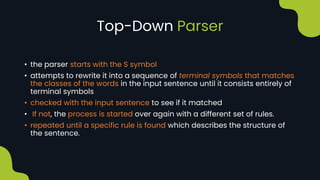
Top-Down Parser
• the parser starts with the S symbol
• attempts to rewrite it into a sequence of terminal symbols that matches
the classes of the words in the input sentence until it consists entirely of
terminal symbols
• checked with the input sentence to see if it matched
• If not, the process is started over again with a different set of rules.
• repeated until a specific rule is found which describes the structure of
the sentence.
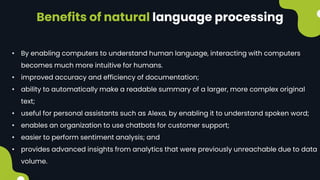
Benefits of natural language processing
• By enabling computers to understand human language, interacting with computers
becomes much more intuitive for humans.
• improved accuracy and efficiency of documentation;
• ability to automatically make a readable summary of a larger, more complex original
text;
• useful for personal assistants such as Alexa, by enabling it to understand spoken word;
• enables an organization to use chatbots for customer support;
• easier to perform sentiment analysis; and
• provides advanced insights from analytics that were previously unreachable due to data
volume.
Why NLP matters?
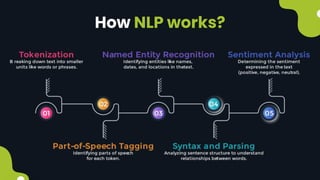
How NLP works?
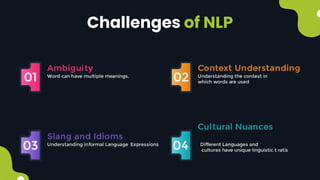
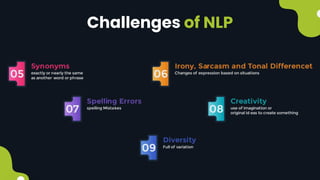
Challenges of NLP
Challenges of NLP
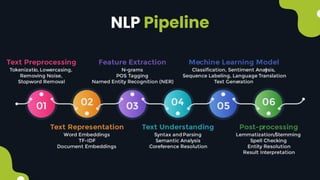
NLP Pipeline
Real World Application
Recent Developments in NLP
Conclusion
In conclusion, Natural Language Processing is revolutionizing the way
we interact with technology. Its applications are diverse and its
potential is vast. As we move forward, it's crucial to embrace and
understand the power of NLP in shaping the future of human-
computer interaction. Thank you for your attention! I'm happy to
answer any questions you may have.
References:
 https://link.springer.com/article/10.1007/s11042-022-
13428-4
 https://youtube.com/playlist?list=PLKnIA16_RmvZo7fp
5kkIth6nRTeQQsjfX&si=IgmSr1Imq37609W1
Thank You!

Natural Language Processing (NLP)

  • 1.
  • 2.
    • What isNLP? • Input and Output of NLP • NLP Tools • Components of NLP • Broad Classification of NLP • Natural Language Understanding (NLU) • Natural Language Generation (NLG) • Difficulties in NLU • Steps of NLP • Context Free Grammar • Top-Down Parser • Benefits of NLP • Why NLP matters? • How NLP works? • Challenges of NLP • NLP Pipeline • Real World Applications of NLP • Recent Developments in NLP • Conclusion • References Outlines
  • 3.
    • Ability ofa computer program to understand human language as it is spoken and written. • Gives computers the ability to interpret, manipulate, and comprehend human language. • Example: Language translation, Search results, Predictive text. What is NLP?
  • 4.
    The input andoutput of an NLP system can be  Speech  Written Text Input and Output of NLP
  • 5.
    NLP Tools: MonkeyLearn: • platformfor text analysis, allowing users to get actionable data from text. • provides instant data visualizations and detailed insights for when customers want to run analysis on their data. • Customers can choose from a selection of ready- machine machine learning models or build and train their own. OpenAI: • used for NLP tasks such as text classification, sentiment analysis, language translation, text generation, and question answering.
  • 6.
    NATURAL LANGUAGE COMPONENTS Speaker Generator Componentand Level of Representation application or speaker Textual Organization Realization Content Selection Linguistic Resource Components of NLP
  • 7.
    NATURAL LANGUAGE Processing NaturalLanguage Understanding (Linguistics) Natural Language Text Phonology Morphology Pragmatics Syntax Semantics Natural Language Generation Broad Classification of NLP
  • 8.
    Natural Language Understanding(NLU) • deals with the ability of computers to understand human language • Mapping the given input in natural language into useful representations. • Analyzing different aspects of the language.
  • 9.
    Natural Language Generation(NLG) In many of the most interesting problems in natural language processing, language is the output. Natural language generation focuses on three main scenarios: It involves –  Text planning − It includes retrieving the relevant content from knowledge base.  Sentence planning − It includes choosing required words, forming meaningful phrases, setting tone of the sentence.  Text Realization − It is mapping sentence plan into sentence structure.
  • 10.
    Difficulties in NLU TheNLU is harder than NLG. NL has an extremely rich form and structure.  Lexical ambiguity − It is at very primitive level such as word-level. For example: treating the word “board” as noun or verb?  Syntax Level ambiguity − A sentence can be parsed in different ways. For example: “He lifted the beetle with red cap.” − Did he use cap to lift the beetle or he lifted a beetle that had red cap?  Referential ambiguity − Referring to something using pronouns. For example, Rima went to Gauri. She said, “I am tired.” − Exactly who is tired? • One input can mean different meanings. • Many inputs can mean the same thing.
  • 11.
    Steps of NLP LexicalAnalysis − • identifying and analyzing the structure of words. • dividing the whole chunk of txt into paragraphs, sentences, and words. Syntactic Analysis (Parsing) − • analysis of words in the sentence for grammar • arranging words in a manner that shows the relationship among the words. • The sentence such as “The school goes to boy” is rejected by English syntactic analyzer. • CFG and Parsing. Semantic Analysis − • The text is checked for meaningfulness. • The semantic analyzer disregards sentence such as “hot ice-cream”. Discourse Integration − • The meaning of any sentence depends upon the meaning of the sentence just before it. In addition, it also brings about the meaning of immediately succeeding sentence. Pragmatic Analysis − • what was said is re-interpreted on what it actually meant.
  • 12.
    Context-Free Grammar The rewriterules or grammer for the sentence are as follows − S → NP VP NP → DET N | DET ADJ N VP → V NP Lexocon − DET → a | the ADJ → beautiful | perching N → bird | birds | grain | grains V → peck | pecks | pecking The parse tree can be created as shown − It is the grammar that consists rules with a single symbol on the left-hand side of the rewrite rules. Let us create grammar to parse a sentence − “The bird pecks the grains” • The parse tree breaks down the sentence into structured parts so that the computer can easily understand and process it.
  • 13.
    Top-Down Parser • theparser starts with the S symbol • attempts to rewrite it into a sequence of terminal symbols that matches the classes of the words in the input sentence until it consists entirely of terminal symbols • checked with the input sentence to see if it matched • If not, the process is started over again with a different set of rules. • repeated until a specific rule is found which describes the structure of the sentence.
  • 14.
    Benefits of naturallanguage processing • By enabling computers to understand human language, interacting with computers becomes much more intuitive for humans. • improved accuracy and efficiency of documentation; • ability to automatically make a readable summary of a larger, more complex original text; • useful for personal assistants such as Alexa, by enabling it to understand spoken word; • enables an organization to use chatbots for customer support; • easier to perform sentiment analysis; and • provides advanced insights from analytics that were previously unreachable due to data volume.
  • 15.
  • 16.
  • 17.
  • 18.
  • 19.
  • 20.
  • 21.
  • 22.
    Conclusion In conclusion, NaturalLanguage Processing is revolutionizing the way we interact with technology. Its applications are diverse and its potential is vast. As we move forward, it's crucial to embrace and understand the power of NLP in shaping the future of human- computer interaction. Thank you for your attention! I'm happy to answer any questions you may have.
  • 23.
  • 24.