Ensemble Learning-Random
forest
Ensemble Learning Techniques in Machine
Learning
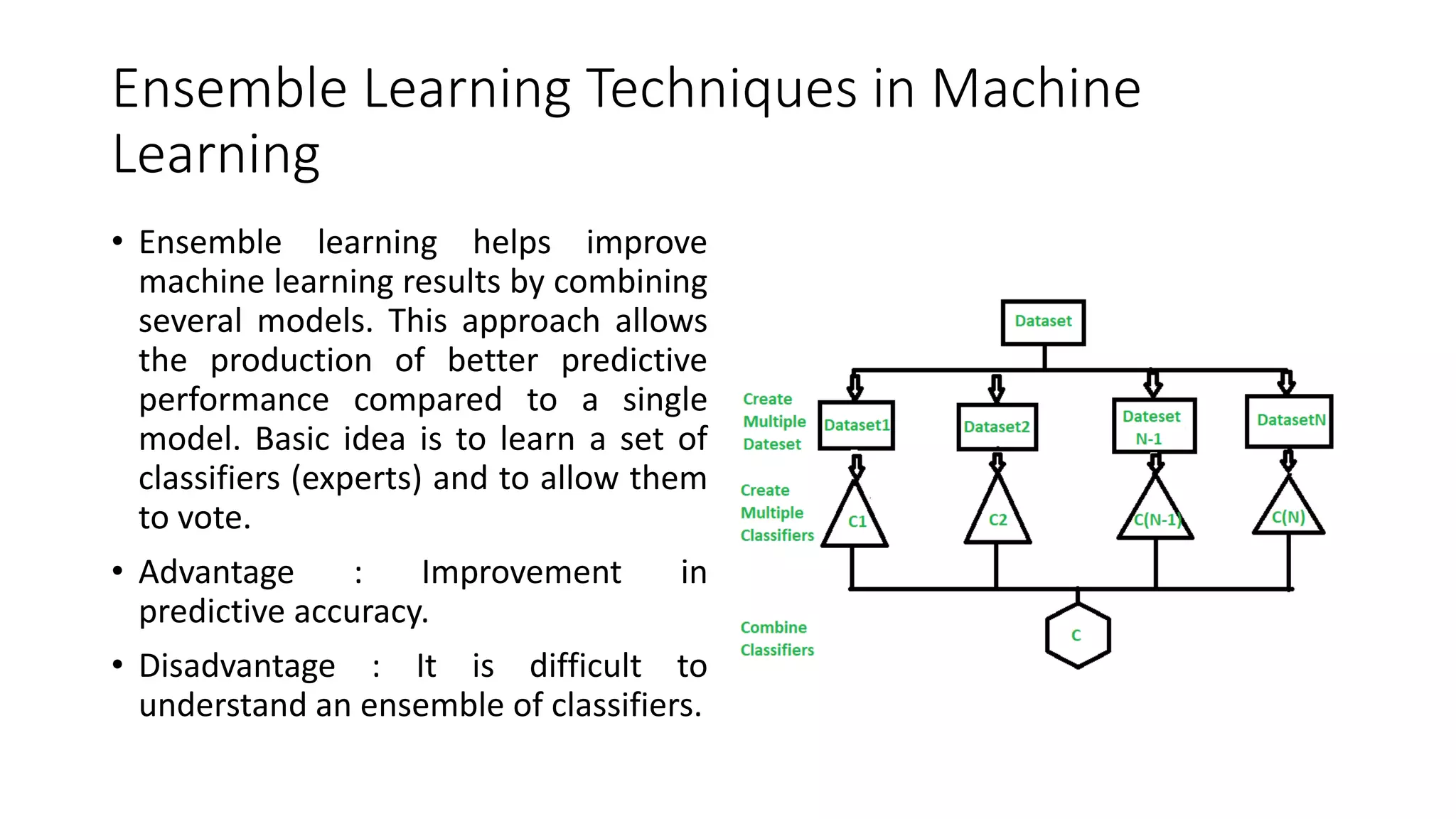
• Ensemble learning helps improve
machine learning results by combining
several models. This approach allows
the production of better predictive
performance compared to a single
model. Basic idea is to learn a set of
classifiers (experts) and to allow them
to vote.
• Advantage : Improvement in
predictive accuracy.
• Disadvantage : It is difficult to
understand an ensemble of classifiers.
Random Forest Algorithm
• Random Forest is a popular machine learning algorithm that belongs to the
supervised learning technique. It can be used for both Classification and
Regression problems in ML. It is based on the concept of ensemble learning,
which is a process of combining multiple classifiers to solve a complex problem
and to improve the performance of the model.
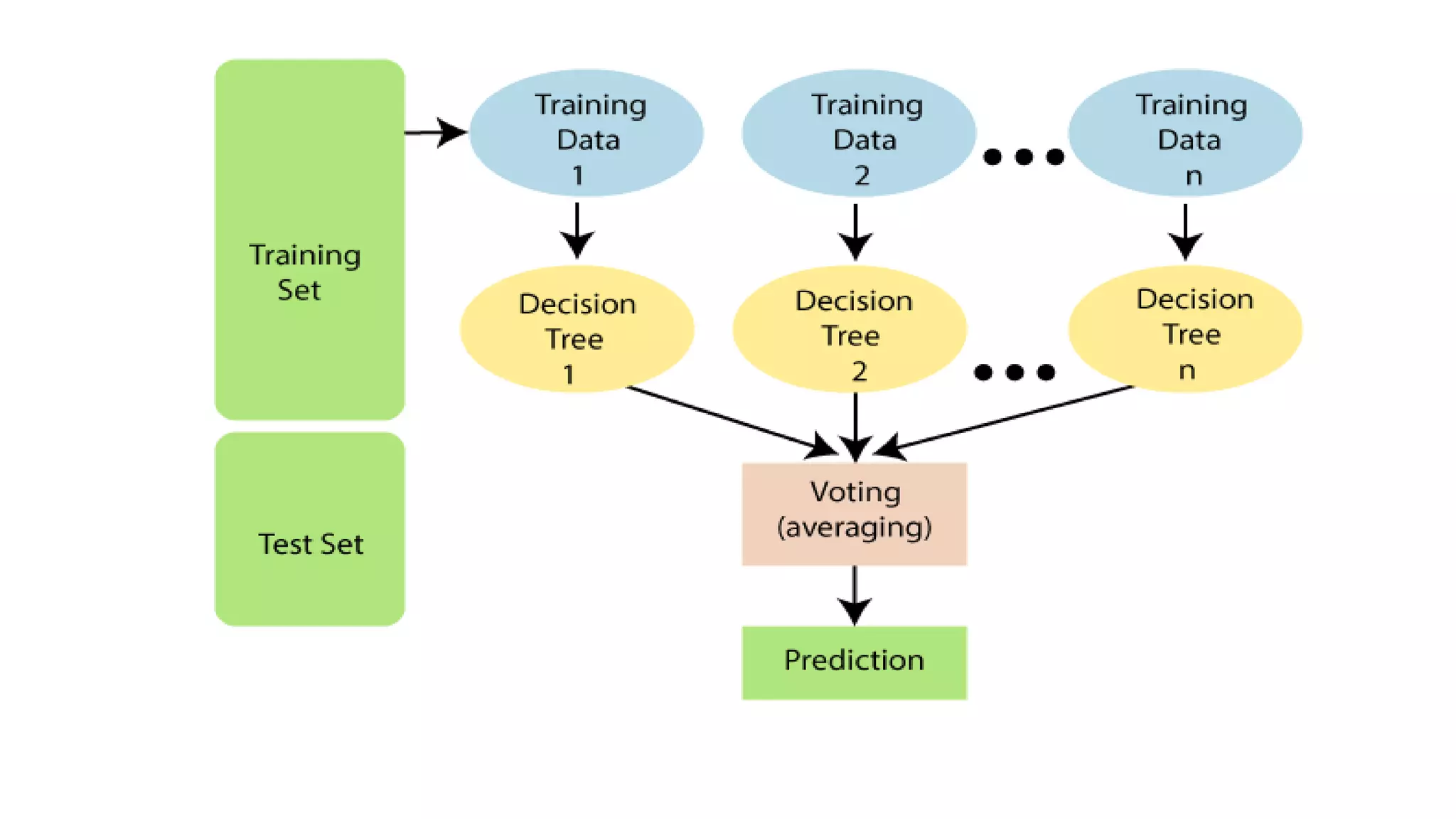
• As the name suggests, "Random Forest is a classifier that contains a number of
decision trees on various subsets of the given dataset and takes the average to
improve the predictive accuracy of that dataset." Instead of relying on one
decision tree, the random forest takes the prediction from each tree and based
on the majority votes of predictions, and it predicts the final output.
• The greater number of trees in the forest leads to higher accuracy and prevents
the problem of overfitting.
• The below diagram explains the working of the Random Forest algorithm:
Assumptions for Random Forest
• Since the random forest combines multiple trees to predict the class
of the dataset, it is possible that some decision trees may predict the
correct output, while others may not. But together, all the trees
predict the correct output. Therefore, below are two assumptions for
a better Random forest classifier:
• There should be some actual values in the feature variable of the
dataset so that the classifier can predict accurate results rather than a
guessed result.
• The predictions from each tree must have very low correlations.
Why use Random Forest?
• Below are some points that explain why we should use the Random
Forest algorithm:
• It takes less training time as compared to other algorithms.
• It predicts output with high accuracy, even for the large dataset it
runs efficiently.
• It can also maintain accuracy when a large proportion of data is
missing.
How does Random Forest algorithm work?
• Random Forest works in two-phase first is to create the random forest by
combining N decision tree, and second is to make predictions for each tree
created in the first phase.
• The Working process can be explained in the below steps and diagram:
• Step-1: Select random K data points from the training set.
• Step-2: Build the decision trees associated with the selected data points
(Subsets).
• Step-3: Choose the number N for decision trees that you want to build.
• Step-4: Repeat Step 1 & 2.
• Step-5: For new data points, find the predictions of each decision tree, and
assign the new data points to the category that wins the majority votes.
• The working of the algorithm can be better understood by the below
example:
• Example: Suppose there is a dataset that contains multiple fruit
images. So, this dataset is given to the Random forest classifier. The
dataset is divided into subsets and given to each decision tree. During
the training phase, each decision tree produces a prediction result,
and when a new data point occurs, then based on the majority of
results, the Random Forest classifier predicts the final decision.
Consider the below image:
Applications of Random Forest
• There are mainly four sectors where Random forest mostly used:
• Banking: Banking sector mostly uses this algorithm for the
identification of loan risk.
• Medicine: With the help of this algorithm, disease trends and risks of
the disease can be identified.
• Land Use: We can identify the areas of similar land use by this
algorithm.
• Marketing: Marketing trends can be identified using this algorithm.
Advantages of Random Forest
• Random Forest is capable of performing both Classification and
Regression tasks.
• It is capable of handling large datasets with high dimensionality.
• It enhances the accuracy of the model and prevents the overfitting
issue.
Disadvantages of Random Forest
• Although random forest can be used for both classification and
regression tasks, it is not more suitable for Regression tasks.
Python Implementation of Random Forest Algorithm
• Building a random forest Regression Model in Machine Learning
Using Python and Sklearn
• Problem Statement: Use Machine Learning to predict the selling
prices of houses based on some economic factors. Build a random
forest regression model in Python and Sklearn
• Dataset: Boston House Prices Dataset
• CRIM - per capita crime rate by town
• ZN - proportion of residential land zoned for lots over 25,000 sq.ft.
• INDUS - proportion of non-retail business acres per town.
• CHAS - Charles River dummy variable (1 if tract bounds river; 0 otherwise)
• NOX - nitric oxides concentration (parts per 10 million)
• RM - average number of rooms per dwelling
• AGE - proportion of owner-occupied units built prior to 1940
• DIS - weighted distances to five Boston employment centres
• RAD - index of accessibility to radial highways
• TAX - full-value property-tax rate per $10,000
• PTRATIO - pupil-teacher ratio by town
• B - 1000(Bk - 0.63)^2 where Bk is the proportion of blacks by town
• LSTAT - % lower status of the population
• MEDV - Median value of owner-occupied homes in $1000's
Regression Model Building: Random Forest in
Python
• Let us build the regression
model with the help of the
random forest algorithm.
• Step 1: Load required
packages and the Boston
dataset
Step 2: Define the features and the target
Step 3: Split the dataset into train and test sets
Step 4: Build the random forest regression model with
random forest regressor function
Creating and Visualizing a Random Forest
Classification Model in Machine Learning Using
Python
• Problem Statement: Use Machine Learning to predict cases of breast
cancer using patient treatment history and health data
• Dataset: Breast Cancer Wisconsin (Diagnostic) Dataset
• Classification Model Building:
Random Forest in Python
• Let us build the classification
model with the help of a random
forest algorithm.
• Step 1: Load Pandas library and
the dataset using Pandas
Step 2: Define the features and the target
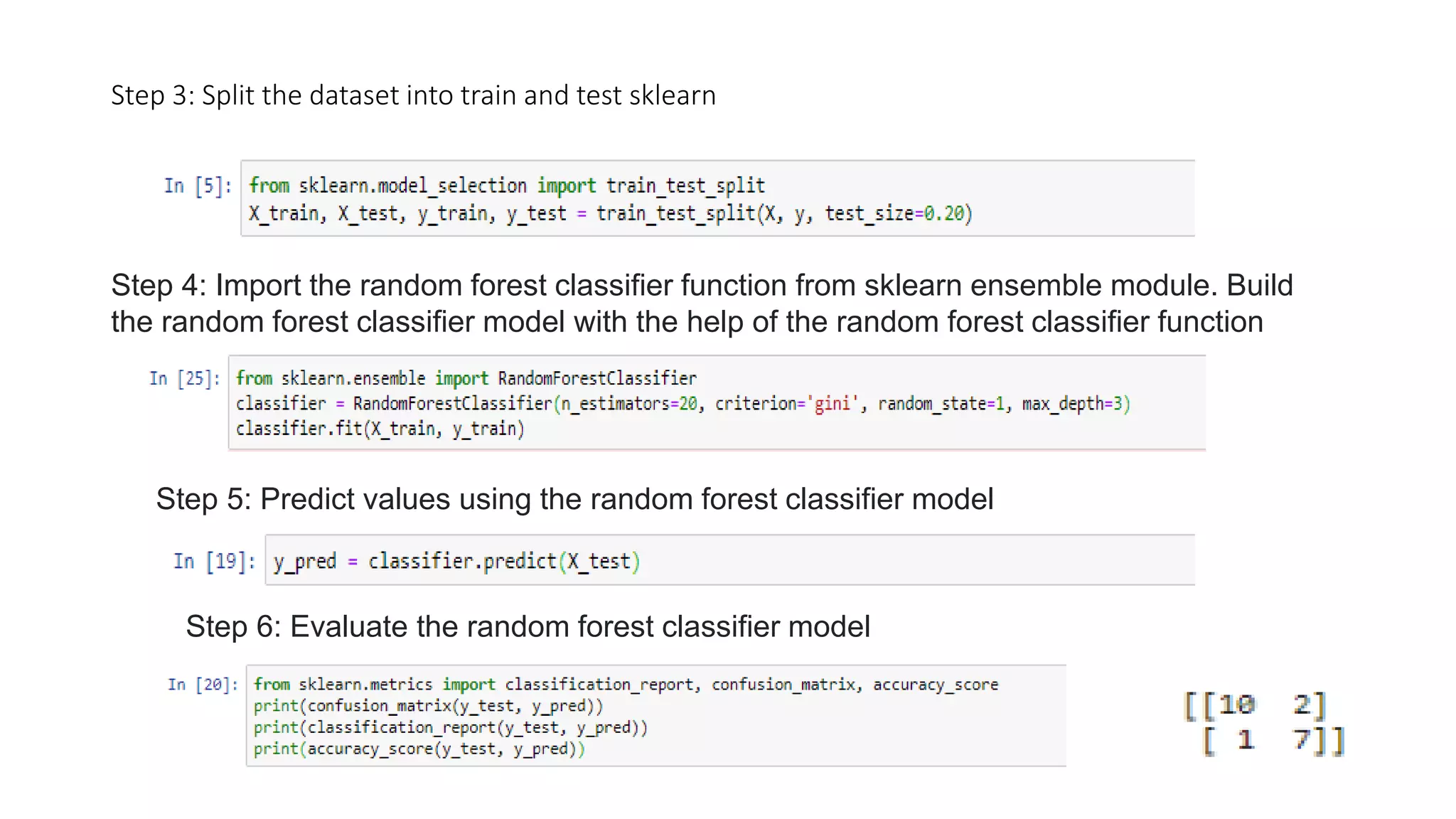
Step 3: Split the dataset into train and test sklearn
Step 4: Import the random forest classifier function from sklearn ensemble module. Build
the random forest classifier model with the help of the random forest classifier function
Step 5: Predict values using the random forest classifier model
Step 6: Evaluate the random forest classifier model

random forest.pptx

  • 1.
  • 2.
    Ensemble Learning Techniquesin Machine Learning • Ensemble learning helps improve machine learning results by combining several models. This approach allows the production of better predictive performance compared to a single model. Basic idea is to learn a set of classifiers (experts) and to allow them to vote. • Advantage : Improvement in predictive accuracy. • Disadvantage : It is difficult to understand an ensemble of classifiers.
  • 3.
    Random Forest Algorithm •Random Forest is a popular machine learning algorithm that belongs to the supervised learning technique. It can be used for both Classification and Regression problems in ML. It is based on the concept of ensemble learning, which is a process of combining multiple classifiers to solve a complex problem and to improve the performance of the model. • As the name suggests, "Random Forest is a classifier that contains a number of decision trees on various subsets of the given dataset and takes the average to improve the predictive accuracy of that dataset." Instead of relying on one decision tree, the random forest takes the prediction from each tree and based on the majority votes of predictions, and it predicts the final output. • The greater number of trees in the forest leads to higher accuracy and prevents the problem of overfitting. • The below diagram explains the working of the Random Forest algorithm:
  • 5.
    Assumptions for RandomForest • Since the random forest combines multiple trees to predict the class of the dataset, it is possible that some decision trees may predict the correct output, while others may not. But together, all the trees predict the correct output. Therefore, below are two assumptions for a better Random forest classifier: • There should be some actual values in the feature variable of the dataset so that the classifier can predict accurate results rather than a guessed result. • The predictions from each tree must have very low correlations.
  • 6.
    Why use RandomForest? • Below are some points that explain why we should use the Random Forest algorithm: • It takes less training time as compared to other algorithms. • It predicts output with high accuracy, even for the large dataset it runs efficiently. • It can also maintain accuracy when a large proportion of data is missing.
  • 7.
    How does RandomForest algorithm work? • Random Forest works in two-phase first is to create the random forest by combining N decision tree, and second is to make predictions for each tree created in the first phase. • The Working process can be explained in the below steps and diagram: • Step-1: Select random K data points from the training set. • Step-2: Build the decision trees associated with the selected data points (Subsets). • Step-3: Choose the number N for decision trees that you want to build. • Step-4: Repeat Step 1 & 2. • Step-5: For new data points, find the predictions of each decision tree, and assign the new data points to the category that wins the majority votes.
  • 8.
    • The workingof the algorithm can be better understood by the below example: • Example: Suppose there is a dataset that contains multiple fruit images. So, this dataset is given to the Random forest classifier. The dataset is divided into subsets and given to each decision tree. During the training phase, each decision tree produces a prediction result, and when a new data point occurs, then based on the majority of results, the Random Forest classifier predicts the final decision. Consider the below image:
  • 10.
    Applications of RandomForest • There are mainly four sectors where Random forest mostly used: • Banking: Banking sector mostly uses this algorithm for the identification of loan risk. • Medicine: With the help of this algorithm, disease trends and risks of the disease can be identified. • Land Use: We can identify the areas of similar land use by this algorithm. • Marketing: Marketing trends can be identified using this algorithm.
  • 11.
    Advantages of RandomForest • Random Forest is capable of performing both Classification and Regression tasks. • It is capable of handling large datasets with high dimensionality. • It enhances the accuracy of the model and prevents the overfitting issue. Disadvantages of Random Forest • Although random forest can be used for both classification and regression tasks, it is not more suitable for Regression tasks.
  • 12.
    Python Implementation ofRandom Forest Algorithm • Building a random forest Regression Model in Machine Learning Using Python and Sklearn • Problem Statement: Use Machine Learning to predict the selling prices of houses based on some economic factors. Build a random forest regression model in Python and Sklearn • Dataset: Boston House Prices Dataset
  • 14.
    • CRIM -per capita crime rate by town • ZN - proportion of residential land zoned for lots over 25,000 sq.ft. • INDUS - proportion of non-retail business acres per town. • CHAS - Charles River dummy variable (1 if tract bounds river; 0 otherwise) • NOX - nitric oxides concentration (parts per 10 million) • RM - average number of rooms per dwelling • AGE - proportion of owner-occupied units built prior to 1940 • DIS - weighted distances to five Boston employment centres • RAD - index of accessibility to radial highways • TAX - full-value property-tax rate per $10,000 • PTRATIO - pupil-teacher ratio by town • B - 1000(Bk - 0.63)^2 where Bk is the proportion of blacks by town • LSTAT - % lower status of the population • MEDV - Median value of owner-occupied homes in $1000's
  • 15.
    Regression Model Building:Random Forest in Python • Let us build the regression model with the help of the random forest algorithm. • Step 1: Load required packages and the Boston dataset
  • 16.
    Step 2: Definethe features and the target
  • 17.
    Step 3: Splitthe dataset into train and test sets Step 4: Build the random forest regression model with random forest regressor function
  • 18.
    Creating and Visualizinga Random Forest Classification Model in Machine Learning Using Python • Problem Statement: Use Machine Learning to predict cases of breast cancer using patient treatment history and health data • Dataset: Breast Cancer Wisconsin (Diagnostic) Dataset
  • 20.
    • Classification ModelBuilding: Random Forest in Python • Let us build the classification model with the help of a random forest algorithm. • Step 1: Load Pandas library and the dataset using Pandas
  • 21.
    Step 2: Definethe features and the target
  • 22.
    Step 3: Splitthe dataset into train and test sklearn Step 4: Import the random forest classifier function from sklearn ensemble module. Build the random forest classifier model with the help of the random forest classifier function Step 5: Predict values using the random forest classifier model Step 6: Evaluate the random forest classifier model