K-Nearest Neighbor(KNN)
Contents
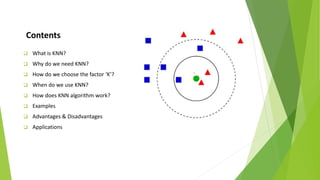
 What is KNN?
 Why do we need KNN?
 How do we choose the factor ‘K’?
 When do we use KNN?
 How does KNN algorithm work?
 Examples
 Advantages & Disadvantages
 Applications
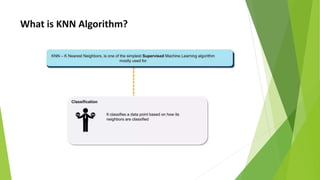
What is KNN Algorithm?
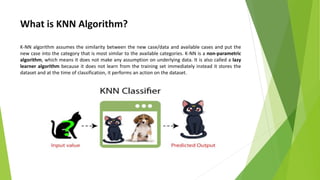
K-NN algorithm assumes the similarity between the new case/data and available cases and put the
new case into the category that is most similar to the available categories. K-NN is a non-parametric
algorithm, which means it does not make any assumption on underlying data. It is also called a lazy
learner algorithm because it does not learn from the training set immediately instead it stores the
dataset and at the time of classification, it performs an action on the dataset.
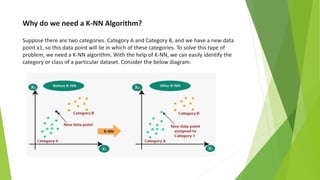
Why do we need a K-NN Algorithm?
Suppose there are two categories. Category A and Category B, and we have a new data
point x1, so this data point will lie in which of these categories. To solve this type of
problem, we need a K-NN algorithm. With the help of K-NN, we can easily identify the
category or class of a particular dataset. Consider the below diagram:
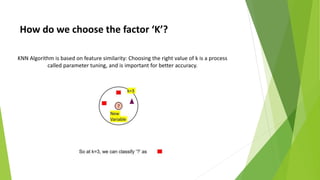
How do we choose the factor ‘K’?
KNN Algorithm is based on feature similarity: Choosing the right value of k is a process
called parameter tuning, and is important for better accuracy.
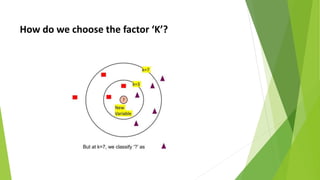
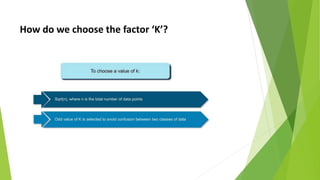
How do we choose the factor ‘K’?
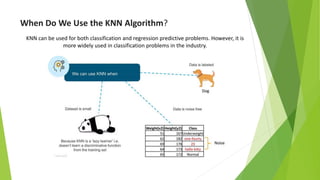
When Do We Use the KNN Algorithm?
KNN can be used for both classification and regression predictive problems. However, it is
more widely used in classification problems in the industry.
How does K-NN work?
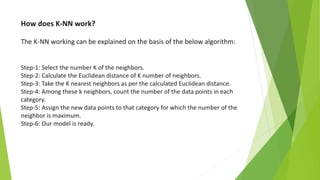
The K-NN working can be explained on the basis of the below algorithm:
Step-1: Select the number K of the neighbors.
Step-2: Calculate the Euclidean distance of K number of neighbors.
Step-3: Take the K nearest neighbors as per the calculated Euclidean distance.
Step-4: Among these k neighbors, count the number of the data points in each
category.
Step-5: Assign the new data points to that category for which the number of the
neighbor is maximum.
Step-6: Our model is ready.
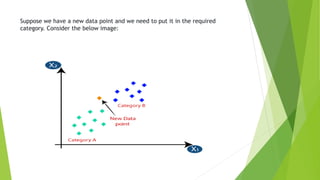
Suppose we have a new data point and we need to put it in the required
category. Consider the below image:
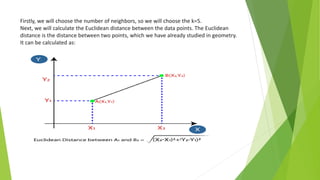
Firstly, we will choose the number of neighbors, so we will choose the k=5.
Next, we will calculate the Euclidean distance between the data points. The Euclidean
distance is the distance between two points, which we have already studied in geometry.
It can be calculated as:
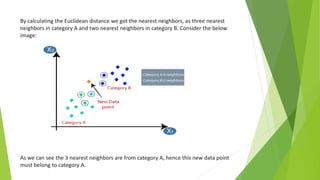
By calculating the Euclidean distance we got the nearest neighbors, as three nearest
neighbors in category A and two nearest neighbors in category B. Consider the below
image:
As we can see the 3 nearest neighbors are from category A, hence this new data point
must belong to category A.
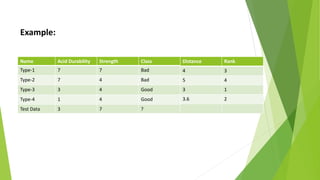
Example:
Name Acid Durability Strength Class
Type-1 7 7 Bad
Type-2 7 4 Bad
Type-3 3 4 Good
Type-4 1 4 Good
Test Data 3 7 ?
Distance Rank
4 3
5 4
3 1
3.6 2
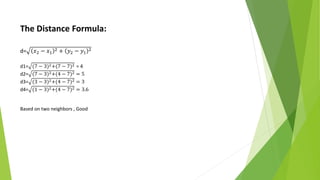
The Distance Formula:
d= 𝑥2 − 𝑥1
2 + 𝑦2 − 𝑦1
2
d1= (7 − 3)2+(7 − 7)2 = 4
d2= (7 − 3)2+(4 − 7)2 = 5
d3= (3 − 3)2+(4 − 7)2 = 3
d4= (1 − 3)2+(4 − 7)2 = 3.6
Based on two neighbors , Good
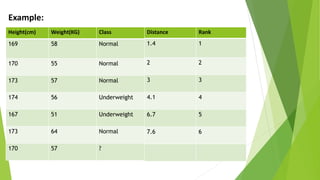
Example:
Height(cm) Weight(KG) Class
169 58 Normal
170 55 Normal
173 57 Normal
174 56 Underweight
167 51 Underweight
173 64 Normal
170 57 ?
Distance Rank
1.4 1
2 2
3 3
4.1 4
6.7 5
7.6 6
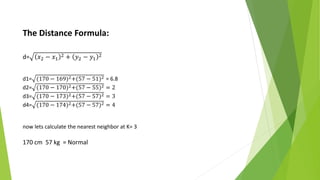
The Distance Formula:
d= 𝑥2 − 𝑥1
2 + 𝑦2 − 𝑦1
2
d1= (170 − 169)2+(57 − 51)2 = 6.8
d2= (170 − 170)2+(57 − 55)2 = 2
d3= (170 − 173)2+(57 − 57)2 = 3
d4= (170 − 174)2+(57 − 57)2 = 4
now lets calculate the nearest neighbor at K= 3
170 cm 57 kg = Normal
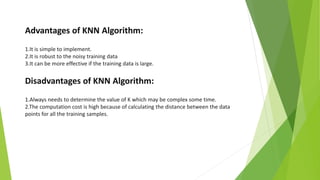
Advantages of KNN Algorithm:
1.It is simple to implement.
2.It is robust to the noisy training data
3.It can be more effective if the training data is large.
Disadvantages of KNN Algorithm:
1.Always needs to determine the value of K which may be complex some time.
2.The computation cost is high because of calculating the distance between the data
points for all the training samples.
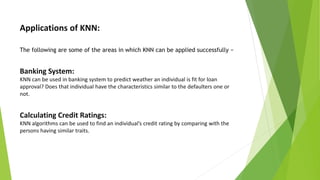
Applications of KNN:
The following are some of the areas in which KNN can be applied successfully −
Banking System:
KNN can be used in banking system to predict weather an individual is fit for loan
approval? Does that individual have the characteristics similar to the defaulters one or
not.
Calculating Credit Ratings:
KNN algorithms can be used to find an individual’s credit rating by comparing with the
persons having similar traits.
References:
https://www.javatpoint.com/k-nearest-neighbor-algorithm-for-machine-learning
https://www.tutorialspoint.com/machine_learning_with_python/machine_learni
ng_with_python_knn_algorithm_finding_nearest_neighbors.htm
https://www.youtube.com/watch?v=Vk9lGGODaJA
https://www.youtube.com/watch?v=HZT0lxD5h6k
Thank You
Any Questions?

K-Nearest Neighbor(KNN)

  • 1.
  • 2.
    Contents  What isKNN?  Why do we need KNN?  How do we choose the factor ‘K’?  When do we use KNN?  How does KNN algorithm work?  Examples  Advantages & Disadvantages  Applications
  • 3.
    What is KNNAlgorithm?
  • 4.
    What is KNNAlgorithm? K-NN algorithm assumes the similarity between the new case/data and available cases and put the new case into the category that is most similar to the available categories. K-NN is a non-parametric algorithm, which means it does not make any assumption on underlying data. It is also called a lazy learner algorithm because it does not learn from the training set immediately instead it stores the dataset and at the time of classification, it performs an action on the dataset.
  • 5.
    Why do weneed a K-NN Algorithm?
  • 6.
    Why do weneed a K-NN Algorithm? Suppose there are two categories. Category A and Category B, and we have a new data point x1, so this data point will lie in which of these categories. To solve this type of problem, we need a K-NN algorithm. With the help of K-NN, we can easily identify the category or class of a particular dataset. Consider the below diagram:
  • 7.
    How do wechoose the factor ‘K’? KNN Algorithm is based on feature similarity: Choosing the right value of k is a process called parameter tuning, and is important for better accuracy.
  • 8.
    How do wechoose the factor ‘K’?
  • 9.
    How do wechoose the factor ‘K’?
  • 10.
    When Do WeUse the KNN Algorithm? KNN can be used for both classification and regression predictive problems. However, it is more widely used in classification problems in the industry.
  • 11.
    How does K-NNwork? The K-NN working can be explained on the basis of the below algorithm: Step-1: Select the number K of the neighbors. Step-2: Calculate the Euclidean distance of K number of neighbors. Step-3: Take the K nearest neighbors as per the calculated Euclidean distance. Step-4: Among these k neighbors, count the number of the data points in each category. Step-5: Assign the new data points to that category for which the number of the neighbor is maximum. Step-6: Our model is ready.
  • 12.
    Suppose we havea new data point and we need to put it in the required category. Consider the below image:
  • 13.
    Firstly, we willchoose the number of neighbors, so we will choose the k=5. Next, we will calculate the Euclidean distance between the data points. The Euclidean distance is the distance between two points, which we have already studied in geometry. It can be calculated as:
  • 14.
    By calculating theEuclidean distance we got the nearest neighbors, as three nearest neighbors in category A and two nearest neighbors in category B. Consider the below image: As we can see the 3 nearest neighbors are from category A, hence this new data point must belong to category A.
  • 15.
    Example: Name Acid DurabilityStrength Class Type-1 7 7 Bad Type-2 7 4 Bad Type-3 3 4 Good Type-4 1 4 Good Test Data 3 7 ? Distance Rank 4 3 5 4 3 1 3.6 2
  • 16.
    The Distance Formula: d=𝑥2 − 𝑥1 2 + 𝑦2 − 𝑦1 2 d1= (7 − 3)2+(7 − 7)2 = 4 d2= (7 − 3)2+(4 − 7)2 = 5 d3= (3 − 3)2+(4 − 7)2 = 3 d4= (1 − 3)2+(4 − 7)2 = 3.6 Based on two neighbors , Good
  • 17.
    Example: Height(cm) Weight(KG) Class 16958 Normal 170 55 Normal 173 57 Normal 174 56 Underweight 167 51 Underweight 173 64 Normal 170 57 ? Distance Rank 1.4 1 2 2 3 3 4.1 4 6.7 5 7.6 6
  • 18.
    The Distance Formula: d=𝑥2 − 𝑥1 2 + 𝑦2 − 𝑦1 2 d1= (170 − 169)2+(57 − 51)2 = 6.8 d2= (170 − 170)2+(57 − 55)2 = 2 d3= (170 − 173)2+(57 − 57)2 = 3 d4= (170 − 174)2+(57 − 57)2 = 4 now lets calculate the nearest neighbor at K= 3 170 cm 57 kg = Normal
  • 19.
    Advantages of KNNAlgorithm: 1.It is simple to implement. 2.It is robust to the noisy training data 3.It can be more effective if the training data is large. Disadvantages of KNN Algorithm: 1.Always needs to determine the value of K which may be complex some time. 2.The computation cost is high because of calculating the distance between the data points for all the training samples.
  • 20.
    Applications of KNN: Thefollowing are some of the areas in which KNN can be applied successfully − Banking System: KNN can be used in banking system to predict weather an individual is fit for loan approval? Does that individual have the characteristics similar to the defaulters one or not. Calculating Credit Ratings: KNN algorithms can be used to find an individual’s credit rating by comparing with the persons having similar traits.
  • 21.
  • 22.