1) Certain water characteristics such as dissolved
oxygen concentration, pH, salt concentration
can’t be observed directly with water
reflection changes but can be correlated with
the observed reflectance.
2) Reflectance data for water bodies has been
used to detect number of pollutance . (eg. Oil
and industrial wastes)
3) Used to determine the presence or absence of
tannin dyes from the bog vegetation in lowland
areas.
Objectives
 Energy transfer from one body another in the
form of electromagnetic waves.
 A fundamental characteristic of radiation is the
wavelength (λ) of propagation.
Electromagnetic spectrum
 Reflectivity is the fraction of incident radiation
reflected by a surface.
 The reflectance characteristics of Earth’s surface
features may be quantified by measuring the
portion of incident energy that is reflected.
 This is measured as a function of wavelength
and is called as spectral reflectance.
Spectral reflectivity
 Water (in soil, vegetation or water bodies)
absorbs radiation at near –IR wavelengths
and beyond (strong absorption bands at
about 1.4, 1.9 and 2.7 µm)
Spectral reflectance of water
 Clear water absorbs relatively little energy with
wavelength of < 0.6 µm, resulting in high
transmittance in the blue-green portion of the
spectrum.
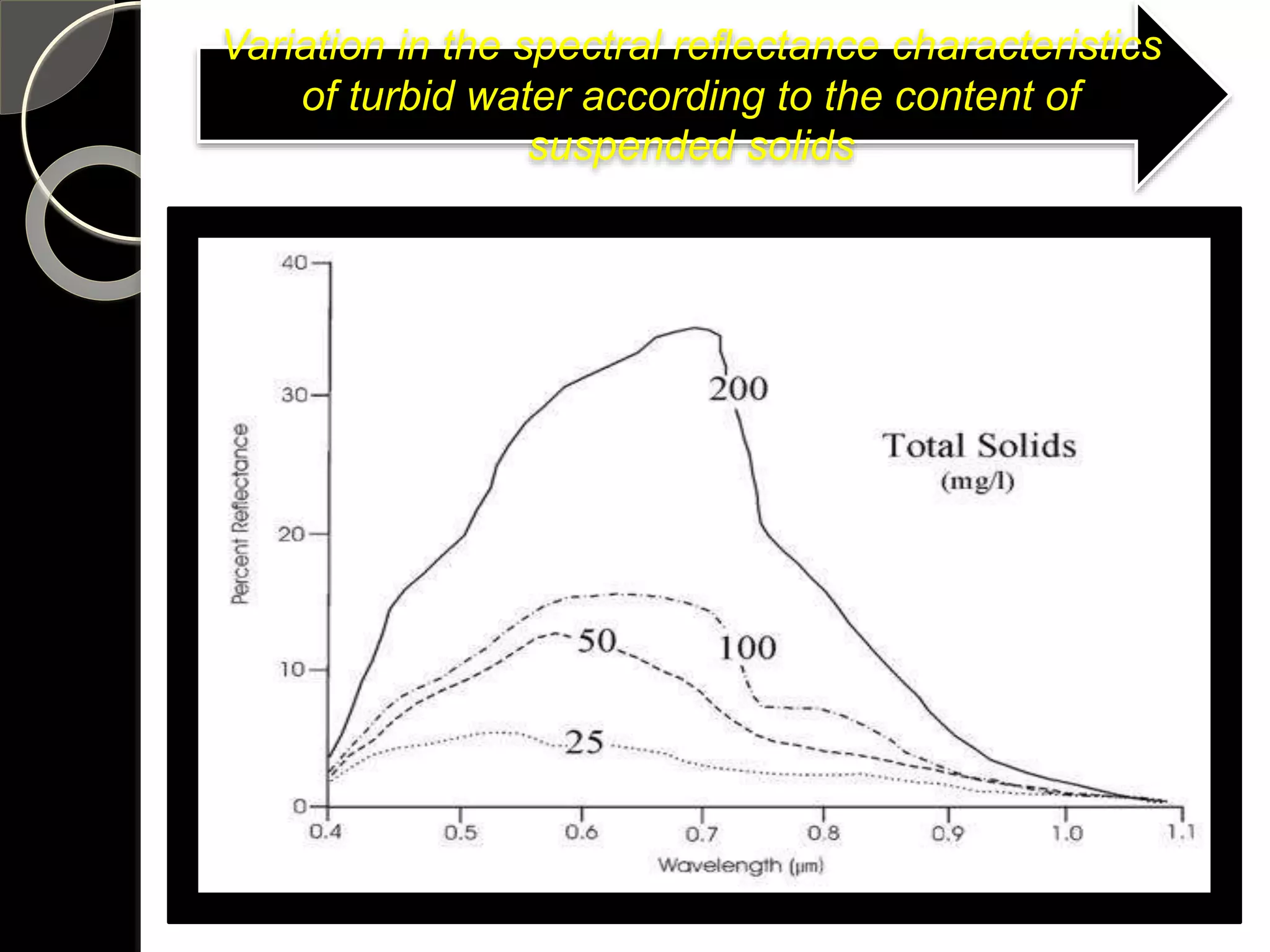
 As the turbidity of water changes, the reflectance
changes dramatically.
 Increase in chlorophyll concentration tend to
decrease reflectance in blue wavelengths and
increase in its green wavelengths (helps to monitor
algae).
Variation in the spectral reflectance characteristics
of turbid water according to the content of
suspended solids
Factors affecting water reflection
 The variation in the reflectance of
water body is determined by three
important factors viz.,
Depth of the water
Materials present in the water
Roughness of the water
Temperature variation
Depth of the water
 In the shallow water some of the
radiation is reflected not by the water
itself but by the bottom of the water
body.
 Therefore, the shallow pools and
streams it is often the underlying
material that determines the water
body’s reflection properties and colour.
Depth of the water
ALFISOL VERTISOL
Material suspended and roughness
 The suspended particles in the water
various pollutants and the floating
algal mass on the surface all affect the
reflection properties of water.
 Roughness of the water surface can
also affect its reflection properties.
 If the surface is smooth then light is
reflected specularly from its surface.
High concentration of dissolved lime
give the water, a turquoise colour.
Havasu falls
Dissolved organic compounds called
tannins can result in dark brown
colour.
Algal floating in the water can impart a
green colour.
Reflection of different live water bodies
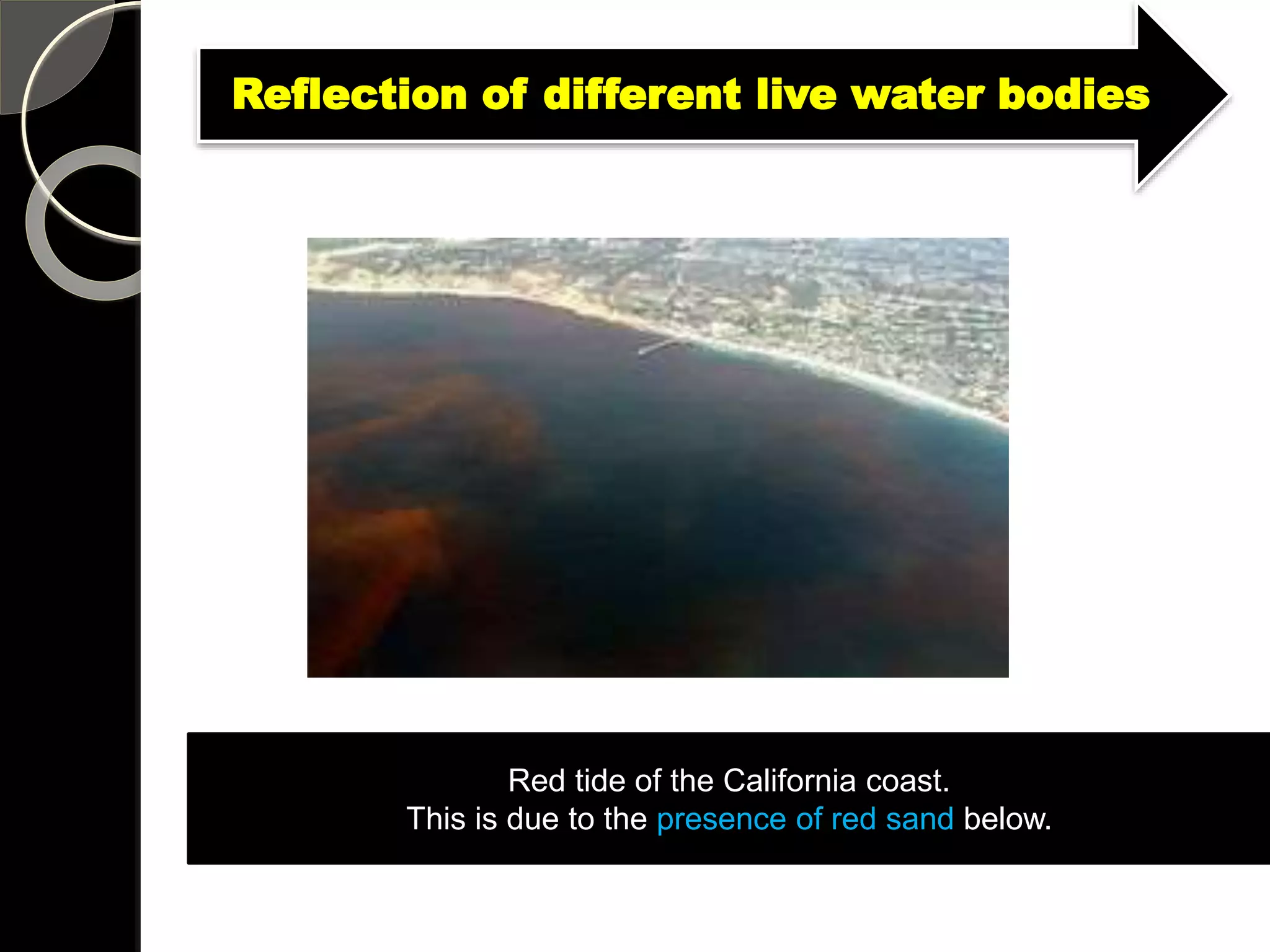
Red tide of the California coast.
This is due to the presence of red sand below.
Reflection of different live water bodies
The Colorado River is often a muddy red colour because of suspended
reddish silt in the water.
Reflection of different live water bodies
Banff National Park’s Moraine Lake is turquoise because finely ground
rock is present. We are able to observe the blue light produced by the
water’s absorption, because light is scattered by suspended matter and so
returns to the surface. Such scattering can also shift the spectrum of the
emerging photons toward the green, a color often seen in water laden with
suspended particles.
Reflection of different live water bodies
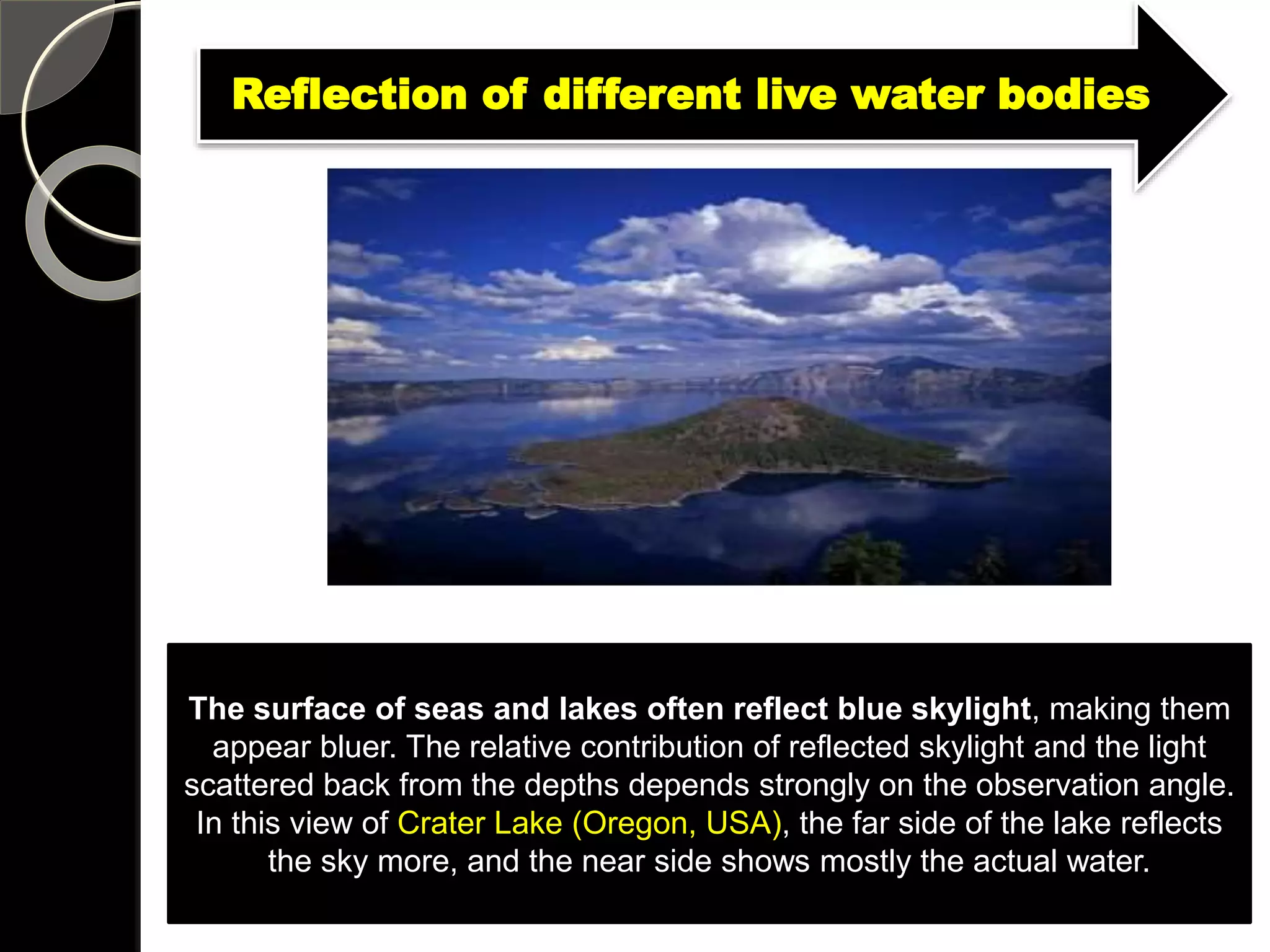
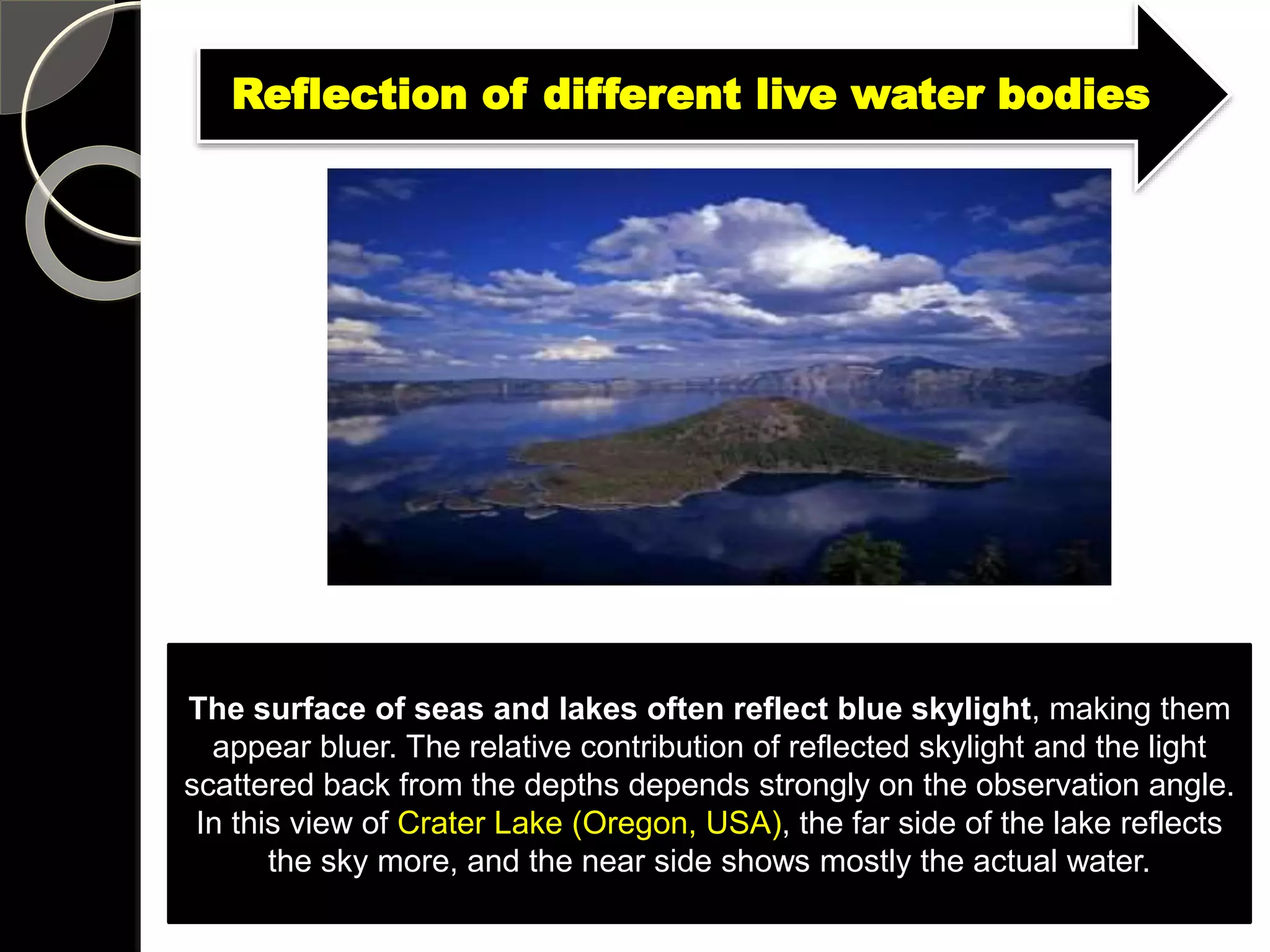
The surface of seas and lakes often reflect blue skylight, making them
appear bluer. The relative contribution of reflected skylight and the light
scattered back from the depths depends strongly on the observation angle.
In this view of Crater Lake (Oregon, USA), the far side of the lake reflects
the sky more, and the near side shows mostly the actual water.
Reflection of different live water bodies
The surface of seas and lakes often reflect blue skylight, making them
appear bluer. The relative contribution of reflected skylight and the light
scattered back from the depths depends strongly on the observation angle.
In this view of Crater Lake (Oregon, USA), the far side of the lake reflects
the sky more, and the near side shows mostly the actual water.
Reflection of different live water bodies
Marble Canyon viewed from the Navajo Bridge over the
Colorado River. The green color of the Colorado River is
caused by the algae bloom in the spring snowmelt, while
the Red Sea may get its name from the occasional bloom
of red Trichodesmium erythraeum algae
Reflection due to micro and macro flora
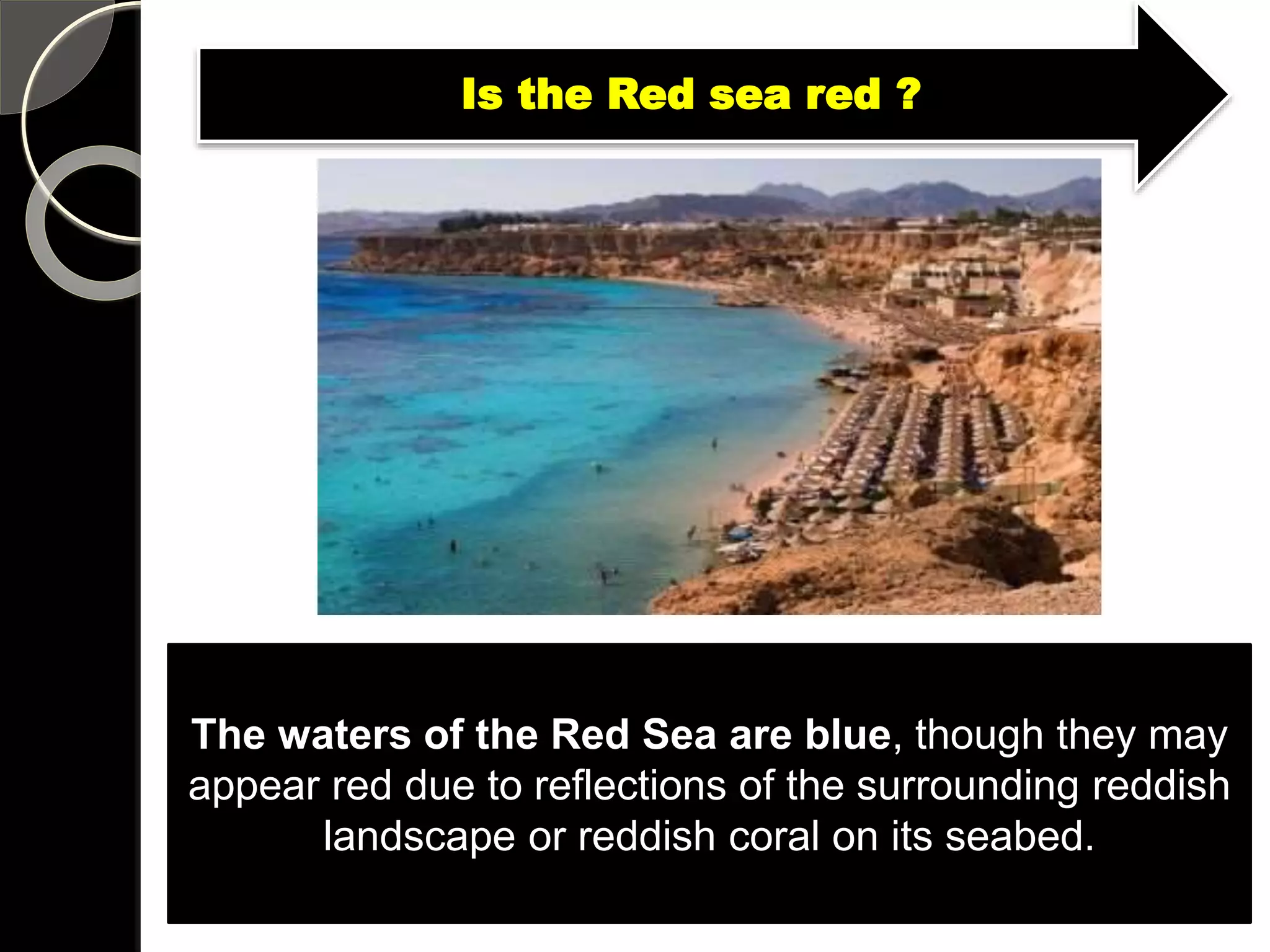
The waters of the Red Sea are blue, though they may
appear red due to reflections of the surrounding reddish
landscape or reddish coral on its seabed.
Is the Red sea red ?
The Red Sea is named for an
occasional bloom of the
cyanobacteria, Trichodesmium
erythraeum algae, which clouds and
muddies the usually translucent blue-
green waters. These cyanobacteria
appear as red and pinkish blankets on the
surface of these waters. After blooming,
the Trichodesmium erythraeum die, and
they turn the sea reddish-brown.
Is the Red sea red ?
SEASAT
 An experimental satellite designed by
NASA to establish the utility of
microwave sensors for remote sensing
of oceans.
 Seasat had a circular on sun
synchronous orbit at an altitude of 800
km, sensing earth’s surface from 72˚
N to 72˚ S orbiting the earth 14 times
a day and passes over the same
ground once in every 152 days.
SEASAT
 The satellite consists of 5 sensors.
 The radiometer recorded in two
wavebands
◦ Visible (0.47-0.4µm) @ spatial resolution
2km
◦ Thermal IR (10.5-12.5µm) @ 8km
 SAR sensor operated at a wavelength
of 2.5µm – produced image with
nominal ground resolution of 25m over
100km wide swath.
SEASAT
 The satellite had only a short life from
June,1978 until it short circuited its
electrical system in Oct, 1978.
 Recorded 100 million square km.
◦ Used to monitor the state of the sea
◦ For mapping sea ice, vegetation, urban,
land cover,, geology and a whole
hydrological features.
http://www.ucalgary.ca/GEOG/Virtual/Remote%20Sensi
ng/rswater.html
http://rsgislearn.blogspot.in/2007/04/spectral-
reflectance.html
https://en.wikipedia.org/wiki/Color_of_water
http://www.webexhibits.org/causesofcolor/5D.html
Reference
Reflection of water bodies

Reflection of water bodies

  • 2.
    1) Certain watercharacteristics such as dissolved oxygen concentration, pH, salt concentration can’t be observed directly with water reflection changes but can be correlated with the observed reflectance. 2) Reflectance data for water bodies has been used to detect number of pollutance . (eg. Oil and industrial wastes) 3) Used to determine the presence or absence of tannin dyes from the bog vegetation in lowland areas. Objectives
  • 3.
     Energy transferfrom one body another in the form of electromagnetic waves.  A fundamental characteristic of radiation is the wavelength (λ) of propagation. Electromagnetic spectrum
  • 4.
     Reflectivity isthe fraction of incident radiation reflected by a surface.  The reflectance characteristics of Earth’s surface features may be quantified by measuring the portion of incident energy that is reflected.  This is measured as a function of wavelength and is called as spectral reflectance. Spectral reflectivity
  • 5.
     Water (insoil, vegetation or water bodies) absorbs radiation at near –IR wavelengths and beyond (strong absorption bands at about 1.4, 1.9 and 2.7 µm) Spectral reflectance of water
  • 6.
     Clear waterabsorbs relatively little energy with wavelength of < 0.6 µm, resulting in high transmittance in the blue-green portion of the spectrum.  As the turbidity of water changes, the reflectance changes dramatically.  Increase in chlorophyll concentration tend to decrease reflectance in blue wavelengths and increase in its green wavelengths (helps to monitor algae).
  • 7.
    Variation in thespectral reflectance characteristics of turbid water according to the content of suspended solids
  • 8.
    Factors affecting waterreflection  The variation in the reflectance of water body is determined by three important factors viz., Depth of the water Materials present in the water Roughness of the water Temperature variation
  • 9.
    Depth of thewater  In the shallow water some of the radiation is reflected not by the water itself but by the bottom of the water body.  Therefore, the shallow pools and streams it is often the underlying material that determines the water body’s reflection properties and colour.
  • 10.
    Depth of thewater ALFISOL VERTISOL
  • 11.
    Material suspended androughness  The suspended particles in the water various pollutants and the floating algal mass on the surface all affect the reflection properties of water.  Roughness of the water surface can also affect its reflection properties.  If the surface is smooth then light is reflected specularly from its surface.
  • 12.
    High concentration ofdissolved lime give the water, a turquoise colour. Havasu falls Dissolved organic compounds called tannins can result in dark brown colour. Algal floating in the water can impart a green colour. Reflection of different live water bodies
  • 13.
    Red tide ofthe California coast. This is due to the presence of red sand below. Reflection of different live water bodies
  • 14.
    The Colorado Riveris often a muddy red colour because of suspended reddish silt in the water. Reflection of different live water bodies
  • 15.
    Banff National Park’sMoraine Lake is turquoise because finely ground rock is present. We are able to observe the blue light produced by the water’s absorption, because light is scattered by suspended matter and so returns to the surface. Such scattering can also shift the spectrum of the emerging photons toward the green, a color often seen in water laden with suspended particles. Reflection of different live water bodies
  • 16.
    The surface ofseas and lakes often reflect blue skylight, making them appear bluer. The relative contribution of reflected skylight and the light scattered back from the depths depends strongly on the observation angle. In this view of Crater Lake (Oregon, USA), the far side of the lake reflects the sky more, and the near side shows mostly the actual water. Reflection of different live water bodies
  • 17.
    The surface ofseas and lakes often reflect blue skylight, making them appear bluer. The relative contribution of reflected skylight and the light scattered back from the depths depends strongly on the observation angle. In this view of Crater Lake (Oregon, USA), the far side of the lake reflects the sky more, and the near side shows mostly the actual water. Reflection of different live water bodies
  • 18.
    Marble Canyon viewedfrom the Navajo Bridge over the Colorado River. The green color of the Colorado River is caused by the algae bloom in the spring snowmelt, while the Red Sea may get its name from the occasional bloom of red Trichodesmium erythraeum algae Reflection due to micro and macro flora
  • 19.
    The waters ofthe Red Sea are blue, though they may appear red due to reflections of the surrounding reddish landscape or reddish coral on its seabed. Is the Red sea red ?
  • 20.
    The Red Seais named for an occasional bloom of the cyanobacteria, Trichodesmium erythraeum algae, which clouds and muddies the usually translucent blue- green waters. These cyanobacteria appear as red and pinkish blankets on the surface of these waters. After blooming, the Trichodesmium erythraeum die, and they turn the sea reddish-brown. Is the Red sea red ?
  • 22.
    SEASAT  An experimentalsatellite designed by NASA to establish the utility of microwave sensors for remote sensing of oceans.  Seasat had a circular on sun synchronous orbit at an altitude of 800 km, sensing earth’s surface from 72˚ N to 72˚ S orbiting the earth 14 times a day and passes over the same ground once in every 152 days.
  • 23.
    SEASAT  The satelliteconsists of 5 sensors.  The radiometer recorded in two wavebands ◦ Visible (0.47-0.4µm) @ spatial resolution 2km ◦ Thermal IR (10.5-12.5µm) @ 8km  SAR sensor operated at a wavelength of 2.5µm – produced image with nominal ground resolution of 25m over 100km wide swath.
  • 24.
    SEASAT  The satellitehad only a short life from June,1978 until it short circuited its electrical system in Oct, 1978.  Recorded 100 million square km. ◦ Used to monitor the state of the sea ◦ For mapping sea ice, vegetation, urban, land cover,, geology and a whole hydrological features.
  • 25.