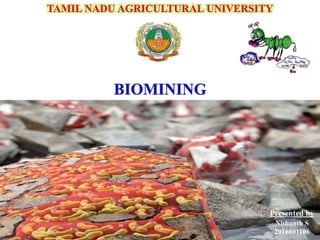
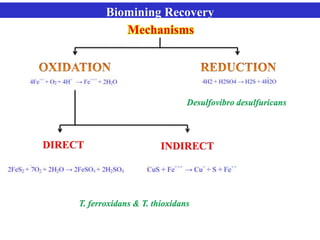
Presented by
Nishanth S
2016601106
Introduction
Traditional ways of mining:
Excavation
Crushing
Smelting
Extraction of Fe, Cu & Au
Why Biomining?
Dust
Gases
Toxic compounds
1. Cheap
2. Reliable
3. Efficient
4. Safe
5. Environmentally friendly
The use of micro-organisms to facilitate the extraction and
recovery of precious and base metals from primary ores and
concentrates, referred to generically as ‘biomining’, has developed
into successful and expanding area of biotechnology.
Simply,
1. Extracting mineral ores
2. Enhancing the mineral recovery
Copper - first metal extracted using microorganisms
Rio Tinto mines in Spain 1752.
Biomining
Rawlings & Johnson (2007)
Rossi (1990)
BIOLEACHING / BIO-OXIDATION
How this could be possible!!!
Extraction of metals Removal of constituents
Mediated by microbial enzymes Metabolite formed by the MO’s
Oxidases/Reductases Organic / Inorganic acids
Biomining Recovery
DIRECT INDIRECT
T. ferroxidans & T. thioxidans
Desulfovibro desulfuricans
Characteristics of organisms
Process involved Character
1. Production of high
temperatures
THERMOPHILIC
2. Strong acids and alkalis CHEMOPHILIC
3. Produce energy from inorganic
compounds
AUTOTROPHIC
4. Attachment BIOFILMS
Examples:
Thiobacillus ferrooxidans - Chemophilic, Moderately thermophilic, Produce
energy from oxidation of inorganic compounds like sulfur and iron.
Thermothrix thiopara - extremely thermophilic 60-75C - extraction of sulfur
Sulfolobus acidocaldarius
S. brierleyi
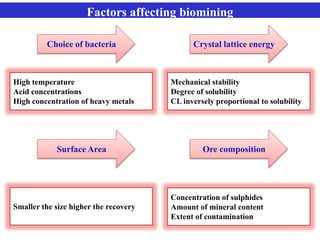
Factors affecting biomining
Crystal lattice energy
Surface Area
High temperature
Acid concentrations
High concentration of heavy metals
Mechanical stability
Degree of solubility
CL inversely proportional to solubility
Smaller the size higher the recovery
Concentration of sulphides
Amount of mineral content
Extent of contamination
Ore composition
Choice of bacteria
Factors affecting biomining
TemperatureAcidity
Aeration
Solid-Liquid ratio Surfactants
pH 2.5 – 5.3
Mesophilic / Thermophilic
25-35C
Aerobic
Stirred Tank Biomining
Bioheaps
In –situ biomining
Types of Biomining
Stirred tank biomining
Leaching from substrates with
high mineral concentration
Types of Biomining
Expensive
Time consuming
Copper and refractory gold ores
Thiobacillus is commonly used
Bioheaps
CRUSHING
Acid treatment
Agglomeration
Water treatment
Breakdown into small particles
Growth & multiplication of chemophilic
bacteria
Finner particles attached to the coarse ones
Optimization of moisture content
Height: 2- 10 feet
with altering tubes for air supply
biopiles/ biomounds/ biocells
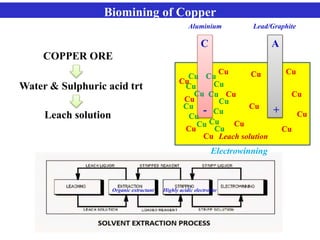
Biomining of Copper
COPPER ORE
Water & Sulphuric acid trt
Leach solution
Lead/Graphite
Cu
C A
Aluminium
- +
Cu
Cu
Cu
Cu
Cu
Cu
Cu
Cu
CuCu Cu
Cu
Cu
Cu
Cu
Cu
Cu
Cu Cu
Cu
Cu
Cu
Cu
Cu
Cu
Organic extractant Highly acidic electrolyte
Leach solution
Electrowinning
1. http://biologywriteup.blogspot.in/2014/10/biomining-use-of-
microbes-biomining.html
2. Agate, A D. 1996. Recent Advances in Microbial mining. World
Journal of Microbiology & Biotechnology 12: 497-495
3. Rawlings, D.E, Johnson,D.B. 2007. The microbiology of
biomining: development and optimization of mineral-oxidizing
microbial consortia. Microbiology,153: 315–324
References
Biomining

Biomining

  • 1.
  • 2.
    Introduction Traditional ways ofmining: Excavation Crushing Smelting Extraction of Fe, Cu & Au Why Biomining? Dust Gases Toxic compounds 1. Cheap 2. Reliable 3. Efficient 4. Safe 5. Environmentally friendly
  • 3.
    The use ofmicro-organisms to facilitate the extraction and recovery of precious and base metals from primary ores and concentrates, referred to generically as ‘biomining’, has developed into successful and expanding area of biotechnology. Simply, 1. Extracting mineral ores 2. Enhancing the mineral recovery Copper - first metal extracted using microorganisms Rio Tinto mines in Spain 1752. Biomining Rawlings & Johnson (2007) Rossi (1990)
  • 4.
    BIOLEACHING / BIO-OXIDATION Howthis could be possible!!! Extraction of metals Removal of constituents Mediated by microbial enzymes Metabolite formed by the MO’s Oxidases/Reductases Organic / Inorganic acids
  • 5.
    Biomining Recovery DIRECT INDIRECT T.ferroxidans & T. thioxidans Desulfovibro desulfuricans
  • 6.
    Characteristics of organisms Processinvolved Character 1. Production of high temperatures THERMOPHILIC 2. Strong acids and alkalis CHEMOPHILIC 3. Produce energy from inorganic compounds AUTOTROPHIC 4. Attachment BIOFILMS Examples: Thiobacillus ferrooxidans - Chemophilic, Moderately thermophilic, Produce energy from oxidation of inorganic compounds like sulfur and iron. Thermothrix thiopara - extremely thermophilic 60-75C - extraction of sulfur Sulfolobus acidocaldarius S. brierleyi
  • 7.
    Factors affecting biomining Crystallattice energy Surface Area High temperature Acid concentrations High concentration of heavy metals Mechanical stability Degree of solubility CL inversely proportional to solubility Smaller the size higher the recovery Concentration of sulphides Amount of mineral content Extent of contamination Ore composition Choice of bacteria
  • 8.
    Factors affecting biomining TemperatureAcidity Aeration Solid-Liquidratio Surfactants pH 2.5 – 5.3 Mesophilic / Thermophilic 25-35C Aerobic
  • 9.
    Stirred Tank Biomining Bioheaps In–situ biomining Types of Biomining
  • 10.
    Stirred tank biomining Leachingfrom substrates with high mineral concentration Types of Biomining Expensive Time consuming Copper and refractory gold ores Thiobacillus is commonly used
  • 11.
    Bioheaps CRUSHING Acid treatment Agglomeration Water treatment Breakdowninto small particles Growth & multiplication of chemophilic bacteria Finner particles attached to the coarse ones Optimization of moisture content Height: 2- 10 feet with altering tubes for air supply biopiles/ biomounds/ biocells
  • 12.
    Biomining of Copper COPPERORE Water & Sulphuric acid trt Leach solution Lead/Graphite Cu C A Aluminium - + Cu Cu Cu Cu Cu Cu Cu Cu CuCu Cu Cu Cu Cu Cu Cu Cu Cu Cu Cu Cu Cu Cu Cu Cu Organic extractant Highly acidic electrolyte Leach solution Electrowinning
  • 13.
    1. http://biologywriteup.blogspot.in/2014/10/biomining-use-of- microbes-biomining.html 2. Agate,A D. 1996. Recent Advances in Microbial mining. World Journal of Microbiology & Biotechnology 12: 497-495 3. Rawlings, D.E, Johnson,D.B. 2007. The microbiology of biomining: development and optimization of mineral-oxidizing microbial consortia. Microbiology,153: 315–324 References