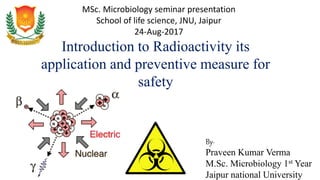
Introduction to Radioactivity its
application and preventive measure for
safety
By-
Praveen Kumar Verma
M.Sc. Microbiology 1st Year
Jaipur national University
MSc. Microbiology seminar presentation
School of life science, JNU, Jaipur
24-Aug-2017
Discovery of Radioactivity
Henri Bequerel (1852-1908)
During his studies of phosphorescence (1896), found a mineral (uranium)
would darken a photographic plate even if the plate was wrapped. Found that this
mineral emitted a new kind of radiation (X-rays needed an external stimulus),
Named radioactivity.
 Marie (1867-1934) and Pierre (1859-1906) Curie
isolated two previously unknown radioactive materials, polonium and radium.
Radioactivity was found to be unaffected by chemical and physical testing, showing that the
radiation came from the atom itself – specifically from the disintegration or decay of an
unstable nucleus
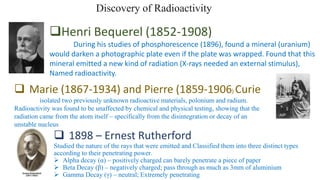
 1898 – Ernest Rutherford
Studied the nature of the rays that were emitted and Classified them into three distinct types
according to their penetrating power.
 Alpha decay (α) – positively charged can barely penetrate a piece of paper
 Beta Decay (β) – negatively charged; pass through as much as 3mm of aluminium
 Gamma Decay (γ) – neutral; Extremely penetrating
Isotopes and radioactive isotopes
Isotopes- are atoms with the same number of protons but that have a
different number of neutrons.
Radioactive Isotopes
 Uranium
 Plutonium
etc.
Isotopes
 Hydrogen
 Carbon
etc.
Concept of decay
 The number of atoms left after a specified amount of time to decay. Like example
decay of uranium in power plant
 The number of decays per second is called the activity of the sample.
 To signify how fast an isotope decays, the term “half life” is used. The half life of an
isotope is the time it takes half of the original sample to decay
N/t  N(t)
N  number of radionuclides
at some moment of time t
N  number of nuclei that
decay in a time interval t
  decay constant
N0  initial number of nuclei
e = 2.718
N = Nt

N(t) = N0 e t
 Equation of radioactive decay
Alpha Decay
Transmutation is the changing of one element into another by
the release of alpha [particle i.e. Helium
Beta decay occurs with the emission
of an electron (e-) or β- particle.
Beta Decay
neutrinoaeNC  14
7
14
6
Gamma rays are photons having very high energies. The
decay of a nucleus by the emission of a gamma ray is much
like the emission of photons by excited electrons.
The gamma rays come from an excited nucleus that is
trying to get back to its ground state.
Gamma Decay
 CC 12
6
12
6
Half-life
N0/2 = N0 e T1/2
T1/2 = 0.693/

Half life of any radioactive substance is the time interval after
which the final concentration of substance become half of initial
concentration
T1/2  half-life
N0  initial number of nuclei
e = 2.718
N  number of radionuclides at
some moment of time t
Types of Half Life
•Physical half-life: The length of time required for one half of the original
number of atoms in a given radioactive sample to disintegrate.
•Biologic half-life: The time required for the body to eliminate one half of
the dose of any substance by the regular process of elimination
•Effective half-life: The time required for the body to eliminate one half of
the dose of any radioactive substance.
Principle of scinitillation
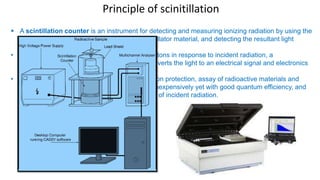
 A scintillation counter is an instrument for detecting and measuring ionizing radiation by using the
excitation effect of incident radiation on a scintillator material, and detecting the resultant light
pulses.
• It consists of a scintillator which generates photons in response to incident radiation, a
sensitive photomultiplier tube (PMT) which converts the light to an electrical signal and electronics
to process this signal.
• Scintillation counters are widely used in radiation protection, assay of radioactive materials and
physics research because they can be made inexpensively yet with good quantum efficiency, and
can measure both the intensity and the energy of incident radiation.
Principle GM counter
• A Geiger counter consists of a Geiger-Müller tube, the sensing element which detects
the radiation, and the processing electronics, which displays the result
• The Geiger-Müller tube is filled with an inert gas such as helium, neon, or argon at low
pressure, to which a high voltage is applied. The tube briefly conducts electrical charge
when a particle or photon of incident radiation makes the gas conductive by ionization.
The ionization is considerably amplified within the tube by the Townsend
discharge effect to produce an easily measured detection pulse, which is fed to the
processing and display electronics.
Applications of Radioactive Isotopes
(A) Investigating Aspects of Metabolism
Metabolic Pathways
Metabolic Turnover Times
Studies of Absorption, Accumulation and Translocation
Pharmacological Studies
(B) Analytical Applications
Enzyme and Ligand Binding Studies
Isotope Dilution Analysis
Radioimmunoassay
Radio Dating
(C) Other Applications
Molecular Biology Techniques
Clinical Diagnosis
Ecological Studies
Sterilization of Food and Equipment
Mutagens
Autoradiography
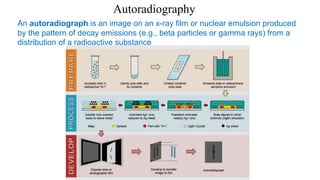
An autoradiograph is an image on an x-ray film or nuclear emulsion produced
by the pattern of decay emissions (e.g., beta particles or gamma rays) from a
distribution of a radioactive substance
Turnover Rate and Studies
•Turnover of Phosphorus-Containing
Carbohydrates
•Turnover of Nucleic Acids
•Phosphorus Turnover in Cell Nuclei
•Phosphorus Turnover in Leukemic Tissue
•Intravenous Transfer of 32P from
Chromatin to Hepatic Tissue
IN a recent communication, Kleiber criticized the ‘logic’ of the term ‘turnover-rate’ used
as an index of rate of synthesis, exchange, or appearance of some material. He suggested
that turnover-rate should properly refer only to the reciprocal of turnover time, that is, the
fraction of a given metabolic pool renewed per unit of time.
Some examples of turnover rate studies
•Phosphorus Turnover in Yeast
•Studies of Virus Reproduction
•Dynamic State of Body Constituents
•Turnover of Sulfur Compounds
•Role of Iodine in Thyroid Metabolism.
Turnover of Diiodotyrosine and Thyroxin
•Turnover of Phosphatides
Radiation Hazard
•Radiation injury causes changes in the living tissues causing radiation sickness
•Somatic effects -harmful to the person
•Genetic effects - reflected in the offspring.
•Radiation decomposition i.e. splitting of water into H+ and OH- and also splitting
of other solvents of the body.
•kinetic energy of the incident photons heats up the molecules of the living tissues
•Incident radiation when traveling through the body tissues knock out the bound
electrons free from their parent atoms or molecules. These free electrons are highly
unstable and interact with other atoms and molecules within the irradiated system.
Prevention of radiation hazard and safety
Principles of radiation safety:
The distance between the radiation source and personnel exposed should be increased.
Usually doubling the distance from the source will reduce the radiation exposure by a
factor of four
Key for prevention
 Allow only the operator in the x- ray room when exposures are made
 Always try to restraint the animal or subject by anesthesia
 Always use a cassette holding device especially in large animal radiography.
 Behind the Shielding screen or at least 6 feet away from the source the exposure should be made.
 Fluoroscopy should never be used as a substitute for a non motion radiographic procedure as amount of
radiations is extremely large in fluoroscopy.
 Use of protective barriers
 Use of optimal exposure factors and reduction of unnecessary radiography
 Use of intensifying screens minimizes the factors.
 Provide workers with instruction and training on the health effects associated with radiation exposure and the
safe use of equipment.
 Pregnant woman and persons under 18 years of age should not be involved in radiographic work as it may
adversely affect the growing fetus and the gonads of the persons exposed which may cause sterility or infertility.
 Users may receive a dosimeter badge or ring to monitor radiation exposure.
References
Web pages
i. http://www.biologydiscussion.com/biochemistry/radioisotope-techniques/various-applications-of-radioisotopes/12926
ii. https://www.ncbi.nlm.nih.gov/pmc/articles/PMC1953657/
iii. http://ib.bioninja.com.au/standard-level/topic-3-genetics/32-chromosomes/chromosome-size.html
iv. https://www.thoughtco.com/definition-of-isotopes-and-examples-604541
v. http://study.com/academy/lesson/radioactive-isotope-definition-uses.html
Reserch articles
i. Pochin EE. RADIOACTIVE ISOTOPES IN BIOCHEMISTRY. British Medical Journal. 1961;1(5232):1091-1092.
ii. Pochin, E. E. “RADIOACTIVE ISOTOPES IN BIOCHEMISTRY.” British Medical Journal 1.5232 (1961): 1091–1092.
iii. Pochin, E. E. (1961). RADIOACTIVE ISOTOPES IN BIOCHEMISTRY. British Medical Journal, 1(5232), 1091–1092.
iv. Kleiber, M. , Nature, 175, 342 (1955). | PubMed | ISI | ChemPort
v. Zilversmit, D. B. , Entenman, C. , and Fishler, M. C. , J. Gen. Physiol., 26, 325 (1943). | Article | ChemPort |
vi. F. F. Nord, G. Hevesy; Some Applications of Radioactive Indicators in Turnover Studies; 22 NOV 2006,
Wikipedia refrance link
i. https://en.wikipedia.org/wiki/Geiger_counter
ii. https://en.wikipedia.org/wiki/Scintillation_counter
Introduction to radioactivity

Introduction to radioactivity

  • 1.
    Introduction to Radioactivityits application and preventive measure for safety By- Praveen Kumar Verma M.Sc. Microbiology 1st Year Jaipur national University MSc. Microbiology seminar presentation School of life science, JNU, Jaipur 24-Aug-2017
  • 2.
    Discovery of Radioactivity HenriBequerel (1852-1908) During his studies of phosphorescence (1896), found a mineral (uranium) would darken a photographic plate even if the plate was wrapped. Found that this mineral emitted a new kind of radiation (X-rays needed an external stimulus), Named radioactivity.  Marie (1867-1934) and Pierre (1859-1906) Curie isolated two previously unknown radioactive materials, polonium and radium. Radioactivity was found to be unaffected by chemical and physical testing, showing that the radiation came from the atom itself – specifically from the disintegration or decay of an unstable nucleus  1898 – Ernest Rutherford Studied the nature of the rays that were emitted and Classified them into three distinct types according to their penetrating power.  Alpha decay (α) – positively charged can barely penetrate a piece of paper  Beta Decay (β) – negatively charged; pass through as much as 3mm of aluminium  Gamma Decay (γ) – neutral; Extremely penetrating
  • 3.
    Isotopes and radioactiveisotopes Isotopes- are atoms with the same number of protons but that have a different number of neutrons. Radioactive Isotopes  Uranium  Plutonium etc. Isotopes  Hydrogen  Carbon etc.
  • 4.
    Concept of decay The number of atoms left after a specified amount of time to decay. Like example decay of uranium in power plant  The number of decays per second is called the activity of the sample.  To signify how fast an isotope decays, the term “half life” is used. The half life of an isotope is the time it takes half of the original sample to decay N/t  N(t) N  number of radionuclides at some moment of time t N  number of nuclei that decay in a time interval t   decay constant N0  initial number of nuclei e = 2.718 N = Nt  N(t) = N0 e t  Equation of radioactive decay Alpha Decay Transmutation is the changing of one element into another by the release of alpha [particle i.e. Helium Beta decay occurs with the emission of an electron (e-) or β- particle. Beta Decay neutrinoaeNC  14 7 14 6 Gamma rays are photons having very high energies. The decay of a nucleus by the emission of a gamma ray is much like the emission of photons by excited electrons. The gamma rays come from an excited nucleus that is trying to get back to its ground state. Gamma Decay  CC 12 6 12 6
  • 5.
    Half-life N0/2 = N0e T1/2 T1/2 = 0.693/  Half life of any radioactive substance is the time interval after which the final concentration of substance become half of initial concentration T1/2  half-life N0  initial number of nuclei e = 2.718 N  number of radionuclides at some moment of time t
  • 6.
    Types of HalfLife •Physical half-life: The length of time required for one half of the original number of atoms in a given radioactive sample to disintegrate. •Biologic half-life: The time required for the body to eliminate one half of the dose of any substance by the regular process of elimination •Effective half-life: The time required for the body to eliminate one half of the dose of any radioactive substance.
  • 7.
    Principle of scinitillation A scintillation counter is an instrument for detecting and measuring ionizing radiation by using the excitation effect of incident radiation on a scintillator material, and detecting the resultant light pulses. • It consists of a scintillator which generates photons in response to incident radiation, a sensitive photomultiplier tube (PMT) which converts the light to an electrical signal and electronics to process this signal. • Scintillation counters are widely used in radiation protection, assay of radioactive materials and physics research because they can be made inexpensively yet with good quantum efficiency, and can measure both the intensity and the energy of incident radiation.
  • 8.
    Principle GM counter •A Geiger counter consists of a Geiger-Müller tube, the sensing element which detects the radiation, and the processing electronics, which displays the result • The Geiger-Müller tube is filled with an inert gas such as helium, neon, or argon at low pressure, to which a high voltage is applied. The tube briefly conducts electrical charge when a particle or photon of incident radiation makes the gas conductive by ionization. The ionization is considerably amplified within the tube by the Townsend discharge effect to produce an easily measured detection pulse, which is fed to the processing and display electronics.
  • 9.
    Applications of RadioactiveIsotopes (A) Investigating Aspects of Metabolism Metabolic Pathways Metabolic Turnover Times Studies of Absorption, Accumulation and Translocation Pharmacological Studies (B) Analytical Applications Enzyme and Ligand Binding Studies Isotope Dilution Analysis Radioimmunoassay Radio Dating (C) Other Applications Molecular Biology Techniques Clinical Diagnosis Ecological Studies Sterilization of Food and Equipment Mutagens
  • 10.
    Autoradiography An autoradiograph isan image on an x-ray film or nuclear emulsion produced by the pattern of decay emissions (e.g., beta particles or gamma rays) from a distribution of a radioactive substance
  • 11.
    Turnover Rate andStudies •Turnover of Phosphorus-Containing Carbohydrates •Turnover of Nucleic Acids •Phosphorus Turnover in Cell Nuclei •Phosphorus Turnover in Leukemic Tissue •Intravenous Transfer of 32P from Chromatin to Hepatic Tissue IN a recent communication, Kleiber criticized the ‘logic’ of the term ‘turnover-rate’ used as an index of rate of synthesis, exchange, or appearance of some material. He suggested that turnover-rate should properly refer only to the reciprocal of turnover time, that is, the fraction of a given metabolic pool renewed per unit of time. Some examples of turnover rate studies •Phosphorus Turnover in Yeast •Studies of Virus Reproduction •Dynamic State of Body Constituents •Turnover of Sulfur Compounds •Role of Iodine in Thyroid Metabolism. Turnover of Diiodotyrosine and Thyroxin •Turnover of Phosphatides
  • 12.
    Radiation Hazard •Radiation injurycauses changes in the living tissues causing radiation sickness •Somatic effects -harmful to the person •Genetic effects - reflected in the offspring. •Radiation decomposition i.e. splitting of water into H+ and OH- and also splitting of other solvents of the body. •kinetic energy of the incident photons heats up the molecules of the living tissues •Incident radiation when traveling through the body tissues knock out the bound electrons free from their parent atoms or molecules. These free electrons are highly unstable and interact with other atoms and molecules within the irradiated system.
  • 13.
    Prevention of radiationhazard and safety Principles of radiation safety: The distance between the radiation source and personnel exposed should be increased. Usually doubling the distance from the source will reduce the radiation exposure by a factor of four Key for prevention  Allow only the operator in the x- ray room when exposures are made  Always try to restraint the animal or subject by anesthesia  Always use a cassette holding device especially in large animal radiography.  Behind the Shielding screen or at least 6 feet away from the source the exposure should be made.  Fluoroscopy should never be used as a substitute for a non motion radiographic procedure as amount of radiations is extremely large in fluoroscopy.  Use of protective barriers  Use of optimal exposure factors and reduction of unnecessary radiography  Use of intensifying screens minimizes the factors.  Provide workers with instruction and training on the health effects associated with radiation exposure and the safe use of equipment.  Pregnant woman and persons under 18 years of age should not be involved in radiographic work as it may adversely affect the growing fetus and the gonads of the persons exposed which may cause sterility or infertility.  Users may receive a dosimeter badge or ring to monitor radiation exposure.
  • 14.
    References Web pages i. http://www.biologydiscussion.com/biochemistry/radioisotope-techniques/various-applications-of-radioisotopes/12926 ii.https://www.ncbi.nlm.nih.gov/pmc/articles/PMC1953657/ iii. http://ib.bioninja.com.au/standard-level/topic-3-genetics/32-chromosomes/chromosome-size.html iv. https://www.thoughtco.com/definition-of-isotopes-and-examples-604541 v. http://study.com/academy/lesson/radioactive-isotope-definition-uses.html Reserch articles i. Pochin EE. RADIOACTIVE ISOTOPES IN BIOCHEMISTRY. British Medical Journal. 1961;1(5232):1091-1092. ii. Pochin, E. E. “RADIOACTIVE ISOTOPES IN BIOCHEMISTRY.” British Medical Journal 1.5232 (1961): 1091–1092. iii. Pochin, E. E. (1961). RADIOACTIVE ISOTOPES IN BIOCHEMISTRY. British Medical Journal, 1(5232), 1091–1092. iv. Kleiber, M. , Nature, 175, 342 (1955). | PubMed | ISI | ChemPort v. Zilversmit, D. B. , Entenman, C. , and Fishler, M. C. , J. Gen. Physiol., 26, 325 (1943). | Article | ChemPort | vi. F. F. Nord, G. Hevesy; Some Applications of Radioactive Indicators in Turnover Studies; 22 NOV 2006, Wikipedia refrance link i. https://en.wikipedia.org/wiki/Geiger_counter ii. https://en.wikipedia.org/wiki/Scintillation_counter