 Some substances emit light when radiation fall on them.
Emission process is called fluorescence or
phosphorescence. Light output can be used as a
measure of incident radiation. This is the principle of
scintillation detectors
 Fluorescence: Prompt emission of visible radiation from
a substance following its excitation
 Delayed Fluorescence: Delayed emission of visible
radiation from a substance following its excitation
 Phosphorescence: Emission of longer wave length.
Lighter than fluorescence
Nuclear Detectors 2
 High scintillation efficiency
 Light yield should be proportional to the deposited
energy
 Detector material should be transparent to the
wavelength of its own emission
 Decay time of the induced luminescence should be
short
 It should be possible to make them in large size and
desired shape
Nuclear Detectors 3
 Refractive index should be near to that of glass (1.5) to
permit efficient coupling with the photo multiplier tube
 High density and high atomic number
 Good temperature stability and mechanical properties
 Good resolution
 Ease of operation
 Non hygroscopic
Nuclear Detectors 4
 Inorganic Scintillator
 Organic Scintillator
Nuclear Detectors 5
Both inorganic & organic Scintillators
can be used as detectors
 Alkali halides (NaI(Tl)) are the most widely used for
this purpose
 They are insulators and have wide gap between the
valence band and conduction band (NaI)
 Suitable activators (Tl) are used to create excited
states which decay by emission of light in the visible
range
 Decay time = 230 ns (91%), 0.15 sec (9%)
Nuclear Detectors 6
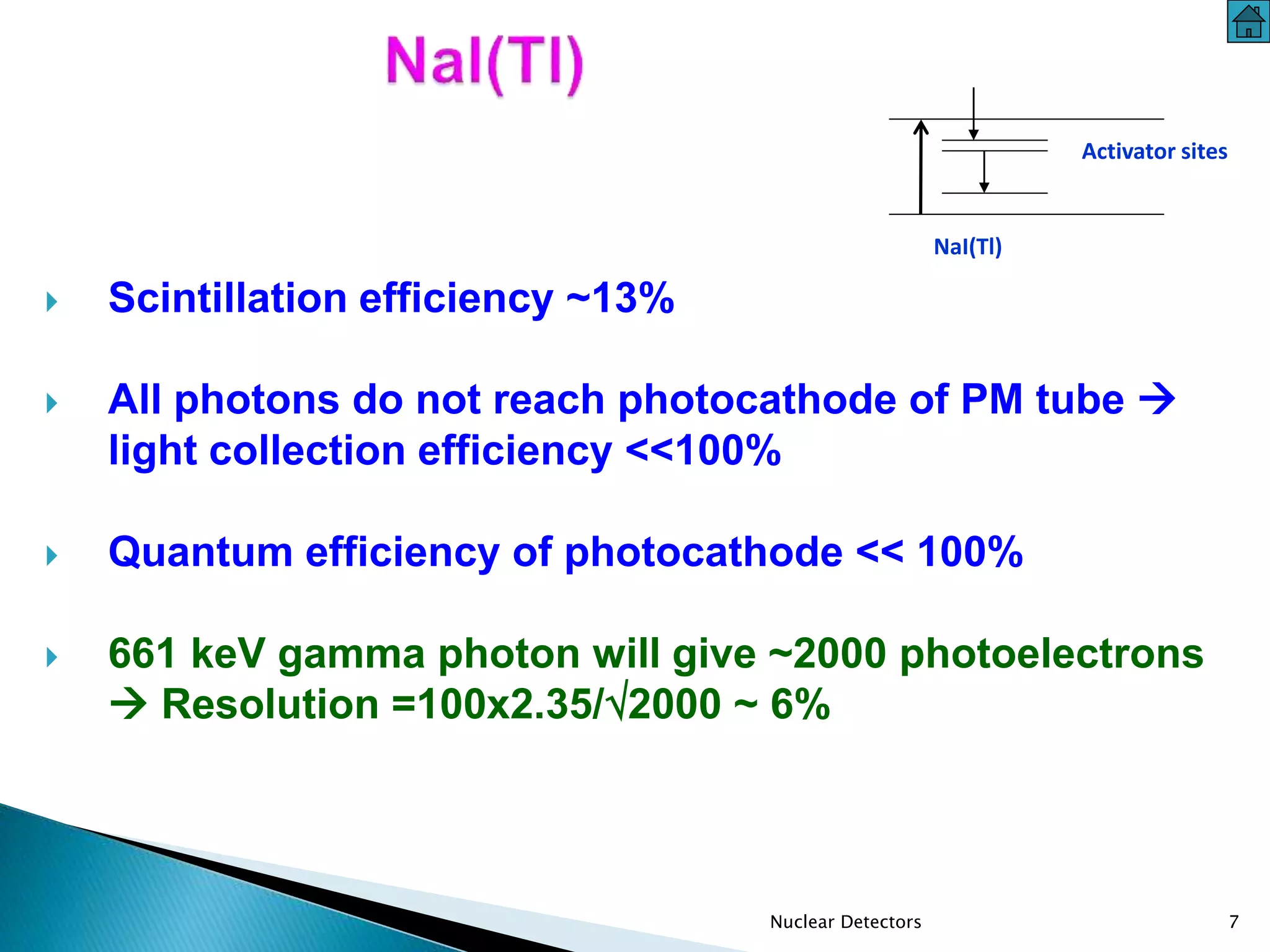
NaI(Tl)
 Scintillation efficiency ~13%
 All photons do not reach photocathode of PM tube 
light collection efficiency <<100%
 Quantum efficiency of photocathode << 100%
 661 keV gamma photon will give ~2000 photoelectrons
 Resolution =100x2.35/2000 ~ 6%
Nuclear Detectors 7
NaI(Tl)
Activator sites
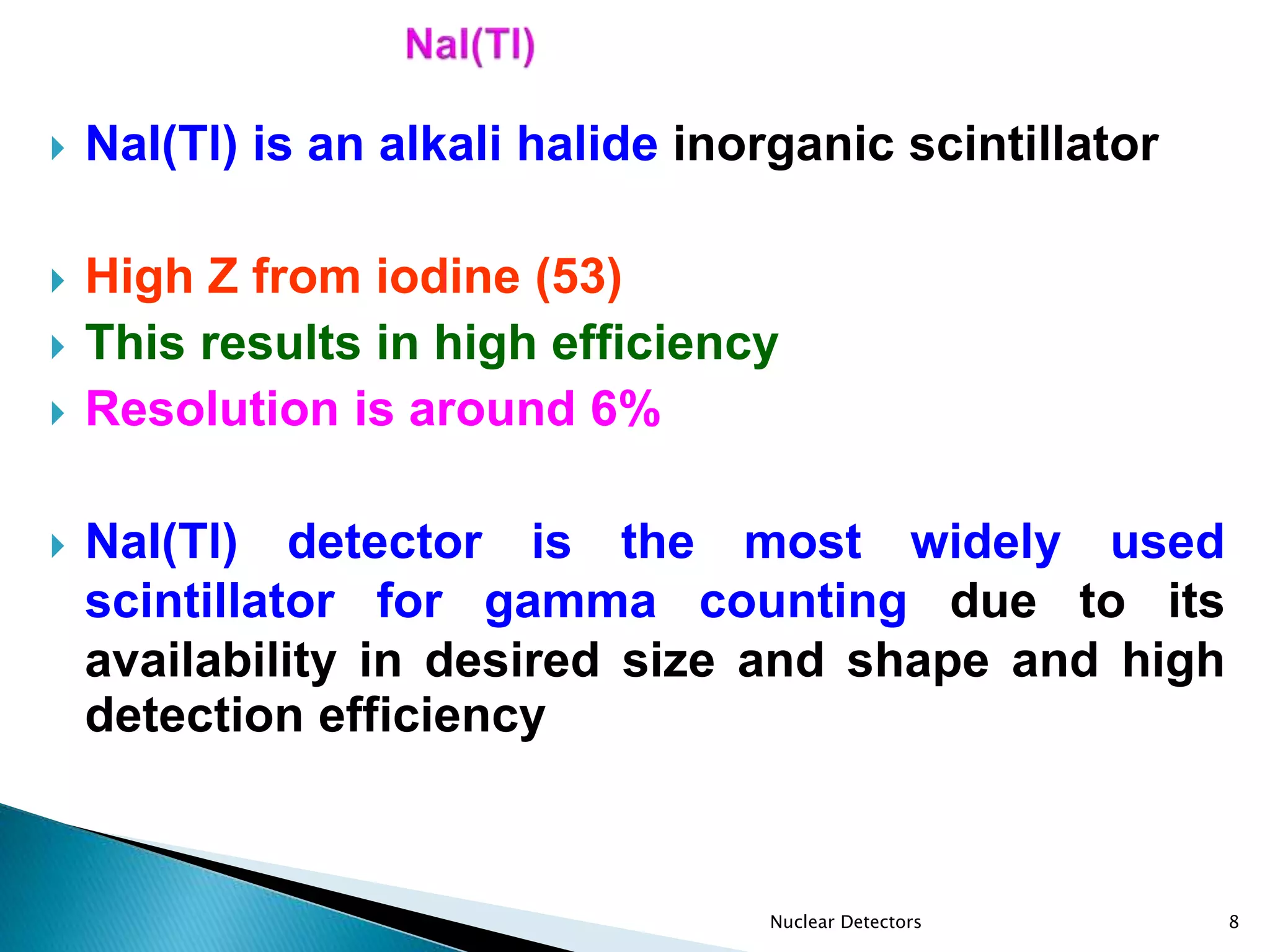
 NaI(Tl) is an alkali halide inorganic scintillator
 High Z from iodine (53)
 This results in high efficiency
 Resolution is around 6%
 NaI(Tl) detector is the most widely used
scintillator for gamma counting due to its
availability in desired size and shape and high
detection efficiency
Nuclear Detectors 8
Bismuth germinate (BGO) (Bi4Ge3O12) is a
scintillation crystal with high Z of bismuth (83)
 High intrinsic efficiency at high gamma ray
energies
 Excellent alternative to NaI for gross counting
applications
 Poor energy resolution
9
LaBr3 (Ce3+) gives an energy resolution of
2.9% for the 661.7 keV
Nuclear Detectors 10
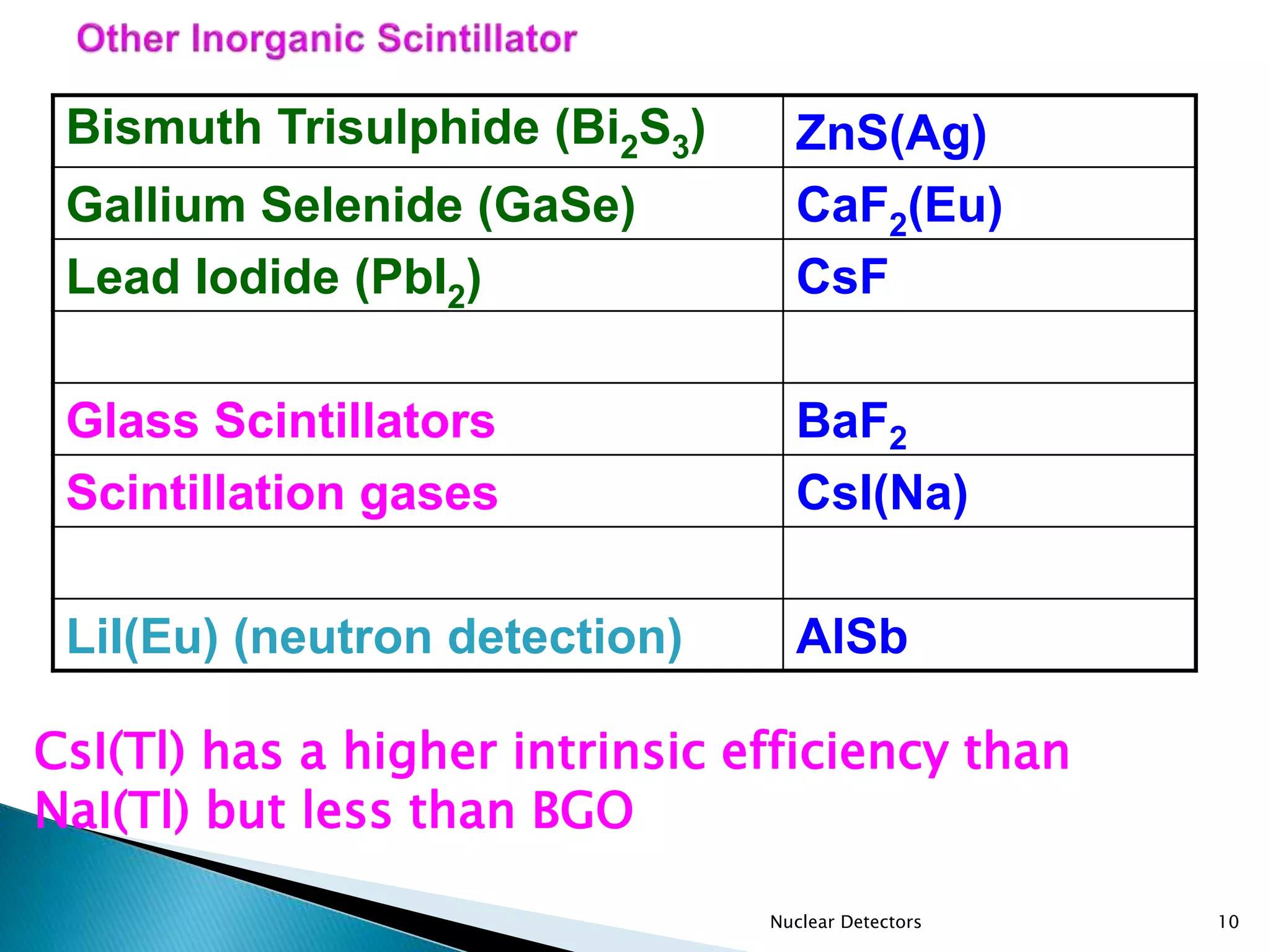
Bismuth Trisulphide (Bi2S3) ZnS(Ag)
Gallium Selenide (GaSe) CaF2(Eu)
Lead Iodide (PbI2) CsF
Glass Scintillators BaF2
Scintillation gases CsI(Na)
LiI(Eu) (neutron detection) AlSb
CsI(Tl) has a higher intrinsic efficiency than
NaI(Tl) but less than BGO
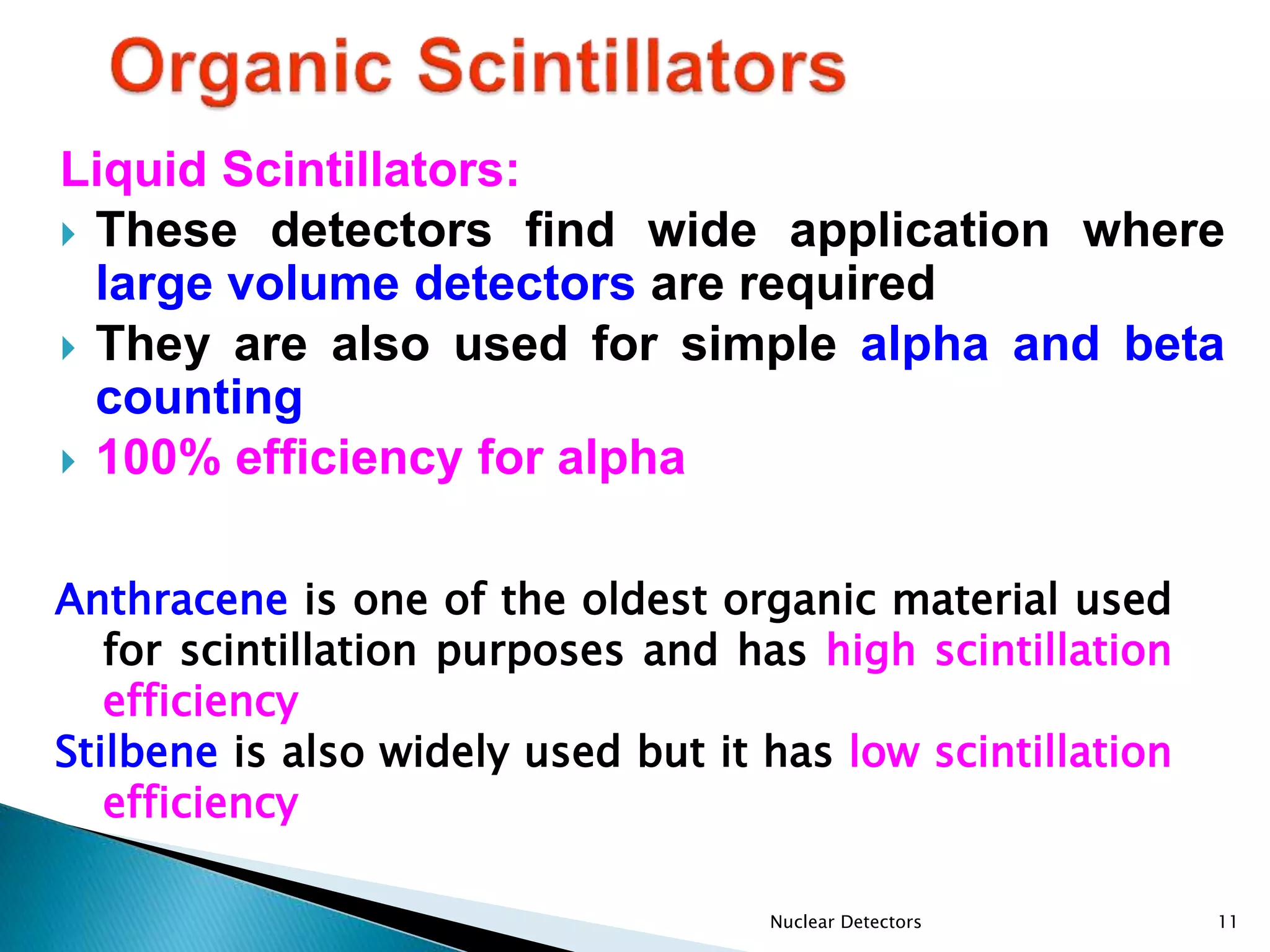
Liquid Scintillators:
 These detectors find wide application where
large volume detectors are required
 They are also used for simple alpha and beta
counting
 100% efficiency for alpha
Nuclear Detectors 11
Anthracene is one of the oldest organic material used
for scintillation purposes and has high scintillation
efficiency
Stilbene is also widely used but it has low scintillation
efficiency
 Solvent = Dioxan (1 litre)
 Scintillator = PPO (0.7%) (2,5 diphenyl oxazole)
 Wavelength shifter = POPOP (0.03%)
(1,4 bis-[2-(5-phenyloxazolyl)]-benzene
 To keep Pu in the complex form = TOPO (2%)
 Anti quencher = Naphthalene (10%)
Nuclear Detectors 12
Nuclear Detectors 13
 Fast timing response, they are very useful in
nuclear spectroscopy
 Poor energy resolution due to large energy
required for one photon/electron
 Used as anti-coincidence detector to reduce the
background or to reduce pile up effects
Nuclear Detectors 14
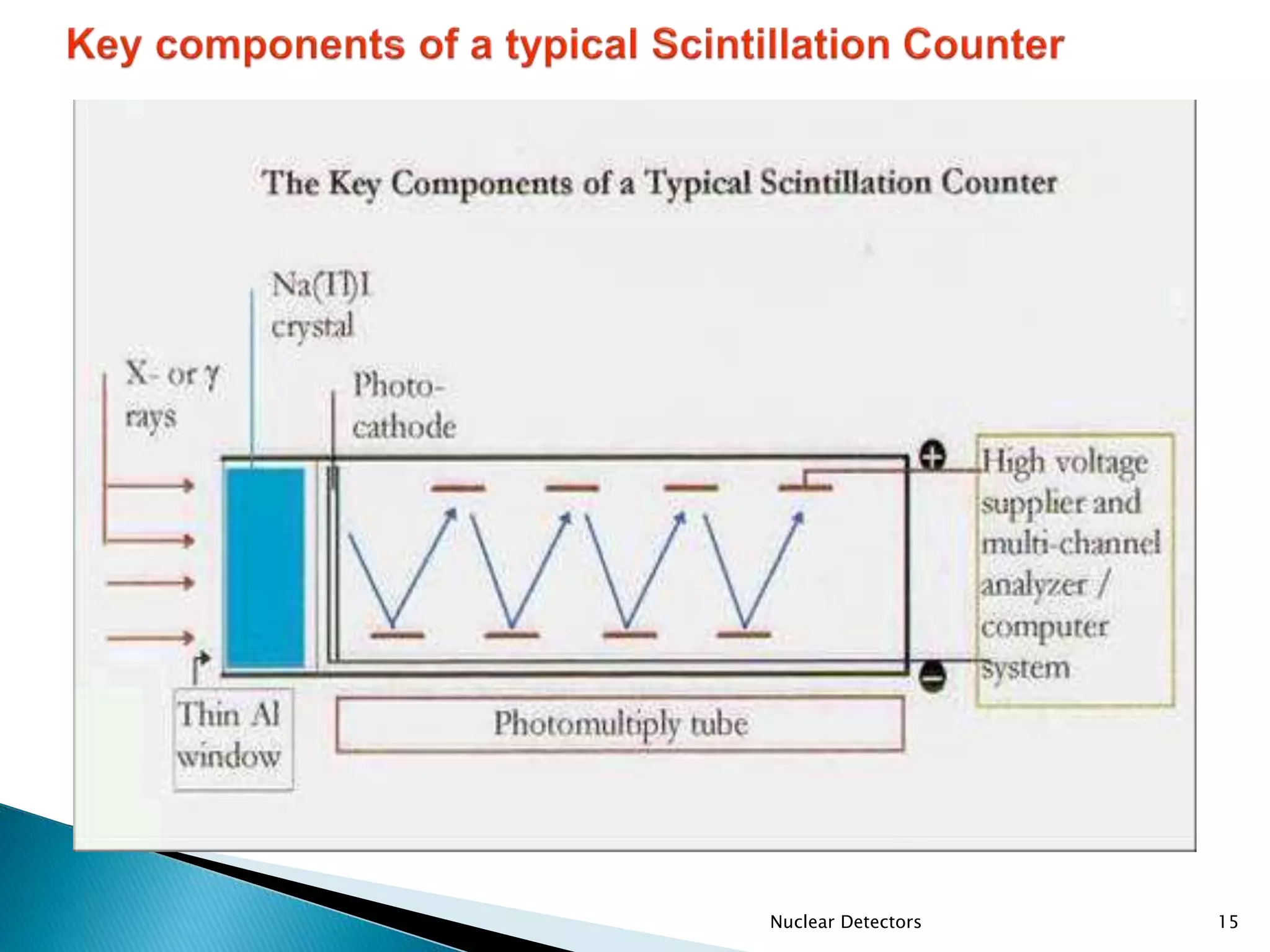
Nuclear Detectors 15
Nuclear Detectors 16
D = Compton Valley (Between Full Energy Photopeak and Compton Edge)
E = Backscatter Peak (Gamma ray scattering from the surrounding medium)
F = Excess Energy Region (Compton events from high energy gamma rays, Pile
up effect)
G = Low Energy Rise (Electronic noise)
Nuclear Detectors 17
A = Full Energy Photopeak (It
centeroid represent the photon
energy E0, Width is due to
statistical fluctuations)
B = Compton Background
Continuum (Below Compton
Edge)
C = Compton Edge (Ec) (It
represents the maximum
energy that a photon can
transfer in a single scattering
event
Fig 3.7 Page 53
Photopeak
Compton
Edge
Backscatter
Scintillation Detector.pptx

Scintillation Detector.pptx

  • 2.
     Some substancesemit light when radiation fall on them. Emission process is called fluorescence or phosphorescence. Light output can be used as a measure of incident radiation. This is the principle of scintillation detectors  Fluorescence: Prompt emission of visible radiation from a substance following its excitation  Delayed Fluorescence: Delayed emission of visible radiation from a substance following its excitation  Phosphorescence: Emission of longer wave length. Lighter than fluorescence Nuclear Detectors 2
  • 3.
     High scintillationefficiency  Light yield should be proportional to the deposited energy  Detector material should be transparent to the wavelength of its own emission  Decay time of the induced luminescence should be short  It should be possible to make them in large size and desired shape Nuclear Detectors 3
  • 4.
     Refractive indexshould be near to that of glass (1.5) to permit efficient coupling with the photo multiplier tube  High density and high atomic number  Good temperature stability and mechanical properties  Good resolution  Ease of operation  Non hygroscopic Nuclear Detectors 4
  • 5.
     Inorganic Scintillator Organic Scintillator Nuclear Detectors 5 Both inorganic & organic Scintillators can be used as detectors
  • 6.
     Alkali halides(NaI(Tl)) are the most widely used for this purpose  They are insulators and have wide gap between the valence band and conduction band (NaI)  Suitable activators (Tl) are used to create excited states which decay by emission of light in the visible range  Decay time = 230 ns (91%), 0.15 sec (9%) Nuclear Detectors 6 NaI(Tl)
  • 7.
     Scintillation efficiency~13%  All photons do not reach photocathode of PM tube  light collection efficiency <<100%  Quantum efficiency of photocathode << 100%  661 keV gamma photon will give ~2000 photoelectrons  Resolution =100x2.35/2000 ~ 6% Nuclear Detectors 7 NaI(Tl) Activator sites
  • 8.
     NaI(Tl) isan alkali halide inorganic scintillator  High Z from iodine (53)  This results in high efficiency  Resolution is around 6%  NaI(Tl) detector is the most widely used scintillator for gamma counting due to its availability in desired size and shape and high detection efficiency Nuclear Detectors 8
  • 9.
    Bismuth germinate (BGO)(Bi4Ge3O12) is a scintillation crystal with high Z of bismuth (83)  High intrinsic efficiency at high gamma ray energies  Excellent alternative to NaI for gross counting applications  Poor energy resolution 9 LaBr3 (Ce3+) gives an energy resolution of 2.9% for the 661.7 keV
  • 10.
    Nuclear Detectors 10 BismuthTrisulphide (Bi2S3) ZnS(Ag) Gallium Selenide (GaSe) CaF2(Eu) Lead Iodide (PbI2) CsF Glass Scintillators BaF2 Scintillation gases CsI(Na) LiI(Eu) (neutron detection) AlSb CsI(Tl) has a higher intrinsic efficiency than NaI(Tl) but less than BGO
  • 11.
    Liquid Scintillators:  Thesedetectors find wide application where large volume detectors are required  They are also used for simple alpha and beta counting  100% efficiency for alpha Nuclear Detectors 11 Anthracene is one of the oldest organic material used for scintillation purposes and has high scintillation efficiency Stilbene is also widely used but it has low scintillation efficiency
  • 12.
     Solvent =Dioxan (1 litre)  Scintillator = PPO (0.7%) (2,5 diphenyl oxazole)  Wavelength shifter = POPOP (0.03%) (1,4 bis-[2-(5-phenyloxazolyl)]-benzene  To keep Pu in the complex form = TOPO (2%)  Anti quencher = Naphthalene (10%) Nuclear Detectors 12
  • 13.
  • 14.
     Fast timingresponse, they are very useful in nuclear spectroscopy  Poor energy resolution due to large energy required for one photon/electron  Used as anti-coincidence detector to reduce the background or to reduce pile up effects Nuclear Detectors 14
  • 15.
  • 16.
  • 17.
    D = ComptonValley (Between Full Energy Photopeak and Compton Edge) E = Backscatter Peak (Gamma ray scattering from the surrounding medium) F = Excess Energy Region (Compton events from high energy gamma rays, Pile up effect) G = Low Energy Rise (Electronic noise) Nuclear Detectors 17 A = Full Energy Photopeak (It centeroid represent the photon energy E0, Width is due to statistical fluctuations) B = Compton Background Continuum (Below Compton Edge) C = Compton Edge (Ec) (It represents the maximum energy that a photon can transfer in a single scattering event Fig 3.7 Page 53 Photopeak Compton Edge Backscatter