This document discusses radiopharmaceuticals, which are radioactive compounds used for diagnosis and treatment of diseases. It defines radiopharmaceuticals as composed of a radionuclide and a pharmaceutical. It also discusses the structure of atoms, isotopes, types of radiation (alpha, beta, gamma), half-life, units of measurement for radioactivity (Curie, Becquerel), and devices used to measure radioactivity such as Geiger counters and scintillation counters.
RADIOPHARMACEUTICAL
Radiopharmaceutical ~ radiopharmaceuticalis a branch of
pharma in which radioactive compound used for The diagnosis &
therapeutic treatment of Human diseases.
Radiopharmaceutical composed Of
Radionuclide + pharmaceutical
• A Pharmaceutical that Target a specific oragan &Tissue and A
radioactive material (radio nuclide ) That Gives of small amount
of radiation.
3.
RADIOPHARMACEUTICAL PREPARATION
• Radiopharmaceuticalare medicinal formulation contains radioisotopes (Emit particular types of ionizing
radiation Which are safe for administration in Human for Diagnosis or for Therapy .
4.
STRUCTURE OF ATOM
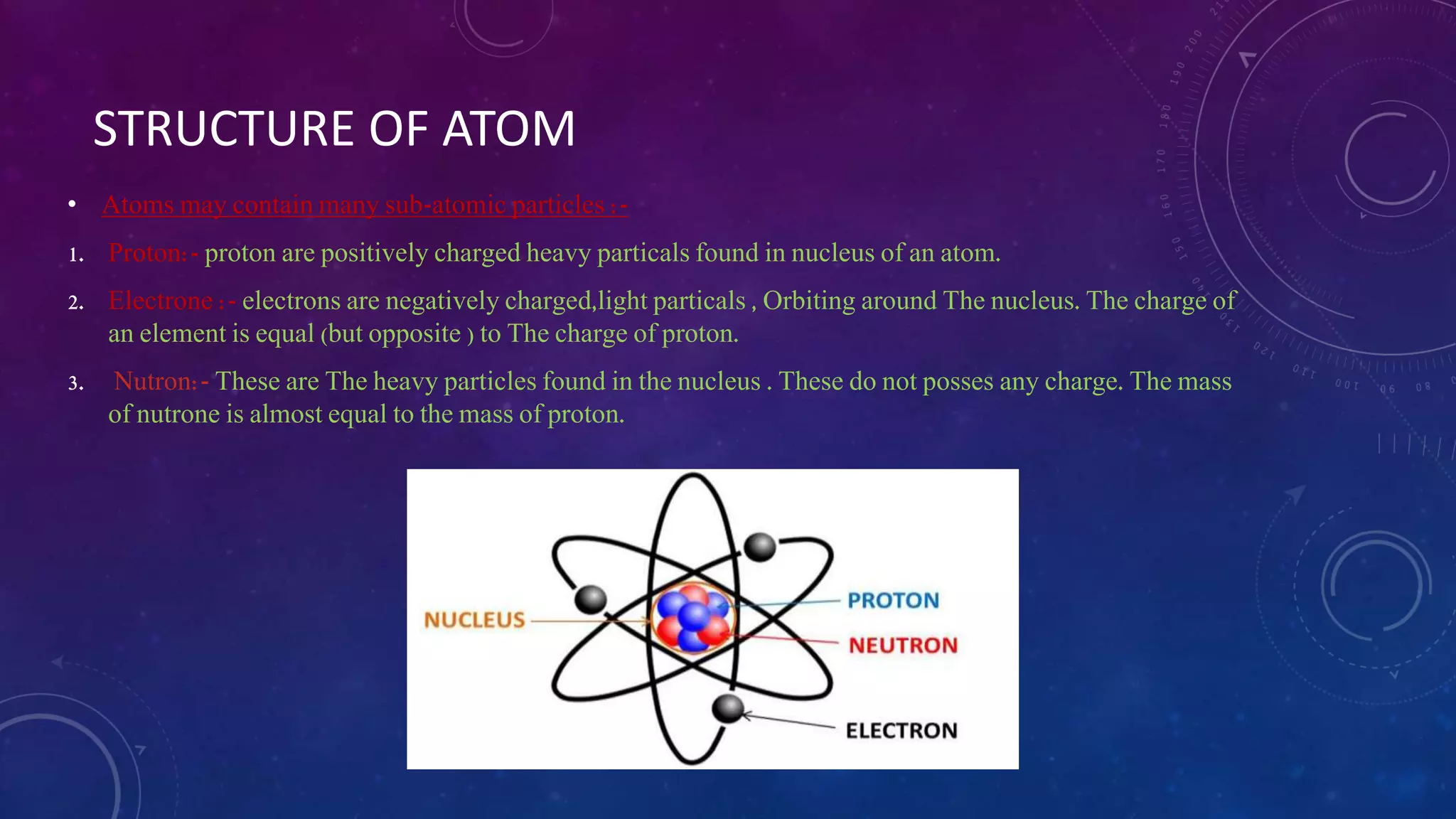
•Atoms may contain many sub-atomic particles :-
1. Proton:- proton are positively charged heavy particals found in nucleus of an atom.
2. Electrone :- electrons are negatively charged,light particals , Orbiting around The nucleus. The charge of
an element is equal (but opposite ) to The charge of proton.
3. Nutron:- These are The heavy particles found in the nucleus . These do not posses any charge. The mass
of nutrone is almost equal to the mass of proton.
5.
ISOTOPES
• Isotopes :-Isotopes are atoms of the same element which contain the same number of proton but different
number of neutrone. Means They have Same atomic number but different atomic mass.
• Isotops have same chemical properties but slightly different physical properties..
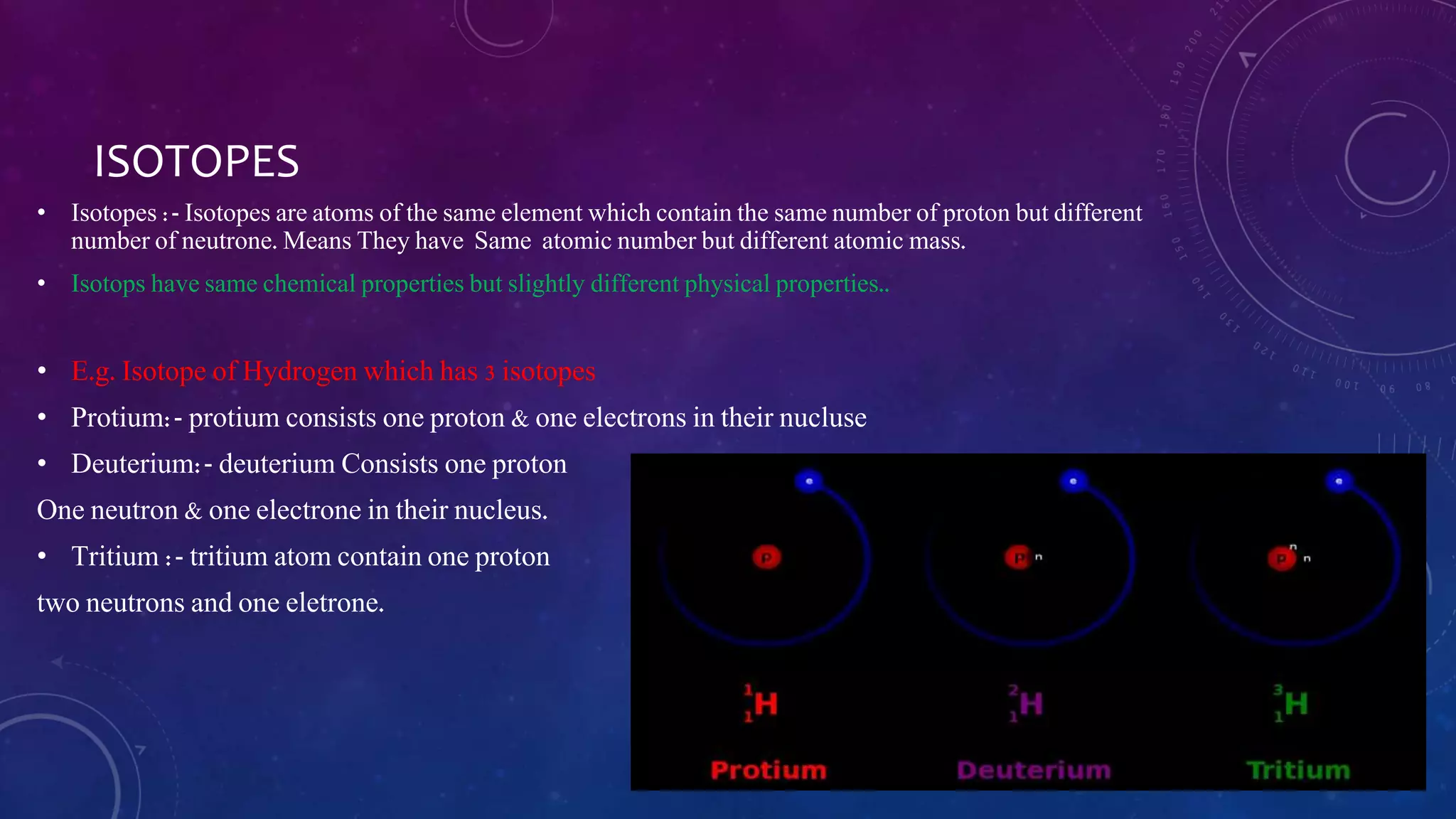
• E.g. Isotope of Hydrogen which has 3 isotopes
• Protium:- protium consists one proton & one electrons in their nucluse
• Deuterium:- deuterium Consists one proton
One neutron & one electrone in their nucleus.
• Tritium :- tritium atom contain one proton
two neutrons and one eletrone.
RADIO ACTIVITY
• ‘’thephenomenon of emitting raditions by the unstable isotopes (radioactive isotope) is known as
radioactivity’’
• *Unstable isotopes (nucleus) In order To become stable The make ‘decay’. This decay causes the
nucleus to emit ionising radiation and an atom of a different element is formed. These isotopes are
called ‘’radioisotops’’ or radio include.
• *a Unstable atomic nucleus emit a form of radiation (alpha , beta ,or gamma ) to became stable
8.
ALPHA PARTICLE
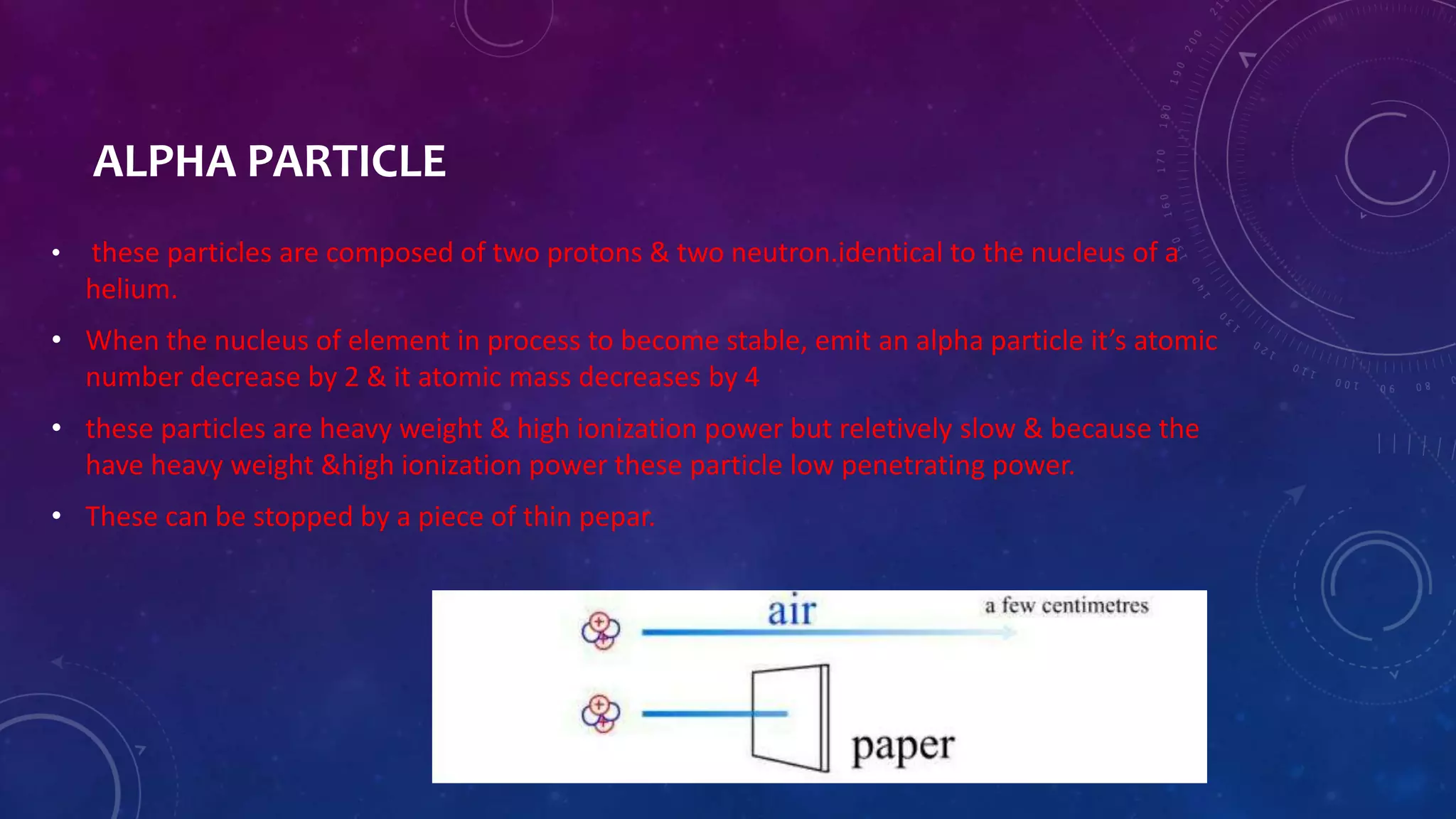
• theseparticles are composed of two protons & two neutron.identical to the nucleus of a
helium.
• When the nucleus of element in process to become stable, emit an alpha particle it’s atomic
number decrease by 2 & it atomic mass decreases by 4
• these particles are heavy weight & high ionization power but reletively slow & because the
have heavy weight &high ionization power these particle low penetrating power.
• These can be stopped by a piece of thin pepar.
9.
BETA PARTICLE
• Theseparticals simply high energy electrons emitted by nuclues & having a negative charge
• These particals have low mass but their energy is too high.because they have high energy the
range of beta particles in air is 1 metre.
• Beta particle being less ionising then alpha particle so beta particle has more penetrating
power then alpha.
• Beta particals can penetrate a tissue to the extent of 1 centimetre or slightly more.
10.
GAMMA PARTICLE
• Gammarays is a form of ‘electromagnetic ‘ (high energy photon ) radiation like visible light e.g
x-rays
• Gamma rays are neutral do not have any positive & negative charge.
• Gamma rays have much more energy &much greater penetrating power about 100
centimetres.
• Gamma rays stopped by a sheet of lead or concrete .
11.
HALF LIFE OFRADIOACTIVITY
• the rate in which a radioactive isotops decays is Mesured in half life
• Half life is defined as The time it takes for one half of the atoms of radioactive material to
disintegrate
• E.g Half life affect on isotops
• Suppose you have 10 gram of Barium139. It has a half life of 86 minutes.
• After 86 minute half of the atoms in the sample would have decayed into another
element ‘’lanthanum139’’
• After Half life you would have 5 gram of lanthanum139 & 5 gram of Barium139.
12.
HALF LIFE MATHEMATICALFORMULA
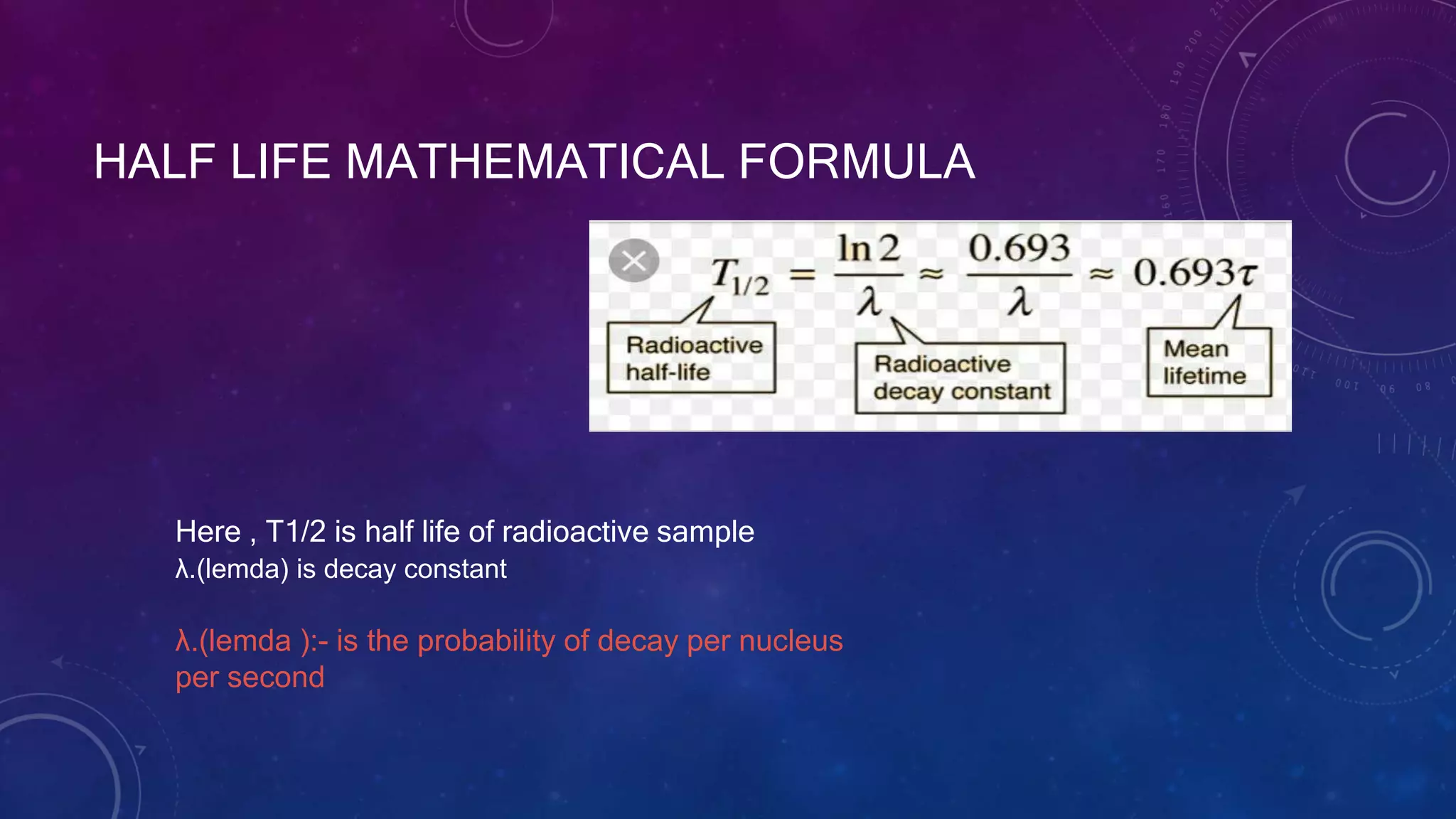
Here , T1/2 is half life of radioactive sample
λ.(lemda) is decay constant
λ.(lemda ):- is the probability of decay per nucleus
per second
13.
HALF LIFE OFSOME COMMON RADIOPHARMACEUTICALS
Name
1. Ferric citrate (59Fe) solution
Half life
45 days
Major use (application)
Study of iron metabolism and RBC
formation
2. Sodium Iodide(131 I) solution
3.Sodium phosphate (32P )
injection
8.06 days
14.2 days
Thyroid scanning and study of
thyroid uptake
Treatment of polycythemavera
(over production of RBC)
4. Calcium chloride (45ca )
solution
5. Ammonium Bromide (82Br)
injection
160 days
36 hours
Study of calcium metabolism
disorders ,bone Cancer.
Extracellular water measurement.
14.
MEASUREMENT OF RADIOACTIVITY
•Radioactivity of an element is measure in term of dps (disintegrate per second) which is raTe at which
an elements radioactive nuclei disintgrate.
• The rate is called activity of the radioactive sample
If In elementel time duration is ‘’dt’’, No of nuclei disintegrated an ‘’dN’’. The activity of that element is
given us as
Ac = - dN/dt
• N is number of undecay nucleus in a radioactive sample remaining after some time.
Unit of measurement radioactivity is the ‘’curie ‘’ (ci).
• One Curie is the amount of radiation produced by 1 gram of radium (Ra226) that is
equivalent to 2.7× 10¹¹ decays per seconds.
15.
IMPORTANT NOTES
1. Theactivity of a source is measured in ‘’Becquerels’’ (Bq ).One Bq is ‘’One decay per second’’.
2. The amount of radiation that our cell absurb during therapy is measured in Gray’s(gy)
One gray is one Joule of energy absorbed by 1 kg of our body.this is the dose we received during
treatment.
• A dose of 1 gray of β-particles, γ-rays or X-rays will give you a dose equivalent of 1
sievert. A dose of 1 gray of α-particles will give you a dose equivalent of 20 sieverts Sievert is quite
a large unit so we are usually work in millisieverts (msg) or microsurgery (use).
16.
RADIOACTIVITY MEASURING DEVICES
•For measuring radioactivity three types of devices are available
1. Gas filled tube counters (e.g the Geiger counter)
2. Scintillation counters
3. Semi conductor detectors
17.
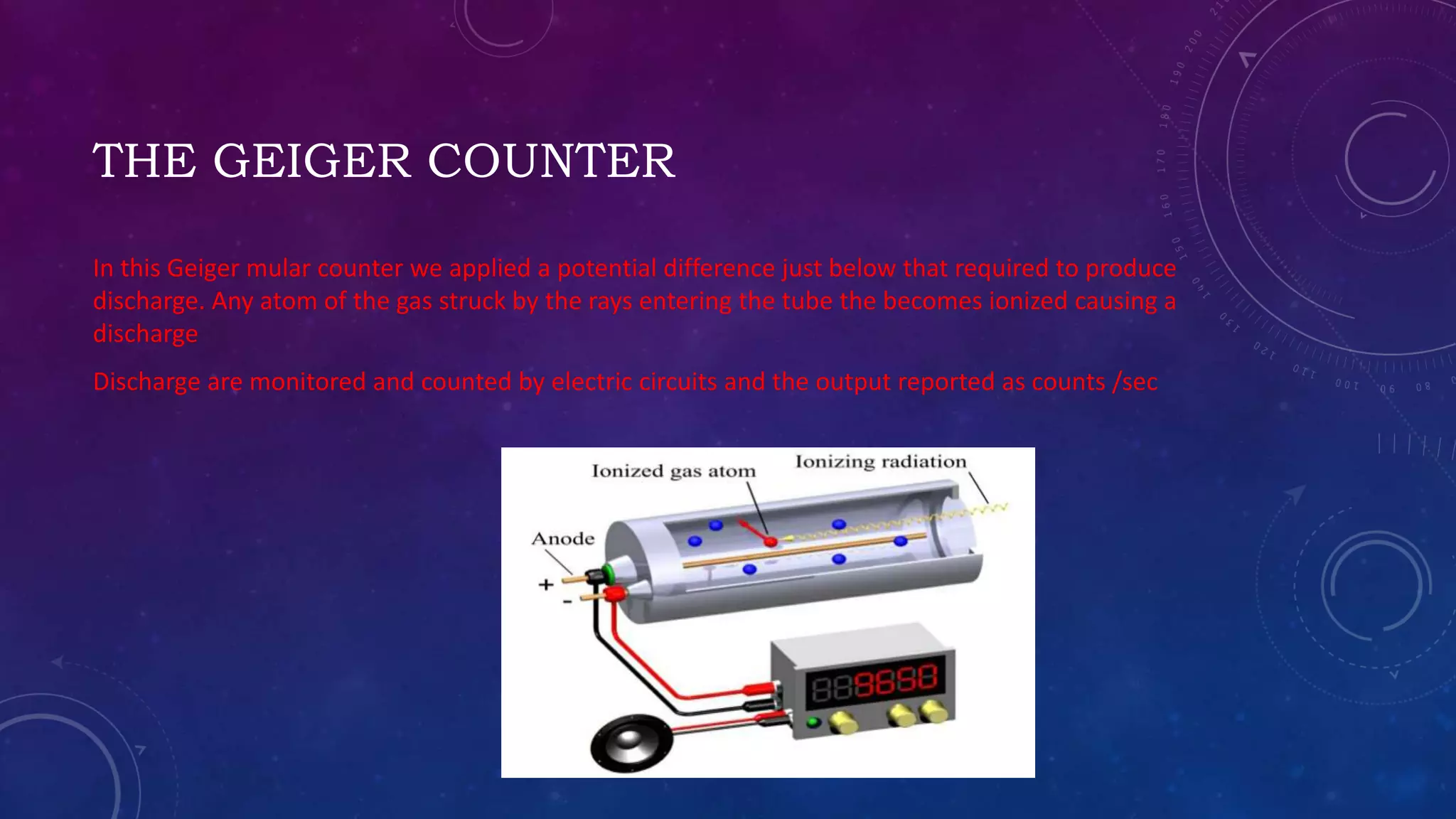
THE GEIGER COUNTER
Inthis Geiger mular counter we applied a potential difference just below that required to produce
discharge. Any atom of the gas struck by the rays entering the tube the becomes ionized causing a
discharge
Discharge are monitored and counted by electric circuits and the output reported as counts /sec
18.
SCINTILLATION COUNTERS
• Crystalsof certain substances e.g. cesium fluoride, cadmium
• tungstate, anthracine and sodium iodide emit small flashes of light when bombarded
• by γ-rays. The most commonly used phosphor in scintillation counters is NaI.
• In the instrument, the crystal is positioned against a photocell.
• which in turn is linked to a recording unit. The number of flashes produced per unit time is proportional
to the intensity of radiation.











![Measurement of Radioactivity - Geiger Muller [GM] Counter & SCINTILLATION COU...](https://cdn.slidesharecdn.com/ss_thumbnails/radioisotopes-210528094310-thumbnail.jpg?width=640&height=640&fit=bounds)


