Radioactivity and
Nuclear Reactions
Chp 18 Section 1
Radioactivity
Contents
 Section 1 Radioactivity slides 3-31
 Section 2 Nuclear Decay slides 32-55
 Section 3 Detecting Radioactivity
slides 56-74
 Section 4 Nuclear Reactions slides
75-106
1 Radioactivity
What You’ll Learn
 What particles make up an atom and
its nucleus
 How the nucleus is held together
 What radioactivity is
 The properties of radioactive and
stable nuclei
The Nucleus
 The atom is made up of protons,
neutrons and electrons.
The Nucleus
 The atom is made up of protons,
neutrons and electrons.
 Positively-charged protons and
electrically neutral neutrons are
located in the nucleus.
The Nucleus
 The atom is made up of protons,
neutrons and electrons.
 Positively-charged protons and
electrically neutral neutrons are
located in the nucleus.
 Each proton has one positive charge
or +1 so each nucleus has a positive
charge equal to the number of
protons that it has.
The Nucleus
 The number of protons is called the
element’s atomic number.
The Nucleus
 The number of protons is called the
element’s atomic number.
 Atoms contain the same number of
protons as negatively-charged
electrons.
The Nucleus
 The number of protons is called the
element’s atomic number.
 Atoms contain the same number of
protons as negatively-charged
electrons.
 The electric attraction of opposites
pulls the electrons close to the
nucleus.
Is the nucleus the largest part of an
atom?
 Protons and neutrons are packed
together tightly so that the nucleus
takes up only a tiny part of an atom.
Is the nucleus the largest part of an
atom?
 Protons and neutrons are packed
together tightly so that the nucleus
takes up only a tiny part of an atom.
 If an atom were the size of a football
stadium, its nucleus would be the
size of a marble!
Is the nucleus the largest part of an
atom?
 Protons and neutrons are packed
together tightly so that the nucleus
takes up only a tiny part of an atom.
 If an atom were the size of a football
stadium, its nucleus would be the
size of a marble!
 Despite taking little space, the
nucleus contains almost all the mass
of the atom.
Is the nucleus the largest part of an
atom?
 A proton or neutron has about 2,000
times the mass of an electron.
The Strong Force
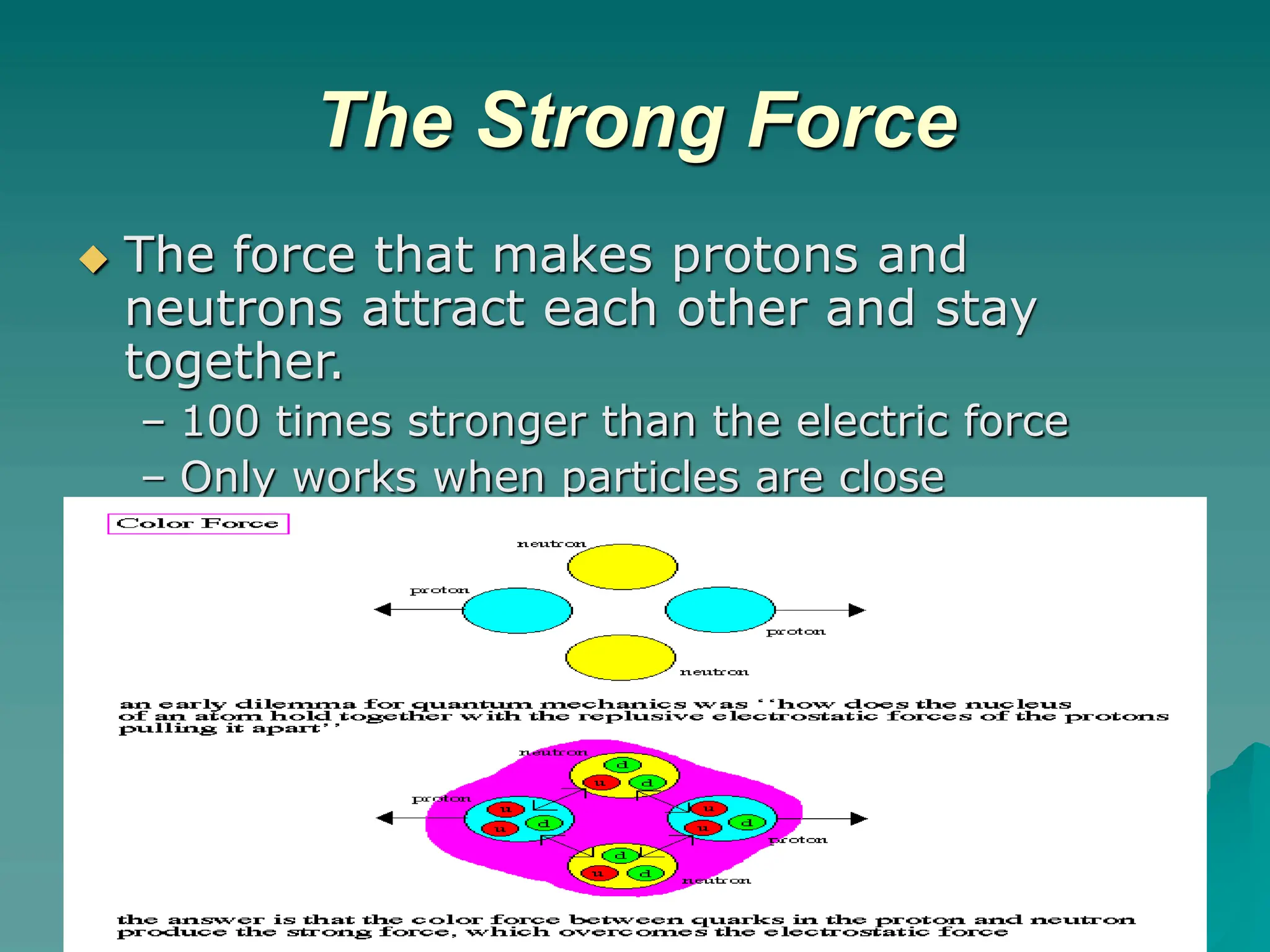
 The force that makes protons and
neutrons attract each other and stay
together.
– 100 times stronger than the electric force
– Only works when particles are close
How do forces work in a small
nucleus?
 In a small nucleus, the particles are
close together so that the strong
force holds the protons and neutrons
tightly together.
How do forces work in a large
nucleus?
 In a large nucleus, the strong force
holds together only the particles that
are closest to one another.
How do forces work in a large
nucleus?
 In a large nucleus, the strong force
holds together only the particles that
are closest to one another.
 In a nucleus with many protons, the
electric force repels protons that are
far apart.
How do forces work in a large
nucleus?
 In a large nucleus, the strong force holds
together only the particles that are closest
to one another.
 In a nucleus with many protons, the
electric force repels protons that are far
apart.
 This increased repulsive force causes the
particles in a large nucleus to be held less
tightly than those in a small nucleus.
Radioactivity
 When the strong force can hold a
nucleus together forever, the nucleus
is stable.
Radioactivity
 When the strong force can hold a
nucleus together forever, the nucleus
is stable.
 If not, the nucleus becomes unstable
and can break apart or decay by
emitting particles and energy.
Radioactivity
 When the strong force can hold a
nucleus together forever, the nucleus
is stable.
 If not, the nucleus becomes unstable
and can break apart or decay by
emitting particles and energy.
 Large nuclei are more unstable; all
with more than 83 protons are
radioactive.
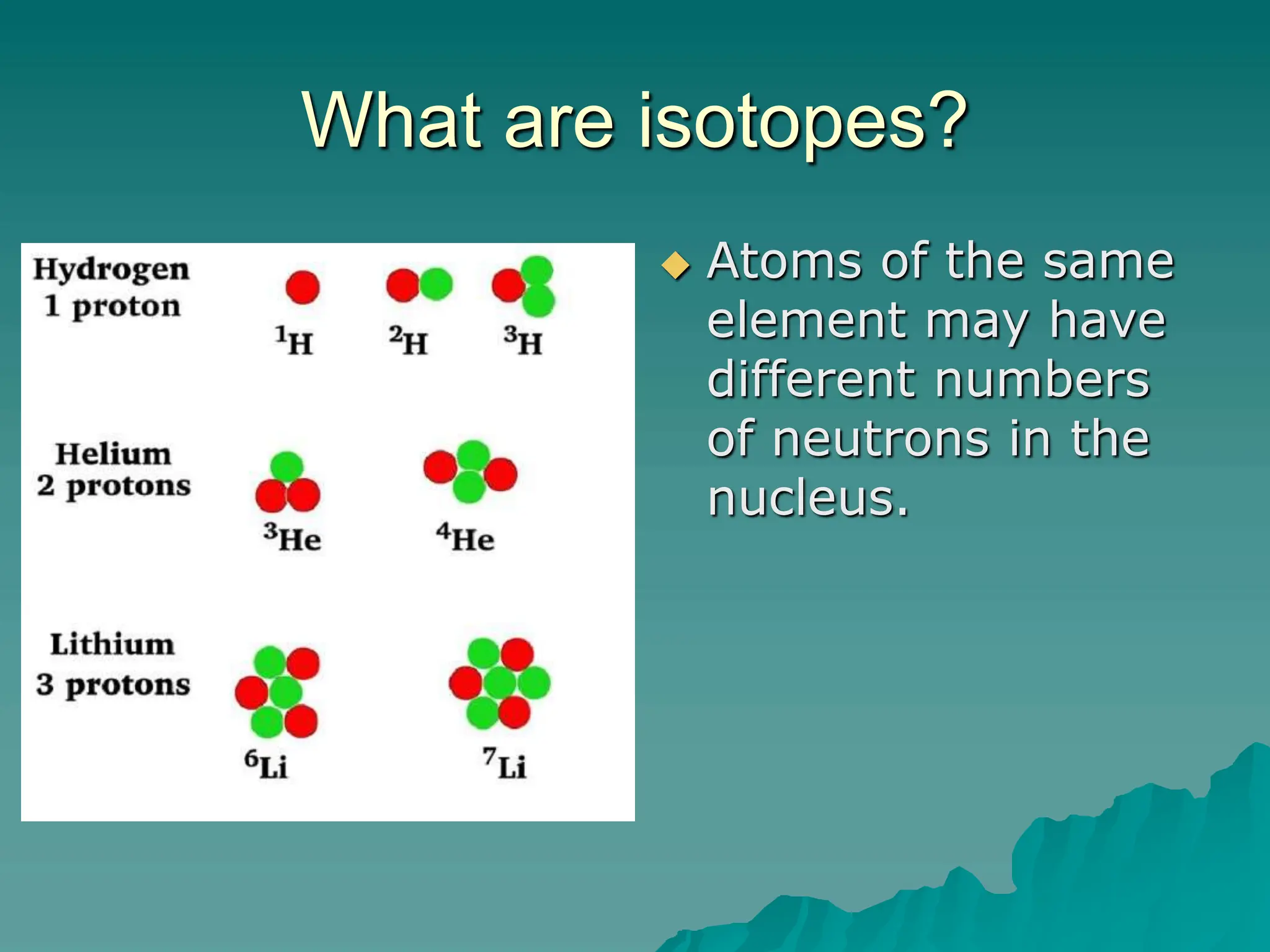
What are isotopes?
 Atoms of the same
element may have
different numbers
of neutrons in the
nucleus.
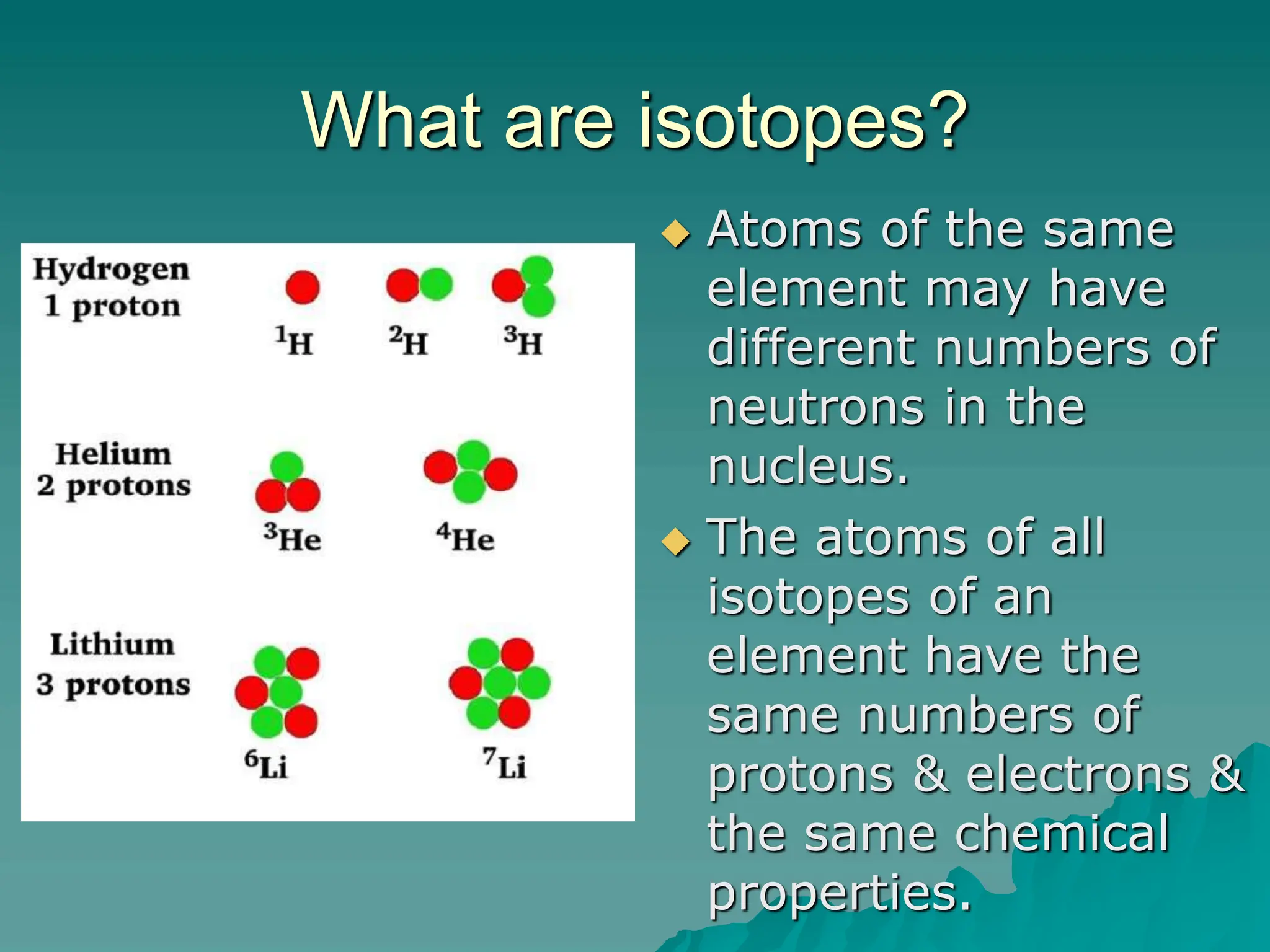
What are isotopes?
 Atoms of the same
element may have
different numbers of
neutrons in the
nucleus.
 The atoms of all
isotopes of an
element have the
same numbers of
protons & electrons &
the same chemical
properties.
What makes nuclei unstable?
 The ratio of neutrons to protons
determines whether a nucleus is
stable or unstable.
– Small isotopes 1 neutron:1 proton
– Large isotope 3 neutrons: 2 protons
– Generally, nuclei with too many or too
few neutrons compared to the numbers
are unstable or radioactive.
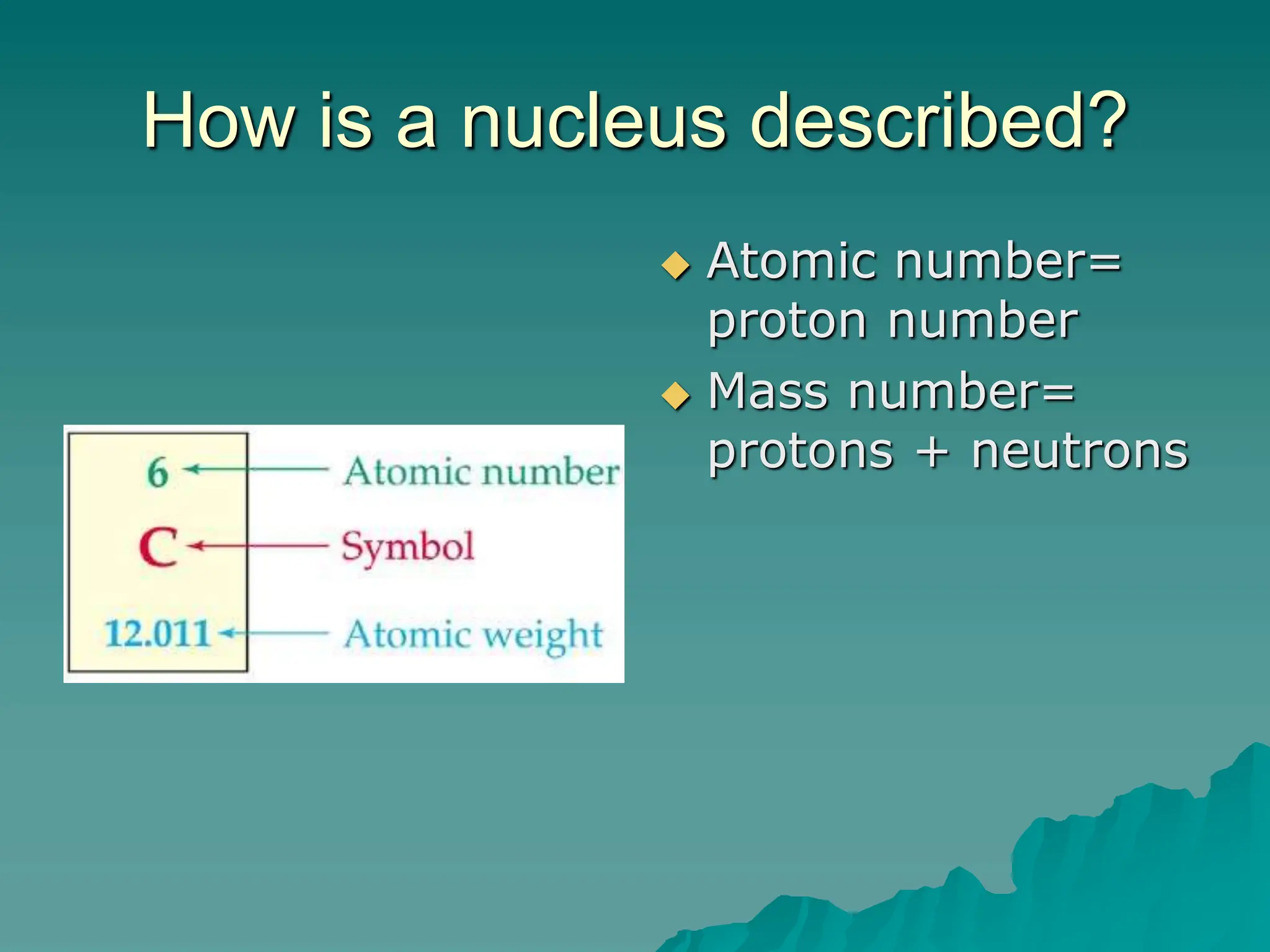
How is a nucleus described?
 Atomic number=
proton number
 Mass number=
protons + neutrons
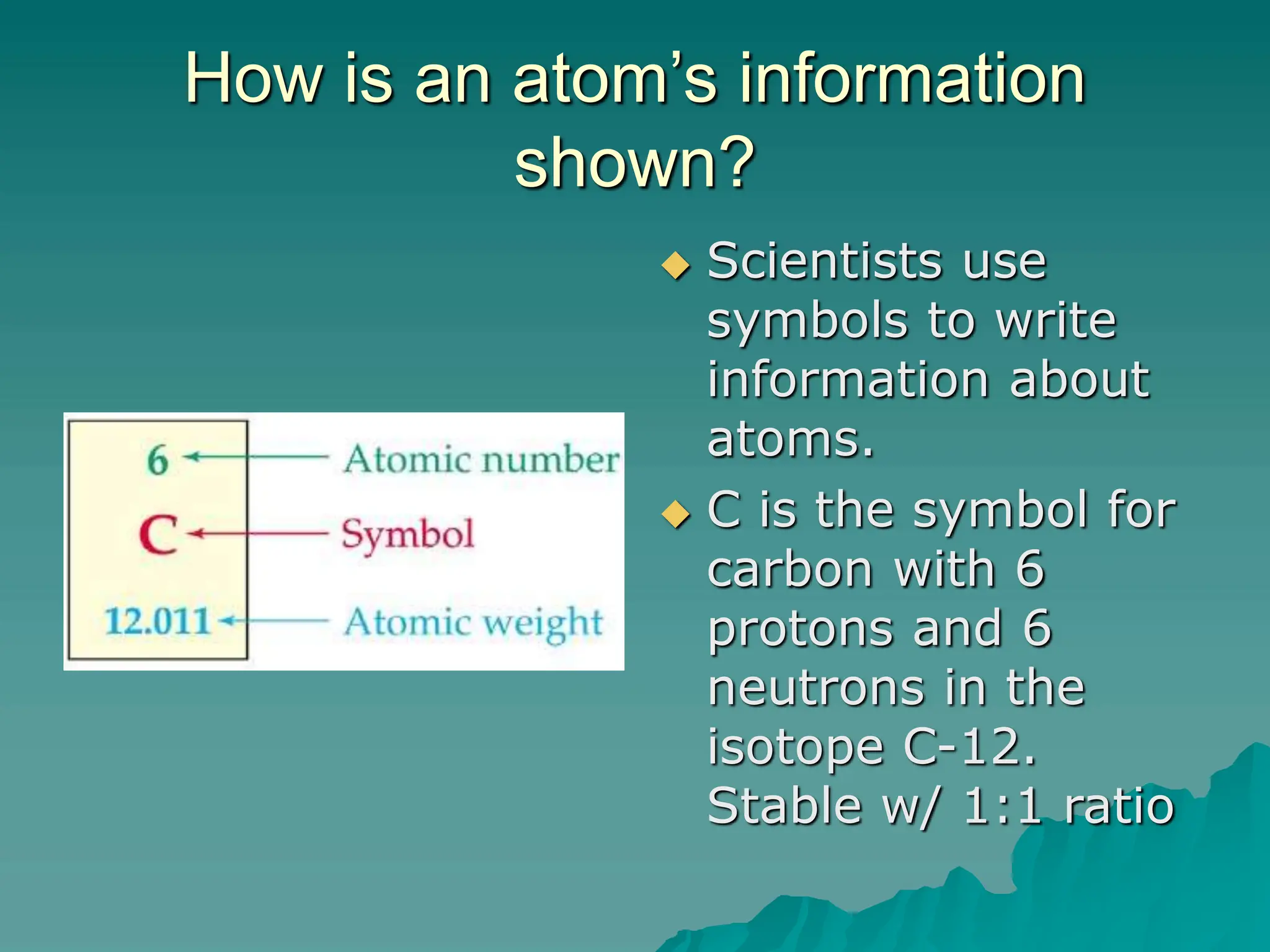
How is an atom’s information
shown?
 Scientists use
symbols to write
information about
atoms.
 C is the symbol for
carbon with 6
protons and 6
neutrons in the
isotope C-12.
Stable w/ 1:1 ratio
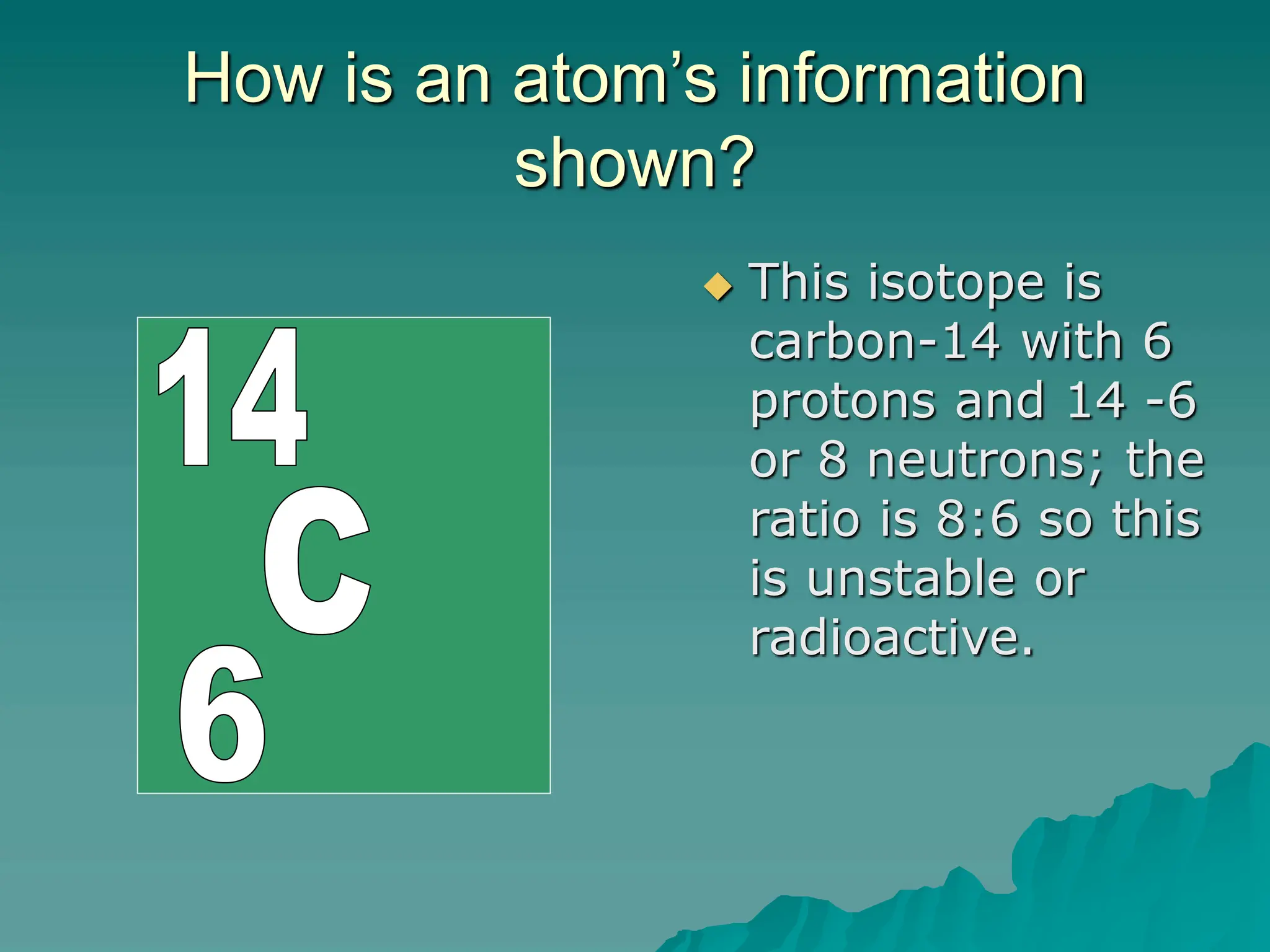
How is an atom’s information
shown?
 This isotope is
carbon-14 with 6
protons and 14 -6
or 8 neutrons; the
ratio is 8:6 so this
is unstable or
radioactive.
Who discovered radioactivity?
 In 1896, Henri Becquerel accidentally left
pieces of uranium salt in a drawer on a
photographic plate. When he developed
the plate, he saw an outline of the
uranium salt on it. He realized that it
must have given off rays that darkened
the film.
 http://www.hulu.com/watch/113908/miles
tones-in-science-and-engineering-
radioactivity-%E2%80%93-henri-
becquerel-marie-and-pierre-curie
Who discovered radioactivity?
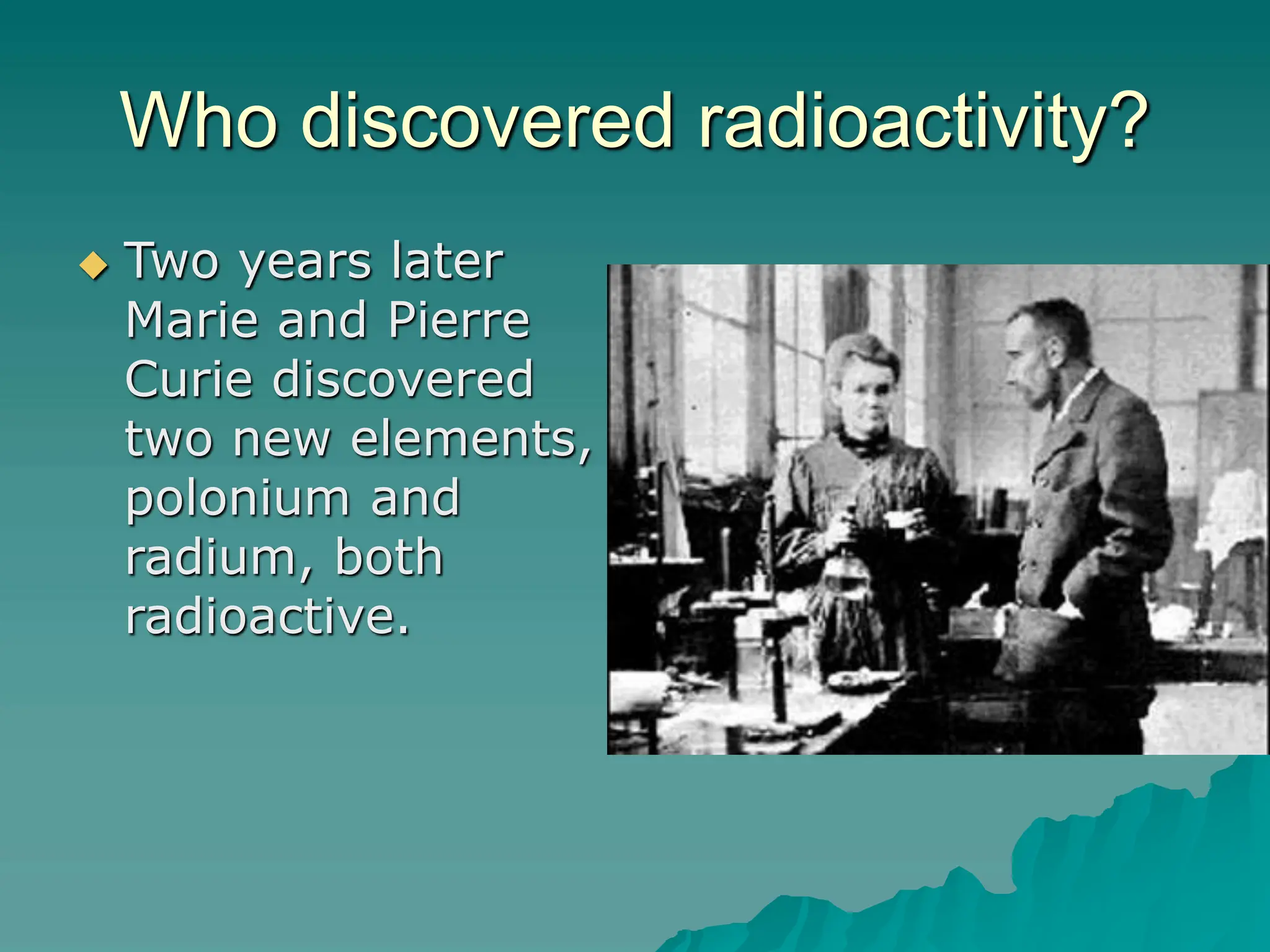
 Two years later
Marie and Pierre
Curie discovered
two new elements,
polonium and
radium, both
radioactive.
Who discovered radioactivity?
 Two years later Marie and Pierre
Curie discovered two new elements,
polonium and radium, both
radioactive.
 It took them >3 years to get 0.1g of
radium from several tons of the
mineral pitchblende.
2 Nuclear Decay
What You’ll Learn
 How alpha, beta, and gamma
radiation are similar and different
 What the half-life of a radioactive
material is
 How radioactive dating is used
Nuclear Radiation
 When an unstable nucleus decays, it
breaks apart emitting particles and
energy as it decays.
Nuclear Radiation
 When an unstable nucleus decays, it
breaks apart emitting particles and
energy as it decays.
 Three types of nuclear radiation:
– Alpha particles
– Beta particles
– Gamma radiation electromagnetic wave
Alpha Particles
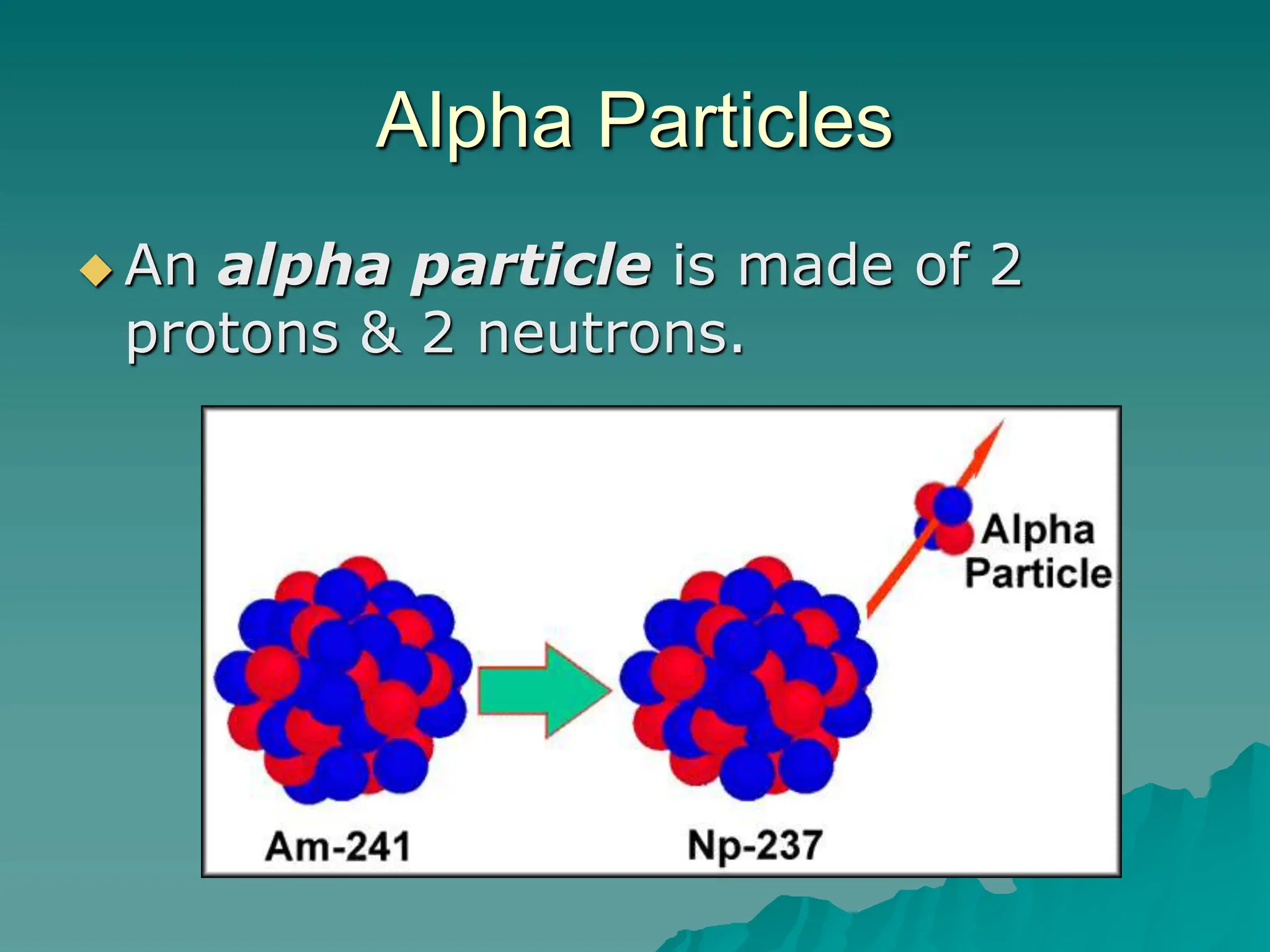
 An alpha particle is made of 2
protons & 2 neutrons.
Alpha Particles
 An alpha particle is made of 2
protons & 2 neutrons.
 The decaying nucleus emits an alpha
particle ( 4
2He) with a mass number
of 4 & atomic number of 2.
Alpha Particles
 An alpha particle is made of 2
protons & 2 neutrons.
 The decaying nucleus emits an alpha
particle ( 4
2He) with a mass number
of 4 & atomic number of 2.
 An alpha particle is the same as the
nucleus of a Helium (He) atom.
Alpha Particles
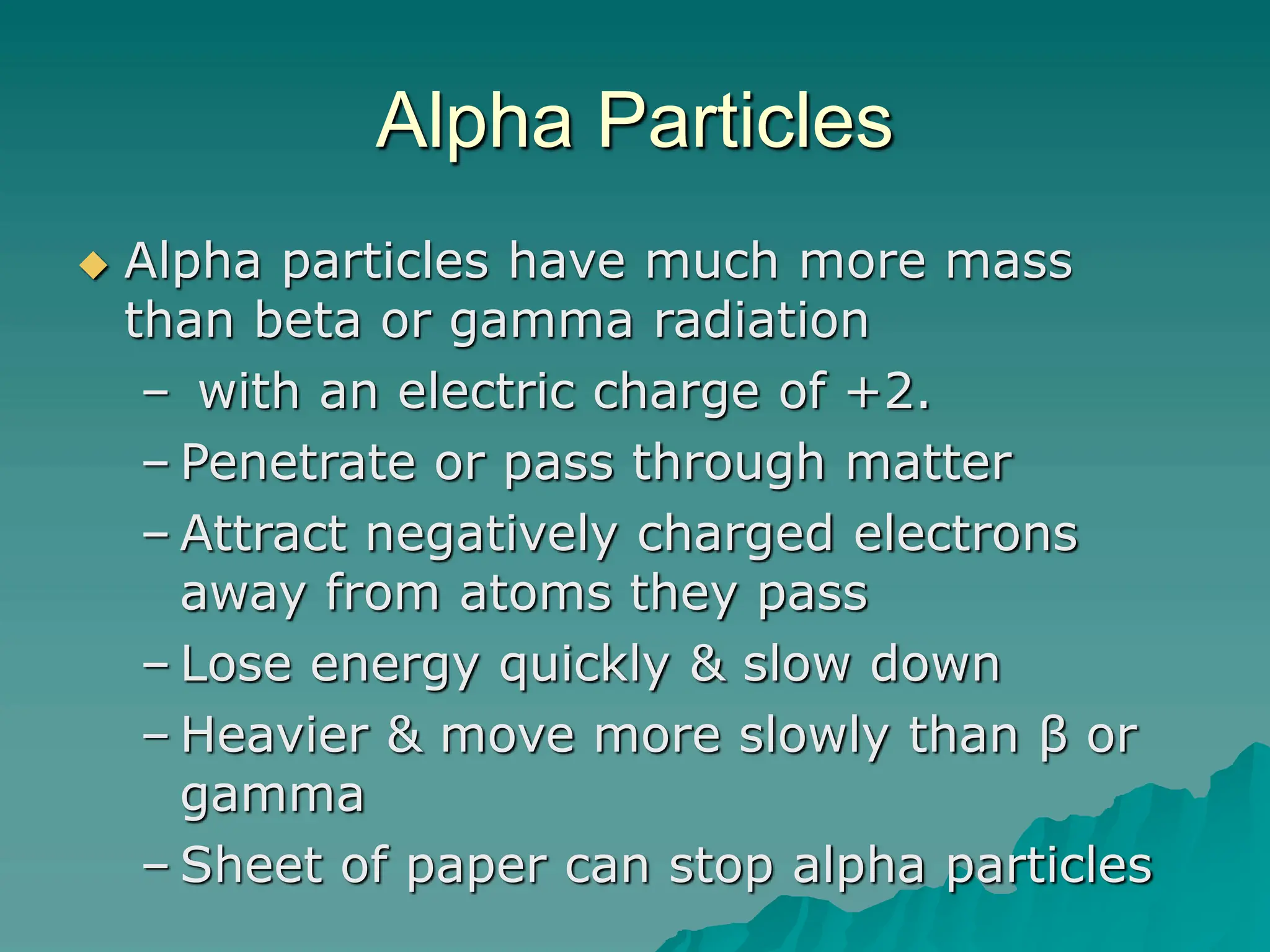
 Alpha particles have much more mass
than beta or gamma radiation
– with an electric charge of +2.
– Penetrate or pass through matter
– Attract negatively charged electrons
away from atoms they pass
– Lose energy quickly & slow down
– Heavier & move more slowly than β or
gamma
– Sheet of paper can stop alpha particles
How can alpha particles harm you?
 Think of alpha particles like bowling
balls moving in slow motion – they
may not penetrate deeply but they
can do lots of damage to whatever
they hit.
 Released inside the human body they
can damage cells causing illness &
disease.
How can alpha particles help you?
 Smoke detectors work by emitting
alpha particles which collide with
molecules in the air forming ions that
flow within the detector to create an
electric circuit. Smoke particles
break this circuit causing the alarm
to sound.
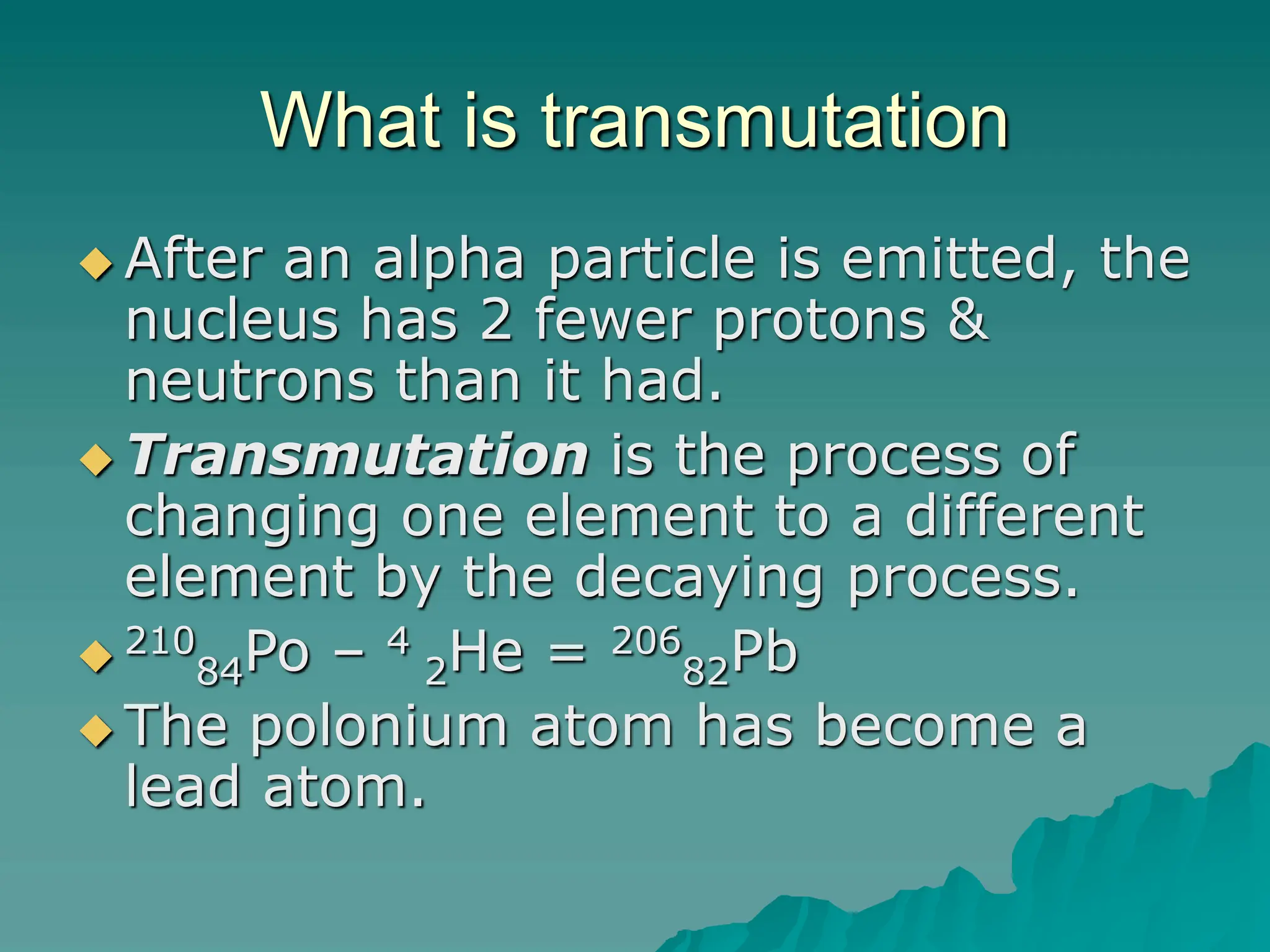
What is transmutation
 After an alpha particle is emitted, the
nucleus has 2 fewer protons &
neutrons than it had.
 Transmutation is the process of
changing one element to a different
element by the decaying process.
 210
84Po – 4
2He = 206
82Pb
 The polonium atom has become a
lead atom.
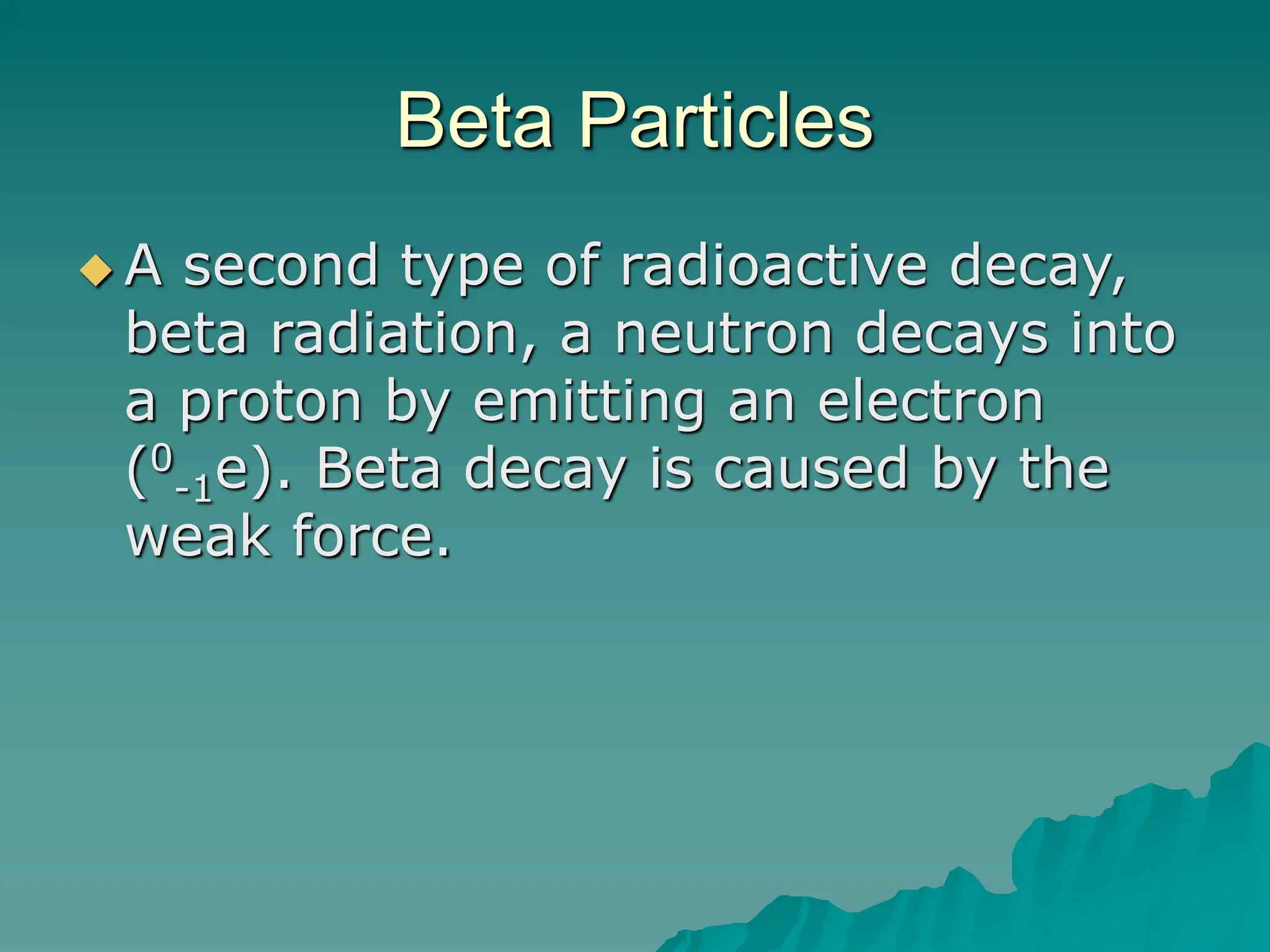
Beta Particles
 A second type of radioactive decay,
beta radiation, a neutron decays into
a proton by emitting an electron
(0
-1e). Beta decay is caused by the
weak force.
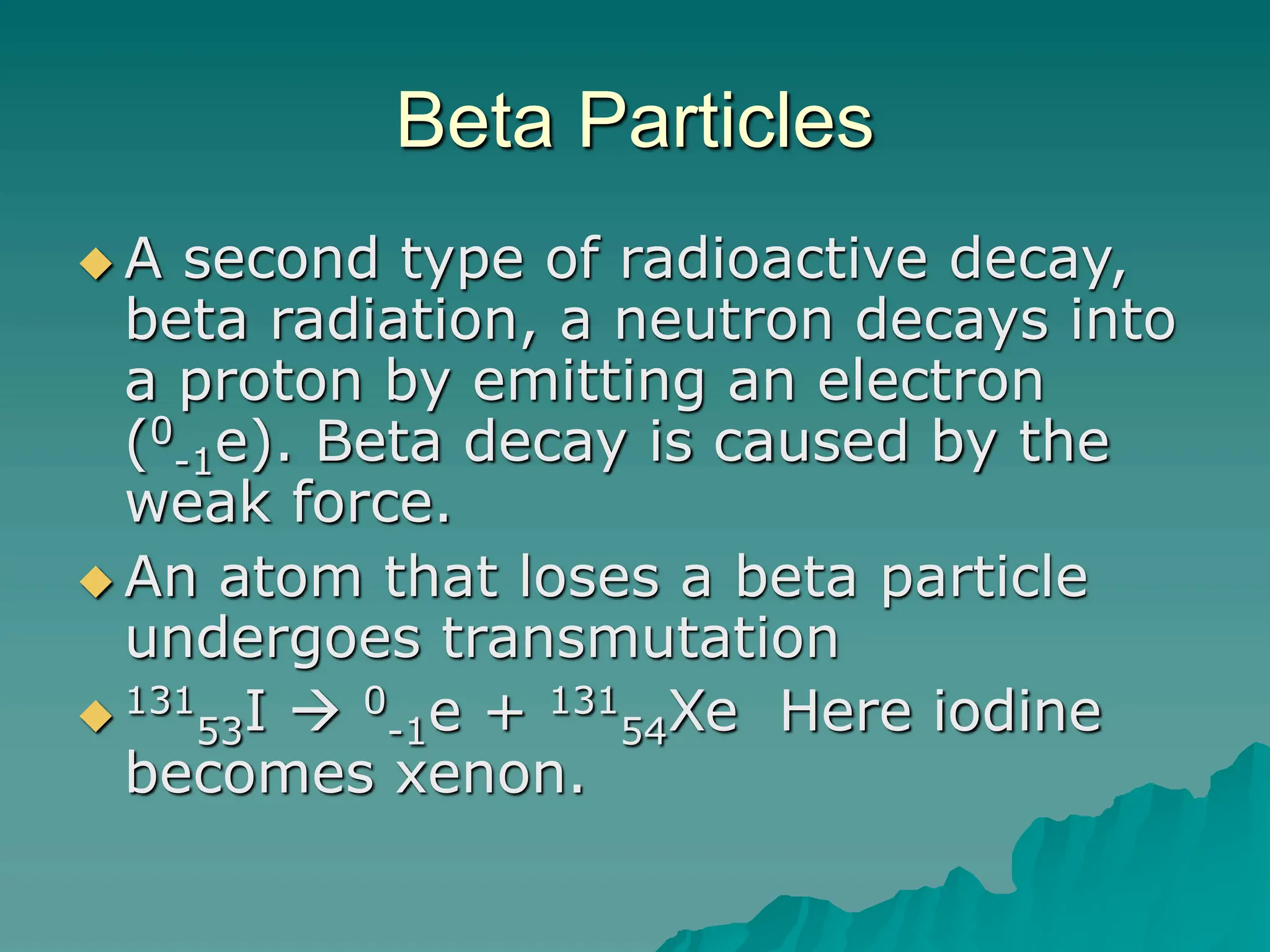
Beta Particles
 A second type of radioactive decay,
beta radiation, a neutron decays into
a proton by emitting an electron
(0
-1e). Beta decay is caused by the
weak force.
 An atom that loses a beta particle
undergoes transmutation
 131
53I  0
-1e + 131
54Xe Here iodine
becomes xenon.
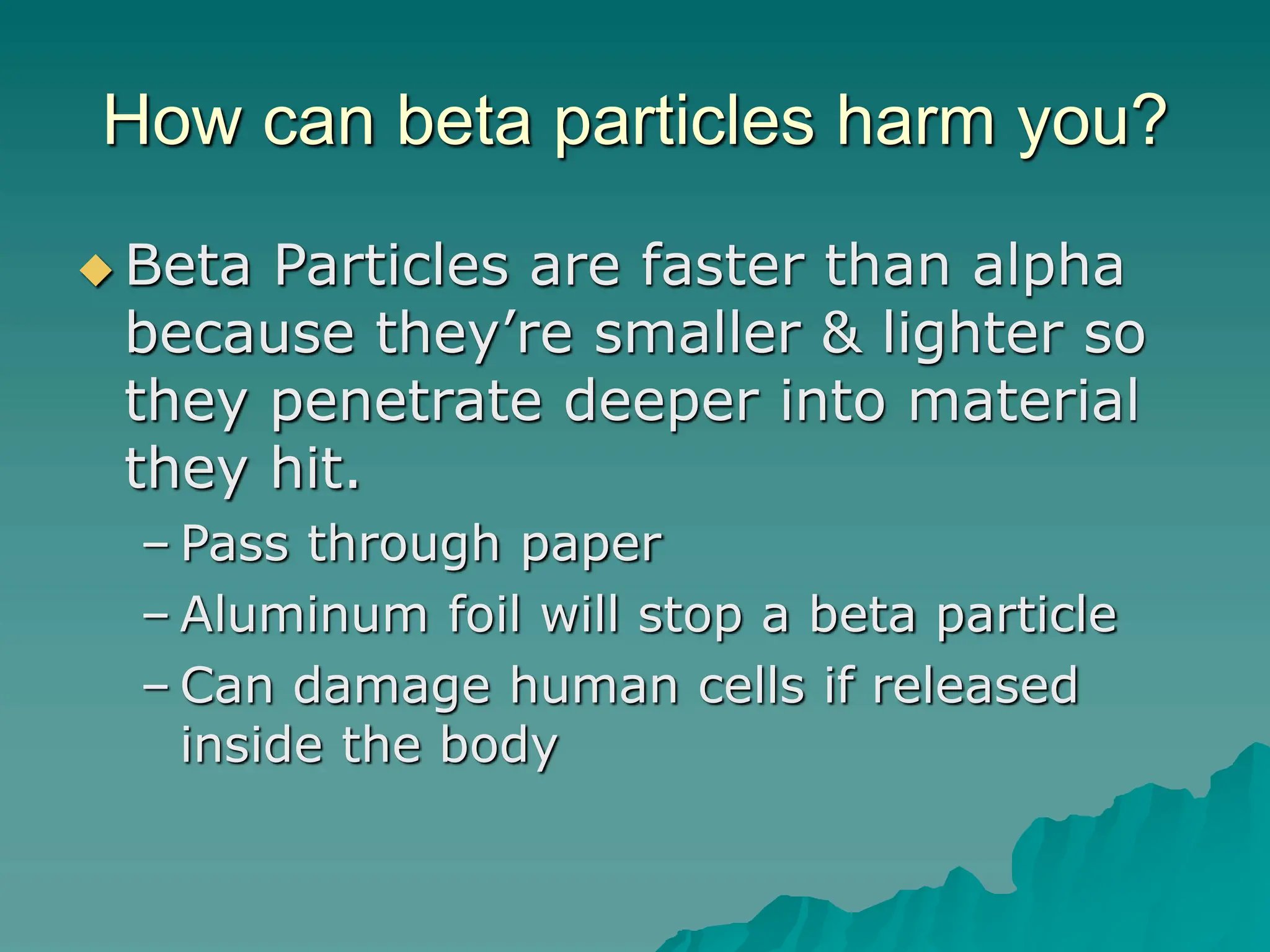
How can beta particles harm you?
 Beta Particles are faster than alpha
because they’re smaller & lighter so
they penetrate deeper into material
they hit.
– Pass through paper
– Aluminum foil will stop a beta particle
– Can damage human cells if released
inside the body
Gamma Rays
 Gamma radiation is emitted as
electromagnetic waves.
 Gamma rays are EM waves with the
highest frequencies & the shortest
wavelength in the EM spectrum.
 The symbol for a gamma ray is the
Greek letter γ gamma.
Gamma Rays
 Have no mass & no charge.
 Travel at the speed of light.
 Emitted by nucleus when alpha or
beta particle is created.
 Takes thick blocks of concrete or lead
to stop gamma rays.
 Cause less damage to cells inside the
body than alpha or beta particles.
Radioactive Half-Life
 The measure of the time it takes for
half of the radioactive nuclei in a
sample to decay is called a half-life.
 The remaining nucleus is called the
daughter nucleus.
 Various isotopes decay at different
rates.
Half-Life
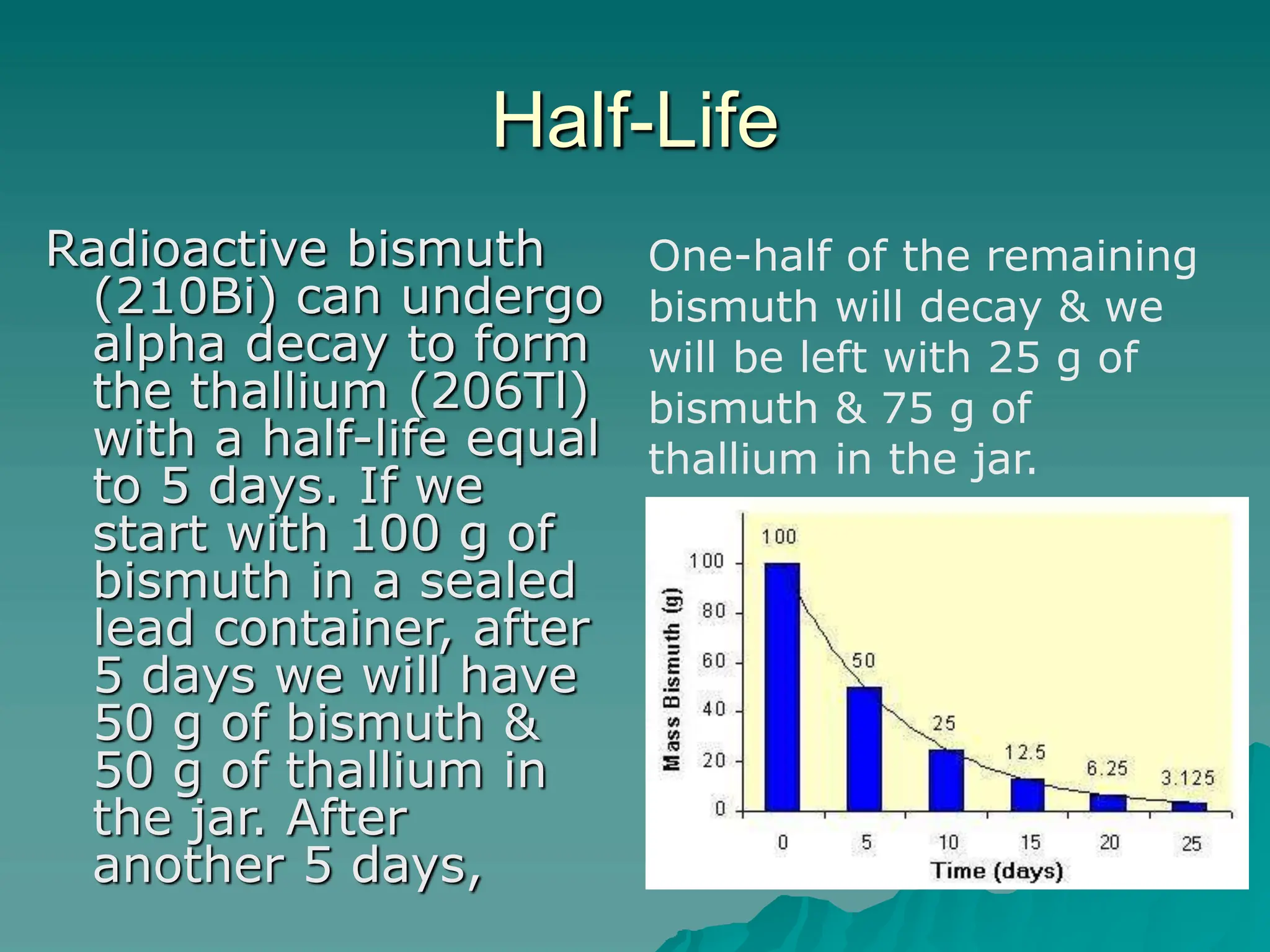
Radioactive bismuth
(210Bi) can undergo
alpha decay to form
the thallium (206Tl)
with a half-life equal
to 5 days. If we
start with 100 g of
bismuth in a sealed
lead container, after
5 days we will have
50 g of bismuth &
50 g of thallium in
the jar. After
another 5 days,
One-half of the remaining
bismuth will decay & we
will be left with 25 g of
bismuth & 75 g of
thallium in the jar.
Radioactive Dating
 Scientists often want to know the ages
of rocks & fossils using radioactive
isotopes & their half-lives.
Radioactive Dating
 Scientists often want to know the ages
of rocks & fossils using radioactive
isotopes & their half-lives.
 The amount of the radioactive isotope
in object is measured, then the
amount of the daughter nuclei is
measured. With these the number of
half-lives or age of the object can be
calculated.
How is carbon used to date
objects?
 Carbon-14, with a half-life of 5,730
years is often used to estimate the age
of plant & animal remains.
How is carbon used to date
objects?
 Carbon-14, with a half-life of 5,730
years is often used to estimate the age
of plant & animal remains.
 CO2 which plants use in photosynthesis
contains C-14 which stays in the same
ratio while alive.
How is carbon used to date
objects?
 Carbon-14, with a half-life of 5,730
years is often used to estimate the age
of plant & animal remains.
 CO2 which plants use in photosynthesis
contains C-14 which stays in the same
ratio while alive.
 Once it dies, C-14 decreases as the C-
12 increases over time. The ratio
estimates ages up to 50,000 years.
How is uranium used to date
objects?
 Some rocks can be dated using the
amount of radioactive uranium
isotopes that have decayed into lead.
How is uranium used to date
objects?
 Some rocks can be dated using the
amount of radioactive uranium
isotopes that have decayed into lead.
 The ratio of the amounts of U
isotopes & and their daughter nuclei
are compared to estimate the age of
the rock.
3 Detecting Radioactivity
What You’ll Learn
 How cloud and bubble chambers are
used to detect radioactivity
 How an electroscope is used to
detect radiation
 How a Geiger counter measures
radiation
Radiation Detectors
 Special instruments detect the
electric charge of the ions formed by
the radioactive particles as they pass
through matter.
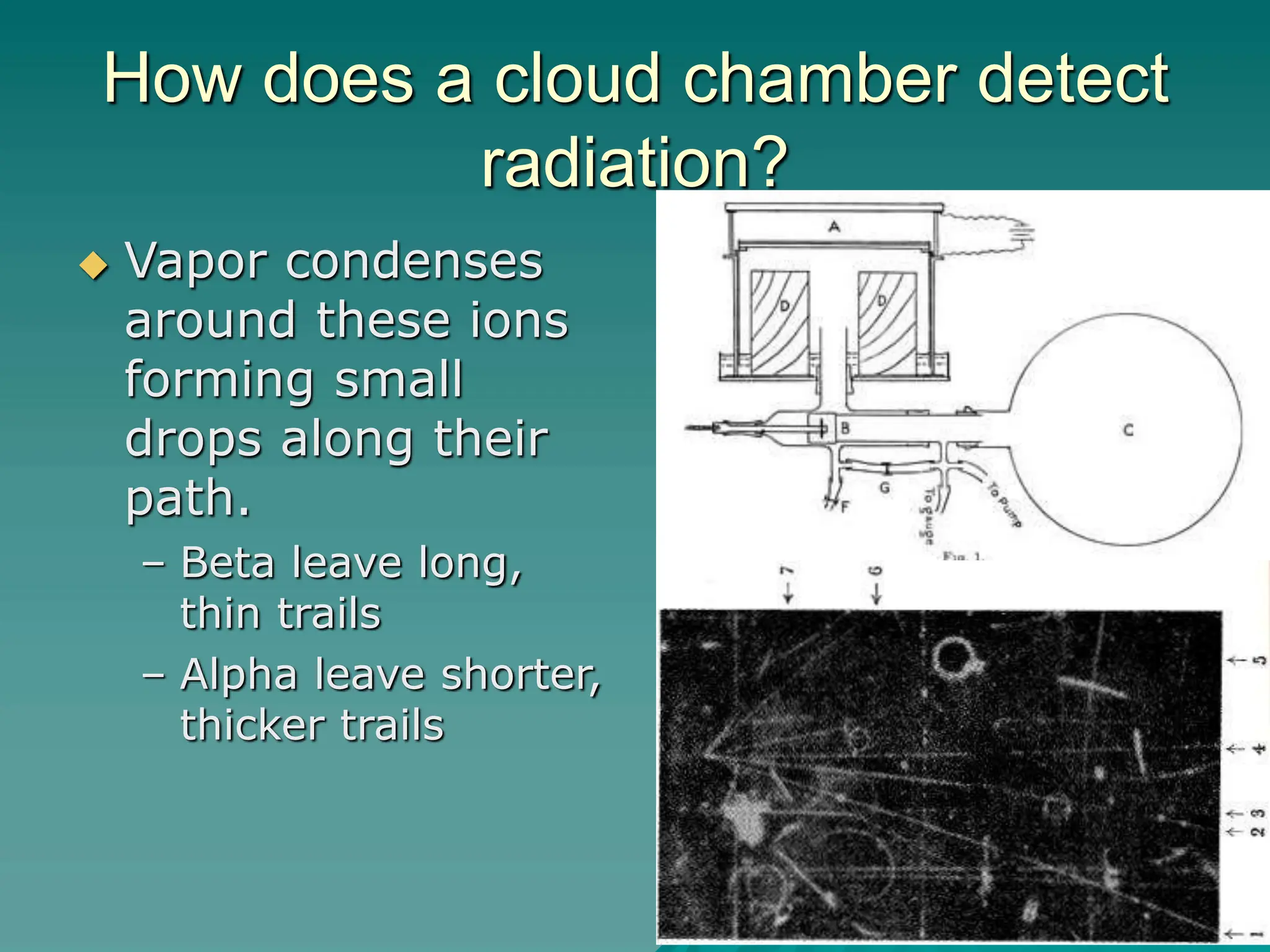
How does a cloud chamber detect
radiation?
 A cloud chamber, a rectangular box
with transparent sides containing
water or ethanol vapor, can be used
to detect α or β radiation.
How does a cloud chamber detect
radiation?
 A cloud chamber, a rectangular box
with transparent sides containing
water or ethanol vapor, can be used
to detect α or β radiation.
 A radioactive sample placed in the
cloud chamber emits charged α or β
particles which pull electrons off
atoms in the air leaving a trail of
ions.
How does a cloud chamber detect
radiation?
 Vapor condenses
around these ions
forming small
drops along their
path.
– Beta leave long,
thin trails
– Alpha leave shorter,
thicker trails
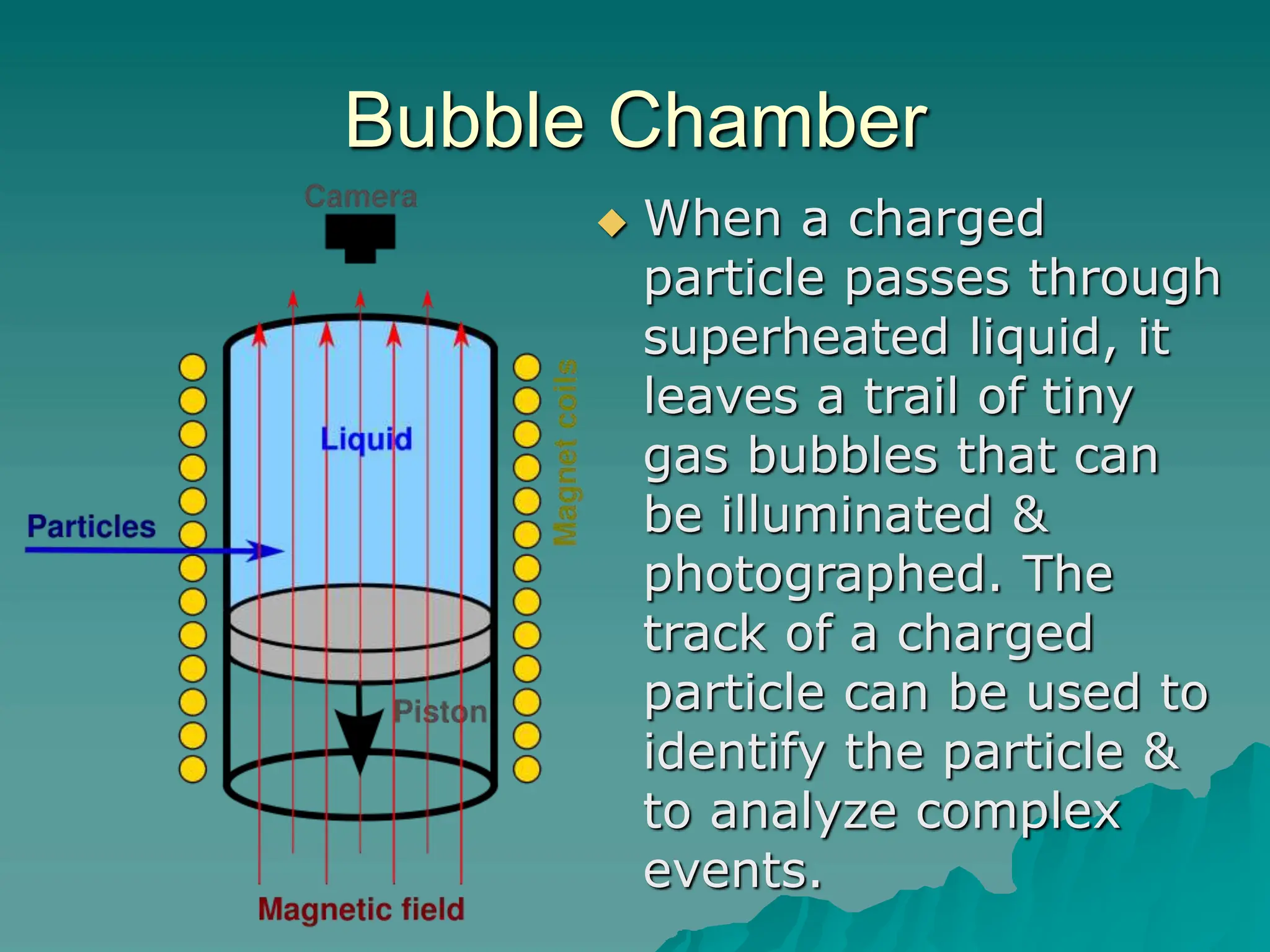
What is a bubble chamber?
 A bubble chamber contains
superheated liquid under high
pressure so that it does not boil.
What is a bubble chamber?
 A bubble chamber contains
superheated liquid under high
pressure so that it does not boil.
 When a radioactive particle passes
through, it leaves a trail of ions that
causes the liquid to boil along the ion
trail.
Bubble Chamber
 When a charged
particle passes through
superheated liquid, it
leaves a trail of tiny
gas bubbles that can
be illuminated &
photographed. The
track of a charged
particle can be used to
identify the particle &
to analyze complex
events.
How does an electroscope detect
radiation?
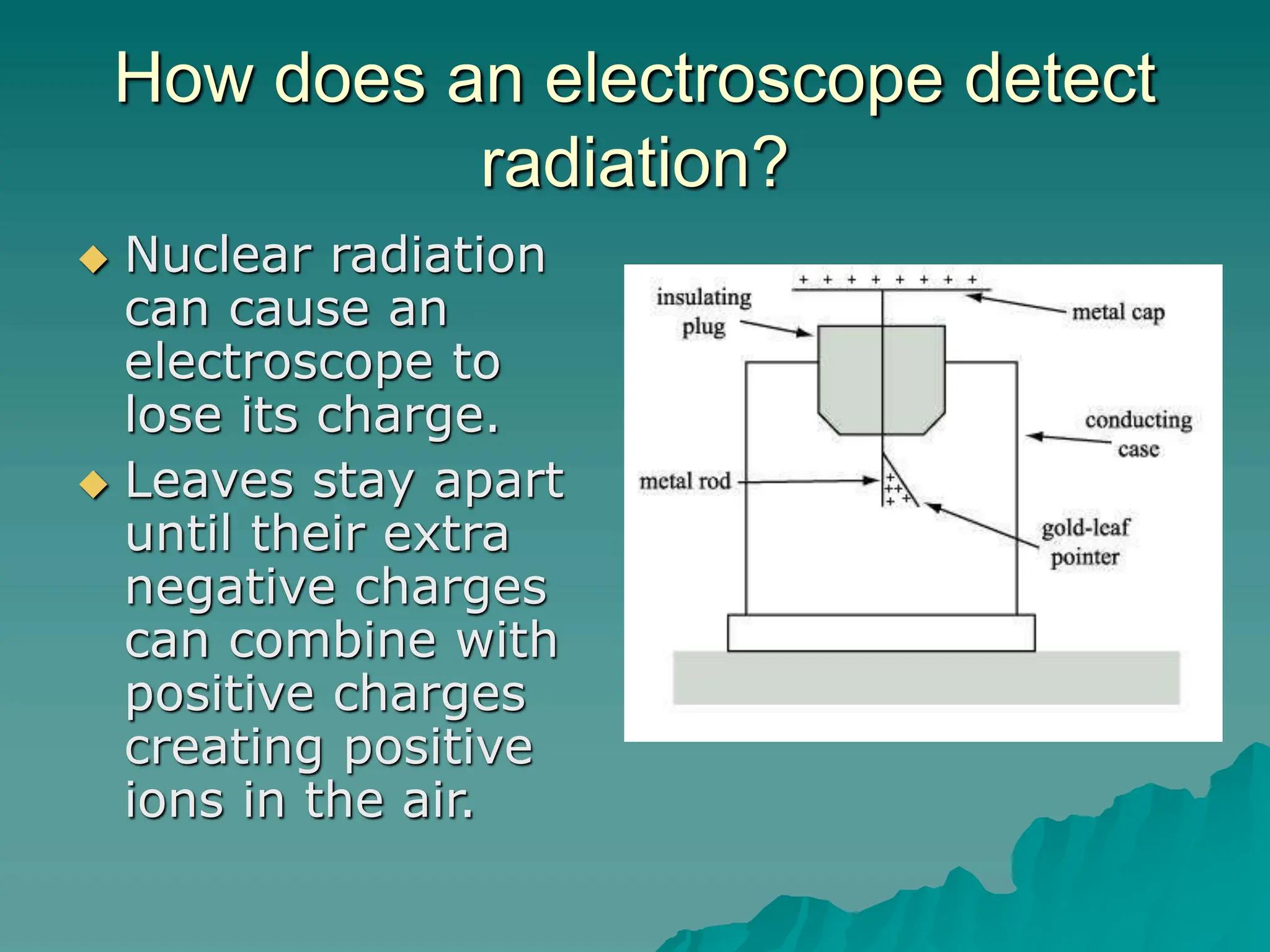
 Nuclear radiation can cause an
electroscope to lose its charge.
How does an electroscope detect
radiation?
 Nuclear radiation
can cause an
electroscope to
lose its charge.
 Leaves stay apart
until their extra
negative charges
can combine with
positive charges
creating positive
ions in the air.
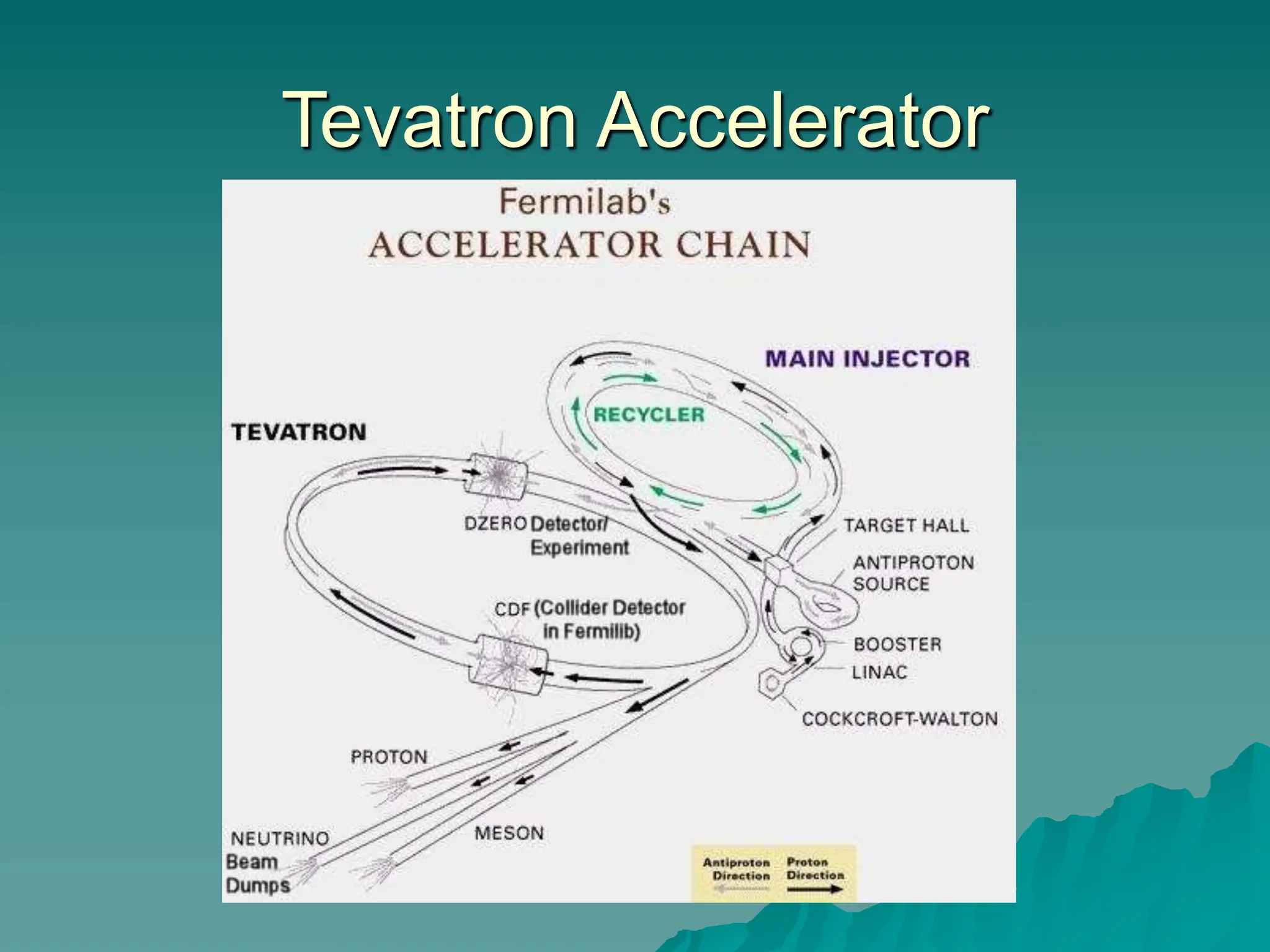
Tevatron Accelerator
Measuring Radiation
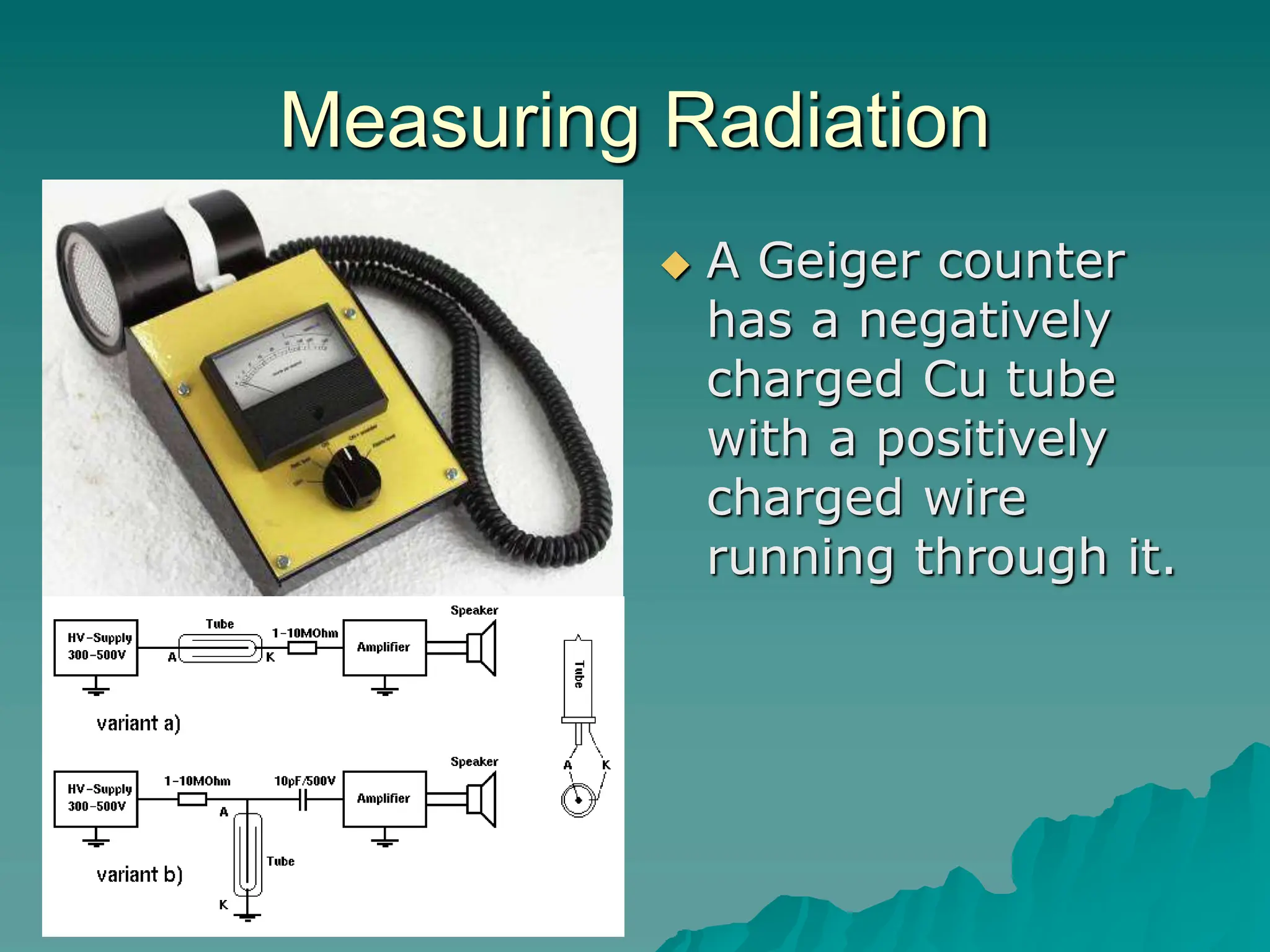
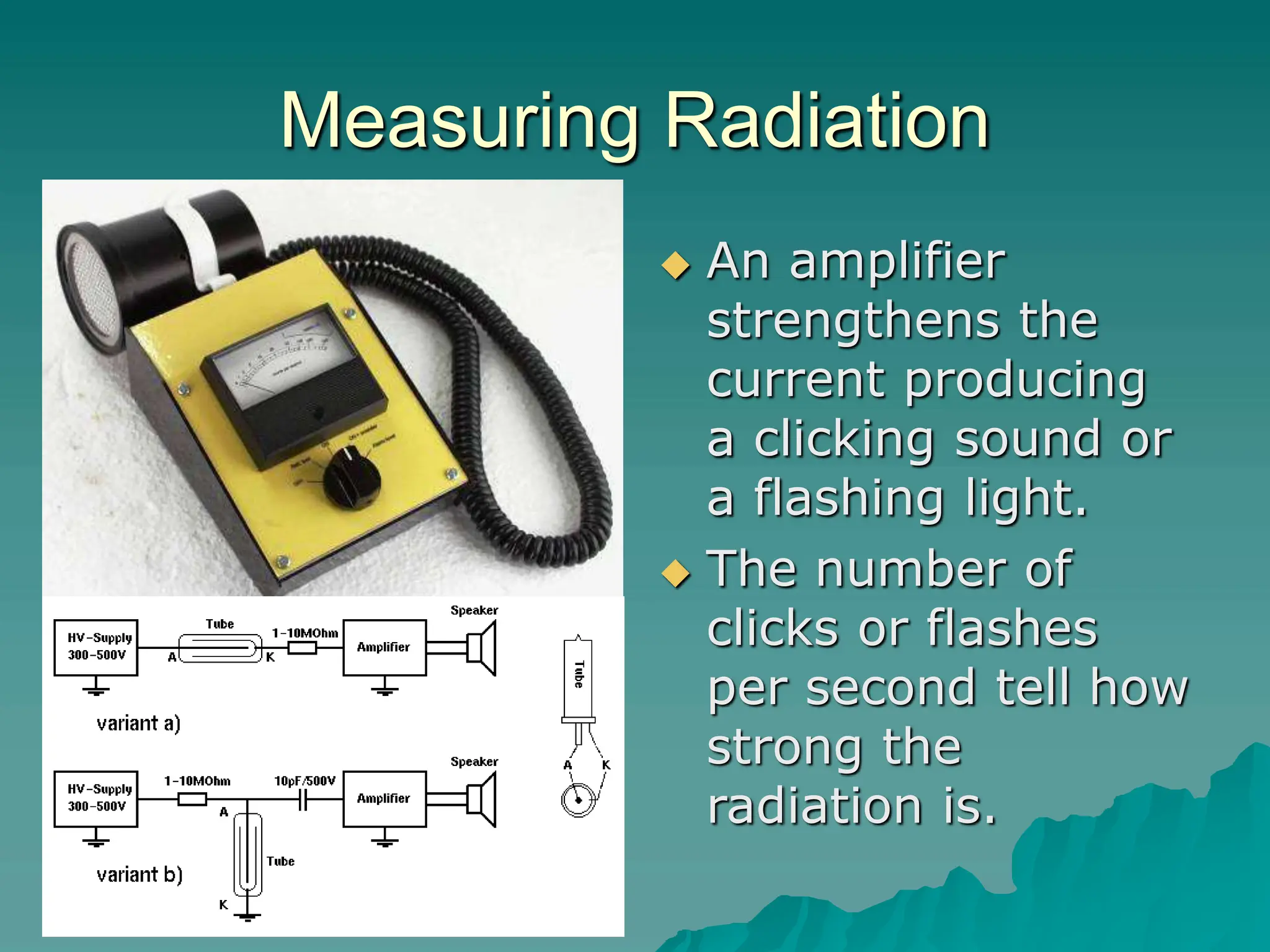
 A Geiger counter
has a negatively
charged Cu tube
with a positively
charged wire
running through it.
Measuring Radiation
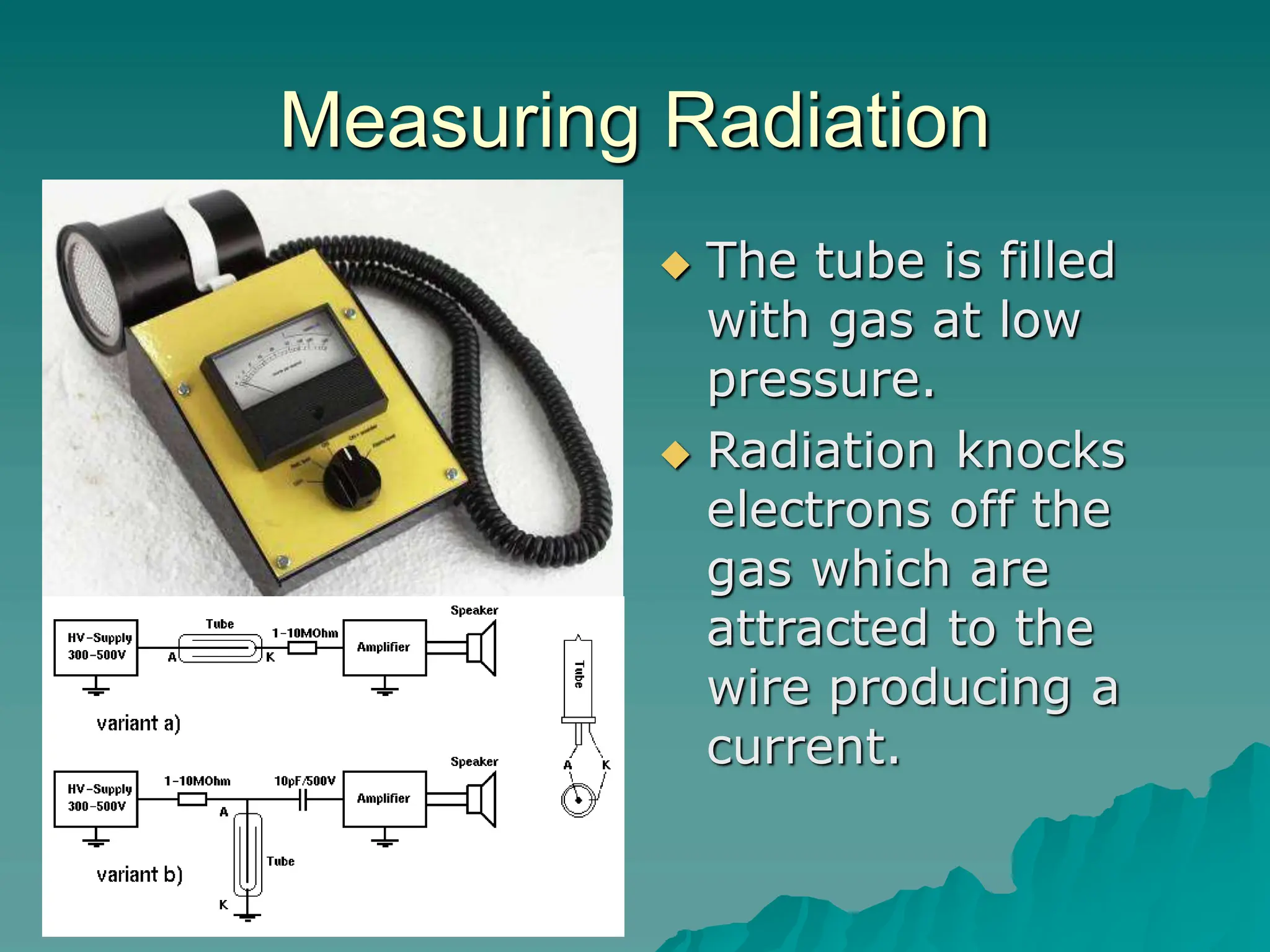
 The tube is filled
with gas at low
pressure.
 Radiation knocks
electrons off the
gas which are
attracted to the
wire producing a
current.
Measuring Radiation
 An amplifier
strengthens the
current producing
a clicking sound or
a flashing light.
 The number of
clicks or flashes
per second tell how
strong the
radiation is.
Background Radiation
 The air, the ground, & even the walls
of your home give off radiation in
small amounts.
Background Radiation
 The air, the ground, & even the walls
of your home give off radiation in
small amounts.
 Radioactive isotopes that occur in
nature emit background radiation
from rocks, soil, air, bricks, wood,
stone, food, water, animals, plants,
etc.
Where does background radiation
come from?
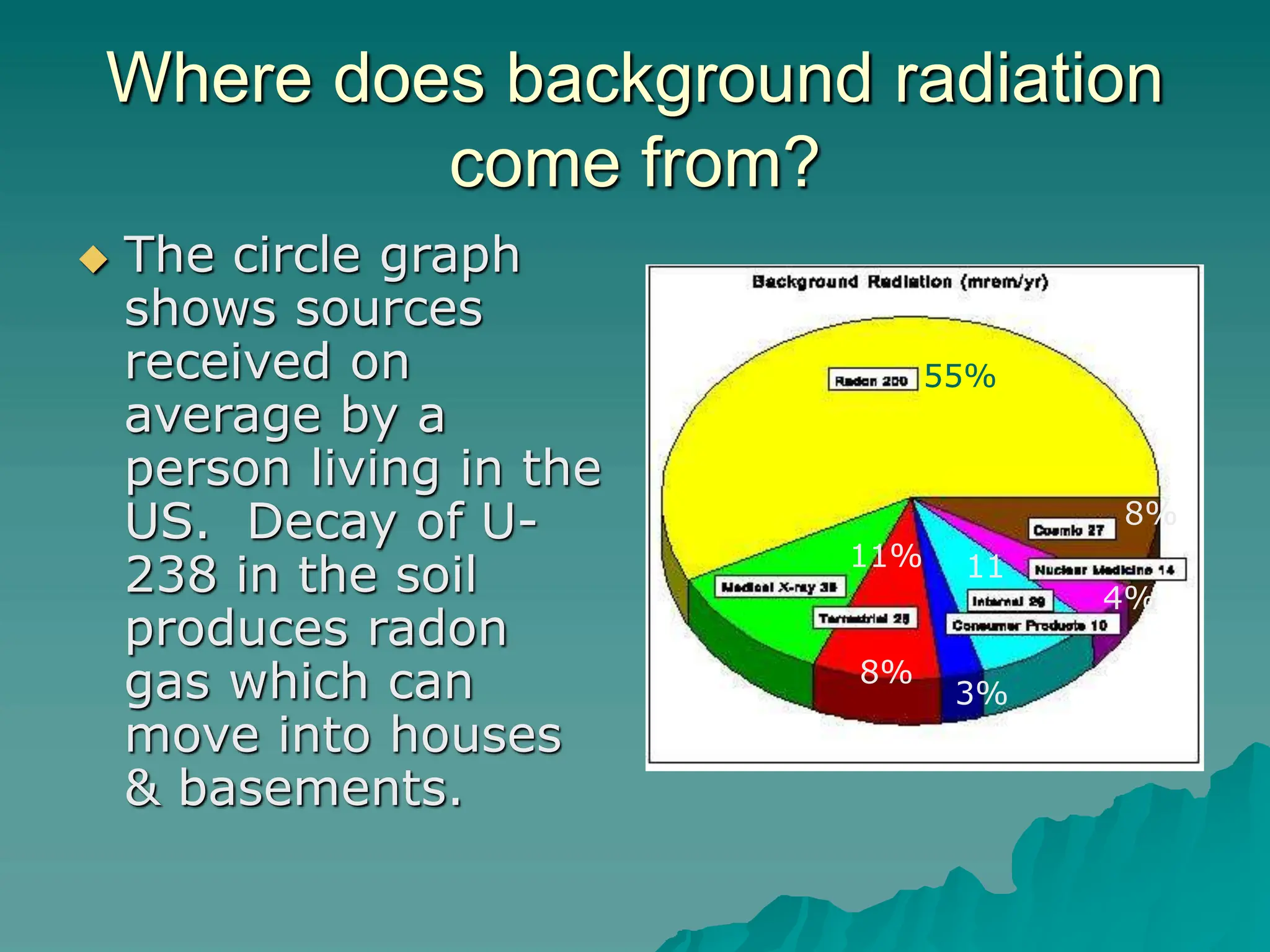
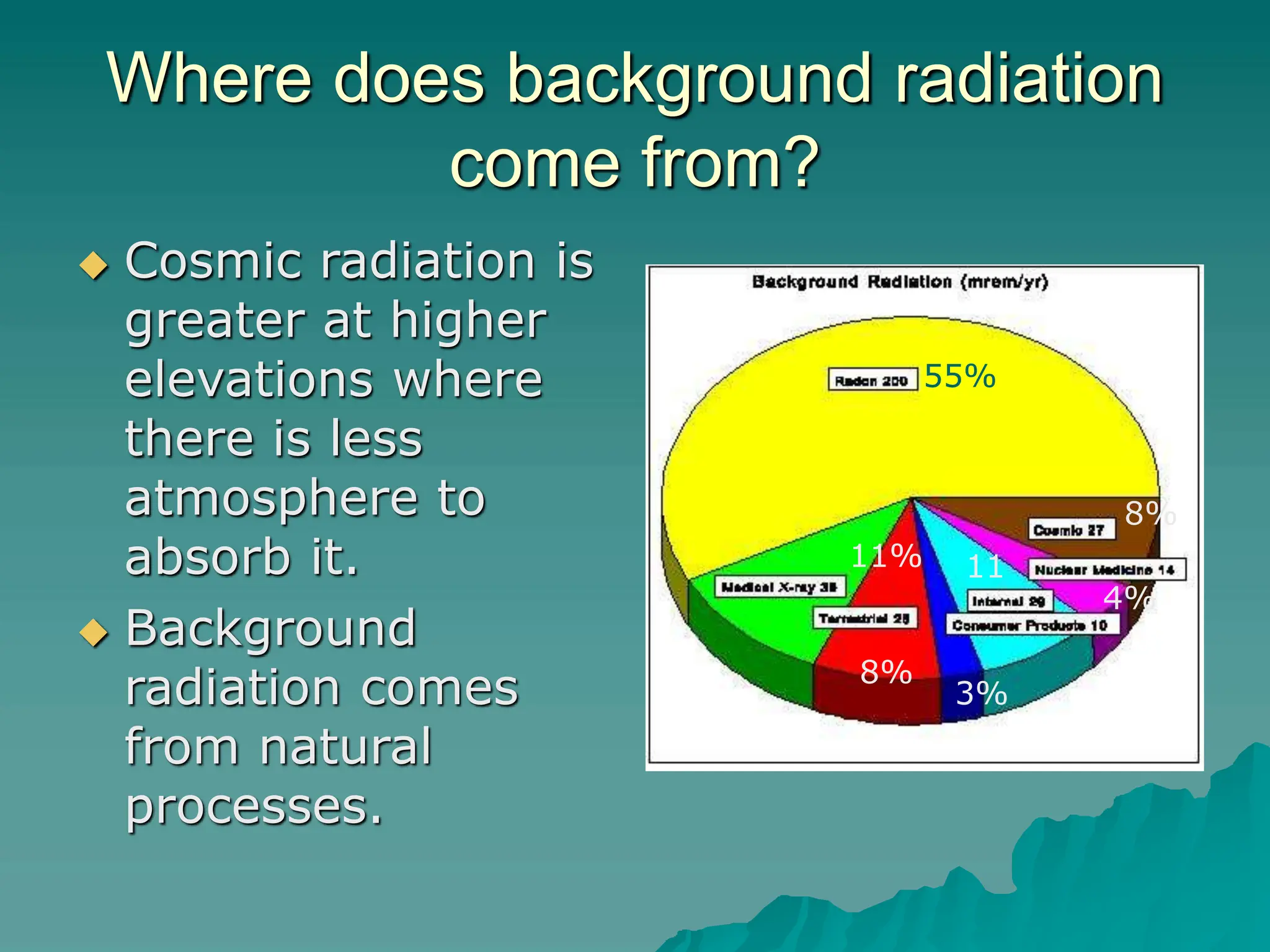
 The circle graph
shows sources
received on
average by a
person living in the
US. Decay of U-
238 in the soil
produces radon
gas which can
move into houses
& basements.
55%
11%
8%
4%
8%
3%
11
Where does background radiation
come from?
 Cosmic radiation is
greater at higher
elevations where
there is less
atmosphere to
absorb it.
 Background
radiation comes
from natural
processes.
55%
11%
8%
4%
8%
3%
11
4 Nuclear Reactions
What You’ll Learn
 What nuclear fission is
 What nuclear fusion is
 How radioactive tracers can be used
in medicine
 How nuclear reactions can help treat
cancer
Nuclear Fission
 1934- Enrico Fermi bombards U
nuclei with neutrons.
Nuclear Fission
 1934- Enrico Fermi bombards U
nuclei with neutrons.
 1938- Otto Hahn & Fritz Strassmann
split U-235 into smaller nuclei.
Nuclear Fission
 1934- Enrico Fermi bombards U
nuclei with neutrons.
 1938- Otto Hahn & Fritz Strassmann
split U-235 into smaller nuclei.
 1939- Lise Meitner theorized that
splitting occurs when the nucleus
becomes so unstable that it splits.
Nuclear Fission
 1934- Enrico Fermi bombards U
nuclei with neutrons.
 1938- Otto Hahn & Fritz Strassmann
split U-235 into smaller nuclei.
 1939- Lise Meitner theorized that
splitting occurs when the nucleus
becomes so unstable that it splits.
 The process of splitting a nucleus
into smaller nuclei- nuclear fission
What nuclei can split during nuclear
fission?
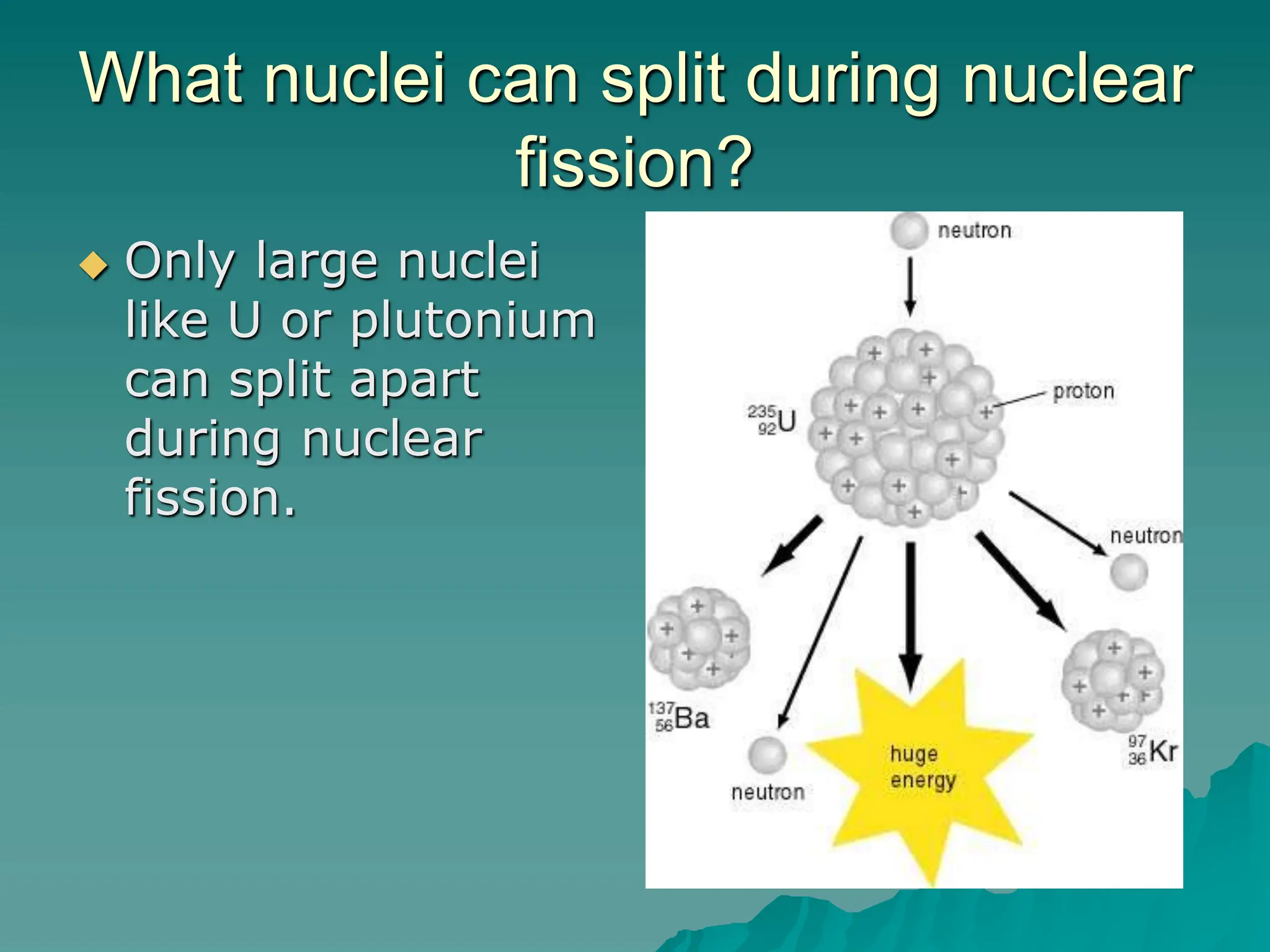
 Only large nuclei
like U or plutonium
can split apart
during nuclear
fission.
What nuclei can split during nuclear
fission?
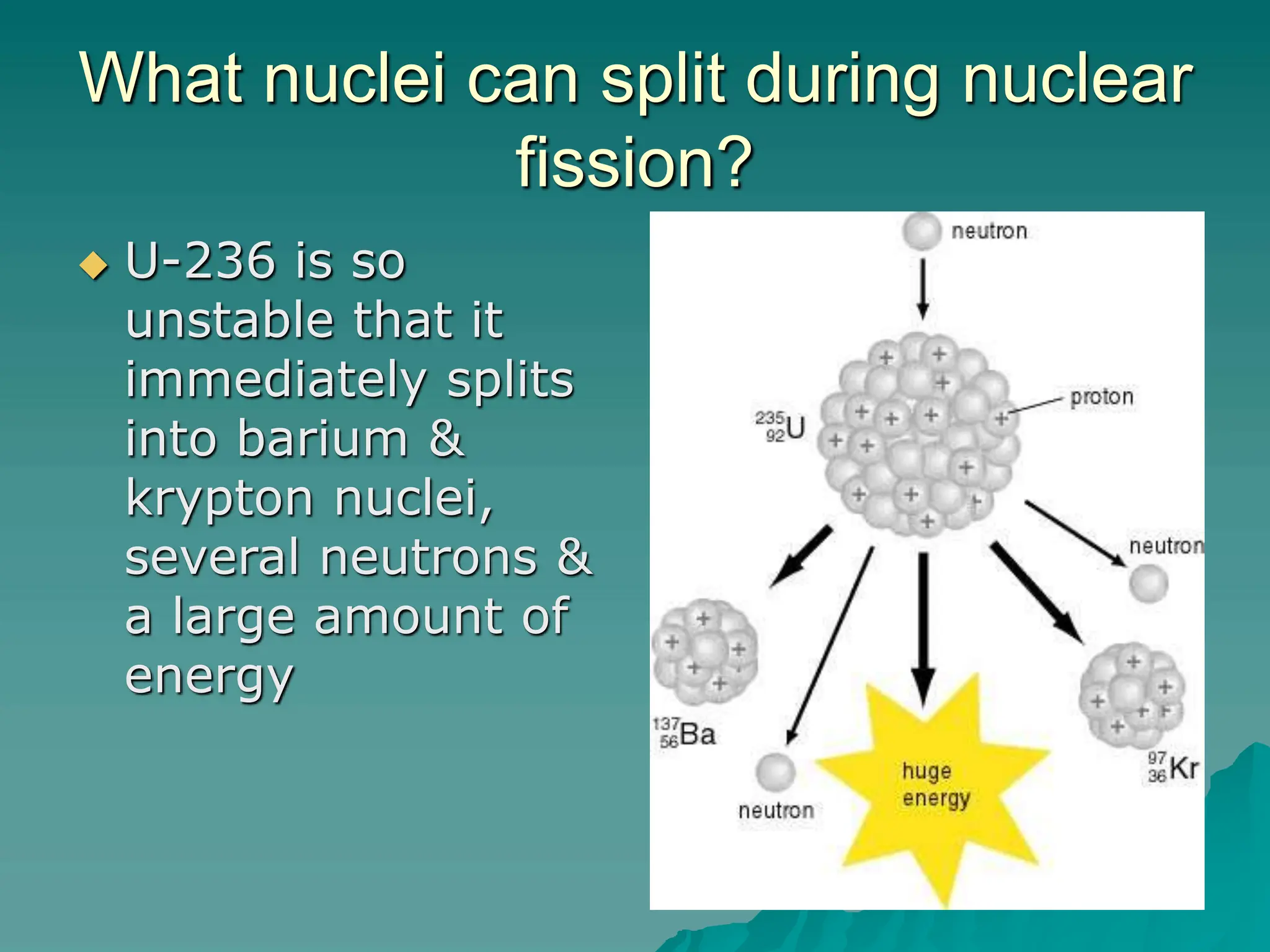
 U-236 is so
unstable that it
immediately splits
into barium &
krypton nuclei,
several neutrons &
a large amount of
energy
How are mass & energy related?
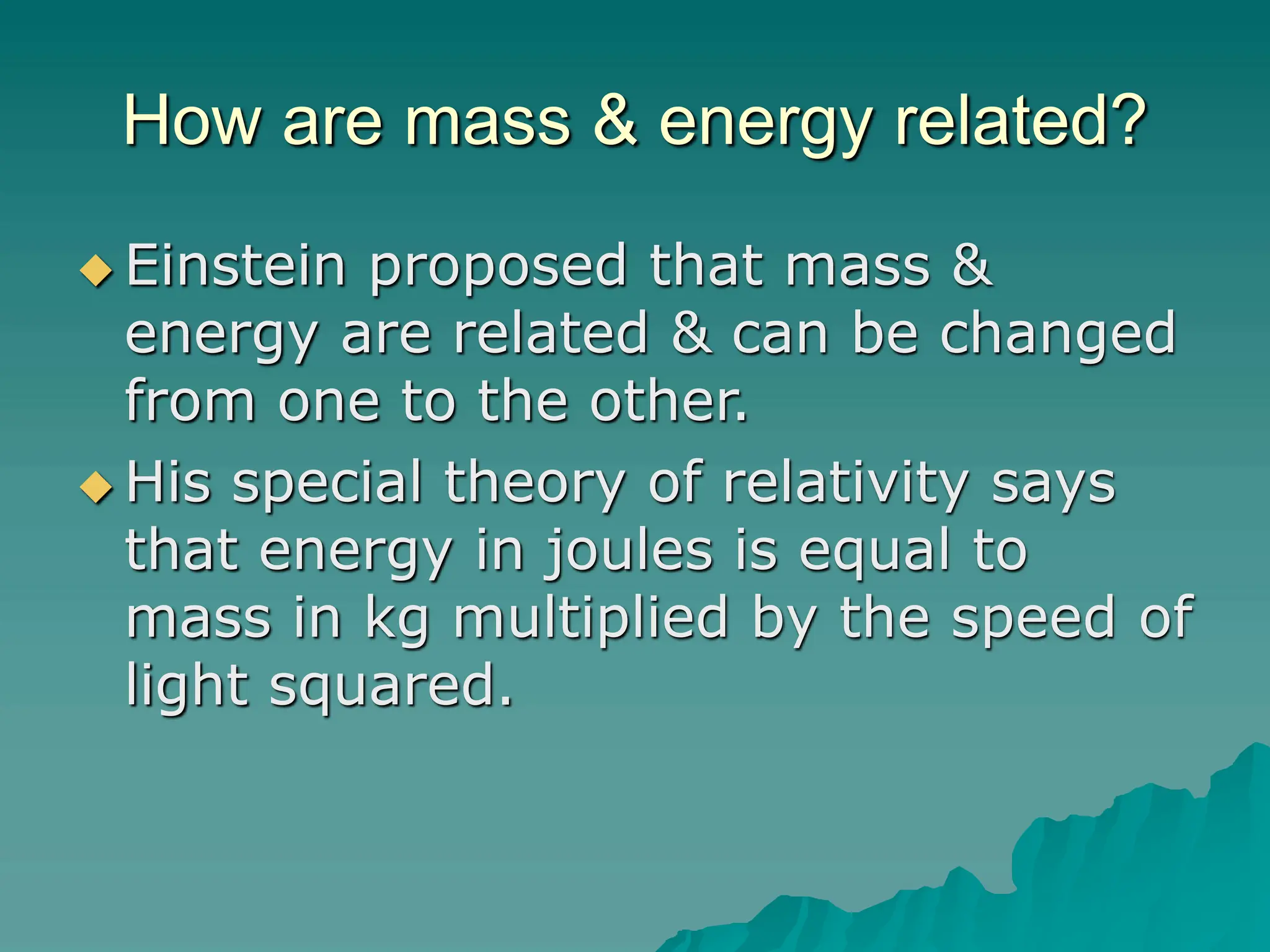
 Einstein proposed that mass &
energy are related & can be changed
from one to the other.
How are mass & energy related?
 Einstein proposed that mass &
energy are related & can be changed
from one to the other.
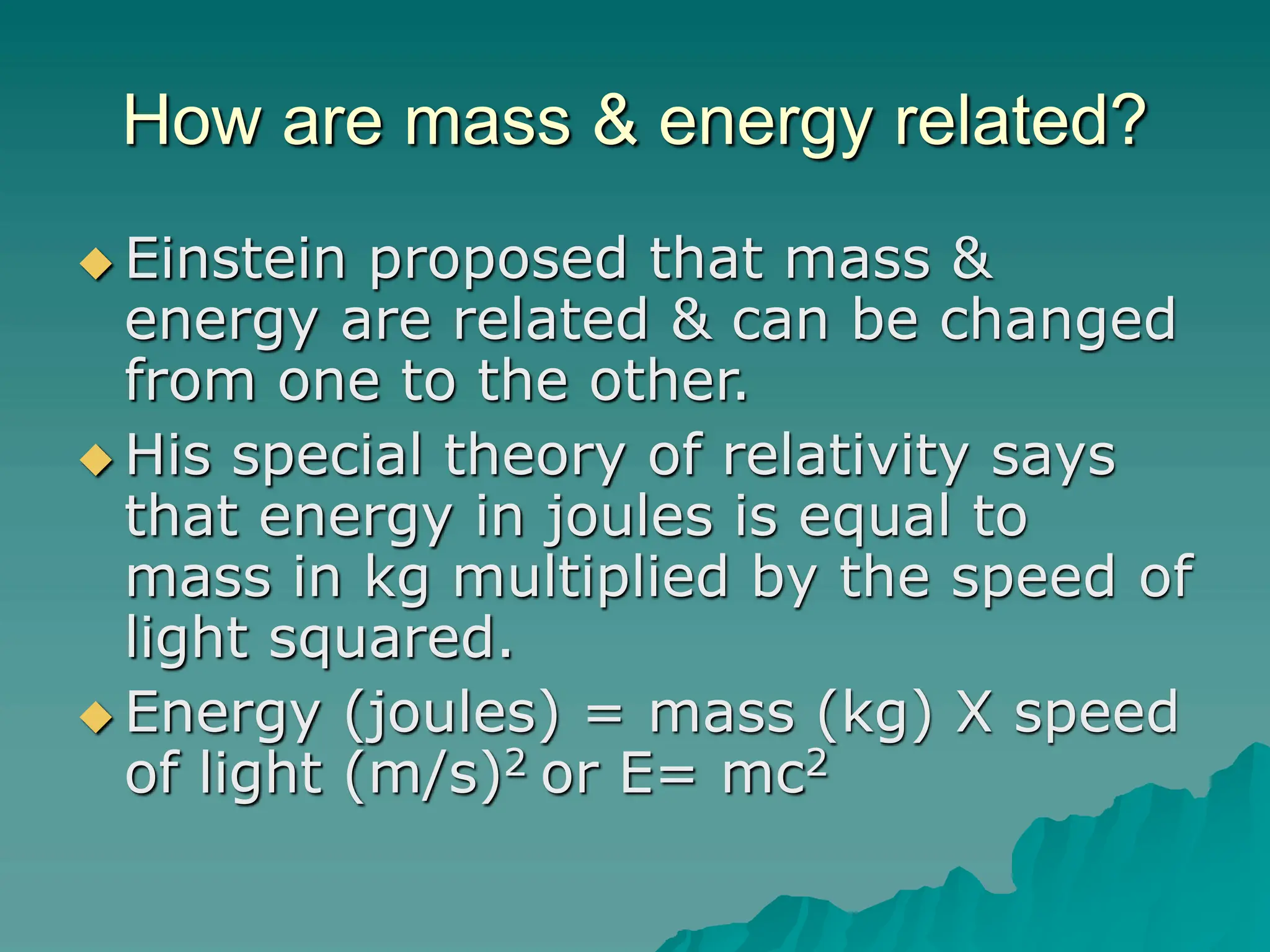
 His special theory of relativity says
that energy in joules is equal to
mass in kg multiplied by the speed of
light squared.
How are mass & energy related?
 Einstein proposed that mass &
energy are related & can be changed
from one to the other.
 His special theory of relativity says
that energy in joules is equal to
mass in kg multiplied by the speed of
light squared.
 Energy (joules) = mass (kg) X speed
of light (m/s)2 or E= mc2
What is a chain reaction?
 Free neutrons produced by fission
can hit other nuclei emitting more
neutrons repeating the reaction over
and over.
What is a chain reaction?
 Free neutrons produced by fission
can hit other nuclei emitting more
neutrons repeating the reaction over
and over.
 A series of fission reactions is called
a chain reaction.
What is a chain reaction?
 Free neutrons produced by fission can hit
other nuclei emitting more neutrons
repeating the reaction over and over.
 A series of fission reactions is called a
chain reaction.
 An uncontrolled chain reaction releases a
huge amount of energy in a short time &
requires a critical mass of starting
material to produce more reactions.
Nuclear Fusion
 Splitting one nucleus of U-235
releases about 30 million times more
energy than when one molecule of
dynamite explodes.
Nuclear Fusion
 Splitting one nucleus of U-235
releases about 30 million times more
energy than when one molecule of
dynamite explodes.
 In a nuclear fusion reaction, two
small, light nuclei combine to form
one larger, heavier nucleus.
Nuclear Fusion
 Splitting one nucleus of U-235
releases about 30 million times more
energy than when one molecule of
dynamite explodes.
 In a nuclear fusion reaction, two
small, light nuclei combine to form
one larger, heavier nucleus.
 Fusion combines nuclei & fission
splits them apart.
How are temperature & fusion
related?
 How can two nuclei get close enough
to combine?
How are temperature & fusion
related?
 How can two nuclei get close enough
to combine? They must be moving
very fast.
How are temperature & fusion
related?
 How can two nuclei get close enough
to combine? They must be moving
very fast.
– All nuclei positively charged
– Thus repel each other
How are temperature & fusion
related?
 How can two nuclei get close enough
to combine? They must be moving
very fast.
– All nuclei positively charged
– Thus repel each other
– KE must overcome electric force to push
them close enough to combine
– KE increases as temperature increases
How are temperature & fusion
related?
 How can two nuclei get close enough
to combine? They must be moving
very fast.
– All nuclei positively charged
– Thus repel each other
– KE must overcome electric force to push
them close enough to combine
– KE increases as temperature increases
– Temp must be millions of °C like Sun &
other stars
How does the Sun produce
energy?
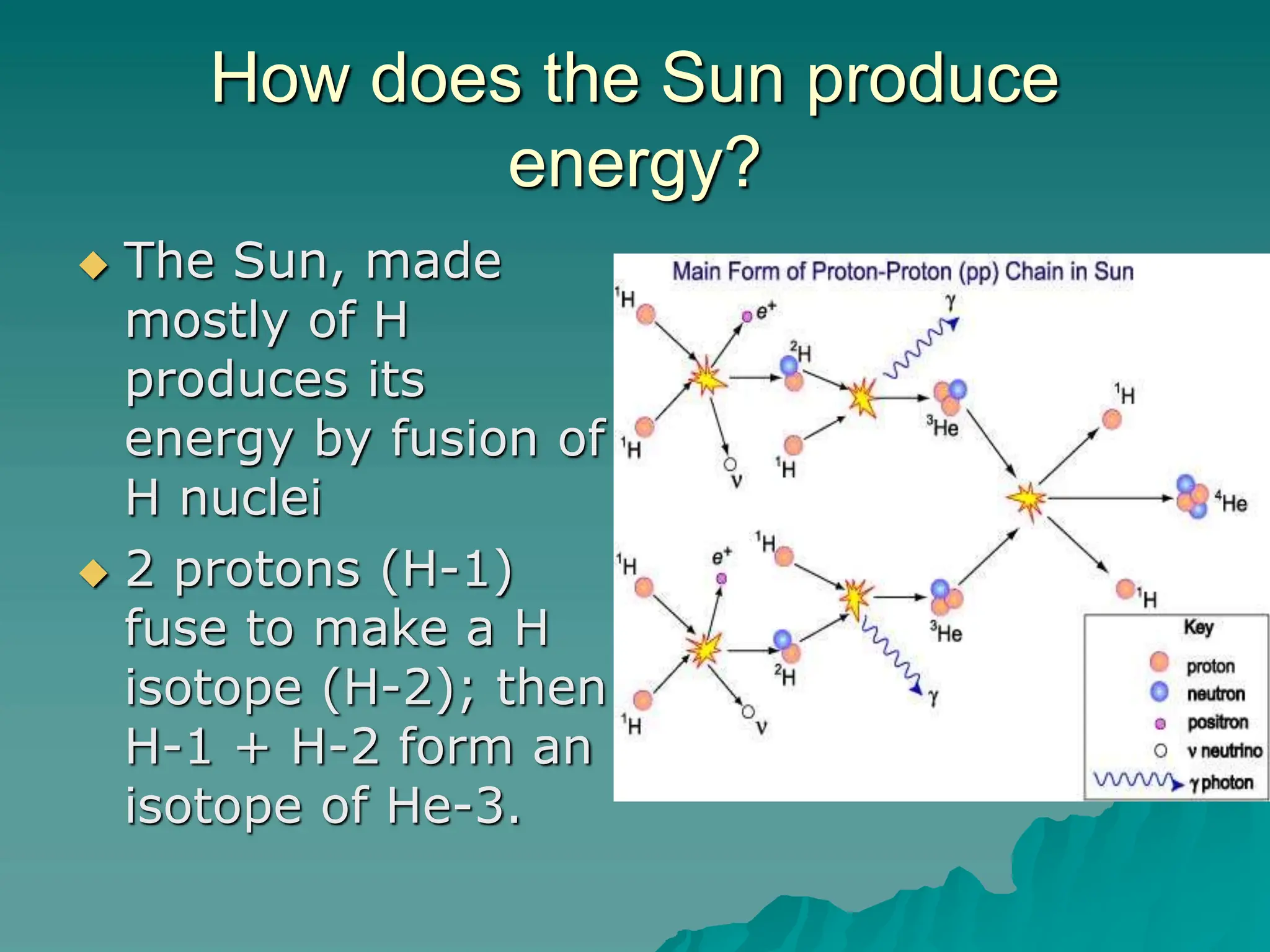
 The Sun, made
mostly of H
produces its
energy by fusion of
H nuclei
 2 protons (H-1)
fuse to make a H
isotope (H-2); then
H-1 + H-2 form an
isotope of He-3.
How does the Sun produce
energy?
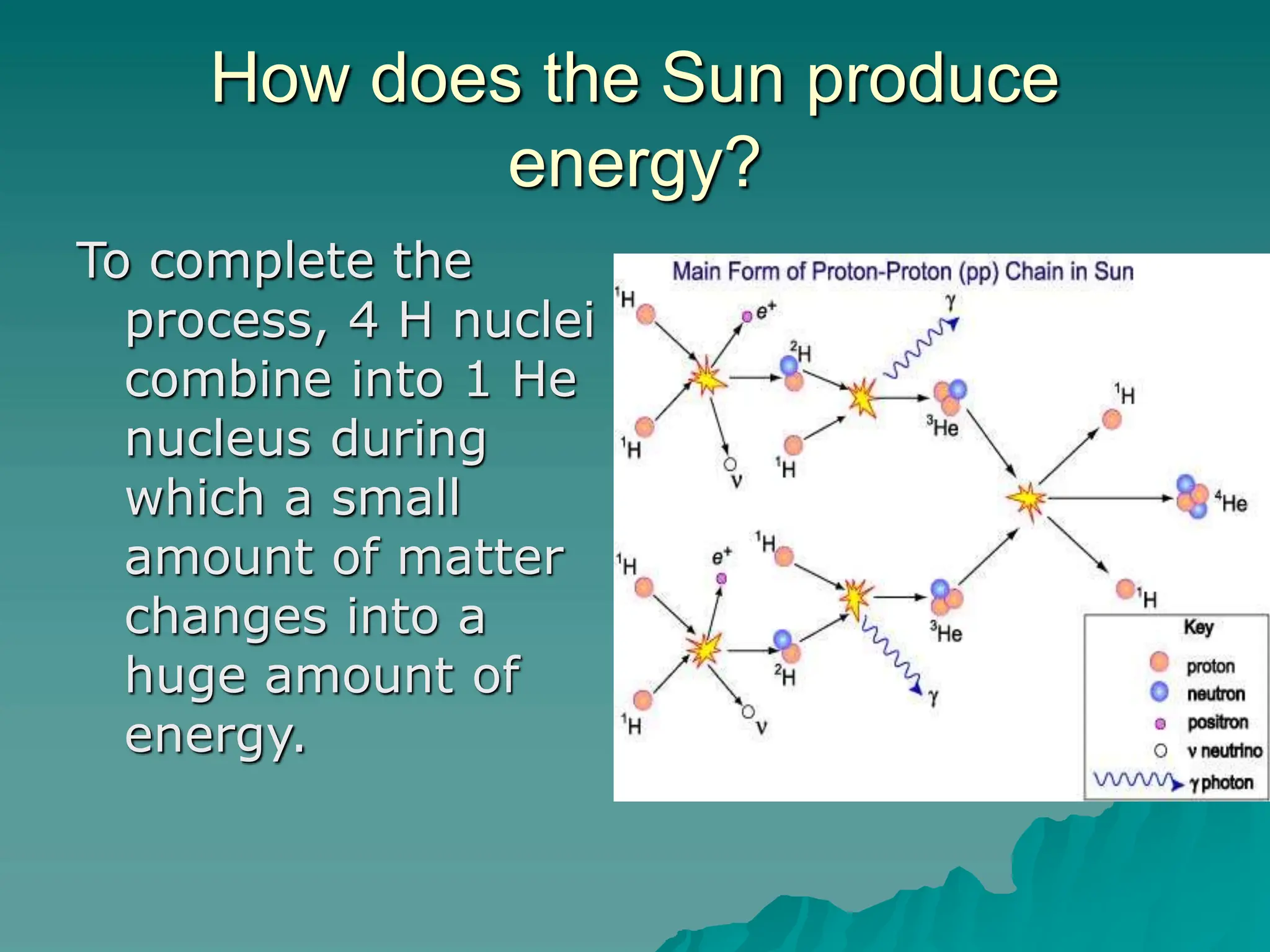
To complete the
process, 4 H nuclei
combine into 1 He
nucleus during
which a small
amount of matter
changes into a
huge amount of
energy.
Fusion on the Sun
 The heat & light Earth receives
comes from this process.
 About 1% of the Sun’s hydrogen has
been changed into energy.
 Sun has enough H to continue fusion
reactions for another 5 billion years.
Using Nuclear Reactions in
Medicine
 A tracer is a radioactive isotope
used to find or keep track of a
molecule as it moves through your
body.
How are iodine tracers used?
 If the thyroid gland in your neck is
not working properly, you get sick.
The radioactive isotope I-131 is used
to see if the thyroid is working
properly. The I-131 decays giving off
gamma rays which can be detected.
How can cancer be treated with
radioactivity?
 Radiation can be used to stop some
cells from growing into tumors.
How can cancer be treated with
radioactivity?
 Radiation can be used to stop some
cells from growing into tumors.
 Sometimes a radioactive isotope can
be placed inside or near a tumor;
other times, tumors can be treated
from outside the body.
How can cancer be treated with
radioactivity?
 Radiation can be used to stop some
cells from growing into tumors.
 Sometimes a radioactive isotope can
be placed inside or near a tumor;
other times, tumors can be treated
from outside the body.
 The radiation emitted when particles
decay can turn nearby atoms into
ions.
How can cancer be treated with
radioactivity?
 If a source of radiation is placed near
cancer cells, atoms in those cells can
be ionized such as atoms in DNA or
RNA which can stop the tumor from
growing or even kill it.
How can cancer be treated with
radioactivity?
 If a source of radiation is placed near
cancer cells, atoms in those cells can
be ionized such as atoms in DNA or
RNA which can stop the tumor from
growing or even kill it.
 Because cancer cells grow quickly,
radiation affects them more than
other cells. Patients receiving
radiation suffer side effects when it
ionizes healthy cells.
Fission Both Fusion
Complete the Venn diagram by listing one thing that fission &
fusion have in common, one thing that applies only to fission, &
one thing that applies only to fusion,
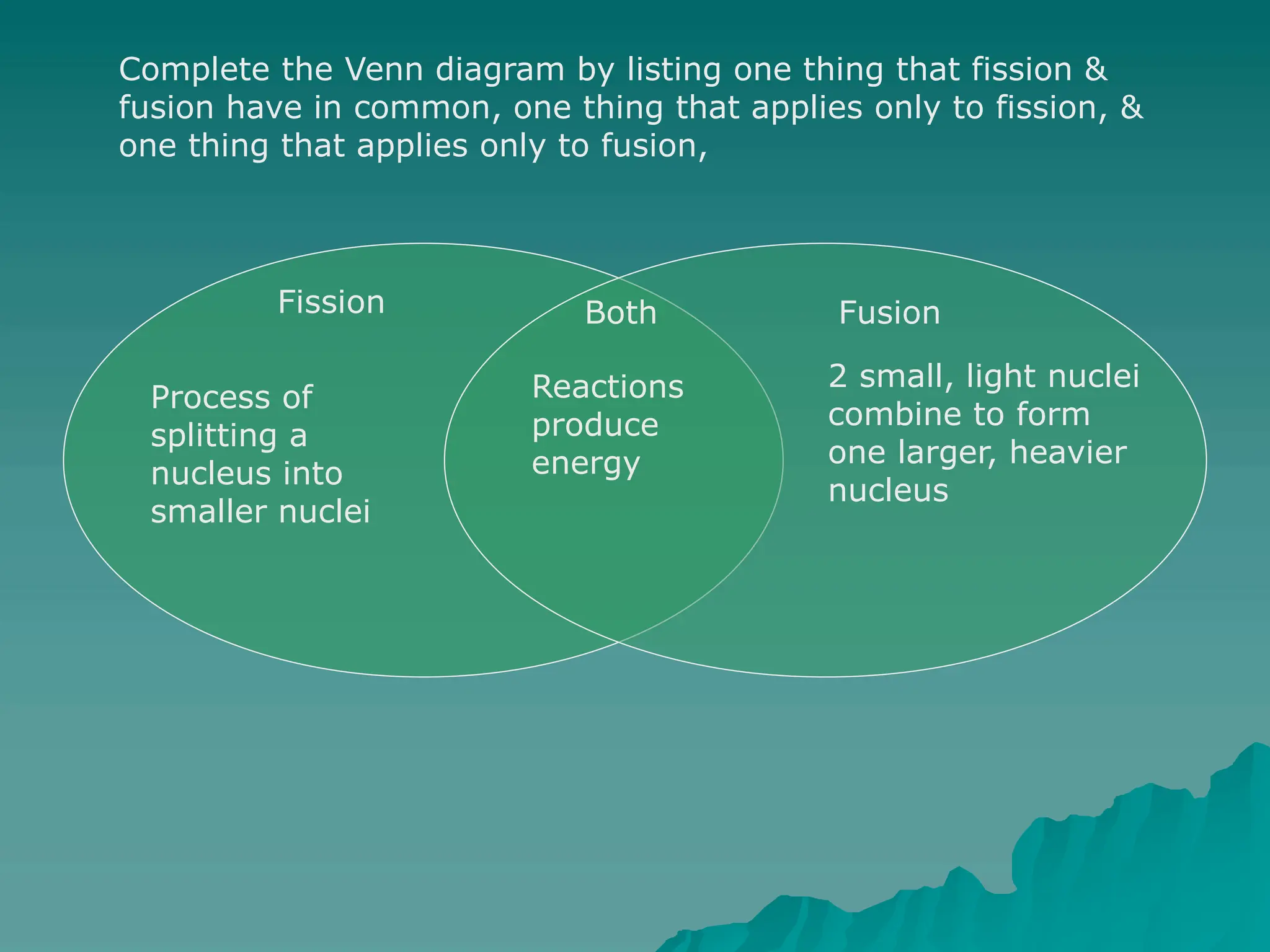
Fission Both Fusion
Complete the Venn diagram by listing one thing that fission &
fusion have in common, one thing that applies only to fission, &
one thing that applies only to fusion,
Reactions
produce
energy
Process of
splitting a
nucleus into
smaller nuclei
2 small, light nuclei
combine to form
one larger, heavier
nucleus

C18-Radioactivity_and_Nuclear_Reactions.ppt

  • 1.
    Radioactivity and Nuclear Reactions Chp18 Section 1 Radioactivity
  • 2.
    Contents  Section 1Radioactivity slides 3-31  Section 2 Nuclear Decay slides 32-55  Section 3 Detecting Radioactivity slides 56-74  Section 4 Nuclear Reactions slides 75-106
  • 3.
    1 Radioactivity What You’llLearn  What particles make up an atom and its nucleus  How the nucleus is held together  What radioactivity is  The properties of radioactive and stable nuclei
  • 4.
    The Nucleus  Theatom is made up of protons, neutrons and electrons.
  • 5.
    The Nucleus  Theatom is made up of protons, neutrons and electrons.  Positively-charged protons and electrically neutral neutrons are located in the nucleus.
  • 6.
    The Nucleus  Theatom is made up of protons, neutrons and electrons.  Positively-charged protons and electrically neutral neutrons are located in the nucleus.  Each proton has one positive charge or +1 so each nucleus has a positive charge equal to the number of protons that it has.
  • 7.
    The Nucleus  Thenumber of protons is called the element’s atomic number.
  • 8.
    The Nucleus  Thenumber of protons is called the element’s atomic number.  Atoms contain the same number of protons as negatively-charged electrons.
  • 9.
    The Nucleus  Thenumber of protons is called the element’s atomic number.  Atoms contain the same number of protons as negatively-charged electrons.  The electric attraction of opposites pulls the electrons close to the nucleus.
  • 10.
    Is the nucleusthe largest part of an atom?  Protons and neutrons are packed together tightly so that the nucleus takes up only a tiny part of an atom.
  • 11.
    Is the nucleusthe largest part of an atom?  Protons and neutrons are packed together tightly so that the nucleus takes up only a tiny part of an atom.  If an atom were the size of a football stadium, its nucleus would be the size of a marble!
  • 12.
    Is the nucleusthe largest part of an atom?  Protons and neutrons are packed together tightly so that the nucleus takes up only a tiny part of an atom.  If an atom were the size of a football stadium, its nucleus would be the size of a marble!  Despite taking little space, the nucleus contains almost all the mass of the atom.
  • 13.
    Is the nucleusthe largest part of an atom?  A proton or neutron has about 2,000 times the mass of an electron.
  • 14.
    The Strong Force The force that makes protons and neutrons attract each other and stay together. – 100 times stronger than the electric force – Only works when particles are close
  • 15.
    How do forceswork in a small nucleus?  In a small nucleus, the particles are close together so that the strong force holds the protons and neutrons tightly together.
  • 16.
    How do forceswork in a large nucleus?  In a large nucleus, the strong force holds together only the particles that are closest to one another.
  • 17.
    How do forceswork in a large nucleus?  In a large nucleus, the strong force holds together only the particles that are closest to one another.  In a nucleus with many protons, the electric force repels protons that are far apart.
  • 18.
    How do forceswork in a large nucleus?  In a large nucleus, the strong force holds together only the particles that are closest to one another.  In a nucleus with many protons, the electric force repels protons that are far apart.  This increased repulsive force causes the particles in a large nucleus to be held less tightly than those in a small nucleus.
  • 19.
    Radioactivity  When thestrong force can hold a nucleus together forever, the nucleus is stable.
  • 20.
    Radioactivity  When thestrong force can hold a nucleus together forever, the nucleus is stable.  If not, the nucleus becomes unstable and can break apart or decay by emitting particles and energy.
  • 21.
    Radioactivity  When thestrong force can hold a nucleus together forever, the nucleus is stable.  If not, the nucleus becomes unstable and can break apart or decay by emitting particles and energy.  Large nuclei are more unstable; all with more than 83 protons are radioactive.
  • 22.
    What are isotopes? Atoms of the same element may have different numbers of neutrons in the nucleus.
  • 23.
    What are isotopes? Atoms of the same element may have different numbers of neutrons in the nucleus.  The atoms of all isotopes of an element have the same numbers of protons & electrons & the same chemical properties.
  • 24.
    What makes nucleiunstable?  The ratio of neutrons to protons determines whether a nucleus is stable or unstable. – Small isotopes 1 neutron:1 proton – Large isotope 3 neutrons: 2 protons – Generally, nuclei with too many or too few neutrons compared to the numbers are unstable or radioactive.
  • 25.
    How is anucleus described?  Atomic number= proton number  Mass number= protons + neutrons
  • 26.
    How is anatom’s information shown?  Scientists use symbols to write information about atoms.  C is the symbol for carbon with 6 protons and 6 neutrons in the isotope C-12. Stable w/ 1:1 ratio
  • 27.
    How is anatom’s information shown?  This isotope is carbon-14 with 6 protons and 14 -6 or 8 neutrons; the ratio is 8:6 so this is unstable or radioactive.
  • 28.
    Who discovered radioactivity? In 1896, Henri Becquerel accidentally left pieces of uranium salt in a drawer on a photographic plate. When he developed the plate, he saw an outline of the uranium salt on it. He realized that it must have given off rays that darkened the film.  http://www.hulu.com/watch/113908/miles tones-in-science-and-engineering- radioactivity-%E2%80%93-henri- becquerel-marie-and-pierre-curie
  • 29.
    Who discovered radioactivity? Two years later Marie and Pierre Curie discovered two new elements, polonium and radium, both radioactive.
  • 30.
    Who discovered radioactivity? Two years later Marie and Pierre Curie discovered two new elements, polonium and radium, both radioactive.  It took them >3 years to get 0.1g of radium from several tons of the mineral pitchblende.
  • 31.
    2 Nuclear Decay WhatYou’ll Learn  How alpha, beta, and gamma radiation are similar and different  What the half-life of a radioactive material is  How radioactive dating is used
  • 32.
    Nuclear Radiation  Whenan unstable nucleus decays, it breaks apart emitting particles and energy as it decays.
  • 33.
    Nuclear Radiation  Whenan unstable nucleus decays, it breaks apart emitting particles and energy as it decays.  Three types of nuclear radiation: – Alpha particles – Beta particles – Gamma radiation electromagnetic wave
  • 34.
    Alpha Particles  Analpha particle is made of 2 protons & 2 neutrons.
  • 35.
    Alpha Particles  Analpha particle is made of 2 protons & 2 neutrons.  The decaying nucleus emits an alpha particle ( 4 2He) with a mass number of 4 & atomic number of 2.
  • 36.
    Alpha Particles  Analpha particle is made of 2 protons & 2 neutrons.  The decaying nucleus emits an alpha particle ( 4 2He) with a mass number of 4 & atomic number of 2.  An alpha particle is the same as the nucleus of a Helium (He) atom.
  • 37.
    Alpha Particles  Alphaparticles have much more mass than beta or gamma radiation – with an electric charge of +2. – Penetrate or pass through matter – Attract negatively charged electrons away from atoms they pass – Lose energy quickly & slow down – Heavier & move more slowly than β or gamma – Sheet of paper can stop alpha particles
  • 38.
    How can alphaparticles harm you?  Think of alpha particles like bowling balls moving in slow motion – they may not penetrate deeply but they can do lots of damage to whatever they hit.  Released inside the human body they can damage cells causing illness & disease.
  • 39.
    How can alphaparticles help you?  Smoke detectors work by emitting alpha particles which collide with molecules in the air forming ions that flow within the detector to create an electric circuit. Smoke particles break this circuit causing the alarm to sound.
  • 40.
    What is transmutation After an alpha particle is emitted, the nucleus has 2 fewer protons & neutrons than it had.  Transmutation is the process of changing one element to a different element by the decaying process.  210 84Po – 4 2He = 206 82Pb  The polonium atom has become a lead atom.
  • 41.
    Beta Particles  Asecond type of radioactive decay, beta radiation, a neutron decays into a proton by emitting an electron (0 -1e). Beta decay is caused by the weak force.
  • 42.
    Beta Particles  Asecond type of radioactive decay, beta radiation, a neutron decays into a proton by emitting an electron (0 -1e). Beta decay is caused by the weak force.  An atom that loses a beta particle undergoes transmutation  131 53I  0 -1e + 131 54Xe Here iodine becomes xenon.
  • 43.
    How can betaparticles harm you?  Beta Particles are faster than alpha because they’re smaller & lighter so they penetrate deeper into material they hit. – Pass through paper – Aluminum foil will stop a beta particle – Can damage human cells if released inside the body
  • 44.
    Gamma Rays  Gammaradiation is emitted as electromagnetic waves.  Gamma rays are EM waves with the highest frequencies & the shortest wavelength in the EM spectrum.  The symbol for a gamma ray is the Greek letter γ gamma.
  • 45.
    Gamma Rays  Haveno mass & no charge.  Travel at the speed of light.  Emitted by nucleus when alpha or beta particle is created.  Takes thick blocks of concrete or lead to stop gamma rays.  Cause less damage to cells inside the body than alpha or beta particles.
  • 46.
    Radioactive Half-Life  Themeasure of the time it takes for half of the radioactive nuclei in a sample to decay is called a half-life.  The remaining nucleus is called the daughter nucleus.  Various isotopes decay at different rates.
  • 47.
    Half-Life Radioactive bismuth (210Bi) canundergo alpha decay to form the thallium (206Tl) with a half-life equal to 5 days. If we start with 100 g of bismuth in a sealed lead container, after 5 days we will have 50 g of bismuth & 50 g of thallium in the jar. After another 5 days, One-half of the remaining bismuth will decay & we will be left with 25 g of bismuth & 75 g of thallium in the jar.
  • 48.
    Radioactive Dating  Scientistsoften want to know the ages of rocks & fossils using radioactive isotopes & their half-lives.
  • 49.
    Radioactive Dating  Scientistsoften want to know the ages of rocks & fossils using radioactive isotopes & their half-lives.  The amount of the radioactive isotope in object is measured, then the amount of the daughter nuclei is measured. With these the number of half-lives or age of the object can be calculated.
  • 50.
    How is carbonused to date objects?  Carbon-14, with a half-life of 5,730 years is often used to estimate the age of plant & animal remains.
  • 51.
    How is carbonused to date objects?  Carbon-14, with a half-life of 5,730 years is often used to estimate the age of plant & animal remains.  CO2 which plants use in photosynthesis contains C-14 which stays in the same ratio while alive.
  • 52.
    How is carbonused to date objects?  Carbon-14, with a half-life of 5,730 years is often used to estimate the age of plant & animal remains.  CO2 which plants use in photosynthesis contains C-14 which stays in the same ratio while alive.  Once it dies, C-14 decreases as the C- 12 increases over time. The ratio estimates ages up to 50,000 years.
  • 53.
    How is uraniumused to date objects?  Some rocks can be dated using the amount of radioactive uranium isotopes that have decayed into lead.
  • 54.
    How is uraniumused to date objects?  Some rocks can be dated using the amount of radioactive uranium isotopes that have decayed into lead.  The ratio of the amounts of U isotopes & and their daughter nuclei are compared to estimate the age of the rock.
  • 55.
    3 Detecting Radioactivity WhatYou’ll Learn  How cloud and bubble chambers are used to detect radioactivity  How an electroscope is used to detect radiation  How a Geiger counter measures radiation
  • 56.
    Radiation Detectors  Specialinstruments detect the electric charge of the ions formed by the radioactive particles as they pass through matter.
  • 57.
    How does acloud chamber detect radiation?  A cloud chamber, a rectangular box with transparent sides containing water or ethanol vapor, can be used to detect α or β radiation.
  • 58.
    How does acloud chamber detect radiation?  A cloud chamber, a rectangular box with transparent sides containing water or ethanol vapor, can be used to detect α or β radiation.  A radioactive sample placed in the cloud chamber emits charged α or β particles which pull electrons off atoms in the air leaving a trail of ions.
  • 59.
    How does acloud chamber detect radiation?  Vapor condenses around these ions forming small drops along their path. – Beta leave long, thin trails – Alpha leave shorter, thicker trails
  • 60.
    What is abubble chamber?  A bubble chamber contains superheated liquid under high pressure so that it does not boil.
  • 61.
    What is abubble chamber?  A bubble chamber contains superheated liquid under high pressure so that it does not boil.  When a radioactive particle passes through, it leaves a trail of ions that causes the liquid to boil along the ion trail.
  • 62.
    Bubble Chamber  Whena charged particle passes through superheated liquid, it leaves a trail of tiny gas bubbles that can be illuminated & photographed. The track of a charged particle can be used to identify the particle & to analyze complex events.
  • 63.
    How does anelectroscope detect radiation?  Nuclear radiation can cause an electroscope to lose its charge.
  • 64.
    How does anelectroscope detect radiation?  Nuclear radiation can cause an electroscope to lose its charge.  Leaves stay apart until their extra negative charges can combine with positive charges creating positive ions in the air.
  • 65.
  • 66.
    Measuring Radiation  AGeiger counter has a negatively charged Cu tube with a positively charged wire running through it.
  • 67.
    Measuring Radiation  Thetube is filled with gas at low pressure.  Radiation knocks electrons off the gas which are attracted to the wire producing a current.
  • 68.
    Measuring Radiation  Anamplifier strengthens the current producing a clicking sound or a flashing light.  The number of clicks or flashes per second tell how strong the radiation is.
  • 69.
    Background Radiation  Theair, the ground, & even the walls of your home give off radiation in small amounts.
  • 70.
    Background Radiation  Theair, the ground, & even the walls of your home give off radiation in small amounts.  Radioactive isotopes that occur in nature emit background radiation from rocks, soil, air, bricks, wood, stone, food, water, animals, plants, etc.
  • 71.
    Where does backgroundradiation come from?  The circle graph shows sources received on average by a person living in the US. Decay of U- 238 in the soil produces radon gas which can move into houses & basements. 55% 11% 8% 4% 8% 3% 11
  • 72.
    Where does backgroundradiation come from?  Cosmic radiation is greater at higher elevations where there is less atmosphere to absorb it.  Background radiation comes from natural processes. 55% 11% 8% 4% 8% 3% 11
  • 73.
    4 Nuclear Reactions WhatYou’ll Learn  What nuclear fission is  What nuclear fusion is  How radioactive tracers can be used in medicine  How nuclear reactions can help treat cancer
  • 74.
    Nuclear Fission  1934-Enrico Fermi bombards U nuclei with neutrons.
  • 75.
    Nuclear Fission  1934-Enrico Fermi bombards U nuclei with neutrons.  1938- Otto Hahn & Fritz Strassmann split U-235 into smaller nuclei.
  • 76.
    Nuclear Fission  1934-Enrico Fermi bombards U nuclei with neutrons.  1938- Otto Hahn & Fritz Strassmann split U-235 into smaller nuclei.  1939- Lise Meitner theorized that splitting occurs when the nucleus becomes so unstable that it splits.
  • 77.
    Nuclear Fission  1934-Enrico Fermi bombards U nuclei with neutrons.  1938- Otto Hahn & Fritz Strassmann split U-235 into smaller nuclei.  1939- Lise Meitner theorized that splitting occurs when the nucleus becomes so unstable that it splits.  The process of splitting a nucleus into smaller nuclei- nuclear fission
  • 78.
    What nuclei cansplit during nuclear fission?  Only large nuclei like U or plutonium can split apart during nuclear fission.
  • 79.
    What nuclei cansplit during nuclear fission?  U-236 is so unstable that it immediately splits into barium & krypton nuclei, several neutrons & a large amount of energy
  • 80.
    How are mass& energy related?  Einstein proposed that mass & energy are related & can be changed from one to the other.
  • 81.
    How are mass& energy related?  Einstein proposed that mass & energy are related & can be changed from one to the other.  His special theory of relativity says that energy in joules is equal to mass in kg multiplied by the speed of light squared.
  • 82.
    How are mass& energy related?  Einstein proposed that mass & energy are related & can be changed from one to the other.  His special theory of relativity says that energy in joules is equal to mass in kg multiplied by the speed of light squared.  Energy (joules) = mass (kg) X speed of light (m/s)2 or E= mc2
  • 83.
    What is achain reaction?  Free neutrons produced by fission can hit other nuclei emitting more neutrons repeating the reaction over and over.
  • 84.
    What is achain reaction?  Free neutrons produced by fission can hit other nuclei emitting more neutrons repeating the reaction over and over.  A series of fission reactions is called a chain reaction.
  • 85.
    What is achain reaction?  Free neutrons produced by fission can hit other nuclei emitting more neutrons repeating the reaction over and over.  A series of fission reactions is called a chain reaction.  An uncontrolled chain reaction releases a huge amount of energy in a short time & requires a critical mass of starting material to produce more reactions.
  • 86.
    Nuclear Fusion  Splittingone nucleus of U-235 releases about 30 million times more energy than when one molecule of dynamite explodes.
  • 87.
    Nuclear Fusion  Splittingone nucleus of U-235 releases about 30 million times more energy than when one molecule of dynamite explodes.  In a nuclear fusion reaction, two small, light nuclei combine to form one larger, heavier nucleus.
  • 88.
    Nuclear Fusion  Splittingone nucleus of U-235 releases about 30 million times more energy than when one molecule of dynamite explodes.  In a nuclear fusion reaction, two small, light nuclei combine to form one larger, heavier nucleus.  Fusion combines nuclei & fission splits them apart.
  • 89.
    How are temperature& fusion related?  How can two nuclei get close enough to combine?
  • 90.
    How are temperature& fusion related?  How can two nuclei get close enough to combine? They must be moving very fast.
  • 91.
    How are temperature& fusion related?  How can two nuclei get close enough to combine? They must be moving very fast. – All nuclei positively charged – Thus repel each other
  • 92.
    How are temperature& fusion related?  How can two nuclei get close enough to combine? They must be moving very fast. – All nuclei positively charged – Thus repel each other – KE must overcome electric force to push them close enough to combine – KE increases as temperature increases
  • 93.
    How are temperature& fusion related?  How can two nuclei get close enough to combine? They must be moving very fast. – All nuclei positively charged – Thus repel each other – KE must overcome electric force to push them close enough to combine – KE increases as temperature increases – Temp must be millions of °C like Sun & other stars
  • 94.
    How does theSun produce energy?  The Sun, made mostly of H produces its energy by fusion of H nuclei  2 protons (H-1) fuse to make a H isotope (H-2); then H-1 + H-2 form an isotope of He-3.
  • 95.
    How does theSun produce energy? To complete the process, 4 H nuclei combine into 1 He nucleus during which a small amount of matter changes into a huge amount of energy.
  • 96.
    Fusion on theSun  The heat & light Earth receives comes from this process.  About 1% of the Sun’s hydrogen has been changed into energy.  Sun has enough H to continue fusion reactions for another 5 billion years.
  • 97.
    Using Nuclear Reactionsin Medicine  A tracer is a radioactive isotope used to find or keep track of a molecule as it moves through your body.
  • 98.
    How are iodinetracers used?  If the thyroid gland in your neck is not working properly, you get sick. The radioactive isotope I-131 is used to see if the thyroid is working properly. The I-131 decays giving off gamma rays which can be detected.
  • 99.
    How can cancerbe treated with radioactivity?  Radiation can be used to stop some cells from growing into tumors.
  • 100.
    How can cancerbe treated with radioactivity?  Radiation can be used to stop some cells from growing into tumors.  Sometimes a radioactive isotope can be placed inside or near a tumor; other times, tumors can be treated from outside the body.
  • 101.
    How can cancerbe treated with radioactivity?  Radiation can be used to stop some cells from growing into tumors.  Sometimes a radioactive isotope can be placed inside or near a tumor; other times, tumors can be treated from outside the body.  The radiation emitted when particles decay can turn nearby atoms into ions.
  • 102.
    How can cancerbe treated with radioactivity?  If a source of radiation is placed near cancer cells, atoms in those cells can be ionized such as atoms in DNA or RNA which can stop the tumor from growing or even kill it.
  • 103.
    How can cancerbe treated with radioactivity?  If a source of radiation is placed near cancer cells, atoms in those cells can be ionized such as atoms in DNA or RNA which can stop the tumor from growing or even kill it.  Because cancer cells grow quickly, radiation affects them more than other cells. Patients receiving radiation suffer side effects when it ionizes healthy cells.
  • 104.
    Fission Both Fusion Completethe Venn diagram by listing one thing that fission & fusion have in common, one thing that applies only to fission, & one thing that applies only to fusion,
  • 105.
    Fission Both Fusion Completethe Venn diagram by listing one thing that fission & fusion have in common, one thing that applies only to fission, & one thing that applies only to fusion, Reactions produce energy Process of splitting a nucleus into smaller nuclei 2 small, light nuclei combine to form one larger, heavier nucleus