Physics for senior secondary
or A-level students
~lalit kishore, The plenum School, HP
Genesis
 There exist elements with unstable nuclei
 Reason: The neutron-proton combination is such that
the forces between nucleons get unbalanced
 To become stable they emit 2 things
 Particles ...and/or
 Electro-magnetic radiations
 Such nuclei are called radioactive and the emission is
called radioactivity
Three types of emissions from
radioactive nuclei
 Types of radioactive emission are:
 Alpha-particles
 Beta-particles
 Gamma radiations
 Notes:
 All three emissions originate from nucleus of a
radioactive atom
 Emissions are invisible to the eye
 They are detected by impressions in the form of tracks
on high density photographic films or nuclear emulsion
plates
Alpha-particles -1
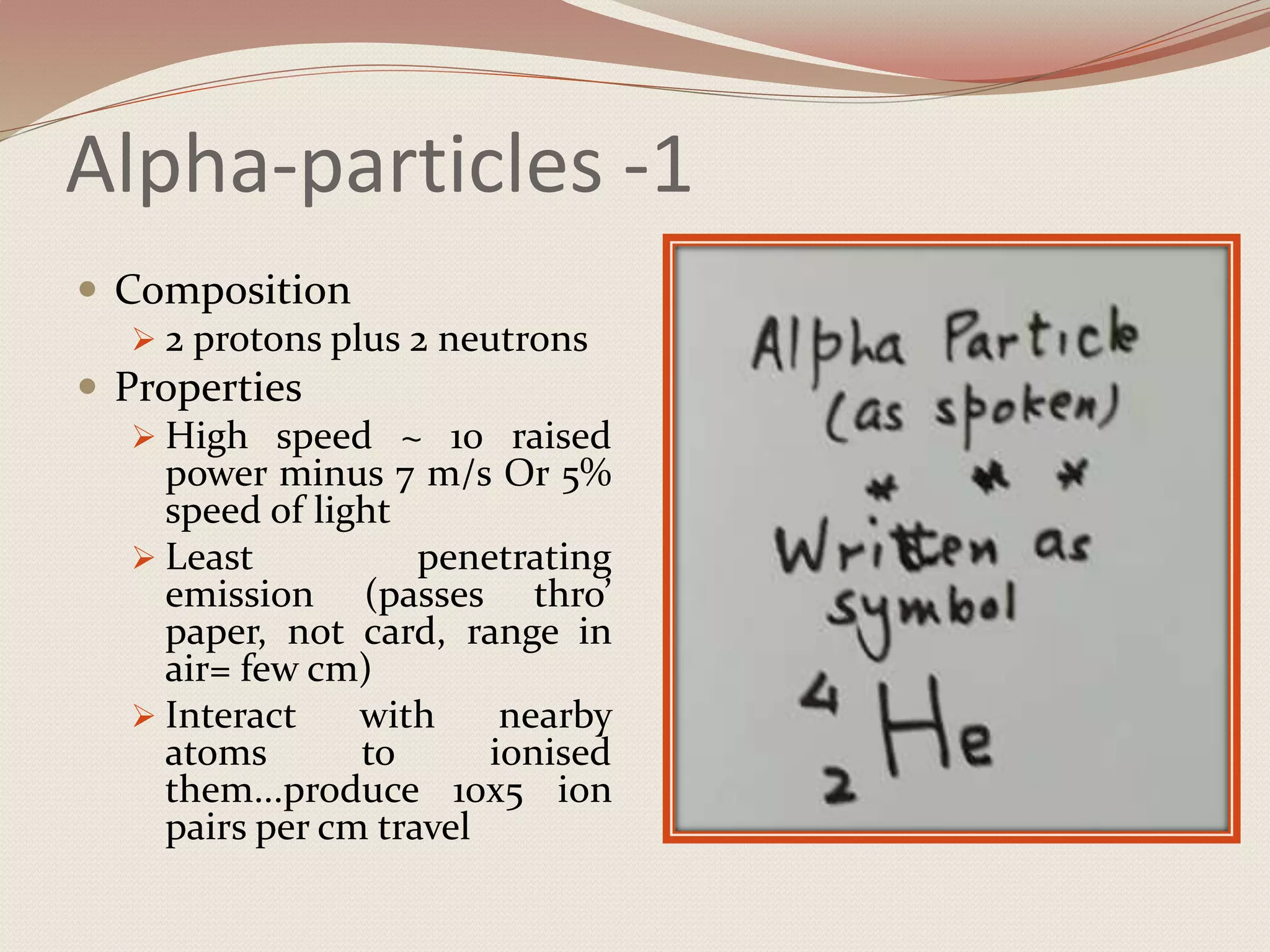
 Composition
 2 protons plus 2 neutrons
 Properties
 High speed ~ 10 raised
power minus 7 m/s Or 5%
speed of light
 Least penetrating
emission (passes thro’
paper, not card, range in
air= few cm)
 Interact with nearby
atoms to ionised
them...produce 10x5 ion
pairs per cm travel
Alpha particles - 2
 An alpha particle is the
nucleus of helium atom
 When an atom emits alpha-
particle, it is said to undergo
alpha-decay by loosing 2
protons and 2 neutrons
 With alpha decay, one
element changes to another
and this process is called
transmutation
• Emitted alpha particles
have the same KE
Beta particles - 1
 Some radioactive elements
such radioactive lead and
radioactive phosphorus
electrons and positrons
respectively as beta
particles along with
neutron particles
 Even free neutrons and
protons undergo decay to
emit electron and positron
along with production of
energy
Beta particles - 2
 In beta-minus decay in which negative electron is emitted,
a daughter nuclide is formed with:
 Proton no. increased by 1
 Nucleon no. remaining unchanged
 In beta-plus decay in which positive electron (positron) is
emitted, a daughter nuclide is formed with:
 Proton no. decreased by 1
 Nucleon no. remaining unchanged
• Emitted beta particles have continuous range of KE
since the process is accompanied by emission of
neutrinos
Gamma radiations - 1
 Some radioactive emit gamma
radiations which are
 Part of e-m spectrum
 Wavelength of the radiations is 10
raised power -11 to -13 metres
 Can penetrate
 Air to unlimited range
 Several metres of concrete
 Several cm of lead
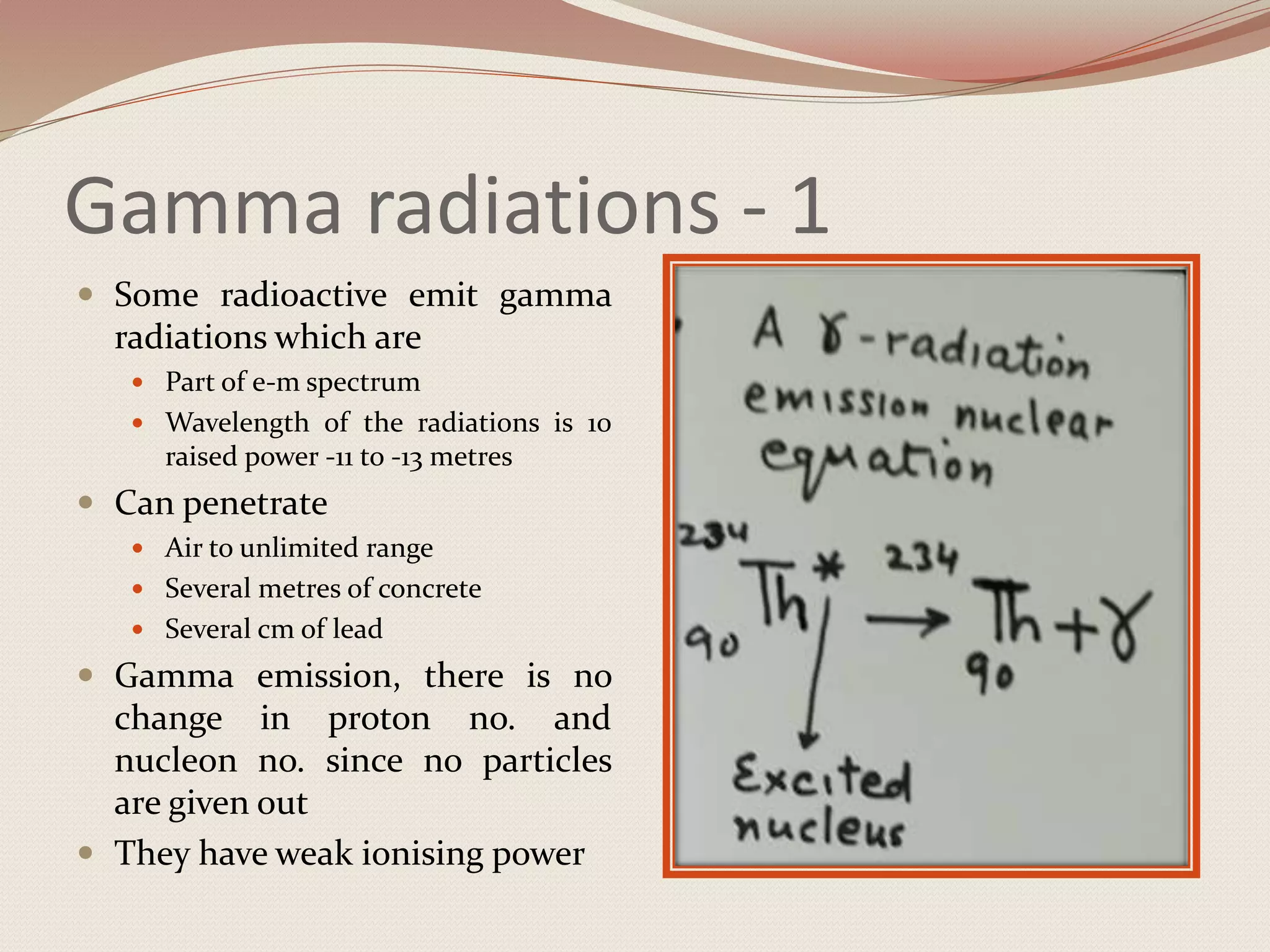
 Gamma emission, there is no
change in proton no. and
nucleon no. since no particles
are given out
 They have weak ionising power
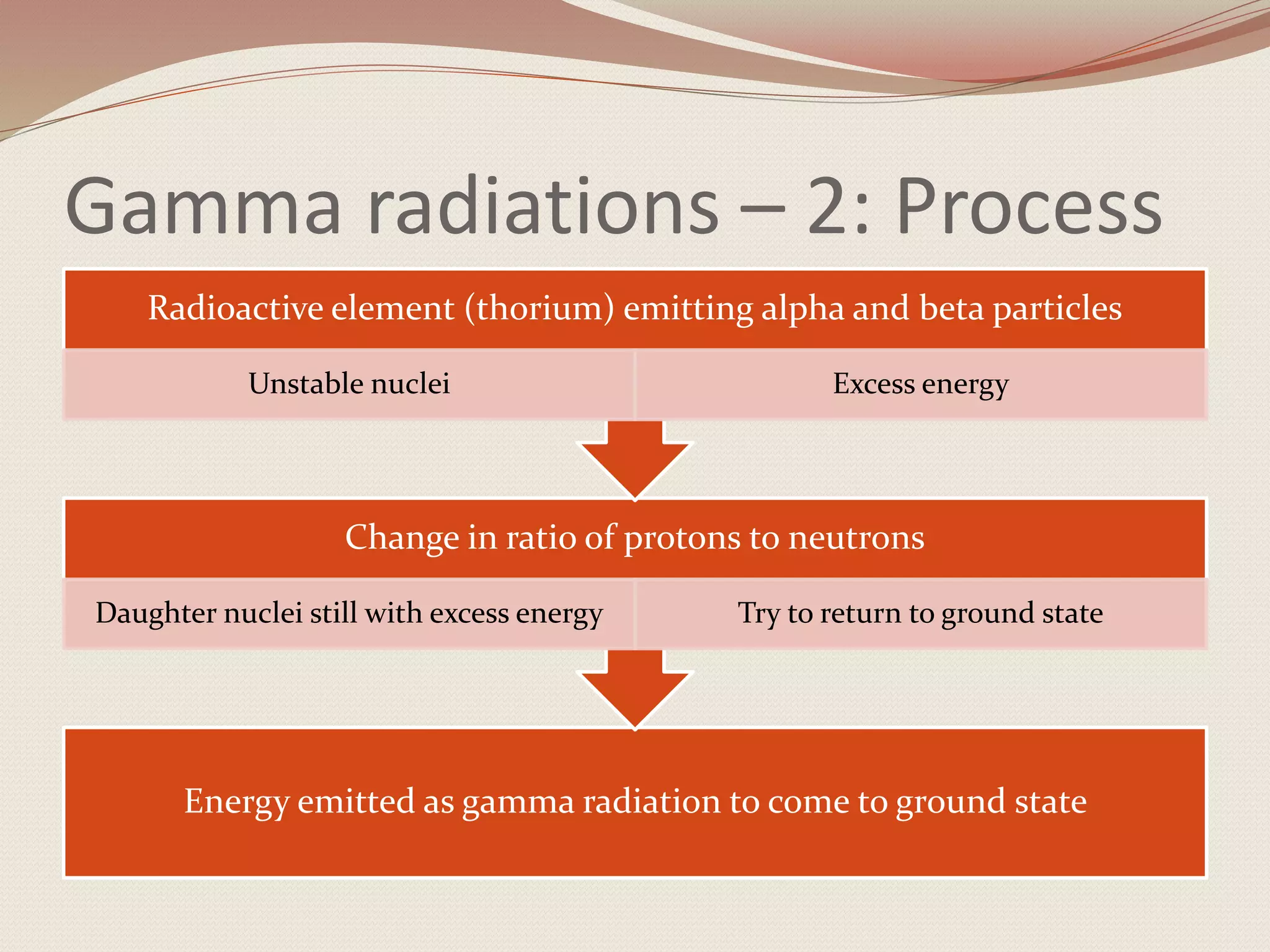
Gamma radiations – 2: Process
Energy emitted as gamma radiation to come to ground state
Change in ratio of protons to neutrons
Daughter nuclei still with excess energy Try to return to ground state
Radioactive element (thorium) emitting alpha and beta particles
Unstable nuclei Excess energy
Radioactive decay series
 The nuclide may be unstable, further
decay happens to give different
nuclide
 Sequence of decays till stable nuclide
is reached is called decay series
 Do some reference work to find the
decay series uranium-238

Alpha and Beta Particles and Gamma Radiation.pptx

  • 1.
    Physics for seniorsecondary or A-level students ~lalit kishore, The plenum School, HP
  • 2.
    Genesis  There existelements with unstable nuclei  Reason: The neutron-proton combination is such that the forces between nucleons get unbalanced  To become stable they emit 2 things  Particles ...and/or  Electro-magnetic radiations  Such nuclei are called radioactive and the emission is called radioactivity
  • 3.
    Three types ofemissions from radioactive nuclei  Types of radioactive emission are:  Alpha-particles  Beta-particles  Gamma radiations  Notes:  All three emissions originate from nucleus of a radioactive atom  Emissions are invisible to the eye  They are detected by impressions in the form of tracks on high density photographic films or nuclear emulsion plates
  • 4.
    Alpha-particles -1  Composition 2 protons plus 2 neutrons  Properties  High speed ~ 10 raised power minus 7 m/s Or 5% speed of light  Least penetrating emission (passes thro’ paper, not card, range in air= few cm)  Interact with nearby atoms to ionised them...produce 10x5 ion pairs per cm travel
  • 5.
    Alpha particles -2  An alpha particle is the nucleus of helium atom  When an atom emits alpha- particle, it is said to undergo alpha-decay by loosing 2 protons and 2 neutrons  With alpha decay, one element changes to another and this process is called transmutation • Emitted alpha particles have the same KE
  • 6.
    Beta particles -1  Some radioactive elements such radioactive lead and radioactive phosphorus electrons and positrons respectively as beta particles along with neutron particles  Even free neutrons and protons undergo decay to emit electron and positron along with production of energy
  • 7.
    Beta particles -2  In beta-minus decay in which negative electron is emitted, a daughter nuclide is formed with:  Proton no. increased by 1  Nucleon no. remaining unchanged  In beta-plus decay in which positive electron (positron) is emitted, a daughter nuclide is formed with:  Proton no. decreased by 1  Nucleon no. remaining unchanged • Emitted beta particles have continuous range of KE since the process is accompanied by emission of neutrinos
  • 8.
    Gamma radiations -1  Some radioactive emit gamma radiations which are  Part of e-m spectrum  Wavelength of the radiations is 10 raised power -11 to -13 metres  Can penetrate  Air to unlimited range  Several metres of concrete  Several cm of lead  Gamma emission, there is no change in proton no. and nucleon no. since no particles are given out  They have weak ionising power
  • 9.
    Gamma radiations –2: Process Energy emitted as gamma radiation to come to ground state Change in ratio of protons to neutrons Daughter nuclei still with excess energy Try to return to ground state Radioactive element (thorium) emitting alpha and beta particles Unstable nuclei Excess energy
  • 10.
    Radioactive decay series The nuclide may be unstable, further decay happens to give different nuclide  Sequence of decays till stable nuclide is reached is called decay series  Do some reference work to find the decay series uranium-238