TRACER TECHNIQUE
            Kratika Daniel (Ph.D)
            Assistant professor
            MANDSAUR INSTITUTE OF PHARMACY,
            Mandsaur


12/7/2012             Mrs Kratika Daniel,Asst. Prof.
                                                       Kratika
                             MIP Mandsaur
INTRODUCTION
• Living plants considered as biosynthetic laboratory          primary
  as well as secondary metabolite.
• Different biosynthetic pathway: -
               » Shikmic acid pathway
               » Mevalonic acid pathway
               » Acetate pathway
• Various intermediate and steps are involved in biosynthetic pathway
  in plants can be investigated by means of following techniques: -
               » Tracer technique
               » Use of isolated organ
               » Grafting methods
               » Use of mutant strain

   12/7/2012              Mrs Kratika Daniel,Asst. Prof.
                                 MIP Mandsaur
• Definition: - It can be defined as technique
  which utilizes a labelled compound to find out
  or to trace the different intermediates and
  various steps in biosynthetic pathways in
  plants, at a given rate & time.
                        OR
• In this technique different isotope, mainly the
  radioactive isotopes which are incorporated
  into presumed precursor of plant metabolites
  and are used as marker in biogenic
  experiments.
12/7/2012        Mrs Kratika Daniel,Asst. Prof.
                        MIP Mandsaur
• The labelled compound can be prepared by use of
  two types of isotopes.
                » Radioactive isotopes.
                » Stable isotopes.
• Radioactive isotopes: - [e.g. 1H, 14C, 24Na,                42K, 35S,
  35P, 131I decay with emission of radiation]
            – For biological investigation – carbon & hydrogen.
            – For metabolic studies – S, P, and alkali and alkaline earth
              metals are used.
            – For studies on protein, alkaloids, and amino acid – labelled
              nitrogen atom give more specific information.
            – 3H compound is commercially available.
• Stable isotopes: - [e.g. 2H, 13C, 15N, 18O]
            – Used for labelling compounds as possible intermediates in
              biosynthetic pathways.
            – Usual method of detection are: – MASS spectroscopy [15N,
              18O]

            – NMR spectroscopy [2H, 13C]
12/7/2012                Mrs Kratika Daniel,Asst. Prof.
                                MIP Mandsaur
SIGNIFICANCE OF TRACER TECHNIQUE
•       Tracing of Biosynthetic Pathway: - e.g. By incorporation of radioactive
        isotope of 14C into phenylalanine, the biosynthetic cyanogenetic glycoside
        prunasin, can be detected.
•       Location & Quantity of compound containing tracer: - 14C labelled glucose is
        used for determination of glucose in biological system
•       Different tracers for different studies: - For studies on nitrogen and amino
        acid. (Labelled nitrogen give specific information than carbon)
•       Convenient and suitable technique
CRITERIA FOR TRACER TECHIQUE
    • The starting concentration of tracer must be sufficient withstand
      resistance with dilution in course of metabolism.
    • Proper Labelling: - for proper labelling physical & chemical
      nature of compound must be known.
    • Labelled compound should involve in the synthesis reaction.
    • Labelled should not damage the system to which it is used.

     12/7/2012                  Mrs Kratika Daniel,Asst. Prof.
                                       MIP Mandsaur
ADVANTAGES
•     High sensitivity.
•     Applicable o all living organism.
•     Wide ranges of isotopes are available.
•     More reliable, easily administration & isolation procedure.
•     Gives accurate result, if proper metabolic time & technique applied.

    LIMITATION
•     Kinetic effect
•     Chemical effect
•     Radiation effect
•     Radiochemical purity
•     High concentration distorting the result.

     12/7/2012              Mrs Kratika Daniel,Asst. Prof.
                                   MIP Mandsaur
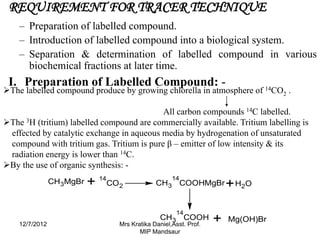
REQUIREMENT FOR TRACER TECHNIQUE
    – Preparation of labelled compound.
    – Introduction of labelled compound into a biological system.
    – Separation & determination of labelled compound in various
      biochemical fractions at later time.
 I. Preparation of Labelled Compound: -
The labelled compound produce by growing chlorella in atmosphere of 14CO2 .

                                           All carbon compounds 14C labelled.
The 3H (tritium) labelled compound are commercially available. Tritium labelling is
 effected by catalytic exchange in aqueous media by hydrogenation of unsaturated
 compound with tritium gas. Tritium is pure β – emitter of low intensity & its
 radiation energy is lower than 14C.
By the use of organic synthesis: -
                                                   14
                CH3MgBr   + 14CO2            CH3 COOHMgBr            + H2O
                                                    14
    12/7/2012
                                               CH3 COOH
                                Mrs Kratika Daniel,Asst. Prof.
                                                                 +   Mg(OH)Br
                                       MIP Mandsaur
II. Introduction of labelled compound: -
PRECAUTION: -
•The precursor should react at necessary site of synthesis in plant.
•Plant at the experiment time should synthesize the compound under investigation
•The dose given is for short period.
                   1.    Root feeding
                   2.    Stem feeding
                   3.    Direct injection
                   4.    Infiltration
                   5.    Floating method
                   6.    Spray technique
III. Separation and detection of compound: -
                 a)     Geiger – Muller counter.
                 b)     Liquid Scintillation counter.
                 c)     Gas ionization chamber.
                 d)     Bernstein – Bellentine counter.
                 e)     Mass spectroscopy.
                 f)     NMR eletrodemeter.
                 g)     Autoradiography.
    12/7/2012    h)     Radio paper chromatography.
                                  Mrs Kratika Daniel,Asst. Prof.
                                           MIP Mandsaur
METHODS IN TRACER TECHNIQUE
1. PRECURSOR PRODUCT SEQUENCE: -           In this technique, the presumed
precursor of the constituent under investigation on a labelled form is fed
into the plant and after a suitable time the constituent is isolated, purified
and radioactivity is determined.
Disadvantage: - The radioactivity of isolated compound alone is not
usually sufficient evidence that the particular compound fed is direct
precursor, because substance may enter the general metabolic pathway
and from there may become randomly distributed through a whole range
of product.
Application: -
•Stopping of hordenine production in barley seedling after 15 – 20 days
of germination.
•Restricted synthesis of hyoscine, distinct from hyoscyamine in Datura
stramonium.
•This method is applied to the biogenesis of morphine & ergot alkaloids
    12/7/2012                Mrs Kratika Daniel,Asst. Prof.
                                    MIP Mandsaur
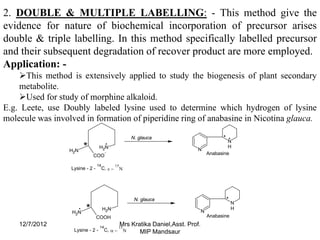
2. DOUBLE & MULTIPLE LABELLING: - This method give the
evidence for nature of biochemical incorporation of precursor arises
double & triple labelling. In this method specifically labelled precursor
and their subsequent degradation of recover product are more employed.
Application: -
    This method is extensively applied to study the biogenesis of plant secondary
    metabolite.
    Used for study of morphine alkaloid.
E.g. Leete, use Doubly labeled lysine used to determine which hydrogen of lysine
molecule was involved in formation of piperidine ring of anabasine in Nicotina glauca.

                                                        N. glauca
                                                                                            N
                                  H2N                                                       H
                  H2N                                                            N
                                       -                                           Anabasine
                            COO
                                 14            15
                  Lysine - 2 -        C, ε −        Ν


                                                         N. glauca
                                                                                                     N
                                      H2N                                                            H
                  H2N                                                                N
                                 COOH                                                    Anabasine
    12/7/2012                     14            15
                                                    Mrs Kratika Daniel,Asst. Prof.
                   Lysine - 2 -        C, α −        Ν     MIP Mandsaur
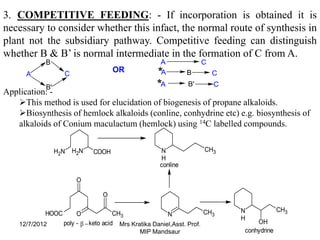
3. COMPETITIVE FEEDING: - If incorporation is obtained it is
necessary to consider whether this infact, the normal route of synthesis in
plant not the subsidiary pathway. Competitive feeding can distinguish
whether B & B’ is normal intermediate in the formation of C from A.
            B                                         A              C
                   C
                                     OR               A         B        C
      A
            B'                                        A         B'       C
Application: -
   This method is used for elucidation of biogenesis of propane alkaloids.
   Biosynthesis of hemlock alkaloids (conline, conhydrine etc) e.g. biosynthesis of
   alkaloids of Conium maculactum (hemlock) using 14C labelled compounds.


                 H2N   H2N   COOH                     N               CH3
                                                      H
                                                      conline

                        O

                                 O

                                                                       CH3   N            CH3
            HOOC        O              CH3               N
                                                                             H
    12/7/2012      poly - β − keto acid Mrs Kratika Daniel,Asst. Prof.           OH
                                              MIP Mandsaur                   conhydrine
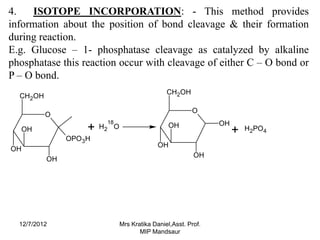
4.   ISOTOPE INCORPORATION: - This method provides
information about the position of bond cleavage & their formation
during reaction.
E.g. Glucose – 1- phosphatase cleavage as catalyzed by alkaline
phosphatase this reaction occur with cleavage of either C – O bond or
P – O bond.
                                                CH2OH
  CH2OH

                                                         O
          O
                         18                                     OH
  OH                +   H2 O                     OH
                                                                     +   H2PO 4
               OPO 3H
                                             OH
OH
                                                          OH
          OH


  12/7/2012                    Mrs Kratika Daniel,Asst. Prof.
                                      MIP Mandsaur
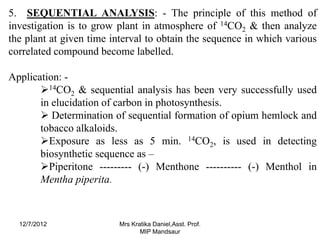
5. SEQUENTIAL ANALYSIS: - The principle of this method of
investigation is to grow plant in atmosphere of 14CO2 & then analyze
the plant at given time interval to obtain the sequence in which various
correlated compound become labelled.

Application: -
       14CO2 & sequential analysis has been very successfully used
       in elucidation of carbon in photosynthesis.
        Determination of sequential formation of opium hemlock and
       tobacco alkaloids.
       Exposure as less as 5 min. 14CO2, is used in detecting
       biosynthetic sequence as –
       Piperitone --------- (-) Menthone ---------- (-) Menthol in
       Mentha piperita.


  12/7/2012              Mrs Kratika Daniel,Asst. Prof.
                                MIP Mandsaur
APPLICATION OF TRACER TECHNIQUE
1. Study of squalene cyclization by use of 14C, 3H labelled mevalonic acid.
2. Interrelationship among 4 – methyl sterols & 4, 4 dimethyl sterols, by use of
   14C acetate.

3. Terpenoid biosynthesis by chloroplast isolated in organic solvent, by use of
   2- 14C mevalonate.
4. Study the formation of cinnamic acid in pathway of coumarin from labelled
   coumarin.
5. Origin of carbon & nitrogen atoms of purine ring system by use of 14C or
   15N labelled precursor.

6. Study of formation of scopoletin by use of labelled phenylalanine.
7. By use of 45Ca as tracer, - found that the uptake of calcium by plants from
   the soil. (CaO & CaCO2).
8. By adding ammonium phosphate labelled with 32P of known specific activity
   the uptake of phosphorus is followed by measuring the radioactivity as label
   reaches first in lower part of plant, than the upper part i.e. branches, leaves
   etc.
    12/7/2012                 Mrs Kratika Daniel,Asst. Prof.
                                     MIP Mandsaur

Tracer technique

  • 1.
    TRACER TECHNIQUE Kratika Daniel (Ph.D) Assistant professor MANDSAUR INSTITUTE OF PHARMACY, Mandsaur 12/7/2012 Mrs Kratika Daniel,Asst. Prof. Kratika MIP Mandsaur
  • 2.
    INTRODUCTION • Living plantsconsidered as biosynthetic laboratory primary as well as secondary metabolite. • Different biosynthetic pathway: - » Shikmic acid pathway » Mevalonic acid pathway » Acetate pathway • Various intermediate and steps are involved in biosynthetic pathway in plants can be investigated by means of following techniques: - » Tracer technique » Use of isolated organ » Grafting methods » Use of mutant strain 12/7/2012 Mrs Kratika Daniel,Asst. Prof. MIP Mandsaur
  • 3.
    • Definition: -It can be defined as technique which utilizes a labelled compound to find out or to trace the different intermediates and various steps in biosynthetic pathways in plants, at a given rate & time. OR • In this technique different isotope, mainly the radioactive isotopes which are incorporated into presumed precursor of plant metabolites and are used as marker in biogenic experiments. 12/7/2012 Mrs Kratika Daniel,Asst. Prof. MIP Mandsaur
  • 4.
    • The labelledcompound can be prepared by use of two types of isotopes. » Radioactive isotopes. » Stable isotopes. • Radioactive isotopes: - [e.g. 1H, 14C, 24Na, 42K, 35S, 35P, 131I decay with emission of radiation] – For biological investigation – carbon & hydrogen. – For metabolic studies – S, P, and alkali and alkaline earth metals are used. – For studies on protein, alkaloids, and amino acid – labelled nitrogen atom give more specific information. – 3H compound is commercially available. • Stable isotopes: - [e.g. 2H, 13C, 15N, 18O] – Used for labelling compounds as possible intermediates in biosynthetic pathways. – Usual method of detection are: – MASS spectroscopy [15N, 18O] – NMR spectroscopy [2H, 13C] 12/7/2012 Mrs Kratika Daniel,Asst. Prof. MIP Mandsaur
  • 5.
    SIGNIFICANCE OF TRACERTECHNIQUE • Tracing of Biosynthetic Pathway: - e.g. By incorporation of radioactive isotope of 14C into phenylalanine, the biosynthetic cyanogenetic glycoside prunasin, can be detected. • Location & Quantity of compound containing tracer: - 14C labelled glucose is used for determination of glucose in biological system • Different tracers for different studies: - For studies on nitrogen and amino acid. (Labelled nitrogen give specific information than carbon) • Convenient and suitable technique CRITERIA FOR TRACER TECHIQUE • The starting concentration of tracer must be sufficient withstand resistance with dilution in course of metabolism. • Proper Labelling: - for proper labelling physical & chemical nature of compound must be known. • Labelled compound should involve in the synthesis reaction. • Labelled should not damage the system to which it is used. 12/7/2012 Mrs Kratika Daniel,Asst. Prof. MIP Mandsaur
  • 6.
    ADVANTAGES • High sensitivity. • Applicable o all living organism. • Wide ranges of isotopes are available. • More reliable, easily administration & isolation procedure. • Gives accurate result, if proper metabolic time & technique applied. LIMITATION • Kinetic effect • Chemical effect • Radiation effect • Radiochemical purity • High concentration distorting the result. 12/7/2012 Mrs Kratika Daniel,Asst. Prof. MIP Mandsaur
  • 7.
    REQUIREMENT FOR TRACERTECHNIQUE – Preparation of labelled compound. – Introduction of labelled compound into a biological system. – Separation & determination of labelled compound in various biochemical fractions at later time. I. Preparation of Labelled Compound: - The labelled compound produce by growing chlorella in atmosphere of 14CO2 . All carbon compounds 14C labelled. The 3H (tritium) labelled compound are commercially available. Tritium labelling is effected by catalytic exchange in aqueous media by hydrogenation of unsaturated compound with tritium gas. Tritium is pure β – emitter of low intensity & its radiation energy is lower than 14C. By the use of organic synthesis: - 14 CH3MgBr + 14CO2 CH3 COOHMgBr + H2O 14 12/7/2012 CH3 COOH Mrs Kratika Daniel,Asst. Prof. + Mg(OH)Br MIP Mandsaur
  • 8.
    II. Introduction oflabelled compound: - PRECAUTION: - •The precursor should react at necessary site of synthesis in plant. •Plant at the experiment time should synthesize the compound under investigation •The dose given is for short period. 1. Root feeding 2. Stem feeding 3. Direct injection 4. Infiltration 5. Floating method 6. Spray technique III. Separation and detection of compound: - a) Geiger – Muller counter. b) Liquid Scintillation counter. c) Gas ionization chamber. d) Bernstein – Bellentine counter. e) Mass spectroscopy. f) NMR eletrodemeter. g) Autoradiography. 12/7/2012 h) Radio paper chromatography. Mrs Kratika Daniel,Asst. Prof. MIP Mandsaur
  • 9.
    METHODS IN TRACERTECHNIQUE 1. PRECURSOR PRODUCT SEQUENCE: - In this technique, the presumed precursor of the constituent under investigation on a labelled form is fed into the plant and after a suitable time the constituent is isolated, purified and radioactivity is determined. Disadvantage: - The radioactivity of isolated compound alone is not usually sufficient evidence that the particular compound fed is direct precursor, because substance may enter the general metabolic pathway and from there may become randomly distributed through a whole range of product. Application: - •Stopping of hordenine production in barley seedling after 15 – 20 days of germination. •Restricted synthesis of hyoscine, distinct from hyoscyamine in Datura stramonium. •This method is applied to the biogenesis of morphine & ergot alkaloids 12/7/2012 Mrs Kratika Daniel,Asst. Prof. MIP Mandsaur
  • 10.
    2. DOUBLE &MULTIPLE LABELLING: - This method give the evidence for nature of biochemical incorporation of precursor arises double & triple labelling. In this method specifically labelled precursor and their subsequent degradation of recover product are more employed. Application: - This method is extensively applied to study the biogenesis of plant secondary metabolite. Used for study of morphine alkaloid. E.g. Leete, use Doubly labeled lysine used to determine which hydrogen of lysine molecule was involved in formation of piperidine ring of anabasine in Nicotina glauca. N. glauca N H2N H H2N N - Anabasine COO 14 15 Lysine - 2 - C, ε − Ν N. glauca N H2N H H2N N COOH Anabasine 12/7/2012 14 15 Mrs Kratika Daniel,Asst. Prof. Lysine - 2 - C, α − Ν MIP Mandsaur
  • 11.
    3. COMPETITIVE FEEDING:- If incorporation is obtained it is necessary to consider whether this infact, the normal route of synthesis in plant not the subsidiary pathway. Competitive feeding can distinguish whether B & B’ is normal intermediate in the formation of C from A. B A C C OR A B C A B' A B' C Application: - This method is used for elucidation of biogenesis of propane alkaloids. Biosynthesis of hemlock alkaloids (conline, conhydrine etc) e.g. biosynthesis of alkaloids of Conium maculactum (hemlock) using 14C labelled compounds. H2N H2N COOH N CH3 H conline O O CH3 N CH3 HOOC O CH3 N H 12/7/2012 poly - β − keto acid Mrs Kratika Daniel,Asst. Prof. OH MIP Mandsaur conhydrine
  • 12.
    4. ISOTOPE INCORPORATION: - This method provides information about the position of bond cleavage & their formation during reaction. E.g. Glucose – 1- phosphatase cleavage as catalyzed by alkaline phosphatase this reaction occur with cleavage of either C – O bond or P – O bond. CH2OH CH2OH O O 18 OH OH + H2 O OH + H2PO 4 OPO 3H OH OH OH OH 12/7/2012 Mrs Kratika Daniel,Asst. Prof. MIP Mandsaur
  • 13.
    5. SEQUENTIAL ANALYSIS:- The principle of this method of investigation is to grow plant in atmosphere of 14CO2 & then analyze the plant at given time interval to obtain the sequence in which various correlated compound become labelled. Application: - 14CO2 & sequential analysis has been very successfully used in elucidation of carbon in photosynthesis.  Determination of sequential formation of opium hemlock and tobacco alkaloids. Exposure as less as 5 min. 14CO2, is used in detecting biosynthetic sequence as – Piperitone --------- (-) Menthone ---------- (-) Menthol in Mentha piperita. 12/7/2012 Mrs Kratika Daniel,Asst. Prof. MIP Mandsaur
  • 14.
    APPLICATION OF TRACERTECHNIQUE 1. Study of squalene cyclization by use of 14C, 3H labelled mevalonic acid. 2. Interrelationship among 4 – methyl sterols & 4, 4 dimethyl sterols, by use of 14C acetate. 3. Terpenoid biosynthesis by chloroplast isolated in organic solvent, by use of 2- 14C mevalonate. 4. Study the formation of cinnamic acid in pathway of coumarin from labelled coumarin. 5. Origin of carbon & nitrogen atoms of purine ring system by use of 14C or 15N labelled precursor. 6. Study of formation of scopoletin by use of labelled phenylalanine. 7. By use of 45Ca as tracer, - found that the uptake of calcium by plants from the soil. (CaO & CaCO2). 8. By adding ammonium phosphate labelled with 32P of known specific activity the uptake of phosphorus is followed by measuring the radioactivity as label reaches first in lower part of plant, than the upper part i.e. branches, leaves etc. 12/7/2012 Mrs Kratika Daniel,Asst. Prof. MIP Mandsaur