UMANG JAGANI
NUCLEAR PHYSICS
NUCLEAR PHYSICS
The physics of atomic nuclei and
their interactions.
Three types of radiation emanating
from atoms, which they
named alpha, beta,
and gamma radiation
ELECTRON & PROTON
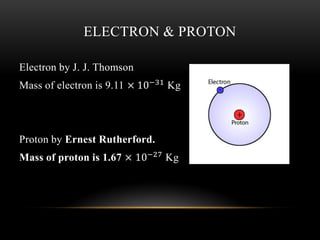
Electron by J. J. Thomson
Mass of electron is 9.11 Ɨ 10āˆ’31 Kg
Proton by Ernest Rutherford.
Mass of proton is 1.67 Ɨ 10āˆ’27 Kg
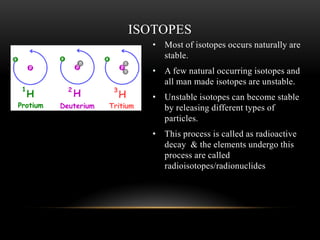
• Most of isotopes occurs naturally are
stable.
• A few natural occurring isotopes and
all man made isotopes are unstable.
• Unstable isotopes can become stable
by releasing different types of
particles.
• This process is called as radioactive
decay & the elements undergo this
process are called
radioisotopes/radionuclides
ISOTOPES
• Radioactivity means that atoms decay
Reason behind this they are instable.
• Every atom which has got higher
number of nucleons( protons &
neutrons together) than 210 is
instable.
RADIOACTIVITY
• Used in technologies and
medicines.
• Uranium is cheap.
• Low air pollution.
• Can be run anywhere
uranium can be supplied.
• Perhaps only 100 years of
uranium available.
• Expensive to run.
• Plants last only about 50 years
before having to be dismantled.
• The waste is highly radioactive.
NUCLEAR POWER PLANT
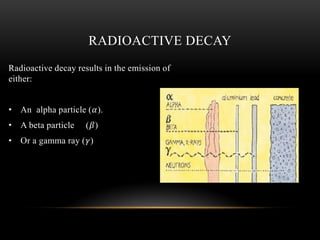
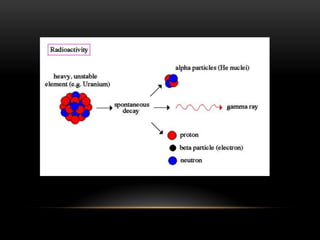
Radioactive decay results in the emission of
either:
• An alpha particle (š›¼).
• A beta particle (š›½)
• Or a gamma ray (š›¾)
RADIOACTIVE DECAY
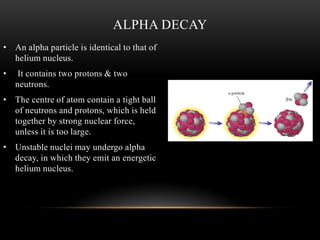
• An alpha particle is identical to that of
helium nucleus.
• It contains two protons & two
neutrons.
• The centre of atom contain a tight ball
of neutrons and protons, which is held
together by strong nuclear force,
unless it is too large.
• Unstable nuclei may undergo alpha
decay, in which they emit an energetic
helium nucleus.
ALPHA DECAY
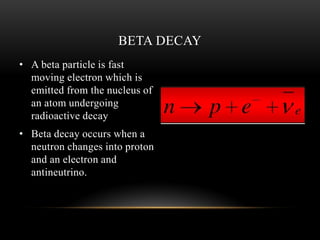
• A beta particle is fast
moving electron which is
emitted from the nucleus of
an atom undergoing
radioactive decay
• Beta decay occurs when a
neutron changes into proton
and an electron and
antineutrino.
BETA DECAY
• Gamma rays have the smallest
wavelengths and the most energy of
any wave in the electromagnetic
spectrum.
• They are produced by the hottest
and most energetic objects in the
universe, such as neutron stars and
pulsars, supernova explosions, and
regions around black holes.
GAMMA RAYS
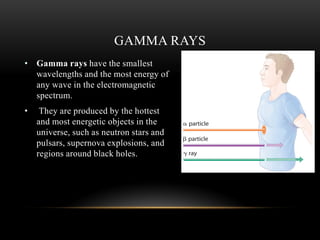
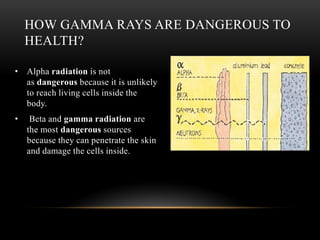
• Alpha radiation is not
as dangerous because it is unlikely
to reach living cells inside the
body.
• Beta and gamma radiation are
the most dangerous sources
because they can penetrate the skin
and damage the cells inside.
HOW GAMMA RAYS ARE DANGEROUS TO
HEALTH?
• Gamma-rays have the smallest
wavelengths and the most
energy of any other wave in the
electromagnetic spectrum.
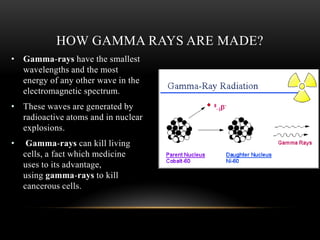
• These waves are generated by
radioactive atoms and in nuclear
explosions.
• Gamma-rays can kill living
cells, a fact which medicine
uses to its advantage,
using gamma-rays to kill
cancerous cells.
HOW GAMMA RAYS ARE MADE?
THANK YOU

Nuclear physics

  • 1.
  • 2.
    NUCLEAR PHYSICS The physicsof atomic nuclei and their interactions. Three types of radiation emanating from atoms, which they named alpha, beta, and gamma radiation
  • 3.
    ELECTRON & PROTON Electronby J. J. Thomson Mass of electron is 9.11 Ɨ 10āˆ’31 Kg Proton by Ernest Rutherford. Mass of proton is 1.67 Ɨ 10āˆ’27 Kg
  • 5.
    • Most ofisotopes occurs naturally are stable. • A few natural occurring isotopes and all man made isotopes are unstable. • Unstable isotopes can become stable by releasing different types of particles. • This process is called as radioactive decay & the elements undergo this process are called radioisotopes/radionuclides ISOTOPES
  • 6.
    • Radioactivity meansthat atoms decay Reason behind this they are instable. • Every atom which has got higher number of nucleons( protons & neutrons together) than 210 is instable. RADIOACTIVITY
  • 7.
    • Used intechnologies and medicines. • Uranium is cheap. • Low air pollution. • Can be run anywhere uranium can be supplied. • Perhaps only 100 years of uranium available. • Expensive to run. • Plants last only about 50 years before having to be dismantled. • The waste is highly radioactive. NUCLEAR POWER PLANT
  • 8.
    Radioactive decay resultsin the emission of either: • An alpha particle (š›¼). • A beta particle (š›½) • Or a gamma ray (š›¾) RADIOACTIVE DECAY
  • 9.
    • An alphaparticle is identical to that of helium nucleus. • It contains two protons & two neutrons. • The centre of atom contain a tight ball of neutrons and protons, which is held together by strong nuclear force, unless it is too large. • Unstable nuclei may undergo alpha decay, in which they emit an energetic helium nucleus. ALPHA DECAY
  • 10.
    • A betaparticle is fast moving electron which is emitted from the nucleus of an atom undergoing radioactive decay • Beta decay occurs when a neutron changes into proton and an electron and antineutrino. BETA DECAY
  • 11.
    • Gamma rayshave the smallest wavelengths and the most energy of any wave in the electromagnetic spectrum. • They are produced by the hottest and most energetic objects in the universe, such as neutron stars and pulsars, supernova explosions, and regions around black holes. GAMMA RAYS
  • 13.
    • Alpha radiationis not as dangerous because it is unlikely to reach living cells inside the body. • Beta and gamma radiation are the most dangerous sources because they can penetrate the skin and damage the cells inside. HOW GAMMA RAYS ARE DANGEROUS TO HEALTH?
  • 14.
    • Gamma-rays havethe smallest wavelengths and the most energy of any other wave in the electromagnetic spectrum. • These waves are generated by radioactive atoms and in nuclear explosions. • Gamma-rays can kill living cells, a fact which medicine uses to its advantage, using gamma-rays to kill cancerous cells. HOW GAMMA RAYS ARE MADE?
  • 18.